Sublittoral and Upper Bathyal Vetigastropods (Mollusca: Gastropoda) Dredged from the Ogasawara Islands
Kazunori Hasegawa
Department of Zoology, National Museum of Nature and Science, 4–1–1, Amakubo, Tsukuba, Ibaraki 305–0005, Japan
E-mail: [email protected]
Abstract. The sublittoral and upper bathyal vetigastropod fauna around the Ogasawara Islands is surveyed based on material collected via several dredging programs, mainly by the R/V Koyo of the Tokyo Metropolitan Fisheries Experiment Station, during the years 1976–2017 discontinu- ously. Ninety-three morphospecies are recognized among the material, including juvenile and incomplete specimens, and identified to at least generic level. Seventy are identified as previously named species, and 23 are considered to be probably undescribed. Fifty-one species (55%) are recorded for the first time in the Ogasawara Islands, including 22 (24%) new to Japanese waters.
Twelve species (13%) are considered to be endemic to this area, and four are considered possibly endemic. Species that are new to the Ogasawara Islands as well as those with taxonomic discus- sion are illustrated in color, together with comparative specimens from other areas, mainly the Nansei Islands.
Key words: Ogasawara Islands, vetigastropods, sublittoral, bathyal, new records.
Introduction
The Ogasawara (Bonin) Islands are an oceanic island group located ca. 1000 km south of Tokyo Bay in a latitude range between 28°N and 26°N, and form the middle part of the Izu-Ogasawara (Bonin)-Mariana island arc. Although they fall in a subtropical climate zone within the same lati- tude range as the Okinawa-Amami Island groups, their marine faunas differ considerably because of the difference in the marine environ- ments, especially the influence of the Kuroshio Current. In contrast to the extremely rich marine faunas of the Okinawa-Amami Islands, those of the Ogasawara and adjacent Northern Mariana Islands are known to be generally poor but dis- tinctive (e.g., Vermeij et al., 1983; Kurozumi and Asakura, 1994; Okutani and Saito, 2011).
Vermeij et al. (1983) also pointed out some simi- larity between the upper shore gastropod fauna in the northern Marianas and that of Hawaii.
The gastropod fauna of the Ogasawara Islands
was relatively documented, though mainly in the intertidal and upper sublittoral zones, in a series of comprehensive works by Fukuda (1993, 1994, 1995). A total of 1031 species of marine gastro- pods were recorded, including 21 “probably endemic” species. Although the total is compara- ble to that in Okinawa (1383 species: Kuroda, 1960), it includes many microgastropods and nudibranchs as well as a number of unidentified species that were not included in previous faunal accounts. The actual comparative diversity in the Ogasawara Islands is not high. Furthermore, spe- cies in the sublittoral to bathyal zones have not been well surveyed, not only in the Ogasawara Islands but also in many other regions in Japanese waters, especially the Nansei Islands, making it difficult to carry out detailed biogeo- graphical comparisons.
This being so, the gastropod fauna of the
Ogasawara Islands is here surveyed in detail,
with special emphasis on the sublittoral and
upper bathyal zones, based on the material
Kazunori Hasegawa 106
obtained by various dredging programs in con- nection with the research program “Comprehen- sive Studies of Fauna and Flora in Biodiversity Hotspots” carried out by the National Museum of Nature and Science. This project focuses on the founding and biological properties of biodiver- sity hotspots in Japan, and the Ogasawara Islands were selected because of the relatively high degree of endemism for Japan observed in their marine invertebrate fauna. Among gastropods, the clade Vetigastropoda was selected for analy- sis because of its lack of a widely dispersing tele- planic larval stage (Kay, 1984) and relatively high local speciation in comparison to other sub- groups. Furthermore, taxonomic studies of veti- gastropods have progressed recently in the tropi- cal western Pacific (e.g., Poppe et al., 2006;
Vilvans, 2009, 2017; Huang et al., 2016), making it possible to compare with the results of this study.
For biogeographical comparison, specimens collected from the Nansei Islands (mainly around Amami-oshima) at equivalent depths in previous surveys (e.g., Shinohara et al., 2005) were also examined for the present study, as well as pub- lished results of previous studies including some in Sagami Bay (Hasegawa et al., 2001; Hasegawa, 2006).
Materials and Methods
Materials examined in the present study con- sist of numerous specimens accumulated via var- ious independent dredging surveys and deposited in the National Museum of Nature and Science.
Important sources include:
1)
“Natural History of the Izu-Mariana Arc”(Natural History Research Project of the Japanese Islands, by the National Science Museum, Tokyo) in 1976 (18 stations: see Imajima, 1977 for over- view);
2) “Relationship between shallow-sea animals and plate tectonics around the Japanese archipel- ago” (Kaken A: principal investigator M. Takeda) in 1995 (11 stations);
3) “Studies on the origin of biodiversity in the
Sagami Sea Fossa Magna element and the Izu- Ogasawara (Bonin) Arc” (research project of the National Museum of Nature and Science) in 2008–2010 (91 stations: see Namikawa et al.
2011 for details);
4) “Comprehensive Studies of Fauna and Flora of Biodiversity Hotspots” (the present research) in 2014–2017 (93 stations).
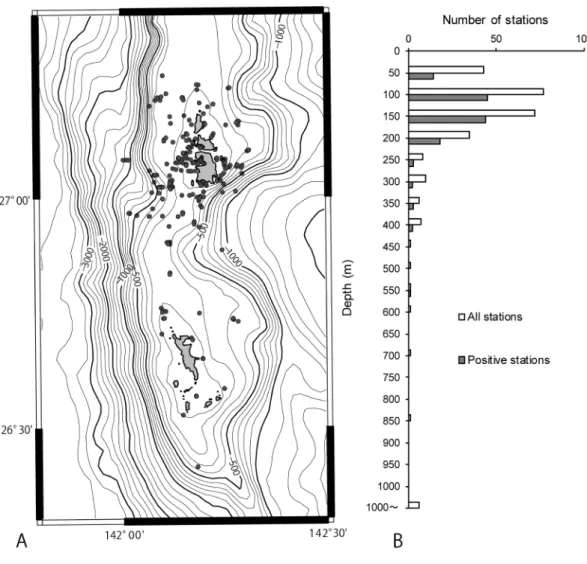
Specimens collected via various cruises of research vessels such as the R/V Soyo-Maru and R/V Tansei-Maru and preserved in the museum were also taken into account, though excluding those collected at depths below 1000 m because of their incompleteness. All the stations (266 sta- tions: including negative and deeper [>1000 m]
stations) are plotted in Fig. 1A to show the range of the research area. Most of the stations fall in the depth range of 0–200 m (Fig. 1B). Detailed data for positive stations are summarized in Table 1 (133 stations). Stations of some addi- tional material obtained in the Nansei Islands during various research cruises for comparison are also summarized in Table 2.
Specimens were treated with varying methods, reflecting the length of the survey period, but most were primarily fixed in formalin. In recent surveys, however, live-collected specimens were lightly fixed by immersion in boiling water, and preserved in 99% ethanol for DNA analysis.
Voucher specimens were deposited in the mollus- can collection of the National Museum of Nature and Science with registration numbers. All the specimens were basically retained intact for sub- sequent detailed taxonomic studies.
All the specimens available were treated as the
subject of taxonomic investigation, including
juveniles, incomplete empty shells and even
fragments. Specimens were roughly classified
under a microscope, and smaller ones were more
precisely examined based on photographs. Pho-
tographs were taken with a Nikon D7200 digital
camera using lenses such as the Micro Nikkor
60 mm and a reversed Nikkor 20 mm with or
without several extension rings. Stacks of at least
ten shots were taken and combined with the aid
of the focus stacking software CombineZP, then
processed with Adobe Photoshop. High resolu- tion digital images will be accessible using the registration number of each illustrated specimen on the database http://collection.db.kahaku.go.jp/
musetheque/.
Abbreviations and institutional acronyms:
fr—fragment(s) of shell; leg.—collected by;
NSMT-Mo—National Museum of Nature and Science, molluscan collection; op—operculum;
SL—shell length; TWP—tropical West Pacific;
USNM—National Museum of Natural History, Smithsonian, Washington D.C.; ZMA Moll.—Zoölogisch Museum Amsterdam [now
transferred to Naturalis], molluscan collection.
Results
More than 2700 vetigastropods (including ca.
170 imperfect specimens or identifiable frag- ments but excluding some poorly preserved ones) in 748 lots were classified into 93 morpho- species (hereinafter referred to as just species) belonging to 17 families.
Specimens from the Ogasawara Islands often differ to varying degrees from those of the pre- sumed same species from other areas, and it can
Fig. 1. Outline of survey stations. A. A map showing all the dredging sites by various research vessels (see Table 1 for details), including negative stations (yielding no vetigastropods). B. Vertical frequency distribution of survey stations (number of stations in every 50 m depth).
Kazunori Hasegawa 108
Table 1. Positive stations of various dredge surveys around the Ogasawara Islands. Abbreviations: BD, biological dredge; KT, R/V Tansei-Maru; KY, R/V Koyo; OG, Koyu-Maru VIII (95 only); RD, Niino-style rock dredge;
SO, R/V Soyo-Maru.
Station No. Date Gear Position in Position out Depth (m)
KT-09-02-TW-1-1 2009/3/19 1 m BD 27°01.40′ N 142°07.41′ E 27°01.36′ N 142°07.47′ E 145–139 KT-09-02-TW-1-2 2009/3/19 1 m BD 27°01.37′ N 142°07.47′ E 27°01.34′ N 142°07.49′ E 138–138 KT-09-02-TW-1-4 2009/3/19 1 m BD 27°01.48′ N 142°05.97′ E 27°01.42′ N 142°06.02′ E 185–179 KT-09-02-TW-1-6 2009/3/19 1 m BD 27°01.43′ N 142°05.50′ E 27°01.35′ N 142°05.56′ E 297–310 KT-09-02-TW-2-4 2009/3/19 1 m BD 27°02.94′ N 142°07.17′ E 27°02.95′ N 142°07.25′ E 141–152 KY-08-04 2008/10/24 50 cm BD 27°03.60′ N 142°04.22′ E 27°03.78′ N 142°03.85′ E 211–214 KY-08-10 2008/10/27 50 cm BD 26°57.67′ N 142°06.06′ E 26°57.53′ N 142°06.07′ E 330–330 KY-08-17 2008/10/29 50 cm BD 27°05.02′ N 142°15.22′ E 27°04.86′ N 142°15.22′ E 70–69 KY-08-18 2008/10/29 50 cm BD 27°05.01′ N 142°14.89′ E 27°04.88′ N 142°14.87′ E 49–48 KY-08-19 2008/10/29 50 cm BD 27°06.07′ N 142°18.56′ E 27°06.06′ N 142°18.76′ E 175–176 KY-08-20 2008/10/29 50 cm BD 27°04.23′ N 142°15.19′ E 27°04.22′ N 142°15.06′ E 54–52 KY-08-21 2008/10/29 50 cm BD 27°03.84′ N 142°15.44′ E 27°03.70′ N 142°15.23′ E 95–98 KY-08-23 2008/10/30 50 cm BD 27°12.04′ N 142°04.28′ E 27°12.17′ N 142°04.29′ E 202–199 KY-08-25 2008/10/30 50 cm BD 27°07.31′ N 142°07.70′ E 27°07.03′ N 142°07.64′ E 129–127 KY-08-26 2008/10/30 50 cm BD 27°04.84′ N 142°08.93′ E 27°04.98′ N 142°09.15′ E 84–87 KY-09-01 2009/7/10 50 cm BD 27°02.23′ N 142°07.24′ E 27°02.12′ N 142°07.32′ E 137–137 KY-09-06 2009/7/10 1 m RD 27°01.80′ N 142°07.37′ E 27°01.90′ N 142°07.28′ E 136–137 KY-09-07 2009/7/10 50 cm BD 27°01.72′ N 142°07.39′ E 27°01.93′ N 142°07.28′ E 138–136 KY-09-08 2009/7/13 50 cm BD 26°45.20′ N 142°06.44′ E 26°45.38′ N 142°06.55′ E 98–102 KY-09-09 2009/7/13 50 cm BD 26°45.64′ N 142°05.75′ E 26°45.87′ N 142°05.88′ E 102–118 KY-09-12 2009/7/13 50 cm BD 26°42.24′ N 142°05.80′ E 26°42.30′ N 142°05.79′ E 97–103
KY-09-13 2009/7/14 50 cm BD 26°34.10′ N 142°10.79′ E 97–
KY-09-14 2009/7/14 50 cm BD 26°34.03′ N 142°10.80′ E 26°34.04′ N 142°10.81′ E 92–93 KY-09-15 2009/7/14 50 cm BD 26°24.79′ N 142°10.92′ E 26°24.81′ N 142°10.98′ E 107–109 KY-09-21 2009/7/15 50 cm BD 27°13.09′ N 142°90.19′ E 27°13.19′ N 142°09.23′ E 136–136 KY-09-22 2009/7/15 50 cm BD 27°14.79′ N 142°11.27′ E 27°14.86′ N 142°11.24′ E 91–93 KY-09-27 2009/7/15 50 cm BD 27°06.29′ N 142°13.88′ E 27°06.28′ N 142°14.01′ E 81–83 KY-09-28 2009/7/15 50 cm BD 27°07.05′ N 142°10.68′ E 27°07.02′ N 142°10.69′ E 52–52 KY-09-29 2009/7/16 50 cm BD 27°06.59′ N 142°10.25′ E 27°06.58′ N 142°10.21′ E 61–60 KY-09-30 2009/7/16 50 cm BD 27°07.22′ N 142°10.6′ E 27°07.28′ N 142°10.58′ E 52– 50 KY-09-31 2009/7/16 50 cm BD 27°00.84′ N 142°16.81′ E 27°00.92′ N 142°16.56′ E 311– 300 KY-09-34 2009/7/16 50 cm BD 27°02.34′ N 142°07.52′ E 27°02.55′ N 142°07.34′ E 139– 141 KY-10-02 2010/7/5 50 cm BD 26°41.44′ N 142°10.33′ E 26°41.33′ N 142°10.39′ E 115– 115 KY-10-03 2010/7/5 50 cm BD 26°45.32′ N 142°05.99′ E 26°45.30′ N 142°06.28′ E 106– 92 KY-10-04 2010/7/5 50 cm BD 26°45.08′ N 142°05.94′ E 26°45.05′ N 142°06.20′ E 101– 98 KY-10-06 2010/7/5 50 cm BD 26°44.29′ N 142°06.23′ E 26°44.29′ N 142°06.37′ E 76– 73 KY-10-07 2010/7/6 50 cm BD 26°31.60′ N 142°08.85′ E 26°31.60′ N 142°08.94′ E 105– 99 KY-10-09 2010/7/6 50 cm BD 26°35.02′ N 142°14.94′ E 26°34.98′ N 142°14.90′ E 90– 82 KY-10-11 2010/7/6 50 cm BD 26°38.98′ N 142°11.85′ E 26°38.95′ N 142°11.96′ E 94– 83 KY-10-15 2010/7/7 50 cm BD 27°12.41′ N 142°11.62′ E 27°12.43′ N 142°11.54′ E 72– 64 KY-10-17 2010/7/7 50 cm BD 27°12.78′ N 142°05.14′ E 27°12.47′ N 142°05.14′ E 160– 160 KY-10-18 2010/7/7 1 m RD 26°57.78′ N 142°02.33′ E 26°57.59′ N 142°02.03′ E 540– 529 KY-10-19 2010/7/7 1 m RD 27°04.82′ N 142°08.95′ E 27°04.75′ N 142°09.06′ E 87– 91 KY-10-21 2010/7/8 1 m RD 27°06.20′ N 142°18.82′ E 27°06.11′ N 142°18.73′ E 177– 178 KY-10-23 2010/7/8 50 cm BD 27°06.22′ N 142°18.82′ E 27°06.04′ N 142°18.69′ E 178– 179 KY-10-24 2010/7/8 50 cm BD 27°07.23′ N 142°10.7′ E 27°07.14′ N 142°10.73′ E 47– 51 KY-10-26 2010/7/9 50 cm BD 27°04.68′ N 142°11.72′ E 27°04.68′ N 142°11.56′ E 36– 40 KY-10-27 2010/7/9 50 cm BD 27°06.65′ N 142°10.42′ E 27°06.61′ N 142°10.29′ E 59– 60 KY-10-30 2010/7/9 50 cm BD 27°00.14′ N 142°12.11′ E 27°00.16′ N 142°11.91′ E 147– 139 KY-10-31 2010/7/9 50 cm BD 27°05.18′ N 142°08.48′ E 27°05.12′ N 142°08.39′ E 97– 97 KY-13-01 2013/7/16 50 cm BD 27°00.14′ N 142°12.11′ E 26°59.92′ N, 142°11.82′ E 146– 142 KY-13-03 2013/7/16 50 cm BD 27°01.73′ N 142°11.90′ E 27°01.92′ N 142°12.15′ E 113– 92 KY-14-01 2014/6/23 50 cm BD 27°12.783′ N 142°05.882′ E 27°13.175′ N 142°05.916′ E 157– 157 KY-14-02 2014/6/23 50 cm BD 27°13.239′ N 142°06.016′ E 27°13.685′ N 142°06.688′ E 157– 157 KY-14-03 2014/6/23 50 cm BD 27°13.646′ N 142°06.743′ E 27°13.348′ N 142°06.446′ E 156– 156 KY-14-04 2014/6/23 50 cm BD 27°15.997′ N 142°06.254′ E 27°15.693′ N 142°05.871′ E 171– 170 KY-14-06 2014/6/23 50 cm BD 27°10.17′ N 142°10.133′ E 27°09.798′ N 142°09.942′ E 104– 106 KY-14-07 2014/6/23 50 cm BD 27°09.564′ N 142°10.431′ E 27°09.257′ N 142°10.210′ E 69– 75 KY-14-08 2014/6/24 50 cm RD 26°57.58′ N 142°08.358′ E 26°56.949′ N 142°08.454′ E 162– 165 KY-14-09 2014/6/24 50 cm RD 27°00.359′ N 142°08.955′ E 26°59.966′ N 142°08.904′ E 150– 155
KY-14-10 2014/6/24 50 cm BD 27°01.612′ N 142°12.565′ E 132– 121
KY-14-11 2014/6/24 50 cm BD 27°01.948′ N 142°12.490′ E 27°01.806′ N 142°11.583′ E 107– 89
KY-14-12 2014/6/25 50 cm BD 27°09.484′ N 142°15.468′ E 202– 209
KY-14-13 2014/6/25 50 cm BD 27°09.743′ N 142°12.365′ E 27°09.872′ N 142°12.438′ E 76– 87
KY-14-14 2014/6/25 50 cm BD 27°11.009′ N 142°12.218′ E 58– 82
KY-14-15 2014/6/25 50 cm BD 27°12.226′ N 142°13.642′ E 27°12.724′ N 142°13.474′ E 166– 161
Station No. Date Gear Position in Position out Depth (m) KY-14-16 2014/6/25 50 cm BD 27°11.878′ N 142°12.843′ E 27°12.346′ N 142°12.625′ E 129– 127 KY-14-17 2014/6/25 50 cm BD 27°09.247′ N 142°11.98′ E 27°09.612′ N 142°12.233′ E 59– 59 KY-16-01 2016/7/11 50 cm BD 27°01.536′ N 142°07.388′ E 27°01.855′ N 142°07.414′ E 133– 134 KY-16-02 2016/7/11 50 cm BD 27°02.126′ N 142°07.435′ E 27°02.445′ N 142°07.512′ E 134– 139 KY-16-06 2016/7/11 50 cm BD 27°13.104′ N 142°09.091′ E 27°13.173′ N 142°09.497′ E 135– 137 KY-16-07 2016/7/11 50 cm BD 27°12.784′ N 142°09.284′ E 27°12.867′ N 142°09.676′ E 138– 141 KY-16-11 2016/7/12 50 cm BD 27°03.959′ N 142°15.58′ E 27°04.014′ N 142°15.787′ E 81– 89 KY-16-13 2016/7/12 50 cm BD 27°05.032′ N 142°15.367′ E 27°04.825′ N 142°15.347′ E 84– 83 KY-16-14 2016/7/12 50 cm BD 27°09.407′ N 142°12.163′ E 27°09.718′ N 142°12.291′ E 57– 63 KY-16-18 2016/7/13 50 cm BD 27°06.467′ N 142°10.069′ E 27°06.565′ N 142°10.31′ E 59– 59 KY-16-23 2016/7/13 50 cm BD 27°00.033′ N 142°11.474′ E 27°00.062′ N 142°11.309′ E 135– 135 KY-16-24 2016/7/13 50 cm BD 27°00.142′ N 142°11.590′ E 27°00.105′ N 142°11.398′ E 137– 134 KY-16-31 2016/7/14 50 cm BD 27°04.255′ N 142°17.104′ E 27°04.255′ N 142°17.104′ E 141–
KY-16-33 2016/7/14 50 cm BD 27°04.219′ N 142°16.085′ E 27°04.286′ N 142°16.115′ E 87– 92 KY-16-37 2016/7/14 50 cm BD 27°04.573′ N 142°15.332′ E 27°04.466′ N 142°15.456′ E 80– 81 KY-17-01 2017/7/18 50 cm BD 26°58.115′ N 142°09.010′ E 26°57.905′ N 142°09.026′ E 152– 155 KY-17-02 2017/7/18 50 cm BD 26°57.903′ N 142°09.020′ E 26°58.167′ N 142°08.991′ E 155– 151 KY-17-03 2017/7/18 50 cm BD 26°56.915′ N 142°10.719′ E 26°56.556′ N 142°10.711′ E 194– 203 KY-17-04 2017/7/18 50 cm BD 26°56.915′ N 142°10.719′ E 26°56.556′ N 142°10.711′ E 194– 203 KY-17-05 2017/7/18 50 cm BD 26°56.188′ N 142°11.434′ E 26°55.940′ N 142°11.310′ E 385– 380 KY-17-08 2017/7/19 50 cm BD 27°07.892′ N 142°13.339′ E 27°07.807′ N 142°13.401′ E 54– 61 KY-17-09 2017/7/19 50 cm BD 27°08.380′ N 142°13.634′ E 27°08.609′ N 142°13.545′ E 117– 121 KY-17-10 2017/7/19 50 cm BD 27°08.116′ N 142°13.507′ E 27°08.016′ N 142°13.617′ E 105– 103 KY-17-15 2017/7/19 50 cm BD 27°09.760′ N 142°17.006′ E 27°09.889′ N 142°16.870′ E 298– 301 KY-17-16 2017/7/20 50 cm BD 27°04.215′ N 142°09.624′ E 27°04.069′ N 142°09.352′ E 74– 77 KY-17-17 2017/7/20 50 cm BD 27°03.735′ N 142°08.107′ E 27°03.496′ N 142°08.097′ E 86– 85 KY-17-18 2017/7/20 50 cm BD 27°02.257′ N 142°00.316′ E 27°01.968′ N 142°07.324′ E 136– 135 KY-17-19 2017/7/20 50 cm BD 27°01.909′ N 142°07.171′ E 27°01.664′ N 142°07.166′ E 138– 139 KY-17-22 2017/7/20 50 cm BD 27°00.679′ N 142°05.572′ E 27°00.544′ N 142°05.670′ E 348– 341 KY-17-23 2017/7/20 50 cm BD 27°01.276′ N 142°07.228′ E 27°01.491′ N 142°07.070′ E 147– 147 KY-17-25 2017/7/21 50 cm BD 27°00.091′ N 142°11.196′ E 27°00.160′ N 142°11.557′ E 136– 138 KY-17-26 2017/7/21 50 cm BD 26°59.619′ N 142°11.420′ E 26°59.623′ N 142°11.698′ E 148– 145 KY-17-27 2017/7/21 50 cm BD 26°58.995′ N 142°11.644′ E 26°59.169′ N 142°11.908′ E 178– 175 KY-17-28 2017/7/21 50 cm BD 26°58.785′ N 142°11.836′ E 26°58.939′ N 142°12.045′ E 194– 196 KY-17-29 2017/7/21 50 cm BD 26°44.934′ N 142°11.356′ E 26°56.140′ N 142°11.462′ E 383– 385 KY-17-31 2017/7/21 50 cm BD 27°00.463′ N 142°10.551′ E 27°00.455′ N 142°10.512′ E 137– 137 KY-17-32 2017/7/21 50 cm BD 27°00.795′ N 142°12.136′ E 27°00.778′ N 142°12.028′ E 151– 141 KY-17-33 2017/7/21 50 cm BD 26°59.897′ N 142°11.538′ E 26°59.932′ N 142°11.432′ E 140– 141 OG-76-02 1976/6 BD 27°03.5′ N 142°10.4′ E 27°03.6′ N 142°10.5′ E 36
OG-76-04 1976/6 BD — 80
OG-76-05 1976/6 BD 27°05.5′ N 142°09.6′ E 27°05.5′ N 142°09.7′ E 65 OG-76-07 1976/6 BD 27°06.5′ N 142°11.7′ E 27°06.4′ N 142°11.6′ E 47 OG-76-08 1976/6 BD 27°06.9′ N 142°11.4′ E 27°06.8′ N 142°11.3′ E 45 OG-76-10 1976/6 BD 27°05.8′ N 142°09.2′ E 27°05.8′ N 142°09.3′ E 80 OG-76-11 1976/6 BD 27°07.5′ N 142°09.7′ E 27°07.4′ N 142°09.7′ E 75 OG-76-12 1976/6 BD 27°08.0′ N 142°09.2′ E 27°07.9′ N 142°09.1′ E 110 OG-76-13 1976/6 BD 27°08.3′ N 142°09.8′ E 27°08.2′ N 142°09.5′ E 95 OG-76-15 1976/6 BD 27°05.9′ N 142°09.2′ E 27°05.9′ N 142°09.3′ E 84
OG-76-17 1976/6 BD — 42
OG-95-07 1995/1/14 BD 27°05.19′ N 142°11.90′ E 6– 39
OG-95-13 1995/1/17 BD 27°06.77′ N 142°12.13′ E 34
OG-95-16 1995/1/17 BD 27°05.13′ N 142°14.04′ E 45
OG-95-19 1995/1/17 BD 27°05.22′ N 142°14.12′ E 42
OG-95-22 1995/1/19 BD 27°01.87′ N 142°11.67′ E 48– 42
OG-95-23 1995/1/19 BD 27°01.64′ N 142°11.74′ E 75
OG-95-31 1995/1/20 BD 27°03.53′ N 142°09.93′ E 60
OG-95-32 1995/1/20 BD 27°02.25′ N 142°14.62′ E 116
OG-95-33 1995/1/20 BD 27°01.80′ N 142°15.07′ E 144– 130
OG-95-34 1995/1/20 BD 27°03.21′ N 142°15.11′ E 103
OG-95-35 1995/1/22 BD 27°04.58′ N 142°10.58′ E 61
OG-95-39 1995/1/22 BD 27°05.18′ N 142°09.41′ E 80– 84
OG-95-40 1995/1/22 BD 27°07.73′ N 142°11.01′ E 37
OG-95-41 1995/1/22 BD 27°08.41′ N 142°09.67′ E 102
OG-95-42 1995/1/22 BD 27°07.62′ N 142°10.06′ E 82 76
OG-95-44 1995/1/22 BD 27°05.79′ N 142°9.3′ E 90
SO-77-R8 1977/7/6 BD 27°26.0′ N 142°05.0′ E 194– 235
SO-90-HD-1 1990/7/1 BD 27°05.0′ N 142°11.5′ E 35 40
Table 1. (continued)
Kazunori Hasegawa 110
be difficult to judge whether this represents intra- specific variation or different species. If the degree of difference of the Ogasawara population clearly exceeded the differences between other popula- tions, it was judged to be a different species. How- ever, more detailed taxonomic examination, including genetic analysis, is essential to clarify the precise relationships between these forms.
Another issue to be considered was whether species recorded so far only in the Ogasawara Islands are endemic to this area or not. If a species that morphologically closely resembles the Ogasawara specimens (a presumed sister species) is distributed in adjacent waters (e.g., the Nansei Islands, Mainland Japan or the TWP), the Ogasawara population was judge to be endemic. If the species in the Ogasawara Islands was repre- sented by only a few specimens, and no compara- ble species were found in the surrounding waters, it was considered to be only possibly endemic because of the lack of enough information.
As a result, 70 among 93 species were identi- fied as previously named species, and 23 were considered to be probably undescribed (Table 3).
Fifty-one species (55%) were recorded for the first time in the Ogasawara Islands, including 22 (24%) recorded for the first time in Japanese waters. Twelve species (13%) were considered to be endemic to the Ogasawara Islands, and four are so far recorded only from this area (Table 4).
All the species are listed in systematic order in the following “Taxonomy” section. The system-
atic arrangement and scientific names basically follow Okutani (2017), although several nomen- clatural changes are made as mentioned in the remarks accompanying each species. For each species, the number of specimens is given in parentheses (the number of live-collected speci- mens is indicated with an asterisk) as well as the depth range in brackets and the geographical dis- tribution. Species recorded for the first time from the Ogasawara Islands and those with a taxo- nomic discussion are illustrated in the color plates. Some comparative material (of the same and sister species) from other areas, such as the Nansei Islands and Mainland Japan, are also illustrated.
Taxonomy
Family Angariidae Gray, 1857
Angaria rugosa (Kiener, 1838)
ベニカタベ(Fig. 2A–C)
Material examined: KY-10-04 (1: Fig. 2B–C), NSMT- Mo 114053; KY-10-06 (1: Fig. 2A), NSMT-Mo 114054;
[73–101 m].
Distribution: Kii Peninsula and southwards to TWP. New to Ogasawara Islands.
Remarks: In the family Angariidae, only “A.
atrata (Reeve)” [=A. neglecta Poppe & Goto, 1993] has been recorded in the Izu and Ogasawara Islands (Nishimura, 1999: 30).
Although A. neglecta is commonly found in the
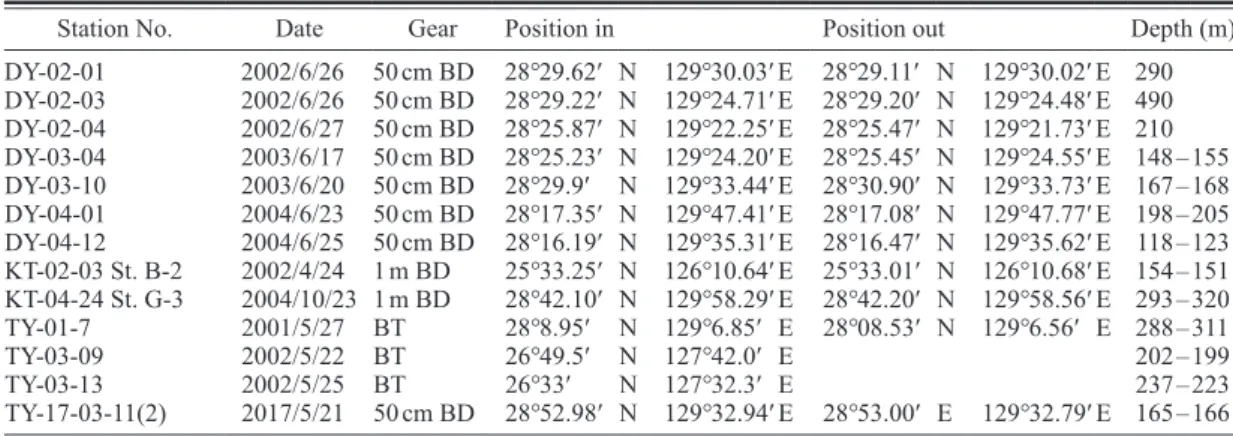
Table 2. Stations of additional surveys around the Nansei Islands for comparative material. Abbreviations: BD, bio- logical dredge; DY, a tagboat Daiyu-Maru, Amami-oshima; KT, R/V Tansei-Maru; TY, T/V Toyoshio-Maru.
Station No. Date Gear Position in Position out Depth (m)
DY-02-01 2002/6/26 50 cm BD 28°29.62′ N 129°30.03′ E 28°29.11′ N 129°30.02′ E 290 DY-02-03 2002/6/26 50 cm BD 28°29.22′ N 129°24.71′ E 28°29.20′ N 129°24.48′ E 490 DY-02-04 2002/6/27 50 cm BD 28°25.87′ N 129°22.25′ E 28°25.47′ N 129°21.73′ E 210 DY-03-04 2003/6/17 50 cm BD 28°25.23′ N 129°24.20′ E 28°25.45′ N 129°24.55′ E 148–155 DY-03-10 2003/6/20 50 cm BD 28°29.9′ N 129°33.44′ E 28°30.90′ N 129°33.73′ E 167–168 DY-04-01 2004/6/23 50 cm BD 28°17.35′ N 129°47.41′ E 28°17.08′ N 129°47.77′ E 198–205 DY-04-12 2004/6/25 50 cm BD 28°16.19′ N 129°35.31′ E 28°16.47′ N 129°35.62′ E 118–123 KT-02-03 St. B-2 2002/4/24 1 m BD 25°33.25′ N 126°10.64′ E 25°33.01′ N 126°10.68′ E 154–151 KT-04-24 St. G-3 2004/10/23 1 m BD 28°42.10′ N 129°58.29′ E 28°42.20′ N 129°58.56′ E 293–320 TY-01-7 2001/5/27 BT 28°8.95′ N 129°6.85′ E 28°08.53′ N 129°6.56′ E 288–311
TY-03-09 2002/5/22 BT 26°49.5′ N 127°42.0′ E 202–199
TY-03-13 2002/5/25 BT 26°33′ N 127°32.3′ E 237–223
TY-17-03-11(2) 2017/5/21 50 cm BD 28°52.98′ N 129°32.94′ E 28°53.00′ E 129°32.79′ E 165–166
Table 3. Summary of species recorded in the present study. *, new to Ogasawara Islands; **, new to Japan; fr, fragment; op, operculum.
Species name No. of
specimens total (live)/lot
Depth range (m)
Endemic Ogasa-to wara Id.
Distribution Records Sagami-
Izu Nansei Islands TWP Family Angariidae
Angaria rugosa (Kiener, 1838)* 2(0)/2 73–101 + +
Family Phasianellidae
Hiloa variabilis (Pease, 1861)* 7(0)/4 35–115 + + +
Phasianella solida (Born, 1780) 56(0)+12fr/16 36–113 + + +
Family Colloniidae
Collonista picta (Pease, 1868)* 116(0)/20 35–178 + + +
Collonista rubricincta (Mighels, 1845) 115(6)/14 35–160 + + −
Collonista verruca (Gould, 1845)** 1(0)/1 40 − − −
Homalopoma sp. 1** 11(0)/2 156–160 − + −
Homalopoma sp. 2** 3(0)/1 380–385 Y − − −
Family Trochidae
Trochus rota Dunker, 1860 3(0)/3 69–107 + + +
Clanculus bronni Dunker, 1860 3(0)/1 42 + + +
Clanculus cognatus (Pilsbry, 1903) 2(0)/2 75 + + +
Clanculus denticulatus (Gray, 1827) 31(0)+17fr/14 35–107 − + +
Clanculus sp.** 10(0)+3fr/11 65–137 Y − − −
Jujubinus sp.** 64(2)/19 76–385 − + −
Kanekotrochus boninensis (Okutani, 2001) 91(0)+9fr/21 48–171 Y − − −
Tosatrochus attenuatus (Jonas, 1844) 2(0)/2 69–82 − + +
Alcyna ocellata A. Adams, 1860 12(0)/6 35–107 + + +
Synaptocochlea concinna (Gould, 1845) 11(0)/4 35–105 − + +
Microtis tuberculata H. Adams & A. Adams, 1850 3(0)+1fr/1 89–107 − + +
Stomatella auricula Lamarck, 1816 4(0)+12fr/4 36–107 + + +
Stomatella lintricula (A. Adams, 1850)* 1(0)/1 85 − + +
Stomatia phymotis Helbling, 1779 6(2)/5 6–59 + + +
Stomatolina angulata (A. Adams, 1850)* 3(0)/3 92–156 + + +
Stomatolina sp. 25(0)/7 45–107 Y − − −
Conotalopia ornata (G. B. Sowerby III, 1903)* 3(0)/2 84–107 + + −
Ethalia guamensis (Quoy & Gaimard, 1834) 1(0)/1 42 − + +
Ethaliella floccata (G. B. Sowerby III, 1903) 1(0)/1 42 − + +
Ethminolia sp. 148(8)+3fr/30 36–151 Y − − −
Monilea belcheri (Philippi, 1849) 128(14)+16fr/30 36–147 − + +
Pseudominolia tramieri Poppe, Tagaro & Dekker, 2006** 4(0)/2 127–330 − − +
Rossiteria nucleus (Philippi, 1849) 385(9)+33fr/26 36–113 + + +
Sericominolia vernicosa (Gould, 1861) 109(13)/21 36–107 − + +
Family Solariellidae
Archiminolia fulgens (Dall, 1907)* 2(0)/2 298–311 + + +
Archiminolia ziczac (Kuroda & Habe, 1971)* 5(0)/2 300–385 + − −
Bathymophila gravida Marshall, 1999** 26(0)+4fr/1 529–540 − − +
Bathymophila sp. 2** 1(0)/1 141–151 Y? − − −
Family Margaritidae
Callogaza sericata (Kira, 1959)* 1(0)/1 380–385 + − +
Family Calliostomatidae
Calliostoma takujii Kosuge, 1986 7(3)/4 98–385 − − +
Calliostoma sp. 1 33(0)/16 36–137 Y − − −
Calliostoma sp. 2 10(0)/6 47–135 Y − − −
Family Turbinidae
Astralium provisorium Schepman, 1908** 86(6)+1op/28 35–171 − − +
Bolma girgyllus (Reeve, 1861)* 2(1)/2 34–105 + + +
Bolma kiharai Kosuge, 1986 1(0)/1 175–178 Y − − −
Bolma minutiradiosa Kosuge, 1983* 2(2)/2 202–311 − + +
Bolma persica (Dall, 1907))* 4(0)/2 136–310 + + +
Bolma tamikoana (Shikama, 1973)* 47(13)+3op
+8fr/22 102–385 + + +
Bolma sp. 109(46)+39op
+2fr/33 98–348 Y − − −
Kazunori Hasegawa 112
Species name No. of
specimens total (live)/lot
Depth range (m)
Endemic Ogasa-to wara Id.
Distribution Records Sagami-
Izu Nansei Islands TWP Turbo excellens G. B. Sowerby III, 1914 13(1)+6op
+2fr/18 45–171 + − −
Turbo reevei Philippi, 1847 1(0)/1 42 + + +
Family Liotiidae
Bathyliotina armata (A. Adams, 1861)* 2(0)/1 380–385 + + +
Liotina montamarina Okutani, 2001 67(1)/25 36–137 Y − − −
Liotina sp. 1 83(1)/22 52–385 − + −
Liotina sp. 2 19(0)/11 47–156 Y − − −
Family Skeneidae
Cirsonella sp.** 3(0)/3 136–160 − + −
Leucorhynchia tricarinata Melvill & Standen, 1896 5(0)/2 35–84 − + +
Munditiella ammonoceras (A. Adams, 1863) 8(0)/4 35–107 + + +
Family Seguenziidae
Ancistrobasis sp.** 1(0)/1 380–385 Y? − − −
Visayasequenzia sp. 5(0)/2 115–156 − + −
Calliobasis sp. 1(0)/1 160 Y? − − −
Family Chilodontidae
Ascetostoma sp.** 15(0)/9 73–156 Y − − −
Herpetopoma ludiviniae Poppe, Tagaro & Dekker, 2006 ** 3(0)/1 380–385 − − +
Herpetopoma rubrum (A. Adams, 1853)* 8(0)/6 47–107 + − +
Perrinia concinna (A. Adams, 1864)* 7(1)/5 99–171 + + −
Pholidotrope asteroeides Vilvens, 2017** 5(1)/4 99–156 − + +
Tibatrochus sp.** 1(0)/1 160 − + +
Vaceuchelus favosus (Melvill & Standen, 1896)** 15(0)/6 35–156 − − + Family Anatomidae
Anatoma equatoria (Hedley, 1899)* 29(0)/2 160–540 − + +
Anatoma indonesica Bandel, 1998* 6(0)/3 107–160 − + +
Anatoma japonica (A. Adams, 1862)* 2(0)/1 529–540 + + +
Family Scissurellidae
Scissurella evaensis Bandel, 1998* 11(3)/7 92–115 − + +
Sukashitrochus carinatus (A. Adams, 1862) * 10(4)/7 35–115 + + +
Family Larocheidae
Trogloconcha sp.** 7(0)/1 160 Y? − − +
Family Haliotiidae
Haliotis sp. 6(0)/6 47–129 Y − − −
Family Fissurellidae
Diodora mus (Reeve, 1850) 5(0)/4 35–129 + + +
Diodora octagona (Reeve, 1850) 6(0)/6 87–166 − + +
Diodora quadriradiata (Reeve, 1850) 5(0)/1 42 + + +
Diodora semilunata Habe, 1953* 17(0)/7 36–110 + + −
Diodora sp. 162(8)/26 45–138 − + −
Macroschisma dilatata (A. Adams, 1851) 19(1)/9 35–107 + + +
Cranopsis propinqua (A. Adams, 1853) 6(0)/6 35–160 + − +
Emarginella sakuraii Habe, 1963 7(0)/7 36–137 − + −
Hemimarginula laevicostata (A. Adams, 1852) 88(0)/13 35–115 − + +
Laeviemarginula kimberi (Cotton, 1930)* 1(0)/1 117–121 + + +
Zeidora calceolina A. Adams, 1860* 3(0)/3 35–160 + + +
Emarginula choristes Dall, 1925* 33(1)/15 127–385 + + −
Emarginula curvata Schepman, 1908** 1(0)/1 300–311 − + +
Emarginula foveolata Schepman, 1908* 1(0)/1 330 + + +
Emarginula fragilis Yokoyama, 1920* 17(0)/12 84–540 + + +
Emarginula eximia A. Adams, 1863 7(0)/4 47–107 + + +
Emarginula maculata A. Adams, 1863* 112(4)/27 36–160 + + +
Emarginula sublaevis Schepman, 1908** 4(0)/3 330–385 + + +
Emarginula sp. 1 38(4)/21 47–202 − + −
Emarginula sp. 2** 2(0)/2 89–109 − + −
Table 3. (continued)
Izu Islands, there are no reliable records with voucher specimens or illustrations of the species in the Ogasawara Islands. The present material comprises only one adult in very poor condition and one juvenile shell, but it apparently differs from A. neglecta and is identifiable with A.
rugosa in possessing finer sculpture and distinct subsutural ramps, and lacking of distinctive black-tipped spines. It is not clear whether the record of A. neglecta was based on the misidenti- fication with A. rugosa, or two species are actu- ally distributed in the Ogasawara Islands.
Family Phasianellidae Swainson, 1840 Hiloa variabilis (Pease, 1861) ベニバイ (Fig.
2D–E)
Material examined: OG-76-15 (1); SO-90-HD-1 (2);
KY-10-02 (3: Fig. 2D–E), NSMT-Mo 114057; KY-10-7 (1); [35–115 m].
Distribution: Southern Hokkaido and south- wards to TWP. New to Ogasawara Islands.
Remarks: Although Fukuda (1950: 5, pl. 47, fig. 841) recorded a similar possible undescribed species with a distinct spiral sculpture as “Tricolia sp.” from the intertidal zone in the Ogasawara Islands, all the specimens in the present material could easily be identified as this species, though this represents the first record of it in this region.
In temperate Japanese waters, including the Izu Islands (south to Hachijo-jima Island), two dis- continuous forms are recognized in this species and this has been interpreted as sexual dimor- phism (Robertson, 1985), but specimens from the Ogasawara Islands are uniform and agree well with the typical H. variabilis, as is also the case in the Nansei Islands.
Phasianella solida (Born, 1780) サラサバイ
Material examined: OG-76-04 (1ex.); OG-76-07 (2);
OG-76-08 (2); OG-76-11 (10+3fr); OG-76-15 (4+9fr);
OG-95-16 (1); OG-95-19 (1); OG-95-22 (1); KY-08-17 (1); KY-08-18 (1); KY-10-24 (2); KY-10-26 (1); KY-10- 27 (1); KY-03-13 (2); KY-14-11 (25); KY-17-10 (1); [36–
113 m].
Distribution: Boso Peninsula and southwards to TWP.
Family Colloniidae Cossmann, 1917 Collonista picta (Pease, 1868) ミナミサンショ
ウスガイ(新称) (Fig. 2F–J)
[=Collonista pilula (Dunker, 1860) fide Fukuda (1995: pl. 5, fig. 38)]
Material examined: OG-76-02 (5); OG-76-05 (2);
OG-76-07 (40: Fig. 2F–H), NSMT-Mo 114077; OG-76- 08 (2); OG-76-11 (7); OG-76-15 (22); SO-90-HD-1 (4);
Table 4. Species endemic to the Ogasawara Islands and possible sister species, with their geographical distribution.
Species Morphologically allied species Distribution
Honshu Nansei Id. TWP
Homalopoma sp. 2 Homalopoma hui Huang et al., 2016 − + +
Clanculus sp. Clanculus buijsei Poppe et al., 2006 − − +
Kanekotrochus boninensis Kanekotrochus infuscatus (Gould, 1861) + − −
Stomatolina sp. Stomatolina rubra (Lamarck, 1822) + − −
Ethminolia sp. Ethminolia nektonica (Okutani, 1961) + + −
Bathymophila sp. 2 ?
Calliostoma sp. 1 Calliostoma simodense Ikebe, 1942 + − −
Calliostoma sp. 2 ?
Bolma kiharai Bolma tamikoana (Shikama, 1973) + + +
Bolma sp. 1 Bolma guttata (A. Adams, 1863) + − −
Liotina montamarina Liotina solidula (Gould, 1859) + + −
Liotina sp. 2 Liotina loculosa (Gould, 1859) − +
Ancistrobasis sp. ?
Calliobasis sp. ?
Trogloconcha sp. Trogloconcha lammelinodosa Geiger, 2012 − − +
Haliotis sp. Haliotis varia Linnaeus, 1758 − + +
Kazunori Hasegawa 114
Fig. 2. A–C. Angaria rugosa; A, KY-10-04; B–C, KY-10-06. D–E. Hiloa variabilis; KY-10-02. F–J. Collonista picta; F–H, OG-76-07; I–J, KY-17-08. K–O. Collonista rubricincta; K–M, O, SO-90-HD1 (2 specimens); N, OG-76-75. P–S. Collonista verruca; P–Q, KY-10-26; R–S, Kopepe Beach, Chichi-jima Island, in intertidal zone. T–U. Collonista amakusaensis; holotype. Scales: A, 10 mm; B, 5 mm; C, 1 mm, F–J, 1 mm; K–O, 1 mm:
P–U; 2 mm.
KY-09-29 (1); KY-10-02 (6); KY-10-06 (5); KY-10-11 (4); KY-10-15 (2); KY-10-21 (1); KY-10-24 (3); KY-10- 27 (3); KY-14-03 (3); KY-14-08 (1); KY-17-05 (2);
KY-17-08 (2: Fig. 2I–J), NSMT-Mo 114093; KY-17-17 (1); [35–178 m].
Distribution: Boso Peninsula and southwards to TWP. New to Ogasawara Islands.
Remarks: The taxonomy of the Japanese species of the family Colloniidae is confused, and detailed revision will be necessary to resolve it. The present species is often misidentified as a phenotype of the superficially similar Bothropoma pilula (Dunker, 1860) in museums and private collections, and it was actually recorded from the Ogasawara Islands by Fukuda (1995) as “Collonista pilula.” Specimens previ- ously recorded “C. glareosa (Gould, 1861)” from the Ogasawara Islands (Fukuda, 1953: 20) proba- bly correspond to the C. verruca (and partly C.
rubricincta; see below) in the present study, judged from the examination of related material.
Accordingly this is the first firm record of this species from the Ogasawara Islands.
Collonista rubricincta (Mighels, 1845) ベニツ
ブサンショウ (Fig. 2K–O)Material examined: OG-76-15 (2: fig. 2N), NSMT-Mo 114095; SO-90-HD-1 (15: fig. 2K–M, O), NSMT-Mo 114096; KY-09-34 (1); KY-10-04 (1); KY-10-06 (7);
KY-10-07 (5*); KY-10-09 (1); KY-10-15 (4); KY-10-17 (11); KY-10-31 (1); KY-14-03 (70); KY-14-11 (1);
KY-17-10 (1); KY-17-25 (1*); [35–160 m].
Distribution: From Kii Peninsula to Nansei Islands, and Hawaii.
Remarks: Huang et al. (2016) described a very similar species, C. thachi Huang, Fu & Poppe, 2016, from the Philippines, and they stated that it can be distinguished from the present species by having a clear umbilicus and more elevated spi- ral ribs in addition to a different color pattern.
Specimens from the Ogasawara Islands and other areas in Japanese waters more closely resemble C. rubricincta, which was originally described from Hawaii and is sometimes cited as endemic to that region. Specimens from the Ogasawara Islands exhibit a wide range of variation in color
from white to red, like those in Hawaii. The white phenotype (e.g., from OG-76-15: Fig. 2O) was identified by Fukuda (1995: 20) as Colloni- sta glareosa (Gould, 1861), as confirmed by the examination of voucher specimens.
Collonista verruca (Gould, 1845) フイリシラタ
マサンショウスガイ(新称)(Fig. 2P–S)Material examined: KY-10-26 (1: Fig. 2P–Q), NSMT- Mo 114109; [0–40 m].
Additional material: Kopepe Beach, Chichi-jima Island, under boulders in intertidal zone, 11 July 2010, leg. K. Hasegawa (10+7*: Fig. 2R–S), NSMT-Mo 114771.
Distribution: Ogasawara Islands, and Hawaii.
New to Japan.
Remarks: Although only one empty shell was found in the present material, live specimens were rather commonly found in the intertidal zone (Fig. 2R–S). These specimens closely resemble Collonista amakusaensis Habe, 1960 (Fig. 2T–U: holotype, NSMT-Mo 39787), which is distributed along the Pacific coast of mainland Japan, but is clearly distinguished by a more elongate shell with an elevated spire, different sculpture (spiral cords being narrower, with sec- ondary spiral threads in the interspaces and bear- ing red spots), and completely closed umbilicus.
They are, on the other hand, morphologically indistinguishable from the Hawaiian taxon, C.
verruca (see Alf and Kreipl in Severns, 2011: pl.
12, fig. 9 for color photograph). Considering both the geographical distance between Hawaii and the Ogasawara Islands and the absence of records of this species in other areas, however, the Ogasawara population may be genetically distinct and represent the third species in this putative species group.
Homalopoma sp. 1 (Fig. 3D–E)
Material examined: KY-10-17 (1); KY-14-03 (8: Fig.
3D–E), NSMT-Mo 114111; [156–160 m].
Distribution: From the Kii Peninsula to Nansei Islands and Ogasawara Islands. New to Japan.
Remarks: This probably undescribed species
has also been collected from off the Kii Penin-
Kazunori Hasegawa 116
Fig. 3. A–E. Homalopoma sp. 1; A–C, off Amami-oshima Island, 288–311 m, TY-01-7; D–E, KY-14-03. F–H.
Homalopoma sp. 2; KY-17-05. I–J. Homalopoma hui; off Amami-oshima Island, ca. 480 m, DY-02-03. K–L.
Trochus rota; KY-14-11. M–O. Clanculus sp.; M–N, KY-10-06; O, KY-16-33. P–T. Jujubinus sp.; P–R, KY-09-21 (2 specimens); S, KY-10-7; T, Zyuho-Sone Bank, near Miyako Island, 162–151 m, KT-02-03 St.
B-2. Scales: A–E, 2 mm; F–L, 2 mm; M–O, 2 mm; P–T, 2 mm.
sula (Hasegawa, personal observation) to the Nansei Islands (Amami-oshima Island: Fig.
3A–C, NSMT-Mo 114772).
Homalopoma sp. 2 (Fig. 3F–H)
Material examined: KY-17-05 (3), NSMT-Mo 114112;
[380–385 m].
Distribution: Ogasawara Islands (endemic).
New to Japan.
Remarks: The specimens in the present mate- rial are apparently related to H. hui Huang, Fu &
Poppe, 2016, which was originally described from Taiwan and is also distributed in Japan from the Nansei Islands (Fig. 3I–J, NSMT-Mo 114773) north to Sagami Bay (Hasegawa, in preparation). However, in contrast to the low morphological variability of this species in other populations in its wide geographical range, spec- imens from the Ogasawara Islands differ consid- erably in having a significantly smaller and more globose shell with weaker and more crowded spiral sculpture and a dark red protoconch. They are thus considered to belong to a distinct unde- scribed species.
Family Trochidae Rafinesque, 1815 Trochus rota Dunker, 1860 ウズイチモンジ
(Fig. 3K–L)
Material examined: OG-76-15 (1); KY-14-07 (1);
KY-14-11 (1: Fig. 3K–L), NSMT-Mo 114115; [69–
107 m].
Distribution: Boso Peninsula and southwards to TWP.
Remarks: Although this species is common in the intertidal zone in temperate Japanese waters, including the Izu Islands, it is very rare in the Ogasawara Islands and the present material com- prises only very small immature shells. Identifi- cation was confirmed by direct comparison with the apical part of Japanese specimens. However, T. rota seems to be contiguous to T. histrio Reeve, 1848 (sensu Sasaki in Okutani, 2017: pl.
20, fig. 64 for a figure) that is said to be widely distributed in the TWP northwards to the Nansei Islands, and it is possible that the former repre-
sents a geographical form (in temperate Japanese waters) of the latter.
Clanculus bronni Dunker, 1860 コマキアゲエ
ビスMaterial examined: OG-76-17 (1); [42 m].
Distribution: Boso Peninsula and southwards to TWP.
Clanculus cognatus (Pilsbry, 1903) クルマチグサ
Material examined: OG-95-23 (1); KY-14-11 (1);
[75 m].
Distribution: Boso Peninsula and southwards to TWP.
Clanculus denticulatus (Gray, 1827) テツイロ
ナツモモMaterial examined: OG-76-04 (1fr); OG-76-07 (7);
OG-76-08 (3fr); OG-76-15 (3+8fr); OG-76-11 (4fr); SO- 90-HD-1 (1); OG-95-19 (1); KY-09-27 (1); KY-10-06 (1);
KY-10-24 (1+1fr); KY-10-27 (1); KY-14-07 (1); KY-14- 11 (13); KY-14-14 (1); [35–107 m].
Distribution: Yaku-shima Island and south- wards to TWP.
Clanculus sp. (Fig. 3M–O)
[=Clanculus gemmulifera pallidus fide Fukuda (1993: pl. 5, fig. 59) non Pilsbry, 1903]
Material examined: OG-76-05 (1fr); OG-76-11 (1fr);
OG-76-15 (1fr); OG-95-39 (1); KY-10-02 (1); KY-10-06 (3: Fig. 3M–N), NSMT-Mo 114138; KY-10-11 (1);
KY-16-33 (1: Fig. 3O), NSMT-Mo 114140; KY-16-37 (1);
KY-17-05 (1); KY-17-31 (1); [65–137 m].
Distribution: Ogasawara Islands (endemic).
New to Japan.
Remarks: A fragment of this species was pre-
viously recorded as “C. gemmulifera pallidus
Pilsbry, 1903” by Fukuda (1993: voucher mate-
rial in OG-76-15), but complete specimens in the
present material showed that they belong to an
apparently different and distinct species. It is
most closely similar to Clanculus buijsei Poppe,
Tagaro & Dekker, 2006, that was originally
described from the Philippines, but is readily dis-
tinguished by the non-canaliculate suture, more
angulate periphery and wider umbilicus.
Kazunori Hasegawa 118
Fig. 4. A–D. Kanekotrochus boninensis; A–B, holotype; C–D, KY-09-27. E–F. Kanekotrochus infuscatus; off Isshiki, Aichi Prefecture, Sakurai Coll. G. Tosatrochus attenuatus; KY-08-17. H-J. Stomatolina sp.; H–I, KY-14-11; J, KY-08-17. K–L. Stomatolina rubra; Tsuji-jima Island, Amakusa, Kumamoto Prefecture. M–N.
Stomatolina angulata; Ky-17-33. O–P. Stomatella lintricula; KY-17-17. Q–R. Stomatia phymotis; Q, KY-09- 28; R, KY-14-17. Scales: A–F, 5 mm; G, 5 mm; H–K, 2 mm; M–N, 2 mm; O–P, 2 mm; Q–R, 5 mm.
Jujubinus sp. (Fig. 3P–S)
Material examined: KT-09-02-TW-01-02 (1); KY-09- 12 (2); KY-09-13 (1*); KY-09-14 (1); KY-09-15 (1);
KY-09-21 (4+1*: Fig. 3P–R), NSMT-Mo 114149;
KY-10-04 (1); KY-10-06 (7); KY-10-07 (3: Fig. 3S), NSMT-Mo 114152; KY-10-17 (4); KY-10-31 (2); KY-14- 03 (23); KY-14-08 (2); KY-17-05 (7); KY-17-17 (1);
KY-17-29 (1); KY-17-31 (1); KY-17-33 (1); [76–385 m].
Distribution: Ogasawara and Nansei Islands.
New to Japan.
Remarks: This species closely resembles J. geographicus and J. hubrechti, both recently described from the Philippines by Poppe et al.
(2006), but is distinguished by its coarser sculp- ture and more convex whorls. Specimens with exactly the same characters have also been col- lected from the Okinawa Islands (Fig. 3T, NSMT-Mo 114774).
Kanekotrochus boninensis (Okutani, 2001) ア
ラハダチグサ (Fig. 4A–D)Material examined: OG-76-10 (1); OG-76-15 (4+7fr);
KY-08-18 (1); KY-08-26 (13); KT-09-02-TW-01-01 (1);
KY-09-08 (7); KY-09-09 (2); KY-09-27 (18: Fig. 4C–D), NSMT-Mo 114169; KY-09-28 (2); KY-10-03 (1); KY-10- 04 (9); KY-10-06 (6); KY-10-27 (1); KY-14-04 (1);
KY-14-06 (1); KY-14-16 (1); KY-16-13 (12); KY-17-05 (3); KY-17-17 (2+1fr); KY-17-31 (4+1fr); KY-17-33 (1); [48–171 m].
Distribution: Ogasawara Islands (endemic).
Remarks: This species was described from a seamount east of the Ogasawara Islands, at a depth of 90 m, in the genus Prothalotia Thiele, 1930 (Fig. 4A–B: holotype, NSMT-Mo 73046), but it is apparently related to the temperate Japanese species Kanekotrochus infuscatus (Gould, 1861) (Fig. 4E–F, NSMT-Mo 114775).
Fukuda (1993: 22, pl. 5, fig. 56: voucher in OG-76-15) actually recorded a fragment of this species as “Canthatidus [sic; Cantharidus] infus- catus,” and Bouchet (2015) transferred the spe- cies in the genus Kanekotrochus Habe, 1958 (type species by original designation: Ziziphinus infuscatus Gould, 1861). The present material revealed that it is common around the Ogasawara Islands, and shows a wide range of variation in
the sculpture, and some of the specimens do approximately resemble K. infuscatus. The Ogasawara specimens can only be distinguished by their small size and uniform coloration with a distinct axial pattern. More detailed study will thus be necessary to clarify the taxonomic rela- tionship between the two nominal taxa.
Tosatrochus attenuatus (Jonas, 1844) オニノハ (Fig. 4G)
Material examined: KY-08-17 (1: Fig. 4G), NSMT-Mo 114183; KY-14-14 (1); [69–82 m].
Distribution: Kii Peninsula and southwards to TWP. Remarks: This species was recorded only by name (Nishimura, 1999), and this is the first firm record with a figure of the voucher specimen.
Alcyna ocellata A. Adams, 1860 キバベニバイ
Material examined: OG-76-07 (1); OG-76-15 (6); SO- 90-HD-1 (2); KY-10-15 (1); KY-14-11 (1); KY-17-08 (1);
[35–107 m].
Distribution: Boso Peninsula and southwards to TWP.
Synaptocochlea concinna (Gould, 1845) クモリ
チゴアシヤMaterial examined: OG-76-11 (1); OG-76-15 (4); SO- 90-HD-1 (5); KY-10-07 (1); [35–105 m].
Distribution: Amami Islands and southwards to TWP.
Microtis tuberculata H. Adams & A. Adams, 1850 クジケアシヤガマ
Material examined: KY-14-11 (3+1fr); [89–107 m].
Distribution: Amami Islands and southwards to TWP.
Stomatella auricula Lamarck, 1816 ヒメアワビ
Material examined: OG-76-11 (1); KY-09-27 (1);
KY-10-26 (1+12fr); KY-14-11 (1); [36–107 m].
Distribution: Boso Peninsula and southwards to TWP.
Stomatella lintricula (A. Adams, 1850) ウスヒ
メアワビ (Fig. 4O–P)Kazunori Hasegawa 120
Material examined: KY-17-17 (1), NSMT-Mo 114200;
[85 m].
Distribution: Kii Peninsula and southwards to TWP. New to Ogasawara Islands.
Remarks: Identification of this species is con- fused, and it has seldom been illustrated properly in Japanese literature. The specimen illustrated by Sasaki in Okutani (2017: pl. 23, fig. 2) as “S.
lintricula” seems to be indistinguishable from S.
planulata (Lamarck, 1816). The specimen in the present material agrees well with the figure of the possible type (Adams, 1854: pl. 173, fig. 22) in being small and having an oblong outline (not tapered apically). Similar specimens have been found in small numbers along the Pacific coast of mainland Japan based on the material deposited in the NSMT-Mo.
Stomatia phymotis Helbling, 1779 フルヤガイ (Fig. 4Q–R)
Material examined: OG-76-07 (1); OG-76-15 (2);
OG-95-07 (1); KY-09-28 (1*: Fig. 4Q), NSMT-Mo 114204; KY-14-17 (1*: Fig. 4R), NSMT-Mo 114205;
[6–59 m].
Distribution: Izu Peninsula and southwards to TWP. Remarks: Fukuda (1993: pl. 7, fig. 81) recorded a juvenile specimen from a part of the present material (OG-76-15) as “Stomatia cf.
phymotis.” Mature specimens in the present material confirm the identification, and also show a wide range of variation in the general shape and strength of the spiral ribs.
Stomatolina angulata (A. Adams, 1850) シワア
シヤガマ (Fig. 4M–N)Material examined: KY-09-14 (1); KY-14-03 (1);
KY-17-33 (1: Fig. 4 M–N), NSMT-Mo 114208; [92–
156 m].
Distribution: Boso Peninsula and southwards to TWP. New to Ogasawara Islands.
Remarks: Although this species is common in the intertidal zone in the Nansei Islands, it is apparently uncommon in Sagami Bay and the Izu Islands, and is not listed in most faunal cata- logues of the region (e.g., Kuroda et al., 1971;
Nishimura, 1999; Ikeda and Kuramochi, 2010).
However, it was found in material dredged around the Izu Peninsula at multiple stations (Hasegawa et al., 2001), similar to the case in the Ogasawara Islands.
Stomatolina sp. (Fig. 4H–J)
Material examined: OG-76-07 (2); OG-76-08 (5);
OG-76-11 (2); OG-76-15 (3); KY-08-17 (1: Fig. 4J), NSMT-Mo 114213; KY-10-24 (2); KY-14-11 (10: Fig.
4H–I), NSMT-Mo 114215; [45–107 m].
Distribution: Ogasawara Islands (endemic).
Remarks: This species most closely resembles S. rubra (Lamarck, 1822) (Fig. 4K–L, NSMT- Mo 114776: immature specimen of similar size), which is common in temperate Japanese waters north to the Boso Peninsula, but it is clearly dis- tinguished from the latter by its significantly smaller size (less than half in mature specimens) and the complete absence of nodular sculpture on the distinct spiral cord below the suture.
Conotalopia ornata (G. B. Sowerby III, 1903)
ヒナシタダミ (Fig. 5A–C)Material examined: OG-16-15 (1); KY-14-11 (2: Fig.
5A–C), NSMT-Mo 114217; [84–107 m].
Distribution: From southern Hokkaido south to Nansei Islands. New to Ogasawara Islands.
Remarks: Only some incomplete specimens were found among the present material, and they differ slightly from typical examples of this species in possessing a less angulate shoulder and weaker sculpture. However, identification was confirmed by comparison with many examples of this species collected from off Shimoda, Izu Peninsula (Hasegawa et al., 2001), which show a wide range of variation both in shape (shoulder round to angu- late) and sculpture (spiral cord distinct to absent).
Ethalia guamensis (Quoy & Gaimard, 1834) キ
サゴモドキMaterial examined: OG-76-17 (1); [42 m].
Distribution: Kii Peninsula and southwards to TWP.
Ethaliella floccata (G. B. Sowerby III, 1903) ハ
Fig. 5. A–C. Conotalopia ornata; KY-14-11. D–F. Ethminolia sp.; KY-08-21. G–H. Ethminolia nektonica; holo- type. I–J. Archiminolia ziczac; KY-17-05. K–L. Archiminolia fulgens; KY-17-15. M–N. Pseudominolia tram- ieri; KY-14-16. O–P. Bathymophila gravida; KY-10-18. Q–R. Bathymophila sp.; KY-17-32. Scales: A–F, 2 mm; G–H, 2 mm; I–J, 2 mm; K–R, 2 mm.
Kazunori Hasegawa 122
ナゴショグルマ
Material examined: OG-76-17 (1); [42 m].
Distribution: Kii Peninsula and southwards to TWP.
Ethminolia sp. (Fig. 5D–F)
Material examined: OG-76-02 (1); OG-76-05 (2);
OG-76-07 (25); OG-76-11 (1); OG-76-13 (2); OG-76-15 (17+3fr); OG-95-44 (1); KY-08-17 (1); KY-08-21 (1:
Fig. 5D–F), NSMT-Mo 114228; KY-08-26 (2); KY-09-12 (2); KY-09-14 (4); KY-09-27 (10); KY-09-28 (1); KY-10- 02 (4); KY-10-04 (4); KY-10-07 (4); KY-10-11 (1);
KY-10-19 (5+2*); KY-10-31 (4); KY-14-06 (1); KY-14- 10 (1*); KY-14-11 (16); KY-16-13 (4); KY-16-18 (3);
KY-16-33 (1); KY-17-09 (1+1*); KY-17-10 (20+4*);
KY-17-17 (1); KY-17-32 (1); [36–151 m].
Distribution: Ogasawara Islands (endemic).
Remarks: As already stated by Fukuda (1993:
24, pl. 6, fig. 65), this species is closely related to E. nektonica (Okutani, 1961) (Fig. 5G–H: holo- type, NSMT-Mo 69540) but morphologically distinguishable by the narrower umbilicus encir- cled by coarser axial indentation, and the absence of spiral ribs on the base. Ethminolia nektonica is also distributed in the Nansei Islands, and the specimens in that region are indistinguishable from those in more temperate regions, including the type locality (off Kushikino, Kagoshima pre- fecture) (Hasegawa, personal observation). This all confirms the distinctiveness of the Ogasawara population. See also discussion for comparison between E. nektonica and E. sp.
Monilea belcheri (Philippi, 1849) ヘソワゴマ
Material examined: OG-76-02 (3fr); OG-76-04 (4
+2fr); OG-76-05 (4+3fr); OG-76-07 (4); OG-76-08 (6
+7fr); OG-76-15 (3+1fr); OG-76-17 (6); OG-95-16 (6);
OG-95-19 (3); OG-95-22 (2); OG-95-23 (1); OG-95-31 (1); OG-95-34 (1); OG-95-35 (1); KY-08-17 (11+2*);
KY-08-18 (3+2*); KY-08-25 (1); KY-09-29 (1); KY-10- 24 (3); KY-10-30 (1); KY-13-03 (2); KY-14-06 (1);
KY-14-07 (1); KY-14-11 (40); KY-14-14 (1); KY-14-17 (1+1*); KY-16-13 (3+5*); KY-16-14 (1+4*); KY-16- 37 (1); KY-17-10 (1); [36–147 m].
Distribution: Kii Peninsula and southwards to TWP.
Pseudominolia tramieri Poppe, Tagaro &
Dekker, 2006 ヘソワゴマモドキ(新称)
(Fig. 5M–N)
Material examined: KY-08-10 (1); KY-14-16 (3: Fig.
5M–N), NSMT-Mo 114334; [127–330 m].
Distribution: Ogasawara Islands, and TWP.
New to Japan.
Remarks: Specimens in the present material fall within the range of variation of this species from the Philippines shown by Poppe et al.
(2006: pl. 74, figs. 1–4). This species has not been found in the similar dredging survey around the Nansei Islands.
Rossiteria nucleus (Philippi, 1849) コノボリガイ
Material examined: OG-76-02 (1); OG-76-04 (100);
OG-76-05 (1); OG-76-07 (26); OG-76-08 (17+9fr);
OG-76-11 (3); OG-76-15 (19+23fr); OG-76-17 (6);
OG-95-16 (4); OG-95-22 (2); OG-95-23 (3); OG-95-40 (2); KY-08-17 (36); KY-08-18 (9); KY-09-29 (2); KY-10- 24 (11+6*); KY-10-26 (1); KY-10-27 (1); KY-13-03 (4);
KY-14-06 (6); KY-14-07 (3+1fr); KY-14-11 (100);
KY-14-17 (1); KY-16-13 (9+3*); KY-17-16 (8); KY-17- 17 (1); [36–113 m].
Distribution: Boso Peninsula and southwards to TWP.
Sericominolia vernicosa (Gould, 1861) ハブタ
エシタダミMaterial examined: OG-76-02 (2); OG-76-05 (1);
OG-76-08 (7); OG-76-11 (5); OG-76-15 (5); KY-09-08 (2); KY-09-09 (7); KY-09-13 (1+1*); KY-09-14 (4*);
KY-09-28 (3*); KY-09-29 (3); KY-10-04 (1*); KY-10-06 (4); KY-10-19 (1); KY-10-24 (4+1*); KY-10-27 (1);
KY-10-31 (1); KY-14-11 (12); KY-16-11 (1*); KY-16-18 (2*); KY-17-17 (40); [36–107 m].
Distribution: Kii Peninsula and southwards to TWP.
Family Solariellidae Powell, 1951 Archiminolia fulgens (Dall, 1907) ヒカリシタ
ダミ (Fig. 5K–L)
Material examined: KY-09-31 (1); KY-17-15 (1: Fig.
5K–L), NSMT-Mo 114328; [298–311 m].
Distribution: Boso Peninsula and southwards
to TWP. New to Ogasawara Islands.
Remarks: This is one of the commonest spe- cies occurring on the shelf and upper bathyal sandy bottom in temperate and subtropical Japanese waters, but it is apparently rather rare around the Ogasawara Islands, and is represented in the present material only by two empty shells.
Archiminolia ziczac (Kuroda & Habe, 1971) ヤ
ガスリシタダミ (Fig. 5I–J)Material examined: KY-09-31 (2); KY-17-05 (3: Fig.
5I–J), NSMT-Mo 114330; [300–385 m].
Distribution: From Boso Peninsula to Tosa Bay, Izu and Ogasawara Islands. New to Ogasawara Islands.
Remarks: This species is endemic to temperate Japanese waters, and commonly occurs on sub- marine banks along the Izu Islands south to the Kurose Bank near Hachijo-jima Island (Okutani, 1972, 1975). However, it has not been recorded in the Ogasawara Islands until this study.
Bathymophila gravida Marshall, 1999ジュズカ
ケシタダミ(新称)(Fig. 5O–P)Material examined: KY-10-18 (26+4fr), NSMT-Mo 114331; [529–540 m].
Distribution: Ogasawara Islands, and TWP (New Caledonia, Vanuatu) to New Zealand. New to Japan.
Remarks: The single lot of specimens agree well with the original description of B. gravida, which was described from off New Zealand (Norfolk Ridge and Three Kings Rise), and also with the specimen recorded from off Vanuatu (Vilvens, 2009: figs. 75–77). This is the first record of this species from the Northern Hemi- sphere, and represents a significant range exten- sion to Japanese waters.
Bathymophila sp. (Fig. 5Q–R)
Material examined: KY-17-32 (1), NSMT-Mo 114332;
[141–151 m].
Distribution: Known only from Ogasawara Islands. New to Japan.
Remarks: This species is very close to B.
aages Vilvens, 2009 in general shape, but appar-
ently differs in having a completely closed umbi- licus and a well-developed smooth callus. It is represented only by one empty shell, and its dis- tribution is uncertain because of the lack of enough information.
Family Margaritidae Thiele, 1924 Callogaza sericata (Kira, 1959)
タカラシタダミ (Fig. 6A–B)
Material examined: KY-17-05 (1), NSMT-Mo 114335;
[380–385 m].
Distribution: Sagami Bay and southwards to TWP. New to Ogasawara Islands.
Remarks: This species had been considered to be distributed only in the temperate Japanese and adjacent waters, from Sagami Bay to the East China Sea (Sasaki in Okutani, 2017), but it has also been commonly found in the Philippines (Poppe et al., 2006: 95–96, pl. 42, figs. 1–4), suggesting a wide geographical distribution in the TWP.
Family Calliostomatidae Thiele, 1924 Calliostoma takujii Kosuge, 1986
オオサトエビス (Fig. 6G–H)
Material examined: KY-09-21 (1+1*); KY-10-04 (1);
KY-17-05 (2); KY-17-25 (2*: Fig. G–H), NSMT-Mo 114339; [98–385 m].
Distribution: Ogasawara Islands, and TWP.
Remarks: This species was originally described from the Ogasawara Islands (Kosuge, 1986) and considered to be endemic to the area, but was subsequently recorded also from the Philippines (Poppe et al., 2006).
Calliostoma sp. 1 アサヤケエビス (Fig. 6C–D)
Material examined: OG-76-02 (2); OG-76-07 (2);
OG-76-11 (1); OG-76-15 (2); KY-08-26 (1); KY-09-08 (2); KY-09-27 (3: Fig. 6C–D), NSMT-Mo 114346;
KY-09-28 (1); KY-10-06 (5); KY-10-15 (5); KY-10-27 (1); KY-14-11 (1); KY-16-33 (1); KY-17-16 (1); KY-17- 17 (4); KY-17-31 (1); [36–137 m].
Distribution: Ogasawara Islands (endemic).
Remarks: This species was recorded as Cal-
Kazunori Hasegawa 124
Fig. 6. A–B. Callogaza sericata; KY-17-5. C–D. Calliostoma sp. 1; KY-09-27. E–F. Calliostoma simodense;
Nanbara, Hachijo-jima Island. G–H. Calliostoma takujii; KY-17-25. I–K. Calliostoma sp. 2; I–J, OG-76-15;
K, OG-76-07. L–Q. Astralium provisorium; L–N, KY-17-25; O–Q, off Cebu, the Philippines, Kawamura Coll.
(N, Q: external view of operculum). Scales: A–B, 2 mm; C–D, 2 mm; E–F, 2 mm; G–K, 2 mm; L–Q, 5 mm.