Immobilization of Oscillation Groups in CNN Using Three Kinds of Cloning Templates
Mana Tanaka
Dept. Media and Information Syst.
Shikoku University Email:[email protected]
Yasuteru Hosokawa Dept. Media and Information Syst.
Shikoku University
Email:[email protected]
Yoshifumi Nishio
Dept. Electrical and Electronic Eng.
Tokushima University Email:[email protected]
Abstract—In our previous study, Cellular neural networks us- ing three kinds of cloning templates have been researched. Some computer simulation results show that cells are immobilized. In this study, immobilize of oscillation phenomena are investigated.
I. INTRODUCTION
There are many studies of coupled oscillatory systems. In these systems, observed phenomena are influenced by the network structure which is as ladder, ring, full-coupled and so on. Additionally, characteristics of the oscillator affect the observed phenomena. Therefore, these two factors are very important to study coupled chaotic systems.
On the other hand, Zou et al showed that CNN which consists of three cells generates chaos [3]. By applying this CNN to the element of coupled oscillatory systems, the coupled system has a novel network structure and becomes a chaotic system.
In our previous study, we have proposed cellular neural networks using three kinds of cloning templates [5]. Three, six, twelve, eighteen, twenty-four and thirty six cells are investigated. Some computer simulation results show that cells are immobilized. In this study, immobilize of oscillation phenomena are investigated.
By some computer simulations, relationships between the phenomena and the structure are investigated.
II. CELLULAR NEURAL NETWORKS USING THREE KINDS OF CLONING TEMPLATES
Figure1shows a structure of cellular neural networks using three kinds of cloning templates. The system consists of three kinds of cells which name is Cellα, Cell β or Cell γ. Each cells connects six neighbour cells. The difference of three kinds of cells is only values of cloning templates. Three kinds of cells are placed at uniformly. Cells are coupled as triangle lattice. In this study, The boundary condition is set as a periodic condition. The state equations are shown as follows.
Cellα:
dxij
dt =−xij+Iα
+ ∑
c(k,l)
Aα(i, j;k, l)ykl
+ ∑
c(k,l)
Bα(i, j;k, l)ukl
(1)
:α :β :γ
i
j
c(1,1) c(1,2) c(1,3) c(1,N)
c(2,1) c(2,2) c(2,3) c(2,N)
c(3,1) c(3,2) c(3,3) c(3,N)
c(i,1) c(i,2) c(i,j) c(i,N)
c(M,1) c(M,2) c(M,j) c(M,N)
Fig. 1. Structure of cellular neural networks using three kind of cloning templates.
Cell β:
dxij
dt =−xij+Iβ
+ ∑
c(k,l)
Aβ(i, j;k, l)ykl
+ ∑
c(k,l)
Bβ(i, j;k, l)ukl
(2)
Cell γ:
dxij
dt =−xij+Iγ
+ ∑
c(k,l)
Aγ(i, j;k, l)ykl
+ ∑
c(k,l)
Bγ(i, j;k, l)ukl
(3)
where, A{αβγ}(i, j;k, l)ykl, B{αβγ}(i, j;k, l)ukl, I{αβγ}
show feedback value, input value, bias value, respectively. The output function is shown as follows.
yij =f(xij). (4)
- 98 -
IEEE Workshop on Nonlinear Circuit Networks December 12-13, 2014
where
f(x) = 0.5(|x+ 1| − |x−1|). (5) In order to keep a symmetric property, symmetric cloning template is defined as follows.
Aα=
k l
l 1.24 k
k l
,
Aβ=
m k
k 1.1 m
m k
,
Aγ=
l −m
−m 1.0 l
l −m
,
Bα=Bβ=Bγ = 0 and Iα=Iβ=Iγ = 0.
(6)
Parameterkis coupling strength of Cellαand Cellβ. Param- eterl is coupling strength of Cellβ and Cell γ. Parameterm is coupling strength of Cellαand Cellγ.
III. COMPUTER SIMULATIONS
In this section, some computer simulations are shown.
Initial values are set randomly. Parameterk, Parameterl and Parameterm are refered to [3].
A. Three cells
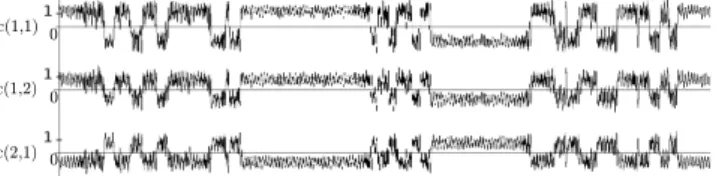
Three cells are connected as shown in Figure2. Figure3and 4shows a simulation result corresponding to Figure2. Chaotic phenomena are observed. Each cell oscillates in positive area or negative area. Additionally, these two oscillations are switching randomly. Switching phenomena occur almost same time. Cell α c(1,1) and Cell β c(1,2) oscillate same area.
c(1,1) c(1,2)
c(2,1)
c(1,1) c(1,2) c(2,1) c(1,1) c(1,2)
c(1,1) c(1,2)
c(2,1) c(2,1)
Fig. 2. Cells are connected in the case of three cells.
0
0
0 c(1,1)
c(1,2)
c(2,1)
Fig. 3. Waveforms in the case of three cells.k=−1.06,l=−1.07and m=−1.47.
Fig. 4. Chaotic phenomena in the case of three cells.Vertical axis is Cellα c(1,1)and horizontal axis is Cellβ c(1,2).
c(1,1) c(1,2) c(1,3)
c(2,1) c(2,2) c(2,3)
c(3,1) c(3,2) c(3,3)
c(4,1) c(4,2) c(4,3)
c(4,1) c(4,2) c(4,2) c(4,3)
c(1,1) c(1,2) c(1,2) c(1,3)
c(1,3)
c(2,3)
c(3,3)
c(4,3)
c(1,1)
c(2,1)
c(3,1)
c(4,1)
Fig. 5. Cells are connected in the case of twelve cells (M = 4,N = 3).
Cell γ c(2,1) oscillates different area. A double-scroll type attractor is observed in Figure 4. By changing parameter k, some periodic orbits, bifurcation phenomena and chaos are observed.
B. Twelve cells
In this case, two pattern are considerated as shown in Fig- ure5and 6. Figure7shows a simulation result corresponding to Figure 5. Cell α c(1,1) and Cell β c(1,2) oscillate same area. Cell γ c(1,3) oscillates different area. This phenomena is same as case of three cells. Cell α c(1,1), Cell β (1,2) and Cellγ c(1,3)is immobilized as one set. In this case, one set consists of one Cell α, one Cellβ and one Cellγ. These sets consist of same row cells. Namely, this case has four sets.
Each set does not concern each other.
Figure 8 shows a simulation result corresponding to Fig- ure6. This case has no set. Additionally, switching phenomena disappeared.
C. Eighteen cells
In this case two pattern considerated as shown in Figure 9 and 10. Figure11shows a simulation result corresponding to Figure 9. In this case, cells are immobilized as six sets. Sets which consists of same row cells are observed. Each set does not concern each other. This phenomena is same as case of twelve cells (M = 4,N = 3) .
Figure 12 shows a simulation result corresponding to Fig- ure 10. In this case, cells are immobilized as six sets. Sets
- 99 -
c(1,1) c(1,2) c(1,3)
c(2,1) c(2,2) c(2,3)
c(1,4) c(1,5) c(1,6)
c(2,4) c(2,5) c(2,6)
c(1,1) c(1,2) c(1,3) c(1,4) c(1,5) c(1,6)
c(2,2) c(2,3) c(2,4) c(2,5) c(2,6)
c(1,6)
c(2,6)
c(1,1)
c(2,1)
c(1,1) c(2,6) c(2,1)
Fig. 6. Cells are connected in the case of twelve cells (M = 2,N = 6).
c(1,1) c(1,2) c(1,3) c(2,1) c(2,2) c(2,3) c(3,1) c(3,2) c(3,3) c(4,1) c(4,2) c(4,3) 0
0
0 0
0
0
0 0
0
0 0
0
Fig. 7. Waveforms in the case of twelve cells(M = 4,N = 3).k=−1.06, l=−1.07andm=−1.47.
which consists of same column cells are observed. Each set does not concern each other.
D. twenty four cells
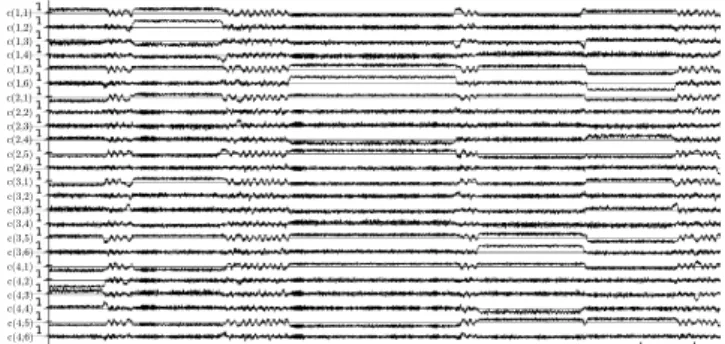
Twenty four cells are connected as shown in Figure13. Fig- ure14 shows a simulation result corresponding to Figure13.
In this case, there are no immobilized sets which are observed in cases of twelve (M = 4,N = 3), eighteen (M = 3,N = 6 ) and eighteen (M = 6,N = 3) cells. This case is observed clustering phenomena. We consider that Cellα c(1,1), Cellβ (1,3)and Cell γ c(4,5) have similar waveforms in rigth side of Figure 14. And Figure 14 shows that all cells switching occur almost same time.
E. Thirty six cells
Thirty six cells are connected as shown in Figure15. Fig- ure16 shows a simulation result corresponding to Figure15.
Each cells move separately. However, clustering phenomena are observed. Cell γ c(3,5) and Cell α c(3,6) have similar waveforms in centre area of Figure16.
F. Consideration
Computer simulation results show that observed phenomena can be divided into two phenomena by the structure as follows.
In cases of twelve ( M = 4,N = 3 ), eighteen ( M = 6, N = 3) and eighteen ( M = 3, N = 6), one set consists of one Cellα, one Cellβ and one Cellγ. Same row or column cells are immobilized. Namely, three cells of a set are coupled as a loop.
In cases of twelve ( M = 2, N = 6 ), twenty four ( M = 4, N = 6 ) and thirty-six ( M = 6, N = 6 ), the loop does not exist. Therefore, the set could not be observed and immobilized.
c(1,1) c(1,2) c(1,3) c(1,4) c(1,5) c(1,6) c(2,1) c(2,2) c(2,3) c(2,4) c(2,5) c(2,6) 0 0 0 0 0 0 0 0 0 0 0 0
Fig. 8. Waveforms in the case of twelve cells(M = 2,N = 6).k=−1.20, l=−1.30andm=−2.50.
c(1,1) c(1,2) c(1,3)
c(2,1) c(2,2) c(2,3)
c(3,1) c(3,2) c(3,3)
c(4,1) c(4,2) c(4,3)
c(5,1) c(5,2) c(5,3)
c(6,1) c(6,2) c(6,3)
c(1,1) c(1,2) c(1,3)
c(6,1) c(6,2) c(6,3) c(6,1)
c(1,3) c(1,3)
c(2,3)
c(3,3)
c(4,3)
c(5,3)
c(6,3) c(1,1)
c(2,1)
c(3,1)
c(4,1)
c(5,1)
c(6,1)
Fig. 9. Cells are connected in the case of eighteen cells (M = 6,N = 3).
We consider that existence of a loop which consists of Cell α, Cellβ and Cellγmakes oscillation sets.
IV. CONCLUSIONS
In this study, cellular neural networks using three kinds of cloning templates are investigated. Some computer simulations were carried out. In cases of twelve (M = 4,N = 3), eighteen (M = 6,N = 3) and eighteen (M = 3,N = 6) cases can be some sets which have a Cell α, Cellβ and Cellγ. However, these sets are disappeared in case of twelve ( M = 2, N = 6 ), twenty four and thirty six cells.
In the future work, twelve ( M = 2,N = 6 ), twenty four and thirty six cells are investigated in detail.
REFERENCES
[1] L. O. Chua and L. Yang, “Cellular Neural Networks: Theory,” IEEE Trans. Circuits Syst., vol. 35, no. 10, pp. 1257–1272, 1988.
c(1,1) c(1,2) c(1,3)
c(2,1) c(2,2) c(2,3)
c(3,1) c(3,2) c(3,3)
c(1,4) c(1,5) c(1,6)
c(2,4) c(2,5) c(2,6)
c(3,4) c(3,5) c(3,6)
c(1,1) c(1,2) c(1,3) c(1,4) c(1,5) c(1,6)
c(1,6)
c(3,1) c(3,2) c(3,3) c(3,4) c(3,5) c(3,6) c(3,1)
c(1,6)
c(2,6)
c(3,6)
c(1,1)
c(2,1)
c(3,1)
Fig. 10. Cells are connected in the case of eighteen cells (M = 3,N = 6 ).
- 100 -
c(1,1) c(1,2) c(1,3) c(2,1) c(2,2) c(2,3) c(3,1) c(3,2) c(3,3) c(4,1) c(4,2) c(4,3) c(5,1) c(5,2) c(5,3) c(6,1) c(6,2) c(6,3) 0 0 0 0 0 0 0 0 0 0 0 0 0 0 0 0 0 0
Fig. 11. Waveforms in the case of eighteen cells( M = 6, N = 3 ).
k=−1.06,l=−1.07andm=−1.47.
c(1,1) c(1,2) c(1,3) c(1,4) c(1,5) c(1,6) c(2,1) c(2,2) c(2,3) c(2,4) c(2,5) c(2,6) c(3,1) c(3,2) c(3,3) c(3,4) c(3,5) c(3,6) 00
0 0 0 0 0 0 0 0 0 0 0 0 0 0
0 0
Fig. 12. Waveforms in the case of eighteen cells( M = 3, N = 6 ).
k=−1.06,l=−1.07andm=−1.47.
c(1,1) c(1,2) c(1,3)
c(2,1) c(2,2) c(2,3)
c(3,1) c(3,2) c(3,3)
c(4,1) c(4,2) c(4,3)
c(1,4) c(1,5) c(1,6)
c(2,4) c(2,5) c(2,6)
c(3,4) c(3,5) c(3,6)
c(4,4) c(4,5) c(4,6)
c(1,2) c(1,3) c(1,4) c(1,5) c(1,6) c(1,1) c(1,2)
c(4,1) c(4,2) c(4,3) c(4,4) c(4,5)
c(4,5) c(4,6)
c(1,6)
c(2,6)
c(3,6)
c(4,6)
c(1,1)
c(2,1)
c(3,1)
c(4,1)
Fig. 13. Cells are connected in the case of twenty four cells (M = 4, N = 6).
c(1,1) c(1,2) c(1,3) c(1,4) c(1,5) c(1,6) c(2,1) c(2,2) c(2,3) c(2,4) c(2,5) c(2,6) c(3,1) c(3,2) c(3,3) c(3,4) c(3,5) c(3,6) c(4,1) c(4,2) c(4,3) c(4,4) c(4,5) c(4,6)
Fig. 14. Waveforms in the case of twenty four cells.k=−1.20,l=−1.25 andm=−2.50.
c(1,1) c(1,2) c(1,3)
c(2,1) c(2,2) c(2,3)
c(3,1) c(3,2) c(3,3)
c(4,1) c(4,2) c(4,3)
c(5,1) c(5,2) c(5,3)
c(6,1) c(6,2) c(6,3)
c(1,4) c(1,5) c(1,6)
c(2,4) c(2,5) c(2,6)
c(3,4) c(3,5) c(3,6)
c(4,4) c(4,5) c(4,6)
c(5,4) c(5,5) c(5,6)
c(6,4) c(6,5) c(6,6)
c(1,1) c(1,2) c(1,3) c(1,4) c(1,5) c(1,6)
c(1,6)
c(6,1) c(6,2) c(6,3) c(6,4) c(6,5) c(6,6) c(6,1)
c(1,1)
c(2,1)
c(3,1)
c(4,1)
c(5,1)
c(6,1) c(1,6)
c(2,6)
c(3,6)
c(4,6)
c(5,6)
c(6,6)
Fig. 15. Cells are connected in the case of thirty six cells (M = 6,N = 6 ).
c(1,1) c(1,2)
c(1,3) c(1,4)
c(1,5) c(1,6)
c(2,1) c(2,2)
c(2,3) c(2,4)
c(2,5) c(2,6)
c(3,1) c(3,2)
c(3,3) c(3,4)
c(3,5) c(3,6)
c(4,1) c(4,2)
c(4,3) c(4,4)
c(4,5) c(4,6)
c(5,1) c(5,2)
c(5,3) c(5,4)
c(5,5) c(5,6)
c(6,1) c(6,2)
c(6,3) c(6,4)
c(6,5) c(6,6)
Fig. 16. Waveforms in the case of thirty six cells.k=−1.26,l=−1.28 andm=−2.50.
[2] L. O. Chua and L. Yang, “Cellular Neural Networks: Applications,”IEEE Trans. Circuits Syst., vol. 35, no. 10, pp. 1273–1290, 1988.
[3] F. Zou, and J. A. Nossek, “Bifurcation and Chaos in Cellular Neural Networks,”IEEE Trans. Circuits Syst. I, vol. 40, no. 3, pp. 166–173, 1993.
[4] J. Fujii, Y. Hosokawa and Y. Nishio, “Wave Phenomena in Cellular Neural Networks Using Two Kinds of Template Sets,” Proc. of NOLTA’07, pp. 23–26, 2007.
[5] M. Tanaka, Y. Hosokawa and Y. Nishio, “Relationship between a Number of Cells and Phenomena in Cellular Neural Networks Using Three Kinds of Cloning Templates,”RISP Proc. NCSP’14, pp533–536, 2014.
- 101 -