• 検索結果がありません。

3 2 1 v v v 21 11 i 31 i i

N/A
N/A
Protected

Academic year: 2021

シェア "3 2 1 v v v 21 11 i 31 i i"

Copied!
1
0
0

読み込み中.... (全文を見る)

全文

(1)

令和元年度電気関係学会四国⽀部連合⼤会 講演論⽂集 (2019 新居浜⾼専) 2019 SHIKOKU-SECTION JOINT CONVENTION RECORD OF THE INSTITUTES OF ELECTRICAL AND RELATED ENGINEERS (NIIHAMA)

1-19

19

Comparison of Complexity of Chaos in Three Degrees of Freedom Chaotic Circuits

Naoto YONEMOTO Katsuya NAKABAI Yoko UWATE Yoshifumi NISHIO ( Tokushima University )

1. Introduction

In this study, we investigate comparison of the complex- ity of chaos generated in many degrees of freedom chaotic circuits. In the previous study, the circuit consists of two nonlinear subcircuits coupled by one linear negative resister has proposed [1]. We increase the number of connected sub- circuits from 2 to 3 in order to produce more complex chaos.

It leads to better effects when we applied such as improving the secrecy of chaotic communication.

2. System Model

The circuit model of the 3 degrees of freedom chaotic circuit is shown in Fig. 1.

Figure 1: Circuit model of the 3 degrees of freedom chaotic circuit.

The normalized circuit equations are described as follows.

⎧ ⎪

⎪ ⎪

⎪ ⎪

⎪ ⎪

⎪ ⎪

⎪ ⎪

⎪ ⎨

⎪ ⎪

⎪ ⎪

⎪ ⎪

⎪ ⎪

⎪ ⎪

⎪ ⎪

˙

x

1

= α(x

1

+ x

4

+ x

7

) − (x

2

+ x

3

)

˙ x

2

= x

1

˙

x

3

= β

1

(x

1

− f(x

3

))

˙

x

4

= αγ

1

(x

1

+ x

4

+ x

7

) − γ

1

(x

5

+ x

6

)

˙

x

5

= β

2

x

4

˙

x

6

= β

3

(x

4

− f(x

6

))

˙

x

7

= αγ

2

(x

1

+ x

4

+ x

7

) − γ

2

(x

8

+ x

9

)

˙

x

8

= β

4

x

7

˙

x

9

= β

5

(x

8

− f(x

9

))

(1)

The characteristic equation for the diode is described as follows

f(x) =

1

(x + ε − | x − ε | ). (2)

3. Results

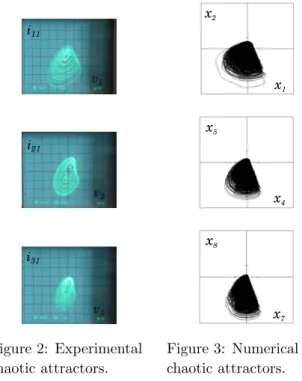
In this study, we change the number of Inaba’s circuit connected from 2 to 3. We show the experimental and com- puter simulation results of the 3 degrees of freedom chaotic circuit.

i

11

v

1

x

2

x

1

v

2

i

21

x

5

x

4

v

3

i

31

Figure 2: Experimental chaotic attractors.

x

8

x

7

Figure 3: Numerical chaotic attractors.

In the computer simulation, the circuit parameters are chosen as α = 0.3, β

1

= 10.0, β

2

= 2.0, β

3

= 20.0, β

4

= 3.0, β

5

= 30.0, γ

1

= 2.0, γ

2

= 3.0, and ε = 0.01. In this result, attractors are similar in shape, and become complicated.

In the circuit experiment, the circuit parameters are cho- sen as C

1

= 15[nF ], L

11

= 300[mH], L

12

= 30[mH], C

2

= 7.5[nF ], L

21

= 150[mH], L

22

= 15[mH], C

3

= 5[nF ], L

31

= 100[mH], and L

32

= 10[mH]. In this result, the newly connected circuit generates more complex chaotic at- tractor.

4. Conclusion

In this study, we have investigated comparison of the complexity of chaos generated in multiple Inaba’s circuit in series. The newly connected Inaba’s circuit makes it possible to observe more complicated chaotic attractors. As our future works, we will clearly evaluate the difference in complexity.

References

[1] Katunori SUZUKI, Yoshifumi NISHIO, and Shinsaku

MORI, “Twin Chaos - Simultaneous Oscillation of

Chaos -”, The Institute of Electronics, Information and

Communication Engineers (IEICE), vol. j79-A, No. 3,

pp. 813-819, Mar. 1996.

Figure 1: Circuit model of the 3 degrees of freedom chaotic circuit.

参照

関連したドキュメント

Part V proves that the functor cat : glCW −→ Flow from the category of glob- ular CW-complexes to that of flows induces an equivalence of categories from the localization glCW[ SH −1

In the literature it is usually studied in one of several different contexts, for example in the game of Wythoff Nim, in connection with Beatty sequences and with so-called

Chaudhuri, “An EOQ model with ramp type demand rate, time dependent deterioration rate, unit production cost and shortages,” European Journal of Operational Research, vol..

In the first section we introduce the main notations and notions, set up the problem of weak solutions of the initial-boundary value problem for gen- eralized Navier-Stokes

At the same time we should notice that problems of wave propagation in a nonlinear layer that is located between two semi-infinite linear or/and nonlinear media are much more

By virtue of Theorems 4.10 and 5.1, we see under the conditions of Theorem 6.1 that the initial value problem (1.4) and the Volterra integral equation (1.2) are equivalent in the

On the other hand, modeling nonlinear dynamics and chaos, with its origins in physics and applied mathematics, usually concerned with autonomous systems, very often

iv Relation 2.13 shows that to lowest order in the perturbation, the group of energy basis matrix elements of any observable A corresponding to a fixed energy difference E m − E n