三浦 洋先生の御逝去を悼む
当学会元会長,顧問でおられます 三浦 洋 先生が平成28年10月25日に逝去されました。享年96歳であり ました。
三浦先生は,昭和19年3月に東京帝国大学農学部農芸化学科を卒業,食糧庁食糧研究所に入所されて以来,
農林水産省食品総合研究所園芸部長,同省農林水産省技術会議事務局研究管理官,同省食品総合研究所所長 を経て,昭和56年4月に実践女子大学教授,平成元年には同大学家政学部長に就任,平成3年3月に同大学 を定年退職されました。政府機関の各種審議会の委員を務められるとともに,学術活動では(社)日本食品 工業学会(現(公社)日本食品科学工学会)会長(その後顧問),また,(社)菓子総合技術センター(現,
(一社)菓子・食品新素材技術センター)理事長,(財)日本醤油検査協会(現(一財)日本醤油技術センタ ー)理事長,(社)(現一社)日本果汁協会技術部会長の他,食品品質保持技術研究会会長,(公財)飯島記 念食品科学振興財団評議員会長等の各種食品産業の技術関連団体の要職を歴任されてきました。こうした経 歴は,先生の学術と産業の連携における造詣の深さによるものであり,常に学術研究とそれを活かす産業を 重視した証しでもあります。
本学会では理事として学会運営に参画していただき,平成4年には会長に御就任頂き,学会の発展に御尽 力頂きました。特に会員の加入促進にはことの他熱意を示されるとともにわが国の食品保藏科学研究分野の 発展に大きく貢献され,現在の学会の礎を築かれたのであります。
先生のお仕事は,農林水産省でのご研究で始まり,大学での人材育成,食品産業団体や食品産業センター へのご指導と,まさに産学官の各分野で大きなご功績を残されました。
特に果物を中心とした園芸産物の利用研究には特筆すべきものがあり,「果実とその加工」(1988,建帛 社)は当該分野のバイブルとして広く活用されております。先生は産業界の実状把握のため,時折地域に出 向いて視察や勉強を繰り返されていたというエピソードも伺っております。学会の理事会においても,とか く閉鎖的になりがちな雰囲気のなかで,常に改革や行動の重要性について発言され,的確でかつ厳しさを感 じさせられる一方で,懇親会場等では,ユーモアに富んだお話でその場を和ませ,いつも明るく盛り上げて 頂く貴重な先生であったことは,先生の人柄を如実に物語っているものと思います。顧問になられた後も学 会の大会に時折お顔を出されており,この度の訃報に接し残念極まりないところですが,今後の本会の行く 末を天国から温かく見守っていただくことを心から祈念し,謹んでご冥福をお祈り申し上げます。
(日本食品保蔵科学会会長 高井陸雄)
ご略歴
昭和19年3月 東京帝国大学農学部農芸化学科卒業 昭和25年9月 食糧庁食糧研究所入所
昭和42年6月 農林水産省食糧研究所 園芸食品部長
昭和44年4月 農林水産省農林水産技術会議事務局研究管理官 昭和47年12月 農林水産省食品総合研究所 企画連絡室長 昭和54年4月 農林水産省食品総合研究所 所長
昭和56年4月 実践女子大学家政学部教授
平成元年4月 実践女子大学家政学部長
平成3年3月 実践女子大学定年退職 実践女子大学名誉教授 平成28年10月25日 逝去 享年96歳
学術活動
平成2年〜3年 (社)日本食品工業会(現(公社)日本食品科学工学会)会長 平成4年〜28年 (公社)日本食品科学工学会(組織変更前も含む)顧問 平成元年〜4年 日本食品保藏科学会理事
平成4年〜9年 日本食品保藏科学会会長 平成9年〜28年 日本食品保藏科学会顧問
受賞
平成5年 (公社)日本食品科学工学会 功労賞 平成10年 日本食品保蔵科学会 小原哲二郎記念功績賞
(本追悼文のお写真は,先生の奥様であります三浦せい子様より提供されたものであります)
日本食品保蔵科学会誌
VOL.
4 3
NO.1
会 長 "井 陸雄 副 会 長 太田 英明 小宮山美弘 早坂 薫
編集委員長 太田 英明
編 集 委 員 稲熊 隆博 井上 茂孝 今堀 義洋 恩田 匠 竹永 章生
古庄 律 松田 茂樹 宮本 敬久
<報 文>
食品に利用する へしこ糠 の特性 ………(3)
/牧 慎也・滝本祐也・田中貴道 秋廣高志・鶴永陽子・松本敏一
<報 文>(英文)
品種比較に基づいた水ナス果実の品質並びに加工特性 ………(9)
/橘田浩二・松島さゆり・下川陽大 執行正義・板村裕之・山内直樹
<技術報告>
セイヨウカボチャのテクスチャーに及ぼす成分の近赤外分光法による非破壊評価………(17)
/鮫島陽人・満留克俊・!永太藏・桑鶴紀充
<技術報告>(英文)
衝撃によるブドウの脱粒を防止するための包装方法の提案………(23)
/北澤裕明・明石秀也・長谷川奈緒子・永田雅靖
<総 説>
分子間相互作用に基づく乳タンパク質の製パン性改良機序の解明………(29)
/岡 大貴
<情 報>
高度な衛生管理・品質管理基準を満たす開放型食品加工試作施設の設計と運用………(35)
/柚木崎千鶴子
<文献抄録>………(43)
<本会記事>………(44)
( 1 ) 1
Food Preservation Science
CONTENTS OF VOL. 4 3 NO. 1(2 0 1 7)
<Article>(Japanese)
Characteristics of Rice Bran after ‘Heshiko’ Processing MAKI Shinya, TAKIMOTO Yuya, TANAKA Takamichi,
AKIHIRO Takashi, TSURUNAGA Yoko and MATSUMOTO Toshikazu ………(3)
<Article>(English)
Characteristics of Quality and Processing of Mizu-nasu(Solanum melongena L.)
Eggplant Fruit Based on a Varietal Comparison
KITSUDA Koji, MATSUSHIMA Sayuri, SHIMOKAWA Akihiro,
SHIGYO Masayoshi, ITAMURA Hiroyuki and YAMAUCHI Naoki ………(9)
<Technical Report>(Japanese)
Nondestructive Determination of Components on Texture
of Squash Fruit(Cucurbuta maxima Duch.)using Near Infrared Spectroscopy SAMESHIMA Yoto, MITSUDOME Katsuyoshi,
TOKUNAGA Taizou and KUWAZURU Norimitsu ………(17)
<Technical Report>(English)
Proposal for an Efficient Packaging System for Preventing Shock-Induced Berry Drop in Grapes during Transportation and Handling
KITAZAWA Hiroaki, AKASHI Shuya, HASEGAWA Naoko and NAGATA Masayasu ……(23)
<Review>(Japanese)
Clarification of the Baking Quality Improved Mechanism of Milk Protein based on the Intermolecular Interaction
OKA Daiki ………(29)
<Information>(Japanese)
Architectural Plan and Operation of Open Laboratory
for Food Processing with High Hygiene and Quality Control
YUKIZAKI Chizuko ………(35)
2 ( 2 )
へしこ は山陰地方から北陸地方にかけての日本海 側での伝統発酵食品である。マサバに塩を振り,米ぬか を主成分として樽に漬け込み6か月以上発酵熟成させる と完成である。 へしこ の研究は食物史,製造方法,
発酵・熟成などがある1),2)。米糠の炭水化物を利用した 微生物の発酵作用により生成する有機酸とタンパク質分 解酵素の作用により生成する大量のペプチドや遊離アミ ノ酸が呈味に大きく寄与することが知られている3),4)。 へしこ の熱水抽出エキスには,血圧上昇を抑制する 作用5),血中コレステロール濃度を低下させる作用6)があ ることが示唆されている。
玄米を精米する過程において発生する 米糠 は玄米 重量の10%にあたる7)。 米糠 は白米を生産する際の副 産物であるが,皮脂腺賦活,紫外線吸収,酸化防止作用 をもつ医薬品として認められているγ-オリザノール,ラ ジカル消去能と活性酸素消去能を有するフェラル酸など 多くの機能性化合物を含んでおり,新たな工業的な利用 法の検討が行われている8)。
漬け込んだ へしこ糠 は有効利用されず,ほとんど 廃棄されている。 へしこ糠 を食してみると食味は非 常によいことから豊富な有機酸・遊離アミノ酸などが へしこ から浸出されていると考えられる。米糠に含
*1 〒940―2188 新潟県長岡市上富岡町1603―1
§ Corresponding author, E-mail : [email protected]
*2 〒669―6553 兵庫県美方郡香美町香住区三谷735
*3 〒690―8504 島根県松江市西川津町1060
*4 〒690―8504 島根県松江市西川津町1060
食品に利用する へしこ糠 の特性
牧 慎 也*1§・滝 本 祐 也*1・田 中 貴 道*2 秋 廣 高 志*3 ・鶴 永 陽 子*4・松 本 敏 一*3
*1 長岡技術科学大学技術研究院技術科学イノベーション専攻
*2 !トキワ
*3 島根大学生物資源科学部
*4 島根大学教育学部
Characteristics of Rice Bran after
‘Heshiko’
ProcessingMAKI Shinya
*1§, TAKIMOTO Yuya
*1, TANAKA Takamichi
*2,
AKIHIRO Takashi
*3, TSURUNAGA Yoko
*4and MATSUMOTO Toshikazu
*3*1 Department of Science of Technology Innovation, Nagaoka University of Technology, Nagaoka, Niigata 940−2188
*2 Tokiwa, Kami, Hyogo 669−6553
*3 Faculty of Life and Environment Science, Shimane University, Matsue, Shimane 690−8504
*4 Faculty of Education, Shimane University, Matsue, Shimane 690−8504
To determine the extractive components of ‘Heshiko’ rice bran, a kind of fermented seafood, flesh mackerel was pickled in rice bran mixture and then evaluated after six months of fermentation.
During the fermentation period, taurine and vitamin A were transferred from the mackerel into the rice bran since rice bran mixture does not have these compounds. Vitamin B levels in the ‘Heshiko’
rice bran increased, while vitamin E levels remained unchanged and were the same as compared to the rice bran mixture. Throughout the fermentation process, levels of most of the free amino acids were significantly increased. Notably, histidine was converted into histamine by microorganisms ; however, the histamine levels present in 'Heshiko’ rice bran were under the possible allergic reaction level threshold. The increased levels and profiles of organic acids and amino acids suggested that these components might contribute to the characteristic taste of 'Heshiko' rice bran.
(Received Jul. 4, 2016;Accepted Dec. 5, 2016)
Key words:mackerel in salted rice-bran paste(Heshiko), rice-bran, organic acid, free amino acid, vitamin へしこ,米糠,有機酸,遊離アミノ酸,ビタミン
日本食品保蔵科学会誌 VOL.43 NO.1 2017 〔報 文〕
( 3 ) 3
有しているビタミンなどの有効成分と へしこ から浸 出してきている様々な機能性成分が多く存在すると推察 される。 へしこ糠 から抽出された成分は血圧を下げ る効果があることが報告されているが9), へしこ糠 の 食品利用に関する報告は少ない。
本報では へしこ糠 をふりかけへの食品に利用する ことを想定し,水溶性ビタミン,脂溶性ビタミン,有機 酸,遊離アミノ酸の特性を明らかにした。
実 験 方 法
(1) へしこ の製造方法
サバ(Scomber scombrus)120匹を用いた。平均体長 は38$,平均重量は600&であった。サバから内臓,鰓 を除去し,水洗除去した。背開きにしたサバの全面に魚 体に対して重量比30%の食塩を撒布して,魚体重量の 30%の米糠を,魚体腹腔部詰め込み,魚体表面にも 米 糠 をまぶし7日間塩漬けした。70'容器に隙間のない ように敷き詰め, 米糠 を加え魚体を覆い,魚体と米 糠の層が交互に重なるようにして120匹を漬け込んだ。
魚体表面にまぶすときなどに使用した発酵開始前の試料 を 米糠 とし,重石をして兵庫県美方郡香美町で10か 月以上,発酵・熟成させた後,得られた へしこ糠 を 材料に用いた(Fig.1)。試料は各種分析を行うまで,冷 凍庫で凍結保存を行った。
(2)一般成分の分析
水分含量は5&の試料を105℃で5時間,常圧加熱乾 燥して,乾燥前後の重量の減少量から算出した。灰分は 5&の試料を105℃で5時間乾燥させた後,600℃で2時 間灰化し,試料を冷却し,残存物の重量から算出した。
タンパク質含量は0.5&の試料を用いてケルダール法に より,ケルダール窒素量(TKN)を測定し,窒素・タ ンパク質換算係数6.25を乗じて算出した。脂質含有量は
2.0&の試料にクロロホルム―メタノール混液(2:1=
v/v)を用いて脂質を抽出し,溶媒を留去させて残存物 の重量から算出した。
炭水化物含量はこれら成分の分析結果から差し引き法 により求めた4)。
(3)有機酸の分析
試料0.5&(FW)にMiliQ水5!を加えVortexにて5
分間撹拌した。pH9〜10に調製後,80℃,15分間加温 した。室温で冷却後,MiliQ水で10!にメスアップし,
遠心分離(10,000rpm,10min,4℃)した。上清をポ アサイズ0.45"セルロース混合エステルタイプメンブレ ンフィルター(アドバンテック東洋)でろ過後,20µ' を高速液体クロマトグラフィー(日立ハイテクノロジー 社 LaChrom Elite L―2000システム)により定量した。
陽イオン交換樹脂を充填したHPLCカラム(GL―C610H―
S,7.8―id×300―#,日立ハイテクノロジー社)を用い,
イオン排除モードで分離した。0.1%リン酸水溶液(和 光純薬 特級)を移動相として,0.5!/minの流量を用 い,210!の吸光度,カラム温度は55℃とした10)。
(4)水溶性ビタミンの分析
試料2&に,0.1N硫酸を加えた後,30分間,100℃で
加温した。30分後,50℃以下まで冷却した。4M酢酸ナ トリウム溶液を1!加え,pHを4.5に合わせた。50%酸 性ホスファターゼ(和光純薬 ビタミンB1・B2定量用)
を加え,恒温器にて40℃で5時間酵素処理を行った。酵 素処理後,MQ水で液量を50!に定容し,遠心分離(3,000 rpm,10℃,10分間)した9)。上清をポアサイズ0.45"
セルロース混合エステルタイプメンブレンフィルター
(アドバンテック東洋)でろ過後,20µ'を高速液体クロ マトグラフィー(日立ハイテクノロジー社 LaChrom Elite L-2000システム)により定量した。移動相は0.2%
リン酸(5mMヘキサンスルホン酸ナトリウム含有)を
A C
B
Fig. 1 Production of ‘Heshiko rice bran’
A: Fill the fish abdominal cavity with the rice bran mixture, as well as the fish’s surface.
B: The fish layers with rice bran have to overlap alternately.
C: The fermentation process takes place for more than 10 months at ambient temperature.
4 日本食品保蔵科学会誌 VOL.43 NO.1 2017 ( 4 )
A液とし,B液としてアセトニトリルを用い,グラジエ ント条件について0分ではB液5%とし,30分後にB液 が20%になるようにリニアグラジエントとした。カラム 温度は40℃とし,流 速 は0.4!/min,260!の 吸 光 度 か ら水溶性ビタミンを定量した11)。
(5)脂溶性ビタミンの分析
試料0.5%に1%NaCl水溶液を1!加えた。Vortexに
て1分間撹拌後,3%ピロガロール/エタノール溶液を 7!加え,次いで60%KOH(w/v)を1!加えた。70℃
の水浴中で30分間遠心管を加温し,10分ごとに撹拌した。
30分の加温後,速やかに室温まで水冷却し1%NaClを 15!,酢酸エチル―n―ヘキ サ ン 混 液(1:9,v/v)を 15!加え5分間Vortexした。遠心分離(10℃,2,000rpm で5分間)し,上層を回収した。下層にはさらに酢酸エ チル―n―ヘキサン混液を15!加え,同様に振とう抽出を 行った。さらにもう一度抽出を行い,計3回の抽出液を ナス型フラスコに集めた。抽出液をロータリーエヴァポ レーターで10分間溶媒留去し,残留物を5!のメタノー ルを加え溶解させた11)。上清をポアサイズ0.45"セルロ ース混合エステルタイプメンブレンフィルター(アドバ ンテック東洋)でろ過後,20µ&を高速液体クロマトグ ラフィー(日立ハイテクノロジー社 LaChrom Elite L
―2000システム)により定量した。HPLCカラム(LaChrom C184.6#―i.d.×250―# 日立ハイテクノロジー社)を用 いた。移動相はアセトニトリル:メタノール(60:40,
v/v)で,流速は1!/min,カラム温度は40℃とし,325
!(レチノール),265!(エルゴカルシフェロール,コ レカルシフェロール),280!(α-トコフェロール)の吸 光度から脂溶性ビタミンを定量した14)。
(6)遊離アミノ酸の分析
試料0.5%に,8%トリクロロ酢酸水溶液を5!加え た。Vortexにて10分間撹拌後,遠心分離(10,000rpm,20 min,4℃)した。上清をポアサイズ0.45"セルロース 混合エステルタイプメンブレンフィルター(アドバンテ ック東洋)でろ過後,1!の試料に対して0.5!のジエ チルエーテルを加え,Vortexにて10分間撹拌,遠心分 離(10,000rpm,20min,4℃)し た。上 清 を 取 り 除 き,0.5!のジエチルエーテルを加え,Vortexにて10分 間 撹 拌 後,遠 心 分 離(10,000rpm,20min,4℃)し た。
これを凍結乾燥後,200µ&の超純水に懸濁した。この前 処 理 済 み 試 料 をAccQ-Tag Ultra Derivatization Kit
(Waters社)を用いて誘導化し,超高速液体クロマトグ ラ フ ィ ー お よ び 質 量 分 析 器(UPLC-Xevo TQ MS, Waters社)を用いて分析を行った15)。
実験結果および考察
(1)一般成分分析
へしこ糠 の一般成分分析を行った(Table1)。日 本食品標準成分表16)によれば, 米糠 の一般成分は水 分 含 量10.3%,脂 質19.6%,タ ン パ ク 質10.7%,灰 分
7.9%,炭水化物48.8%とされている。 へしこ糠 の炭 水化物含量は 米糠 に比べて,8分の1の極めて低い 値を示した。 へしこ糠 の水分含量は57.9%であり,
米糠 と比較して5倍量含まれていた。発酵過程で魚 体水分が 米糠 に浸出してきたと示唆された。
(2)有機酸分析
有機酸分析を行った結果, へしこ糠 には,酒石酸,
n−吉草酸,イソ酪酸は含有していなかったが,リンゴ 酸,コハク酸は 米糠 含有量に比べると10倍量含有し ていた。クエン酸,酢酸および乳酸は 米糠 には含ま れていないが, へしこ糠 のみ含まれていることが示 された(Table2)。発酵過程で,乳酸菌が繁殖するこ とにより乳酸が増加したと考えられ,乳酸発酵も行われ ていることが示唆された4)。
(3)水溶性ビタミン分析
米糠 に豊富に含まれる水溶性ビタミンB1の分析を 行った結果, へしこ糠 では11.3$と 米糠 の4倍 多く含まれていることが示された(Fig.2)。 へしこ は乳酸菌の発酵によって得られる発酵食品の一つであり,
乳酸菌には水溶性ビタミンを生産する種が存在する17)。 小麦,野菜や香辛料などの植物とヨーグルトを用いてつ くられる発酵食品のタルハナでは乳酸菌や酵母菌などの 作用により,ビタミンB1,B2,ナイアシン,B6,葉酸が 増加する18)。 米糠 に含まれるビタミンB1に加え,発 酵過程の乳酸菌の働きによってビタミンB1が増加したこ とが推察された。偏食およびアルコール摂取量が多い傾 向にある食生活の人は,ビタミンB1不足のために脚気や Table 1 ‘Heshiko rice bran’ approximate composition
(g/100g F.W.)
‘Heshiko rice bran’
Moisture 57.9±0.8
Protein 8.3±0.5
Lipid 14.7±1.3
Ash 13.3±0.7
Carbohydrate 5.8±0.7 Mean±SE(n=3)
Table 2 Organic acid profile between ‘Heshiko rice bran’ and ‘rice bran’
(mg/100g F.W.)
organic acid ‘Heshiko rice bran’ ‘rice bran’
Lactic acid 2408.5±195.1 0 Acetic acid 146.32±4.9 0 Citric acid 324.0±9.6 0 Malic acid 1032.3±74.5 90.0±10.7 Succinic acid 2020.8±321.6 245.0±39.0 Mean±SE(n=3)
( 5 ) 〔報 文〕 へしこ糠 の特性 5
** *
* * *
**
(mg/100g F.W.)
(mg/100g F.W.) (mg/100g F.W.)(mg/100g F.W.)
(mg/100g F.W.)
(mg/100g F.W.)
A Vitamin A(Retinol) B Vitamin B₁(Thiamine)
D Histamine E GABA F Taurine
C Vitamin B₂(Riboflavin)
ʻHeshiko rice branʼ ʻrice branʼ ʻHeshiko rice branʼ ʻrice branʼ ʻHeshiko rice branʼ ʻrice branʼ
ʻHeshiko rice branʼ ʻrice branʼ ʻHeshiko rice branʼ ʻrice branʼ ʻHeshiko rice branʼ ʻrice branʼ 50
40 30 20 10 0
12 10 8 6 4 2 0
0.5 0.4 0.3 0.2 0.1 0
8 7 6 5 4 3 2 1 0
9 8 7 6 5 4 3 2 1 0
18 16 14 12 10 8 6 4 2 0
乳酸アシドーシスを発症することがある19)。
ビタミンB1をほとんど含有していない白米20)に へし こ糠 ふりかけをまぶして食べることにより,炭水化物 をエネルギーに変換するビタミンB1を摂取できる可能性 が示された。
(4)脂溶性ビタミン分析
米糠 にはビタミンA(レチノール)はほとんど含 まれていないが, へしこ糠 では40µg含まれているこ とが示された(Fig.2)。原料であるサバが熟成されてい くときに魚体に含まれているビタミンAが浸出してきた と考えられた。抗酸化機能をもつビタミンE(α-トコフ ェロール)を分析した結果, 米糠 に含まれている値
(2.0!/100")8),21)と へ し こ 糠 の 値(2.2!/100") の変化はほぼないことが示された。魚体に多く含まれて いるビタミンD(エルゴカルシフェロール:VD2,コレ カ ル シ フ ェ ロ ー ル:VD3)を 分 析 し た 結 果, へ し こ 糠 に含有されていないことが示された。
(5)遊離アミノ酸分析
へしこ糠 に浸出している遊離アミノ酸含有量の測 定を行った(Fig.3)。 へしこ を発酵させる過程にお いて,魚肉に含まれるうま味を有するアミノ酸であるGlu や,甘みを有するAlaなど22)が へしこ糠 で顕著に増 加していることから,魚肉からアミノ酸成分が へしこ 糠 に浸出してきたことにより, へしこ糠 の独特の 呈味に寄与していると考えられる。
へしこ糠 に浸出してきたヒスチジンが微生物によ
りヒスタミンに代謝され,アレルギー様食中毒を引き起 こす可能性があるか調べた。原料サバ魚体に含まれてい るヒスチジンは485!/100"であったが4),発酵終了時
(7か月後)の へしこ では12.2!/100"と減少する こ と が 報 告 さ れ て い る4)。魚 体 の 筋 肉 中 に 存 在 す る histidase(EC4.3.1.3)の作用により,発酵過程におい て,原料魚中のヒスチジンは減少し,魚肉の自己消化と 細菌の作用により様々なアミノ酸が増加すると報告され ている23),24)。 米糠 では0.7!/100"であったヒスチジ ンが,発酵工程終了時の へしこ糠 には3.3!/100"
浸出してきていたことが示された。
発酵過程中に へしこ糠 に浸出したヒスチジンはヒ スタミン生成菌によりヒスタミンになることが知られて いる24)。 米糠 ではヒスタミンは検出限界以下であり 含まれていない。発酵開始日が違った様々な へしこ 糠 を 測 定 し た 結 果,1.5!/100"(n=3)と ご く 少 量ヒスタミンを含有していたが,顕著な含有量の差異は 示さなかった。食品中のヒスタミンは,一般的には100
!/100"の量を超えると顔面,特に口の周りが赤くなり,
じんましん,頭痛,おう吐,下痢などの症状があらわれ るアレルギー様食中毒を引き起こすことが知られている が25),26), へしこ糠 にはアレルギー様食中毒を引き起 こす量のヒスタミンは含まれていないことが示された。
タウリンは魚介類,特に海産無脊椎動物に特に多量に 含まれている成分で,アミノ酸の一種である。カルボン 酸ではなくスルホン酸を分子内にもつため,タンパク質 Fig. 2 Free amino acid and vitamin levels between Heshiko rice bran’ and rice bran mixture’
Vertical bars indicate standard error(n=3) of means.“**” and “*” indicate a significant difference at P<0.05 andP<0.01 by Student’s t-test, respectively.
6 日本食品保蔵科学会誌 VOL.43 NO.1 2017 ( 6 )
(mg/100g F.W.)
ʻHeshiko rice branʼ ʻrice branʼ
50 40 30 20 10 0
Asp Glu Thr Ser Gly Ala Pro Val Met
Ile Leu Tyr Phe Lys Asn Cys Gln
の結合様式であるペプチド結合ができず,遊離のまま存 在している。タウリンは通常の抗酸化剤では消去されに くい次亜塩素酸などの活性酸素種の消去活性,あるいは 血圧やコレスレロールの低下作用が顕著であることが報 告されている27)。タウリンについて へしこ糠 と 米 糠 を比較した。 米糠 では検出限界以下であったが,
へしこ糠 では3.7"/100#タウリンが含くまれていた。
原料のマサバを発酵することにより へしこ糠 に浸出 してきたと考えられる。
遊離アミノ酸については,Asp,タウリンのように 米糠 には存在しない成分が浸出してきたように,
様々なアミノ酸も 米糠 の値に比べて,大きく増加し てきた。マサバのへしこ製造過程において,魚肉中の遊 離アミノ酸はGlu, Ilu, Lys, Asp, Alaの増加が著しく,
Phe, Val, Leu, Tyr, Glyも増加すると 報 告 さ れ て い る が4), へしこ糠 でも同様にAsp, Glu, Ala, Val, Leuな どの増加が顕著であった(Fig.3)。
へしこ 発酵過程において,乳酸などの有機酸が産 生されていることから,乳酸発酵などによりビタミンB1
が産生されていることが示唆された。魚肉より遊離した ビタミンA,アミノ酸,ペプチド,タウリンが浸出して きたと考えられ,食味がある へしこ糠 を食品として 利用できる可能性が示された。青魚でしばしば課題にな るヒスタミンについては,アレルギー様食中毒を引き起 こす量は へしこ糠 には含有されていないことが示さ れたが,注意する必要性はある。
ふりかけを試作したところ,市販されているふりかけ と同様の食味をもっていた。フリーズドライにより へ しこ糠 を乾燥することにより, 米糠 のもつ機能性 とへしこの機能性を併せもつ商品化も十分可能と考えら れる。今後はふりかけ工程の加工法を検討する必要性が ある。
謝 辞 本研究は平成25年度ひょうご農商工連携ファ ンド事業の研究助成によって行われた。
文 献
1)山本 巖:へしこ考(竹下印刷所,福井),pp.1〜
33(2005)
2)赤羽義章:サバの伝統食品(吉中禮二編:若狭のお さかな)(福井県立大学県民双書!,福井),pp.105
〜123(2007)
3)伊藤光史・赤羽義章:マサバへしこ一般成分ならび にエキス成分の比較,日本水産学会誌,65,878〜885
(1999)
4)伊藤光史・赤羽義章:マサバへしこ製造中の一般成 分 な ら び に エ キ ス 成 分 の 変 化,日 本 水 産 学 会 誌,
66,1051〜1058(2000)
5 ) ITOU, K. and AKAHANE, Y. : Antihypertensive effect of heshiko, a fermented mackerel product, on spontaneously hypertensive rats, Fish. Sci., 70, 1121〜1129(2004)
6 ) ITOU, K. and AKAHANE, Y. : Effect of extract from heshiko, a fermented mackerel product, on cholsterol metabolism in Wistar rats, Fish. Sci.,75, 241〜248(2009)
7)大坪研一:2.1米の形態(竹生新治郎監修:米の科 学)(朝倉書店,東京),pp.13〜18(1995)
8)谷口久次・橋本博之・細田朝夫・米谷 俊・築野卓 夫・安達修二:米糠含有成分の機能性とその向上,日 本食品科学工学会誌,59,301〜318(2012)
9) ITOU, K. : Hypotensive Effect of Rice Bran Discarded after Heshiko Processing, Food science and technology research,18, 99〜105(2012)
10)天川映子・大西和夫・西島基弘・坂井千三:高速液 Fig. 3 Free amino acid levels between ‘Heshiko rice bran’ and ‘rice bran mixture’
Vertical bars indicate standard error(n=3) of means.
( 7 ) 〔報 文〕 へしこ糠 の特性 7
体クロマトグラフィーによる食品中の有機酸分析法,
食衛誌,29,267〜272(1988)
11)ARELLA, F. , LAHELY, S. , BOURGUIGNON, J. B.
and HASSELMANN, C. : Liquid chromatographic determination of vitamins B1 and B2 in foods. A collaborative study, Food Chemistry, 56, 81〜86
(1996)
" " " ! "
12)VIDOVIC S., STOJANOVIC B., VELJKOVIC, J., PRAZIC-
" " "
ARSIC L., ROGLIC, G. and MANOJLOVIC D. : Simultaneous determination of some water-soluble vitamins and preservatives in multivitamin syrup by validated stability - indicating high - performance liquid chromatography method, Journal of Chromatography A,1202, 155〜162(2008)
13)氏家 隆・武山哲茂・近藤あゆみ・廣江玲子・森 光昭:酢酸エチル・ヘキサン抽出−HPLCによる食品 中トコフェロールの定量,ビタミン,65,393〜397
(1991)
14)LOPEZ-CERVANTES, J., SANCHEZ-MACHADO, D. I. and RIOS- VAZQUEZ, N. J. : High - performance liquid chromatography method for the simultaneous quantification of retinol, α - tocopherol, and cholesterol in shrimp waste hydrolysate, Journal of Chromatography A,1105, 135〜139(2006)
15)MATSUMOTO, T., AKIHIRO, T., MAKI, S., MOCHIDA, K., KITAGAWA, M., TANAKA, D., YAMAMOTO, S. and NIINO, T. : Genetic stability assessment of wasabi plant regenerated from long - term cryopreserved shoot tips using morphological, biochemical and molecular analysis, CryoLetters,34, 128〜36(2012)
16)文部科学省科学技術・学術審議会資源調査分科会:
7訂日本食品標準成分表(全国官報販売協同組合)
(2015)
17)上西寛司・瀬戸泰幸:乳酸菌の生理機能とその要因,
日本調理科学会誌,46,129〜133(2013)
18)CERTEL, M., ERBA!, M., USLU, M. K. and ERBA!,
M. O. : Effects of fermentation time and storage on the water-soluble vitamin contents of tarhana, Journal of the Science of Food and Agriculture,87, 1215〜1218(2007)
19)橋詰直孝:ビタミンB1欠乏症と血中ビタミンB1値の 標準化,Japanese Journal of Clinical Chemistry,26, 210〜214(1997)
20)HOUSTON, D. F., HOUSTON, D. F. and KOHLER, G. O. : Nutritional properties of rice(National Academy of Science, Washington D. C.), p. 17(1970)
21)春野涼子・赤羽義章・大泉 徹:マサバを原料とす るへしこ及びなれずしの製造過程における脂質酸化の 進行と抗酸化活性の変化,日本水産学会誌,77,674
〜681(2011)
22)村田道代・安藤正史・坂口守彦:魚肉の鮮度とおい しさ,日本食品科学工学会誌,42,462〜468(1995)
23) SHEWAN, J. M. and JONES, N. R. : Chemical changes occurring in cod muscle during chill storage and their possible use as pbjective indices of quality, J. Sci. Food Agric.,8, 491〜498(1957)
24)和田 俊・小泉千秋:いわし糠漬け製造工程中にお け る ヒ ス タ ミ ン の 消 長,日 水 誌,52,1035〜1038
(1986)
25) SAKAGUCHI, M. , MURATA, M. and KAWAI, A. : Changes in free amino acid contents in juvenile mackerel Scomber japonicus muscel during ice storage, Nippon Suisan Gakkaishi, 50, 323〜329
(1984)
26)KAN, K., USHIYAMA, H., SHINDO, T. and Saito, K. : Outbreak of histamine poisoning due to ingestion of broiled sardine, Tokyo Eiken Nenpo( Ann. Rep.
Tokyo)52, 163〜166(2001)
27)鈴木平光・和田 俊・三浦理代:水産食品栄養学−
基礎からヒトへ(技報堂出版,東京)(2004)
(平成28年7月4日受付,平成28年12月5日受理)
8 日本食品保蔵科学会誌 VOL.43 NO.1 2017 ( 8 )
Eggplant, a vegetable with a high annual consumption in Japan, has been designated as one of 14 major vegetables in Japan, and its production is promoted by the Ministry of Agriculture, Forestry and Fisheries of Japan. Eggplants, including ornamentals, have been bred and cultivated for more than 1,200 years across all areas of Japan. Several eggplant cultivars have been adapted for specific climatic environments in various regions. Therefore, unique cultivars of various shapes, e. g. , round, egg-shaped, oblong, long, and very long, and with various peel colors, such as purple, green, and white, have been cultivated1).
Mizu-nasu, which has been cultivated for at least 100 years in the Senshu region, Osaka Prefecture, Japan, has a round, purple fruit with a smooth and shiny peel. Most of the harvested fruit are used to
produce salted pickles, which are very popular throughout Japan. NAKAMURA et al.2) investigated differences in fruit characteristics among several Mizu-nasu strains. However, the quality characteristics of Mizu-nasu fruit in comparison with different varieties are not clear.
Eggplant fruits contain some principal nutrients, such as lipids and proteins, but abundant polyphenol compounds, such as anthocyanin and chlorogenic acid, which are known as functional components3). In addition to the functional effects, these compounds exhibit antimutagenic activity. In an analysis of 25 vegetables, AZUMA et al.4) found that antioxidative activity is higher in the extract of eggplant that in the extracts of other vegetables, except Jew’s mallow (Corchorus olitorius L. ) and perilla (Perilla ocymoides L.). Moreover, the contents of functional
§ Corresponding author, E-mail : [email protected]
Part of this paper was presented at the 62nd annual meeting of the Japan Association of Food Preservation Scientists, 2013.
Characteristics of Quality and Processing of Mizu-nasu
(Solanum melongena L.)Eggplant Fruit Based on a Varietal Comparison
KITSUDA Koji*1,*4, MATSUSHIMA Sayuri*2, SHIMOKAWA Akihiro*2, SHIGYO Masayoshi*2, ITAMURA Hiroyuki*3 and YAMAUCHI Naoki*2§
*1 The United Graduate School of Agricultural Science, Tottori University, 4−101 Koyama-Minami, Tottori 680−8553
*2 Faculty of Agriculture, Yamaguchi University, 1677−1 Yoshida, Yamaguchi 753−8515
*3 Faculty of Life and Environmental Science, Shimane University,1060Nishikawatsu-cho, Matsue, Shimane 690−8504
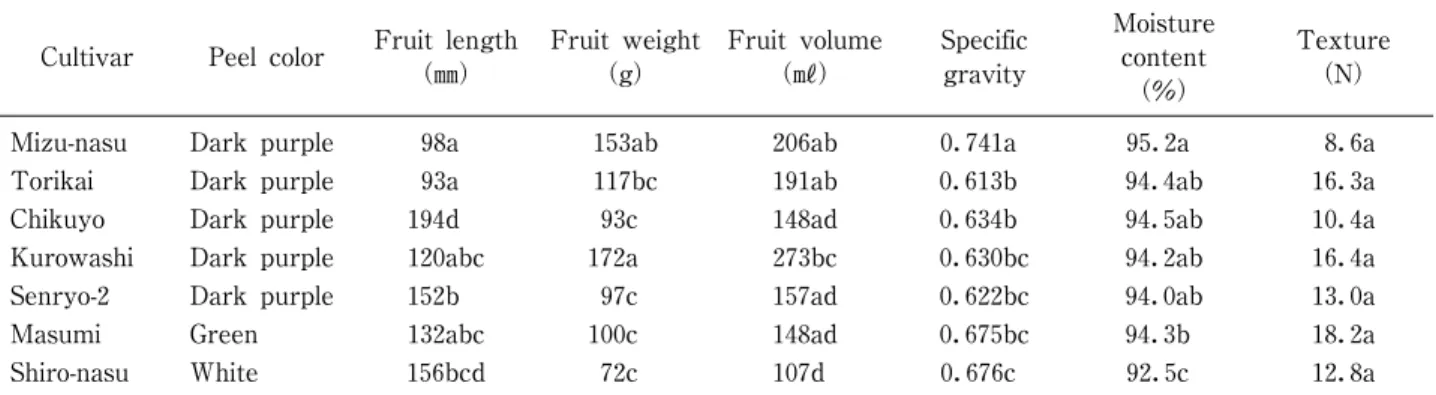
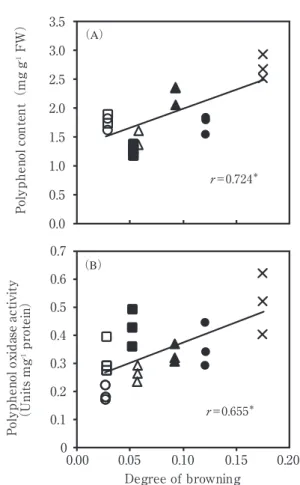
*4 Research Institute of Environment, Agriculture and Fisheries, Osaka Prefecture, 442 Shakudo, Habikino, Osaka 583−0862 Eggplant is a frequently eaten vegetable in Japan. A number of cultivars adapted for particular climatic environments have been developed in various regions of Japan. The Mizu-nasu eggplant, the fruit of which is mostly used to produce salted pickles, has been cultivated in the Senshu District in Osaka over time. We compared its chemical components with those of several cultivars ( Torikai, Chikuyo, Kurowashi, Senryo-2, Masumi, and Shiro-nasu)that vary in shape, appearance, and additional properties to clarify the quality characteristics of Mizu-nasu. Senryo-2, Chikuyo, and Kurowashi had higher anthocyanin contents than those of Mizu-nasu and Torikai. The peel of every cultivar contained chlorophyll ; however, the content was highest in Senryo-2. The polyphenol content in the peel was highest in Kurowashi. Polyphenol oxidase(PPO)activity was highest in Shiro-nasu and lowest in Mizu -nasu. In addition, the degree of browning was highest in Shiro-nasu and lowest in Mizu-nasu. These results indicate that Mizu-nasu fruit could be suitable for processing as salted pickles due to low levels of polyphenol and PPO activity as compared to the other cultivars.
(Received Sep. 5, 2016;Accepted Nov. 30, 2016)
Key words:eggplant, quality characteristics, polyphenol, polyphenol oxidase, browning ナス,品質特性,ポリフェノール,ポリフェノール酸化酵素,褐変
Food Preservation Science VOL.43 NO.1 2017 〔Article〕
( 9 ) 9
substances, including antioxidants, vary according to the cultivar and/ or growing season, especially the former. It is thought that the contents of functional substances could differ among eggplant cultivars.
In contrast, polyphenol compounds are known to cause browning when eggplant fruit is cut during processing5) or stored at a low temperature6). Polyphenol oxidase(PPO)and peroxidase, especially the former, are involved in the browning process.
Varietal differences in chlorogenic acid, a main polyphenol in eggplant fruit7), have been reported previously, but the relationships between polyphenol levels, PPO activity, and browning are not clear for eggplant cultivars. Accordingly, it is necessary to clarify the polyphenol compounds and PPO activity in the tissues of fruits that brown easily.
In this study, we compared several components of multiple eggplant varieties to clarify the quality characteristics of Mizu-nasu fruit. Varietal differences in the occurrence of browning during processing were also determined.
Materials and Methods
1.Plant materials
To harvest the fruits of seven cultivars in autumn, eggplant (Solanum melongena L. ) cultivars Mizu - nasu, Torikai, Chikuyo, Kurowashi, Senryo-2, Masumi, and Shiro-nasu were sown in horticultural medium on July 12, 2012. The seedlings were grown for 2 months and then transplanted in the field in a plastic-film greenhouse at the Research Institute of Environment, Agriculture and Fisheries, Osaka Prefecture, Japan. Slow-release fertilizer(N : P : K = 12:10:11)was applied to all plants. After anthesis, 300 #$−1 p- chlorophenoxyacetic acid was sprayed on each flower for parthenocarpy. Mizu-nasu fruit, which were grown to a marketable size in November, were harvested at 36 days after anthesis.
Likewise, Torikai was harvested at 29 days, Chikuyo at 38 days, Kurowashi at 41 days, Senryo-2 at 35 days, Masumi at 41 days, and Shiro-nasu at 36 days after anthesis. Additionally, to harvest eggplant fruit in the summer, Mizu-nasu was also cultivated from February to July, 2012 and harvested at 23 days after anthesis.
After harvesting, the length, weight, volume, moisture content, texture, and chemical components of fruit were measured. All analyses were performed using triplicate samples.
2. Assays of specific gravity, moisture content, and texture
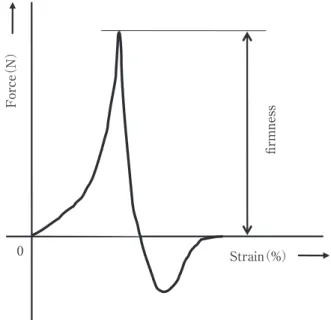
The specific gravity was measured as the ratio of the weight to the volume of each fruit. An aliquot of the fruit was dried in an air oven at 105℃ to determine the moisture content. The texture of the fruit peel was evaluated by the cylinder penetration test using a texturometer(Instron 5542). The peel tissue was laid on the stage, and then a crosshead equipped with a cylinder of 5 mm in diameter was operated at a rate of 20 mm min−1. The maximum force needed to penetrate the peel tissue was determined.
3.Anthocyanin assay
Fruit peels (2.5 g, 3 mm in thickness ) were placed in 20! of 5 % formic acid overnight and anthocyanin pigments were extracted. After extraction, the peel tissues were further homogenized with 5 % formic acid using a mortar and pestle. The extract was filtered through one layer of Miracloth(CALBIOCHEM), and the filtrate was centrifuged at 15,000 × g for 10 min. The anthocyanin content in the supernatant was determined spectrophotometrically at 525 ! using purified nasunin ( delphinidin-3-(p-coumaroylrutin- oside)-5-glucoside)as a standard.
To determine the major anthocyanin in the peel, the extract was filtered through a 0.45-" filter
( ADVANTEC ) and then analyzed by HPLC.
Anthocyanins were analyzed by HPLC using a Hitachi L-2130 pump with an automated gradient controller and a Hitachi L-2450 diode array detector.
Pigments were separated on a LiChrospher C18 column(Merck), 4 × 250 mm, using two solvents, i.
e., solvent A, methanol, and solvent B, 5 % formic acid(A : 15 %→60 % for 25 min), in a gradient.
The flow rate was 1.0 ! min−1, and the injection volume was 100µ$. The identification of anthocyanins was based on the retention time and the visible absorption spectra. Nasunin and commercially available delphinidin-3-rutinoside8) were used as standards.
4.Assays of polyphenol and chlorophyll
Peels, including flesh (3 mm in thickness ), or whole fruits were used for the polyphenol assay.
Each 2.5-g sample was dipped in 37.5! of 74 % ethanol in a water bath at 80℃ for 15 min, homogenized in 70 % ethanol, and filtered under reduced pressure. The extract was stored at −20℃
until analysis. The polyphenol content was 10 Food Preservation Science VOL.43 NO.1 2017 ( 10 )