§36 . Observation of High F requency Energetic Ion Driven MHO Instabilities in NBI - Heated Plasmas at Low Toroidal Field
Yamamoto, S. (Dep. Energy Eng. Science, Nagoya Univ.), Toi, K., Ohdachi, S., Nakajima, N ., Sakakibara, S., LHD Experimental Group
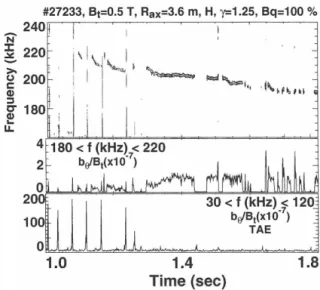
The energetic ion driven MHD instabilities, of which frequency is eight times higher than that of toroidicity induced Alfven eigenmode (TAE) gap, are newly observed in NBI heated plasmas of LHD at the low magnetic fields
(B[< 0.7 T). The temporal evolution of these modes is shown in Fig. 1, where hydrogen beams are injected into H plasma in the configuration of Rax =
3.6 m at B[ = 0.5 T. The coherent modes in the range of 180 - 220 kHz are observed after
t =1 s. The magnetic fluctuation amplitude reaches bel B[ - 10-
7at the probe position. The observed modes are identified to be n
=2 and propagate in the diamagnetic drift direction of energetic ion. These modes are thought to be Alfven eigenmode (AE), because the frequencies of these modes are scaled with the Alfven velocity
(v A)'The toroidal mode coupling related to 3D magnetic configuration leads to the generation of a new spectral gap, which is related to the helical field components. In this new gap, the helicity induced Alfven eigenmodes (HAEs) [1,2] can be excited. The frequencies of these modes are by 40 % lower than the predicted HAE gap frequency. However, the full width of the HAE gap is considerably wide (200 - 400 kHz in this case). The observed modes may be related to the HAEs.
We compare these observed frequencies at t = 0.8 s of
the plasma shown in Fig. 1 with the shear Alfven spectrum for the mode family N
f= 2 (Fig .2.), where the toroidal mode coupling among n = 2, 8, 12, ... .48, 52, (including 13 kinds of nand 919 modes), is taken into account. The HAE gap is well aligned from the plasma core toward the edge. Generation of new continua inside the HAE gap through toroidal mode coupling may be caused by the lack of helical symmetry of the field [3]. The solid line in Fig. 2 indicates the measured frequency of the magnetic fluctuations. The frequency lies inside the RAE gap at the plasma edge
(p -0.8) and intersects newly generated continua inside the HAE
gap . The profile of energetic ion pressure is predicted to
be flat because the Larmor radius of injected beam ion reaches up to about 10
%of plasma radius . Therefore, the gradient region of energetic ion pressure will be located near the plasma edge. The drive of the mode may be significantly large near the plasma edge. This mode is terminated by bursting TAEs, which are though to be excited in the plasma edge region. In conclusion , the observed high frequency modes are though to be HAEs.
40
#27233, Bt=O.5 T, Rax=3.6 m, H, 1-1.25, Bq=100 % 240.
1.4 Time (sec)
1.8
Fig. 1, The high frequency modes with n
=2 are observed in a NBI-heated plasma.
-
N:I: ~