Agricultural Irrigation in Ouagadougou, Burkina Faso
Introduction
1 Water Quality Control Department, National Institute for Land and Infrastructure Management, Japan
2 Division of Environmental Engineering, Faculty of Engineering, Hokkaido University, Japan.
Atsuko MICHINAKA1, Nowaki HIJIKATA2, Hiroyuki SHIGEMURA1, Ryota KAWASUMI1, Hiromasa YAMASHITA1, Eijiro TAKASHIMA1, MasahiroTAKAHASHI2
Vol. 1 (01) pp. 027-034, 2017 Sanitation Value Chain
Published by Research Institute for Humanity and Nature
Ouagadougou, the capital city of Burkina Faso, is located in dry savanna and the issue of water scarcity is of particular concern since water shortage affects the local economy. Treated wastewater from treatment plants can be reused for irrigation. Currently, stabilization ponds are widely used in Ouagadougou, however, the effluent could adversely affect crop production due to low water quality, especially during the dry season. Therefore advanced pond systems are required. This study focuses on wastewater management in urban areas, and discusses the application of high-rate algal ponds (HRAPs) to treated wastewater reuse for agricultural irrigation. Compared with conventional stabilization ponds, HRAPs indicated a lower risk of microbial pathogen contaminants in treated water and higher removal efficiency of nutrients from wastewater. When the effluent from stabilization ponds and HRAPs were used as irrigation water, the estimated yields of tomato production were expected to be 10,208 t and 17,488 t, respectively. Since HRAPs have the advantage of a significantly shorter HRT compared to stabilization ponds, evaporation loss is reduced. Thus, when introducing sewage treatment, it is necessary to consider not only the impact of effluent on the environment, but also the value of irrigation water.
Keywords: Irrigation; Grey Water; Sahel Africa; High Rate Algal Ponds
In Sub-Saharan Africa, cereal yields are extremely low; they are at least twice as low as those observed in South and Southeast Asia (Rockström et al. 2006), since the potential for irrigation expansion is limited by surface water and groundwater availability. Burkina Faso is a landlocked country located in Sub-Saharan Africa.
It has three major biomes. Sahel (northern region) has an annual precipitation of 400–600 mm and potential evapotranspiration of over 1,900 mm. Moist Guinea Savanna (southern region) has more than 1,000 mm of annual rainfall and potential evapotranspiration of 1,700 mm or less. Dry Savanna (central region) has an annual precipitation of 600–1,000 mm and evapotranspiration of 1,700–2,000 mm (UNEP 2010). Burkina Faso receives most of its rain between June and September (more than 500 mm), and this typically provides water for crops and livestock. In 2011, 80% of the country’s active population was engaged in agriculture, and the proportion of the total gross domestic product contributed by this sector was 33.8%. However, the rainfall in Burkina Faso has declined rapidly, and the 2000–2009 average was approximately 15% less than the average in 1920–1969 owing to a significant reduction in the number of rainy days between June and August during the rainy season (Lodou et al. 2013). The water shortage is rapidly becoming a critical concern as it affects the local economy, which
Abstract
1. Materials and Methods
is mainly based on agriculture. Water resource management to improve irrigation has important implications for hunger and poverty. Therefore, strategies to develop technologies such as water harvesting are required to improve and stabilize food crop production.
Stabilization ponds are widely used in developing countries for wastewater treatment owing to their simple construction and operation, cost effectiveness, and low maintenance and energy requirements. High-rate algal pond systems (HRAPs) have been developed as advanced integrated wastewater pond systems (Oswald 1995;
Green et al. 1996). Since, the systems have low investment and operation costs, and are simple management solutions for greywater, it has considerable potential to upgrade stabilization pond. HRAPs would be of great benefits due to less suspended sludge in effluent and rapid retention time.
This study focuses on wastewater management in Ouagadougou, an urban area in Burkina Faso, and discusses the application of HRAPs and the potential of treated wastewater reuse for agricultural irrigation.
Study site
Ouagadougou, located in a Dry Savanna region, is the capital and largest city of Burkina Faso, with a mean annual precipitation of 740 mm and daily temperatures reaching 40 °C or more in April, the hottest month of the year. The annual potential evapotranspiration in the city is estimated to be 2,080 mm (Wang et al. 2007).
Therefore, it has been experiencing water shortages. The National Water and Sanitation Office (L'Office national de l'eau et de l'assainissement; ONEA), a public sector and financially autonomous entity, manages sanitation services, including sewage and wastewater treatment, in urban areas. The wastewater treatment plants in Ouagadougou were designed for population equivalents of 140,000, and mainly utilize the lagoon system (stabilization pond).
The Kossodo wastewater treatment plant is in an industrial area and currently treats 5,400 m3/day of influent wastewater from domestic areas, hospitals, commercial, and industrial areas. Industrial influent from a brewery and a slaughterhouse represent 60% of the total influent. A conventional stabilization pond was installed as a wastewater treatment system, which consists of an anaerobic pond and a following maturation pond at the hydraulic retention time (HRT) of around 30 days. The new development district Ouaga 2000 is located south of the city centre, and commercial facilities and government buildings are currently being built in this area to promote urban development. Therefore, a plan has been developed to augment the treatment capacity of the Kossodo wastewater treatment plant (phase II) to 11,600 m3/day to account for the expected increase in influent.
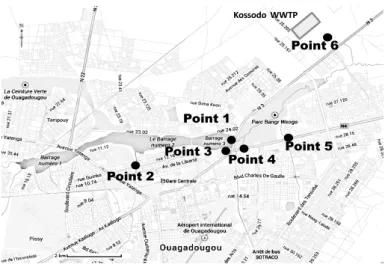
This study included a literature review and an interview with representatives at ONEA in April 2014. The water quality analysis of the treated water (effluent of the Kossodo wastewater treatment plant) and environmental water samples taken from Dam and river (Barrage) near the Kossodo wastewater treatment plant was performed.
The sampling sites are shown in Figure 1.
Electric conductivity (EC) and pH were measured by electrode method in a bucket of the sampling water on each sampling site. Samples for COD, total nitrogen (TN) and total phosphorus (TP) were collected with conical tubes from the bucket and stored in a freezer at -20°C. These parameters were measured with Hach test tube kits, which were reactor digestion method (Hach method 8000), persulfate digestion method (Hach method 10071) and PhosVer® 3 ascorbic acid method with acid persulfate digestion method (Hach method 8190), respectively.
These values were determined by DR2800 spectrophotometer (Hach) after heat digestion by DRB200 reactor (Hach).
2. Results and Discussion
Impacts of wastewater reuse for agriculture in urban area
Agrarian economies commonly raise concerns about the competition for water resources with other sectors.
In case of Burkina Faso, The competition between the agriculture sector (51% of total) and domestic water use (46%) is growing, according to Food and Agriculture Organization of United Nations. However, the treated urban wastewater could add to the total water available for irrigation without any competition from the domestic sector. Figure 2 shows the split between urban and rural populations in Burkina Faso as a percentage of the total population for the period 1960–2012. As reported by the World Bank, in 2012, the urban and rural population growth rates (annual %) were last measured at 5.99 and 1.71, respectively, which indicates a continuing trend of rapid urbanization. The amount of wastewater is expected to increase due to the increasing urbanization and the rising number of people with sewerage connections owing to the subsidies given in the connection fee (90% of total) by ONEA. Associated with rapid urbanization, “collected wastewater” is expected to become a potential resource through wastewater management and wastewater treatment system contributes to expand available irrigation area and its productivity.
Microbial pollution of wastewater treatment effluent
When used for irrigation, microbial pathogen contaminants in treated wastewater pose a health risk. Hamouri et al. (1994) indicated that the removal of each type of indicator bacteria tested during wastewater treatment High-rate algal pond system (HRAP)
A bench-scale HRAP reactor was developed to execute the operation of the pilot plant; it was implemented at the 2iE campus in Ouagadougou, and simulated greywater treatment under arid and semi-arid conditions (Derabe Maobe et al. 2011a, Derabe Maobe et al. 2011b). This system adopts a gravity sedimentation process to control the hydraulic retention time (HRT) and solid retention time (SRT) in a way that allows algae recirculation and high performance of solid-liquid separation. It is equipped with a sedimentation tank and a common screw mixer instead of paddle wheel mixers, which is specially manufactured in an industrial country, for introducing to developing countries. The HRAPs were evaluated in this study on the basis of the performance of the bench- scale HRAP reactor.
Point 1
Point 2 Point 3 Point 4 Point 5
Kossodo WWTP
Point 6
Figure 1. Sampling location at dam in Ouagadougou.
Table 1. The concentration of indicator bacteria at wastewater treatment plants during the dry season.
in the HRAPs system is over 90% (92% of total coliforms, 99.9% of fecal coliforms and 99.8% of fecal Streptococci). Takahashi et al. (2014) investigated the effect of disinfection on the removal pathogen bacteria and viruses using a bench-scale HRAP reactor, and more than 2 log units of Escherichia coli were removed within 2 days, and a 4-log reduction of viruses was observed within 3 days.
Microbial pollution of wastewater treatment effluent in the urban area of Ouagadougou (including at the Kossodo wastewater treatment plant) was estimated by Nitiema et al. (2013). Table 1 shows the concentration of E. coli in wastewater treatment plants and its predicted value for HRAPs treatment. Although the stabilization pond in the wastewater treatment process reduced indicator bacteria by 1 log unit, the concentration of E. coli in the maturation pond did not meet WHO standards or national guidelines recommend for wastewater use in agriculture (<1,000 CFU/100 mL ). Even though the application of HRAPs requires careful monitoring of indicator bacteria and viruses in Burkina Faso, it might reduce the concentration to less than 1,000 CFU/100 mL.
0 20 40 60 80 100
1960 1970 1980 1990 2000 2010
Population (% of total)
Year
Rural Urban
Figure 2. The percentage of urban and rural population in Burkina Faso from 1960 to 2012.
Predicted E. coli conc.
Anaerobic pond Maturation pond Discharge pond in HRAPb)
Kossodo 11200 0 3300 112
Abattoir 172000 6450 10400 1720
2iE 129200 22800 33400 1292
a) Nitiema et al. 2013
b) The values are estimates from Takahashi et al. 2014
Treatment plant Concentration of E. coli ( CFU/100mL )a)
Effect of HRAPs on nutrient removal
For the reuse of effluent from a wastewater treatment plant, based on an interview, ONEA identified a problem at the Kossodo wastewater treatment plant. Specifically, the quantity of treated water was related to crop
Table 2. The water quality of environmental water and the effluent from the Kossodo wastewater treatment plant.
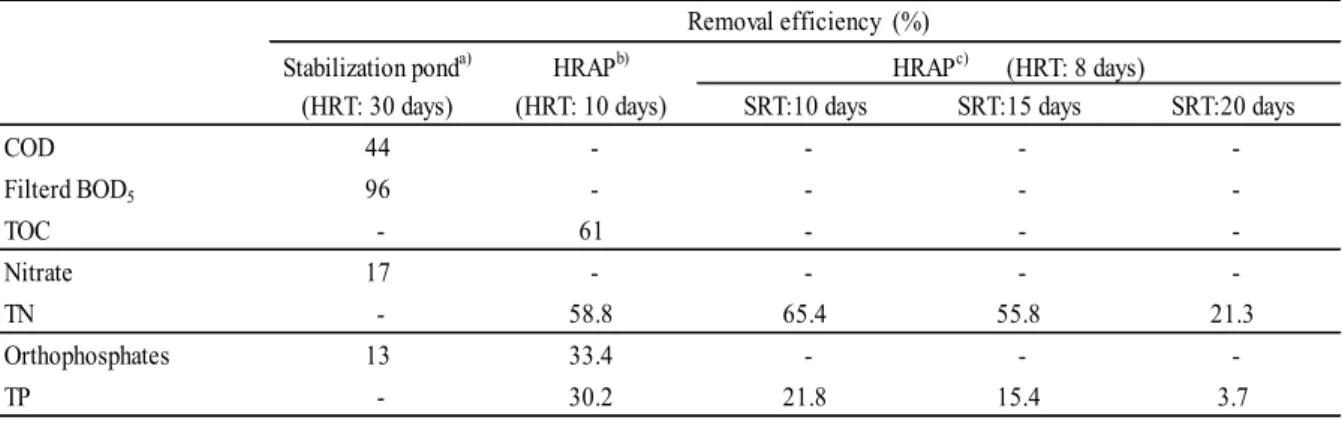
Table 3. Nutrient removal efficiency for a stabilization pond in Ouagadougou and a bench-scale HRAP reactor.
production because nutrient removal was not sufficient due to influent variability (consisting mostly of industrial wastewater) and the lack of industrial pre-treatment, especially during the dry season. The pH, electrical conductivity (EC), chemical oxygen demand (COD), total nitrogen (TN) and total phosphorus (TP) were measured in environmental water samples taken from dam near the Kossodo wastewater treatment plant (Figure 1), the result are summarized in Table 2. The concentrations of COD, TN, and TP in effluent from wastewater treatment plant (point 6) were significantly higher than the ones of in the environmental waters from dam and river (point 1, 2, 3, 4 and 5). Bassan and Strande (2011) reported water quality of the effluent from Kossodo wastewater treatment plant. The COD concentration in effluent was 128–346 mg/L (average, 254 mg/L), higher than the standard for discharge (<150 mg/L). Phosphorus and nitrogen were poorly removed. The nitrate and orthophosphate concentrations of nutrients in effluent were 0–7 mg/L (average, 2 mg/L) and 7–38 mg/L (average, 26 mg/L), respectively.
The carbon and nutrient removal efficiencies of the stabilization pond (Bassan and Strande 2011) and HRAPs are summarized in Table 3. The COD removal efficiency of the stabilization pond was low (44%), and the HRAPs had generally higher carbon and nutrient removal efficiency compared to the stabilization pond. The different the HRT and SRT condition in HRAPs were compared, and lower nutrient removal efficiency was observed in longer SRT (20 days).
While there is an advantage that available nutrients left in the effluent decreases irrigation costs due to less fertilizer usage, depending on the type of crop, the concentrations of carbon and nutrients influences crop production. For example, agricultural water standards for paddy rice irrigation established by the Ministry of
Range Mean Range Mean Range Mean Range Mean Range Mean
Point 1a) Dam lake 8.41-9.21 8.73 246-353 312 12-47 29 0.1-1.5 0.8 0.03-0.06 0.05
Point 2a) Drainage canal 8.57-9.21 8.96 446-916 702 42-76 59 1.9-10.8 6.4 0.11-0.16 0.13
Point 3a) Drainage canal 6.71-7.39 7.21 314-617 482 36-47 41 16.7-24.9 20.8 0.67-1.60 1.13
Point 4a) Main river 7.15-8.78 7.89 405-497 459 33-47 40 4.1-4.7 4.4 0.23-0.25 0.24
Point 5a) Drainage canal 6.81-8.14 7.47 281-496 338 42-53 48 8.0-10.7 9.4 0.41-0.60 0.50
Point 6b) WWTP effluent 8.21-8.54 8.38 1293-1852 1573 99-195 147 16.0-30.9 23.5 2.55-5.64 4.10
a) The enviromental water samples were corrected on July, September 2012 and April 2013. (N=3)
b) The effluent samples from Kossodo wastewater treatement plant were corrected on September 2012 and April 2013 (N=2)
pH EC (mS/cm) COD (mg/L) TN (N mg/L) TP (P mg/L)
Stabilization ponda) HRAPb)
(HRT: 30 days) (HRT: 10 days) SRT:10 days SRT:15 days SRT:20 days
COD 44 - - - -
Filterd BOD5 96 - - - -
TOC - 61 - - -
Nitrate 17 - - - -
TN - 58.8 65.4 55.8 21.3
Orthophosphates 13 33.4 - - -
TP - 30.2 21.8 15.4 3.7
a) Bassan and Strande, 2011 b) Derabe Maobe et al., 2014 c) Onodera et al., 2014
HRAPc) (HRT: 8 days) Removal efficiency (%)
Table 4. Water consumption and average yields.
Agriculture, Forestry and Fisheries in Japan recommend less than 1 mg/L of total nitrogen and 6 mg/L of COD because nitrogen and COD concentrations of irrigation water affects rice growth and yield. More than 3 mg/L of TN would cause a reduction in yield. A COD of 20 mg/L would be projected to result in a 10–12% reduction in yield. The excess nitrogen leads to a reduction in productivity of nitrogen sensitive plant by rank growth, such as soybean and paddy rice.
Therefore, the concentrations of carbon and nutrients in treated water must be considered for irrigation use.
HRAPs have advantage that it could reduce this effect by controlling HRT and SRT.
Water usage and potential amount of irrigation
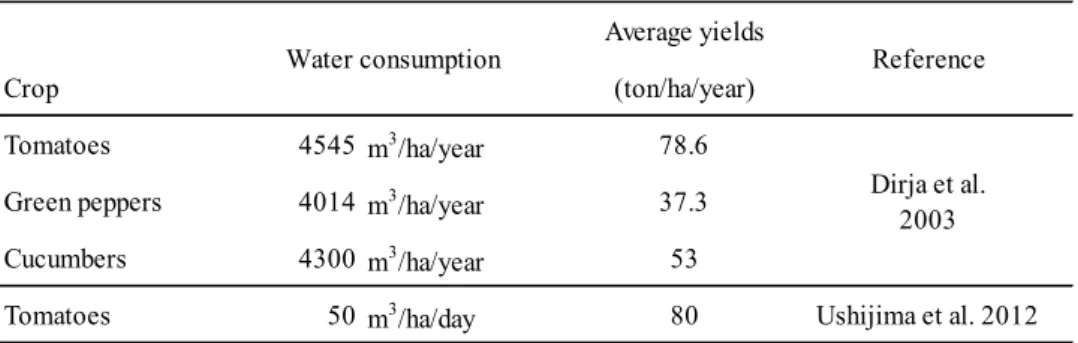
Dirja et al. (2003) has calculated the water quantity necessary to tomato, green pepper and cucumber based on agriculture experiment in 1999-2002, the irrigation water was administered by dripping using microsprinker.
Ushijima et al. (2012) has been reported tomato cultivation yield based on household survey in the rural area of Burkina Faso under the dry season. Estimated water consumption and average yields were summarized in
Table 5. Estimation of available water amount for irrigation from treatment plan and predicted tomatoes production yield.
Average yields
Crop (ton/ha/year)
Tomatoes 4545 m3/ha/year 78.6
Green peppers 4014 m3/ha/year 37.3
Cucumbers 4300 m3/ha/year 53
Tomatoes 50 m3/ha/day 80 Ushijima et al. 2012
Water consumption Reference
Dirja et al.
2003
Influent HRT Total volume
of pond Total
pond area
Amount of
evaporationa) Available water amount for irrigation
Available area for
irrigaionb) Predict tomato production yield
(m3/day) (day) (m3) (m2) (m3/day) (m3/day) (ha) (ton/year)
Stabilization pondc)
Current 5,400 30 162,000 95,789 553 0.55 2,970 59 4,752
Phase II 11,600 30 348,000 191,578 1,107 0.55 6,380 128 10,208
HRAPsd) 11,600 10 116,000 116,000 670 1.00 10,930 219 17,488
Decrease ratio
a) Annual evaporation is caluculated by 2080mm (Wang et al. 2007).
b) Water consumption is caluculated based on 5L/day/m2 . (Ushijima et al. 2012).
c) The plant capacity is calculated based on the data of the Kossodo treatment plant.
d) The depth of pond in HRAPs: 1 m.
Table 4. In case of tomatoes production, a recommended irrigating norm was 4,400-5,000 m3/ha/year or 50 m3/ ha/day, and average yield was 80 ton/ha/year in either case. Total pond area of stabilization pond was calculated by based on Kossodo wastewater treatment plant. In case of HRAPs, total pond area was calculated based on the allowable water depth (1 m) and the volume of treated wastewater. When it comes to water consumption rate in Burka Faso mentioned above, agricultural and domestic water use account for 51% and 46% of total, respectively. Given the value of sewage water equal to domestic water, it is estimated that the amount of agricultural water is 1.1 times as much as sewage water. Based on the water quality of the effluent from the stabilization pond, such as the concentration of E. coli described above, we hypothesize that the effluent is needs to be diluted 3-fold with agricultural water before use. Hence, the decrease factor was considered as 0.55 in the estimation. Available water amount of irrigations were estimated in Table 5. In the result of estimated tomatoes
References
Bassan, M. and Strande, S. 2011. Capacity strengthening in sanitation: benefits of long-tern collaboration with a utility and research institute. Proceedings of the 35th WEDC International Conference, 2011; 1-8.
Derabe Maobe, H., Satoh, M. and Takahashi, M. 2011a. Development of High Rate Settleable Algae Pond (HRSAP) for Gray Water Treatment and Resource Recovery in the Sahel. Proceedings of the 48th Sewage Res. Conference, Japan, 2011; 70-72.
Derabe Maobe, H., Satoh, M., Shimoda, K., Hashimoto, Y. and Takahashi, M. 2011b. Treatment of Domestic Wastewater by Involving High Rate Algal Pond (Hrap) and Performing Solid-Liquid Separation. Proceedings of the 45th Annual Conference of Japan Society on Water Environment, 2011; 185.
Derabe Maobe, H., Onodera, M., Takahashi, M., Satoh, H. and Fukazawa, T. 2014. Control of algal production in a high rate algal pond: investigation through batch and continuous experiments. Water Sci Technol. 69(12):
2519-2525. doi: 10.2166/wst. 2014. 174.
Dirja, M., Budid, V., Pacurar, I. and Jurian, M. 2003. Research regarding the Water Consumption of Tomatoes, Green Pepper and Cucumbers Cultivated in Solariums. Journal of Central European Agriculture 4(3): 265- 273.
Food and Agriculture Organization of United Nations Open Data AQUASTAT: FAO's global water information system. http://www.fao.org/nr/water/aquastat/main/index.stm. (Accessed May 28, 2014).
Green, F. B., Bernstone, L., Lundquist, T. J. and Oswald, W. J. 1996. Advanced Integrated Wastewater Pond Systems for Nitrogen Removal. Water Sci. Technol. 33(7): 207-217. doi: 10.1016/0273-1223 (96) 00356-3.
Hamouri, B. E., Khallayoune, K., Bouzouba, K., Rhallabi, N. and Chalabi, M. 1994. High rate algal pond performances in faecal coliforms and helminth egg removals. Water Res. 28:171-174. doi: 10.1016/0043- 1354(94)90131-7.
Lodoun, T., Giannini, A., Traore, P. S., Some, L., Sanon, M., Vaksmann, M. and Milloge Rasolodilby, J. 2013.
Acknowledgements
This work was supported by Science and Technology Research Partnership for Sustainable Development (SATREPS), Japan Science and Technology Agency (JST), and Japan Intertnational Cooperatin Agency (JICA).
It is clear that water usage will increase due to new public and commercial facilities and residences at urban area in Burkina Faso, and the urban sewage system is a valid water source for irrigation. While, water discharged from these large-scale facilities are expected to contain high concentrations of carbon and nutrients.
Therefore, sewer systems, which will grow in the future, must be considered to apply the technologies with the higher removal efficiency than conventional lagoon systems. HRAPs may assist the treatment of wastewater and its reuse in irrigation, and it is strongly required by using pilot plant to demonstrate the validity and estimate practical applicability.
Conclusion
production yield in case of phase II (influent of treatment plant: 11,600 m3/day), stabilization pond and HRAPs would be expected 10,208 t and 17,488 t, respectively. Rapid retention time of HRAPs has contributed to the increase in production due to less water loss by evaporation not only water quality of effluent.
Changes in seasonal descriptors of precipitation in Burkina Faso associated with late 20th century drought and recovery in West Africa. Env. Development 5: 96-108.
Nitiema, L. W., Boubacar, S., Dramane, Z., Kabore, A., Noël, P. J., Traoré, A. S. and Dianou, D. 2013. Microbial Quality of Wastewater Used in Urban Truck Farming and Health Risks Issues in Developing Countries: Case Study of Ouagadougou in Burkina Faso. Journal of Environmental Protection 4(6): 575-584. doi: 10.4236/
jep.2013.46067.
Oswald, W. J. 1995. Ponds in the Twenty-First Century. Water Sci. Technol. 31(12): 1-8. doi: 10.1016/0273- 1223(95)00487-8.
Onodera, M., Takahashi, M., Satoh, H. and Fukazawa, T. 2014. Control of suspended sludge and nutrient concentration in treated water form a high rate algal ponds (HRAPs) by SRT for applying to Africa Sahel region. Proceedings of the 50th Sewage Res. Conference, 2014; 103-105 (in Japanese).
Rockström, J., Lannerstad, M. and Falkenmark, M. 2006. Assessing the water challenge of a new green revolution in developing countries. Proceeding of the National Academy of Sciences of the United States of America 104 (15): 6253-6260. doi: 10.1073/pnas.0605739104.
Takahashi, M., Derabe Maobe, H., Onodera, M., Satoh, H. and Fukazawa, T. 2014. Disinfect and Removal of Pathogen in High Rate Algal Pond with Algal Recirculation. Proceeding of the Africa Water 2014, Ouagadougou, Burkina Faso.
UNEP, n.d., Ouagadougou. Environmental Change Hotspots. Division of Early Warning and Assessment (DEWA). United Nations Environment Programme (UNEP). http://na.unep.net/atlas/webatlas.php?id=2268.
(Accessed May 28, 2014).
Ushijima, K., Hijikata, N., Ito, R. and Funamizu, N. 2012. Effect Estimation of Dry-Toilet Application for Rural Farmer Family in Burkina Faso. Journal of Arid Land Studies 22-1: 99 -102.
Wang, Y., Traore, S. and Kerh, T. 2007. Determination of a Reference Model for Estimating Evapotranspiration in Burkina Faso. Proceedings of the 6th WSEAS Int. Conf. on Artificial Intelligence; 211-216.
World Bank Open Data: free and open access to data about development in countries around the globe. http://
data.worldbank.org/country/burkina-faso. (Accessed May 28, 2014).