The History of the First Tibetan Texts Acquired by the St. Petersburg Academy
of Sciences in the 18
thCentury
Alexander Zorin
国際仏教学大学院大学研究紀要
第 19 号(平成 27 年) for Postgraduate Buddhist Studies Vol. XIX, 2015
The History of the First Tibetan Texts Acquired by the St. Petersburg Academy
of Sciences in the 18
thCentury
*Alexander Zorin
Two years ago, the legendary collection of Tibetan book leaves brought to St. Petersburg from deserted Buddhist monasteries in South Siberia in the first third of the 18thcentury was refound at the Institute of OrientalManuscripts of the Russian Academy of Sciences. The present paper offers a new look at the history of their acquisition based upon carefulexamination of archivaldocuments and personalwitnesses from the 18thcentury. Thus, I argue that the first Tibetan texts were brought to St.
Petersburg from the so-called Sem Palat monastery in ca. 1718 before the large library at Ablaikit monastery was found in 1721 and its 6 leaves were delivered to Peter the Great and then were brought to London and Paris. In 1734, about 1,500 leaves from Ablaikit were sent by G. Müller and J. Gmelin to the ImperialAcademy of Sciences, the major part of them being in Mongolian. Their consequent “life” in the library of the Academy of Sciences and then the Asiatic Museum, now the IOM RAS, is outlined, too.
Keywords: the first Tibetan texts in Europe, Russian exploration of Siberia, Sem Palat, Ablaikit, John Bell, Daniel Messerschmidt, Gerhard Müller, Johann Gmelin, collections of the St. Petersburg Academy of Sciences
The story of Tibetan and Mongolian texts brought to St. Petersburg
*The study was supported by the Russian Foundation for Basic Research, Project No. 14-06-00460.
and some places in West Europe from at least three deserted Buddhist monasteries in South Siberia during the first third of the 18th century is surely one of the major points in the early history of European Tibetology (Proto-Tibetology to use the term suggested by Hartmut Walravens1).
More or less detailed reference to it can be found in many publications but, strangely enough, its scope has narrowed to rather a short version to such an extent that one of the monasteries where the texts were found (Sem Palat) was cut out and its library virtually passed to another one found last of all three (Ablaikit2) while the one found first (a temple on the Khemchik river) is almost never mentioned though one of its folios was probably the second published Tibetan folio in Europe. The true story in its fullness remains a bit dim but the carefulexamination of few early witnesses put against the historical background allows us to present an account of events as follows from the historical sources and not from the established academic tradition shared so far by both Russian and foreign authors. This tradition goes, perhaps, from the librarian Johann V. Bacmeister (1732- 1788) who, in his 1779 survey of the Library of the St. Petersburg Academy of Sciences, wrote that it was “abundantly supplied with Tangut and Mongolian scriptures written by gold, silver and ink… A lot of designated scriptures were sent from Siberia in 1720, there they were found in ancient temple Ablainkied.”3It was maintained by early Soviet classics of Oriental studies such as Boris Ya. Vladimirtsov (1884-1931) and Andrei I.
Vostrikov (1902-1937) whose authority was solid enough for the later Soviet scholars and, even more, by Ekaterina A. Knyazhetskaya (1900-
1 WALRAVENS2008, 150.
2 I use this corrupted form of the name following the long-established European tradition although in Russian papers a more correct formАблaŭ-xuĩ, or evenАблaŭ- xuŭ哀would be used, e.g. ALEKSEEV ET AL. 2014. The more correct English writing of the name of the monastery would be Ablai Keyid (it is used in ALEKSEEV ET AL. 2015).
3 BACMEISTER1776: 122. The English quotation is borrowed from POPOVA2007, 127.
1986) who was sure that she managed to find some archivaldocuments to prove the entire Ablaikit story and point at the particular discoverer of the monastery and its library, major Ivan Likharev. While she did find some very important documents her analysis of them turned out to be largely false as was shown by Vadim B. Borodaev, Barnaul University, partly in one of his papers4but, on a much bigger scale, in private correspondence with me (from October to November, 2014) and so his vision of the situation influenced significantly the results of this study. The great role was played also by the late 19th century editionSibirskie drevnosti by Vasily V. Radlov (1837-1918) who compiled and translated into Russian a number of sources relevant to our subject.5Somehow, Radlovʼs edition was not used in full by scholars who wrote about ʻthe Ablaikit storyʼ although E.A. Knyazhetskaya cited a selected portion from there that fitted her conception.6
4 BORODAEV2011.
5 RADLOV1888-1894. The sources concerning our theme include fragments from the works by Messerschmidt (RADLOV1888, app. 9-19); Weber, Strahlenberg, Bell (RADLOV1891, app. 23-52); Müller & Gmelin, Witsen (RADLOV1894, app. 55-134).
6 Knyazhetskaya referred to one of the three parts of Radlovʼs edition (Radlov 1891) with excerpts from Strahlenberg and Bellʼs books (KNYAZHETSKAYA1989, 18).
We can only guess why she totally ignored Bellʼs description of the Sem Palat library. Later on in her paper, she claims that this “wrong” identification of Sem Palat as a place of discovery of various antiquities and writings can only be found in Jacob Stählinʼs (1709-1785) book on the life of Peter the Great discarded by her as full of mistakes (IBID., 30) although he rendered the story as allegedly told him by J.
Schumacher (STÄHLIN1785, 160)(see also WALRAVENS2008, 151). Whatever dubious Stählinʼs words may be she only used this argument to prove “falseness” of the reference to Semipalatinsk as a place of the discovery of the antiquities which is put under the drawings made from two of them by painters Andrei Polyakov (on March 11, 1736) and Frans Bernz (undated)(KNYAZHETSKAYA 1989, 29-30). These two belonged to the set of nine figures offered by the Siberian Governor, Prince Matvey Gagarin (1659?-1721) to Peter the Great who ordered to make drawings from them and so this earlier set of pictures was secured by Schumacher to the French scholar
Practicalimportance of the re-considering of the history of the first Tibetan and Mongolian texts in Europe is proved with an explosion of new discoveries of the separate leaves in West Europe and in St. Petersburg, the place where the bulk of them was said to be brought to. It suffices to mention that one of the most famous Tibetan leaves ever in the history used to belong to the St. Petersburg collection. It got all-European fame thanks to curiosity of the Russian Emperor Peter the Great (1672-1725) who ordered his librarian Johann D. Schumacher (1690-1761) to show some of the found folios to any European experts in exotic writings and languages who could identify the language and translate the text. This way it attracted much interest of severaldistinguished scholars who tried to translate it up to the early 19thcentury when the task was fulfilled, for the first time quite successfully, by Sándor Csoma de Kőrös (1784-1842).7After the end of this discussion and due to the fast development of Tibetology as an established academic discipline the Ablaikit leaves turned into a matter of simple historical curiosity and did not attract much interest up to the last quarter of the 20th century when some of them were found in Linköping (Sweden), Wolfenbüttel (Germany), and London.8In the new millennium, some more German acquisitions were edited and now, as if proving the existence of certainzeitgeist, the vastest Tibetan and Mongolian collections
Bernard de Montfaucon (1655-1741) who published them along with Schumacherʼs short introduction (MONTFAUCON 1724, 152-154). Some of the figures were first described by Friedrich Ch. Weber (16??-1739)(WEBER1721, 124). But it is known that already the Dutch scholar Nicolaes Witsen (1641-1717) obtained a number of artefacts found in the South Siberian burialsites and sent to him in the early 18th century (GEBHARD1882, 303-455).
7 CSOMA 1832. For some reasons his contribution remained unknown for the Russian (or, at least, late Soviet) scholars and even an attempt of an identification and translation of the already identified and translated text was made (VOROBYOVA- DESYATOVSKAYA1989).
8 HEISSIG1979; ROHNSTRÖM1971; AALTO1996.
of the folios from South Siberia were separately refound by the author of this paper and Natalia V. Yampolskaya in St. Petersburg, at the Institute of OrientalManuscripts (IOM), RAS, that inherited the huge Tibetan and Mongolian collections gathered over time at the Asiatic Museum (AM, founded 1818). The study of Mongolian folios can be crucial for the better understanding of how the Buddhist canon in Mongolian was formed during the 17thcentury.9 The Tibetan folios are of similar importance since the ones brought from Ablaikit seem to represent an unknown manuscript version of the Tibetan Buddhist canon.10
The Tibetan and Mongolian leaves from South Siberia share almost the same history in their “European life”, hence the following historical account is basically true to both of them, but this paper is focused on the Tibetan folios. Their story consists of five main parts such as -
1. The initialdiscovery of texts in three deserted monasteries, their delivery to St. Petersburg and West Europe, from 1717 to late 1720s. I argue that the first texts sent to St. Petersburg were the blue leaves with golden writings from Sem Palat (ca. 1718), next, six folios with dark violet margins from Ablaikit were sent to Peter the Great in 1721 (one of them was later sent to Paris while the other five were probably left in London by J. Schumacher) and finally a few texts including some manuscripts from the Khemchik river (found in 1717) were brought to St. Petersburg, by DanielG. Messerschmidt (1685-1735), and Sweden, by Philip J. von
9 The project is carried out by the group of St. Petersburg Mongolists - Kirill V.
Alekseev, Anna A. Turanskaya, Natalia V. Yampolskaya. The first results of analysis of the IOM refound Mongolian leaves obtained from South Siberia in their relation to other 17th century fragments of Mongolian Kanjur are presented in ALEKSEEV ET AL. 2014. I am grateful to these colleagues and another St. Petersburg Mongolist, Natalia S. Yakhontova, for sharing some valuable remarks and important materials related to this study.
10HELMAN-WAŻNY ET AL. forthcoming.
Strahlenberg (1676-1747). Thus, the theory that the first texts were brought to St. Petersburg from Ablaikit by major I. Likharev in 1720, maintained by E. Knyazhetskaya and repeated in many papers up to 2015,11 must be denied.
2. The dispatch of manuscripts and various artefacts from Sem Palat and Ablaikit to St. Petersburg by Gerhard F. Müller (1705-1783) and Johann F. Gmelin (1709-1755) in 1734. Some of the objects were destroyed or damaged during the fire at the Kunstkamera in late 1747.
3. The cataloguing of Tibetan and Mongolian books at the library of the St. Petersburg Academy of Sciences and, later, the AM from 1788 to 1847.
The leaves from Ablaikit were just very briefly mentioned in the list of texts compiled.
4. The Soviet time: from an attempt to catalogue the first Tibetan texts from Siberia to their dissemination within the huge Tibetan collection of the then Institute of OrientalStudies (now the IOM RAS).
5. Their rediscovery in early 2010s.
The first stage is most controversialand its analysis is better to be divided into two sections - 1) the first discovery of Tibetan texts in Sem Palat and near the Khemchik river, 2) the discovery of Ablaikit and the first appearance of its manuscripts in St. Petersburg and West Europe. The second stage is also of major importance so it will be analyzed in a separate section while the last three stages can be covered in one section.
The text is full of details so I preferred not to give any additional extensive comments on the figures of the Russian history and history of Tibetology in Europe that are mentioned in the paper. Their first names and dates of their lives are provided so, hopefully, their biographies can be found in literature or online resources.
11KNÜPPEL2014; ALEKSEEV ET AL. 2015.
1. The first discovery of Tibetan and Mongolian manuscripts in South Siberia
The Russian expansion east to the UralMountains, to the vastest Siberian lands, started in the second half of the 16thcentury and continued very successfully during the entire 17thcentury. In South Siberia, Russians only had to stop in face of two major forces in the Far East and Central Asia such as the Chinese Qing Empire (including Khalkha Mongolia since 1691) and the Dzungar Empire. During the first quarter of the 18thcentury, with Peter the Great fighting for strengthening Russia and changing its entire system of life, several military campaigns took place, in both European and Eastern directions. To run the campaigns Peter the Great needed economic resources, hence it is no surprise that he thought about expanding to the South East, up to the legendary rich lands embodied in the image of India.
There was an idea that the Amudarya river could be connected with the Caspian Sea thus opening direct access by water to the fabulous Orient. To explore this possibility, in 1716, an expedition headed by Prince Alexander Bekovich-Cherkassky (16??-1717) was sent to the Caspian Sea but it was very unsuccessful, the detached force that left Astrakhan for Khiva was defeated by Khiva Khanʼs troops and Bekovich-Cherkassky was killed.12
At the same time but quite independently, another expedition was ordered to go from Tobolsk down by the Irtysh river towards the trading town of Yarkend, where, according to some talks, huge amounts of gold could be found. Moreover, it stood on the Darya river which was mistakenly taken for the Amudarya, hence again the Caspian Sea and direct way to India was targeted. Of course, it was nothing but a mistake - Yarkend located in the then Dzungar territory had nothing to do with the Amudarya and it was very hard to get there from Tobolsk by the Irtysh
12KNYAZHETSKAYA1975.
since the distance was far and it meant expansion deep into the hostile territory.
Nevertheless, in 1715, the expedition headed by Ivan Buchholz (1671- 1741), a faithfulservant of Peter the Great, started its way from Tobolsk.
They crossed the border with the Dzungars and founded the Yamyshevs- kaya fortress but soon were confronted and besieged by the troops of their enemy and had to return to the Russian territory losing both a great number of people and the fortress which was destroyed by the Dzungars.
Peter the Great was angry with this failure and turned very suspicious of the Siberian governor, Prince Matvei Gagarin, who had initiated the whole adventure and offered some “Yarkend” gold to the Tsar in evidence of the truth of his news.13Around the same time, Gagarin was accused in bad tax administration. In 1718, he was arrested for corruption and eventually executed in St. Petersburg, after three years spent in the jail. There is an opinion that he was punished so severely for some secret plans to separate Siberia and found his own Kingdom. Although there is no evidence of these plans, his idea of expansion to the south supported with building a chain of fortresses and aimed at getting both new territories and riches might signal about some well-hidden intentions, given his talents and bright mind.14
After the failure of Buchholz (who claimed that Gagarin had not supported him enough and so the loss of men and fortress was his fault) Gagarin sent his own people to rebuild the Yamyshevskaya fortress and continue the way down by the river. In 1717, the detached troop headed by Pyotr Stupin settled in newly-built Yamyshevskaya and a small group was sent further to search for a convenient site for another fortress to be built.
This is how the Russians found the deserted Buddhist complex called by
13BORODAEV2010, 13.
14AKISHIN1996.
them Sem Palat (Seven Chambers)15since it consisted of seven parts. Most probably, it was this squad that found there some Tibetan and Mongolian texts.16 In 1718, the Semipalatnaya fortress was built not far from the Buddhist site and so large-scale plundering of its library could start.
Obviously, some leaves found there were presented by Gagarin to Peter the Great in 1717 or 1718 along with a number of antiquities and curiosities found by his people in the numerous ancient burial sites.17These things brought to St. Petersburg apparently became associated with the exploration of the Caspian Sea. And the same motif appears every time they are mentioned in our earliest sources.
15The Dzungar originalname of the monastery is Darqan čorȷ̌i-yin keyid, its history and description are provided in MÜLLER1747, 432-439.
16MÜLLER1760, IV, 256. From this work we learn also that Müller thought that the folio translated by European scholars had been brought from Sem Palat but it was a mistake as will be shown below.
17Müller writes that Peter the Great tried to get more information from the Siberian governor (Gagarin was surely meant, not Cherkassky of whose 1721 package Müller was obviously unaware, see below) on the circumstances of the discovery of the folios but all he could get was that they had been found in some ruined ancient edifice (MÜLLER1747, 420).
Peter the Great was famous for his interest in rare and ancient things and, especially, books and other writings since one of his dreams was to get the history of the vast Russian Empire first written and “adorned” with such sources from the ancient times.18Hence, he was happy to get these things from Gagarin and kept them at his own cabinet. Perhaps, it is there where F. Weber, the author of the famous bookDas veränderte Russland (the first part published in 1721), could see and even take in hands some of the Siberian old texts written on “parchment”19unless they were available
18ZAVITUKHINA1977, 64.
Fig. 1. A fragment of the 1799 map or the Russian Empire by the English mapmaker C. Crutwell (1743-1808); the asterisks (put by the author of the paper) approximately show the four sites in South Siberia where the Tibetan and Mongolian texts were found in the first third of the 18thcentury - two along the Irtysh (Sem Palat and Ablaikit), and two along the Enisei (near the Tes and Khemchik rivers, both in the territory controlled by Khalkha Mongolia/Qing China), and also another place, under the question mark, near Bikatun/Biysk (Biisk on the map), where some folios could be found, too, though it can be a mistake
in some personal collections since the leaves of Tibetan and Mongolian deluxe manuscripts found in Sem Palat were actively sold off. Unfortunate- ly, there were not so many people who could understand their value, most of them being Swedish military men taken in prison during the Great Northern War (1700-1721) and sent to various places in Siberia.20There was a big colony of them in Tobolsk, and one of them, Colonel Philipp Tabbert, later known as von Strahlenberg, wrote in his famous workDas Nord-und Ostliche Theil von Europa und Asia (1730) that several hundreds of the leaves could find their way to Europe with the Swedish captives returning to their places.21
19WEBER, 1721, 225. The idea that the Tibetan texts were written on parchment was refuted later, perhaps, first in STRAHLENBERG1730, 312. Indeed the blue leaves supposed to have been originated from Sem Palat that were refound at the IOM RAS have rather peculiar cotton-like structure which could easily be misinterpreted.
20Local Russian people, mostly soldiers and peasants, used the manuscripts for their routine needs as described in MÜLLER1747, 448.
21STRAHLENBERG1730, 312, note a. The Linköping leaves, two Mongolian and one Tibetan, are certainly among such materials. One of the Linköping Mongolian leaves became associated with the name of the famous Johan G. Renat (1682-1744) due to the great Swedish writer Johan August Strindberg (1849-1912) who worked as a librarian at the Royal Library in Stockholm for several years and even tried to learn some Oriental languages, including Mongolian. He called this folioCodex Renatus Linkopensis, probably thinking that it could have been obtained from Renat by Henric Benzelius (1689-1758), Bishop of Linköping, who had met Renat in this Swedish city and got a copy of one of the famous Dzungar maps brought by Renat to Sweden (ROHNSTRÖM1971, 300-302). But it could hardly be brought to Sweden by Renat. Being a Russian prisoner, Renat was imprisoned again, now by the Dzungars, in 1716, when he joined the force sent to help Buchholz at Yamyshevskaya, and then he spent many years at the court of the Dzungar Khan. So it must have been brought to Sweden by somebody else, because the folio has a cursive Russian handwriting dated from July 1720 and written in the Beloyarskaya fortress (IBID.), near Bikatun (current Biysk) where some texts were said to be found, too, as we learn from Messerschmidt who got one or two Tibetan leaves from a peasant who was his informant (RADLOV 1888, app. 11-12). In fact, this is the only mentioning of the
Another person whose evidence is important to reconstruct the Sem Palat legacy is the Scottish explorer John Bell (1691-1780) who joined the Russian embassy to Beijing (1719-1722) and traveled via Siberia. While being in Tobolsk, from December 16, 1719, to 9 January, 1720 (according to his diary), he learnt about the Sem Palat complex in which the numerous
“scrolls of glazed paper, fairly wrote, and many of them in gilt characters”
were found some of the scrolls being black, but the greater part white.
Moreover, he “met with a soldier in the street with a bundle of these papers in his hand. He asked me to buy them, which I did for a small sum. I kept them tillmy arrivalin England, where I distributed them among my friends, particularly to that learned antiquarian Sir Hans Sloane who valued them at a high rate, and gave them a place in his celebrated museum”.22 Pentti Aalto mentioned some Mongolian and Tibetan manuscripts kept at the British library and remarked they could be probably identified as these early acquisitions.23Sam van Schaik approved this suggestion - according to him, one of the Mongolian leaves mentioned by Aalto, namely Sloane 2838 (b), has a note written in the margin: “Two rolls of [illegible] characters, wrote upon blue paper, from Mr. Bell”.24
Strahlenberg was lucky enough to leave Tobolsk in 1721 as an assistant of D.G. Messerschmidt sent by Peter the Great to study Siberian geography, nature, ethnography, etc. They left for the Krasnoyarsk area and there Messerschmidt got some of the first Tibetan folios obtained by discovery of Buddhist texts in the Bikatun area so we can doubt its validity. We can speculate that some folios from Sem Palat could have been brought there. However, there is a possibility that the abovementioned one or two folios obtained by Messerschmidt were really found near Bikatun. In this case, the Codex Renatus Linkopensis could be found there, too, since Beloyarskaya fortress was close to Bikatun.
22BELL1763, vol. 1, 193.
23AALTO1996, 4-5.
24An e-mailfrom S. van Schaik to A.V. Zorin (November 19, 2014).
Russians from one of the deserted sacred places of Buddhists that could be met along the Russian borders with the Mongolian-inhabited lands, the temples and entire monasteries having been abandoned largely due to inner conflicts. Thus, in 1711 a Cossack Fyodor Koltsov was sent from Krasnoyarsk to find the camp of one of the Mongolian chieftains, went astray and suddenly came to the Tes river25and found there a deserted temple with many books inside but he did not take any.26In 1716 or 1717 a small group of Russian spies started their trip from Krasnoyarsk down by the Enisei river and on the shore of one of its tributaries named Kemchik (Khemchik)27they found a chapelinside a rock and there a big number of Buddhist books.28They took some leaves with them and Messerschmidt, who met one of their leaders, Ivan Nashivoshnikov, in 1722, could obtain about 20 folios - all that remained of a much bigger portion, the rest of them had been used by the boys for… making firecrackers. According to Müller, Strahlenberg obtained some of the leaves from Messerschmidt and brought them to Sweden.29One of them was published in his book,30thus being the
25The modern name of the river is Tesiyn Gol, it starts from Sangiin Dalai Lake and flows into Uvs Lake. Presently, it is located mostly in Mongolia, partially in Tuva Republic, the Russian Federation, in the early18th century it was the land controlled by the Khalkha Mongols. (I would like to thank V. Borodaev for his generous help with geographicalidentifications.)
26RADLOV1894, 75.
27Presently, in Tuva Republic, the Russian Federation, in the early18th century it was the land controlled by the Khalkha Mongols.
28In the 1730s, G. Müller found several documents concerning expeditions down by Enisei (RADLOV 1894, 75-81; MÜLLER 1747, 452-460). One of the documents accounts the trip to Kemchik (now Khemchik) as witnessed by two Cossacks who participated in it and they claimed the trip took place in 1716. But Nashivoshnikov, whom Müller and Gmelin met in 1735, claimed it was in 1717. Borodaev and Kontev hold that the latterʼs opinion is more preferable in light of some other documents (BORODAEV ANDKONTEVforthcoming).
29MÜLLER1747, 453.
second European edition of a Tibetan folio.31In 1726, a new expedition was sent to explore the Tes river temple, a detailed description of its interior was made and a packet of more folios was taken and sent to Count Sava Raguzinsky (1669-1734), who was on his way to China with an important diplomatic mission.32
The fate of the leaves brought by Messerschmidt is not totally clear.
They were passed to the Kunstkamera and Müller saw them there (he noticed that they looked very similar to the ones taken from Irtysh33). At least one text, a block print with the Sanskrit alphabet in the Lantsa, Tibetan and Mongolian scripts, was rediscovered in early 2015.34It seems to be almost impossible to identify the others. Moreover, they could be destroyed with the 1747 fire in the Kunstkamera given the fact that, according to Müller, Messerschmidtʼs Siberian collection was ruined at large.35
2. The first manuscripts from Ablaikit and the problem of the attribution
Strahlenberg seems to be the first person to mention Ablaikit36 in
30STRAHLENBERG, 1730: tab. I.
31Strahlenberg mentions also he had some other folios, obviously from Sem Palat, but he presented them to his good friends (STRAHLENBERG1730, 312). The image of a tsha-tsha figure of Guhyasamāja published by Strahlenberg STRAHLENBERG1730, Tab.
V, fig. C) was first identified by Braham Norwick (NORWICK1985).
32Raguzinsky returned to St. Petersburg in 1728 and so, theoretically, the leaves from the Tes river temple also could be spread among Russian and foreign dwellers of the Russian Empireʼs capital.
33MÜLLER1747, 455.
34It was described and partially published in BAYER, 1732.
35MÜLLER1890, 151.
36The Ablaikit monastery was founded in 1654 by Ablai, one of the Dzungar chieftains, as a part of his citadel surrounded with the stone wall. In 1657, it was consecrated by Zaya Pandita (1599-1662). Ablai had two conflicts with his brother
print, though without naming it. He wrote about some Russian military expedition that left Tobolsk in 1720 and went down by the Irtysh river to its head and discovered a lot of antiquities and heathen temples (in plural!).37Although this brief note cannot be considered as a document,38 E.A. Knyazhetskaya used it as a proof of the common belief that Ablaikit was indeed found in 1720 and her own theory that the person whose name is to be glorified for this discovery was Ivan Likharev (1676-1728). But she was wrong.
Ochirtu Khan (died 1678) who defeated him and even took Ablaikit but returned it back. In 1671, Ablai moved to the Yaik (now Ural) river and had a military conflict with the Kalmyk leader Ayuka Khan. He was defeated again, then seized by the Russians who deported him to Moscow where he died (BORODAEV& KONTEV1999, 15-17). Müller rendered a little bit different but undocumented story of Ablai (MÜLLER1747, 441-442). Ablaikit was not destroyed but left without any support and thus doomed to gradual disappearance. It is not clear when exactly it was finally left by its inhabitants. Borodaev and Kontev think it could continue serving as a religious center untilthe early 18thcentury since its library was intact by the time it was found by the Russian soldiers (BORODAEV & KONTEV 1999, 19). Müller explained, though, relying on the words of a Kalmyk merchant he met in Tomsk, that the Mongols had a custom never to return or make services at the sacred places that had to be left by its priests due to some military actions or other social calamities and all the books remaining in such places were just left intact and doomed to slow decay (RADLOV1894, 76). Some information on Ablaikit and its founder was first published in Europe by N. Witsen (WITSEN 1705, 774-775). The extensive description of Ablaikit is provided by Müller (MüLLER 1747, 441-452), land surveyor Vasily M.
Shishkov who visited the place in 1737 and made both detailed plans of the place (published several times, first by Müller) and a handwritten account (first published in BORODAEV& KONTEV1999b, 124-132), and Peter S. Pallas (PALLAS1773, 544-552).
37STRAHLENBERG, 1730, 3, note.
38This remark is certainly too vague to prove anything. Strahlenberg travelled far from the Irtysh as an assistant of Messerschmidt and could only get some fragmentary news from Tobolsk, otherwise his statement would have been much more certain.
Major Likharev was sent to Tobolsk by Peter the Great to search for the facts of Gagarinʼs crimes (see above) and to make a new expedition to Lake Zaysan aimed at finding the way to Yarkend with its long-desired gold and checking if there was any water connection between Zaysan and the Darya river or the AralSea.39 In 1719, Likharev made all needed preparations and, in May of 1720, started the journey by boats40 and successfully got down the Irtysh right to Lake Zaysan. Continuing his way along its shores and then to the Cherny Irtysh river he finally had to stop because of a serious threaten to have the whole troop killed by the Dzungars. On the return way, Likharev pointed the place where the new fortress, going next after Semipalatnaya, was to be erected. This one was called Ust-Kamenskaya and it was built after Likharev left for Tobolsk from where he almost immediately left for St. Petersburg in October 1720.41 His route diary of the expedition to Lake Zaysan found and edited by Borodaev42totally refutes the hypothesis that it was Likharev who found Ablaikit. Moreover, it is highly unlikely that the deserted monastery could be found by the Russians until1721 since the building of the fortress started in mid-autumn with severe Siberian winter to come soon.
The most probable time for this important discovery would be late
39BORODAEV2010: 13.
40Only one expedition, the one headed by the Tobolsk noble man Ivan Kalmykov and sent by Gagarin (BORODAEV2014, 272-273) in 1717, rode along the Irtysh river up to their target and then returned back to Tobolsk (one way travel from Yamyshevskaya to Zaysan took 2 to 2,5 weeks). A question can arise if Kalmykovʼs expedition could find Ablaikit. It is highly unlikely since to get to the ruined monastery they had to turn, without any reasons, from their route to the west of Irtysh, with its much more distinct Dzungar threaten, and move along one of its minor tributaries for severalhours. As for the boat trips, an idea of such an inclination from the route would have been a pure fantasy.
41TIMOFEEV1885, 209.
42BORODAEV2011, 33-34.
spring or rather summer of 1721. Indeed, in his letter from August 25, 1721, the new Siberian Governor, Prince Aleksei M. Cherkassky (1680-1742) reported that he had learnt from some visiting officers about a discovery of an old edifice not far from the Ust-Kamenskaya fortress with some writings of which six folios were sent by him to Peter the Great.43He also ordered to make a plan of the place, it is most probably the one published by E.
Knyazhetskaya who thought it had been made a year earlier, in 1720, by Likharevʼs order44 but it is impossible since the plan has an inscription where the town of “Uskaminei” (Ust-Kamenskaya, later Ust- Kamenogorskaya) is already mentioned.45
The discovery of a new place with Buddhist manuscripts seems to have passed unheeded in St. Petersburg. Curiously enough, just as later Ablaikit would extrude the memory of Sem Palat, the former one had to remain under the latterʼs shadow for about ten years.46It is true also to the
43SPITSYN1906, 241.
44KNYAZHETSKAYA, 1989: 19-21.
45The plan is kept at the Library of the Russian Academy of Sciences, St.
Petersburg, in the album of maps, schemes, etc. that used to belong to Peter the Great, its description was published in the catalogue of the library collections of maps (ISTORICHESKIY OCHERK1961, 208-209). There is an information passed in an anonymous manuscript that must be dated from the early to mid-1730s, perhaps authored by the Russian historian Vasily N. Tatishchev (1686-1750), that a wooden model of Ablaikit was also made (RADLOV1894, app. 140) but this statement remains rather obscure.
46The first sign of the roles change is detected in the above-mentioned anonymous manuscript (by Tatishchev?) that contains commentaries to Strahlen- bergʼs book. The author claims that all the writings were found in one only temple, in 1721. He obviously knew about Cherkasskyʼs package but was unaware of the earlier acquisitions. It seems his opinion remained unnoticed, given the fact that the manuscript was never published. Bacmeister who consecrated 1720 as the date for bringing Tibetan texts from Ablaikit to St. Petersburg clearly followed the vague note in Strahlenbergʼs book. To be fair we have to render Müllerʼs information that, in mid-1730s when he visited Semipalatnaya, its inhabitants told him they had never
Khemchik temple and its folios. According to Müller, Theophilus (=
Gottlieb) S. Bayer (1694-1738) who talked with Messerschmidt about the
“Tangut” leaves heard what he wanted to hear and reconciled the place of their origin with that of Sem Palat.47
Texts found “near the Caspian Sea” written in an unknown language were first mentioned in Europe in 1721, by Weber in hisDas veränderte Russlandand in the Paris newspaperGazette. It is clear that, although some leaves from Sem Palat must have been at Peter the Greatʼs cabinet for about three years, no accounts on them were published in any European media of that time. Thus, I think it is quite probable that theirsudden appearance in a newspaper article was connected with Weberʼs book.
In the first article at Gazette (from Oct. 4, 1721), an anonymous correspondent from St. Petersburg (on Sep. 1, 1721) told that Peter the Great made an engraved copy of the map of the Caspian Sea and that the ruined edifice with unknown texts had been found by “some of the people responsible for the matter of [exploration of the Caspian Sea]”. According to these people, the edifice was half made of stone, half made of sand.48 Moreover,Gazettewrote that the local people (i.e. the Dzungars) did not seen any complete texts found in Sem Palat but all such leaves were brought from Ablaikit. In one of the corners of Sem Palat Müller found some rotten fragments of texts but they could hardly be in much better conditions in the late 1710s (MüLLER
1747, 437). This witness, nevertheless, cannot overweigh all other arguments. It seems that the Sem Palat library was plundered very quickly and people who lived in Semipalatnaya in the 1730s were just unaware of its former existence (or lied for some unknown reasons). We can speculate also that a large portion of the books could be carried away by the Dzungars who did not want to let their sacred books get to the profane hands.
47MÜLLER1747, 460.
48It perfectly fits the description of the main chamber of the Sem Palat complex the lower part of which was made of stone while the upper half of earth bricks, all other chambers were made totally of earth bricks and they largely had fallen in pieces by early 1730s when Müller visited the site.
like anything to be taken by the Moscovites away from their sacred place but still the Russians managed to take three volumes (out of “three thousand” kept in “big heavy book cases of dark wood”) and bring to “this city” of St. Petersburg.49The second article inGazette(from Oct. 18) added some more details on the outlook and contents of the texts. It is important that the leaves were described as consisting of both blue and black layers,50 hence it is clear that the leaves with blue margins were meant, not the ones with dark violet margins characteristic for the Tibetan folios from Ablaikit.
Peter himself obviously had not tried to spread news on these leaves what can be suggested from a look at the list of tasks for J. Schumacher sent by the Emperor to West European major cities to look for some collections of books and other scientific materials, investigate the museums and libraries, look for some scholars to cooperate with St. Petersburg. In addition to this rather general tasks, it included some more detailed instructions and it is highly improbable that the order to show unknown manuscripts to European experts would have been omitted if such was indeed made. The first point of the list was to present the newly-made map of the Caspian Sea and Peterʼs letter to the Paris Academy of Sciences and personally Abbé Jean-Paul Bignon (1662-1743),51this task being fulfilled in August of 1721, before theGazette’s articles appeased.
It is quite probable that Weberʼs book andGazetteʼs articles aroused interest in the “ancient” unknown writings and so, in 1722, at least one of the folios becomes available to all learnt men of Europe.52
49GAZETTE1721, No. 42, 485-486. Surely, it is hard to believe that three standard Tibetan or Mongolian volumes could be brought to St. Petersburg. Maybe, three rolls of some loose folios could be meant.
50GAZETTE 1721, No. 44. 509-510. The article ended with a suggestion that the found structure could be the ruins of the capital of the ancient Scythian Kingdom.
51PEKARSKY1862, 533-536.
52The story of its translation is rather fascinating and its outlines are well-known,
In the short note that supplied its skillful reproduction in Acta eruditorum, it is said that Schumacher brought this folio to Leipzig when he returned there after visiting Paris (where he offered the map of the Caspian Sea), Britain and Belgium.53It is very much likely that Schumacher received this folio and, perhaps, some others after he left Paris but before he left London since he is said to have presented some more folios to Sloane.
This information was given to the St. Petersburg scholar Anton Schiefner (1817-1879) by Charles Rieu (1820-1902) during Schiefnerʼs trip to England in summer of 1863. According to Rieu, a another folio the one belonging to theAs
̇t
̇asāhasrikā Prajñāpāramitā Sūtra, came to the British Museum from the British scholar Brian H. Hodgson (1800-1894), perhaps in 1852.54
The Tibetan and Mongolian leaves at the British Museum checked by S. van Schaik on my request are as follows: 1) Sloane 2836, a Tibetan folio,
still some in-depth study of it is awaited. A good preliminary survey is presented by H. Walravens (WALRAVENS2008, 150-152) but it is worth mentioning here some facts that remain unknown for the foreign scholars. G. Müller who tried to make a correct translation of the folio used the double translation, from Tibetan into Mongolian and from Mongolian to Russian, and the former one was made by the famous Agwan Puntsok, an ethnic Tibetan from Cone monastery who came to Buryatia and was officially recognized by the Russian authorities as the hierarch of the Buryat Buddhists (VOSTRIKOV1935, 65); his first disciple Damba-Dorzho Zayaev (1711-1776) inherited his status and, in 1764, was given the title of the first Bandido Khambo Lama of Buryatia. Moreover, at the turn of the 18thcentury, at the Posolsky Prikaz (Ministry for Foreign Affairs) in Moscow there worked PavelI. Kulvinsky (b.
1635/40, d. 1707) who knew Kalmyk, Mongolian and Tibetan and who could have probably made a decent translation of the folio if he were alive in the 1720s (KNYAZHETSKAYA1989, 26). Perhaps, he was not the only person like that in Russia that had rather tight trading and political contacts with the Mongols during the 17th century but the names of the others were never documented (VOSTRIKOV1935, 62).
53[MENCKE?] 1722, 374-375.
54SCHIEFNER1864, 44-45.
paper with blue margins, a fragment of the largePrajñāpāramitā Sūtra, in 100,000 or 25,000 stanzas (obtained from Hodgson?), 2) Sloane 2837 - five Tibetan folios, paper with blackish margins, 3) Sloane 2838 - two Mongolian leaves, one of which identifies them both (?) as two rolls obtained from Bell.
Will it be too shaky then to suppose that the five leaves numbered as Sloane 2837 were brought by Schumacher and they had belonged to Cherkasskyʼs batch while the last of its six leaves was taken by Schumacher further on, to Leipzig? It is almost for sure that Schumacher did not have any Tibetan leaves when he left St. Petersburg in February of 1721 and it is highly likely that Cherkasskyʼs batch was forwarded to him in late 1721 or early 1722. Cherkasskyʼs letter dated August 25, 1721 must have come to St. Petersburg about thirty to forty days later (again,after the publications inGazette).
To sum up, the order of events could be as follows. Schumacher came to Paris in August 1721 without any Tibetan texts. In late September or early October 1721, six leaves got to St. Petersburg from Cherkassky, they were forwarded to Schumacher - perhaps, due to interest from European scholars who must have learnt about the strange old folios from Weber or Gazette. Schumacher could leave some of the folios in London in late 1721 or early 1722 - maybe the five leaves of Sloane 2837. The last of the six folios was taken by him to Leipzig where it was reproduced inActa eruditorum.
Of course, it is partly hypothetical but seems rather coherent.
The important thing is that both Weber andGazettetold their readers about the blue folios from Sem Palat while Schumacher passed to the European scholars thedark violetfolios from Ablaikit and they eventually overshadowed the Sem Palat manuscripts which were silentlyincluded into the ʻAblaikit storyʼ.
In 2012-2014, thirty three blue Tibetan folios and fragments of folios were refound at the IOM RAS and I am sure they do belong to the earliest Tibetan texts sent to St. Petersburg from Sem Palat, presumably in 1718.
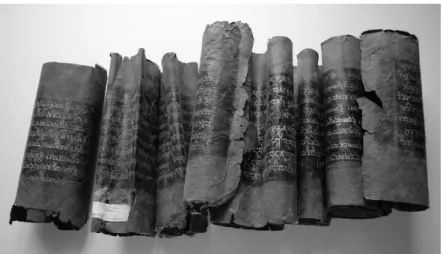
They turned out to be fragments from two different copies of the Prajñāpāramitā Sūtra in 25,000 stanzasin four volumes (Fig. 2).
Two else folios that have similar appearance and contain fragments from the same Sūtra must have been originated from Sem Palat, namely
- Sloane 2836 kept at the British Library and
- a folio published by the eminent German archaeologist Wilhelm Dorow (1790-1846), who had it in his personal collection55 (its further destiny is unknown).
Some fragments of the blue folios found at the IOM RAS were obviously torn off or cut intentionally - their edges are rather even, some have traces left with sharp tools (probably, knives). One folio lacks the larger part of the layer with text (space must have been “cleared” for writing purposes), there is even a piece of such a layer with text torn away (but not from the previous one). Let us remember then that Peter the Great replied to Bignon who had asked about more samples of “Tangut” (=
Tibetan) writing (in 1724) that his people could not find more suitable folios - all the others were in bad condition due to rude people who had used them for their aims.56It proves, by the way, that in 1724 Peter the Great had only these fragments while the six Ablaikit folios sent by Cherkassky remained in West Europe.
55DOROW 1820. I would like to thank Hartmut Walravens for this valuable information.
56KNYAZHETSKAYA1989, 22-23.
There is uncertainty concerning the fragments found in Wolfenbüttel and Halle. Most probably, during 1723 to 1724, single examples of Tibetan and Mongolian folios and a copy of Bignonʼs letter to Peter the Great from 172357came to the hands of the German diplomat Andreas E. von Stambke (1670-1739) who lived in St. Petersburg in the above-mentioned period.58 Via the scholar Jacob F. Raimman (1668-1743) they came to the Herzog August Library, Wolfenbüttel, Germany. One of them is nothing but another fragment of the same text,Mahāvairocana-sūtra, to which the folio reproduced in 1722 belongs. We can only guess if it could be taken from
57It is surely a copy and not an original letter as M. Knüppel, whose recent brochure contains some mistakes, thinks (Knüppel2014, 21-23). It suffices to compare the Wolfenbüttelcopy with some originalBignon letters kept at the St.
Petersburg Branch of the Archives of the Russian Academy of Sciences to see that the handwriting is totally different and the personal signature by Abbé Bignon lacks being just rendered with ordinary letters (so it was surely a copy from the letter signedby Bignon). Unfortunately, the original of the mentioned letter from Bignon to Peter the Great has not been found so far.
58HEISSIG1979, 209-210.
Fig. 2. One of the rolls of blue folios with golden writing originated from Sem Palat monastery (before conservation)
Cherkasskyʼs package (if so, then our hypothesis concerning the leaves at the British Library can be put under question) or got to the German diplomat independently, either directly from Siberia or through some Russian contacts in St. Petersburg who could bring or order the folios from Siberia. Similar sources could be used to get the Mongolian leaves kept at Franckeschen Stiftungen in Halle, they were sent to Germany from St.
Petersburg in 1725.59
There is yet much to explore concerning the history of European acquisitions of Tibetan and Mongolian leaves from South Siberia. We can hope also that new folios will be found in Sweden, Germany or other countries.
3. The acquisition of manuscripts and some artefacts from Sem Palat and Ablaikit by G. Müller & J. Gmelin
The greatest asset of the fragments of the Ablaikit library was acquired by the St. Petersburg Academy of Sciences from Gerhard F.
Müller and Johann F. Gmelin (1709-1755), the participants of the ambitious academic Second Kamchatka Expedition (1733-1743) aimed at exploration of vast Siberian territories. They visited Semipalatnaya and Ust- Kamenskaya fortresses but avoided going to Ablaikit preferring to send there a corporal, a local clerk and 30 soldiers. Gmelin explains that they were afraid of rather a long and adventurous travel but adds that their people sent to the deserted monastery spent less than three days for their journey and it turned out to be rather smooth so the scholars were sorry for having not come to Ablaikit themselves.60 Anyway, their people brought a huge number of artefacts which were soon transferred to St.
Petersburg.
59KNÜPPEL2014, 23.
60GMELIN1751, 233, 237.
The first object sent by them from Yamyshevskaya on July 21, 1734,61 was a decorative fragment of one of the pillars at Sem Palat, lost in the 1747 fire.62 We can have some impression of what it looked like thanks to Müllerʼs description and picture (Fig. 3, right).63
The Ablaikit artefacts were sent from Kolyvano-Voskresensk Plants on August 27, 1734.64According to Gmelin & Müllerʼs account, it consisted of the following items:
1) a wooden Kalmyk book;
2) two chests full of Tibetan and Kalmyk leaves some of which were on white paper with black writings (75 nos.) and the others were on dark violet paper with gold and silver writing (16 nos.);
3) Kalmyk printing blocks (6 nos.) 4) Buddhist frescoes on wooden plates.65 Let us consider now these entries.
1) Müller wrote that he had found three books made of birch bark with Kalmyk idioms inscribed there.66Perhaps, this number included one sent to St. Petersburg and two brought by him later. At the IOM RAS one wooden book aimed at writing exercises with both Oirat and Tibetan phrases was found. Two other books of the same sort that probably belonged to Müller are found at the Kunstkamera.67
61GMELIN& MÜLLERundated (2): 132.
62TAUBERT1748, 70.
63MÜLLER1747, 436-437, Tab. 2, fig. 2.
64GMELIN& MÜLLERundated (2): 132.
65GMELIN& MÜLLERundated, 25.
66MÜLLER1747, 449.
67On the 18th century acquisitions of Buddhist artefacts kept now at the Kunstkamera see IVANOV2009.
2) It is not quite clear what texts exactly were sent in the two chests.
The word “nos.” must mean units that could consist either of single items or of groups of them. Müller mentioned the number of 1,500 leaves.68 According to him, the bulk of the Tibetan manuscripts that remained in Ablaikit were on white paper, some of them written in cursive, some printed, the Mongolian leaves were all handwritten, mostly on white paper with either black, or red, or red & black text, blue and black folios were not so numerous after many years of plundering.
In 2012-2015, 237 Tibetan leaves (33 from Sem Palat and 204 from Ablaikit69) and about 1,050 Mongolian leaves that can belong to the mid- 18th acquisition were found at the IOM RAS. The bulk of the Mongolian leaves are white, but there are twenty one dark blue leaves.70It is hard to
68MÜLLER1747, 441.
69These folios are fragments of an unique version of the Tibetan Buddhist Canon.
The bulk of them used to belong to different volumes of six main sections of the Kagyur, while the other five (or at least three) folios must have belonged to the Tengyur so we can assume that the second part of the canon, or at least some of its volumes, was also kept at Ablaikit; for details see HELMAN-WAŻNYet al. forthcoming.
Fig. 3. Some of the pictures published by G. Müller - that of a decorative fragment of one of the pillars at Sem Palat, lost in the 1747 fire (right), and an image of the Buddha, a fragment from one of the Mongolian leaves (left), kept at the Russian State Archives of Ancient Acts, Moscow
say if the latter ones could be brought from Sem Palat, like two dark blue Mongolian folios obtained by Sloane from Bell (see above); their belonging to the Ablaikit legacy cannot be excluded either. In any case, it seems we have more than 1250 Tibetan and Mongolian leaves from the 1,500 mentioned by Müller. Perhaps, some of the lacking 220-240 folios should be searched for among other loose leaves that are still to be examined at the IOM Tibetan collection but it seems to be almost impossible to identify them.
Some of the leaves could be lost during the terrible fire that occurred at the Kunstkamera on the night from Dec. 5 to 6, 1747. Rich Siberian and Chinese collections suffered most of all. Many books in European languages were burnt down and many books and exhibits suffered a lot being thrown by people who tried to save them through the windows right on snow where they lay for a long time, some of them were even stolen.71
It is clear that some of the Tibetan folios were “saved” this way, namely a few of the blue folios that have rather lax structure of paper that signifies their affliction with humidity. Moreover, there are little fragments of white paper with text printed in German (on one side) and Russian (on
70Information provided by N. Yampolskaya.
71KHARTANOVICH& KHARTANOVICH 2014, 191.
Fig. 4. One of the fragments of Russian German bilingual books found on some of the folios from Sem Palat
the other side) pressed into them - definitely, remnants from some bilingual books published by the St. Petersburg Academy of Sciences during the first half of the 18thcentury (Fig. 4). It seems obvious that the Tibetan leaves laid on snow along with pages from such bilingual books. Such
“applications” are only found on the blue folios, so there is a possibility that in 1747 the earliest share of Tibetan texts was kept separately from the later Ablaikit portion which, in its turn, could avoid any damage from the fire.
3) Six nos. of wooden printing blocks can well be five single blocks and a series of blocks for printing a Tibetan Mongolian bilingual text, all having very similar and definitely old appearance, that are found at the IOM RAS.
The Kunstkamera also has two single blocks that could relate to Müller but it is tempting to think that the visible material homogeneity of the IOM units is not coincidental even though Müller wrote about six tablets with engravedMongolianletters.72
4) The four frescoes on wooden plates, three of which were published by Müller,73are not found at the IOM RAS and have not been found at the Kunstkamera so far. Perhaps, they were lost in 1747.
Additionally, “a paper icon” described and published by Müller (Fig. 3, left)74is nothing but a left part of the first folio of one of the volumes of the Mongolian Buddhist canon, with the figure of the BuddhaŚākyamuni, no way a goddess as Müller thought. This fragment is kept now at the Russian State Archives of Ancient Acts in Moscow.75
Even after the visit of Müller & Gmelinʼs people, there remained a
72MÜLLER1747, 441. Each block of a bilingual set is marked also with numbers whose style is distinctive for the 18thcentury.
73MÜLLER1747, Tab. VI, fig. 1-3.
74MÜLLER1747, 449-450, Tab. VI, fig. 4.
75RGADA, F. 126, op. 1, no. 2, f. 4. B.V. Borodaev kindly drew my attention to this fragment thus securing its identification.
huge number of leaves and other artefacts in Ablaikit that was emphasized by both Müller according to whom ten horses would have hardly been enough to bring all the other folios76 and Gmelin who exceeded their number to 20 horses.77 It is a great shame, therefore, that the next scholarly-oriented person interested in manuscripts visited the place almost 40 years later, in 1771, and, again, it was even not the scholar, this time Peter S. Pallas, but his assistant, student Nikolai Sokolov, who found there but very fragile fragments of texts that crumbled in hands. We can only guess if he brought any samples of remaining fragments to Pallas and if the latter one took them to St. Petersburg. It seems though that Sokolov was not very careful. In 1777, a complete single folio of a Tibetan block print was found in Ablaikit. Later, in 1817, it was passed to the Imperial Public Library, St. Petersburg (founded in 1795; now the NationalLibrary of Russia) by the Siberian and St. Petersburg scholar Grigory I. Spassky (1783-1864).78This seems to be the last documented discovery of a text in Ablaikit79whose buildings remained in rather good conditions until they were broken and dismantled by local Kyrgyz people.80
76MÜLLER1747, 448.
77GMELIN1751, 237.
78Spassky passed also one Mongolian folio from the same place but it could be found separately (OLENIN1818, pl. VIII). Moreover, the National Library of Russia has two dark violet folios from Ablaikit that could be found there by the early 19th century but, unfortunately, no information on their previous history is known.
79Perhaps, some artefacts, that may be found now at some local museums in Kazakhstan and Russia, were discovered there after 1777, this question needs more investigation. There are photos of a block print with a Tibetan protective circle and a piece of birch bark with some mantras written in Tibetan that are claimed to belong to the Ablaikit legacy (ATLAS2011, 129, 131). They are kept at the Ust- Kamenogorsk/Öskemen RegionalHistoricalMuseum.
80Some photos of the place with its remnants of the fortress walls and the fundament of the temple are provided in ATLAS2011, 128, 132-135, 138.
4. Cataloguing attempts, oblivion and new discovery
Although J. Bacmeister emphasized, in his 1776 survey, the importance of the Ablaikit folios (with the Sem Palat contribution effectively forgotten) and their abundant number at the Library of the St.
Petersburg Academy of Sciences, the loose leaves from South Siberia were not regarded as a great value by the author of the first catalogue of the St.
Petersburg collection of Tibetan and Mongolian texts, Johann Jährig (1747-1795), another assistant of Pallas and himself a great scholar who mastered both Mongolian and Tibetan. The catalogue, or rather the list of texts containing their brief description only, was prepared in 1788-1789 and published posthumously by the librarian Johann H. Busse (1763-1835) in 1796.81It consisted of 12 Tibetan, 12 bilingual Tibetan-Mongolian ones, 139 Mongolian complete texts, and 95 painted figures.82As Busse mentions in his introduction, Jährig thought that the loose leaves from the earliest South Siberian acquisitions were worth keeping only because they were already found at the library.83The majority of the Mongolian texts were collected by Jährig himself in 1781-1787.84Still, we cannot exclude totally that some complete texts could be taken by him out of the Ablaikit materials. Anyway, all the Tibetan and Mongolian texts left uncatalogued were listed by J. Busse in his manuscript catalogue of Chinese, Manchu, Japanese, Tibetan and Mongolian texts dated 179885and later, in 1828, by
81BUSSE& JÄHRIG1796, 126-137.
82The number of icons is unclear but they are much fewer than 95, e.g. the first 25 nos. belong to one icon.
83BUSSE& JÄHRIG1796, 124.
84SAZYKIN1988, 10.
85BUSSE1798, 25-26. I would like to thank Hartmut Walravens for his transcribing, on my request, the German ornate-styled text of the manuscript.
Isaac J. Schmidt (1779-1847),86the great scholar of Tibet and Mongolia who worked at the Asiatic Museum (AM) of the Russian Academy of Sciences, the institution founded in 1818 specially for the gathering of books in Oriental languages (now the IOM RAS). Both lists mention Tibetan and Mongolian rolls on blue and black paper but the first one is slightly more chaotic and claims for more analysis so we will use Schmidtʼs list here.
Thus, its No. 20 contains21 rolls of Tibetan texts, obviously from Ablaikit (on blue paper), No. 176 - 3 Mongolian rolls from the Ablaikit monastery (the leaves on blue paper with golden writing, perhaps from Sem Palat, must be meant), No. 177 -4 piles of extensive Mongolian texts, large-sized, but mixed and defected(more than 1,000 folios on white paper from Ablaikit can be meant).87
86SCHMIDT1828.
87Both Busse and Schmidt mention the famous Fourmont translation of the Tibetan folio secured to Paris by Schumacher (No. 180 in Schmidtʼs list) but Busseʼs description adds also the duplicate of the Tibetan original (No. 26). It seems that the duplicate was lost between 1798 and 1828 and that J. Klaproth could be the last person who saw it (along with the translation) in St. Petersburg, in 1809-1810 (WALRAVENS1997, 96-97).
By 1820, according to Abel-Rémusat, the original folio “translated” by É. Fourmont (1683-1745) and M. Fourmont (1690-1746) along with seven other Tibetan and Mongolian folios were kept at the Royal Library in Paris (ABEL-RÉMUSAT1820, 332, note 1), this information is supported with the late 19th century handwritten catalogue of the Oriental collection kept in Paris (MXT, 41, No. 464). Schumacher did not send more folios to Paris as follows from the correspondence between Bignon and Peter the Great (see above). We can only guess now if Klaproth could provide more folios given the fact that he did take a number of Far Eastern books and documents from St. Petersburg to West Europe and never sent them back (KULIKOVA2002, 24-31). Of course, there could be other ways for these folios to get to Paris, so the closer study of them and the libraryʼs archives is desired.
It is interesting also that the Royal Library had some “first page” of the Fourmont translation (MXT, 42, No. 470). It may be a draft version that was never sent to St.
Petersburg. Vostrikov claimed, in 1935, that the entire(?) translation was kept at the
During the next one hundred years, no attempt to sort out these folios was made. They were just kept - exactly in line with Jährigʼs suggestion. It does not mean though that they were forgotten. B. Vladimirtsov who made a short survey of the AM Mongolian collection from 1818 to 1918 mentioned some texts taken from Ablaikit as a very interesting example of Oirat writings88so their existence was, at least, no secret.
In 1928, A. Vostrikov was hired by the AM to process its Tibetan collection and, for a couple years, he did a lot to arrange it in a good order.
He must have found a number of materials without any access numbers and gave them draft numbers with pencil, probably thinking to process them in a right way over a few next years. But other academic tasks made him look for a person to do this kind of work instead of him and, in 1931, Nina P. Yaroslavtseva (later Yaroslavtseva-Vostrikova)(1902-1988) was hired for this purpose but, because the new Institute of OrientalStudies had been organized a year before on the basis of the AM, she had to start cataloguing the entire collection from the very beginning and worked rather successfully until 1937. At the same time, the Mongolian collection was processed, too, and some of the South Siberian leaves were given access numbers inside the part called, ironically enough,Mongolica Nova.
We could expect that the Tibetan share would have obtained at least access numbers but after the Stalinist purges and the Second World War both Mongolian and Tibetan manuscripts from Sem Palat and Ablaikit turned into a legend.
In the mid 1960s, the project aimed at thorough processing and
Institute of OrientalStudies but he did not provide any access number probably because it did not have any number at that time (VOSTRIKOV1935, 63, note 3). Again, this item is yet to be found.
I would like to thank Viacheslav Zaytsev and Hartmut Walravens for their important remarks on this subject.
88VLADIMIRTSOV1920, 79.
cataloguing of the Tibetan collection was started and it was carried out especially fruitfully during the first half of the 1970s by Lev S. Savitsky (1932-2007), Margarita I. Vorobyova-Desyatovskaya and Elena D. Ogneva.
During this time, numerous Mongolian texts were found and passed to the Mongolian collection, some of them being rather old and important.
Unfortunately, the project was not accomplished, with a huge number of scattered leaves left unsorted. In the middle of the 2000s, Vladimir L.
Uspensky started arranging these parts of the collection and his attention was drawn to a red box (clearly made in the Tsarist period) with some texts that looked rather old and he supposed they could belong to the legendary Ablaikit library.89He marked this box with a paper label bearing his guess. Several years later, when a new group of scholars started working at the Tibetan collection, this label aroused interest in the Ablaikit issue and helped tie various bits of information into the more or less coherent picture.
This red box and some more boxes with visibly old packs and rolls of texts were found in both the IOM Tibetan library and the IOM main storage room. They all had some draft numbers written with pencil, and it took some time to understand that they must have been ascribed to them by Vostrikov in the late 1920s (analysis of his handwriting is the major proof here). Among them, the rolls (sometimes, bound with blue tape) of large Tibetan leaves with blue and dark violet margins and texts written with gold or/and silver were found. Two old labels that corresponded with defected and loose materials from Schmidtʼs list were also found there and one of them, too, had a new draft number put by Vostrikov. But even without this evidence it was rather clear that the above-mentioned rolls must have belonged to the famous Irtysh stock.
89This information was confirmed by V.L. Uspensky in our conversation in 2014.
In September of 2014, Olga V. Lundysheva during her work with the IOM Serindian collection found there a box with various texts including two Tibetan rolls of the same origin - and, interestingly enough, some almost totally ruined, most probably burnt, material wrapped in paper. A chemical analysis is needed to check if it was solid paper or wood burnt by fire. Perhaps, this ruined material could also belong to the South Siberian acquisition.
In November of 2014, two piles of dark violet leaves and one pile of blue leaves were added. They had been put (by Savitsky?) between cardboard plates and this way more or less flattened. Finally, in early 2015 a box with two more rolls of leaves from Ablaikit was found. Urgent conservation was needed for both rolled and slightly flattened leaves due to numerous defects and fragility. This work was started by the IOM leading conservator Lyubov I. Kryakina, in 2014. This way, these precious objects of Eurasian cultural heritage can be given new life. Their further textological and scientific analysis promise to be important for the history of the Tibetan Buddhist canon and Tibetan book culture.
Fig. 5. Leaves from one of the rolls of the Ablaikit folios (before conservation)