Author(s) サベット・メヘラン
Citation 聖学院大学論叢, 22(1): 45-69
URL http://serve.seigakuin-univ.ac.jp/reps/modules/xoonips/detail.php?item_i d=1803
Rights
聖学院学術情報発信システム : SERVE
SEigakuin Repository for academic archiVE〈原著論文〉
Japanese Students in America:
Have They Made the Adjustment?
Mehran SABET
アメリカの日本人留学生:新しい環境に適合できましたか?
サベット メヘラン
この研究論文は,アメリカにいる日本人留学生が,どのように新しい環境に適応し,どのような 問題を抱え,困難に直面したときに,誰に相談をしているのかを,調査したものである。
毎年,何千人もの学生が留学をしている中,留学生が留学を成功するかしないか,その要因を調 査することは,教育者と保護者にとって大変興味深いことである。
この調査の対象学生は,カリフォルニア州とワシントン州のコミュニティ・カレッジに留学をし ている 120 名の留学生である。
Key words; Japanese, study-abroad, problems, satisfaction, adjustment
With more than 30,000 Japanese students going to America every year, it is of benefit to educators and administrators to investigate: (1) how these students are adjusting to their new surroundings, (2) what kinds of problems they have, (3) who they turn to when facing difficulties, (4) what types of assistance they are receiving, and (5) what can be done to make the transition from one culture to another easier. Therefore, this paper takes a systematic and practical approach to the analysis of study-abroad programs, and therefore, is organized as follows: a) based on a literature review, the potential problems students face when going abroad; b) a report on the survey conducted during this study that investigates the actual problems or concerns students have expressed; and, c) suggestions on how to overcome these problems.
Although the number of students going from Japan to study in the U. S. has been declining in the past few years, according to data complied by the Institute of International Education (IIENETWORK, 2008), 33,974 students still entered the U. S. during the 2007-2008 academic year
執筆者の所属:人文学部・欧米文化学科 論文受理日 2009 年6月 30 日
to study. Japanese students accounted for approximately 5.4% of the total population of interna- tional students in the U. S. and were fourth on the list only behind India, China, and Korea.
Therefore, it is natural for administrators, teachers, and parents to be concerned about the quality of education these students receive, their mental and physical well-being resulting from potential culture shock, their adjustments to their new lives, and how they view their lives overseas.
America is, by far, the most popular country in the world for college degree seekers, which is probably due to its high quality of education and its living standards. According to data compiled by the Institute of International Education in 2007-2008, 623,805 international students were enrolled in American colleges and universities. That is almost twice the number of international students in Britain, which is second on the list. These students contributed more than $15.5 billion to the U. S. economy in 2008 (IIENETWORK, 2008).
Upon arrival in the new country, students must deal with a new language, a new culture, and new expectations. According to Macdonald (2007), students suffer from culture shock and at times need interpreters, friends, and mentors to help them bridge the gap between the two worlds.
The problem of adjusting to a new life on campus not only affects international students, but also their American counterparts. They have to leave their family and friends behind and establish a new home. This can bring about feelings of anxiety and uncertainty to college freshmen as they have to face new challenges in their new surroundings. In a recent study of students from 15 campuses in the U. S., students listed anxiety as one of their top-six concerns. The study con- ducted at Kansas State University, showed an increase in severity of anxiety symptoms from 1989 to 2001 (Vye, 2007). But the problem with international students can be even more complicated because in addition to being away from family and friends, they also have to adjust and get accustomed to a new environment. Differences in cultural norms and expectations can be confus- ing and cause considerable worry during this time when establishing new friendships is so impor- tant (Vye, 2007).
Therefore, considering the enormous opportunities for gains as well as potential problems that studying abroad can bring to students and their families, this study intends to focus on the following three research questions:
1.What kinds of problems do Japanese students have when they arrive in the U. S., and what kinds of problems are they having now?
2.Who do they turn to for help when having problems?
3.How satisfied are these students with their life in America?
Potential problems facing international students
According to Pederson (1995), the following are the most commonly reported difficulties experienced by international students:
1.Language barrier 2.Culture shock 3.Lack of study skills
4.Loss of social support and status 5.Academic demands
6.Anxiety, stress, and loneliness 7.Lack of self-assertiveness
Obviously, not everyone is affected equally by the difficulties mentioned above, but knowing that these problems can distract from a student’s academic performance and negatively influence his or her social life requires that steps must be taken to limit the amount of harm these problems may cause. For those who have lived overseas for more than a few months, relating to the problems stated above is not difficult. Educators who have worked with international students most likely have heard of or come into contact with a few students who have gone through one or more of the phases of culture shock. Although most international students face common problems, it is also fairly safe to say that learners from every country have their own set of issues that are unique to their specific cultures. Japanese students are no exception and coming from a homogeneous society, their problems can be unique to their own culture. In the next section, we attempt to look more closely at Pederson’s most commonly reported difficulties and examine their relevance or application to Japanese students.
1.Language barrier
Almost all colleges and universities in America require a TOEFL score of 450, or higher, as one of the main requirements for international students for admission to their schools (most universi- ties ask for 500). But having the required score does not guarantee academic competence and success. Meeting the criterion only indicates that a student has reached a certain level of language proficiency, but there is more to performing adequately at school than just having a desirable TOEFL score. Understanding the lectures, taking notes, participating in class discussions, contri-
buting sufficiently, and being aware of socio-linguistic skills are some examples of linguistic skills that the TOEFL test cannot measure extensively. Nonetheless, these skills play a major role in a student’s performance in college, as well as in outside life.
A language barrier not only slows down a student’s academic progress, it also causes frustra- tion and anxiety, interferes with how people want to express themselves, hinders full participation in discussions, and may distort how students are viewed by others. Mari Takai (2007), who was an international student in America, says “I feel obliged to be a good person out of fear of rejection from English-speaking people. Because of my still developing verbal skills and cultural knowledge, I cannot express my whole personality. Instead, I express only what I think is acceptable and safe out of self-protection. In short, I feel as if I am a different person when I speak English.” Lack of the requisite language skills to perform well at school and an inability to express oneself properly outside the school can have negative affects on all aspects of students’ lives; slow their academic progress and their full participation as a member of society.
2.Culture shock
Students, as well as newcomers to any country, usually go through stages of culture shock and although the length of each stage can differ depending on the person, everyone goes through the same five stages of the shock at one time or another. According to many experts (Addison 2004 et al), the five stages are:
Honeymoon Phase: People at this stage feel good about themselves and their new environment.
Rejection Phase: People at this stage start facing problems and begin to feel frustrated and at times, lonely.
Regression Phase: People become more attached to their own country and culture and start complaining about the host country’s way of living, its people, and the manner that businesses, schools, and families function. They often talk with people of their own country about how things are much better back home.
Recovery Phase: People at this stage feel comfortable at the host country and become more understanding and tolerant of its custom and people. They are positive, complain less, and do not feel sad or anxious in their daily lives.
Reverse Cultural Shock: Reverse culture shock takes place when people return to their own country. Since they were away for a long time, it takes them time to adjust to their new environ- ment. They start complaining about how things are run and show signs of irritation and frustra-
tion by wanting to go back to the host country. They want to see changes in the society and wonder why people act or talk in certain ways.
Depending on how students handle the culture shock and adjust to their new surroundings, the outcome can set the tone for the rest of their stay and future success. For example, if a student stays in the “Rejection Phase” for too long and allows sadness and anxiety to control his or her life, he or she may not be able to function well in and outside the school. In mild cases, this brings isolation and loneliness. In extreme instances, the student may decide to return to his or her home country, or in severe cases of shame or desperation, may even attempt suicide. Although many students may not be aware of the phases they are going through, they are affected by culture shock in one way or another.
3.Lack of study skills
Teaching styles and teachers’ expectations vary greatly between American and Japanese schools. In America, students’ participation in the classroom is strongly encouraged from a young age. But in Japan, teachers control the entire class time so there is little interaction between the teachers and their students. These two contrasting styles have set standards and expectations in their respective countries, and as a result, have influenced the study habits of the students. For example, Japanese teachers usually use written tests to determine students’ grades, and therefore, learners spend a considerable amount of time on rote memorization. This method of studying applies to many subjects and has deep roots in the Japanese educational system. On the other hand, although rote memorization has its place in American schools, it is not as widely used as in Japan. Class participation, individual and group projects, and contributions to class discussions are also used to assess students’ grades. Therefore, when Japanese students enter American colleges and universities, in addition to having language proficiency problems, they have to adapt and adjust to very different kinds of study skills. The need for adjustment in their learning styles, combined with a language barrier and culture shock, can adversely affect students’ physical and mental conditions.
4.Loss of social support and status
When students go to study abroad, it usually means leaving their family and friends behind.
This can have a devastating affect on them as they may feel a void and a sense of loneliness in their
new environment. When people move to a new country, it sometimes means starting all over. No one knows them and they have to establish themselves based on their character, knowledge, and social and communication skills. People cannot depend on their past history or status in society to establish relationships. Therefore, many factors contribute to forming a person’s position and status in the new environment. It becomes a matter of survival and the strong ones make it through successfully. Consequently, students go through stages of uncertainty and anxiety while trying to familiarize themselves with their new surrounding and attempting to establish a new social network of friends.
According to Vye (2007), one factor that seems to help students deal with the stress experi- enced in college is a good social support network. In fact, research suggests that high levels of social support can provide protection from the emotional stress. Japanese are known for being shy and reserved and although this may not fully apply to the most recent generation anymore, they are still more reserved than other nationalities when it comes to mixing with local people. That could be one reason, according to Hodges, that they have one of the lowest communication skills among international students on university campuses (Hodges, 2007). This lack of ability or willingness to communicate in English with others can influence students’ status, confidence, and performance in and outside of the school.
5.Academic demands
As stated previously, due to contrasting teaching styles and academic standards, students are forced into certain study habits in order to meet goals and expectations established by their teachers. Academic demands are a part of the educational system in any country and they reflect its history and culture. In a study conducted by Watanabe (1993), she compared group discus- sions of Japanese and American students and found Americans viewed discussion as an activity that brought together individuals for the purpose of discussing and therefore began and ended the discussion promptly. In contrast, Japanese were more concerned about the hierarchy, the group members’ age and status, and the order of turn taking. If Japanese students are not familiar with standards and norms at American schools, they cannot meet the expectations of the teachers, and as a result, are at a disadvantage when it comes to assessment.
Another big difference between universities in America and those in Japan is grading and what constitutes an “A”, “B”, “C”, or “D” in both countries. In most Japanese universities, an “A” is given to a student whose final score is between 80-100 percent, but in America grading is much stricter.
Depending on the teacher and the course, an “A” is usually given to someone whose final score is between 90-100 percent. Standards for giving “D” or “F” in Japan are also lower than in America.
It is also fair to say that Japanese teachers are more lenient towards tardy students, where they tolerate late-comers or students who sleep in class. This author can testify to this because he has about twenty years of teaching experience in Japan and has observed numerous occasions where students are asleep, playing with their cell-phones, reading comics, or doing assignments for other classes while the teacher is giving a lecture. It is hard to imagine any university professor in America who would tolerate this kind of behavior. Therefore, at least initially, Japanese students are surprised at how strict their American teachers are. They cannot understand why a teacher gets upset when two students are talking in the class or someone is dozing off.
Another major difference between the two countries’ academic standards is the quality of work demanded by teachers in America. Depending on the nature of the course, in order to get a satisfactory grade, students may have to write a paper, take quizzes, give a presentation, take a final exam, or combinations thereof. Extensive reading and writing is required for many courses, and given the language deficiency of some Japanese students, they must work much harder to get a good grade. Some students are shocked at the level of academic demands placed upon them by their American teachers.
6.Anxiety, stress, and loneliness
Research findings suggest that if international students fail to adjust to new, challenging and diverse demands, they undergo high levels of loneliness, depression, and have increased physical and mental health issues (Pedersen, 1995). Once they adapt to the new demands and roles of the new culture, however, international students are likely to experience improved academic perform- ance and psychological stability. Anxiety and stress not only affects international students, they can also have devastating affect on American students when they move away from their families and friends. Academic demands at universities can overwhelm students, while moving into the new environment usually brings anxiety to the already existing tension. College students are expected to become independent young adults and set their own intellectual, physical, and inter- personal standards. But at the same time, they go through various changes in their physical and mental states. Not everyone is capable of coping with these changes. Studies show that a higher and higher percentage of students do not believe they possess sufficient coping skills for managing their anxiety (Vye, 2007).
The problem is more severe for international students because they have to learn how to live independently while coping with many unknown elements in their new lives. Managing the new life requires access to a variety of resources such as family, friends, and professionally trained counselors. Japanese students do not readily share their problems with others, and therefore, are not accustomed to seeking help. Pride, shame, fear of being seen as weak, and not wanting to inconvenience others stop many Japanese from asking for assistance and advice. As a result, schools may have students on their campuses that, in addition to being away from family and friends, have language and communication problems, experience various difficulties, and do not know to whom they should turn.
7.Lack of self-assertiveness
In general, Japanese students are known as modest, passive, silent thinkers, who are reserved and avoid expressing their opinions openly. According to Kondo & Blake (2005), Japanese stu- dents find it difficult to praise themselves and to speak confidently of their own background and accomplishments in a positive way. They are used to making modest comments about themselves, comments that most Westerners do not understand or sometimes confuse. This kind of attitude is instilled in Japanese, and when demonstrated on university campuses, may affect their grades negatively, as well as influence how they are perceived by their teachers and classmates. For example, although a student may have done well in a classroom presentation, he or she may say that the presentation did not go well and he or she could have done better. The teacher may interpret this as indication that the student did not give his or her best.
In personal relationship and communication with others, Japanese usually hesitate to express their opinions directly, worry about the feelings of other people, and are concerned about how they are perceived. Even if a student wants to express his or her opinion, as mentioned earlier by Mari Takai (2005), the language barrier can limit what he or she actually says. This sometimes characterizes Japanese as passive individuals who are not interested in participating in discus- sions. Furthermore, lack of participation in formal and informal discussions can result in loss of confidence, which in turn makes the student less assertive. On the other hand, to what extent are the students expected to conform to the norms of the society and how much of their own culture should be retained? Where should the line be drawn and what is the balance? Kondo and Blake (2005) also ask how much an individual is required to adapt to another culture to be able to communicate, to understand, and to be understood correctly. The potential is there for students to
lose their own cultural identity by trying to become someone different.
The Study
Participants
Japanese students from three community colleges in Orange County, California and one com- munity college in Seattle, Washington participated in this research. In total, 120 students took part in this survey, of which 47 were male and 73 female. All of the students were taking regular college courses and none of them were full-time language school students. The majority of the students were in their late teens or early to mid-20s, with only 9 of them in their 30s and 40s. In addition to the survey, 25 students participated in personal interviews. During these interviews it was also discovered that 6 students had already completed their two-year college or university degrees in Japan and were in America to acquire a certificate or seek another four-year degree.
Most of the students interviewed stated that they had spent at least one semester at a language school prior to their enrolment at college.
The Questionnaire
A questionnaire was designed and administered to the targeted students on the four campuses (See Appendix A). In most cases, the college administration administered the questionnaire through their international center or assigned the task to student leaders. This writer was also involved in collecting data as he visited the offices of the international centers to interview students, which was arranged by the participating schools. Although the targeted students were Japanese, there was no need to translate the questions into students’ first language since they were easy to understand. The questionnaire was also sent to the participating colleges and revised, based on comments and suggestions made by the administrators there. Furthermore, in order to have a better understanding of Japanese students’ situation in America, advisors, counse- lors, and administrators who worked closely with these students were also interviewed.
Analysis
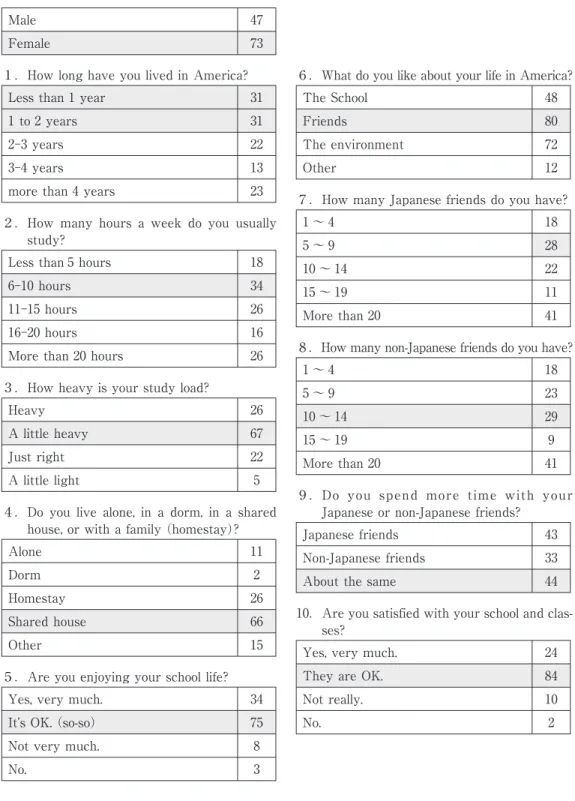
According to Table 1, the majority of the respondents were female and they accounted for about 60% of participants in the survey. Because all of the participating students were in two- year community colleges, the data can be seen as representative of Japanese students studying in
Appendix A Lifestyle Questionnaire
Male/Female School’s name Age
1.How long have you lived in America?
A.Less than 1 year B.1 to 2 years C.2-3 years D.3-4 years E.more than 4 years
2.How many hours a week do you usually study?
A.Less than 5 hours B.6-10 hours C.11-15 hours D.16-20 hours E.More than 20 hours
3.How heavy is your study load?
A.Heavy B.A little heavy C.Just right D.A little light
4.Do you live alone, in a dorm, in a shared house, or with a family (homestay)?
A.Alone B.Dorm C.Homestay D.Shared house E. Other
5.Are you enjoying your school life?
A.Yes, very much. B.It’s OK (so-so). C.Not very much. D.No.
6.What do you like about your life in America? You can check more than one answer.
A.The school B.Friends C.The environment D.Other
7.How many Japanese friends do you have?
A.1-4 B.5-9 C.10-14 D.15-19 E.More than 20
8.How many non-Japanese friends do you have? (Friends are people who you go out with or get together with sometimes)
A.1-4 B.5-9 C.10-14 D.15-19 E.More than 20
9.Do you spend more time with your Japanese or non-Japanese friends?
A.Japanese friends B.Non-Japanese friends C.About the same
10.Are you satisfied with your school and classes?
A.Yes, very much. B.They are OK. C.Not really. D.No.
11.Are you satisfied with your life in general in America?
A.Yes, very much. B.It’s OK. C.Not really. D.No.
12.What percentage of talks or lectures given in the class do you understand?
A.0%∼ 29% B.30%∼ 49% C.50%∼ 69% D.70%∼ 89%
E.90% ∼ 100%
13.Do you have problems with your classes, homework, or anything else at school?
A.Yes, often. B.Yes, sometimes. C.Yes, but once in a while. D.Almost never.
If yes, please comment on what problems you have: (you can write either in Japanese or English)
14.Who do you usually talk about your school-related problems with? You can check more than one answer.
A.School counselor B.Friends C.Parents D.No one
15.Do you sometimes feel stressed out?
A.Yes, often. B.Yes, sometimes. C.Yes, but once in a while. D.Almost never.
16.Do you sometimes feel really lonely or depressed?
A.Yes, often. B.Yes, sometimes. C.Yes, but once in a while. D.Not really.
17.Who do you usually talk about your personal problems or feelings with?
A.Friends B.Parents C.School counselor D.No one
18.What is your biggest problem at the moment? You can check more than one answer.
A.Studies B.Money C.Loneliness D.Stress E. Other
19.How often do you talk with your family in Japan?
A.Every week. B.About 1 or 2 times a month. C.A few times a year.
D.Very seldom.
20.Do you talk with your family more on the phone or through email messages?
A.Telephone B.Email
21.Are you planning to return to Japan after you finish your studies or do you want to stay in America?
A.Go back to Japan. B.Stay in America. C.Not sure.
22.Are you planning to undertake postgraduate study?
A.Yes B.No C.Maybe
Table 1 Lifestyle Questionnaire Results
Male 47
Female 73
1.How long have you lived in America?
Less than 1 year 31
1 to 2 years 31
2-3 years 22
3-4 years 13
more than 4 years 23
2.How many hours a week do you usually study?
Less than 5 hours 18
6-10 hours 34
11-15 hours 26
16-20 hours 16
More than 20 hours 26
3.How heavy is your study load?
Heavy 26
A little heavy 67
Just right 22
A little light 5
4.Do you live alone, in a dorm, in a shared house, or with a family (homestay)?
Alone 11
Dorm 2
Homestay 26
Shared house 66
Other 15
5.Are you enjoying your school life?
Yes, very much. 34
It’s OK. (so-so) 75
Not very much. 8
No. 3
6.What do you like about your life in America?
The School 48
Friends 80
The environment 72
Other 12
7.How many Japanese friends do you have?
1 ∼ 4 18
5 ∼ 9 28
10 ∼ 14 22
15 ∼ 19 11
More than 20 41
8.How many non-Japanese friends do you have?
1 ∼ 4 18
5 ∼ 9 23
10 ∼ 14 29
15 ∼ 19 9
More than 20 41
9.Do you spend more time with your Japanese or non-Japanese friends?
Japanese friends 43
Non-Japanese friends 33
About the same 44
10.Are you satisfied with your school and clas- ses?
Yes, very much. 24
They are OK. 84
Not really. 10
No. 2
Tabel 1 Lifestyle Questionnaire Results 11.Are you satisfied with your life in general in
America?
Yes, very much. 42
They are OK. 69
Not really. 5
No. 4
12.What percentage of talks or lectures given in the class do you understand?
0% ∼ 29% 2
30% ∼ 49% 8
50% ∼ 69% 37
70% ∼ 89% 43
90% ∼ 100% 30
13.Do you have problems with your classes, homework, or anything else at school?
Yes, often. 10
Yes, sometimes. 50
Yes, but once in a while. 49
Almost never. 11
14.Who do you usually talk about your school- related problems with?
School counselor 30
Friends 95
Parents 27
No one 9
15.Do you sometimes feel stressed out?
Yes, often. 22
Yes, sometimes. 66
Yes, but once in a while. 27
Almost never. 5
16.Do you sometimes feel really lonely or de- pressed?
Yes, often. 7
Yes, sometimes. 35
Yes, but once in a while. 49
Not really 29
17.Who do you usually talk about your personal problems or feelings with?
Friends 85
Parents 19
School counselor 2
No one 14
18.What is your biggest problem at the moment?
Studies 55
Money 63
Loneliness 15
Stress 30
Other 21
19.How often do you talk with your family in Japan?
Every week. 49
About 1 or 2 times a month. 51
A few times a year. 12
Very seldom. 8
20.Do you talk with your family more on the phone or through e-mail messages?
Telephone 70
E-mail 50
21.Are you planning to return to Japan after you finish your studies or do you want to stay in America?
Go back to Japan. 59
Stay in America. 28
Not sure. 33
22.Are you planning to undertak graduate study? ( If you are already in graduate school, do not answer.)
Yes 65
No 38
Maybe 17
community colleges in America. In terms of keeping up with the course demands, about 56% of the students said that study more than 11 hours a week and 35% study more than 15 hours during the same time period. The majority of students feel that the study load is a little heavy, but that is natural, especially because English is their second language. The data also reveals that most of the students understand about 70% to 89% of the lectures with the next largest group belonging to the 50% to 69% range. However, more than half of the students who have been in American for more than four years said that they understand 90% to 100% of the lectures (See Table 2).
Based on the responses collected, a large number of students are satisfied with their lives, including school lives. Very few stated their dissatisfaction with school and environment and the results can be found in Questions 6 (See Table 3), 10, and 11. Students ranked environment a close second for what they like about their lives in America. The top choice for what students like
Table 2
What percentage of talks or lectures in the class do you understand?
0% ∼ 29% 30%∼ 49% 50%∼ 69% 70%∼ 89% 90%∼ 100%
Less than 1 year 2 7 8 7 7
1 to 2 years 0 0 12 13 6
2 to 3 years 0 1 13 7 1
3 to 4 years 0 0 1 8 4
More than 4 years 0 0 3 8 12
Table 3
6.What do you like about your life in America?
The School 48
Friends 80
The environment 72
Other 12
18.What is your biggest problem at the moment?
Studies 55
Money 63
Loneliness 15
Stress 30
Other 21
* Students checked more than one answer.
about their life in America is friends and the data suggests that participants in this study had no problems making Japanese and non-Japanese friends. But about 15% said that they have only between 1-4 friends.
The role that friends play in each other’s lives cannot be underestimated since in Question 14 almost 90% stated that they usually talk to friends about school-related problems and in Question 17 another 70% said that they turn to the same group to talk about their personal problems (See Table 4). However, considering the number of students who only have a few friends (Q 7 and Q 8), the ones who often feel stressed out (Q 15), and also individuals who often feel lonely or depressed (Q 16), it is safe to say that closer attention must be paid to this group.
In terms of communicating with their families in Japan, about 83% of the students said that they talk with their families at least once or twice a month and only 6% stated that they seldom do so. Another 10% said that they talk with their families a few times a year. Although the use of telephone (70) is more common than e-mail (50), the numbers are fairly close.
In general, students seem content with their school and classes. In Question 10 about 87% of them stated so and only two indicated that they were not satisfied. Furthermore, considering that English is the students’ second language, the percentage of the learners who have problems with their classes, homework, or other school-related matters seems to be low. Nevertheless, some attention should be paid to the students who have stated that they “often” or “sometimes” encoun- ter problems as this number stands at 50%.
Money tops the list of problems students are facing at the moment, followed by “studies,”
“stress,” and then “loneliness” as it can be seen in Question 18 (See Table 3). If we combine
“stress” and “loneliness,” we can see that 45 students have problems in these areas. This is an area of concern, especially since only two students see their counselors at school for personal problems.
Finally, about half of the participants indicated that they plan to go back to Japan after finishing their studies and the other half are either going to stay or are not sure. This uncertainty can be the result of attending a community college since many students indicated in personal interviews that they want to get a bachelor degree. This view is supported in Questions 24 as 25 students plan to undertake postgraduate study or may consider it later on.
Table 4
14.Who do you usually talk about your school- related problems with?
School counselor 30
Friends 95
Parents 27
No one 9
17.Who do you usually talk about your personal problems or feelings with?
Friends 85
Parents 19
School counselor 2
No one 14
*Students checked more than one answer.
Discussion
In response to the first research question “What kinds of problems did Japanese students have when they arrived in the U. S. and what kinds of problems are they having now? ” a large percentage of the participants in the survey expressed concerns about the high cost of living and education. However, for Japanese, this financial burden usually falls to the parents. According to Cahn, Asian immigrants usually think in terms of family and not the individual: they are willing to sacrifice their own socioeconomic standing in exchange for giving the next generation a better chance to make it in the world (Cahn, 1991). This statement not only applies to the immigrants, but also to Asians living in their own country. According to responses from the students inter- viewed, a typical student spends between $30,000 and $40,000 a year on tuition, books, rent, and other expenses. Since the students are not permitted to work and they are fairly young, it is safe to assume that their parents are paying for most of these expenses.
As for question two in this research “Who do the students turn to for help when having problems?” The obvious answer is “friends.” Friends, by far, outnumber the other people men- tioned in the questionnaire as possible sources of assistance. This is not surprising given the age of the participants and the distance they have from their families. Although the data suggests some students had difficulty making friends at first, they gradually built a good network of people around them, including both Japanese and non-Japanese.
The third research question was “How satisfied are these students with their lives in Amer- ica?” After analyzing the questionnaire results and extensive interviews with students and admi- nistrators, it is safe to say that the majority of the students in this research seemed content with their lives in America and exhibited very few problems. The level of satisfaction with school, environment, and life in general was high. This could be due to factors such as attending a community college (since generally, the study load at community colleges is less than universities) , where it is usually easier to settle down and make friends, or having a large population of Japanese in the area as well as living in a desirable place such as California.
In reference to Pederson’s (1995) most common difficulties experienced by international stu- dents, based on personal interviews conducted with 25 students they can be summarized as follows:
Language barrier
The most common problem facing these students was the language barrier. Lack of language proficiency caused difficulties ranging from everyday communication to making friends, studying, understanding the instructions and lectures, and basic survival in the real world. This barrier also hindered students’ ability in more specific areas such as getting a driver’s license, opening a bank account, buying insurance, using public transportation, as well as many other basic needs in everyday life. Although the students stated in the questionnaire that they have many non- Japanese friends, according to them, initially, it was not easy to initiate a conversation with non- Japanese. Additionally, talking on the phone was extremely hard for some of these newcomers, especially when they had to function at a multi-task level, such as negotiating with an insurance agent about an accident or talking with school administrators. As it can be observed in Table 2, the longer the students stay in America, the more they understand talks and lectures given in their classes. But although 45 students stated that they understand 70% to 89% of classroom instructions, another 37 students said that they understand only 50% to 69% of what is being said the class. That is despite the fact that 13 of students in this group have been in America between 2-3 years. According to this data, students need to be equipped with more language skills and proficiency if they want to succeed academically.
Culture shock
Students experienced culture shock mostly through communication with their host families, differences in managing conflicts, and difficulties in understanding cultural norms. Although the majority of the participants in this survey said that they were able to adjust to their new lives, a few expressed experiencing slight cases of depression or knew of someone who was already depressed. These depressed students want to stay home and do not wish to communicate with anybody. Is it possible that these students were stuck in the Rejection or Regression phase of culture shock?
Lack of study skills
A considerable number of students interviewed expressed frustration at their inability to write
well and wished that they had spent more time on this skill while in Japan. A few students commented that instead of grammar or reading classes, Japanese education needs to focus more on practical skills such as writing, presentations, and discussion strategies in high schools. Many students also dreaded group projects or presentations. Even though some had been in the U. S. for more than 2-3 years, the idea of working on a project with other students made them very uncomfortable. More challenging and new to these students was the idea of speaking in front of the whole class.
Loss of social support and status
During the interviews, a large number of students stated that they felt confused and in need of support when they arrived in the U. S. They felt vulnerable and insecure, and only through gradual association with their Japanese friends did they gain back some of their self-esteem. To paraphrase a few, they had to start all over and establish themselves among their schoolmates.
Specifically, when talking with Japanese friends, letting them know where they came from or what school they attended gave them a sense of self-worth and appreciation. Students confirmed the notion that Japanese friends were the main reason they could regain some of their status among the people in the new environment.
Academic demands
Students said that the academic demands placed on them were much heavier than they had expected and although they were able to cope with the study load, some students said that their courses were becoming more demanding as they progressed from one semester to another. Some students who had attended universities in Japan already said that they enjoyed the academic challenge and felt that they were learning much more at American schools because the content of the courses was much more interesting. This was despite the fact that their teachers were much more demanding than their Japanese counterparts. Based on the opinions of advisors and counse- lors at the participating schools, the majority of Japanese students does well academically, and even in some cases, exceeds the performance of students from other nationalities. However, the students said that adjusting to the academic demands and expectations of American teachers was hard and required more work than they had ever imagined.
Anxiety, stress, and loneliness
The data reveal that a large percentage of students still feel stressed out and many of them feel lonely or depressed. According to the interviewees, the level of stress and loneliness was high when they arrived in the U. S., but gradually subsided as students found more friends. Coming back to an empty home or eating alone was hard for some and it still affects a few students.
During these interviews, more female students said that they feel lonely than male, but this could be due to the fact that in Japanese culture, males usually do not or should not present themselves as weak or sensitive. Some students also argued that the level of loneliness and stress mostly depends on the person’s personality and the majority of the ones who have problems overseas, may already have had them in Japan or could develop similar problems once they move back to Japan.
Lack of self-assertiveness
And finally, the majority of the students confirmed the belief that Japanese have a hard time expressing themselves, especially when they have to state an opinion or disagree with someone.
Students said that when it comes to discussion or arguing in favor or against an issue, Japanese students face many hurdles. One is language proficiency since talking about topics such as politics, economy, or religion requires background knowledge, as well as good command of the language.
One student stated that after being in American for more than two years, he still feels frustrated at not being able to express himself properly. Another hurdle is not knowing when to disagree or how, without sounding naïve or rude. The biggest hurdle, according to the students, was unfami- liarity by Japanese of how to get in or out of a discussion gracefully. Despite efforts to overcome these obstacles, the students were still concerned about how they were perceived by non- Japanese and wondered whether they should try to become more Americanized or keep their Japanese identity intact.
During the interviews, the majority of the students expressed a desire to be better informed and prepared before arriving in America. Language and culture shock were the two most com- mon problems expressed by the interviewees. Given the limited amount of time students have before they leave Japan, it is more beneficial to educate them about the culture and environment they will be living in than improving their language skills. Although some study skills can be
taught in a short time, improving the English proficiency skills of students sufficient enough to cope with college study demands is something that cannot be accomplished overnight. However, the pressure and stress of living in a new country, adjusting to and accepting numerous social and cultural differences, functioning normally despite being away from the support group at home, and performing adequately with the academic demands at school requires the kind or preparation and commitment that is beyond the students’ abilities. Therefore, in order to make an easier transition from one country to another, the following steps are suggested.
Steps that can be taken to accommodate students’ overall needs
Although a student may have the required score and academic skills to enter a college, there is no guarantee that he or she will be socially successful in his or her new environment. According to Watanabe (1995) and in her analysis of Japanese students in America, extroversion was the stronger predictor of success in interactional dimensions. She suggests that a combination of English language skills and extroverted behavioral patterns facilitates successful intercultural adjustment to the highest degree. Since extroverted people are more sociable, they make friends easily and therefore can improve their communication skills, become familiar with norms and culture of the country, and ask for assistance when they need it.
Therefore, having a social network of friends can make adjustment to the new life much easier.
Designing a custom-made intercultural training course through a combination of English teaching sessions with social skills training may help the students overcome some of the problems they face.
Schools in America can do their share of assistance by planning and organizing events that can bring international students and their American counterparts together.
It may be unrealistic to expect college administrators to pay close attention to one group of students over the others, but a coordinated effort and program can go a long way to address many of the issues international students have to grapple with. Zacarian (2005) suggests that we need to keep the following points in mind when working with international students, especially the ones who have just arrived:
Remind students that adjusting socially and linguistically takes a long time and a great deal of patience.
Encourage students to connect with other people and learn from them.
Create a comfortable and secure place for international students. Let students know that you are interested in getting to know them and care about what is happening in their lives,
and point them toward resources they can draw on.
Temper high expectations with an awareness that international students are most likely passing through a difficult, possibly long adjustment phase.
On the other hand, creating opportunities for international students to become socially active outside of their own group may not be as easy as it looks as one can’t be forced people to become friends with others. Furthermore, students from the same country or ethnic background usually stick together and do not try to mix with other nationalities. According to Hodges (2007), lack of mixing is more on the part of the overseas students than of the home students, with the Asians in particular often socializing only within national, geographical or language groups. He also observes that the Japanese students had the lowest level of English proficiency, and the Chinese students, of whom there are many, tended to keep to themselves in class and out of it.
In order to address the problems Japanese students face while studying overseas, and based on the feedback from administrators at the participating community and responses from the students, this writer suggests the following steps;
Before departure
1.Give students an overall picture of the country: its history, race, religion, family structure, customs, and any major differences it has with Japan.
2.Prepare students for the academic demands of higher institutions by explaining average study hours and expectations of professors at universities.
3.Teach the study skills needed for survival at universities e. g., note taking, listening for academic purposes, writing a research paper, and managing group projects. Offer a course such asLiving and Studying Abroad.
4.Educate and equip students with some vital survival skills or information such as asking for directions, taking public transportation, opening a bank account, buying insurance, and so on.
5.Educate students about safety procedures, how to avoid danger, and how to seek help.
6.Teach students how to establish and manage their relationship with their host family and stress the importance of having a circle of friends.
7.Ask students to set realistic academic goals and objectives. That is one of the main problems stated both by students and their advisors.
8.Teach students about main cultural differences between the two countries, taboos, and mis-
understandings that typically occur.
9.Give a detailed and clear picture of the costs of living and studying abroad.
10.Avoid giving false hopes or unrealistic expectations. Clarify the road to academic success as clearly as possible.
After arrival
1.Plan orientations as early as possible. Many students want to finish with things such as opening a bank account, getting a driver’s license, and so on before their classes start.
2.Plan orientations not as once a semester or as once a year event. Students need constant reminders and orientation is much more effective if it is spread out into ten or fifteen sessions.
3.Provide students with a list of emergency phone numbers, what to do if involved in an accident or illness, and other safety measures that can reduce or eliminate risky situations.
4.Find host families who are genuinely interested in having international students. Develop a good screening process in order to provide students with a safe and friendly environment.
5.Form a team or group of senior students who newcomers can go to for help and guidance.
Introduce these seniors to the newcomers during orientation.
6.Plan activities that bring all students together and create opportunities for everyone to make friends.
7.Provide tutorials and let students know that they can get help when they need it.
8.Have a Japanese speaking academic advisor on the staff that students can trust and go to.
The advisor does not have to be Japanese, but someone who speaks the language and is familiar with the transfer system to public and private universities.
9.Have a counselor who students can talk with about their personal problems. These problems can be the result of present or previously existing issues. It may not be possible for many schools to have a counselor for every nationality, but knowing a professional person who is Japanese or has experience working with Japanese is the next best situation.
10.Establish a system that receives feedback from the students, analyze the feedback, and take the necessary steps to meet the needs of the students.
Conclusion
When we consider how many Japanese students go abroad to study every year and in the
process, how much human and financial resources are invested, it is important to realize the roles administrators and educators play in ensuring a successful return on the investment. For educa- tional institutions overseas, in order to welcome these students and provide them with opportuni- ties to succeed, they must pay attention to students’ immediate and long-term needs. At the same time, Japanese students who go abroad to study can be divided into a few major groups: high school graduates, graduates from two-year colleges or universities, or university students who as a part of their school’s curriculum or on their own, attend a college for a semester or two abroad.
Regardless of their origin, institutions who are involved in assisting these students must ensure that they are as prepared as possible before they leave Japan. It is unrealistic to expect students to be fully equipped with skills and knowledge to survive, but attempts must be made to eliminate the hurdles or reduce the negative impact of the obstacles students face in their new environment.
References
Addison, A. 2004. Culture shock; A fish out of water. Hannam University, Taejon, South Korea.
Retrieved December 20, 2008 from http://www.uah.edu/counseling/index_files/Page1707.htm Chan, S. (1991).Asian Americans: An interpretive history. Twayne publishers, Boston
Hodges, L. (2007). Foreign students: Overlooked and over here. The Independent Newspaper.
Retrieved November 15, 2008 from http://www.independent.co.uk/news/education
IIENETWORK (2008). International students on U. S. campuses at all-time high. Retrieved Novem- ber 16, 2008 from http://opendoors.iienetwork.org
Kondo, F. & Blake, D. (2005). Communicating with Japanese students: Understanding influences on language and behavior. Retrieved November 16, 2008 from http://www.tesol.org/s_tesol Macdonald, A. & Macdonald, G. (2007). Assimilation in ESL and the first-year experience. Retrieved
November 17, 2008 from http://www.tesol.org/s_tesol
Pedersen, P. B. (1991). Counseling international students.The counseling psychologists, 19, 10-58.
Pedersen, P. B. (1995).The five stages of culture shock. Westport, CT. Greenwood Press.
Takai, M. 2007. Culture, language, and personality shifts. Retrieved December 8, 2008 from http://www.tesol.org//s_tesol/article.asp?SID=1&NID=3244&DID=8159&VID=184&CIDQS=
&Taxonomy=False&specialSearch=FalsePosted on the Internet on 3/14/2007.TESOl online MA TESOL candidate,San Jose State University
Vye, C (2007).Under pressure and overwhelmed: Coping with anxiety in college. Praeger
Watanabe, S. (1993). Cultural differences in framing: American and Japanese group discussions. In D.
Tannen (ed.),Framing discourse. Oxford: Oxford University Press.
Yashima, T. (1995). English proficiency, personality and intercultural adjustment of Japanese stu- dents studying in America.Intercultural Communication StudiesV: 1
Zacarian, D. (2005). The road taken column,Essential Teacher, 12/2005 (pp. 10-11).