• 検索結果がありません。

A Study on the Effect of Feature Selection against Categorical and Numerical Features in Fixed-length DNA Sequence Classification

N/A
N/A
Protected

Academic year: 2021

シェア "A Study on the Effect of Feature Selection against Categorical and Numerical Features in Fixed-length DNA Sequence Classification"

Copied!
13
0
0

読み込み中.... (全文を見る)

全文

(1)

A Study on the Effect of Feature Selection against Categorical and Numerical Features in Fixed‑length DNA Sequence Classification

著者 ファン ダウ

著者別表示 Phan Dau journal or

publication title

博士論文要旨Abstract 学位授与番号 13301甲第4626号

学位名 博士(工学)

学位授与年月日 2017‑09‑26

URL http://hdl.handle.net/2297/00049550

doi: 10.4236/jbise.2017.108030

Creative Commons : 表示 ‑ 非営利 ‑ 改変禁止 http://creativecommons.org/licenses/by‑nc‑nd/3.0/deed.ja

(2)

Abstract

A Study on the Effect of Feature Selection against Categorical and Numerical Features in Fixed-length DNA Sequence Classification

Graduate School of

Natural Science & Technology Kanazawa University

Division of Electrical Engineering and Computer Science

Student ID No.: 1424042019 Name: Phan Dau

Chief advisor: Professor Kenji Satou

Date of Submission: June 30 th , 2017

(3)

Abstract

In active genomics, classifying unknown DNA sequences into labeled classes is a considering problem. There have been many researches that proposed effective algorithms to tackle this kind of problems. Several models employed numerical features of DNA sequences, other models used categorical features of DNA sequences. However, until present there have not been studies that made use of the combination of numerical features and categorical features. K-mer frequency is widely used to convert sequences with various lengths into the size of feature vectors.

K-mer provides quantitative information but positional information is lost. However, for fixed-length DNA sequence, each subsequence at a specific position can be used as a categorical value. It provides positional information but quantitative information is not available. Therefore, utilizing both positional and quantitative information

could help improve the performance of DNA sequence classification.

In this study, we proposed an effective and efficient framework for enhancing the performance of fixed-length DNA sequence classification by using the union of numerical features (i. e. k-mer frequency) and categorical features (i. e. subsequence beginning at a specific position of DNA sequence). By performing evaluation on six benchmark datasets, the results showed that our model obtained comparable or higher classification performance than advanced models. Moreover, during conducting a two-step feature selection approach, we could also discover which group of features played a vital role in improving prediction accuracy in each dataset.

Keywords: Sequence classification, Numerical and categorical features, Feature selection

(4)

1

Chapter 1 : Introduction

1.1. Research context

In recent decades, biological data have been produced at a tremendous rate.

Not only the number of DNA sequences contained in GenBank repository but the number of protein sequences in UniProt have been increasing dramatically. Analysis and interpretation of these data are two of the most crucial tasks in bioinformatics, and classification and prediction methods are key techniques to address such tasks.

There were active researches using numerical features like k-mer to tackle of problem DN sequence classification. There were also several studies employing categorical features. The union of numerical and categorical features has not been utilized. Therefore, we hope that the combination of them will contribute to the classification performance in a complementary manner.

1.2. Objectives

The major target of our thesis is that we develop an effective model to address the problem for classifying fixed-length DNA sequences. The specific objectives are as follows.

Applying a proposed model to classify promoter sequences

A promoter is the part of DNA sequence which are sited directly upstream of the start site of transcription. The most important step in the process of transcription is to determine where is a gene or where is the transcription start site. Promoter identification can help locate the position of gene and then analyze the process of gene expression. Therefore, promoter prediction and promoter classification are two considering problems in the field of bioinformatics and classifying promoter sequences is the first objective of our research.

Applying a proposed model to classify splice sequences

In eukaryotes, the first important works for predicting gene is to identify splice junctions. Therefore, developing an effective model for accurately predicting splice junctions is an attractive work, and it is also the second goal of our research.

Applying a proposed model to classify nucleosomal sequences

In eukaryotes, one of the fundamental parts forming chromatin includes

nucleosome. Every nucleosome is composed of a segment of roughly 147 base pairs

(bp) which is called a nucleosome core particle being covered stiffly around a histone

(5)

2

octamer [1]. Several researches indicated that nucleosome core particle played crucial roles in biological processes like DNA replication and DNA repair [2], [3]. Therefore, predicting nucleosome positioning sequence (or nucleosomal sequences) is fundamentally important in bioinformatics. This problem is also thirdly addressed in our research.

1.3. Contributions

The key contributions of present thesis can be summarized as follows:

 Developing an effective framework for improving fixed-length DNA sequence classification.

 Applying the framework to classify DNA sequences in various biological datasets.

 Discovering which type of features are more effective in each dataset Chapter 2 : Related Works

2.1. Splice site prediction review

There have been a number studies on the prediction of splice sites. The study of using support vector machine for accurately predicting splice sites was introduced by Sonnenburg et al. [4] in 2007. In 2008, Baten et al. [5] introduced the research on identification of splice site by exploiting informative features and employing attribute selection. By using short sequence motifs, Meher et al. [6] in 2014 released the statistical method for predicting donor splice sites. Two years later, Meher et al. [7]

also proposed another model based on not only neighboring but also non-neighboring dinucleotide dependencies.

2.2. Promoter prediction review

Czibula et al. in 2012 [8] proposed the method for predicting promoter using relational association rules named as “PCRAR”. The combination of expectation maximization clustering and support vector machine (EMSVM) for solving the above issue in bacterial DNA sequences was presented by Maleki el at. in 2015 [9]. Lin et al. [10] proposed another model, named as “iPro54-PseKNC”, in 2014.

2.3. Nucleosome positioning prediction review

In 2010, Yi et al. [11] introduced a model for solving the problem of predicting

nucleosome positioning by using transcription factor binding sites (TFBSs) and the

nearest neighbor algorithm. In the research of Guo et al. [1] in 2014, they proposed a

predictor named as ‘iNuc-PseKNC’. In 2016, Tahir and Hayat [12] introduced a

(6)

3

predictor (called iNuc-STNC). Here, nucleosome sequences were encoded into three different groups of features like 2-mer, 3-mer and split 3-mer composition.

2.4. Learning Machine Algorithms

There are many well-know learning algorithms used in bioinformatics.

However, in this thesis, we just focus on several algorithms that are commonly used in splice site, promoter and nucleosome positioning prediction.

2.5. Feature Selection

Feature extraction can be defined as the process of projecting the input data with a higher dimensionality into a new space with lower dimensionality.

Feature selection, however, can be defined as the process of detecting relevant features and eliminating irrelevant, redundant features.

2.6. Classification Evaluation

During classification training, to obtain the optimal classifier, evaluation metrics are so important, and a choice of right evaluation metrics for evaluating a classifier plays a crucial role as well [13]. Each evaluation metrics measures each characteristics of classification performance. In this section, we describe some popular metrics used to evaluate a classifier.

Chapter 3 : Materials and Methods 3.1. Datasets

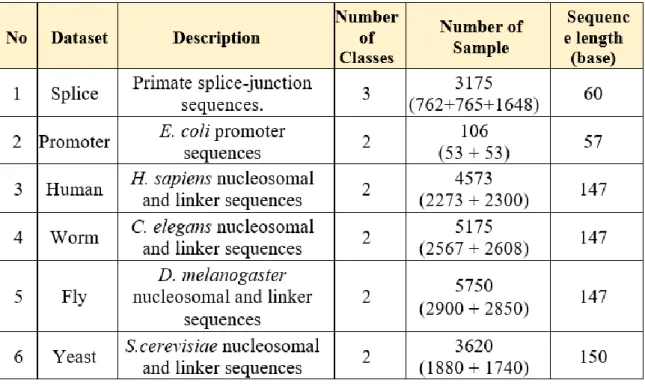
To demonstrate the validity of our method in dealing with DNA sequence classification problem, we evaluated our approach on six datasets (see Table 1).

Table 1. Description of datasets

(7)

4

3.2. Features

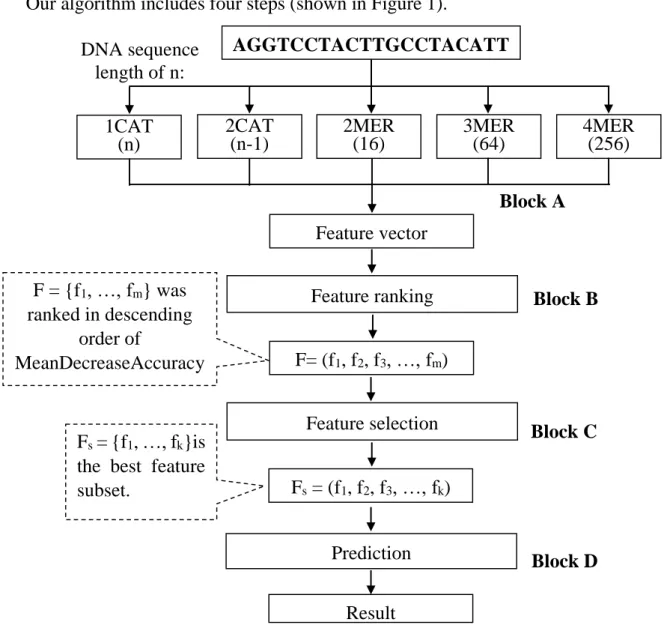
Our model used the combination of the five different vectors named as 1- categorical vector (1CAT), 2-categorical vector (2CAT), 2-mer vector (2MER), 3-mer vector (3MER), and 4-mer vector (4MER).

1CAT = (A

1

, A

2

, …, A

n

), where A

i

is a nucleotide at i

th

position, i = 1, 2, …, n.

2CAT = (B

1

, B

2

, …, B

n-1

), where B

i

is two consecutive nucleotides at i

th

and (i+1)

th

positions, i = 1, 2, …, n-1.

2MER, 3MER and (4MER)

The k-mer vector denoted as kMER is defined by kMER = (𝑐[𝑠

1

], 𝑐[𝑠

2

], …, 𝑐[𝑠

4𝑘

]), where 𝑐[𝑠

𝑖

] is a number of times that 𝑠

𝑖

occurs in s, i = 1, 2, …, 4

k

. 3.3. Algorithm

Our algorithm includes four steps (shown in Figure 1).

Figure 1. The flowchart of the proposed algorithm.

AGGTCCTACTTGCCTACATT DNA sequence

length of n:

1CAT (n)

2CAT (n-1)

2MER (16)

3MER (64)

4MER (256) Block A

Feature vector Feature ranking F= (f

1

, f

2

, f

3

, …, f

m

)

F

s

= (f

1

, f

2

, f

3

, …, f

k

) Feature selection

Prediction Result

Block B

Block C

Block D F = {f

1

, …, f

m

} was

ranked in descending order of

MeanDecreaseAccuracy .

F

s

= {f

1

, …, f

k

}is

the best feature

subset.

(8)

5

3.4. Feature Selection

The feature selection approach used in our research is a kind of greedy algorithm. It is a two-step feature selection approach.

Chapter 4 : Experimental Results and Discussion 4.1. Feature Ranking by Random Forest

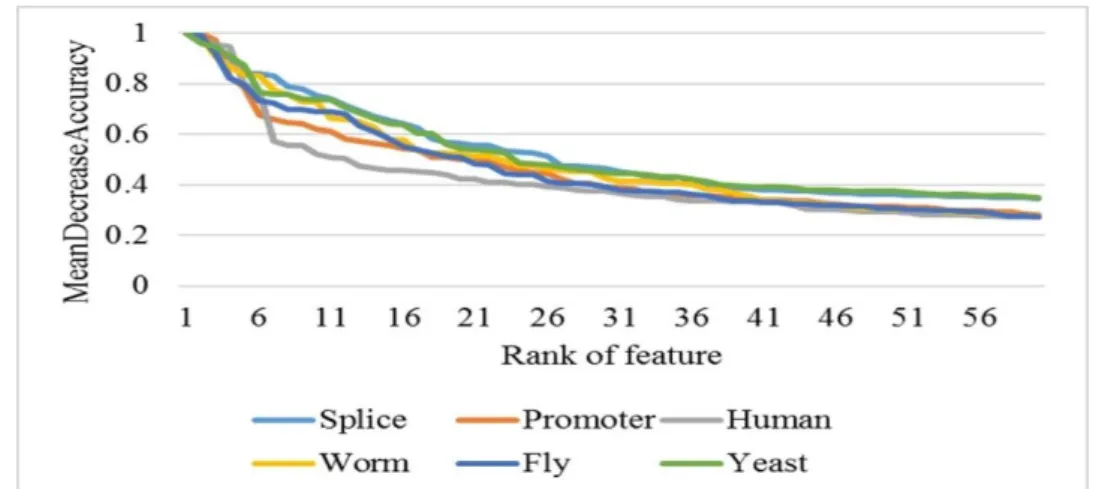
The relationship between rank and MeanDecreaseAccuracy normalized into the range of [0, 1] in each dataset is shown in the Figure 2.

Figure 2. MeanDecreaseAccuracy along feature ranking from top 1~ 60.

Features with high importance in validation datasets are listed in Table 2.

Table 2. List of important features.

4.2. Prediction Accuracy of Feature Subsets along Ranking

Prediction accuracies obtained by using either the whole set of features and the best

feature subset in step 1 is presented in Table 3.

(9)

6

Table 3. Prediction accuracies when using the whole set of features and the best feature subset in step 1.

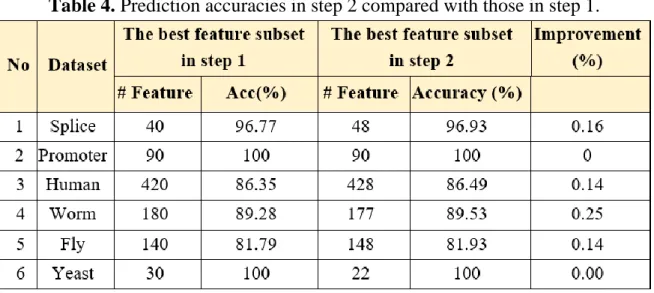
4.3. Prediction accuracy of neighbors around the best feature subset The results are shown in Table 4.

Table 4. Prediction accuracies in step 2 compared with those in step 1.

4.4. Evaluation

To evaluate the quality of our method, four following metrics were used:

accuracy, sensitivity, specificity and Matthews correlation coefficient.

We applied our model to classify the DNA sequences in the validation

datasets and compared its performance with the previous researches. For

evaluation, we mainly carried out 10-fold cross-validation, and then computed

average prediction results. With Promoter data, however, we employed leave-one-

out cross-validation due to the fact that the number of its samples is small, 106

samples.

(10)

7

4.5. Comparison with other methods

For splice and promoter datasets, we compared our model to model in [14]

(see Table 5).

Table 5. Accuracies of our model and model in [14].

For human, worm, fly and yeast datasets, we compared our models to methods in [1], [12], [15], [16], [17] on four metrics (Table 6).

Table 6. Performance comparison of our model and previous models.

Dataset Method Acc (%) Sen (%) Sp(%) MCC

Human Our method 86.33 89.77 82.93 0.73

iNuc-PseKNC [1] 86.27 87.86 84.70 0.73 iNuc-PseSTNC [12] 87.60 89.31 85.91 0.75

3LS [15] 90.01 91.69 88.35 0.80

TNS [15] 81.67 - - -

Worm Our method 89.35 92.45 86.30 0.79

iNuc-PseKNC [1] 86.90 90.30 83.55 0.74 iNuc-PseSTNC [12] 88.62 91.62 86.66 0.77

3LS [15] 87.86 86.54 89.21 0.76

TNS [15] 83.94 - - -

Fly Our method 81.75 79.14 84.40 0.64

iNuc-PseKNC [1] 79.97 78.31 81.65 0.60 iNuc-PseSTNC [12] 81.67 79.76 83.61 0.63

3LS [15] 83.41 84.07 82.74 0.67

TNS [15] 70.82 - - -

Yeast Our method 100 100 100 1.00

TNS [15] 100 - - -

Chen et al. [16] 98.10 98.20 98.00 0.96

Yi et al. [17] 99.06 - - -

(11)

8

4.6. Discussion and Conclusion

The combination vector can reflect not only the positional information (categorical features) of DNA sequence, but also the quantitative information (k- mer features) of sequence. It can characterize a genetic sequence. We proposed a simple but powerful model for solving DNA sequence classification problems. The model was tested on six different datasets. In terms of accuracy, sensitivity and MCC, our method achieved better performance than any other competing methods.

Therefore, it can be concluded that our model is effective for DNA sequence classification.

Chapter 5 : Summary and Future Research 5.1. Dissertation summary

The target of our research is to develop an effective framework for classification of fixed-length DNA sequences by using five feature vectors (1CAT, 2CAT, 2MER, 3MER and 4MER). So as to achieve better the performance, the two- step feature selection algorithm was also utilized. The proposed model in present thesis was evaluated on six benchmark datasets.

Four evaluation metrics (accuracy, sensitivity, specificity and Mathews correlation coefficient), 10-fold cross-validation were used to weigh our model.

Through the performance evaluation on six benchmark datasets of fixed-length DNA sequences, our algorithm achieved comparable or higher performance than other advanced algorithms. The most thing to note is that our model reaches the accuracy of 100 % on two datasets, promoter and yeast.

5.2. Future Research

Application of the proposed model to protein prediction.

For predicting beta-turns and beta-turn types, the combination of categorical

features with the below numerical features will be considered. These features are

Position Specific Scoring Matrices (PSSMs), predicted shape strings, and predicted

protein blocks. For phosphorylation site prediction, we will combine categorical

features with other numerical features used in the research of Ismail et al. [18].

(12)

9

Improving the performance of DNA sequence classification.

We will incorporate other numerical features used by previous studies into our model. These features consist of “Pseudo k-tuple nucleotide composition” [1] and

“General series correlation pseudo trinucleotide composition”) [19].

References

[1] S. H. Guo, E. Z. Deng, L. Q. Xu, H. Ding, H. Lin, W. Chen, and K. C. Chou,

"INuc-PseKNC: A sequence-based predictor for predicting nucleosome positioning in genomes with pseudo k-tuple nucleotide composition,"

Bioinformatics, vol. 30, no. 11, p. 1522–1529, 2014.

[2] N. M. Berbenetz, C. Nislow, and G. W. Brown, "Diversity of eukaryotic DNA replication origins revealed by genome-wide analysis of chromatin structure,"

PLoS Genetics, vol. 6, 2010.

[3] W. Chen, L. Luo, and L. Zhang, "The organization of nucleosomes around splice sites," Nucleic Acids Research, vol. 38, p. 2788–2798, 2010.

[4] S. Sonnenburg, G. Schweikert, P. Philips, J. Behr, and G. Rätsch, "Accurate splice site prediction using support vector machines," BMC Bioinformatics, vol.

8, no. Suppl 10, p. S7, 2007.

[5] a K. M. a Baten, S. K. Halgamuge, and B. C. H. Chang, "Fast splice site detection using information content and feature reduction," BMC bioinformatics, vol. 9, no. Suppl 12, p. S8, 2008.

[6] P. K. Meher, T. K. Sahu, A. R. Rao, and S. D. Wahi, "A statistical approach for 5’ splice site prediction using short sequence motifs and without encoding sequence data," BMC bioinformatics, vol. 15, no. 1, p. 362, 2014.

[7] P. K. Meher, T. K. Sahu, A. R. Rao, and S. D. Wahi, "A computational approach for prediction of donor splice sites with improved accuracy," Journal of Theoretical Biology, vol. 404, p. 285–294, 2016.

[8] G. Czibula, M. I. Bocicor, and I. G. Czibula, "Promoter sequences prediction Using Relational Association Rule Mining," Evolutionary Bioinformatics, vol.

8, pp. 81-196, 2012.

[9] A. Maleki, V. Vaezinia, and A. Fekri, "Promoter Prediction in Bacterial DNA

Sequences Using Expectation Maximization and Support Vector Machine

Learning Approach," Data Mining in Genomics & Proteomics, vol. 6, no. 2,

2015.

(13)

10

[10] H. Lin, E. Z. Deng, H. Ding, W. Chen, and K. C. Chou, "IPro54-PseKNC: A sequence-based predictor for identifying sigma-54 promoters in prokaryote with pseudo k-tuple nucleotide composition," Nucleic Acids Research, vol. 42, no. 21, p. 12961–12972, 2014.

[11] X. Yi, Y.-D. Cai, Z. He, W. Cui, and X. Kong, "Prediction of nucleosome positioning based on transcription factor binding sites," PLOS one, vol. 5, no.

9, p. 1–7, 2010.

[12] M. Tahir and M. Hayat, "iNuc-STNC: a sequence-based predictor for identification of nucleosome positioning in genomes by extending the concept of SAAC and Chou’s PseAAC," Molecular BioSystems, vol. 12, p. 2587–2593, 2016.

[13] M. Hossin and M. N. Sulaiman, "A review on evaluation metrics for data classification evaluations," International Journal of Data Mining & Knowledge Management Process, vol. 5, no. 2, 2015.

[14] N. G. Nguyen, V. A. Tran, D. L. Ngo, D. Phan, F. R. Lumbanraja, M. R. Faisal, B. Abapihi, M. Kubo, and K. Satou, "DNA Sequence Classification by Convolutional Neural Network," J. Biomedical Science and Engineering, vol.

9, no. 9, p. 280–286, 2016.

[15] A. Awazu, "Prediction of nucleosome positioning by the incorporation of frequencies and distributions of three different nucleotide segment lengths into a general pseudo k-tuple nucleotide composition," Bioinformatics, vol. 33, no.

1, p. 42–48, 2017.

[16] W. Chen, P. Feng, H. Ding, H. Lin, and K. C. Chou, "Using deformation energy to analyze nucleosome positioning in genomes," Genomics, vol. 107, no. 2–3, p. 69–75, 2016.

[17] X. F. Yi, Z. S. He, K. C. Chou, and X. Y. Kong, "Nucleosome positioning based on the sequence word composition," Protein and Peptide Letters, vol. 19, pp.

79-90, 2012.

[18] H. D. Ismail, A. Jones, J. H. Kim, R. H. Newman, and D. B. KC, "RF-Phos: A Novel General Phosphorylation Site Prediction Tool Based on Random Forest,"

BioMed Research International, vol. 2016, 2016.

[19] W. Chen, T. Y. Lei, D. C. Jin, H. Lin, and K. C. Chou, "PseKNC: a flexible

web server for generating pseudo K-tuple nucleotide composition," Analytical

biochemistry, vol. 456, pp. 53-60, 2014.

Table 1. Description of datasets
Figure 1. The flowchart of the proposed algorithm.
Figure 2. MeanDecreaseAccuracy along feature ranking from top 1~ 60.
Table 4. Prediction accuracies in step 2 compared with those in step 1.
+2

参照

関連したドキュメント

At Geneva, he protested that those who had criticized the theory of collectives for excluding some sequences were now criticizing it because it did not exclude enough sequences

In this, the first ever in-depth study of the econometric practice of nonaca- demic economists, I analyse the way economists in business and government currently approach

An easy-to-use procedure is presented for improving the ε-constraint method for computing the efficient frontier of the portfolio selection problem endowed with additional cardinality

The inclusion of the cell shedding mechanism leads to modification of the boundary conditions employed in the model of Ward and King (199910) and it will be

Therefore, with the weak form of the positive mass theorem, the strict inequality of Theorem 2 is satisfied by locally conformally flat manifolds and by manifolds of dimensions 3, 4

Using right instead of left singular vectors for these examples leads to the same number of blocks in the first example, although of different size and, hence, with a different

Then it follows immediately from a suitable version of “Hensel’s Lemma” [cf., e.g., the argument of [4], Lemma 2.1] that S may be obtained, as the notation suggests, as the m A

We provide an efficient formula for the colored Jones function of the simplest hyperbolic non-2-bridge knot, and using this formula, we provide numerical evidence for the