Style‑shifting as an Act of Social Identity among Young Japanese People in Australia
journal or
publication title
Global communication studies
number 9
page range 187‑216
year 2020‑03
URL http://id.nii.ac.jp/1092/00001675/
asKUIS 著作権ポリシーを参照のこと
Style-shifting as an Act of Social Identity among Young Japanese People in Australia
K
ITAMURAKoichiro
The present paper makes an analysis of the way in which people and structures are interdependent by focusing on linguistic signs, particularly the style-shifting between polite and plain forms in Japanese. The motivation for the linguistic choice and its function in social interactions are analyzed based on the fi ndings reported in Kitamura (2019) as a result of the fi eld work in a group of Japanese Working Holiday makers in Australia. In reference to the distribution of polite forms observed in discourse analysis and the sense of solidarity investigated through questionnaire survey, this paper attempts to elaborate on social and psychological source behind their linguistic practice shared among members of the Japanese speech community abroad. The use of plain forms is widely recognized as a linguistic practice diagnostic of the group and most notably realized when highlighting their shared interests in the scheme. However, their perspectives towards the linguistic choice are not always matched.
Style-shifting can be viewed both as an action to nurturing the sense of solidarity within the in-group members and to distancing from such sub-culturally constituted circle of Working Holiday makers. Such a mismatch in the notion of the linguistic signs is realized in the opposite direction of style-shifting in their ongoing interactions. Style-shifting is in this sense to be defi ned as a linguistic practice generative of and generated by an act of identity.
Keywords: Politeness, Style-shifting in Japanese, Discourse Analysis, Social identity, Working Holiday makers
1. Introduction
The present paper deals with the investigation of the way in which people and structures are tangled up in each other by focusing on a linguistic practice, particularly the style choice
between formal and plain forms, or “mas-form” and “ø-form”1) in Japanese discourse. The research question is to refi ne the meaning of style- shifting by elaborating on how the knowledge of socially and culturally constructed linguistic norms on mas-form/ø-form and linguistic practice according to the knowledge are correlated.
Style-shifting from one form to the other is observed in ongoing social interactions taking place in a particular speech community: a group of Japanese Working Holiday makers in Australia. In the course of discourse analysis on their essays and conversations as well as questionnaire surveys, Kitamura (2019) argues, despite an unfavorable view that the group of young Japanese people overseas is not sophisticated in maintaining their speech level in a proper manner, that style-shifting is a meaningful linguistic practice through which they defi ne and redefi ne their social relationships with each other in a culturally characterized context.
Based on the distribution of the participants’ mas-form marking in both written and spoken discourse and the description of their images about a typical Working Holiday maker illustrated in the previous study, this paper will further inquire into how the meaning of style-shifting is actually exchanged by the group of young Japanese people in Australia. Since there is a relatively high degree of consistency observed in the way they make the style choice between mas-form and ø-form, it is feasible to characterize a linguistic norm diagnostic of Working Holiday makers.
It is expected that a particular meaning of using the linguistic forms should be appropriated in ongoing social interactions among them, and sharing the extended meaning in turn contributes to constituting and maintaining the linguistic practice as meaningful in the circle of Working Holiday makers. If the appropriation of the knowledge itself is an action carried out through linguistic socialization in the culturally characterized context, the selective use of the linguistic signs can be regarded as a part of social and
cultural practice.
Since an exposure to or access to the fi gured world of Working Holiday makers varies from individual to individual, the appropriation of their schematically stored knowledge of its linguistic norm must be realized differently. The involvement in the culturally particular linguistic community should be defi ned in sociocentric terms, as the group of young people tends to monitor their actions in relation to others in the same group. The treatment of mas-form and ø-form in expressing their social identity is correlated with socially constructed views of the self in relation to a context including other participants. This study is to defi ne style- shifting to be both a result and cause of an act of identity linguistically realized in ongoing social interactions people are autonomously engaged in.
2. Background
This paper bases its theoretical foundations on linguistic politeness in Japanese reviewed in Kitamura (2016) and its methodological framework for discourse analysis and questionnaire survey reported in Kitamura (2019).
The previous studies (Maynard, 1991,1997; Usami, 2002;
Mimaki, 2013) have suggested that a dimension of solidarity as well as formality is operative in the style choice between mas-form and ø-form. However, Kitamura (2016) points out that, in order to seek a correlation of the social and psychological forces behind the linguistic choice, the notion of solidarity needs to be elaborated on particularly in Japanese terms. Crucial to linguistic politeness in Japanese is that style-shifting is codetermined by a range of cultural values, or the two contrasting but shifting parameters of uchi and soto (i.e. in-group and out-group). Moreover equally important is the fact that, due to its fl uid nature of the parameters, the frame of social relationships and contexts is not fi xed but consistently
negotiated in ongoing social interactions.
The motivation for style-shifting from one form to the other is therefore to be discussed further by examining how people extensively relativize a boundary of in-group and out-group relationships with each other in their social encounters. Kitamura (2019) indicates, in a case study on the management of mas-form among a group of Japanese Working Holiday makers in Australia that consist of eight informants of similar age, between 18 and 24, who are from various parts of Japan with Working Holiday visa (i.e.
termed as male Speaker (a) (b) (c) (d) and female Speaker (E) (F) (G) (H) for convenience), that the sense of in-group identity would be a key to investigating their linguistic practice.
2.1. Results of Questionnaire Survey
For the analysis of social and psychological sources for nurturing the sense of in-group identity among young Japanese people staying in Australia, Kitamura (2019) illustrates the results of the questionnaire survey on their understanding about the Working Holiday scheme provided by eight participants of the scheme. The goal of the survey is to specify their shared interests that nurture a sense of solidarity that affects their linguistic practice.
As to the self-categorization, all of the informants claim their social or occupational status as “a Working Holiday maker,” no matter what jobs or activities they are currently engaged in. It is reported that the term Working Holiday maker is applied not simply to a visa holder, but moreover to a distinctive social status beyond such categories as a student of English language school, a waiter of Japanese restaurant, or even any identities attribute to their former jobs in Japan.
Furthermore, as to their notion of the Working Holiday scheme, they describe it as the most attractive option that enables its visa holders to achieve various goals: to develop English skills, make a
trip around Australia, make new friends, and experience different culture, and so forth. As their answer to the question of what a typical Working Holiday maker would be like, the description in the top list is a person who “enjoys round” (100%) followed by
“shares accommodation with friends and “spend little money”
(75%), “studies English at language school” and “works in Japanese restaurant” (65%) and “speaks friendly without any polite forms”
(50%). The word “round” is an expression favorably shared among the Working Holiday makers which is synonymous with sightseeing, yet more likely to indicate a long term trip with small funds like backpackers often do by staying at campsites and cheap lodging houses.
It is indicated in Kitamura (2019) that their description of
“round” as an activity typical of Working Holiday scheme would refl ect a strong tendency for Japanese Working Holiday makers to be engaged in traveling as though it were the main purpose of the scheme. The consensus on the image among the informants does not seem to be accidental since such a stereotypical view of Working Holiday makers as enthusiastic travelers under the name of “round”
can be found in many Japanese publications or web sites that feature the scheme.
2.2. Results of mas-form marking in Written Discourse The questionnaire survey on the eight informants’ understanding about the Working Holiday scheme takes up their common interests as a source of solidarity over social distance or power differential.
In order to inquire into the way a sense of in-groupness among Working Holiday makes is realized linguistically, Kitamura (2019) attempts to make an analysis on the use of mas-form in the two pages of essays written by the informants to two different target readers in mind. They are requested to write a story about their experiences related to the Working Holiday scheme to Japanese
Working Holiday makers in the fi rst page, and again the same story but to Japanese university students in Australia in the second page.
The aim of the task is to investigate if their style choice is made differently depending on the two types of readers. It is posited, if a sense of in-group is being operative, that the Working Holiday makers should use mas-form less in writing to the in-group members than to the out-group ones, which leads to refl ect a gap in their psychological distance between them. The distribution of mas-form used by the eight informants is illustrated in Kitamura (2019:155) as follows.
to Working Holiday Makers to University Students Speaker (a)
Speaker (b) Speaker (c) Speaker (d) Speaker (E) Speaker (F) Speaker (G) Speaker (H)
0 (0%)
8 (82%)
0 (0%)
0 (0%)
4 (57%)
0 (0%)
0 (0%)
0 (0%)
8 (100%) 11 (100%)
0 (0%)
0 (0%)
10 (83%)
0 (0%)
0 (0%)
11 (100%) Table 1: The distribution of mas-form in essays
2.3. Results of mas-form marking in Spoken Discourse
For the investigation of style-shifting practiced by a group of young Japanese people staying in Australia in ongoing social interactions, Kitamura (2019) has illustrated the distribution of polite forms in eight conversations exchanged by the eight informants participating in the Working Holiday scheme.
Within each conversation, the initial 2-minute segments and the last 1-minute segments are extracted in order to examine some changes in the way the informants treat polite forms during their conversations. The description of the eight conversational partners
is made in Kitamura (2019:145) as in the following table, with their age and use of mas-form, followed by the numbers and percentages of mas-form marking observed in each conversation.
Pair Speaker Age UseTotal 3 minutes
First 2 minutes
Last 1 minute
Style Shifting 1 Friends (a)
(H) 23 24
No No
0 (0%) 0 (0%)
0 (0%) 0 (0%)
0 (0%) 0 (0%)
З
—Ð 2 Friends (b)
(F) 24 24
Yes Yes
18 (29.5%) 10 (16.4%)
12 (29.3%) 6 (14.6%)
6 (30.0%) 4 (20.0%)
0.7% up 5.4% up 3 Strangers (b)
(G) 24 23
Yes Yes
2 (3.7%) 2 (3.7%)
2 (5.9%) 2 (5.9%)
0 (0%) 0 (0%)
5.9% down 5.9% down 4 Strangers (F)
(G) 24 23
Yes Yes
6 (10.5%) 4 (7.0%)
6 (15.8%) 4 (10.5%)
0 (0%) 0 (0%)
15.8% down 10.5% down 5 Strangers (a)
(E) 23 24
No Yes
0 (0%) 6 (8.6%)
0 (0%) 6 (12.2%)
0 (0%) 0 (0%)
З
12.2% down 6 Strangers (a)
(b) 23 24
Yes Yes
12 (30.8%) 20 (51.3%)
4 (16.0%) 15 (60.0%)
8 (57.1%) 5 (35.7%)
41.1% up 24.3% down 7 Friends (b)
(c) 24 24
No No
0 (0%) 0 (0%)
0 (0%) 0 (0%)
0 (0%) 0 (0%)
З
З
8 Friends (a) (d)
23 18
No No
0 (0%) 0 (0%)
0 (0%) 0 (0%)
0 (0%) 0 (0%)
З
З
Table 2: The distribution of mas-form in conversations
In order to overview each informant’s management of mas-form and ø-form, the eight conversations are categorized into four types in Kitamura (2019:151) as illustrated in the table below.
3. Discussion
It is true that those who hold the Working Holiday visa could be grouped as Working Holiday makers; however, it is not plausible to interpret that just holding the same visa itself would encourages them to build a sense of in-group feelings with one another. The group of young Japanese people in Australia may fi gure themselves as in-group members, when they fi nd something special in common:
the same goals to achieve, same activities to take part in, or anything typical of Working Holiday makers in interacting with each other in the speech community.
As a result of the questionnaire survey, their goals of and interests in the Working Holiday scheme are described as a clue to explaining the way one may or may not locate him/herself in an in-group relationship. Based on the distribution of mas-form illustrated above, this study deals with the investigation on how a sense of solidarity is refl ected linguistically by analyzing the style choice between mas-form and ø-form in the essays provided by the informants of Working Holiday makers.
Furthermore, through discourse analysis on their conversations, the investigation is developed to inquire into the process of style- shifting or how the meaning of mas-form and ø-form is actually exchanged, negotiated and shared or not shared in their ongoing social interactions. This research is to shed light on a correlation
Type Conversation Pair mas-form marking Result
1 1・7・8 Friends 0% Stable
2 3Ð・4・5 Strangers 0%〜15% Decreasing
3 2 Friends 15%〜30% Stable
4 6 Strangers 30%〜 Increasing
Table 3: The category of the 8 conversations
between style-shifting and an act of social identity by demonstrating how extensively the location of self in terms of the dichotomy of in-group and out-group is realized linguistically in Japanese communication.
3.1. Style Choice in Essays
The informants except two speakers show a consistency in style in both the fi rst and the second essays as pointed out in Kitamura (2019). In Table 1, when excluding the co-occurrence of mas-form and ø-form in self-addressed speech or as a result of presenting backgrounded information, there is virtually no style mixture observed in the two contrasting essays presented by Speaker (b), (c), (d), (E), (F), and (G). Speaker (b) and (E) employ mas-form, while Speaker (c), (d), (F), and (G) use ø-form in presenting their essays. Important to note is the complementary distribution observed in Speaker (a)’s and (H)’s essays. Although the two speakers completely disregard mas-form in writing to Working Holiday makers, they employ mas-form in every sentence to university students.
It is widely recognized that a lack of mas-form is not favored in the fi rst contact situation especially when age and social positions are not known, since it can be taken as an offense against the participants of senior or higher status. However, there are many cases in which mas-form is not employed in communication among Working Holiday makers. The results of the previous survey show half of the informants mention the linguistic behavior (i.e. “speaks friendly without any polite forms”) as one of their salient characteristics. The different style choice made by Speaker (a) in writing to Working Holiday makers and to university students may well demonstrate an example of such cases.
e.g. 1. The essay presented by Speaker (a)2)
To Japanese Working Holiday makers
L.1: Ho: mu-sutei saki no maza: ni ko:hi:-shoppu no arubaito wo susumete-morai, O:ji: to isshyoni hataraku koto ga dekite yoi keiken ni nat-teru-yo
[homestay place GEN / mother / by / coffee shop GEN / part-time job ACC / encourage-give / OZ / with / together / work NOM / be able to / good / experience / turn out to be PARTICLE]
‘The mother of my host family was kind enough to encourage me to work in a café, which turned out to be a very good experience for me because I’ve got a chance to work with Australian people.’
To Japanese university students in Australia
L.1: Hosuto-maza: no susume de ko:hi:-shoppu de hataraite- mas-u.
[host-mother GEN / encouragement / by / café / in / work-MAS]
‘With the advice from my host mother, I started working in a café.’
L.2: Mawari ga subete O:ji: nanode, Eigo wo tsukawa- nakutewa-ike-mas-en.
[around NOM / all / be OZ / because, / English ACC / use-must-MAS]
‘Since the staff are all Australians, I have to use English.’
L.3: Gakkou de tomodachi to hanasu Eigo to wa chigai, totemo hayaku, wakara-nai toki mo takusan aru-no-des-u ga, totemo yoi keiken to natte-i-mas-u.
[school / at / friends / with / speak / English / with TOP / be different, / very / fast, / understand NEG / when / also / many / be-MAS but, / very/ good / experience / that / turn out to be-MAS]
‘Unlike the way we speak English with friends (among
L2 speakers) at a language school, they speak so fast that it is often diffi cult for me to catch what they say. But it turns out to be a very good experience.’
It is realized that Speaker (a) never fails to employ mas-form to university students, though he disregards it to Working Holiday makers in presenting the same story. For example, the description of his part- time job to ‘be very good experience’ is made in mas- form (yoi keiken ni natte-i-mas-u) in L.1 to the former group, while the same description is made in ø-from (yoi keiken ni nat-ø-ta-yo ) in L.3 to the latter group. Evidenced in the use of a sentence fi nal particle, emphasizing “yo,” his speech is directed to Working Holiday makers in an interactive manner.
Furthermore, a gap in the number of sentences between the two versions can be interpreted as a sign of Speaker (a)’s different perspectives towards the audience. The gap can indicate his assumption that the audience of Working Holiday makers and university students should have different understandings on the activity. On the one hand, to Working Holiday makers, Speaker (a) writes about his experience in a single sentence. The brief description may suggest Speaker (a)’s expectation that the group of Working Holiday makers should take it as attractive activity. To university students, on the other hand, Speaker (a) writes the same story in three sentences. The detailed explanation indicates that he is not certain if the group of university students would understand what is so special about working with Australian people for Japanese Working Holiday makers. The difference in the organization between the two essays is derived from the Speaker (a)’s recognition of himself in in-group relationships with other Japanese Working Holiday makers. The use of ø-form can be regarded as a useful means to assert his interests in sharing a joy of Working Holiday activities among them.
It is demonstrated that a key to answer for Speaker (a)’s style choice between mas-form and ø-form should lie in the recognition of his interpersonal relationships. The motivation for his linguistic choice is explained in terms of the difference in his perspectives towards the target readers of Working Holiday makers and of university students. The positon of self that Speaker (a) would relativize with the two groups of audience is defi ned in terms of in- group versus out-group axis. As it is discussed in Kitamura (2016), a sense of in-groupness presupposes the recognition of oneself as a member of a particular group. The location of oneself as a Working Holiday maker in this case can be a basis of in-group feelings. The use of ø-form is therefore regarded as a form of “contextualization cues” (Gumperz,1982:131), to asserting emotional appeals to the fi gured in-group members of the Working Holiday circle.
What is inferred from the analysis of the essays is that ø-form is preferably used as a sign of asserting the informants’ social identity as a Working Holiday maker in expressing their interests to those who share the identity. However, it is also important to recognize that the linguistic norm is not always agreed by everyone who participates in the Working Holiday scheme. In fact, as mentioned earlier in the results of questionnaire survey, while Speaker (a), (E), (F) and (G) give rather a positive remark on the absence of polite forms as a sign of being ‘friendly,’ Speaker (b) conversely gives a negative remark on the same linguistic practice as a sign of showing little courtesy to elder people. Speaker (b)’s belief on linguistic manners is expressed in his essay.
e.g. 2. The essay presented by Speaker (b) To Japanese Working Holiday makers
L.2: Keigo ga tsukaenai koto nado wa yoi koto de wa nai to omoi-mas-u-yo.
[honorifi cs ACC / can use-NEG / that TOP / be
good-NEG / thing / that / think-MAS-PARTICLE]
‘Not being able to use honorifi cs is not a good thing, I think, you know (I’m telling you).’
To Japanese university students in Australia
L.2: Keigo wo matomoni tsukae-nai shitsureina hito ga ooi you- des-u.
[honorifi cs ACC / properly / can use-NEG / impolite / people NOM / many / exist/ seem / be-MAS]
‘It seems that there are many people (among Working Holiday makers) who cannot use honorifi cs properly.’
As illustrated in Table 1, Speaker (b) shows mas-form marking equally in writing essays to Working Holiday makers as well as to university students. His account to university students is more likely to be informative in that he simply displays his idea of undesirable behaviors of Working Holiday makers, whereas he employs a sentence fi nal particle “yo” to emphasize his negative evaluation to Working Holiday makers. The use of the sentence fi nal particle contributes to make his speech interactive, persuasive, or even accusing to Working Holiday makers. The Speaker (b)’s use of mas-form may be interpreted as a distancing speech act that appeals a sense of out-groupness.
A question is, if their notion of mas-form and ø-form is not shared, what meanings the use of the linguistic signs comes to possess in their communication. In order to explore the meaning of their linguistic practice being exchanged or negotiated between Working Holiday makers, the process of style-shifting between mas-form and ø-form should be further analyzed in their ongoing social interactions.
3.2. Style-shifting in Conversations
The meaning of style-shifting between mas-form and ø-form is
not solely determined by the speaker himself/herself. In order for the linguistic practice to be recognized as meaningful in conversations, there needs to be cooperation of participants in working out such textual and interactional functions indexed by them. From the results of categorizing eight conversations exchanged by the Working Holiday makers into four types in Table 3, Conversation 3, 4, and 5 in Type 2 and Conversation 6 in Type 4 are expected to show the process of negotiation on the meaning of using or not using mas-form, since they are the conversations where the informants practice style-shifting in the fi rst contact situation.
The following sections deal with the investigation of how the meaning of their style choice is actually shared or not shared between the participants by analyzing their negotiation being made in the two types of conversations.
3.2.1. Style-shifting to the Same Direction
The tendency of the Japanese Working Holiday makers to prefer ø-form is observed in Conversation 3 between Speaker (b) and (G).
However, in the fi rst contact situation, their style choice is not fi xed from the beginning but rather being made in the course of their conversations. The process of their style-shifting is realized in the fi rst 2 minutes.
e.g. 3. Conversation 3 between Speaker (b) and (G)
T.1: (G) E, ima nani yatte-ru-n-des-u-ka. | Nanno baito wo ... | [well, /now / what / be-MAS-Q / what / part time
job ACC]
‘Well, what do you do? I mean, what kind of part time job…’
(b) | Kicchin-hando des-u. | [Kitchen hand / be-MAS]
‘I am a kitchen maid.’
T.2: (G) Kicchin-hando? E, nanika tuskut-tari shiteru-n-des-u- ka.
[kitchen maid / Well, / something / cook and / do- MAS-Q]
‘Kitchen maid? Then, you cook something?’
(b) Un, sara-arai ga kihon-na-n-des-u kedo, tamani-ne.
Isogashiku-nat-tara o:da: wo ippai tot-tari mo shi- mas-u-yo.
[yes, / dish-wash NOM / basic / be-MAS / but / sometimes PARTICLE. busy become if / order ACC / lot / take / also / do-MAS PARTICLE]
‘Well, washing dishes is my main job but I cook sometimes, yes. When we are busy, I also take orders, you know?’
T.18: (G) Ima shika nai
[now / only / be NEG]
‘It is the last chance for me (to be a Working Holiday Maker).’
(b) E, sonna Wa:hori girigiri te wake jya-nai des-u-yo-ne?
[oh, / so / Working Holiday / to the limit / that / situation / be-NEG-MAS PARTICLE PARTICLE]
‘Oh, you are not even close to the age limit to participate in the Working Holiday scheme, are you?’
T.19: (G) Girigiri… ma, kotoshi 4 ni naru-n-da kedo
[limit… / well, / this year / 4 / to / become / that / be / but]
‘Very close… I mean, I will be 24 (years old) this year.’
(b) A, sokka. Jya, 5 de 1-nen mae da-ne
[oh, / I see. / that is / 5 / by / 1 year / before / be PARTICLE]
‘I get it. So, you mean, just one year left if you were 25.’
T.20: (G) Girigiri de wa nai kedo.
[limit TOP / be NEG / but]
‘Not as that close (to the age limit) Still (it would be the last chance).’
(b) Aa: sou.
[oh, I see]
‘I see.’
It is noticeable that Speaker (G) and (b) begin their conversation by exclusively using mas-form to each other. However, it does not take long before they shift their styles to ø-form.
As to the style-shifting observed in Speaker (G)’s utterances, the results of the questionnaire survey provide a clue in considering her motivation to go without mas-form. As evidence from her description of a typical Working Holiday maker, Speaker (G) should have access to or exposure to the linguistic norm diagnostic of the group (i.e. “speaks friendly without any polite forms”).
Taking her positive remark on the absence of mas-form into consideration, Speaker (G)’s motivation for her style-shifting to ø-form in Conversation 3 can be interpreted as an accommodating speech act to highlighting their equality or solidarity between those who share the same goals and interests in the Working Holiday scheme. The topic regarding to the scheme, or its age limitation, may be considered as one of the important factors that encourage her to be conscious of in-groupness and choose a preferable style in associating with the other Working Holiday maker, Speaker (b).
The tendency of Speaker (G) to shift her style from mas-form to ø-form in the early stage of the fi rst contact situation can also be observed in her conversation with Speaker (F). As illustrated in Table 2, the number of their mas-form making in Conversation 4 in
fact shows a rapid decrease, i.e. from 10.5% to 0% by Speaker (G) and from 15.8 to 0% by Speaker (F) respectively. When analyzing the process of their style shifting in Conversation 4, it becomes apparent that both Speaker (G) and (F) disregard the use of mas- form, right after they start talking into shared goals, interests, and experiences in Australia as Working Holiday makers. However, in Conversation 3, it should be noted that Speaker (G)’s accommodating speech act to Speaker (b) may not be successful in the sense that their linguistic norms are not likely to be shared mutually.
Although Speaker (b) disregards the use of mas-form almost at the same phase in Turn 19, his style-shifting should be interpreted in terms of a different set of linguistic norms. A key to explore the motivations for his style choice can be found in the results of the questionnaire survey and his essay. For example, Speaker (b) presents his negative remarks on a typical Working Holiday maker as a person who “has little courtesy in speaking to elder people”
(Kitamura, 2019:154). Moreover, considering his complaint on some Working Holiday makers who “cannot use honorifi cs properly” illustrated in his essay in e.g. 2 above may well support the view that Speaker (b) does not appreciate the extended way of using ø-form as a sign of nurturing a sense of solidarity among Working Holiday makers. It is interpreted that his style choice should be disciplined by seniority in age differential.
In fact, in Conversation 3, Speaker (b) never fails to use mas- form until he gets to know his interlocutor’s age. It is noticeable that he actually manages to fi gure out how old Speaker (G) is in Turn 18. Confi rming that she is not as old as he is, Speaker (b) begins shifting his style to ø-form in Turn 19, and thereafter no single sign of mas-form is observed in his speech. For Speaker (b), the meaning of style-shifting to ø-form in Conversation 3 is interpreted to be derived from the assertion of his seniority over Speaker (G).
A discrepancy between Speaker (G) and (b) is realized not only in their understanding of linguistic practice, but also in their attitudes towards goals in the Working Holiday scheme. Such a mismatch is most notably realized in their treatment of the word
“round” in the following piece of conversation.
e.g. 4. Conversation 3 between Speaker (b) and (G) T.138: (b) 10-gatsu ni nat-tara, hikkos-ou to omou
[October / in / become / and, / move / intend / that / think]
‘I think I am moving in October.’
(G) Dokoni ? [where]
‘To where?’
T.139: (b) Meruborun [Melbourne]
‘Melbourne.’
(G) Meruborun, Fu:n, ii-ne
[Melbourne, / aha / good PARTICLE]
‘Melbourne. Oh, that’s great.’
T.140: (b) Un [yeah]
‘Sure.’
(G) Raundo | ni iku … | [Round | to / go …|]
‘You are going “round” …’
(b) | Raundo? |
[Round?]
‘Round?’
(G) de soko-kara … ue ni agat-te-iku?
[and / there / from /… up / to / rise / go]
and from there … going up (to the North)?’
T.141: (b) A, iya, Raundo jya naku-te Meruborun ni sumu-no.
[umm, / no, / round / be NEG / Melbourne / in / live PARTICLE]
‘Umm, no, it’s not “round.” I am going to live in Melbourne.’
(G) Ah…
[oh]
‘Oh, okay...’
T.142: (b) Sono ato ryokou iku-n-datara, iku kamo-shirenai.
[that / after / travel / go if / go / may]
‘After that, I’m not sure yet, but I will probably go to travel.’
(G) Fu:n
[aha]
‘I see.’
T.143: (b) E, dou suru-no, kore kara?
[well, / how / do Q / now / from]
‘Well then, what are you going to do?’
(G) Watashi mo, 11 gatsu koro kara raundo ni deru yotei.
[I TOP also, / November / about / from / round / to / out / plan]
‘I also have a plan to go “round” perhaps in November.’
Both Speaker (b) and (G) are talking about a plan to go out of Sydney. Important to note is that the way they call it is different.
Unlike the other informants, Speaker (b) avoids using the term
“round” in describing his plan to move to Melbourne and travel around Australia. In fact, in Turn 140, when Speaker (G) is about to ask if his “round” plan is going up to the North from Melbourne and going around Australia, Speaker (b) immediately responds to the vernacular term, which results in the overlap. Instead of
answering the Speaker (G)’s question, Speaker (b) gives priority to object to her interpretation (i.e. “Round?”) in Turn 140 and corrects the expression in a strongly emphasizing way (i.e. No, it’s not “round.”) in Turn 141.
It is interesting to note that, although the Speaker (b)’s plan to live in Melbourne may not be called as “round,” his plan “to travel (i.e. ryokou in Japanese)” mentioned right after in Turn 142 is nothing but a “round” plan in Speaker (G)’s understanding. It is also interesting to fi nd that Speaker (G) maintains the term “round”
in describing her plan. The use of the topic marker in Japanese (i.e.
not “watashi wa” but “watashi mo”) indicates that Speaker (G) treats the Speaker (b)’s travel plan in the same way as her “round”
plan (i.e. ‘I “also” have a plan to go “round.”’).
It is certain that Speaker (b) does understand the meaning of the word “round.” In fact, in the results of the questionnaire survey, all the eight informants including Speaker (b) mention the word
“round” in describing images of a Working Holiday maker. It is inferred from his obvious avoidance of the specifi c term “round”
that Speaker (b) would not feel comfortable to be treated as an in- group member of the Working Holiday circle. Speaker (b)’s action derived from his social identity will be characterized by focusing on his style choice in conversation with another informant from the group of Working Holiday makers.
3.2.2. Style-shifting to the Opposite Direction
Conversation 6 categorized into Type 4 in Table 3 is distinctive, due to the high degree of style-shifting practiced by each of the participants. There appears a difference between Speaker (a) and (b) in their styles from the beginning observed in the fi rst 2-minute segment of their conversation: the former begins his conversation in ø-form and the latter in mas-form. Furthermore, as illustrated in Table 2, it is remarkable enough to point out that the two speakers
show their style choice in the opposite ways in the last 1-minute segment. While Speaker (a) increases the use of mas-form by 41.1%, Speaker (b) decreases it by 24.3%.
The difference is not only in the choice of the linguistic signs itself, but also in the way they practice them. In analyzing the results of the questionnaire survey as well as the distribution of mas-form listed in Table 1 and 2, it becomes apparent that the two speakers do not make their style choice based on the same grounds, since they do not share the meaning of using mas-form and ø-form in the fi rst place.
On the one hand, as evidenced in the distribution of mas-form marking in his essays in Table 1 and in Conversation 1, 5, and 8 in Table 2, Speaker (a)’s style choice is not likely to be conditioned based on age factors or gender orientations. In fact, there is no single sign of mas-form observed in Speaker (a)’s utterances in conversation with the other Working Holiday makers of different age and gender. Nor is there any single sign of mas-form observed in his essay written to Working Holiday makers, in contrast with the exclusive use of mas-form to the other counterparts (i.e.
Japanese university students). The selective use of ø-form can therefore be interpreted an assertion of his social identity as a Working Holiday maker.
One the other hand, as discussed earlier, it is obvious that Speaker (b)’s choice of using or not using mas-form is largely determined by his seniority in age differential. What he is concerned about is how old his conversation partner is, rather than whether he or she is a Working Holiday maker or not. Therefore, Speaker (b) employs mas-form carefully in conversation with strangers in the fi rst contact situation.
Different style choices are often observed when there is social distance mutually recognized between participants in the conversation. However, in the case of the conversation between
Speaker (a) and (b), their psychological distance is not realized from the beginning but rather created through their interactions.
e.g. 5. Conversation 6 between Speaker (a) and (b) T.4: (b) Hokkaidou isshyuu shimashita?
[Hokkaido / one-round / do-MAS-PAST?]
‘Did you travel around Hokkaido?’
(a) Un, hotondo zenbu [yeah, almost all]
‘Yeah, almost all the areas.’
T.5: (b) Hou. Ano, “Notsukezaki” te, iki-mas-hi-ta?
[wow, well “Notsukezaki” that, go-MAS-PAST]
‘Wow. Then, did you go to a place called “Notsuke- zaki”?’
(a) Notsukezaki, … te doko?
[Notsukezaki … that / wher]
‘Notsukezaki … where’s that?’
T.6: (b) Ano, kocchino, , [that / this way…]
‘Well, that is like…’
(a) Un
[aha]
‘A-ha.’
T.7: (b) Kushiro no kita ni kou … kou-natte-r-u jya-nai-des-u- ka
[Kushiro GEN / north / like… / this shape / be- NEG-MAS-Q]
‘Like underneath the city of Kushiro, and it shapes like this, you see?’
(a) Nosappu-misaki jya-nai-no, | sore. | [Nosappu-cape be-NEG-Q it]
‘The cape of Nosappu, | that is, no?’ |
(b) | Iya! | Notsukezaki des-u!
Boku no kioku ga tadashi-kattara [No! Notuskezaki / be-MAS!
I GEN / memory NOM / correct / if]
| ‘No! | It is Notsukezaki!
if I remember correctly.’
*After 1 second of silence
T.8: (a) … Higashi des-u-yo-ne
[… East / be-MAS PARTICLE PARTICLE]
‘…You are saying, to the east, right?’
(b) Higashi des-u, dakara [East / be-MAS / that is]
‘East for sure, as I’m telling you.’
T.9: (a) Shiretoko-hantou no tokoro?
[Shiretoko-peninsula/ in/ that place?]
‘Around the peninsula of Shiretoko, no?’
(b) Kono-hen ni hyokotto-ne aru-n-des-u
[this-around/ in/ a bit PARTICLE / exist-MAS]
‘That place is like, located in a small area around there.’
T.10: (a) Abashiri no chotto ue?
[Abashiri / from / a little / above]
‘A little bit above the city of Abashiri?’
(b) Des-u-ka-ne?
[be-MAS Q PARTICLE]
‘Could be, if you say so.’
T.11: (a) Umm … [Well…]
‘Well…’
(b) Ah! sore are jya-nai? Nemuro no shita?
[Oh! / that / be-NEG? / Nemuro / from / bottom?]
‘Oh! About that, isn’t it the one underneath the city
of Nemuro?’
T.12: (a) … Nemuro no shita-des-u-ka-ne?
[Nemuro / of / underneath / be-MAS Q PARTICLE]
‘It could be underneath the city of Nemuro, if you say so.’
(b) A, sou-des-u-ne
[Oh / so / be-MAS PARTICLE]
‘Well, maybe you’re right.’
It is noticeable that Speaker (a) and (b) shift their style to completely opposite ways (i.e. from ø-form to mas-form and vice versa) in the course of 10-minute conversation. The motivations for their linguistic practice are to be investigated by analyzing the very process of their negotiation on the meaning of mas-form and ø-form.
Speaker (a), taking the use of ø-form is extensively interpreted as a sign of closeness among many Working Holiday makers, may feel a sense of distance from Speaker (b) who persists on the use of mas- form. It should be reminded that Speaker (a) actually has met Speaker (b) for the fi rst time, and therefore has no idea about the way Speaker (b) treats mas-form with other Working Holiday makers. Not knowing Speaker (b)’s motivation for the use of mas- form, Speaker (a) may perceive him as an unfriendly character for a Working Holiday maker. It can be interpreted that Speaker (a)’s style-shifting from ø-form to mas-form in Conversation 6 is derived from his intention to index psychological distance with Speaker (b).
Speaker (b), to the contrary, may feel uncomfortable with the use of ø-form in the fi rst contact situation since he is so determined with his notion of mas-form as a sign of courtesy. In fact, in Conversation 6, the uncertainty of Speaker (a)’s age seems to make Speaker (b) employ mas-form carefully in speaking with him for the
fi rst time. Therefore, from Speaker (b)’s point of view, a lack of mas-form in Speaker (a)’s utterances may be offensive enough in such a conversation between strangers.
As a result of having different perspectives towards the meanings indexed by each linguistic sign, there seem to be potential confl icts between Speaker (a) and (b). A sign of confl ict in communication between the two speakers can be found in e.g. 5, where there is a second of silence in their conversation. It should be noted in Turn 8 that Speaker (a) changes his consistent use of ø-form for the fi rst time in conversation with other Working Holiday makers. Judging from the silence before he restarts the conversation, the Speaker (b)’s strongly emphasized denial in mas-form (i.e. Iya. Notsukezaki des-u!) to him or against his guess on the location of the cape must be an unexpected response for Speaker (a), which leads him to become conscious of a mismatch in their notion on the use of ø-form. Speaker (a) in fact begins to employ mas-form when he attempts to mention the location of the cape with Speaker (b) again in Turn 8 (i.e. higashi des-u-yo-ne).
It is not feasible to provide a perfect answer for Speaker (a)’s immediate use of mas-form; however, it is at least plausible to claim that Speaker (b)’s consistent use of mas-form has given infl uence on his style choice to a large degree. For example, Speaker (b)’s use of mas-form in responding Speaker (a)’s utterance in Turn 10 above can give some pressure to Speaker (a). It is possible to read that Speaker (b) intends to express that he feels more comfortable to speak in mas-form with each other. Receiving or not receiving the message, Speaker (a) actually presents the same phrase in mas-form (i.e. des-u-ka-ne) in Turn 12 as Speaker (b) does in Turn 10.
A change is also observed in the distribution of mas-form in the interlocutor’s utterances. What is remarkable to note is that Speaker (b) starts to use mas-form less and less as he interacts with Speaker (a). His motivation for style-shifting in the middle of the
conversation is not completely clear; however, his beliefs on the use of mas-form as a sign of respect may give hints to some possible reasons behind the linguistic practice. For example, the use of mas- form from Speaker (a) may give an impression to Speaker (b) that he is in the position to be respected in terms of age. If Speaker (b) comes to believe himself older than Speaker (a), there is nothing wrong with him using ø-form.
To Speaker (a) To Speaker (b)
For Speaker (a) −closeness
For Speaker (b) +respect
Table 4: The meaning of mas-form
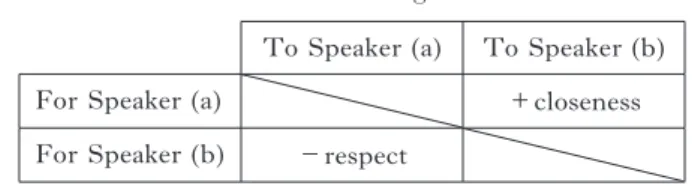
The different interpretations between Speaker (a) and (b) as to the treatment of mas-form result in the situation where both speakers choose mas-form at the same time. However, it is important to note that Speaker (a) is not necessarily motivated to use mas-form in the same way as Speaker (b). Speaker (a)’s style- shifting seems to be derived not from his agreement to the notion of mas-form as a sign of showing respect, but rather from his defi nition or redefi nition of relationship with Speaker (b) as out- group. Categorizing Speaker (b) as an out- group member of the fi gured circle of Working Holiday makers, Speaker (a) would not use ø-form with which he usually enjoys in conversation with the other Working Holiday makers. The following table illustrates that their negotiation on the meaning of mas-form is being approached from two different parameters: one is in-group versus out-group and the other is senior versus junior axis.
The two terms ‘closeness’ and ‘respect’ in Table 4 represent targeted effects that Speaker (a) and (b) would like to create as a result of using mas-form. Although Speaker (a) coordinates his
speech in mas-form with Speaker (b), his style-shifting cannot be regarded as an accommodating speech act. The use of mas-form may be a sign of respect to Speaker (b). However, at the same time, the non-use of ø-form may be a sign of emotional distance from Speaker (b).
Furthermore, the mismatch in the notion of mas-form between Speaker (a) and (b) also results in the situation where the two speakers mutually use ø-form. Equally important to note is the possibility that the meaning of ø-form is not shared with each other. The use ø-form in Speaker (b)’s utterances in the last 1-minute segment and in Speaker (a)’s utterances in the fi rst 2-minute segment is not likely to be derived from the same ground.
Two possible grounds are illustrated as follows:
To Speaker (a) To Speaker (b)
For Speaker (a) +closeness
For Speaker (b) −respect
Table 5: The meaning of ø-form
It is summarized that Speaker (a)’s initial use of ø-form is interpreted to be derived from his motivations to establish an in- group relationship with Speaker (b). For Speaker (a), not using mas-form in the fi rst 2-minute segment is an accommodating speech act to enhance a sense of ‘closeness’ among Working Holiday makers. As discussed in Speaker (G)’s treatment of ø-form in e.g.
4, such an extended meaning can operate as an assertion of shared social identity that nurtures a sense of solidarity among the group of Working Holiday makers as in-group members. To the contrary, Speaker (b)’s choice of ø-form in the last 1-minute segment is interpreted to be made based on his notion of ø-form as an opposite pole to mas-form. Speaker (b)’s use of ø-form seems to be derived
from his motivation to gain ‘respect’ from Speaker (a) rather than
‘closeness’ between the two.
4. Conclusion
Through the investigation of style-shifting practiced by Japanese Working Holiday Makers in Australia, this study has inquired into a correlation between people and structures. It is demonstrated that the meaning of ø-form as a solidarity marker is inculcated through the access to a norm shared among a group of Working Holiday makers, and the practice of the meaning according to the norm in turn maintains in-group relationship among the Working Holiday Makers, which makes the in-group relationship distinctive from others such as an out-group of Japanese university students in Australia.
In fact, for many of the informants in this research, style-shifting from mas-form to ø-form is a linguistic means to asserting their identity as a Working Holiday Maker and enacting in-group relationship with other Working Holiday makers. In other words, their identity as a Working Holiday maker determines their way to practice style-shifting in order to be realized as the one. The world of Japanese Working Holiday makers in Australia is a linguistically constituted reality or “a purely theoretical existence” (Bourdieu, 1991:231) constructed based on subjective judgments in the social world. An in-group relationship of Working Holiday makers exists because those who belong to it believe its existence. Their in-group relationship is not automatically realized by simply holding the same Working Holiday visa, but more strategically appealed by practising what a typical member is believed to do.
The analysis of style-shifting in the process of ongoing social interactions provides insights into how people share and do not share a fi gurative identity. It is demonstrated that, as well as people who are involved in the in-group relationship, those who keep a
distance from the relationship would also intentionally practice style-shifting in opposite ways. Style-shifting is an act of social identity that guides them meaningfully into the fi gured world of Working Holiday makers as a knowledgeable and committed member.
Acknowledgements
This research was partially supported by Global Communication Institute.
Funding from Kanda University of International Studies is gratefully acknowledged.
Notes
1) As to the treatment of polite and plain forms, this article describes the forms in verb morphology masu /desu endings as mas-form and da endings as ø-form. The rationale for the description is that both masu /desu-ending and da-ending forms or styles do not necessarily determine the level of politeness in the same ways as honorifi c and humble forms do. Style-shifting between the two forms is therefore not interpreted as an indication of being ‘more polite’ or ‘less polite.’ In terms of the neutrality, the absence of mas-form is described as ø-form.
2) The following abbreviations are used for glossing Japanese data:
MAS: mas-form (i.e. endings with verb morphology masu/desu) NEG: negative morpheme ACC: accusative case – o Q: question marker GEN: genitive case – no TOP: topic marker NOM: nominalizer – ga
References
Bourdieu, P. (1991) Language and Symbolic Power. Cambridge: Polity Press.
Gumperz, J. J. (1982) Discourse strategies: Studies in interactional sociolinguistics 1. Cambridge: Cambridge University Press.
Kitamura, K. (2016) Some Theoretical Considerations for Studying Linguistic Politeness in Japanese. Global Communication Studies, 4, Special Issue, pp. 197–215. Chiba: Global Communication Institute.
Kanda University of International Studies.
Kitamura, K. (2019) An Analysis of Linguistic Politeness in Japanese: A
Case Study on the Management of Polite Form among Young Japanese People in Australia. Global Communication Studies, 8, pp. 137–158.
Chiba: Global Communication Institute. Kanda University of International Studies.
Maynard, S. (1991) Pragmatics of discourse modality: A case of da and desu/masu forms in Japanese. Journal of Pragmatics, 15, pp. 551–582.
North-Holland.
Maynard, S. (1997) Japanese Communication: Language and Thought in Context. Honolulu: University of Hawai’i Press.
Mimaki, Y. (2013) Poraitonesu no danwa-bunseki: Shotaimenkomunikeeshon no sugata to shikumi (Discourse Analysis in terms of Politeness: Aspects and Mechanism of Communication in the First Meeting). Tokyo: Kuroshio Shuppan.
Usami, M. (2002) Discourse Politeness in Japanese Conversation. Some Implications for a Universal Theory of Politeness. Tokyo: Hitsuji Shobo.