Abstract. NAD(P)H quinone oxidoreductase 1 (NQO1)-depe- ndent antitumor drugs such as
β-lapachone (
β-lap) are attractive candidates for cancer chemotherapy because several tumors exhibit higher expression of NQO1 than adjacent tissues. Although the association between NQO1 and
β-lap has been elucidated, the effects of a NQO1-inducer and
β-lap used in combination remain to be clarified. It has previously been reported that melanoma cell lines have detectable levels of NQO1 expression and are sensitive to NQO1-dependent drugs such as 17-allylamino-17-demethoxygeldanamycin. The present study was conducted to investigate the involvement of NQO1 in
β-lap-mediated toxicity and the utility of combina- tion treatment with a NQO1-inducer and
β-lap in malignant melanoma cell lines. Decreased expression or inhibition of NQO1 caused these cell lines to become less sensitive to
β-lap, indicating a requirement of NQO1 activity for
β-lap-mediated toxicity. Of note was that carnosic acid (CA), a compound extracted from rosemary, was able to induce further expression of NQO1 through NF-E2 related factor 2 (NRF2) stabiliza- tion, thus significantly enhancing the cytotoxicity of
β-lap in all of the melanoma cell lines tested. Taken together, the data presented in the current study indicated that the NRF2-NQO1 axis may have potential value as a therapeutic target in malig- nant melanoma to improve the rate of clinical response to NQO1-dependent antitumor drugs.
Introduction
Malignant melanoma is one of the most aggressive forms of cancer, exhibiting resistance to various forms of chemotherapy.
The global incidence and mortality rates of malignant melanoma are increasing (1-3). Novel targeted therapies designed to kill melanoma cells harboring mutations in B-Raf proto-oncogene, serine/threonine kinase (BRAF) have been developed using vemurafenib, which is a specific BRAF inhibitor (4,5). Missense mutations to the BRAF gene, most commonly a valine-to-glutamic acid substitution at codon 600, has been observed in ~80% of melanocytic nevi and ~50% of melanomas (6-9). In addition to this BRAF mutation, another therapeutic target has been investigated, as melanomas, including acral lentiginous melanoma, the most common type in ethnicities that produce high levels of melanin, have a low frequency of BRAF gene mutation (10,11). However, details of the mechanism responsible for the drug insensitivity of mela- nomas lacking BRAF mutations have been largely unclear. On the basis of the aforementioned background, a search for novel therapeutic strategies is justified.
β
-lapachone (
β-lap), a lipophilic cytotoxic o-naphtoqui- none derived from the bark of the South American Lapacho tree (Tabebuia avellanedae), has recently attracted attention as an antitumor drug (12,13). The mechanism of its antitumor effect is considered to involve the formation of reactive oxygen species (ROS) (13-15). ROS and other types of radicals are involved in a variety of biological phenomena, including tumorigenesis, degenerative disease and aging (16,17), and are also important mediators of tumor cell death (18). NAD(P)H quinone oxidoreductase 1 (NQO1) catalyzes the reduction of
β-lap to an unstable hydroquinone, which then undergoes rapid oxidization and is reconverted to a stable quinone (14). This repeated oxidation-reduction cycle induces ROS, partially contributing to the tumor killing activity of
β-lap (14,15,18).
Under physiological conditions, the intracellular level of ROS is tightly regulated by NF-E2 related factor 2 (NFE2L2, also known as NRF2) and its inhibitor protein, Kelch-like ECH-associated protein 1 (KEAP1), which mediates NRF2 degradation. NRF2 is a transcription factor that forms a heterodimer with one of the small Maf-family proteins and binds to an antioxidant-responsive element to activate tran- scription of target genes, including NQO1 (19,20).
A previous study revealed that several melanoma cell lines have detectable endogenous expression of NQO1 (21). Certain patients with melanoma have a mutation at the KEAP1 locus,
Carnosic acid, an inducer of NAD(P)H quinone oxidoreductase 1, enhances the cytotoxicity of β ‑lapachone in melanoma cell lines
NOBUYUKI ARAKAWA
1, AYAKA OKUBO
1, SHINJI YASUHIRA
1, KAZUHIRO TAKAHASHI
2, HIROO AMANO
2, TOSHIHIDE AKASAKA
3, TOMOYUKI MASUDA
4, MASAHIKO SHIBAZAKI
1and CHIHAYA MAESAWA
11
Department of Tumor Biology, Institute of Biomedical Science, Iwate Medical University, Iwate 028‑8505;
2Department of Dermatology, Iwate Medical University, Iwate 028‑3694;
3Division of Dermatology, Kitakami Saiseikai Hospital, Iwate 024‑8506;
4Department of Pathology, School of Medicine, Iwate Medical University, Iwate 028‑3694, Japan
Received February 15, 2017; Accepted November 2, 2017 DOI: 10.3892/ol.2017.7618
Correspondence to:
Dr Masahiko Shibazaki, Department of Tumor Biology, Institute of Biomedical Science, Iwate Medical University, 2‑1‑1 Nishitokuta, Yahaba‑cho, Shiwa, Iwate 028‑8505, JapanE-mail: [email protected]
Key words
: β-lapachone, carnosic acid, NF-E2 related factor 2, NAD(P)H quinone oxidoreductase 1, melanomaARAKAWA et al: CARNOSIC ACID ENHANCES β‑LAPACHONE CYTOTOXICITY IN MELANOMA CELLS
2394
which results in NRF2 stabilization (22). On the basis of these findings, we hypothesized that certain melanoma cells may be constitutionally sensitive to NQO1-dependent antitumor drugs, including
β-lap, and that this sensitivity may be further increased through activation of the KEAP1-NRF2 axis.
The present study investigated whether forced induction of NQO1, through NRF2 activation, sensitizes melanoma cells to
β-lap. First, whether NQO1 mediated
β-lap toxicity in melanoma cell lines was assessed. Next, to achieve overex- pression of NQO1, phytochemical carnosic acid (CA), which is a potent activator of the KEAP1/NRF2 system, was used (23).
The combined administration of CA augmented the antitumor effect of
β‑lap in several melanoma cell lines. The findings of the present study indicate the potential availability of
β-lap and CA in combination as a novel chemotherapeutic approach for malignant melanoma.
Materials and methods
Cell cultures. Various human melanoma cell lines were obtained from the following sources: CRL-1585 (also known as C32 cells), G‑361, HMV‑II and SK‑MEL‑28 from the Cell Resource Center for Biomedical Research, Tohoku University (Sendai, Japan); MeWo, SK‑MEL‑2 and SK‑MEL‑31 from the American Type Culture Collection (ATCC; Manassas, VA, USA); MM‑AN were provided by Dr M. C. Mihm (Department of Dermatology, Harvard Medical School, Boston, MA, USA); GAK and HMY‑1 from the Japanese Collection of Research Bioresources (Osaka, Japan). The murine melanoma B16BL6 cell line was also obtained from the RIKEN BioResource Center (Tsukuba, Japan). The human non-small cell lung cancer H460 cell line was also obtained from ATCC. The identities of cell lines used in this study were confirmed by a short tandem repeat analysis (data not shown). The cells were maintained at 37˚C under 5% CO
2in RPMI‑1640 supplemented with 10% fetal bovine serum (FBS) and 1% penicillin-streptomycin (all from Thermo Fisher Scientific, Inc., Waltham, MA, USA).
Small interfering RNA (siRNA) transfection. Silencer select siRNAs against NQO1 (cat. no. 4390824; IDs, s4089, s4090, and s4091), NRF2 (cat. no. 4392420; ID, s9491), and a negative control siRNA (cat. no. 4390844), Lipofectamine RNAiMAX transfection reagent and Opti-MEM were all obtained from Thermo Fisher Scientific, Inc. Silencer Select siRNAs were pre-designed and validated by the manufacturer. Cells at 50% confluence were treated for 72 h in prior to the subse- quent experiments, with 10 nM siRNA, 10 µl Lipofectamine RNAiMAX transfection reagent, 1 ml Opti-MEM and 9 ml RPMI‑1640 supplemented with 10% FBS and 1% peni- cillin-streptomycin in a 10-cm dish plate in accordance with the manufacturer's instructions.
Reagents and antibodies.
β-lap, carnosic acid (CA), and a NQO1 inhibitor, ES936, were obtained from Sigma‑Aldrich;
Merck KGaA (Darmstadt, Germany). Stock solutions were prepared by dissolving the chemicals in dimethyl sulfoxide at 20 mM (
β-lap), 100 mM (CA), and 10 mM (ES936).
The antibody directed against NRF2 (cat. no. ab-62352) was obtained from Abcam (Cambridge, MA, USA). The
antibody against NQO1 (cat. no. 3187) was obtained from Cell Signaling Technology, Inc. (Danvers, MA, USA). An antibody against
β-actin (cat. no. A2228) was obtained from Sigma‑Aldrich; Merck KgaA. Anti‑Rabbit IgG, HRP‑Linked F(ab')
2Fragment Donkey (cat. no. NA9340) and Anti-Mouse IgG, HRP‑Linked Whole Ab Sheep (cat. no. NA931) were obtained from GE Healthcare (Chicago, IL USA). The fluorescent dyes against rabbit IgG (Alexa Fluor‑488) was obtained from Thermo Fisher Scientific, Inc. The fluorescent dyes against mouse IgG (Alexa Fluor‑594) was obtained from Thermo Fisher Scientific, Inc. DAPI was obtained from Dojindo Molecular Technologies, Inc. (Kumamoto, Japan).
Cell viability assay. A Cell Counting kit-8 (Dojindo Mole- cular Technologies, Inc.), which utilizes water‑soluble tetrazolium salts, was used to evaluate the proliferation of melanoma cells following drug treatment. All melanoma cell lines were seeded into 96-well plates (5,000 cells/well) and cultured for 24 h prior to treatment with
β-lap and/or CA. Following the treatment, the medium in each well was replaced with 100 µl of drug-free fresh medium and 10 µl of Cell Counting kit-8 solution, incubated for an additional 1-2 h, and the absorbance of each well at 450 nm was measured using a Multiskan Spectrum spectrophotometer (Thermo Fisher Scientific, Inc.).
Western blotting. All melanoma cell lines at 80‑90% confl‑
uence, which were maintained at 37˚C under 5% CO
2in RPMI‑1640 supplemented with 10% FBS and 1% peni- cillin-streptomycin, were washed twice with ice-chilled PBS, treated with 10% trichloroacetic acid for 30 min on ice and then scraped off into a tube. The cell pellet was washed once with deionized water and lysed in 9 M urea, 2% Triton X-100, and 1% dithiothreitol (DTT). Protein concentration was measured using a BCA protein assay kit (EMD Millipore, Billerica, MA, USA) prior to the addition of DTT. Protein samples were separated using SDS-PAGE (10% gel) and then transferred onto polyvinylidene difluoride transfer membranes (Pall Corporation, Portsmouth, UK). All proteins were loaded 30 µg/lane.
For all antibodies, the membranes were blocked with 5%
non-fat dried milk in 0.1% Tween-20/PBS at room temperature for 1 h, then probed with an appropriate primary antibodies overnight at 4˚C, which were diluted to 1:1,000, and with HRP-conjugated secondary antibodies for 1 h at room temperature, which were diluted to 1:5,000. Each antibody was diluted in 5% non-fat dried milk in 0.1% PBS-Tween-20.
Signals were detected with ECL prime detection reagents (GE Healthcare) and ChemiDoc XRS (Bio‑Rad Laboratories, Inc., Hercules, CA, USA). Densitometric analysis of each protein signal was performed using ImageJ software (version 1.50;
National Institutes of Health, Bethesda, MD, USA) (24).
Auxin‑inducible degron (AID) system. The B16BL6/pAO1 cell
line, conditionally expressing NQO1 under the control of the
AID system, was previously established (25). B16BL6/pAO1
cells were treated with
β-lap and/or 0.5 mM auxin (BioROIS
Co., Ltd., Mishima, Japan) for 24 h in 96‑well plates. Cell
viability was measured using a CCK-8 (Dojindo Molecular
Technologies, Inc.) accordng to the manufacturer's instructions.
To detect NQO1 using immunoblotting, B16BL6/pAO1 cells were treated with or without 0.5 mM auxin for 24 h in 10-cm dish plates. Following this treatment, western blotting was performed as aforementioned.
Immunofluorescence staining. Cells were washed with PBS and fixed with 4.0% formaldehyde and 0.5% Triton X‑100 (Sigma‑Aldrich; Merck KGaA) for 20 min at room tempera- ture. The slides were then blocked using 5% FBS (Thermo Fisher Scientific, Inc.) and 0.5% Triton X‑100 for 30 min at room temperature. Following three washes with PBS, the slides were incubated with a primary antibody (NRF2 or NQO1) in blocking buffer (PBS with 5% FBS and 0.5% Triton X-100) at 4˚C, which were diluted to 1:500. The slides were incubated with secondary antibodies: Alexa Fluor-488 (cat. no. A11008) and Alexa Fluor‑594 (cat. no. A11005) (1:250; both from Thermo Fisher Scientific, Inc.) for 3 h at 37˚C. Cells were counterstained with DAPI (Dojindo Molecular Technologies, Inc.) for 30 min at room temperature and images were captured using a KEYENCE BZ9000 fluorescence microscope (Keyence Corporation, Osaka, Japan). Images were captured at magnification, x10.
Statistical analysis. Pearson's correlation coefficient was used to assess the correlation between cell viability and relative NQO1 protein expression. In the cell viability assay, a t‑test with the Bonferroni correction was conducted on raw data for the respective doses. P<0.05 was considered to indicate a statistically significant difference. Fitting to a sigmoid func- tion was performed for estimating the half-maximal inhibitory concentration (IC
50). One-way analysis of variance followed by Tukey's honest significant difference post‑hoc test was used to assess the effect of CA on NQO1 expression. All analyses were conducted using Microsoft Excel 2013 (Microsoft Corporation, Redmond, WA, USA) and RStudio Desktop version 1.0.136 (R Studio, Boston, MA, USA).
Results
Effect of
β‑lap on melanoma cell lines. A previous study demonstrated that melanoma cell lines exhibit detectable endogenous expression of NQO1, with the level of expression varying among the cell lines (21). In the present study, the protein expression levels of NQO1 and NRF2 were verified (Fig. 1A). As it has been shown that NQO1 is required for the
Figure 1. Cytotoxicity of β-lap in melanoma cell lines. (A) The expression of NRF2 and NQO1 determined by western blotting in melanoma cell lines.
(B) Viability of SK-MEL-28 and GAK cells treated for 24 h with β‑lap. (C) Correlation between NQO1 expression levels and calculated IC50 values for β-lap in various melanoma cell lines. NQO1 expression demonstrated by western blotting was densitometrically quantified and the values were normalized against β‑actin. Significance was calculated using Pearson's correlation analysis. NRF2, NF‑E2 related factor 2; NQO1, NAD(P)H quinone oxidoreductase 1; IC50, half maximal inhibitory concentration; β-lap, β-lapachone.
ARAKAWA et al: CARNOSIC ACID ENHANCES β‑LAPACHONE CYTOTOXICITY IN MELANOMA CELLS
2396
bio-activation of
β-lap (14), it was hypothesized that mela- noma cells may be sensitive to the anti-proliferative effect of
β‑lap. To confirm the effect of
β-lap, cell viability was preliminarily measured following treatment of the melanoma SK-MEL-28 and GAK cell lines with various concentra- tions of
β-lap. The two cell lines exhibited dose-dependent decreases of cell viability (Fig. 1B). The calculated IC
50values for
β-lap were 1.49 and 1.51 µM for SK-MEL-28 and GAK cells, respectively (Table I). The viabilities of the remaining six cell lines were also tested and the IC
50values are presented in Table I. These corresponded to the values that had been reported previously for SK-MEL-28 and another cell line, G361 (26). The association between the basal expression levels of NQO1 and the IC
50values of
β-lap in eight melanoma cell lines were then compared. Differences in the basal NQO1 expression level were detected (Fig. 1C and Table I). However, no significant correlation between the basal NQO1 expression levels and IC
50values of
β-lap was observed (R=-0.468, P=0.243).
NQO1‑dependent cytotoxicity of
β‑lap in melanoma cell lines.
To assess whether NQO1 is involved in
β-lap-mediated toxicity in melanoma cell lines, a cell line that conditionally expresses NQO1 under the control of the AID system was used (25,27).
In this system, addition of the plant hormone auxin induces the rapid ubiquitination of AID, followed by the proteosome‑medi- ated degradation of ectopically expressed AID‑fused NQO1 within 1 h (Fig. 2). As presented in Fig. 2B,
β-lap-mediated toxicity in melanoma cells was decreased following auxin treatment in comparison with untreated controls, as assessed by a cell viability assay. For the experiment using siRNAs, CRL-1585 cells were selected as they have relatively higher endogenous expression of NQO1 compared with the other cell lines (Fig. 1A and C). The
β-lap-mediated toxicity was decreased following treatment with siRNA against NQO1 (Fig. 2D). However, the effect was not as evident as that in the AID system (Fig. 2A and B), potentially because endogenous NQO1 expression was not completely abolished by transfection
with the NQO1 siRNA (Fig. 2C). These results indicated that NQO1 expression was involved in the cytotoxicity of
β-lap in melanoma cell lines.
CA stabilizes NRF2 and induces further expression of NQO1.
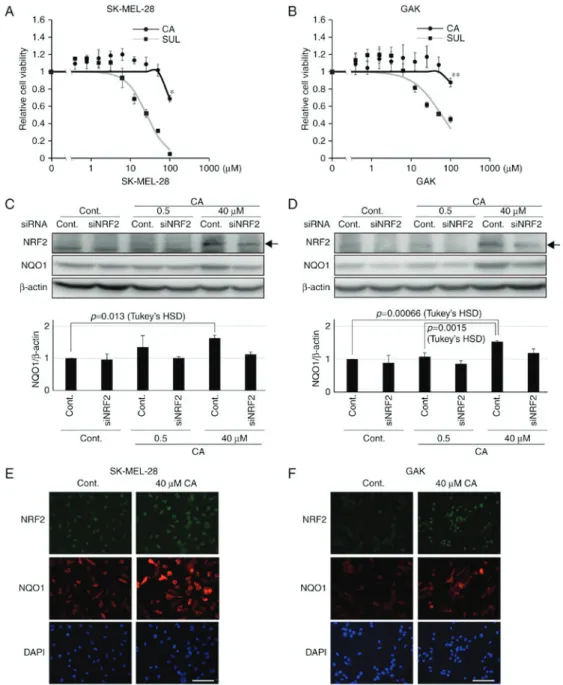
CA is a potent activator of the KEAP1-NRF2 axis (23). In the absence of CA, NRF2 is degraded through the formation of a complex with its inhibitor protein, KEAP1, a member of the E3 ligase family (20). CA induces conformational changes by targeting the cysteine residues on KEAP1 proteins via thiol S-alkylation and the released NRF2 is stabilized by escaping from its degradation complex (23,28). NRF2 is then able to translocate into the nucleus and operate as a transcription factor, forming a heterodimer with one of the small Maf-family proteins, and binding to an antioxidant-responsive element to activate the transcription of target genes, for instance NQO1 (20). Therefore, using the melanoma SK-MEL-28 and GAK cell lines, whether CA treatment would stabilize NRF2 was assessed, leading to further induction of NQO1 expression. The two cell lines had low basal NQO1 and NRF2 expression (Fig. 1A) compared with the non-small cell lung cancer H460 cell line, which has been shown to harbor somatic mutations in the KEAP1 gene, resulting in the high expression of NRF2 (29). Concentrations of CA that did not affect cell viability were used (Fig. 3A and B). Notably, CA was less toxic compared with other KEAP1-NRF2 activators, including sulforaphane (Fig. 3A and B). The expression of NRF2 was associated with that of NQO1 in the two melanoma cell lines (Fig. 3C and D). Furthermore, to confirm the activa- tion of the KEAP1-NRF2 axis by CA in melanoma cell lines, western blot analysis was performed to assess the amount of NRF2 and NQO1 in siRNA-transfected melanoma cell lines.
As expected, it was revealed that the significant increase in NQO1 induced by CA was abolished in siNRF2-treated mela- noma cell lines (Fig. 3C and D). Furthermore, as assessed by immunofluorescence staining, CA treatment resulted in further NRF2 stabilization and induction of NQO1 expression in the entire population of the two cell lines (Fig. 3E and F). These Table I. Effect of CA or ES936 on sensitivity of
β-lap in melanoma cell lines.
IC
50of
β-lap, µM
---
CA --- Fold increase of
Cell line Control 0.5 µM 40 µM ES936 NQO1/
β-actin NQO1 by 40 µM CA
MM-AN 1.41 1.16 0.42 4.77 0.087 1.25
CRL-1585 1.23 0.95 0.28 5.70 0.248 1.26
GAK 1.51 1.38 0.71 2.70 0.047 1.53
G361 0.93 0.77 0.14 3.80 0.156 1.28
MeWo 1.20 0.80 0.30 2.70 0.204 1.85
SK-MEL-2 2.74 1.91 0.73 4.63 0.100 1.32
SK-MEL-28 1.49 1.38 0.62 9.15 0.048 1.63
SK-MEL-31 5.02 2.54 2.05 11.72 0.052 1.32
Melanoma cell lines incubated with 0.5 or 40 µM (MM‑AN and MeWo 20 µM) of CA or 10 µM of ES936 were simultaneously treated with various concentrations of β‑lap for 24 h and IC50 values were calculated in indicated cell lines. CA, carnosic acid; β-lap, β‑lapachone; IC50, half‑maximal inhibitory concentration; NQO1, NAD(P)H quinone oxidoreductase 1.
data indicate that CA may be used as an inducer of NQO1 in melanoma cell lines.
Combination treatment with CA increases the sensitivity of melanoma cells to
β‑lap. Next, whether the induction of the expression of NQO1 was able to increase the sensitivity of melanoma cell lines to
β-lap-mediated toxicity was investigated. As presented in Table I, sensitivity to
β-lap was increased by combination treatment with CA. This induction was CA concentration-dependent (Table I). Treatment with the specific NQO1 inhibitor ES936 decreased the sensitivity of all the cell lines to
β-lap-mediated toxicity (Table I). The concentrations of ES936 used did not affect cell viability (data not shown). These results indicate that combined treatment with CA increases the sensitivity of melanoma cells to
β-lap through induction of NQO1 expression.
Discussion
Malignant melanoma is one of the most aggressive types of skin cancer, and its incidence is increasing in Caucasian and non-Caucasian populations (2,30,31). Although a number of therapeutic approaches for melanoma have been developed, including chemotherapy, immunotherapy, surgery and several
forms of molecular-targeted therapy, the response rate of patients has remained insufficient, and side effects continue to be an issue (2,30). Therefore, other approaches for the improvement of treatment outcome requires investigation.
The present study focused on
β-lap, a natural quinone derived from the bark of the Lapacho tree (12,13). Previous studies have revealed that
β-lap acts as a potent anti-prolifera- tive agent, inhibiting topoisomerase I/II (26,32,33), specificity protein 1 (26) and the cell cycle (34). It has also been shown that repetitive oxidation-reduction of
β-lap by NQO1 generates ROS in tumor cells (14), thus contributing to cytotoxicity in malignancies, including pancreatic cancer (35,36). Among the various aforementioned antitumor mechanisms of
β-lap, the present study focused on the role of NQO1 in
β-lap-mediated toxicity in melanoma cell lines, as a previous study had shown that normal melanocytes express higher levels of NQO1 compared with other tissues (21). As expected, loss or inhibi- tion of NQO1 decreased the degree of
β-lap-mediated toxicity.
NQO1 is involved in the regulation of melanin synthesis via suppression of tyrosinase degradation in melanocytes under physiological conditions (37). We hypothesized that the higher basal expression of NQO1 in melanoma cell lines was due to such a mechanism that is specific to pigmented cells. Collectively, the results of the present study indicate
Figure 2. Association between NQO1 expression and β-lap cytotoxicity in melanoma cell lines. Levels of NQO1 expression determined by (A) western blotting and (B) viability following treatment with β‑lap with or without simultaneous treatment with auxin in an AID‑NQO1‑expressing cell line. NQO1 expression levels in CRL-1585 cells determined by (C) western blotting, and (D) their viability following treatment with β-lap in comparison with cells treated with control siRNA or siRNA against NQO1. The results are presented as mean ± standard deviation from triplicate experiments (*P<0.05; **P<0.01). siRNA, small interfering RNA; siCont, control siRNA; NQO1, NAD(P)H quinone oxidoreductase 1; AID, auxin‑inducible degron; β-lap, β-lapachone.
ARAKAWA et al: CARNOSIC ACID ENHANCES β‑LAPACHONE CYTOTOXICITY IN MELANOMA CELLS
2398
that melanomas originating from melanocytes have constitu- tively high sensitivity to NQO1-dependent antitumor drugs, including
β-lap.
CA is a natural, catechol-type polyphenolic diterpene derived from rosemary (Rosmarinus officinalis), comprising about 5% of the dry weight of rosemary leaves (23,38). CA has various biological effects, mediated via phosphati- dylinositol 3-kinase (39), peroxisome proliferator-activated receptor
γ(40), cyclin A/B1 (41) and free radical-scavenging activity (42). CA is also known to activate the KEAP1/NRF2 system (23). It should be emphasized that NQO1 is known to be a typical target gene of NRF2. The results of the present
study demonstrated that CA treatment led to further induction of NQO1 expression in melanoma cell lines, at least under the experimental conditions utilized in the present study. These findings indicate that CA may have a clinical application as a sensitizer for NQO1‑dependent antitumor drugs; indeed, combination treatment with CA increased the
β-lap sensitivity of all the melanoma cell lines assessed.
Throughout the present study, other than for the NQO1 knockdown experiment, two cell lines, SK-MEL-28 and GAK, were used because they exhibited relatively higher induction of NQO1 by 40 µM CA in comparison with another melanoma cell lines. Furthermore, the induction of NQO1 by CA was
Figure 3. Carnosic acid stabilizes NRF2 and induces further expression of NQO1. Viability of (A) SK-MEL-28 and (B) GAK cells treated for 24 h with CA or SUL. One‑way ANOVA followed by Tukey's honest significant difference test was used for statistical analysis (*P<0.05; **P<0.01). The expression of NRF2 and NQO1 determined by western blotting in siNRF2-treated (C) SK-MEL-28 or (D) GAK cells in the presence of CA at 0.5 or 40 µM for 24 h. Densitometrically quantified expression levels of NQO1/β-actin are shown below. Arrows indicate the band of NRF2. Bars in the graphs indicate the mean ± standard error of the mean of three independent experiments. Ιn SK‑MEL‑28 and GAK cells, the effect of CA on NQO1 expression was significant in the control series (P=0.016 and P=0.000538 by one‑way ANOVA, respectively) and not so in siNRF2 series (P=0.571 and P=0.34, respectively). Immunofluorescent staining of NRF2 and NQO1 in (E) SK‑MEL‑28 or (F) GAK cells treated with 40 µM of CA for 24 h. Scale bar, 100 µm. siRNA, small interfering RNA; NRF2, NF‑E2 related factor 2; NQO1, NAD(P)H quinone oxidoreductase 1; ANOVA, analysis of variance; CA, carnosic acid; SUL, suforaphane; cont, control.
more representative when the levels of NQO1 expression were assessed by western blotting, as these cell lines have basally express low levels of NQO1. Notably, NQO1 induc- tion in MeWo cells was the highest among all cell lines tested.
However, this cell line was not selected owing to its relatively high basal level of NQO1 expression.
Several studies have shown that NQO1 produces
β-lap radicals, leading in turn to generation of the superoxide anion that stabilizes
β-lap (14,15,18). The present study did not assess direct evidence for the involvement of radicals produced via NQO1 in the killing of melanoma cell lines. However, it was demonstrated that the tumor-killing ability of
β-lap was NQO1-dependent, as a decrease in the expression of NQO1 or inhibition by its specific inhibitor ES936, increased the IC
50value of
β-lap. Furthermore, CA treatment induced the expression of NQO1 in melanoma cell lines. Taken together with previous studies, the data in the present study indicated that enhancement of the tumor-killing ability of
β-lap by CA may be due to radicals produced via NQO1.
Thus far, CA has been shown to inhibit cell adhesion and migration, possibly by reducing the activity of secreted proteases, including the urokinase plasminogen activator and matrix metalloproteinases, in several tumor cell lines (43,44).
In addition to the inhibitory effect of CA on cell prolifera- tion, its effect on cell migration and invasion may represent an attractive therapeutic option for highly metastatic malig- nant melanomas. Combined treatment with
β-lap and poly(ADP-ribose) polymerase (PARP) inhibitors has been shown to exert a synergistic therapeutic effect in several tumor types by causing non-repairable DNA damage in the presence of NQO1 activity (45). It is possible that CA treatment may be able to further augment the combined effect of
β-lap and PARP.
An allelic variant of NQO1 with essentially no enzymatic activity is reported to exist at a high frequency, particularly in Asian populations (46). A polymorphism of NQO1 has report- edly been associated with response to chemotherapy (47,48).
Therefore the existing data indicated that confirmation of genetic background prior to
β-lap treatment would be warranted for patients with malignant melanoma.
As
β-lap and CA appear to have few side effects, the results of the present study support the possibility that their use in combination to increase the expression of NQO1 may provide a novel avenue of treatment for patients with malignant melanoma.
References
1. Scolyer RA, Judge MJ, Evans A, Frishberg DP, Prieto VG, Thompson JF, Trotter MJ, Walsh MY, Walsh NM and Ellis DW;
International Collaboration on Cancer Reporting: Data set for pathology reporting of cutaneous invasive melanoma:
Recommendations from the international collaboration on cancer reporting (ICCR). Am J Surg Pathol 37: 1797-1814, 2013.
2. Siegel R, Naishadham D and Jemal A: Cancer statistics, 2012.
CA Cancer J Clin 62: 10‑29, 2012.
3. Tokuzumi A, Fukushima S, Miyashita A, Nakahara S, Kubo Y, Yamashita J, Harada M, Nakamura K, Kajihara I, Jinnin M and Ihn H: Cell division cycle-associated protein 1 as a new melanoma-associated antigen. J Dermatol 43: 1399-1405, 2016.
4. Bollag G, Hirth P, Tsai J, Zhang J, Ibrahim PN, Cho H, Spevak W, Zhang C, Zhang Y, Habets G, et al: Clinical efficacy of a RAF inhibitor needs broad target blockade in BRAF-mutant mela- noma. Nature 467: 596-599, 2010.
5. Tsai J, Lee JT, Wang W, Zhang J, Cho H, Mamo S, Bremer R, Gillette S, Kong J, Haass NK, et al: Discovery of a selective inhibitor of oncogenic B-Raf kinase with potent antimelanoma activity. Proc Natl Acad Sci USA 105: 3041-3046, 2008.
6. Davies H, Bignell GR, Cox C, Stephens P, Edkins S, Clegg S, Teague J, Woffendin H, Garnett MJ, Bottomley W, et al:
Mutations of the BRAF gene in human cancer. Nature 417:
949-954, 2002.
7. Maldonado JL, Fridlyand J, Patel H, Jain AN, Busam K, Kageshita T, Ono T, Albertson DG, Pinkel D and Bastian BC:
Determinants of BRAF mutations in primary melanomas. J Natl Cancer Inst 95: 1878‑1890, 2003.
8. Pollock PM, Harper UL, Hansen KS, Yudt LM, Stark M, Robbins CM, Moses TY, Hostetter G, Wagner U, Kakareka J, et al:
High frequency of BRAF mutations in nevi. Nat Genet 33: 19-20, 2003.
9. Uribe P, Wistuba II and González S: BRAF mutation: A frequent event in benign, atypical and malignant melanocytic lesions of the skin. Am J Dermatopathol 25: 365-370, 2003.
10. Bradford PT, Goldstein AM, McMaster ML and Tucker MA:
Acral lentiginous melanoma: Incidence and survival patterns in the United States, 1986-2005. Arch Dermatol 145: 427-434, 2009.
11. Kogushi‑Nishi H, Kawasaki J, Kageshita T, Ishihara T and Ihn H:
The prevalence of melanocytic nevi on the soles in the Japanese population. J Am Acad Dermatol 60: 767‑771, 2009.
12. Planchon SM, Wuerzberger S, Frydman B, Witiak DT, Hutson P, Church DR, Wilding G and Boothman DA: Beta‑lapa‑
chone-mediated apoptosis in human promyelocytic leukemia (HL-60) and human prostate cancer cells: A p53-independent response. Cancer Res 55: 3706-3711, 1995.
13. Docampo R, Cruz FS, Boveris A, Muniz RP and Esquivel DM:
beta-Lapachone enhancement of lipid peroxidation and super- oxide anion and hydrogen peroxide formation by sarcoma 180 ascites tumor cells. Biochem Pharmacol 28: 723-728, 1979.
14. Siegel D, Yan C and Ross D: NAD(P)H: Quinone oxidoreduc- tase 1 (NQO1) in the sensitivity and resistance to antitumor quinones. Biochem Pharmacol 83: 1033-1040, 2012.
15. Bentle MS, Reinicke KE, Bey EA, Spitz DR and Boothman DA:
Calcium-dependent modulation of poly(ADP-ribose) poly- merase‑1 alters cellular metabolism and DNA repair. J Biol Chem 281: 33684-33696, 2006.
16. Davalli P, Mitic T, Caporali A, Lauriola A and D'Arca D: ROS, cell senescence and novel molecular mechanisms in aging and age-related diseases. Oxid Med Cell Longev 2016: 3565127, 2016.
17. Schieber M and Chandel NS: ROS function in redox signaling and oxidative stress. Curr Biol 24: R453-R462, 2014.
18. Raj L, Ide T, Gurkar AU, Foley M, Schenone M, Li X, Tolliday NJ, Golub TR, Carr SA, Shamji AF, et al: Selective killing of cancer cells by a small molecule targeting the stress response to ROS.
Nature 475: 231-234, 2011.
19. Itoh K, Chiba T, Takahashi S, Ishii T, Igarashi K, Katoh Y, Oyake T, Hayashi N, Satoh K, Hatayama I, et al: An Nrf2/small Maf heterodimer mediates the induction of phase II detoxifying enzyme genes through antioxidant response elements. Biochem Biophys Res Commun 236: 313-322, 1997.
20. Taguchi K, Motohashi H and Yamamoto M: Molecular mecha- nisms of the Keap1-Nrf2 pathway in stress response and cancer evolution. Genes Cells 16: 123-140, 2011.
21. Kasai S, Arakawa N, Okubo A, Shigeeda W, Yasuhira S, Masuda T, Akasaka T, Shibazaki M and Maesawa C: NAD(P) H: Quinone oxidoreductase-1 expression sensitizes malignant melanoma cells to the HSP90 inhibitor 17-AAG. PLoS One 11:
e0153181, 2016.
22. Miura S, Shibazaki M, Kasai S, Yasuhira S, Watanabe A, Inoue T, Kageshita Y, Tsunoda K, Takahashi K, Akasaka T, et al: A somatic mutation of the KEAP1 gene in malignant melanoma is involved in aberrant NRF2 activation and an increase in intrinsic drug resistance. J Invest Dermatol 134: 553‑556, 2014.
23. Satoh T, Kosaka K, Itoh K, Kobayashi A, Yamamoto M, Shimojo Y, Kitajima C, Cui J, Kamins J, Okamoto S, et al:
Carnosic acid, a catechol-type electrophilic compound, protects neurons both in vitro and in vivo through activation of the Keap1/Nrf2 pathway via S-alkylation of targeted cysteines on Keap1. J Neurochem 104: 1116‑1131, 2008.
24. Schindelin J, Arganda‑Carreras I, Frise E, Kaynig V, Longair M, Pietzsch T, Preibisch S, Rueden C, Saalfeld S, Schmid B, et al:
Fiji: An open-source platform for biological-image analysis. Nat Methods 9: 676-682, 2012.
ARAKAWA et al: CARNOSIC ACID ENHANCES β‑LAPACHONE CYTOTOXICITY IN MELANOMA CELLS
2400
25. Okubo A, Yasuhira S, Shibazaki M, Takahashi K, Akasaka T, Masuda T and Maesawa C: NAD(P)H dehydrogenase, quinone 1 (NQO1), protects melanin-producing cells from cytotoxicity of rhododendrol. Pigment Cell Melanoma Res 29: 309-316, 2016.
26. Bang W, Jeon YJ, Cho JH, Lee RH, Park SM, Shin JC, Choi NJ, Choi YH, Cho JJ, Seo JM, et al: β-lapachone suppresses the proliferation of human malignant melanoma cells by targeting specificity protein 1. Oncol Rep 35: 1109-1116, 2016.
27. Nishimura K, Fukagawa T, Takisawa H, Kakimoto T and Kanemaki M: An auxin-based degron system for the rapid deple- tion of proteins in nonplant cells. Nat Methods 6: 917-922, 2009.
28. Venugopal R and Jaiswal AK: Nrf1 and Nrf2 positively and c‑Fos and Fra1 negatively regulate the human antioxidant response element-mediated expression of NAD(P)H: Quinone oxidore- ductase1 gene. Proc Natl Acad Sci USA 93: 14960-14965, 1996.
29. Singh A, Misra V, Thimmulappa RK, Lee H, Ames S, Hoque MO, Herman JG, Baylin SB, Sidransky D, Gabrielson E, et al:
Dysfunctional KEAP1-NRF2 interaction in non-small-cell lung cancer. PLoS Med 3: e420, 2006.
30. Ferlay J, Steliarova‑Foucher E, Lortet‑Tieulent J, Rosso S, Coebergh JW, Comber H, Forman D and Bray F: Cancer incidence and mortality patterns in Europe: Estimates for 40 countries in 2012. Eur J Cancer 49: 1374‑1403, 2013.
31. Marks R: Epidemiology of melanoma. Clin Exp Dermatol 25:
459-463, 2000.
32. Jackson JK, Higo T, Hunter WL and Burt HM: Topoisomerase inhibitors as anti‑arthritic agents. Inflamm Res 57: 126‑134, 2008.
33. Li CJ, Averboukh L and Pardee AB: Beta‑Lapachone, a novel DNA topoisomerase I inhibitor with a mode of action different from camptothecin. J Biol Chem 268: 22463‑22468, 1993.
34. Li CJ, Li YZ, Pinto AV and Pardee AB: Potent inhibition of tumor survival in vivo by beta-lapachone plus taxol: Combining drugs imposes different artificial checkpoints. Proc Natl Acad Sci USA 96: 13369-13374, 1999.
35. Ough M, Lewis A, Bey EA, Gao J, Ritchie JM, Bornmann W, Boothman DA, Oberley LW and Cullen JJ: Efficacy of beta-lapachone in pancreatic cancer treatment: Exploiting the novel, therapeutic target NQO1. Cancer Biol Ther 4: 95-102, 2005.
36. Chakrabarti G, Silvers MA, Ilcheva M, Liu Y, Moore ZR, Luo X, Gao J, Anderson G, Liu L, Sarode V, et al: Tumor-selective use of DNA base excision repair inhibition in pancreatic cancer using the NQO1 bioactivatable drug, β-lapachone. Sci Rep 5: 17066, 2015.
37. Yamaguchi Y, Hearing VJ, Maeda A and Morita A:
NADPH:quinone oxidoreductase-1 as a new regulatory enzyme that increases melanin synthesis. J Invest Dermatol 130: 645‑647, 2010.
38. Kosaka K and Yokoi T: Carnosic acid, a component of rosemary (Rosmarinus officinalis L.), promotes synthesis of nerve growth factor in T98G human glioblastoma cells. Biol Pharm Bull 26:
1620-1622, 2003.
39. Martin D, Rojo AI, Salinas M, Diaz R, Gallardo G, Alam J, De Galarreta CM and Cuadrado A: Regulation of heme oxygenase-1 expression through the phosphatidylino- sitol 3-kinase/Akt pathway and the Nrf2 transcription factor in response to the antioxidant phytochemical carnosol. J Biol Chem 279: 8919-8929, 2004.
40. Rau O, Wurglics M, Paulke A, Zitzkowski J, Meindl N, Bock A, Dingermann T, Abdel-Tawab M and Schubert-Zsilavecz M:
Carnosic acid and carnosol, phenolic diterpene compounds of the labiate herbs rosemary and sage, are activators of the human peroxisome proliferator-activated receptor gamma. Planta Med 72: 881-887, 2006.
41. Visanji JM, Thompson DG and Padfield PJ: Induction of G2/M phase cell cycle arrest by carnosol and carnosic acid is associated with alteration of cyclin A and cyclin B1 levels. Cancer Lett 237:
130-136, 2006.
42. Aruoma OI, Halliwell B, Aeschbach R and Loligers J: Antioxidant and pro-oxidant properties of active rosemary constituents:
Carnosol and carnosic acid. Xenobiotica 22: 257-268, 1992.
43. Park SY, Song H, Sung MK, Kang YH, Lee KW and Park JH:
Carnosic acid inhibits the epithelial-mesenchymal transition in B16F10 melanoma cells: A possible mechanism for the inhibition of cell migration. Int J Mol Sci 15: 12698‑12713, 2014.
44. Barni MV, Carlini MJ, Cafferata EG, Puricelli L and Moreno S:
Carnosic acid inhibits the proliferation and migration capacity of human colorectal cancer cells. Oncol Rep 27: 1041-1048, 2012.
45. Huang X, Motea EA, Moore ZR, Yao J, Dong Y, Chakrabarti G, Kilgore JA, Silvers MA, Patidar PL, Cholka A, et al: Leveraging an NQO1 bioactivatable drug for tumor-selective use of poly (ADP-ribose) polymerase inhibitors. Cancer Cell 30:
940-952, 2016.
46. 1000 Genomes Project Consortium, Abecasis GR, Auton A, Brooks LD, DePristo MA, Durbin RM, Handsaker RE, Kang HM, Marth GT and McVean GA: An integrated map of genetic variation from 1,092 human genomes. Nature 491: 56-65, 2012.
47. Fagerholm R, Hofstetter B, Tommiska J, Aaltonen K, Vrtel R, Syrjakoski K, Kallioniemi A, Kilpivaara O, Mannermaa A, Kosma VM, et al: NAD(P)H:quinone oxidoreductase 1 NQO1*2 genotype (P187S) is a strong prognostic and predictive factor in breast cancer. Nat Genet 40: 844-853, 2008.
48. Jamieson D, Cresti N, Bray J, Sludden J, Griffin MJ, Hawsawi NM, Famie E, Mould EV, Verrill MW, May FE and Boddy AV: Two minor NQO1 and NQO2 alleles predict poor response of breast cancer patients to adjuvant doxorubicin and cyclophosphamide therapy. Pharmacogenet Genomics 21: 808-819, 2011.