Literacy Campaign and International Cooperation : Policy Analysis of Adult Literacy in Tanzania
著者 久保田 賢一
journal or
publication title
情報研究 : 関西大学総合情報学部紀要
volume 1
page range 67‑92
year 1995‑03‑30
URL http://hdl.handle.net/10112/1000
Policy Analysis of Adult Literacy in Tanzania Kenichi Kubota*
Abstract
Despite recent massive efforts in countries around the world, implementation of literacy campaign cannot catch up with the population explosion. At the international level, the United Nations invited UNESCO to assume the leadership role in order to contribute to a greater understanding by the public of the problem of illiteracy, and to advance to the effort to spread literacy campaign. Other international organizations also became interested in funding adult literacy campaign in the Third World countries because they have recognized literacy as the fundamental factor for development. In order to formulate an effective policy of literacy campaign cooperating with both international and intranational efforts, it is necessary to review experiences of successive literacy campaign. Tanzania is known as a country that
hasachieved a successful literacy campaign in collaboration with both multilat- eral and bilateral agencies during 1970s. By analyzing the Tanzania literacy campaign policy between 1960s and 80s and using it as a case study, it will be possible to draw implications about the appropriate roles that international organizations can play in a effective campaign against illiteracy. Although UNESCO and SIDA (Swedish aid organiza- tz"on) played important roles for providing technological support to promote the literacy campaign, a national commitment to mobilize people made a literacy campaign a real success.
"Faculty of Informatics Kansai University
1 . Introduction
Despite recent massive efforts in countries around the world, implementation of literacy campaign cannot catch up with the population explosion. At present, there were estimated 857 million adult (above 15 years) illiterates, and if this trend continues, the number of illiterate is projected to increase to 912 million by the end of the century (UNESCO, 1985).
At the international level, the United Nations General Assembly adopted a resolution proclaiming 1990 International Literacy Year and invited UNESCO to assume the leader- ship role for its preparation. UNESCO responded that an international year would contrib- ute to a greater understanding by the public of the problem of illiteracy, and proclaimed to contribute to the effort to spread literacy campaign. Other international organizations, such as the World Bank and bilateral agencies, also became interested in funding adult literacy campaign in the Third World countries because they have recognized literacy as the fundamental factor for development (UNESCO, 1980). These international supports should play important roles to facilitate the progress of literacy campaign. Although most developing countries have been still struggling to achieve eradication of illiteracy for long period of time with international assistance, few of them have been achieved the goal.
In order to formulate an effective policy of literacy campaign cooperating with both international and intranational efforts, it is necessary to review experiences of successive literacy campaign. In African countries, Tanzania is known as a country that has achieved a successful literacy campaign in collaboration with both multilateral and bilateral agencies during 1970s. By analyzing the Tanzania literacy campaign policy between 1960s and 80s and using it as a case study, it will be possible to draw implications about the appropriate roles that international organizations can play in a successful campaign against illiteracy.
2. Methodology of Policy Analysis
2. 1 A. Process of Policy Analysis
According to Bhola's (1988) definition, policy is more than a statement of principle or a
set of rules and regulations. He defines policy making as redistribution of power. Policy
making is the process in which the governing elites direct and harness social power for
desired social outcome, i.e. national development. The governing elites construct ideologi-
cal consciousness and exercise their power to bring about new distribution of goods among social groups and classes.
The process of policy analysis is to examine the desirability and feasibility of the governing elite's intent and implementation. The elites involve not only politicians and government officials in a country, but also those who come from international organiza- tions. Sometimes these elites fight each other to enforce their own justice over others.
While the desirability question focuses on the justice of the elites' ideology and values, the feasibility question focuses on technological aspects of policy implementation. Technologi- cal aspects involve two dimensions: institutional capacity and professional competence.
Policy making usually involves institution building to make new distribution of power. The institution should be examined concerning its capacity and resources to both internalize the governing elites' ideology and to implement the policy intent. Professional competence also needs to be analyzed in terms of conception, design, and implementation of policy.
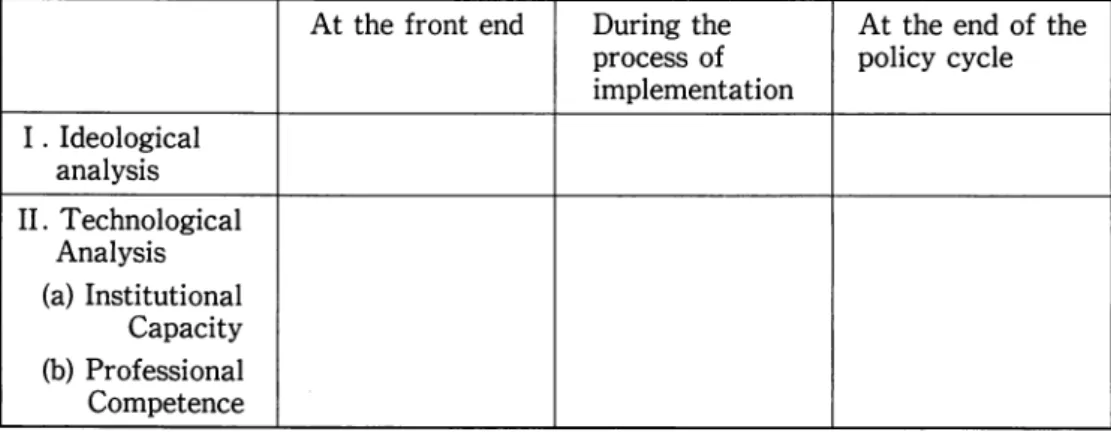
Policy analysis should not be conducted only once. It should be a continuous processes during policy formulation and implementation. In other word, policy analysis and policy making is a dialectic process throughout the life-cycle of a particular policy. Components of the process of policy analysis conceptualized by Bhola (1988) in figure 1 below.
Figure 1 :
Components of the Process of Policy Analysis
At the front end During the At the end of the process of policy cycle implementation
I . Ideological analysis II. Technological
Analysis (a) Institutional
Capacity (b) Professional Competence
2.2 A Policy Analytic Model of Literacy for Development
Policy making and policy outcome is not a cause-effect relationship; it is a dialectical
process in which one influences the other. Political culture, deliniated by economic, social,
and cultural elements, sets the scope and the direction of policy making. Then the policy,
as formulated and implemented, impinges on policy outcome which in turn influences
political culture, changing context of power relation and process of policy making. This
political culture is not closed within society, but is open to the whole world. Social change takes place in this dialectic context (Bhola, 1988).
The political culture determines development approaches. One political culture tends to maintain status quo, while the other political culture tends to seek changes. These two types of political cultures influence on formulation policy of adult litearcy campagin.
LeBelle (1985) in the same vein had described two basic approaches to development processes, focusing on rural areas: human capital approach and revolutionary approach.
Human capital approach is intimately related to capitalism and modernization perspective.
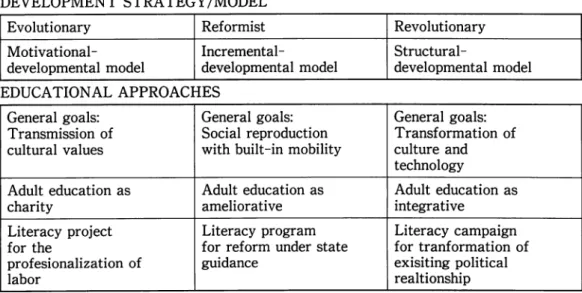
Characteristic of this approach is more capitalist development. Revolutionary approach views capitalism negatively, seeing it as a main producer of inequality and injustice. This strategy attempts to destroy the existing system through the collectivization and redistri- bution of production. This point of view does not abandon the importance of increasing production or making production more efficient. The goal, however, is more explicitly directed toward more equitably distributing wealth, and the means are through assuming greater access to and greater participation in decision making (see Figure2).
Figure 2:
A Policy Analytic Model of Adult Literacy for Development
(Bhola, 1988) DEVELOPMENT STRATEGY /MODEL
Evolutionary Reformist Revolutionary
Motivational- Incremental- Structural-
developmental model developmental model developmental model EDUCATIONAL APPROACHES
General goals: General goals: General goals:
Transmission of Social reproduction Transformation of cultural values with built-in mobility culture and
technology
Adult education as Adult education as Adult education as
charity ameliorative integrative
Literacy project Literacy program Literacy campaign for the for reform under state for tranformation of profesionalization of guidance exisiting political
labor realtionship
Bhola (1985) developed similar policy analytic models for adult literacy campagin for development. The models have three categories: the motivational-development model, the structural-development model, and the incremental-development model.
The motivational-development model, similar to human capital approach, is rooted in
the assumption that individual motivations are important factors of individual develop- ment. Consequently, it is the development of society. This model is congenial to the existing capitalist structure. Non-formal education in this framework is traditionally tied to technical assistance and short courses or activities to enhance economic viability. The teacher retains authority, and the task is to deliver information and skills which foster more effective and efficient production and consumption. This model is based on the assumption, not of conflict, but of cooperation between both the exploiter and the exploit- ed. People must learn to have higher aspirations and must work to go up the social and economic ladder. Therefore, formal education is central to all these processes. Social change may sometimes have to be spread over long period.
The structural-developmental model assumes that there must be structural reform to bring development to underdeveloped societies. The model must include conflict of interest among classes and distribution of wealth for the most oppressed people. This model is a revolutionary approach of development and asserts the need to change society more rapidly.
The incremental-development model is placed between the two models of development.
The model employs a coordinate strategy of structural change and individual motivation.
The model accepts both the existence of conflict and the cooperation among different interest classes.
These three models do not exist exclusive of each other. These models are rather dialectic, in reality. As the graphic presentation of the policy analytic models of literacy for development displays relationships between development strategies and literacy approaches. The literacy campaign in this model involves a high level of commitment on the society while the literacy project is aimed for individual motivation by charity. The policy analytic model indicates differences among project, program, and campaign approaches with conjunction to development strategies (Bhola, 1985).
3. Tanzania Situation in the 1960s
Ever since its independence in 1961, Tanzania has been trying to achieve the goals of
national development and self-reliance (Adams, 1986). In the early years of independence,
Tanzania was a marginal supplier to the world economy of a small number of agricultural
products. During this period, agriculture continued to account for about 45 percent of
domestic product. Coffee, cotton, and sisal were the major export commodities. The
economy grew at a rate of 5 percent per annum during the First Five Year Development Plan (1964-69), and an increase in per capita incomes of 2 percent annually (Kapan, 1978).
In spite of this positive economic growth, the political leaders became increasingly irritated with the unequal distribution from such growth. They argued that the Tanzania market-based economy, which depended on the foreign dominated industry and commerce, was hindering equal distribution of benefits. Rural life seemed to be as impoverished as ever, with little improvement in the incomes, nutrition and health of the major population.
The gap in living standards was widening between urban elites, large commercial farmers and the more numerous peasantry. The political leaders did realize the need to rely mainly on their own resources and abilities if they were to develop and determine the nature and direction of modernization in their own country and at the same time be politically independent. They also wanted to be as well respected as possible by having a definite political and cultural identity and to receive recognition from other nations. President Nyerere and his fellow leaders in Tanzania, however, found it difficult to be self-reliant when the country was so poor. They did not have enough experience with development planning and implementation. Also, people in Tanzania were insufficiently skilled or trained to carry out essential tasks such as government administration and modern agricultural works. It became evident to Tanzanian leaders that it would not be easy to find remedies for these deficiencies without external assistance. Having accept,ed foreign capital and technical assistance to develop as rapidly as possible, they had to also accept a new group of foreigners who merely replaced the former colonialist. Moreover, the foreign aid, particulary bilateral aid, frequently brought frustrating consequences from abroad, effecting both directly on investment decisions and indirectly on other policy matters.
Thus the leaders realized that they would have to relinquish foreign aid altogether if they really wanted to be completely independent. However,. they also recognized that external assistance continued to have an important place in their economy. Nevertheless, they hoped to reduce their degree of dependence upon foreign governments and their aid experts (Harris, 1983).
The Tanzania government expected external source to provide 80 percent of its public development in its First Development Plan, but the external source provided only 34.5 percent of financing of total budgeting during the first year of the Plan (Gitelson, 1976).
Experiencing this kind of unpleasant treatment, President Nyerere and his political leaders
tried to reassess their relationship with development assistance. A radical change would be
required in the strategy for achieving the initial purposes of independence: political sover-
eignty and "African socialism." Comprehensive strategy for national renewal and salvation were articulated in the Arusha Declaration in 1967. The three main strategies were "self- reliance," "socialism" and "freedom." Self-reliance meant that Tanzania should diversify its links with the global economy and restructure domestic production to meet the basic need of an overwhelmingly poor population by employing the structural-developmental model. Educational, health and water service would be directed toward the massive population in the rural area (Young, 1983).
Nationalization became a priority. The private banking system and certain industries were brought under public ownership with compensation. Tanganyika African National Union (T ANU), the only regally-sanctioned political party at that time, was to become more active in implementing the guidelines throughout the country. The Party "cells" at the regional, village and factory levels were to oversee the implementation of a program to reduce the social, political and economic inequity.
The essence of the Arusha Declaration (TANU, 1976) was "We must run while others walk." Tanzania could accelerate its economic growth to "trickle-down" to the majority of the population. Nyerere viewed that Tanzania was trapped in a poverty cycle imposed by the outside world. Through a diversification of its external links, Nyerere believed that Tanzania could at least meet the basic economic needs of the population, although it might retain a relatively poor economy.
Thus Nyerere tried to convince people ideologically and technologically to exert more efforts and intelligence in all sectors and practically in agriculture, which engaged the majority of the population (Gitelson, 1976).
4. UNESCO Functional Literacy and Tanzania Ideology
Illiteracy was considered to be associated with underdevelopment of a society. Especially well-educated, urban- oriented individuals in the Western world were looking for remedies to relieve the misery of the poorest people in the Third World. This literacy doctrine also attracted the political leaders in developing countries, especially those newly elevated to power who wanted to appeal to nations by launching a new literacy campaign. The people themselves usually welcomed the opportunity to acquire skills. For them, literacy was a prestigious symbol of modernity, a means to new power and self-protection, and a way to get ahead (Coombs, 1985).
At the international level, UNESCO became the opinion leader for launching literacy
- 7 3 -
projects in the world since a UNESCO director-general described illiteracy as "the most monstrous, the most scandalous of all the many instances of wasted human potential." In the early 1960s, UNESCO held international conferences to exercise international solidar- ity for a step to initiate literacy projects. Development agencies such as the World Bank indirectly started to lend credibility to the literacy doctrine by regularly citing national literacy statistics as a nation's major social economic development indicator.
At the Teheran Conference of Ministry of Education in 1965, it was decided that UNESCO should launch the Experimental World Literacy Program (EWLP) with support of UNDP. UNDP agreed to provide the external cost of the experiment if UNESCO satisfy two conditions. The first condition was that the experiment should demonstrate whether or not literacy training which integrated with occupational training would increase their productivity. In other words, UNDP wanted to know if integrated literacy training with occupational needs would increase their income and consequently, contribute significantly to the national economic development. The second condition was that the experimental program would be objectively and rigorously evaluated. UNDP wanted to obtain the scientifically validated scrutiny.
The term which UNESCO employed to promote literacy programs was named "func- tional literacy." Functional literacy meant "literacy program designed, thought out, and conducted not for their own sakes but in relation to the development that they make possible." (speech of the Director-General of UNESCO : World Congress of Ministry of Education on the Eradication of Illiteracy, Teheran, September, 1965). The major aim of the EWLP was to try out the concept of functional literacy as an efficient means to make individuals acquire the 3 R's (reading, writing, arithmetic), raise production, adopt better health practices, participate more civic affairs, and so forth. In short, literacy should be taught in a practical economic and social program. Illiterate rural farmers, for instance, should be taught with a view to helping them to exercise modern techniques of farming and increase productivity, by guiding them to reading and writing through agriculture and health and economics. Urban literacy program should be centered on industrial and vocational improvement. Traditional literacy method was used in a way in which the people learned reading and writing without direct linking to the real life, the people tended to regrad it as an unnecessary skill. Even though they learned literacy, some of the newly literate had relapsed into illiteracy (Mpogolo, 1985a).
Twelve countries participated in the UNESCO/UNDP Experimental World Literacy
Program. Tanzania was one of them. Tanzania indeed seemed to be ideologically a suitable
country for a functional literacy program. Beginning in 1967 (in the middle of the 1964-69
Five Year Development Plan for Economic and Social Development), President Nyerere published a series of essays outlining his desired Tanzania development. These essays became the backbone of the government's development policy. They stressed a strategy of gradual development toward self-sufficiency in skilled manpower and food production which was to be accomplished through an increase of agricultural productivity. Thus, the government was strongly concerned with rural development, mass adult education, and economic development at all levels (UNESCO, 1980).
The political climate was thus actively supportive to the literacy project and the concept of functional literacy was agreeable to the government development plan. The organization and implementation structure of the WOALPP was supportive of the self-reliance concept to develop the conviction that local problems can be solved through local initiative and cooperative effort at village level. Particularly viewpoint of top-down, centralized bureau- cratic implementation was carefully illuminated. Literacy education should not be viewed as an imposition, but rather it should be a response to popular demand as people became aware of its functional importance. This view was clearly aligned with the Tanzanian National Five-Year Plan in which President Nyerere emphasized both the absence of exploitation, and a concern for peasant farmers.
When UNESCO introduced the literacy project to the Tanzanian government, the Tanzanian leaders made two suggestions. The first suggestion, which came from people involved with the already- existing national literacy program, was that more equipment be supplied and a nationwide campaign be implemented. The second suggestion, which came from the head of Institute of Adult Education of the University College, Dar es Salaam, was that they establish a national training institute for teachers to train in new teaching methods. However, UNESCO accepted neither of these ideas; instead UNESCO argued that projects should be selective and intensive in order to try to apply and examine new methods. Several pilot areas were carefully examined and finally, the Lake Zone was chosen for setting up the pilot project. The decision to use the Lake Zone was a compro- mise for both the Tanzanian and UNESCO. This was the smallest area acceptable to the Tanzanian government since they had wanted to initiate on a national scale, and for UNESCO, this area was the largest area to which they would agree (Malya, 1978).
The Tanzania component of the EWLP, named the Work-Oriented Adult Literacy Pilot Project (WOALPP), was a five-year program that was initiated in Mwanza, a Lake Zone in Tanzania. The WOALPP was planned for illiterate peasant farmers and established around Lake Victoria in four pilot districts. Reasons why this area was chosen were following: the area was one of the most important economic zone in the country, producing
- 75-
cotton and coffee as both major cash crops and foreign exchange earners, as well as rice, bananas, and tea; the zone was the most densely populated area in the country; it had a well -established educational infrastructure, a good number of extension personnel, and two large well-established cooperative movements for cotton and coffee growers. Illiteracy was considered to be one of the major bottle-necks in the economic development process, in particular for the diffusion of agricultural innovation.
5. Tanzania UNESCO/UNDP WOALPP Policy and Objectives
As described earlier, the Tanzanian WOALPP was implemented against a background of extreme ideological consciousness. The plans were infused with a uniquely Tanzanian socialist ideology (the spirit of
Ujamaaor familyhood) which called for major expansion in primary and adult basic education. The goal, to provide for each citizen, was considered essential to political consciousness and participation, and to increase productivity.
The goals of the project therefore reflected national political/ideological concerns to a greater extent than did most other EWLP projects. These ideological concerns were in addition to the narrower goal which linked literacy with increased productivity through attitudinal and behavioral change. Functional literacy was ultimately aimed at the develop- ment of the total citizen, not simply the citizen as producer.
The project's specific objectives included:
1.
Teaching illiterate men and women basic reading and writing and solving simple problems of arithmetic, using as basic vocabularies the words em- ployed in current agricultural and industrial practice.
2. Helping them apply the new knowledge and skills to solve their basic economic and social problems.
3. Preparing them for more efficient participation in the development of their village, region and country.
4. Integrating the adult literacy and adult education programs with the general agricultural and industrial development of the country.
5. Providing the necessary reading materials, imparting the knowledge of
community and personal hygiene, nutrition, child care, home economics,
which would help improve family and community life, providing opportunity
for a continuing education and avoiding relapse into illiteracy (Hall, 1975).
6. Institutional Configuration
The Tanzania government originally asked mainly for equipment from UNESCO, but UNESCO indicated that it would comply only if the equipment were accompanied by a sufficient number of international experts. In return, the Tanzania government asked for only four experts: a chief technical adviser, a research and evaluation expert, a trainer in adult education and an expert in visual aids. However, UNDP responded that six experts to cost up to $390,600, along with $684,100 worth of equipment and supplies. Finally, UNESCO provided for nine experts at a cost of $716,300, while it allocated only $252,000 for equipment. The experts were as follows:
1) the Chief Technical Adviser,
2) an economics, statistics, and evaluation expert,
3) the Deputy Chief Technical Adviser and specialist in adult education, 4) a literacy and adult education trainer,
5) a rural construction trainer, 6) an agriculturalist,
7) an educational adviser for book production, 8) a graphic and layout specialist, and
9) a printing specialist.
Since the Tanzanian government officials wanted to have more equipment than experts, and to implement the project with their own way, their attitude toward the UNESCO experts was not welcoming from the beginning of the project(Gitelson, 1976). UNESCO hired an experienced Chief Technical Adviser to implement the functional literacy approach defined in the Teheran Conference. The Chief Technical Adviser, Paul Bertelsen, had formally been the first director of the Institute of Adult Education (IAE) at the University College of Dar es Salaam. The Tanzanian adult education initially focused on night classes for the well educated urban elites. Bertelsen, however, brought different perspective of Scandinavian tradition to the IAE. He was a Danish adult educator who studied Scandinavian participatory social movement and folk education, and worked in the adult education program of Ghana during the Nkrumah period (Unsicker, 1988). He hosted several visits by folk educators from Scandinavian countries and the delegation from the Swedish International Development Authority (SIDA) to assess the Tanzania adult educa- tion. After his assignment in the IAE, he came to Tanzania as a Chief Technical Adviser sent from UNESCO.
- 7 7 -
The overall planning, direction and coordination of the project, according to the plan of operation, was carried out by a National Director, who was attached to the Ministry of Local Government and Rural Development in Dar es Salaam. The UNESCO expert team headed by a Chief Technical Adviser was supposed to assist the implementation of the project. This institutional configuration had several problems in practice. Firstly, the National Director was, at the same time, both Acting Assistant Commissioner for Rural Development and Assistant Commissioner for Adult Education for all of Tanzania.
Obviously, he was not able to devote full time to implementing the project since he worked most of his time in the capital city. Secondly, Mwanza, the center of the pilot area and the third largest town in the country, was almost 1,000 miles away from Dar es Salaam, the capital. This meant that the National Director had to appoint the Deputy Director to run the project, but he was not always able to contact his superior about operational problems.
Thirdly, unlike most UNDP project headed by a Project Manager, the UNESCO expert team had the Chief Technical Adviser. The different interpretation of the projects objec- tives led to disunity between the Chief Technical Adviser and the Deputy Director. The Deputy Director preferred to focus on the first objective of stressing basic literacy skills while the Chief Technical Adviser preferred to emphasize the fourth and fifth objective which stressed association between literacy and development. Since both of them had rich experiences in adult education and literacy, it was difficult for them to compromise with each other. This basic professional divergence and personal disagreement impaired efforts in the actual functioning the project (Gitelson, 1976).
7. The UNESCO Experts
During the preparatory phase, the UNESCO experts were to acquire a familiarity of local conditions and knowledge of Swahili. According to Gitelson's interview with a government official, however, the experts generally preferred to stay in the capital or in Mwanza and were reluctant to live
inthe area where they could learn about the real needs of the local people. Only half of the experts were able to speak Swahili: three of them speak fluently and the rest only through interpreters. In this kind of situation, the Tanzanians were particularly disappointed that UNESCO would not recruit a trainer who had exten- sive experience in literacy and knew the country and Swahili adequately.
The expert mostly stayed in their offices to concentrate on planning a large-scale
campaign, and therefore did not seem deeply concerned about familiarizing themselves
with the particular area. The Tanzania officials, on the other hand, wanted to see practical action in these specific Lake regions. Although the Deputy Director asked that all experts should spend one-half of their time outside and the other half in the office, they did not follow it. The UNESCO experts would have liked an advisory rather an operational role, while the government officials would have preferred the opposite (Gitelson, 1976).
Nonetheless, the UNESCO experts had the international credibility which benefited the country. Their existence caused the central government to pay greater attention to the literacy problem and to provide the opportunity for studying it more deeply.
A collaboration between experts and the local staff was also difficult. The Chief Technical Advisor formed the UNESCO experts into a team, while the National Director supervised the local staff separately. The slow recruitment of Tanzanian counterparts managed by the Tanzania side was one factor of hindering cooperation. The situation improved since Tanzania college graduates finally arrived to be trained. The other factor was that the UNESCO experts lacked sufficient sensitivity about the Tanzanians' pride.
This was a very serious problem since community development was one of the first areas to be Africanized, and there were several Tanzanians with extensive experience in the field.
The Deputy Director in the field and the National Director in the capital tried to organize their staff so as to coordinate them with larger rural development efforts. Interaction between Finnish volunteers assisting the UNESCO team and the local people became smoother than between the UNESCO experts and their counterparts.
The other serious problem concerning the UNESCO experts was their length of assign- ment. When the Chief Technical Adviser was promoted and transferred in the middle of the project, he left an important vacancy since it was hard to find a replacement who had equivalent qualification and knew the country as well. Other UNESCO experts also intended to leave after their two-year contracts. The result was that no one might remain to take care of the project from the beginning to the end, and this lack of continuity weakened the project.
Gitelson (1970) argued that it would have been preferable to have used a larger number of less qualified people from the beginning at lower costs who would have been more willing to go out among the people, like the Finnish volunteers did, and to remain through- out the project.
- 7 9 -
8. Assessment of the EWLP
Official assessment of the Experimental World Literacy Program (EWLP) was published jointly by UNESCO and UNDP in 1976. This assessment highlighted both the positive and negative aspects of the project. It was indeed difficult to judge success or failure of the EWLP because objectives were not clear enough and various kinds of factors affected the project outcomes. According to the assessment of the Tanzanian WOALPP, the interna- tional experts and the high-level national counterparts assigned to the project were generally excellent quality and committed to the project's success. They spent considerable cooperative effort to produce the instructional materials. Teaching materials were devel- oped around six learning fields: cotton, banana and rice growing, cattle raising, fishing, and home economics. These primers were produced by the writers workshop comprised of both the international experts and Tanzanian counterparts (UNESCO, 1976). The Tanzanian WOALPP was recognized one of the most successful projects by the member countries of UNESCO.
UNESCO (1976), on the other hand, pointed out that the weakest area of the project throughout its duration was the evaluation unit. Since this unit did not start from the beginning of the project, it resulted in a lack of baseline data. Furthermore, international evaluation specialists sent by UNESCO had different approaches which did not comple- ment each other.
As untrained interviewers, transportation problems, and the experimental nature of functional literacy evaluation itself made evaluation unreliable (Malya, 1979). Precise measurements concerning the impact of functional literacy on various aspects of Tan- zanian social and economic development were not obtained.
Coombs (1985) criticized the inherent value of the EWLP as a whole and drew several lessons from the EWLP assessment. Firstly, the realities in the field turned out to be far more complex than had been anticipated from the Western scientific vantage point of UNESCO's headquarters in Paris.
Secondly, the successful promotion of literacy was not simply a matter of employing the
"right" pedagogical techniques. The EWLP planners assumed that the main reason many previous literacy programs had gone poorly was that they lacked appropriate pedagogical methods. They viewed the problem as a technological one whose solution called for a
"techno-scientific" approach, constructed from rather rigorous scientific concepts and
methodologies. The problems encountered in the field, however, were far less technical
than social, cultural, psychological, and political.
Thirdly, UNESCO and other international agencies tried to apply universal models and experts to various countries without considering its inherent limitations. The planners of the EWLP assumed from the beginning that developing countries had not made better progress in literacy because they lacked the necessary technology. Thus, the obvious solution was to bring joint international expertise to bear in these countries under the leadership of UNESCO (Street, 1984). The Western planners in international agencies embraced the notion that there must be international standards and an universal model applicable in any and all situations. Once the model was designed in Paris, the planners believed that the main task would then be to sell it to developing countries and to recruit and dispatch experts to the Third World countries as products. Although some countries wanted national literacy campaigns, they seemed to have "bought" the selective, intensive, and integrated EWLP "product" partly because they were not aware of all its implications, and partly because they saw no prospect for obtaining international aid in any other way.
Fourthly, the EWLP integrated functional approach was never given a real test in most projects because the literacy part of the instruction was conducted by volunteer teachers who were not sufficiently familiar with the related occupational field concerned, such as cotton, rice, and banana growing, to be able to integrate the two kinds of training. Contrary to the original intention, the integrated functional approach was handled by two instructors and became divorced from each other. Some projects abandoned·the occupational training component altogether and slid back into being a "traditional literacy" program.
Although the EWLP revealed weakness of international projects, no organization is better positioned than UNESCO to take the lead in this matter at the international level.
Indeed UNESCO has taken the lead in some practical operational ways: through its special studies, expert meetings, and publications; through its advisers in developing countries;
through the research and analytical work and country training course conducted by the International Institute for Educational Planning, and through the stimulation and encour- agement that UNESCO provides to many independent scholars and organizations in many countries.
Enthusiastic promoters of the literacy doctrine were quite right in emphasizing the
importance of literacy. Where they went wrong was in attaching a special charm to
mechanical literacy skills, in failing to distinguish between different cultural situations, and
in grossly under-evaluating the realistic and immense hindrances to making the whole
world literate within a short period of time (Coombs, 1985).
9. From the Project to the National Campaign
The people involved in the WOALPP considered that the materials, methods and system developed in the project could be applied, not only to the people in the Lake Zone, but also to millions of illiterates in the country. Throughout the project activities, counterpart staff received training on the job. Some of them visited one of the EWLP in the other eleven countries for several weeks while people from the other project visited and observed the Tanzania Pilot Project (Viscusi, 1971).
The Second Five-Year Development Plan (1969-7 4) delineated the objectives of adult education. It focused on rural areas to make a maximum contribution to development. It required that primary schools serve as centers in each community for adult education and headmasters be responsible not only for education of children, but also for activities of adults. President Nyerere restructured the cabinet and the Ministries to transfer the responsibility of adult education from the Division of Rural Development to the Ministry of Education in 1969. The Ministry of Education changed the name to the Ministry of National Education, which meant that both formal and nonformal education came under one organization. The Department of Adult Education in the Ministry was established and had the responsibility of planning, coordinating, and implementing adult education. One of the first steps of reinstitution was the setting up of adult education committees at all levels (Kassan, 1979).
The Party National Central Committee decided on 1970 as the Adult Education Year. In his New Year's address of 1970 to the nation, President Nyerere directed the people to take adult education more seriously than ever before. He announced that:
The illiterate one will never be able to play their full part in the development of our country of themselves; and they will always be in danger of being exploited by the great knowledge of others. Therefore it is necessary that we should plan to overcome the existing high level of illiteracy. We must help as many of our people as possible on this first step up the hill; afterwards they will be able to climb up further by using this basic knowledge to read and study more. (Nyerere, 1979)
He further directed that within one year illiteracy should be "completely eradicated" in six
districts, followed by the Party's directive that illiteracy should be eliminated in the entire
nation in just four years.
In 1972, the Ministry of National Education issued the literacy campaign guidelines:
(1)
To wipe out illiteracy in the six districts, which was supposed to achieve by 1971, (2) To wipe out illiteracy in all Ujamaa villages and in the Lake Nyanza Zone by 1972,
and
(3) To work out in other area of Tanzania Mainland by 1975.
To achieve these extremely ambitious objectives, the people involved in the campaign tried their best to implement the objectives, but their efforts resulted in distortion of the Nyerere's intent of development.
1 0. Institutional Partnership with the Swedish Government
The first Director of Adult Education, Emmanuel Kibira who occupied his position for ten years, took advantage of a close personal relationship to the President and other connections in the Party and in Sweden. He tried to draw on those contacts for achieving his goals. He was a forceful, demanding and single-minded leader. His understanding of the campaign goal was "high enrollment." Through an interview with the national newspaper, Kibira imposed on regional and district leaders to ensure full enrollment in the campaign, otherwise, they would answer directly to him. Kibira's close connection with Swedes brought support from the Swedish International Development Authority (SIDA). Since the SIDA offered a Swedish planning advisor as a prerequisite of receiving financial support from Sweden, Kibira had to accept this requirement to achieve the campaign goals. The SIDA immediately began supplying paper for printing primers and assigned a Swedish planner to the Department of Adult Education. The pattern of conflict between UNESCO experts and Tanzanian counterparts was repeated once again (Unsicker, 1986).
As the campaign progressed, the Swedes were deeply committed to the literacy effort in Tanzania. The SIDA invited a Tanzanian delegation from the Ministry of National Education to study the Swedish education system. Based on the delegation's recommenda- tion, the study was carried out on the introduction of Folk High School in Tanzania. The SIDA signed a second agreement to support adult education in 1973, providing funds for training workshops for adult education staff and literacy teachers and for honoraria to compensate the teacher, as well as for various supporting project such as rural libraries.
The next year the SIDA expanded the amount and scope of the support, especially in the
area of purchasing transport vehicles for the adult education staff and in supporting the
Adult Education Press. In 1975, the SIDA also agreed to support the capital development
costs of Tanzania version of Folk High School program: the creation of residential Folk Development College in all of the eighty rural district of the country.
Swedish aid became the sole source of Adult Education's development budget. When the local budget was inadequate to operate local activities, the SIDA funds also covered key cost such as teacher honoraria. Because of the expanding flexible Swedish support, it was possible to recruit thousands of literacy teachers. Voluntary teachers were paid honoraria of about four dollar per month. Besides honoraria, literacy teachers were given a choice for permanent job or to join a college of national education for a training as a professional teacher. The teachers were trained in workshops organized by regional and district adult eduction staff, who in turn had been trained by the former WOALPP staff. The teachers initially used the functional literacy primers developed for WOALPP (IAE, 1973).
Figure 3 :
Swedish Technical Assistance to Adult Education up to 1982 (Johnsson, 1983) No. of No. of
experts consultants
Adult education/Literacy 1 2
Adult education printing
31
press
Folk development college
52
IAE 12
-NCI 6
-Total 24
51 1 . Implementation of the Literacy Campaign
There were major instruments used to stimulate activities such as the delivery system, party pressure, appropriation of funds, training and the monitoring system (J ohnsson, 1983).
1 1 . 1 The Delivery System
Adult education was carefully and systematically integrated into the existing structures of formal education. As mentioned before, the Ministry of National Education became responsible for whole adult education activities. Every elementary and secondary school became a center of adult education activities (Bhola, 1984b).
Whenever there was a need to change or supplement the guideline, the Ministry issued
directives and circular. These were sent to the regional level to make them fit the local
condition, so that it was unlikely that the essence of a circular would be missed in implementation.
1 1 .2 Party Pressure
Policy changes had to pass the Party before they could be issued by the Ministry. This ensured that the Party's officials at all levels knew changes and supported their execution.
The interface with the party was particularly important since the literacy campaign involved political enlightenment. The Party's role as a mobilizer of the population was of paramount importance to the success of the literacy campaign. Coordination and collabora- tion among the Party, the executive and the education sector moved the action in one common direction.
1 1 .3 Appropriation of Funds
The government allocated 10 percent of the total budget of the Ministry of National Education. The whole campaign to eradicate illiteracy in Tanzania was estimated at about 20 million dollars (Mpogolo, 1980). Fifty percent of government funds covered administra- tion, transport, personnel emoluments, printing, seminars, and training, while supplemental funds from external agencies covered honoraria, production of primers, materials and equipment, expansion of the Adult Eduction Printing Press, radio sets, tape recorders, cinema vans, rural libraries, and work-oriented projects. Besides international organiza- tions such as UNDP and UNESCO, financial support came from Sweden, China, USSR, West Germany, India, Japan, Canada, etc. at the beginning of the campaign.
1 1 .4 Training
Personnel training played an important part in the implementation of the campaign. The Institute of Adult Education (IAE) trained a large number of teachers and administrators, and some researchers in adult education (Malya, 1978). The University of Dar es Salaam offered a degree course in adult education. The Tanzanian counterparts trained by UNESCO experts, became adult literacy instructors in the National Literacy Center (NLC) in Mwanza. The NLC trained regional and district teams for decentralizing the training of literacy teachers (Bhola, 1984a). The training of adult education coordinators enabled Tanzania to accelerate the campaign.
1 1.5 Monitoring System
A continuous monitoring system developed by the WOALPP was adopted at the incep- tion of the national literacy campaign. The basic element of the system was a log-book kept by literacy or post-literacy teachers. The NLC was the key unit of collecting and analyzing the report from literacy classes, the supporting program, the FDCs and further education (Bhola, 1984b).
- 8 5 -
1 2. Evaluation of the National Literacy Campaign
1 2. 1 Evaluation from the Government Side
Mpogolo (1980) drew conclusion and several lessons from the national literacy campaign.
The campaign was able to achieve the expected political and social goals more than economic ends. The majority of literated people became conscious of socialism and self- reliance as well as their literacy in Swahili. Mpogolo argued that the success of the campaign could be attributed to the ideological consciousness of the people and Tanzania's policy of self-reliance. Based on development strategies, a decentralized administrative system was essential to lead the campaign successfully. He also pointed out the importance of a coordinating system to mobilize the whole population through National, Regional, District, Division, Ward, and literacy class committee.
For the functional literacy approach, the writing of primers and post-literacy materials required a great amount of effort and time. It is therefore advisable to decentralize the system of writing the primers and teaching materials through regional writers' workshops which should be supervised by a central coordinating team of experts on writing and editing materials for literacy and post-literacy (Mpogolo, 1985b).
In Tanzania, a force of about 200,000 literacy teachers was required to wipe out illiteracy in the country. This was possible through decentralization by the Ministry of National Education and UNESCO/UNDP project. This was also facilitated by the introduction of functional literacy as a subject in collages of national education of teachers for primary and secondary education so that they graduated as teachers for both children and adults.
Finally, the analysis of plans, commitments and capacities for implementing adult literacy should take into account the relatively vast size of the country; the wide variety of resource from area to area; the many ethnic groups; the wide spectrum of the socio- economic and cultural stream.
1 2.2 Evaluation from the Donor Side
Johnsson et al. (1983) pointed out that the important factor was the establishment of a systematic, comprehensive and well-functioning administrative structure and the creation of a system that bound the political and administrative structure together. This was realized through the elaborate system of committees which were directly linked the Party at all levels.
A decisive factor in the implementation of adult education activities was the cooperation
with and support from Sweden. The Swedish government contributed with substantial
grants and technical assistance to the various major activities of the literacy education programs. In terms of Tanzanian financial inputs, the Swedish contribution was a major part of the development budget. It was the only source for payment of honoraria to voluntary teachers and composed almost the whole development budget for the Folk Development College (FDC) program. Even with zealous and devoted voluntary teachers who received honoraria, budgets that met the aspirations were essential. If approved funds were considerably less than what was required, high expectations could not be met and a whole program could be jeopardized.
One characteristics of the Swedish support was its flexibility. For instance, an additional amount of financial support was granted upon separate request made necessary by an explosion in enrollment combined with a strained economic situation. Another outstanding characteristic was that the support was provided on the terms of the recipient. This was a guiding principle from the beginning of bilateral cooperation.
Finally, Johnsson et.al. (1983) concluded that "the Swedish support has undoubtedly contributed not only to the practical implementation of adult education program, but also acted as a moral booster of the commitment and devotion displayed the leaders and people of Tanzania."
1 2.3 Evaluation from Recipient Level
Freyhold (1979) criticized that evaluation research was scarce and handicapped by the close link between the evaluators and the planners of these programs.
In Urban Area
From the least benefited individuals view point, Freyhold (1979) described the situation he observed-in adult literacy classes in a urban ward in Dar es Salaam. The teaching staff consisted of low-level clerical workers, domestic servants, an independent tailor, two housewives and some unemployed youth-altogether about 18 people for the five stations.
They received remuneration for holding one course with 30 Tsh per month, but payments were often irregular and sometimes did not arrive for several months. Sometimes there were disagreements over the remuneration. When, for instance, teachers and learners decided that classes should continue during the month of Ramadan, the teachers were later told by the District Office that they should have closed the classes and that they would receive no payment.
Attendance in urban literacy classes was poor. A class with 60-80 registered members, usually only about ten to fifteen people attended. Due to party pressure, some of those registered, but did not show up to the literacy class. Others attended two or three times and found the class was too boring. Learning was unattractive because of the teaching methods
- 8 7 -
used. After the teacher read the lesson, adults were asked to repeat in chorus throughout class.
The books included a general literacy primer which was well organized for learning new words gradually. The second book was a nutrition primer teaching learners to eat suffi- cient proteins, but it did not tell how this could be done on the limited budgets available to most of the women. The third was a political primer which was unpopular because too many complicated words were introduced too rapidly.
After almost three years of operation, the station had its first and only seminar on teaching methods conducted by a person set from the IAE. Most of the time in this seminar was taken up by lectures on visual aids, but the teachers had no materials.
In Ujamaa Village
Although those who was able to read and write in the village were respected for their skill and applied it to deal with government officials and cooperatives, literacy was not considered a necessary skill for rural life. Making it clear to the village members that literacy was necessary for meaningful democratic participation in all village affairs, the village community exerted pressure on all its members to educate themselves. At one Ujamaa village, for instance, the duties of a village member included seven hours of communal work per day and two hours of adult education. Even where education had become a collective task, villagers rarely felt that educational programs really benefitted their lives. The morale of these villages was constantly threatened by a social and economic environment which was hostile to communal progress. When price fell, when a village was unable to market crops, when essential assistance was denied and when bureaucratic measure from outside weaken the village leadership, literacy education was usually one of the first activities to be discontinued.
Under implementation of the campaign at local level, local people viewed the campaign as part of the power struggle going on in the village. The literacy campaign was seen not as a way of giving the ordinary village more power, but as a way of exercising power over them.
Critics to the Campaign
Functional literacy primers uncritically praised whatever crop they dealt with and
equally uncritically repeated the advise given by extension agents on the method of
growing these crops. In the primer on cotton, for instance, peasants were told that cotton
can make them wealthier, though they knew that maize or rice grower were better paid for
their labor. The primers also encouraged them to use fertilizer when peasants feared that
the costs of the fertilizer might be higher than the gain in yield.
When Paulo Freire visited Tanzania, he suggested that it would be advisable to make the primer more'problem solving' and open. However, his suggestion was not implemented.
The planners argued that if peasants were allowed to criticize the advice of the extension agents, they undermined his authority. If peasants began to discuss whether they wanted to grow cotton or not, they might decide against it, and if they produced no cotton, where would foreign exchange be obtained from? As long as peasants had reasons to suspect that the foreign exchange they earned for the country was used to produce or import consumer goods for other classes, it might indeed be difficult to convince them to produce an export crop which had a relatively low price.
1 3. Conclusion
The Tanzanian literacy campaign has been recognized as one of the most successful campaigns in Africa. The illiteracy rate had been brought down from 67 percent in 1967 to 15 percent in 1985. In this policy analysis, however, the problematic aspects were emphas- ized to analyze not only products, but also process of the campaign. The literacy campaign involved different kinds of actors, including Tanzanian government elites, international experts, literacy teachers, adult education coordinators, party cells, and most importantly illiterate masses. The illiterate masses were the least vocal and the most neglected part in the campaign. Although the negative aspects were not pervasive, it is important to pay attention to these aspects for consideration in further implementation.
In the process of policy implementation, goodwill shifted to other directions. The literacy
campaign may have been designed to help the people to raise their own consciousness,
articulate their own interest and make their own choice, but implementation sometimes
goes differently. As described, President Nyerere saw adult education as a tool for the
liberation of the mass. At an international and national level, the literacy campaign was
rich with ideology and technology, but as it passed through the many strata of policy
implementation, the richness was lost. For instance, at the top level, President Nyerere
wanted enlightenment of the people through literacy, but the Director of Adult Education
simply demanded full enrollment of literacy classes. Adult education coordinators and the
party cells were frightened by the request for full enrollment from the central office, and
so illiterates were forced to attend classes, and got bored being taught by untrained
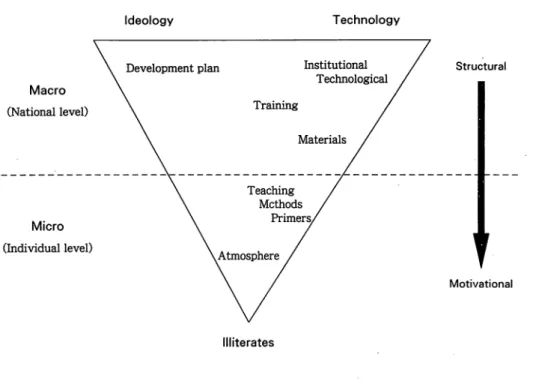
teachers. The structural-developmenttal model was chosen at the macro level to redistrib-
ute wealth, but development strategy, which actually implemented was not to distribute
Figure 4: Model of Literacy Campaign Implementation
Macro (National level)
Micro (Individual level)
Ideology
Development plan
Training
Technology
Institutional Technological
Materials
Illiterates
wealth, instead relied on more individual motivation (see Figure
4).Structural
Motivational
Concerning international cooperation, mismatch of intention and mis-expectations between donor agencies and the recipient country are common phenomena. International aid should create mutual understanding and cooperation. It should not create conflict or hostility. From external agencies' viewpoints, external assistance should be visualized and appreciated by the people back home. The project approach is more favorable for develop- ment because it offers a neatly wrapped package; and it limits the size and duration of the agency's financial commitment. However, from recipient country's viewpoint, the project approach is not appreciated because of its limitations. The campaign approach is preferred, if the government commits itself to mobilize its people as in Tanzania.
This kind of mismatch occurs in individual levels, like between UNESCO experts and
government officials in the WOALPP. For international experts, it is required to have not
only technical skills, but also a commitment to the country. For most developing countries,
it has became almost impossible to implement a nationwide literacy campaign without
expernal support. The UNESCO experts trained literacy personnel who became the core
group to train a great number of literacy teachers. The SIDA experts introduced the Folk
Development College in Tanzania to proliferate useful training to the local people. The
SIDA's flexible funding enabled literacy teachers to continue to teach in classes.
To promote the literacy campaign, UNESCO and SIDA played important roles for providing technological support. However, those who play the most important roles are not international experts, but the nation itself. A national commitment to mobilize people will makes a literacy campaign a real success.
Bibliography
Adams, Juanita (ed.) (1986). Background Notes: Tanzania. Washington, D.C. United States Depart- ment of State.
Bhola, H. S.(1988). A Policy Analysis of Adult Literacy Education in India: Across the Two National Policy Reviews of 1968 and 1986. Perspectives in Education. 4(4)., 213-228.
--.(1985). Literacy in Revolution and Reform: Experience in the SADCC Region of Southern Africa. (ERIC document ED 260 208).
--.(1984a). A Policy Analysis of Adult Literacy Promotion In the Third World: An Accounting of Promises Made and Promises Fulfilled. International Review of Education. 249-269.
--.(1984b). Campaigning for Literacy: Eight National Experiences of the Twentieth Century, with a Memorandum to Decision- Makers. Paris: UNESCO.
--.(1975). The Design of (Educational) Policy: Directing and Harnessing Social Power for Social Outcomes. Viewpoint. 51,1, 1-16.
Coombs, Philip H. (1985). The World Crisis in Education: The View form Eighties. New York:
Oxford University Press.
Freyhold, M Von (1979). Some Observation on Adult Education in T Anzania. in Hizern, H. and Hundsdorfer, V.H.(ed.) (1979). Education for Liberation and Development: The Tanzanian Experience. Hamburg: UNESCO Institute for Education.
Gitelson, Susan (1976). Multilateral Aid for National Development and Self- Reliance. Kampala:
East African Literature Bureau.
Hall, Budd L. (1975). Adult Education and the Development of Socialism in Tanzania. Dar es Salaam: East African Literature Bureau.
Harris, John R. (1983). Tanzania's Performance in Meeting Basic Needs: The International Context.
Working Paper No.82, African Studies Center, Boston University.
Institute of Adult Education (1973). Adult Education Handbook. Dar es Salaam: Tanzania Publish- ing House.
Johnsson, Anders I. et.al. (ed.) (1983). Educational Division Document No.9: Adult Education in Tanzania. Uppsala, Sweden: The Scandinavian Institute of African Studies.
Jones, Phillip W.(1988). International Policy for Third World Education: UNESCO, Literacy and Development. London: Rutledge.
Kapan, Irving, et.al.(1978). Tanzania: A Country Study. Washington, D.C.: The American Univer- sity.
Kassam, Yosuf 0. (1979). Illiterate No More: The Voices of New Liberates from Tanzania. Dar Es Salaam, Tanzania Publishing House.
--.(1978). The Adult Education Revolution in Tanzania. Nairobi: Shungwaya Publishers Ltd.
LaBelle, Thomas
J.
(1985). Nonformal Education in the Poor in Latin American and the Caribbean:Stability, Reform or Revolution. Los Angels: University of California.
Malya, Simoni (1979). Literacy-a Work-Oriented Adult Literacy Pilot Project and National - 9 1 -
Campaign. In Hizern, H. and Hundsdorfer, V.H.(ed.) (1979). Education for Liberation and Development: The Tanzanian Experience. Hamburg: UNESCO Institute for Education.
--.(1978). Creating Literacy Surroundings in Tanzania. Nairobi: Kenya Literature Bureau.
Mpogolo, Z. J. (1985a). Methods of Functional Literacy. Dar Es Salaam: Premier Publishers Co. Ltd.
--.(1985b). Post Literacy in Tanzania. Dar es Salaam: African Publishers Ltd.
--.(1980). Functional Literacy in Tanzania. Dar es Salaam: Swala Publications.
Nyerere, J. K. (1979). Education Never End. In Hizern, H. and Hundsdorfer, V.H.(ed.) (1979).
Education for Liberation and Development: The Tanzanian Experience. Hamburg: UNESCO Institute for Education.
Street, Brain N. (1984). Literacy in Theory and Practice. Cambridge: Cambridge Universality Press.
TANU (1967). The Arusha Declaration and TANU's Policy on Socialism and Self-Reliance. Dar es Salaam: The Publicity Section, T ANU.
UNESCO. (1985). The Development of Adult Education: Aspect and Trend. Paris: UNESCO.
--.(1984). Educational Studies and Document No.42: Literacy and Illiteracy. Paris: UNESCO.
--.(1980). Literacy 1972-1976: Progress achieved in Literacy throughout the World. Paris:
UNESCO.
--.(1976). The Experimental World Literacy Programme: A Critical Assessment. Paris:
UNESCO. Wanger, Daniel (ed.) (1987). The Future of Literacy in a Changing world Vol.I.
Oxford: Pergamon Press.
Unsiker, Jeff (1987). Tanzania's Literacy Campaign in Historical- Structural Perspective. In Arnove, Robert F. and Graff, Harvey J. (ed.) (1987). National Literacy Campaigns: Historical and Comparative PersPectives. New York: Plenum Press.
Visusi, Margo (1971). Literacy Working: Functional Literacy in Rural Tanzania. Paris: UNESCO.
Young, Roger (1983). Canadian Development Assistance to Tanzania. Ottawa: The North-South Institute.