AN ENGLISH EDUCATION PROGRAM FOR SENIOR HIGH SCHOOL STUDENTS TO BE ABLE TO COMMUNICATE IN ENGLISH
Approved by T h e s i s A d v i s o r
AThesis P r e s e n t e d t o
The C o u r s e o f E n g l i s h Language E d u c a t i o n Graduate S c h o o l o f E d u c a t i o n ,
Mie U n i v e r s i t y
I n P a r t i a l F u l f i l l m e n t o f t h e Requirements f o r t h e Degree
Master o f E d u c a t i o n
by SAITAYuri March 1 3 , 2015
仏ょ~.ゆ仲人〆
Table of Contents
Abstract ... iv
Acknowledgements ... v
Introduction and Overview ... 1
1. Two premises ... 1
2. Background ... 2
3. Automatization for oral communication ... 3
3.1 The importance of automatization of listening ... 3
3.2 The importance of automatization of speaking ... 5
4. Research Question ... 6
5. The significance of designing a new English program ... 7
CHAPTER 1 What is Collaboyou English? ... 10
1. Goal limitations ... 10
1.1 The goal of Collaboyou English ... 10
1.2 What are the limitations? ... 10
1.3 Details of the goal ... 11
1.4 Why is the goal limited? ... 13
2. Collaboyou English vocabulary ... 15
2.1 The selected vocabulary ... 15
2.2 Comparison to the current Course of Study ... 15
2.3 Why 1,000 words? ... 16
2.4 The way to provide vocabulary ... 19
3. Linguistic knowledge practices... 19
3.1 Consolidation of the knowledge already attained ... 19
3.1.1 One-minute impromptu speech ... 20
3.1.2 Feedback ... 23
3.1.3 Interaction between students ... 24
3.1.4 Oral Reproduction (Dicto-comp, an oral version) ... 24
3.1.5 One-minute speech (the second time) ... 26
3.2 The practice of the selected vocabulary for this program ... 27
3.2.1 The core images ... 28
3.2.2 Having many examples with pictures ... 29
4. Lessons ... 29
CHAPTER 2 Learning effects of Collaboyou English ... 32
1. Method ... 32
1.1 Participants ... 32
1.2 Material and experimental procedure ... 34
1.2.1 Listening tests ... 35
1.2.2 Speaking tests... 36
1.2.3 Questionnaires... 40
2. Results and Discussion ... 40
2.1 Listening tests ... 40
2.1.1 The results of the online listening test ... 40
2.1.2 The results of the Shinken trial examination ... 42
2.2 Speaking tests... 45
2.3 Questionnaires... 48
2.3.1 Students’ self-assessment ... 48
2.3.2 Lesson (program) evaluation ... 51
Conclusion ... 54
References ... 58
Appendix 1 ... 66
Appendix 2 ... 87
Appendix 3 ... 91
Appendix 4 ... 95
Appendix 5 ... 97
Appendix 6 ... 101
Appendix 7 ... 107
Appendix 8 (1) ... 109
Appendix 8 (2) ... 114
Appendix 9 ... 119
Appendix 10 ... 122
Appendix 11 ... 127
Abstract
The purpose of this paper is to discuss the potentialities of Collaboyou English, an English education program targeting senior high school students. The goal of this program is to develop students’ oral communication abilities such as accurately understanding and appropriately conveying information, ideas, etc. about their fields of interest. The program focuses on automatization of oral skills through communication practice, using the
knowledge which students already have, and a set of chosen 1,000 words in Oxford English Corpus.
In this paper, the author analyses to what extent six senior high school second-year students, who were provided with a 15-hour and 25-minute Collaboyou English program, developed their oral communication abilities. Online listening tests, trial examinations at school, speaking tests, and questionnaires were used to provide data for the purpose of evaluating the results of this program.
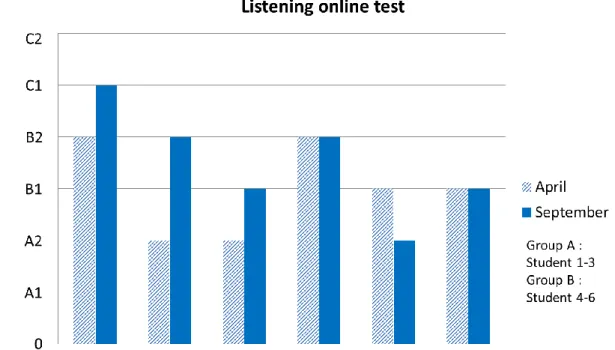
The improvement of the students’ listening and speaking abilities were clearly observed. For example, on the online listening tests, three out of the six students improved their levels, based on the “Common European Framework of Reference for Languages” by the Council of Europe (2001). In the trial examinations, in the period between 2013 and 2014 the difference between the national students’ average and Collaboyou English students’
average increased by 16.5 percentage points in favor of Collaboyou English. Therefore, Collaboyou English could be considered as an effective English education program in terms of cultivating oral English.
In the first chapter of this paper, Collaboyou English is explained in detail. In the
second chapter, the research methods and the final results of this program are analyzed and
discussed.
Acknowledgements
I would like to express my deepest appreciation to Prof. Mitsuaki Hayase, who has always supported and guided me. In addition, I would like to thank Prof. Nobuhiro Miyachi, Prof. Hideo Nishimura, and Prof. Arao Hiroko of Graduate School, Faculty of Education, Mie University for their constant support. I also thank Prof. Alberto Gayle of Graduate School, Faculty of Medicine, Mie University for his wonderful advice.
I cannot express in words the gratitude that I have for Prof. Masaki Umejima of Keio University, who kindly provided the distance education system for the purpose of my research.
I am indebted to Mr. Masatoshi Hideshima, a teacher at N Senior High School, who gave me the precious opportunity that enabled me to carry out Collaboyou English as an after school activity. I would also like to extend my gratitude to all six senior high school students who participated in this program.
I would like to deeply thank Mr. Samo Bitežnik, who has always supported me and discussed the details and issues of this paper with me. His support gave me extra energy and motivation that helped me to continue the hard work, never giving up.
I am indebted to Ms. Ari Nito, who has always supported and encouraged me. I would like to express my gratitude to her for going beyond the call of duty to provide me with more chances and time to complete my research.
I also would like to thank Ms. Supanuch Supanimittrakul, Ms. Ana Bitežnik, and Ms.
Mallory Ginoza who kindly gave me their wonderful advice.
Introduction and Overview 1. Two premises
Collaboyou English is an English education program aimed to enable senior high school students to orally communicate in English (see Chapter 1 for details). This paper has the following two premises.
The first premise: Collaboyou English is an English education program which targets senior high school students. The author of the program recommends this program not as an addition, but as a compulsory part of high school education. It focuses on improving speaking skills; therefore, it is advisable that it is accompanied by other English subjects, such as reading or writing. At the time this paper was created, the Collaboyou English program was provided as an extracurricular activity and not as a regular English course of study for high school students.
The second premise: Limitations of the present research should be considered. The first limitation is that the data given in the research covers only six senior high school students at N Senior High School in Japan. Moreover, their senior high school puts many efforts into
English education. For example, the students of this senior high school have opportunities to engage in cross-cultural communication – going abroad, talking with exchange students, etc.
Therefore, the results cannot be generalized to all Japanese senior high school students. The second limitation is that during the term of the program, they had regular English classes at school. Furthermore, the six students might have had studied by themselves. Therefore it cannot be said that the results of this research have been achieved only by this program. The third limitation is that the duration of this research was 37 lessons, spanning around five
months. Ideally the program should span across one school year, covering 192 lessons in total.
Taking these premises into consideration, the purpose and significance, as well as the
results of the Collaboyou English program will be discussed in this paper.
2. Background
In my experiences of teaching English full-time at a Japanese senior high school, it was observed that the following problem occurred there. At the time of graduation, many students could not communicate orally in a successful manner even after they had studied English for six years. I do not know exactly what percentage of the entire student population did not have the ability to orally communicate in English because of the lack of quantitative data to
measure it. When working for the senior high school, I conducted a small experiment with two students. I discovered that both of them who achieved good English scores even at their university entrance examinations could not orally express their ideas and opinions in English.
In the experiment, those two senior high school students participated in an English program after they had just finished their university entrance examinations. In the program they talked in English with a foreign teacher through a Skype video call
1. Both of them had had good English subject grades at school. As a matter of fact, one of them entered Tokyo Gakugei University, a national university which requires a high English score of the National Center Test for University Admissions.
After the program ended, they said that they understood most of what the teacher said.
Based on my observation, however, they did not. It occurred many times that when the teacher asked questions, they would just smile. It was obvious that they did not understand the questions nor did they know how to respond or continue the conversation on their own.
For further research, interviews were also carried out with all the students, including the six students, who participated in the Collaboyou English program in order to determine the problem with ordinary high school English classes (see Appendix 1). To summarize the interviews, most of the students merely memorized and understood as much vocabulary and grammar as possible for university entrance examinations. That knowledge did not seem
1
Skype is software of Microsoft. It offers video and voice calls, instant messaging, and file sharing via the
Internet which are available free of charge. (Microsoft, n.d.<b>)
necessarily to be “procedural knowledge
2”; nevertheless, their “declarative knowledge
3” seemed to be enough to pass university entrance examinations.
From the small experiment and interviews, it is presumed that one of the imminent problems of the high school English education is the quality of learned knowledge (mostly declarative), which lacks vital procedural knowledge, when students aim to have adequate skills of oral communication in English.
3. Automatization for oral communication
Procedural knowledge is necessary for oral communication because “procedural
knowledge supports language processing rather than declarative knowledge” (Sasaki, 2011, p.
156; my translation). Here, the key is that procedural knowledge “is thought to underlie automatic performance” (Hummel, 2014, p. 76). Looking from the listening and speaking perspective, the reasons why automatization
4is important for oral communication are explained below.
3.1 The importance of automatization of listening
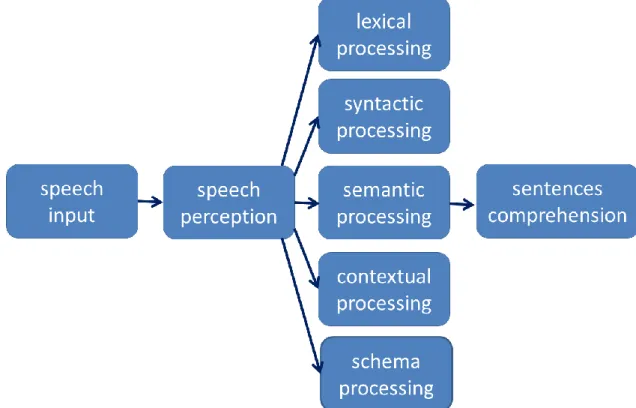
First of all, let us think about automatization from the listening perspective. Kadota (2007) divides the listening process into two stages: (1) Perception and (2) Comprehension (pp. 44-45). (1) In the perception stage, sound is received by the ear, which is then
transmitted to the language processing system. The sounds are processed and converted into phonetic representation. (2) In the comprehension stage, various processes are
comprehensively carried out in order to understand the meaning of the sounds. In particular,
2
“Procedural knowledge is knowing how to do something without having conscious awareness, as being able to produce L2 sentences without conscious reflection on what needs to be done first, second, etc., and is thought to underlie automatic performance” (Hummel, 2014, p. 76).
3
“Declarative knowledge consists of what the learner explicitly knows, as knowing the grammar rule that you need to add an “s” to a noun to form the plural in English” (Hummel, 2014, p. 76).
4
“There are a number of ways that automaticity can be conceptualized, but the most central of these is
that there is fast, unconscious, and effortless processing” (Gass & Selinker, 2008, p. 231).
the following five operations are implemented based on voice and phonological representation, which is formed in the mind: lexical processing, syntactic processing, semantic processing, contextual processing and schema processing.
Figure 1. Kadota’s (2007) summary of the language information processing in the comprehension stage (p. 45). From Science of shadowing and reading aloud (p. 45), by S.
Kadota, 2007, Tokyo: Cosmopier. Copyright 2007 by the Kadota Shuhei. Reprinted with permission.
Listening to and understanding what people are saying in our first language (L1) are normally not difficult, meaning that the perception stage is completely automatized. However in a foreign language, this stage is not automatized (Kadota, 2007, pp. 54-56). Practice for the automatization of the listening process is crucial. This is because there is a limitation of the amount of information that people can process at once (Miller, 1956). For example,
beginning learners pay more attention to processing the meaning of each word they hear and
the relationships between them, so they cannot pay attention to the overall meaning of the
text or conversation. On the other hand, proficient listeners can understand the overall
meaning of what they hear, even without much attention, for example, when there are some
noises and they cannot focus on every sound clearly.
In relation to the above, automatization of listening is important for learning, because
“attention to input is a necessary condition for any learning at all” (Schmidt, 1993, p. 35). If there is no available resource, learners cannot notice new things. In other words, “the more that can be handled routinely - that is, automatically - the more attentional resources are available for new information” (Gass & Selinker, 2008, p. 230). For example, beginning learners can only pay attention to understanding each word in a conversation and they do not pay attention to the form. In this situation they cannot learn the form or grammar.
3.2 The importance of automatization of speaking
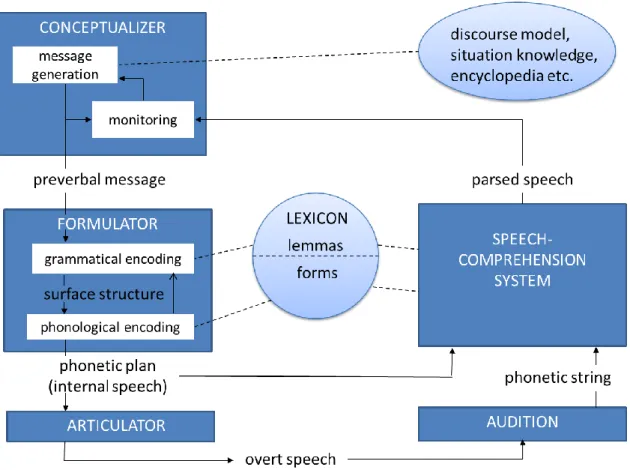
Next, let us think from the speaking perspective. According to Levelt (1989), there are four main components necessary for speech processing. The first is the Conceptualizer where preverbal messages are generated. The second is the Formulator where the preverbal
messages become verbal messages. It has two subcomponents: the Grammatical Encoder which generates “surface structure” and the Phonological Encoder, which creates a phonetic plan (“internal speech”). The third is the Articulator where the phonetic plan from the Formulator becomes overt speech. The fourth is the Speech-Comprehension System:
self-produced internal and overt speech will be available to the conceptual system. Speakers monitor their own productions. These four components work almost simultaneously. Levelt (1989) mentions as follows:
Message generation and monitoring were described as controlled activities requiring the speaker’s continuing attention. Grammatical encoding, form encoding, and articulating, however, are assumed to be automatic to a large degree. They are speedy and reflex-like, require very little attention, and can proceed in parallel. (p. 28)
According to this model, speakers generate messages automatically in many ways in the L1.
So when we learn foreign languages, we need to practice in order to stimulate automatization.
(Sasaki, 2011, p. 160)
Figure 2. Levelt’s (1989) blueprint for the speaker (p. 9). From Speaking: From intention to articulation (p. 9), by W. J. M. Levelt, 1989, Campridge, MA: the MIT Press. Copyright 1989 by the MIT Press. Reprinted with permission.
4. Research Question
DeKeyser (2001, 2007) says that declarative knowledge may become procedural
knowledge through consistent practice. “Once established, procedural knowledge can become automatized” (2007, p. 3).
Based on the English education problems, which were identified earlier, the question to be investigated in this research is as follows:
If senior high school students have the learning environment to practice for
automatization, they will be able to communicate orally. In particular, if senior high
school students take the English education program, Collaboyou English, whose
purpose is automatization through oral communication practice, using the knowledge which they already have, coupled with a set of chosen 1,000 words, they will develop oral communication abilities, such as accurately understanding and appropriately conveying information, ideas, etc. about their interesting fields.
Gass & Selinker (2008) state that there are many definitions of automatization. In this paper, however, automatization is defined as “fast, unconscious, and effortless processing” (p. 231).
5. The significance of designing a new English program
In the small experiment described above, the participating students had good English grades at their senior high school. I wanted to design an English education program which would enable as many senior high school students as possible, at all skill levels, to orally communicate in English. There are four reasons why I believe this is important.
Firstly, in 2003 the Ministry of Culture, Sports, Science and Technology (MEXT) noted
in their action plan for cultivating “Japanese with English abilities” that one of the biggest
problems is that the Japanese people cannot speak in English. The plan aims to drastically
improve English education and states that it is important to acquire communication skills in
listening, speaking, reading, and writing (p. 1).
【Goals】
English-language abilities demanded of all Japanese nationals
“To be able to communicate in English after graduation from junior and senior high schools”
• Upon graduation from junior high school: To be able to communicate about simple
topics such as greetings and responses and about familiar matters related to their lives (English-language ability of the graduates should be at the third level of the Test in Practical English Proficiency (Eiken test), on average).
• Upon graduation from senior high school: To be able to communicate about
everyday topics (English-language ability of the graduates should be at the second level or semi-second level of the Eiken test, on average).
English-language abilities demanded for his or her field of specialization and of those active in the international community “To be able to use English in the work place after graduation from universities”
• Attainment targets to be established by individual universities with a view to
cultivating human resources capable of using English in work place.
Figure 3. Attainment targets of the strategic plan to cultivate “Japanese with English abilities”
(MEXT, 2003, p. 1; my translation).
In February 2014, a “meeting for English education by experts” was held for the first time at MEXT. The senior vice minister Mr. Nishikawa called for transformation of Japanese students into international students who are able to use English as a communication tool.
Secondly, English is one of the necessary elements for the Japanese economy.
According to a survey to foreign-affiliated companies which the Ministry of Economy, Trade and Industry (METI) commissioned to a private research company (Accenture, 2014), the following three points were identified as the main weaknesses of the Japanese business environment: (1) Business activity costs, (2) Smooth communication in English, and (3) Business customs. The survey also included comments given by foreign companies. The following comment is by a North American chemical company:
Japan is superior in terms of the legislation, such as intellectual property, the
customers, and R&D partners. Japan would have been the best location for R&D
centers if there were abundant human resources equipped with English language
abilities. Unfortunately, we are always facing language problems. (p. 31; my translation)
It is extremely discouraging and woesome that Japan loses business chances because of the lack of ability to communicate in English. Not necessarily concerning only business, the necessity of English has come to places which we have not yet expected: for example, workers at kiosks. Staying in Japan may let people think that English is a language with little or no importance. The problem occurs when “abroad” comes to you – Japan has become and is increasingly becoming a bigger and bigger tourist destination. So even a job position which typically required no English skill in the past has now come to a point where English can be encountered daily. We cannot stop internationalization and we should make the best of what it has to offer. Japan will hold the Tokyo Olympic Games in 2020, which means that it will bring huge numbers of tourists to Japan. This alone will dramatically increase the number of situations where Japanese people would require or benefit greatly from knowing English as a communication tool.
Thirdly, it should be pointed out that it can be interesting to communicate with people in English. If you can speak English you can talk not only with native English speakers, but also with many people from all over the world, since English is, without a doubt, a lingua franca. This may bring you to a point where you can see and know about many new and exciting things in the world.
Fourthly, we can say that the ability to speak English will give students more
educational, social, or business possibilities and positive chances now and in their future. The
internationalization has allowed people to connect with each other directly via the Internet. In
such an environment, the ability to speak English will make it possible to expand people’s
activity range immensely.
CHAPTER 1
What is Collaboyou English?
Collaboyou English is an English education program dedicated to senior high school students. It is composed of three elements:
(1) Goal limitations
(2) Selection of vocabulary
(3) Linguistic knowledge practices
In Chapter 1, the details of Collaboyou English will be explained.
1. Goal limitations
1.1 The goal of Collaboyou English
The goal set in the Course of Study for senior high school English by MEXT (2010) is the following:
To develop students’ communication abilities such as accurately understanding and appropriately conveying information, ideas, etc., deepening their understanding of language and culture, and fostering a positive attitude toward communication through foreign languages. (p. 1)
Taking this into consideration, the more focused goal of Collaboyou English was set as follows: “To develop students’ oral communication abilities such as accurately understanding and appropriately conveying information, ideas, etc. about their fields of interest”. In the next section the goal limitations will be described more deeply.
1.2 What are the limitations?
The goal set by MEXT (2010) has been limited in three ways.
(1) Limiting the four communication abilities (speaking, reading, writing, and
listening) by the Course of Study to only two: emphasizing listening and speaking (see “4.
Research Question” in Introduction and Overview for the reasons behind the focus on oral communication).
(2) Narrowing the primary range of communication contents. Each student will usually have a different field of interest. Therefore, the focus of the communication content shifts accordingly. In the Course of Study, communication topics are not specified.
(3) Prioritizing intelligibility. The Commentary on Course of Study (MEXT, 2009) mentions that the phonetic sound, rhythm, and intonation should be properly instructed in addition to the pronunciation of each word, because they are important in conveying the speaker’s intentions and feelings to the listener (p.13). In Collaboyou English, intelligibility is the most important idea of all, which will be described later in greater detail. Even though unclear pronunciation, rhythm, intonation, slowness, and pauses which make listeners wait for a while are problematic, if the contents which are discussed are being conveyed accurately, the quality of speech, such as pronunciation, fluency, rhythm, and intonation, is not really emphasized. The point of Collaboyou English does not push native-like English at least in the beginning of learning.
1.3 Details of the goal
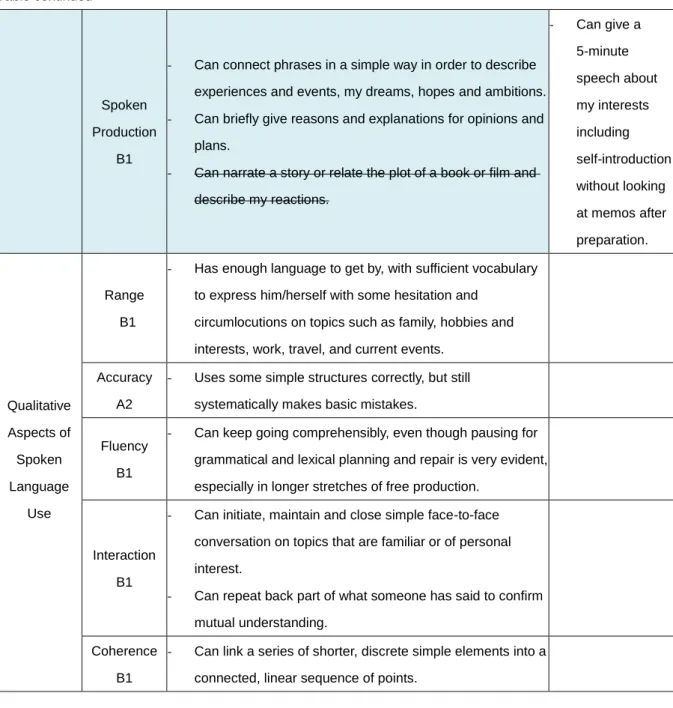
The Collaboyou English goal details and descriptions are partly based on the “Common European Framework of Reference for Languages (CEFR)” by the Council of Europe (2001).
The global scale, self-assessment grid and qualitative aspects of spoken language use are selected for the details of the goal of Collaboyou English and the levels are set (see Table 1).
The reason for setting the levels mainly at B1 is that B1 is the closest objective of Collaboyou
English. In order to make the framework more suitable for the Collaboyou English program,
some parts have been deleted from each section, shown by the crossed-out parts in the Table
1. According to the goal, the CAN-DO statements by the author were also set for listening,
spoken interaction and spoken production.
Table 1
The details of the goal adapted from CEFR
The details of the goal by CEFR CAN-DO
Global Scale
Independent User
B1
- Can understand the main points of clear standard input on familiar matters regularly encountered in work, school, leisure, etc.
- Can deal with most situations likely to arise whilst travelling in an area where the language is spoken.
- Can produce simple connected text on topics which are familiar or of personal interest.
- Can describe experiences and events, dreams, hopes and ambitions and briefly give reasons and explanations for opinions and plans.
Self- Assessment
Grid
Listening A2~B1
- Can understand phrases and the highest frequency vocabulary related to areas of most immediate personal relevance (e.g. very basic personal and family information, shopping, local area, employment).
- Can catch the main point in short, clear, simple messages
and announcements. - Can convey my
interests by having a 15 minute-long interaction if the partner speaks clearly and with a standard accent.
- Can understand the main points of clear standard speech on familiar matters regularly encountered in work, school, leisure, etc.
- Can understand the main point of many radio or TV programmes on current affairs or topics of personal or professional interest when the delivery is relatively slow and clear.
Spoken Interaction
B1
- Can deal with most situations likely to arise whilst travelling in an area where the language is spoken.
- Can enter unprepared into conversation on topics that are familiar, of personal interest or pertinent to everyday life (e.g. family, hobbies, work, travel and current events).
Table continues
Table continued
Spoken Production
B1
- Can connect phrases in a simple way in order to describe experiences and events, my dreams, hopes and ambitions.
- Can briefly give reasons and explanations for opinions and plans.
- Can narrate a story or relate the plot of a book or film and describe my reactions.
- Can give a 5-minute speech about my interests including self-introduction without looking at memos after preparation.
Qualitative Aspects of Spoken Language
Use
Range B1
- Has enough language to get by, with sufficient vocabulary to express him/herself with some hesitation and
circumlocutions on topics such as family, hobbies and interests, work, travel, and current events.
Accuracy A2
- Uses some simple structures correctly, but still systematically makes basic mistakes.
Fluency B1
- Can keep going comprehensibly, even though pausing for grammatical and lexical planning and repair is very evident, especially in longer stretches of free production.
Interaction B1
- Can initiate, maintain and close simple face-to-face conversation on topics that are familiar or of personal interest.
- Can repeat back part of what someone has said to confirm mutual understanding.
Coherence B1
- Can link a series of shorter, discrete simple elements into a connected, linear sequence of points.
There are no specific reasons for individual duration times set for the CAN-DO list.
The lesson is 25 minutes long, while the level check tests are also carried out during the lesson. The test is carried out as follows: (1) 5 minutes of self-introduction, (2) 15 minutes of conversation with a foreigner or teacher, (3) 5 minutes of feedback by the teacher.
1.4 Why is the goal limited?
There are three main reasons why the goal is limited.
Firstly, it will enable many senior high school students to communicate verbally in English. Limiting the goal will allow more senior high school students to attain it. According to Suzuki & Shirahata (2012, pp. 172-173), because other abilities besides the language ability are strongly related to second language (L2) learning, there are differences in ability to tackle L2 learning for each individual. This does not only mean that the starting point of an individual’s L2 learning will be different, but also their reach or learning range will also be different (Mochizuki, 2010, pp.90-91). Thus, the more limited the goal, the more senior high school students will be able to attain it.
Secondly, intelligibility should be the highest priority considering English as a lingua franca. Torikai (2014) says that English as a lingua franca requires intelligibility rather than native-speaker-like fluency (p. 196). “Many have already reconsidered the value of
native-like pronunciation in this internationalized society and have had the idea of
‘Englishes’, English with each country’s accent. Japanese people, for example, do not need to worry about speaking with a Japanese accent” (Torikai, 2010, p. 61; my translation). This does not mean to just focus on conveying what you want to say, while completely ignoring the pronunciation, fluency, rhythm and intonation. Having an extremely bad pronunciation, for example, would make it difficult to communicate successfully. Taking everything into consideration, it is most desirable to avoid situations where students cannot say anything, because they believe and have been drilled into the mindset that requires extreme accuracy, for example, caring about every letter, every word, every structure.
Thirdly, in the perspective of cognitive science, it is very difficult to master an L2.
Imai, Okada and Nojima (2012) state the following:
It is not realistic from the cognitive perspective to aim for the automatic level of information processing of native speakers. Once a brain neural circuit is optimized for a task, it is impossible to optimally execute another task which requires other
information processing. Moreover, it is extremely difficult to rebuild the neural circuit
after a certain age. (p. 144; my translation)
2. Collaboyou English vocabulary 2.1 The selected vocabulary
Collaboyou English has incorporated the “Top 1000 frequently used words” (Oxford University Press, n.d.<c>), which have been selected by the Oxford English Corpus (OEC).
The reason for using the OEC is that it is one of the largest corpora in the world. As stated by the Oxford University Press (n.d.<b>), “the corpus contains nearly 2.5 billion words of real 21
stcentury English, with new text being continuously collected”.
The reason for the selection of the corpus-based 1,000 words by the OEC (OEC1000) is that the higher frequency of each word’s use means that the learner will have a higher chance of coming across such a word in everyday life. The words should not be chosen for specific purposes or fields because each student will undoubtedly have different fields of interest. Because the OEC1000 includes many difficult words, such as political and economic terms which are perhaps not common in casual conversation or literature, for the purpose of the program, the OEC1000 was divided into six levels, according to CEFR: A1, A2, B1, B2, C1 and C2 (see Appendix 2 for the details).
2.2 Comparison to the current Course of Study
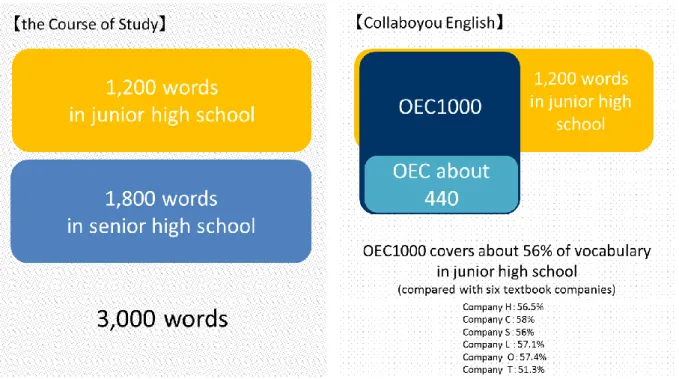
The current Course of Study has determined that a total of 3,000 words are to be learned (MEXT, 2008, 2010): 1,200 words in junior high school and 1,800 words in senior high school. Collaboyou English, which is designed for senior high school students, provides the OEC1000 in addition to 1,200 words learned in junior high school. About 560 of 1,200 words are also covered in the OEC1000. Therefore, only about 440 words
5are virtually new
5
The number of covered words is concluded by cross-referencing the OEC1000 with junior high school
textbook word lists, provided by all six major publishing companies. The referred word lists are taken from
for learners.
The inclusion of the 560 words already learned in junior high school may seem unnecessary and redundant. However, that is not the case. On the contrary, basing our findings on the results of the small experiment, which is described in “2. Background” in Chapter 1, it can be assumed that many senior high school students do not have the ability to verbally use even the most basic and elementary words which should have already been learned in junior high school. Repeating a big part of that vocabulary is therefore more than beneficial and necessary in practice.
Figure 4. Comparison of the number of vocabulary items between the Course of Study and Collaboyou English.
2.3 Why 1,000 words?
There are three main reasons for deciding on the number, 1,000.
Firstly, reducing words lightens learners’ burden. “Learners must master each word’s
Kairyudo Publishing (2011).
nuances, associative meanings, and so on in order to effectively use a lot of synonyms. This is quite difficult for foreign learners. Having to learn many words heavily burdens learning”
(Aizawa, 1995, p. 15; my translation).
According to the Oxford University Press (n.d.<a>), the OEC1000 accounts for 75% of all the words used in the OEC. However, to account for 90% of the corpus, a vocabulary of 7,000 lemmas is required (see Table 2). Even though there is a lack of concrete evidence that the figure of 75% is enough for speaking English, we can deduce that this will lead to the first BIG step for learners, when they can think, feel, and know that 1,000 words is not an
impossible amount to master. Knowing that may even fill them with motivation. This is extremely important because 62.9% of junior high school second grade students think that
“memorizing vocabulary is difficult”, as shown by the result of the questionnaire, which
encompassed about 3,000 junior high school second grade students, conducted by Benesse
Educational Research and Development Center (2009). Furthermore, although vocabulary is
not the only main factor, 77.7% of students, a shockingly high percentage, have expressed
that they are “poor at English” at the latter half of the first grade in comparison with only
11.7% of students claiming the same before entering a junior high school.
Table 2
The relationship between the vocabulary size and the percentage of content in the OEC. From
“The OEC: Facts about the language”, by Oxford University Press, n.d.<a>. Copyright by Oxford University Press. Reprinted with permission.
Secondly, according to Abe’s (1991) study, which analyzed casual movies, about 1,000-1,500 English words, excluding the names of people and places, are used in a movie on average. From this point of view, it is not impossible to presume that 1,000-1,500 words are indeed enough for a conversation based on one theme. As mentioned in the previous section, because students’ fields of interest are different, the necessary words for conversation will also be different. In this situation, the 1,000 words selected by the frequency of use can be a good way to provide general knowledge, which can then be applied as widely as possible.
Thirdly, the goal is “to be able to communicate orally”. It will therefore be more
helpful to have some words, which leaners can use correctly in their output, than to have a lot of words, which learners merely recognize and understand but cannot use correctly in their output. In other words, this program lets students learn productive vocabulary rather than merely having receptive vocabulary. Most of my students, when they first started out Collaboyou English, were only able to translate words from Japanese to English and vice versa. However, they were not able to form new sentences by using those same words.
Although it is true that vocabulary is required and it is important to gain a larger vocabulary,
Vocabulary size (no.
lemmas)
% of content
in OEC Example lemmas
10 25% the, of, and, to, that, have
100 50% from, because, go, me, our, well, way
1000 75% girl, win, decide, huge, difficult, series 7000 90% tackle, peak, crude, purely, dude, modest 50,000 95% saboteur, autocracy, calyx, conformist
>1,000,000 99% laggardly, endobenthic, pomological
its quality, such as the depth of the knowledge, is also important (Takada, 2006, p.156).
Aizawa (1995) mentions about the merits of reducing vocabulary in order to memorize words more successfully. The same words are eventually repeatedly used; therefore, learners will be able to naturally learn various usages and different meanings in each context of those words (pp. 219-220). Moreover, Sasaki (2011) says that “improving speaking skills means
improving overall language processing skills, so simply increasing the amount of vocabulary cannot improve speaking skills rapidly” (p. 156; my translation).
2.4 The way to provide vocabulary
Learners use the Collaboyou English textbook, which was originally designed with the OEC1000 at its center. The OEC1000 is organized into the levels from A1 to C2, based on CEFR. Each chapter in the textbook is composed according to the level. The frequency of appearance of each word is different at each level. For example, the words of level A1 appear more than five times in the textbook (see Appendix 2 for the details).
3. Linguistic knowledge practices
Here the linguistic knowledge practices for automatization are introduced. Collaboyou English has two main types of practices using two kinds of linguistic knowledge (one for each).
(1) The knowledge which learners attained in junior high school
(2) The knowledge which were chosen for this program (the OEC1000)
3.1 Consolidation of the knowledge already attained
Because the target of Collaboyou English is senior high school students, it is expected
that they must have junior high school knowledge, at least to varying degrees. Declarative
knowledge needs to be developed into procedural knowledge and automatized. According to
Yubune (2007):
Grammatical knowledge learned as semantic memory cannot become completely automatized for learners unless repeating language use practice, focusing only on conveying the meaning without thinking about grammar, because without such practice they will acquire a habit to use grammar consciously even when speaking in a real situation. (p. 159; my translation)
In other words, automatization will hopefully be promoted by conveying meaning in practice, using grammatical knowledge which has already been gained. The following five steps are a set, designed for the practice for automatization. However, this will be difficult for learners who do not have enough linguistic knowledge which they should have already carried over from junior high school. Their output without any preparation will be much more difficult.
Thus, those students can skip this section (3.1 Consolidation of the knowledge already attained) and start with the OEC1000 practice section.
Five steps for automatization practice:
(1) One-minute impromptu speech (2) Feedback
(3) Interaction between the participating students about the one-minute speech
(4) Oral reproduction (Repetition of the one-minute impromptu speech by another student in their own words)
(5) One-minute speech (Repetition of the one-minute impromptu speech by the same original speaker improving the first one)
3.1.1 One-minute impromptu speech
One of the Collaboyou English speech activities is a one-minute impromptu speech.
This is for output practice for the students. Output practice will promote automatization of
linguistic knowledge (Swain, 1985, 1995). “What comes to mind immediately is that
language production provides the opportunity for meaningful practice of one’s linguistic resources permitting the development of automaticity in their use” (Swain, 1993, p. 159).
An easy lesson style, in which a teacher asks questions and students answer them, takes away the opportunity for the students to be engaged in normal communication. There are no questions asked by students, no branching discussions, and no dynamic flow. We must keep in mind that the real conversation, which people are exposed to in their daily lives, is not just about answering questions. Letting students experience authentic conversations, therefore, will contribute to their output.
3.1.1.1 Why “impromptu”?
An impromptu speech is “a speech that is delivered with only seconds or minutes of advance notice for preparation and is usually presented without referring to notes of any kind”
(Verderber , Sellnow & Verderber, 2011, p. 219). The reason why “impromptu” speeches have been selected is that students should get used to the feeling of the sudden and unexpected nature of real communication. The aim of this activity is “to encourage students to think on their feet, giving them confidence to meet impromptu situations” (Lundy & Swartz, 2011, p.
53). When experiencing out-of-the-classroom communication, one cannot know what kind of questions/opinions he or she will be asked. “[I]mpromptu communications are common in real life, may it be a formal or informal speech, a spontaneous conversation, a group discussion, or a meeting” (Tseng & Huang, 2004, p. 50). In light of all these reasons, an impromptu speech is one of the most important practices of Collaboyou English.
3.1.1.2 Why “one-minute”?
There are two reasons.
Firstly, communication does not always equally quick and brief conversation composed
of short sentences or phrases, such as “How old are you?”, “10 o’clock”, and “I’m fine, thank
you!”. Communication often requires a cohesive description, explanation, or opinions. As mentioned before (see Table 1 on pages 12 and 13), the detail concerning Collaboyou English goal is set as follows:
Spoken Production B1: Can connect phrases in a simple way in order to describe experiences and events, my dreams, hopes and ambitions. Can briefly give reasons and explanations for opinions and plans.
Coherence B1: Can link a series of shorter, discrete simple elements into a connected, linear sequence of points.
Impromptu speakers can practice gathering their thoughts and organizing them under time pressure.
Secondly, because of the time limitation, students try to express things which they do not know how to say directly in English by using English words which they already do know.
The fact is that from this author’s experience, when students were given no time limit, they often took their time during a speech to ask a friend or the teacher questions such as “How do you say [Japanese] in English?” All these questions are of technical nature concerning
grammar or vocabulary and do not belong in normal communication between two individuals in real life. However, under time pressure, they stopped asking and tried to express what they wanted to say with the vocabulary they already had. Swain (1993) said that “[l]earners need to be pushed to make use of their resources; they need to have their linguistic abilities stretched to their fullest; they need to reflect on their output and consider ways of modifying it to enhance comprehensibility, appropriateness and accuracy” (pp. 160-161). The so-called
“putting it in other words” is therefore very important.
Even in the first language, we are sometimes put in a situation where we cannot think
of the right word in order to say what we want. When we cannot find the exact word, we try
to explain it in other words which we already know. This surely is a significant part of our
language activities (Yanagisawa & Sato, 1997, p. 13). Both the L1 and L2 situations are the
same and it is best that we adapt the L2 process in the same way as we do in the L1.
Learning new words is important. However, it is also very important to express what you want to say by making trial and errors using the resources given to you at that time, and using the words which have already been or are being learned in Collaboyou English. Also, using the same words again and again will help you to understand the different shades of meaning in different contexts and how to use them in a variety of situations (Aizawa, 1995, pp. 219-220). Moreover, it will lead to automatization.
One-minute impromptu speeches should be changed or adapted according to each learner’s level. This might be very difficult for beginners to think and speak in English under time pressure. It will go over and above their information processing ability. When that happens, they are unable to speak for the duration of one minute. For these kinds of students, it is better to take time to communicate about/discuss the speech topic with a teacher first, to let them think and prepare, and then ask them to make a one-minute speech, even though this is not an impromptu speech. For further details about this, see Appendix 3 for an example of a beginner’s one-minute speech.
3.1.2 Feedback
During the feedback phase, the speaker can ask the teacher about what he or she really wanted to say in their allotted one minute, but was not able to because of their English skill.
The teacher gives the speaker feedback about grammatical mistakes, because the students, both the speaker and the listener(s), could memorize the mistakes, wrong expressions or grammatical structures, if the teacher does not point them out. However, as mentioned before, Collaboyou English regards intelligibility more important than speaking perfect English (see
“1. Goal limitations” in Chapter 1 for an explanation).
In Collaboyou English, imprinting the importance of intelligibility on the students is
extremely important. Intelligibility does not focus on accuracy when using a second language.
If students choose, voluntarily or not, to abandon accuracy during their pursuit of successful communication, this might consequently bring forth a certain level of mainly grammatical mistakes. Between the L1 and the L2 lies the interlanguage, which includes all the mistakes a learner naturally makes when developing his or her second language knowledge. The
mistakes are not the same all the time because “[interlanguage] changes as learners receive more input and revise their hypotheses about the second language” (Lightbown & Spada, 2013. p.220). This fact can reduce learners’ anxiety (Hojo, 1992, p. 61).
3.1.3 Interaction between the students
After both the speech and feedback are finished, each listener asks at least one question to the speaker about the contents of the speech. This style of teaching can avoid
teacher-centered lessons. It also offers more opportunities for students to use English under a time limit.
3.1.4 Oral Reproduction (Dicto-comp, an oral version)
In this paper, oral reproduction is defined as a situation where “a student listens to a friend’s speech with or without taking memos and reproduces what the speaker said, either with the speakers’ words or their own”. In this case one student makes an oral reproduction of the previous speech including the information gained during the interaction between the students. The time allocated is again one minute. A minor challenge of this kind of oral reproduction is that the oral reproducer should use reported speech based on the original speech (I went shopping He or she went shopping).
This can perhaps be identified as an oral version of dicto-comp (Ilson, 1962). In the
dicto-comp, students listen to the teacher reading a text. Then they write down the text from
memory using the original words or their own. It is not necessary to completely write the
same text as the original.
Ilson (1962) mentioned why the dicto-comp is useful for learning:
1. The students have to learn the technique of “getting the drift” of an utterance even though they do not catch all the words.
2. People learning a foreign language must for a long time express complicated ideas in a simple way. In so far as the students who work on a dicto-comp are unable to reproduce exactly what they hear, they must re-phrase the content of the passage using structures and vocabulary items within their active control - just as they will have to do in real life when recounting others’ ideas, or their own. (p. 301)
There are three more reasons for using oral reproduction. Firstly, the sentences of the reproduction do not necessarily have to be the same as the original speech. In this respect, this can be an output practice. That means this activity has an effect on automatization.
Secondly, this gives learners the opportunity to immediately use new expressions which they did not know before. For L2 learning it is very important to imitate or borrow expressions which others use (Prabhu, 1987, pp. 60-61; Kunihiro, 1970, pp. 118-119;
Kunihiro, 1999, pp. 277-304). If a reproducer uses their own words, the first speaker can learn other expressions. If he or she thinks the expressions are better, they can use them in their second speech. Actually, from my observation made during this research, it was apparent that students learned from each other in this way.
Thirdly, it is a good way for learners, who do not have many things to say, to learn
from other students and improve their English. Hirai (2011) researched the effects of retelling
of reading. One of his results shows that “retelling written material (stories) can provide a
great learning effect for learners who do not have enough linguistic knowledge about
speaking, and can further promote speaking” (p. 2; my translation). In the Collaboyou
English lesson, this does not derive from reading but from listening. It is believed that this
gives a similar effect. Not all English learners have their own opinions or what they want to
tell in their mind. In such cases, reproduction lets such students speak out. Based on
experience, one of the students, who was not a participant in this research, was not able to say anything during the one-minute impromptu speech, because she did not know what to say (perhaps even in Japanese). However, she was able to do oral reproduction. Sawanobori (1980) says that “one of the Japanese people’s characteristics is ‘being a poor talker’. We can assume the reason why people keep silent is that people may not have their own ideas and the way of their talking is consequently poor” (p. 9; my translation). For these kinds of learners this activity seems suitable.
3.1.5 One-minute speech (the second time)
At the end of the lesson, the first speaker makes another one-minute speech on the same topic as the original speech. Since the content is the same, the speaker will basically repeat the speech, which is regarded as a key to automatization. Although the method according to the 4/3/2 technique
6researched by Arevart and Nation (1991) is slightly different, it ultimately concludes that repetition promotes fluency. They found that “[h]aving the same material repeated from one talk to the other allows the speaker to reach a level of performance in terms of fluency and accuracy which is higher than the speaker’s usual performance” (1991, p. 85).
As mentioned in A revart and Nation (1991), it was also observed in the Collabyou English lessons that the second speech was always far more fluent than the first one. Most of the time, the second speech finishes within one minute. The time pressure is not increased and students are allowed to add more information in the second speech. This is one of the differences from Arevart and Nation’s approach where the same speech is repeated. This is because the style of the Collaboyou English speech is impromptu: making its structure on the
6
A technique devised by Maurice (1983). “In this technique, learners deliver a 4-minute talk on a familiar
topic to a partner. Then they change partners and deliver the same talk to a different partner but with a
3-minute time limit. Finally, they change partners again and deliver the same talk in two minutes to their
new partner” (Arevart & Nation, 1991, p. 84).
spot makes it easy to change the contents. The reason behind this is that the students should experience direct improvement in their output. The feeling of achievement can increase students’ motivation. However, they do not have to think of the new information in the second speech on the spot, but it can be derived from the feedback or interaction between students, which takes place after the first speech. This might decrease the speaker’s pressure to create new information. If it is possible, they can also add completely new information.
3.2 The practice of the selected vocabulary for this program
The selected vocabulary refers to the OEC1000. Here, stress is put on organizing the knowledge because well-organized knowledge will be connected to automatization.
Organizing knowledge is defined as “putting together with classifying and arranging pieces of information” (Sotoyama & Sotoyama, 2010, p. 76; my translation). Organizing knowledge promotes chunking information in short-term memory.
“A chunk is meaningful unit (sic) of information built from smaller pieces of
information, and chunking is the process of creating a new chunk” (Gobet & Lane, 2012). In Miller’s (1956) classic article, he proposed that the so called “chunk” is the correct
measurement of information that a human brain can keep in its short-term memory. The term gained wide acknowledgment in psychology and is regarded to be psychologically important for a person to be able to overcome the limit of short-term memory capacity. On average, the number of chunks that can be held by the human brain is 7±2. Chunking makes it possible for a person to keep in mind a much wider range of information. If chunks are well made,
information process can be carried out with a small number of chunks. Therefore,
information processing can be made with very little conscious awareness. The following two
steps are a set designed for the organization of knowledge and automatization.
3.2.1 The core images
The core image of every selected word is introduced in each lesson of the textbook.
According to Tanaka (2008), “‘Core’ is the essential kernel meaning of each word and it does not depend on the context” (p. 12; my translation). For example, the core of “have” is
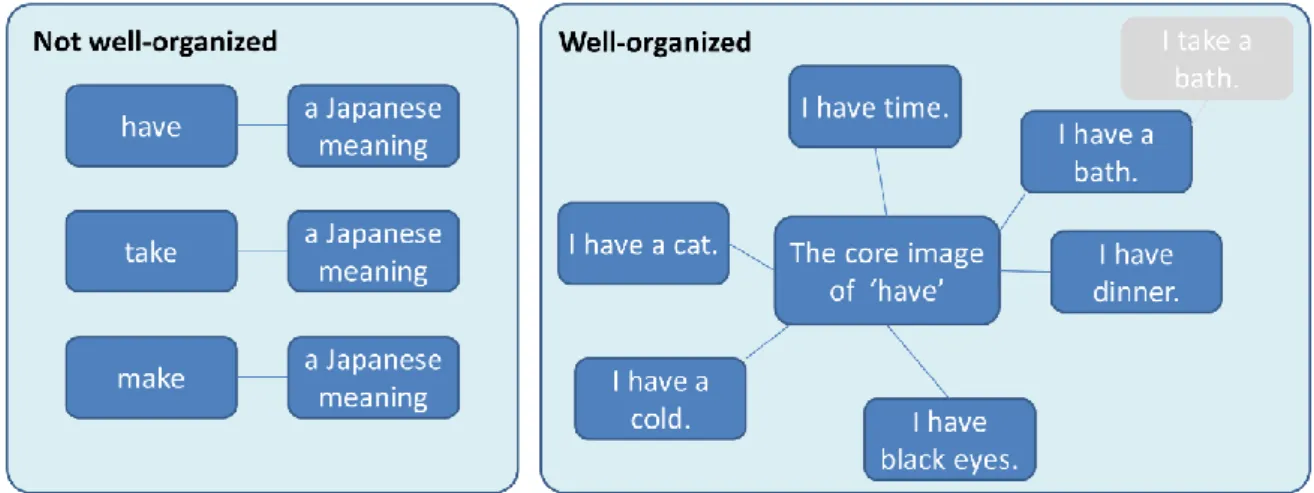
“possession/experience space” (Tanaka, 2008, p. 22; my translation). If learners understand the core image of the word “have”, they will not need to memorize all 20 individual Japanese meanings of the word
7. Core images will help learners to understand the word effectively (Ikemura & Shimizu, 2006, pp. 18-21). As Figure 5 shows, it is desirable that various meanings and situations are connected around the core rather than being tied individually, such as every English word to every Japanese meaning separately. This can be described as well-organized knowledge. “Understanding the cores lets learners know in what kind of situations and how to use the words without depending on Japanese meanings” (Tanaka, 2008, pp. 12-13; my translation). Every word picked for each lesson, especially eight important verbs (come, go, have, make, get, give, take, put), have a lot of meanings and are useful in various situations.
7
The number of the meanings are referenced at Weblio English-Japanese dictionary (http://ejje.weblio.jp/).
Figure 5. An image of well-organized knowledge of the word = have
3.2.2 Having many examples with pictures
In each lesson, after learning the core image, a large number of examples with pictures are introduced to learners in order for them to know various uses of words, as shown in Figure 5 above. Using pictures has effects on memorizing, retaining, and reproducing, and also are useful for establishing memories of vocabulary (Nishiyama, 2006, p.87).
(1) The teacher reads the example aloud and students listen to the teacher while looking at the images and try to understand the situation. First, the students check all the examples at once, listening to the teacher. (2) After reading through all the examples, the teacher confirms each example’s meaning and situation together with the students. At this time, the teacher asks some questions according to the example or the situation. Most of the questions are connected to the students’ lives, and these examples should not stay only inside of the textbook. Teachers should pay extra attention to this. These kinds of questions are “not only producing the process of communication, but also including the possibility to motivate students through self-expression” (Hirose, 1984, p.185; my translation).
4. Lessons
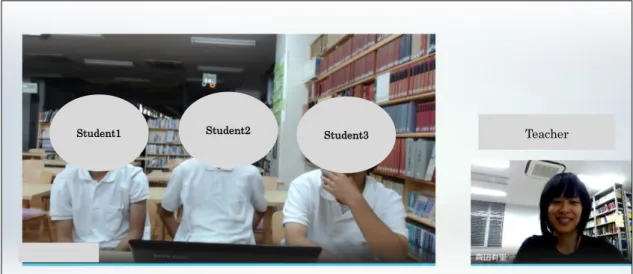
Lessons are remotely provided via the video calling system by Microsoft Lync 2013 (see Figure 6). As described by Microsoft (n.d.<a>), Lync is:
Microsoft Lync is an enterprise-ready unified communications platform. Lync connects
people everywhere, on Windows 8 and other operating systems including mobile
devices, as part of their everyday productivity experience. Lync provides a consistent,
single client experience for presence, instant messaging, voice, video and a great
meeting experience.
Figure 6. A screen shot of Lync on the teacher side computer.
Collaboyou English is currently still an extracurricular activity aiming at Japanese senior high schools.
Lessons are scheduled to take place 192 times (see Appendix 4 for the details).
However, this can be changed depending on the learners’ level. In fact, so far none of the students has finished the entire curriculum. Therefore, there is still some room for
reconsidering the curriculum. The frequency of the lessons depends on requests by schools or learners, for example, weekdays, twice a week.
Each lesson is normally 25 minutes long. It is also changeable according to the requests by the school or the number of learners. Each lesson usually has one to four students. The ideal number is less than four in terms of providing each student with ample opportunity to learn.
The flow of each lesson is as follows:
1. One-minute impromptu speech (the first time) 2. Feedback by a teacher
3. Interaction between the students 4. Oral reproduction
5. Textbook: OEC1000 practice
Student1 Student2 Student3 Teacher
6. One-minute speech (the second time)
CHAPTER 2
Learning effects of Collaboyou English
In this chapter, the learning effects of Collaboyou English will be discussed. In
particular, it will be verified whether the senior high school students who take the Collaboyou English program can “develop oral communication abilities such as accurately understanding and appropriately conveying information, ideas, etc. about their fields of interest”, achieving
“1.3 The details of the goal” set by the Collaboyou English program.
The experiment term was five months in total. The participants were six senior high school students. They were provided with the Collaboyou English program. Listening tests, speaking tests and questionnaires were used for data gathering. The details are given below.
1. Method 1.1 Participants
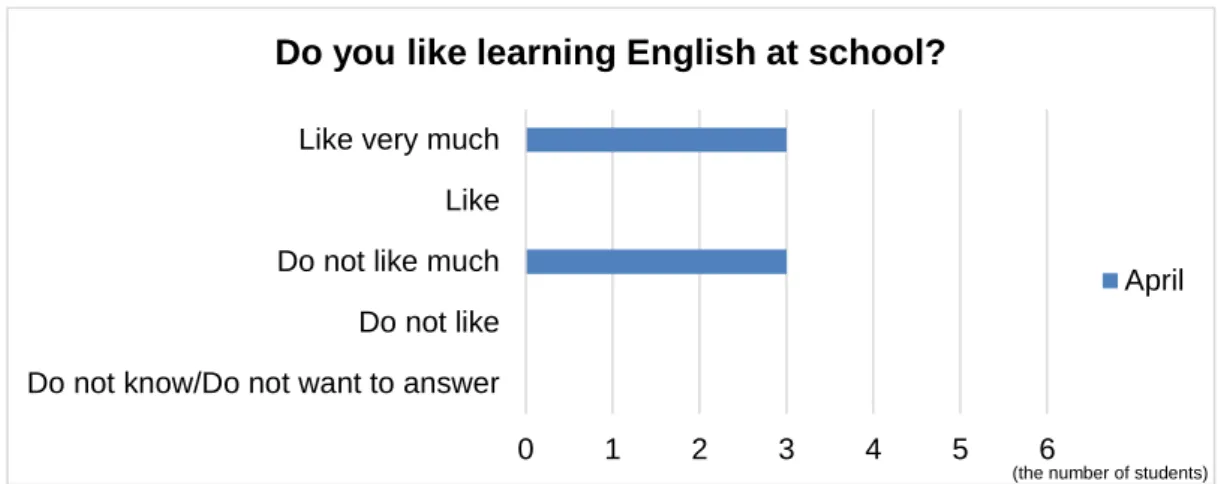
Six senior high school students (Students 1-6) from N Senior High School participated in the program. All six students felt positive about learning English (see Figure 7-9) from the questionnaire taken before the program. Three out of the six students answered “Like very much” to the question, “Do you like learning English at school?” The other three students answered “Do not like much.” However, to the question, “Do you like English?”, three out of the six answered “Like very much”, two students answered “Like” and one answered “Do not like much”. To the question, “How is your motivation for learning English?” five out of the six answered “High”, one answered “Medium”.
These six students were randomly divided into two groups: Students 1, 2 and 3 were in
Group A, Students 4, 5 and 6 were in Group B.
Figure 7. A question about motivation (1/3).
Figure 8. A question about motivation (2/3).
Figure 9. A question about motivation (3/3).
0 1 2 3 4 5 6
Like very much Like Do not like much Do not like Do not know/Do not want to answer
Do you like learning English at school?
April
0 1 2 3 4 5 6
Like very much Like Do not like much Do not like Do not know/Do not want to answer
Do you like English?
April
0 1 2 3 4 5 6
High
Medium
Low
None
How is your motivation for learning English?
April
(the number of students)
(the number of students)
(the number of students)