ContentslistsavailableatScienceDirect
Auris Nasus Larynx
journal homepage:www.elsevier.com/locate/anl
Retrospective evaluation of secondary effects of hearing aids for tinnitus therapy in patients with hearing loss
Yoshihiro Yokota
a, Akinori Yamashita
b, Shinji Koyama
a, Koichi Kitano
b, Shintaro Otsuka
b, Tadashi Kitahara
b,∗aDepartmentofOtolaryngology,Yamato-TakadaMunicipalHospital,Japan
bDepartmentofOtolaryngology-HeadandNeckSurgery,NaraMedicalUniversityHospital,Japan
A R T I C L E I N F O
Articlehistory:
Received26November2019 Accepted17March2020 Availableonline4May2020
Keywords:
Hearingloss Hearingaid Bilateraltinnitus Unilateraltinnitus Wearingside
A B S T R A C T
Objective: Acoustictherapiesincludinghearingaidsandtinnituscontrolinstrumentsarewidely used in Japan but without high levels of evidence. The outpatient hearing aid clinic at our institutionfits patientswith hearing aids and instructs patients on how to use them to control tinnitusif present.Inthis study,weexaminedthe effectsof thisapproach ontinnitus.
Methods: Onehundredandelevenof138patientswhovisitedourhearingaidclinicfromApril 2016toSeptember2018purchasedhearingaidsafterfitting.Sixty-sixofthesepatients(31men, 35 women; meanage78.0 ± 8.0years)had both hearing lossand tinnitus and were enrolled.
The tinnitus wasbilateral in 41 patientsand unilateralin 25 (poor hearing ear, n= 16,good hearingear,n=9).Hearingaidswerewornbilaterallyby23patientsandunilaterallyby43(89 devices).Seventeenofthe 23patientswearingbilateralhearing aidshad bilateraltinnitusand6 hadunilateraltinnitus,i.e.,in40ears,thetinnitussidematchedthehearingaidside(40devices) and in 6 ears did not (6 devices). Twenty-four of 43 patients wearing unilateral hearing aids hadbilateraltinnitus,meaningthatin24 earsthe tinnitussidematchedthehearingaid side(24 devices).In sixof the remaining19 cases with unilateraltinnitus, the hearing aid and tinnitus wereonthesameside(6devices)andin13wereonoppositesides(13devices).Changesinthe Tinnitus HandicapInventory(THI), visualanalog scale(VAS, fortinnitus discomfort,severity, andpersistence),andHospitalAnxietyand DepressionScalescoresweremeasuredimmediately beforeusing ahearingaid and12 monthslater.
Results: Significant effects of hearing aids on tinnitus were observed in all subjects (THI, p= 0.0000030),VAS(severity, p= 0.000000066;discomfort,p= 0.0000013).Significant ef- fectswereobservedwithbilateralhearingaids(THI,p=0.0012;VASforseverity,p=0.00069;
VASfordiscomfort,p=0.00052)andwithunilateralhearingaids(THI,p= 0.00055;VASfor severity,p= 0.000034;VAS fordiscomfort,p= 0.00007).Spearman’srankcorrelationcoeffi- cientshowed asignificant positivecorrelation betweenthe THI and VASscores (p= 0.0033).
In cases of bilateral tinnitus, significant differences were observed with bilateral hearing aids (THI, p = 0.011; VAS for severity, p = 0.0019; VAS for discomfort; p = 0.020) and with unilateralhearingaids(THI, p= 0.00069;VASforseverity,p=0.00071; VASfordiscomfort, p=0.000093).
Conclusion: Acoustictherapyusinghearingaidswaseffectivefortinnitus.Evenwhenbilateral, aunilateral hearing aid isable to improve tinnitus. Whenunilateral, the ipsilateral hearing aid isableto improvetinnitus.
© 2020 Oto-Rhino-Laryngological Society of Japan Inc. Published by Elsevier B.V. All rights reserved.
https://doi.org/10.1016/j.anl.2020.03.005
0385-8146/© 2020 Oto-Rhino-Laryngological Society of Japan Inc. Published by Elsevier B.V. All rights reserved.
is increasing in today’s stressful environment, treatment of the disorder in clinical practice still consists of perfunctory pharmacotherapyand hasshown few signs of advances over time.
Multimodal therapy for tinnitus has consisted of (1) ex- planations of tinnitus and the patient’s status, (2) pharma- cotherapy,(3) acoustictherapy, and(4) psychotherapy. How- ever, the American Tinnitus Association published clinical guidelines for tinnitus in 2014 [3], and based on these guidelines,the Japan AudiologicalSociety publishedits own guidelines in 2019 [4]. These guidelines summarize the previous literature on tinnitus therapies and provide strict assessments of the recommendation levels for each treat- ment. Unfortunately, only acoustic therapy and cognitive therapy were strongly recommended for the treatment of tinnitus.
Before 1980, acoustic therapy had been performed as
“masking therapy” by Vernon and Schleuning [5] but had not been widely used. In the late 1980s, cognitive therapy was added to acoustic therapy based on Jastreboff’s neuro- physiological model of tinnitus. Known as tinnitus retrain- ing therapy, this strategy became popular, particularlyin the US [6]. This is a method of treating tinnitus that seeks to reduce discomfort by adapting the patient to tinnitus and soundstimulation fromasoundgenerator attachedtotheear.
A survey using a questionnaire on how much tinnitus dis- turbed dailylife found that thistreatment achieved improve- ment rates of 69%–96% [7]. However, this therapy requires considerabletime and effort on the part of both patient and doctor.
Recently, therehavebeen many reports onacoustic thera- piesusingenvironmentalsounds,especiallyhearingaids[8,9]. Includingbothahearingaid forhearing lossandatreatment for tinnitus,such therapies are realistic torecommendtopa- tientswithtinnitus andeasyfor themto understand.Patients at our hospital’s outpatient hearing aid clinic are fitted with hearingaids,andif they also havetinnitus,are instructed on theuseofthedevicestocontroltinnitus.Theaimofthisstudy was to examine the therapeutic effects of this approach on tinnitus.
∗Correspondingauthor.
E-mailaddress:[email protected](T.Kitahara).
device.Patientswithextremeleft/right differencesare recom- mended to use a hearing aid in the ear with good hearing andthosewithsimilar hearingloss onbothsides are recom- mended touse hearingaids on bothsides.
2.2. Materials
Our outpatient hearing aid clinic examined 138 patients with the chief complaint of hearing difficulty over the 30 months from April 2016 to September 2018. Devices were purchasedby 111 patients (80.4%), 27(19.6%)of whom re- turned thedevice. Sixty-six(59.5%)of thepatients whopur- chased a device had tinnitus and 45 (40.5%) did not. We examined the 66 patients who both purchased hearing aids and had tinnitus. The study group included 31 men and 35 women of mean age 78.0 ±8.0 (52–97) years. The hearing aids wereworn onatotal of 89ears (21 onthe right, 22on the left, and 23 on both sides).The mean hearing ability of the ears wearing hearing aids was 55.6 ± 12.2 (36.3–101.3) dB by quartation.
The tinnitus was bilateral in 41 patients and unilateral in 25(poorhearingearin16patients,goodhearingearin9pa- tients).Hearingaidswere wornbilaterallyby23patientsand unilaterallyby43 patientsfor atotalof89ears (89devices).
Seventeenofthe23patientswearingbilateralhearingaidshad bilateraltinnitusand6hadunilateraltinnitus;i.e.,in40ears, the tinnitus side matched the hearing aid side (40 devices) andin6 earsthey did notmatch(6 devices). Twenty-four of the 43 patients wearing unilateral hearing aids had bilateral tinnitus,meaning thatin24earsthetinnitussidematchedthe hearingaidside(24devices).Ofthe remaining19caseswith unilateral tinnitus,in6 earsthe hearingaidandtinnituswere on the same side (6 devices) andin 13 ears the hearing aid andtinnitus wereon oppositesides (13devices).
2.3. Methods
Inthepresentstudy,wetreatedpatientswiththechiefcom- plaintof hearingdisturbance,nottinnitus.Theywereadvised that they had better wear hearing aids as long as possible.
They were not received any counseling or cognitive therapy atany time duringfollow-ups.
A questionnaire that included the following items was giventopatients whovisitedouroutpatienthearingaidclinic
Fig. 1. Markedeffectsontinnitus observedusinghearing aids.For thepatientsoverall (n= 66),significantimprovements afterwearinghearingaids were observedfor(A)theTHIscore (from28.00±30.04 to15.21±23.64; ∗p =0.0000030,Wilcoxontest),(B)theVAS scorefortinnitusseverity (from 54.08±22.15to31.36±29.36;∗∗p=0.000000066),and(C)theVASscorefortinnitusdiscomfort(from49.70±31.77to26.55±31.37;∗∗∗p=0.0000013).
THI,TinnitusHandicapInventory;VAS,VisualAnalogScale.
immediately before being fitted with hearing aids and 12 months laterto determine whether they experienced tinnitus and whether being fitted with hearing aids improved their tinnitus: ears fitted with hearing aids and sides affected by tinnitus; 25 items of the Tinnitus Handicap Inventory (THI);
visualanalogscale(VAS)scoresfortinnitusseverityanddis- comfort;and14itemsoftheHospitalAnxietyandDepression Scale (HADS).
2.4. Statisticalanalysis
Theaboveitems werecomparedimmediatelybeforebeing fitted with hearing aids and 12 months later. The paired t- test was used for items that were distributed normally and the Wilcoxon signed-ranktest was used as a non-parametric testfor itemsthat werenot distributednormally.Correlations between the THI and VAS scores for tinnitus severity and discomfortwereexaminedbeforeandafter fittingthehearing aid. Thebefore-afterchangewas evaluated usingSpearman’s rankcorrelation coefficient.
3. Results
Forthe 66 patients overall,wearing hearingaids achieved significantimprovementsintheTHIscore(from28.00±30.04 to 15.21±23.64; p = 0.0000030, Wilcoxon), VAS score for tinnitus severity (from 54.08±22.15 to 31.36±29.36;
p = 0.000000066), and VAS score for tinnitus discom- fort (from 49.70±31.77 to 26.55±31.37; p = 0.0000013, Fig. 1A–1C). Marked effects were observed with both bi- lateral and unilateral hearing aids. For bilateral hearing aids (n = 23), the THI score improved from 29.30±32.79 to 15.65±24.89(p= 0.0012),theVAS scorefortinnitus sever- ity from 55.22±20.50 to 31.22±27.82 (p = 0.00069), and the VAS score for tinnitus discomfort from 57.87±30.85 to 29.00±34.76 (p = 0.00052). For unilateral hearing aids (n = 43), the THI score improved from 27.30±28.43 to 14.98±22.94 (p = 0.00055) the VAS score for severity
from 53.47±22.96 to 31.44±30.15 (p = 0.000034), andthe VASscorefordiscomfortfrom 45.33±31.39to25.23±29.32 (p =0.00007).
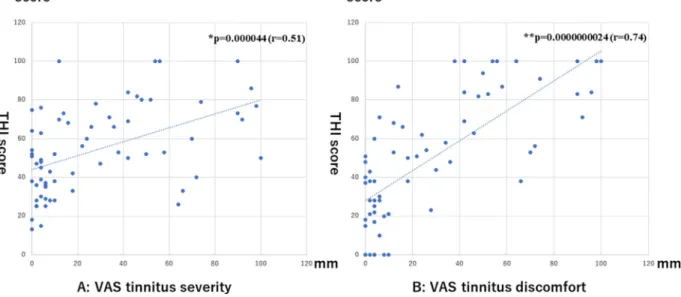
Significant positive correlations were observed between the THI score and VAS score for severity (r = 0.51, p = 0.000044, Spearman’s test) and between the THI score andVASscorefor discomfort(r=0.74,p =0.0000000024) before wearing hearing aids (Figure 2A, 2B) and between the THI score and VAS score for severity (r = 0.79, p = 0.00000000047) and between the THI score and VAS score for discomfort (r = 0.84, p = 0.0000000000028) af- ter wearing hearing aids (Fig. 3A, 3B). With regard to the changes before and after wearing hearing aids, there was a tendencyforapositivecorrelationbetweentheTHIscoreand VASscorefor severity(p =0.053)andasignificant positive correlationbetweentheTHIscoreandVASscorefordiscom- fort(p =0.000017).
When considering only patients with bilateral tinnitus (n = 41), significant improvements were observed in the THI score (from 30.00±35.67 to 16.35±27.45; p = 0.011, Wilcoxon test), VAS score for severity (from 56.47±22.16 to 31.88±27.03; p = 0.0019), and VAS score for dis- comfort (from 59.18±32.23 to 31.88±32.45; p = 0.020) when hearing aids were worn bilaterally (n = 17) and in the THI score (from 29.83±30.03 to 13.00±22.70;
p =0.00069), VASscore for severity(from 52.38±22.13to 25.08±31.06; p = 0.00071), and VAS score for discomfort (from 45.42±31.88 to 19.00±27.13; p = 0.000093) when a unilateralhearingaidwasworn(n=24).Theeffectsofwear- ing bilateral or unilateral hearing aids were not significantly differentin patients withbilateral tinnitus(Fig.4A–4C).
In patients with unilateral tinnitus (n = 25) who wore a unilateral hearing aid (n = 19), the tinnitus tended to im- prove when the hearing aid was fitted on the same side as thetinnitus(n=6),i.e.,theTHIimprovedfrom12.33±19.47 to 10.33±20.47 (p = 0.057, Wilcoxon test), the VAS score for severityfrom 50.17±28.11to33.17±30.45;p = 0.0012, and the VAS score for discomfort from 40.50±33.50 to
Fig.2. Correlations betweenTHIscoreand VAS scoreforseverityand betweenTHIscore andVAS scorefordiscomfort beforewearinghearing aids.Significantpositivecorrelationswereobservedbetween(A)theTHIscoreandVASscoreforseverity(r=0.51,∗p=0.000044,Spearman’stest)and (B)theTHIandVASscorefordiscomfort(r=0.74,∗∗p=0.0000000024)beforewearinghearingaids(n=66).THI,TinnitusHandicapInventory;VAS, VisualAnalogScale.
Fig.3. CorrelationsbetweenTHIscoreandVASscoreforseverityandbetweenTHIscoreandVASscorefordiscomfortafterwearinghearingaids. Significantpositivecorrelationswereobservedbetween(A)theTHIscoreandtheVASscoreforseverity(r=0.79,∗p=0.00000000047,Spearman’stest) and(B)theTHIscoreandtheVASscorefordiscomfort(r=0.84,∗∗p=0.0000000000028)afterwearinghearingaids(n=66).THI,TinnitusHandicap Inventory;VAS,VisualAnalogScale.
22.50±31.31 (p = 0.073, Fig. 5A–5C). However, no sig- nificant improvement was found in patients fitted on the side opposite to the tinnitus (n = 13); in this group, the THI score improved from 29.54±26.72 to 20.77±23.34 (p = 0.11, paired t-test), the VAS score for severity from 57.00±21.33to42.38±24.53(p=0.064),andtheVASscore fordiscomfortfrom 47.38±29.17to38.00±28.18(p =0.20, Fig.6A–6C).
Significant decreases were observed in the HADS score after wearing hearing aids; the anxiety score improved from 5.75±4.16 to 4.77±3.64 (p = 0.038, Wilcoxon test) and the depression score from 6.50±4.35 to 4.36±3.71 (p =0.000063).
4. Discussion
Patients who purchased and used hearing aids from our outpatient hearing aid clinic showed significant changes in terms of theirTHI score,whichindicates the degreeofdiffi- cultyencounteredindailylifeduetotinnitus,andVASscores for theseverityanddiscomfortof tinnitus.Good resultswere obtained regardlessof whether patients worebilateralor uni- lateralhearingaidsandaresimilartothoseofpreviousstudies [8,9] demonstrating thatacoustictherapywithhearingaidsis effective for tinnitus.
Nosignificantdifference wasobservedinpatients withbi- lateral tinnitus according to whether they wore bilateral or
Fig.4. Effectsofbilateralhearingaidsandunilateralhearingaidsonbilateraltinnitus.Whenconsideringonlypatientswithbilateraltinnitus(n=41) significantimprovementswereobservedafterwearingbilateralhearingaids(n=17)in(A)theTHIscore(from30.00±35.67to16.35±27.45;∗p=0.011, Wilcoxontest),(B)VAS score forseverity (from56.47±22.16to31.88±27.03;∗∗p= 0.0019),and (C)VAS scorefor discomfort(from59.18±32.23to 31.88±32.45;∗∗∗p=0.020).Afterwearingaunilateralhearingaid(n=24),thereweresignificantimprovementsin(A)theTHIscore(from29.83±30.03to 13.00±22.70;∗p=0.00069),(B)VASscoreforseverity(from52.38±22.13to25.08±31.06;∗∗p=0.00071),and(C)VASscorefordiscomfort(45.42±31.88 to 19.00±27.13;∗∗∗p =0.000093).Therewerenosignificantdifferencesineffectbetweenwearingbilateralorunilateralhearingaids inthisgroup.THI, TinnitusHandicapInventory;VAS,VisualAnalogScale.
Fig. 5. Effectsofipsilateral hearingaidsonunilateraltinnitus.In casesofunilateral tinnitus(n=25), whenusingaunilateral hearingaid(n= 19), thetinnitustendedtoimproveinpatientsfittedonthesamesideasthetinnitus(n=6).(A)TheTHIscoreimprovedfrom 12.33±19.47to10.33±20.47 (p= 0.057,Wilcoxontest),(B)theVASscore forseverityfrom50.17±28.11to 33.17±30.45(∗p=0.0012),and(C)theVASscore fordiscomfortfrom 40.50±33.50to22.50±31.31(∗∗p=0.073).THI,TinnitusHandicapInventory;VAS,VisualAnalogScale;NS,notsignificant.
unilateral hearing aids, with both being effective in treating tinnitus [8,9]. This finding indicates that clinicians do not need tobe overlyconcernedabout whichsidetofitthe hear- ing aidwhen treatingbilateral tinnitus.In contrast,when pa- tients withunilateral tinnituswore a hearing aid on the side as the tinnitus, the effect of treatment was not significant.
Thisfinding highlightsthe importance of accurate identifica- tionofthesidewithtinnitusandusingthehearingaidonthat side.Recentreports indicatethatbilateralhearingaidscanbe greatly beneficial depending onthe hearinglevel [10].In the future, we plantostudy moresubjects withvariouslevels of hearing.
Our assessments of THI scores and VAS scores for tin- nitus severity anddiscomfort showed significant correlations with each other [11,12]. These observations suggest that simpler VAS assessments could be used instead of the rel- atively complicated 25-item THI. Furthermore, the HADS valuedecreasedsignificantlyafterwearingahearingaid[8,9], indicatingthat hearingaidscanbeexpectedtoimprovetinni- tus and tohave the potential secondary effects of improving anxietyand depression.
This study had some limitations. The first is that, due to the rules governing health insurance and tax deductions for medical expenses in Japan, the study subjects were patients
Fig.6. Effectsofcontralateralhearingaidsonunilateraltinnitus.Inpatientsfittedontheoppositesideofthetinnitus(n=13),therewasnosignificant improvementin(A)theTHI(29.54±26.72to20.77±23.34;p=0.11,pairedt-test),(B)theVASscoreforseverity(57.00±21.33to42.38±24.53;p=0.064), or(C) the VAS score for discomfort (47.38±29.17 to 38.00±28.18; p = 0.20). THI, Tinnitus Handicap Inventory; VAS, Visual Analog Scale; NS, not significant.(Forinterpretationofthereferencestocolourinthisfigurelegend,thereaderisreferredtothewebversionofthisarticle.)
whovisitedan outpatienthearingaidclinicwithhearingloss as their chief complaint. Therefore, they were not patients who came to hospital to be treated for tinnitus and did not include cases of tinnitus regardless of hearing loss [13]. In thisstudy, we examined the effects that therapy intended to supplement hearing had on tinnitus and cannot exclude the possibility that the study population contained patients with underlyingtinnitus-relatedmorbidity [14].The second isthat we cannot exclude apart of cognitive therapycompletely in spite of no performance of counseling during follow-ups. In thisstudy,wemaysaythatourtinnitustreatmentsusinghear- ing aids could be mainly consisted of acoustic therapy. The thirdis that we checkedup subtlechanges inTHI compared with VAS. We may have focused just on larger changes in THIscores. Anyway,we are planning toexamine the effects of acoustic treatment using hearing aids in patients whose chiefcomplaintis tinnitus inthe latercommunication.
5. Conclusion
Acoustic therapy using hearing aids was effective for tin- nitus.Even when bilateral,a unilateral hearingaid isable to improve tinnitus. Whenunilateral, the ipsilateral hearing aid isable toimprove tinnitus.
Declarationof CompetingInterest
Thepresentstudydoesnotincludeanyconflictsofinterest.
Acknowledgements
The authors wish to thank Dr. Masashi Choubi, a regis- tered statistician (certificate number 622017) for helpful ad- viceonthe statistical analysis andEditageCustomer Service (editage.com)for editingadraft of thismanuscript.
This study was supported in part by JSPS KAK- ENHI Grant (17K11340), AMED under Grant Number 18dk0310092h000a, and a Health and Labour Sciences Re- search Grant for Research on Rare and Intractable Diseases
(H29-Nanchito(Nan)-Ippan-031)fromtheMinistryofHealth, Labour andWelfareof Japan.
References
[1]EggermontJJ,RobertsLE.Theneuroscienceoftinnitus.TrendsNeu- rosci2004;27:676–82.
[2]Kojima T,Kanzaki S, OishiN, Ogawa K.Clinical characteristics of patients with tinnitus evaluated with the tinnitus samplecase history questionnaireinJapan:acaseseries.PLoSOne2017;12:e0180609. [3]Tunkel DE, Bauer CA, SunGH, Rosenfeld RM, Chandrasekhar SS,
CunninghamERJr,etal.Clinicalpracticeguideline:tinnitus.Otolaryn- golHeadNeckSurg2014;151(2Suppl):S1–S40.
[4]Yamasoba T.Clinical practiceguidelines for thediagnosis and man- agement of tinnitus 2019. Japan Audiological Society ed.. Kanehara Publisher;2019.
[5]VernonJ, SchleuningA.Tinnitus:a new management.Laryngoscope 1978;88:413–19.
[6]Jastreboff PJ. Phantom auditory perception (tinnitus): mechanism of generationandperception.NeurosciRes1990;8:221–54.
[7]McKinneyCJ.AnevaluationoftheTRTmethod.In:HazellJWP,editor.
Proceedings ofthe6th InternationalTinnitus Seminar.BritishSociety ofAudiology;1999.p.S99–105.
[8]Shekhawat GS, Searchfield GD, Stinear CM. Role of hearing aids in tinnitus intervention: a scoping review. J Am Acad Audiol 2013;24:747–62.
[9]SeredaM,XiaJ,RefaieA,HallDA,HoareDJ.Soundtherapy(using amplification devices and/orsound generators)for tinnitus. Cochrane DatabaseSystRev2018;12:CD013094.
[10]RickettsTA,PicouEM,ShehornJ,DittbernerAB.Degreeofhearing lossaffectsbilateralhearingaidbenefitsinecologicallyrelevantlabo- ratoryconditions.JSpeechLangHearRes2019;62:3834–50. [11]KaratasE,DenizM.Thecomparisonofacousticandpsychicparameters
ofsubjectivetinnitus.EurArchOtorhinolaryngol2012;269:441–7. [12]NascimentoIDP,AlmeidaAA,DinizJJ,MartinsML,FreitasTMMWC,
RosaMRDD.Tinnitusevaluation:relationshipbetweenpitchmatching andloudness,visualanalogscaleandtinnitushandicapinventory.Braz JOtorhinolaryngol2019;85:611–16.
[13]LeeK,MakinoK,YamaharaK.Evaluationoftinnitusretrainingtherapy forpatientswithnormalaudiogramsversus patientswithhearingloss.
AurisNasusLarynx2018;45:215–21.
[14]Brueggemann P, Seydel C, Schaefer C, SzczepekAJ, AmarjargalN, BoeckingB,etal.ICD-10symptomratingquestionnaireforassessment ofpsychological comorbiditiesinpatients withchronictinnitus.HNO 2019;67:46–50.