BLENDED EAP PROFESSIONALS IN CORPORATIZED HIGHER EDUCATIONAL INSTITUTIONS: A CRITICAL GROUNDED THEORY
by
GREGORY STUART HADLEY
A thesis submitted to The University of Binningham
for the degree of DOCTOR OF PHILOSOPHY
College of Arts and Law School of English, Drama and American & Canadian Studies Department of English The University of Birmingham Edgbaston, Birmingham B 15 2TT England, United Kingdom
Abstract
As momentous changes continue to sweep across higher education, tertiary-level English for Academic Purposes (EAP) has experienced a time of challenging and sometimes painful professional transition. In many Higher Educational Institutions (HEls) around the world, EAP units have been transferred from academic departments to administrative offices responsible for international student recruitment and entrepreneurial talent development. The new locus of conflict for many teachers of EAP has centered on the significant disconnect between them and their new administrative managers about the purposes of second language pedagogy.
This thesis is a qualitative grounded theory study situated within these restive dynamics. Drawing froln in-depth interviews of over ninety informants at eleven higher educational institutions in the UK, Japan and the United States, I focus upon the new middle managers of EAP units, referred to in this thesis as Blended EAP Professionals (BLEAPs). I develop a Critical Grounded Theory about the processes and strategies BLEAPs use to survive in corporatized HEIs while working with international students and Teachers of EAP (TEAPs). It was discovered during the course of analysis that, even while BLEAPs are often responsible for teaching EAP classes, those who succeed in corporatized HEIs dedicated most of their energies to processes identified as Hunting& Gathering, Weighing& Measuring, and Molding&
Shaping. All of these are linked to a basic social process, which is theorized to be that of Struggling to Manage and to Lead. This thesis discusses each of these processes in detail, and after explaining how the data used in this grounded theory study was philosophically construed, methodologically structured and theoretically analyzed, I consider the implications of this theory for Tertiary EAP as the profession approaches the middle of the 21stcentury.
Acknowledgements
I wish to recognize the following people who, were it not for their support and encouragement, this thesis would likely have remained either incomplete, or weighed in the scales and found to be lacking.
First, to Iny wife of twenty-four years, Hiromi, for her patience and love during the six years that ithas taken to complete this project. It isa staggering thought that this thesis has been a rival to my wife's affections for nearly a quarter of our lives together. Finally, she will get her husband back. I hope that it will have been worth the wait.
I also wish to thank Dr. Altnut Koester for her guidance and supervision. Her dedication to acadelnic rigor and her flexibility in working with one whose research paradigm is distinct frotn her own were deeply appreciated. To Corony Edwards, whose comprehensive supervision and care often Inade the difference for me at key points in the development of Iny research, and to her husband, Dr. Mohamed Mahmoud, who agreed to open their home and heart to me during my PhD residency.
My thanks to Dr. Chris Kennedy, whose professional life and support near the end of the completion of this thesis reminds me how a person of compassionate integrity, especially during times of difficulty, sows seeds of gratitude which will last a lifetime.
I also wish to thank Dr. Adrian Holliday, whose keen sense of academic skepticism taught me not only to exercise greater academic caution, he has been a great help in preparing me for the future challenges that I will face when disseminating the findings of this thesis.
To Dr. Ray Chatwin of the University of Gloucester and his wife Lena, Dr. Nicholas Groom of the Centre of English Language Studies at the University of Birmingham, Dr. Nicholas Henck of Keio University, Dr. Peter Matanle at the University of Sheffield, Dr. Kathy Charmaz of Sonoma State University, Dr. Robert Vanderplank
of Kellogg College and Dr. Chris Evans at the Tavistock Trust, for their constant encouragement and advice on how to navigate the sometimes perilous waters of the PhD journey.
And finally, to the scores of those who agreed to participate as anonymous research informants. In a very real sense, they were to become my teachers, my guides, and my friends. By opening my eyes to things that, without their help, I would not have seen, I feel a debt of gratitude as I seek to repeat the process and share their words and experiences with a wider audience.
TABLE OF CONTENTS
Abstract iii
Acknowledgements v
Table of Figures xv
List of Tables xix
Part One Theoretical and Methodological Framework 1
Chapter 1 Introduction 3
1.1 The Path of Qualitative Inquiry 3
1.2 Thesis Overview 8
1.3 Looking Forward: An Interdisciplinary Perspective 11 Chapter 2 First Principles: From Paradigm to Methodology 14
2.1 Introduction 14
2.2 Paradigms and Conceptual Metaphors 15
2.3 The Autopoiesis of Research Paradigms 18
2.3.1 Paradigms of Structure 20
2.3.2 Paradigms ofPattem 21
2.3.3 Paradigms of Process 23
2.4 A Commensurable Synthesis 26
2.5 Philosop.hical Underpinnings 28
2.5.1 Ontological Position 28
2.5.2 Epistemological Beliefs 30
2.6 Methodology 32
2.6.1 Basic Stance 32
2.6.2 The Case for a Qualitative Emphasis 33
2.7 Chapter Summary 38
Chapter 3 Grounded Theory: Origins, Methods and Evolution 40
3.1 Introduction 40
3.2 The Origins of Grounded Theory 41
3.3 Roots of the Grounded Theory Methodology (GTM) 43
3.4 An Overview of GTM 45
3.4.1 Ground Rules for Theorists 45
3.4.2 Data Collection 47
3.4.3 Data Analysis 50
3.4.4 The End Product: A Process of Theorization and Dissemination 56
3.5 External Critiques of Grounded Theory 63
3.6 Critical Grounded Theory 65
3.6.1 The Case for a Critical Social Theory Perspective in GTM 65 3.6.2 Theoretical Triangulation: CST, Hermeneutics, and GTM 70 3.7 Methodological Practices of Critical Grounded Theory 71
3.8 Chapter Summary 74
Chapter 4 Theoretical Bricoleur at Work: A Methodological Narrative 77
4.1 Introduction 77
4.2 Open Exploration Stage 79
4.2.1 Reflexive Beginnings: Introducing 'Le Bricoleur' 79 4.2.2 Unlocking the Workshop Door: Venues and Access Strategies 81 4.2.3 Developing Rapport through Open Sampling 82
4.2.4 Tools of the Trade 85
4.2.5 Early Analysis and Open Coding 97
4.3 Focused Investigation 107
4.3.1 Theoretical Sampling of Informants 108
4.3.2 Ethical Issues 109
4.3.3 Substantive Coding 123
4.4 Theory Generation 126
4.4.1 Theoretical Coding 126
4.4.2 Accessing the Literature: A Data-Driven Process 129
4.4.3 Structuring the Written Product 133
4.5 Chapter Summary 133
Part Two Grounded Theory in Action 137
Chapter 5 Critical Context: A Consideration of Prime Objects 139
5.1 Introduction 139
5.2 Vocational Incubation within the Decline of 'Culture' 140
5.3 Automated Pedagogic Machines (APMs) 147
5.3.1 Contextual Factors for APMs 147
5.3.2 Organizational Support for the Development of APMs 155
5.3.3 APMs in EAP 162
5.3.4 Raging Against the Machine 167
5.4 The Appearance of Blended EAP Professionals 170
5.4.1 Becoming a B.LEAP 174
5.4.2 Tasks, Types and Trajectories 177
5.5 Social Processes ofBLEAPs in Corporatized HEls 191
5.6 Chapter Summary 192
Chapter Six Hunting and Gathering 194
6.1 Introduction 194
6.2 .Resource Prospecting 197
6.2.1 Seeking Resource Enhancements 197
6.2.2 Securing Dependable Resource Flows 212
6.2.3 Cultivating Potential Resources 217
6.2.4 TEAP Response to Resource Prospecting 219
6.3 Investment Servicing 221
6.4 Milking the Cash Cow 224
6.4.1 Examples ofNUGIS Overseas Program Milking 227
6.4.2 Role ofBLEAPs 230
6.4.3 Response ofTEAPs 231
6.4.4 Covariances and Conditions of Cash Cow Milking 233
6.5 Resource Leeching 234
6.5.1 Internal Resource Leeching 238 .
6.5.2 External Resource Leeching 244
6.6 Chapter Sumlnary 249
Chapter 7 Weighing and Measuring 252
7.1 Introduction 252
7.2 Contextual Factors in the Weighing&Measuring of Higher Education 253
7.2.1 External Factors 254
7.2.2 Internal Factors ~.255
7.3 Weighing& Measuring Tertiary EAP ProgralTIS 257 7.3.1 Challenges to the Weighing& Measuring ofEAP Programs 259 7.3.2 Strategies for Weighing& Measuring EAP Programs 260
7.4 Weighing& Measuring TEAPs 266
7.4.1 Challenges to the Weighing& Measuring ofTEAPs 268 7.4.2 Strategies for Weighing& Measuring TEAPs 270 7.5 Weighing & Measuring International Students 274
7.5.1 Challenges to Weighing& Measuring International Students 275 7.5.2 Strategies for Weighing& Measuring International Students 283
7.6 Weighing & Measuring BLEAPs 286
7.6.1 Challenges to the Weighing& Measuring ofBLEAPs 287 7.6.2 BLEAP Strategies for Weighing& Measuring 290
7.7 Chapter Summary 298
Chapter 8 Molding and Shaping from On High 301
8.1 Introduction 301
8.2 Seeing the Big Picture 302
8.2.1 BLEAPs and the Big Picture 304
8.2.2 TEAPs in Obscurity: Puzzling out a Different Picture 307
8.3 Maintaining Control 308
8.3.1 Creating Process Frameworks 308
8.3.2 Owning the Process 309
8.3.3 In-Group Consolidation 313
8.3.4 Green Zone Construction and Bunker Building 320 8.3.5 Flow Managelnent as a Strategy for Control Maintenance 322
8.4 Making an Innovative Impact 326
8.4.1 Strategic Thinking 328
8.4.2 Strategic Examples ofBLEAP-driven Impact-Making 329 8.5 Consequences of Molding& Shaping for Tertiary EAP 332
8.5.1 Surviving on Administrative Patronage 332
8.5.2 Reshaping Professional Identities 333
8.5.3 BLEAPification 341
8.6 Chapter Summary 346
Chapter 9 Getting to the Core: Implications and Applications 349
9.1 Looking Back 350
9.2 Contributions 353
9.3 Implicatiolls 355
9.4 Future Research 363
9.5 Conclusion 364
Appendix A Modified Repertory Grid Procedures 367
Appendix B Sample Repertory Grid Data& Analysis 371 Appendix C Example of Semi-structured Qualitative Interview 374 Appendix D ATLAS.ti Graph Showing Data and Theoretical Codes to the Social
Process 'M:ilking Casll Cows' 416
Appendix E ATLAS.ti Graphs of 'Hunting& Gathering' and 'Molding& Shaping' Social Processes with Connected Theoretical Codes and Salnples of Linked
Quotations 422
Appendix F Sociogrid Analysis of Four EAP Administrators 433 Appendix G Sociogrid Analysis of Four EAP Teachers 436 AppendixH Composite Analysis of Four EAP Teachers and Four
.B.LEAPs/Admitlistrators 439
Appendix I Examples of Itnpact Making in Action 443
References 447
Table of Figures
Figure1Author, Former Dean (now deceased) and Senior Polaris Administrators at
the State Quality Awards Ceremony in 2005 6
Figure 2Visual Representation of Thesis Structure 8
Figure 3Paradigms and Related Philosophical Concepts 16 Figure 4Interplay of Methodologies and Methods in Research Paradigm Clusters ..17 Figure 5Capra's Triad (adapted from Lowe, Carr&Thomas 2004) 19 Figure 6Overlapping EpistelTIologies within Capra's Triad 27
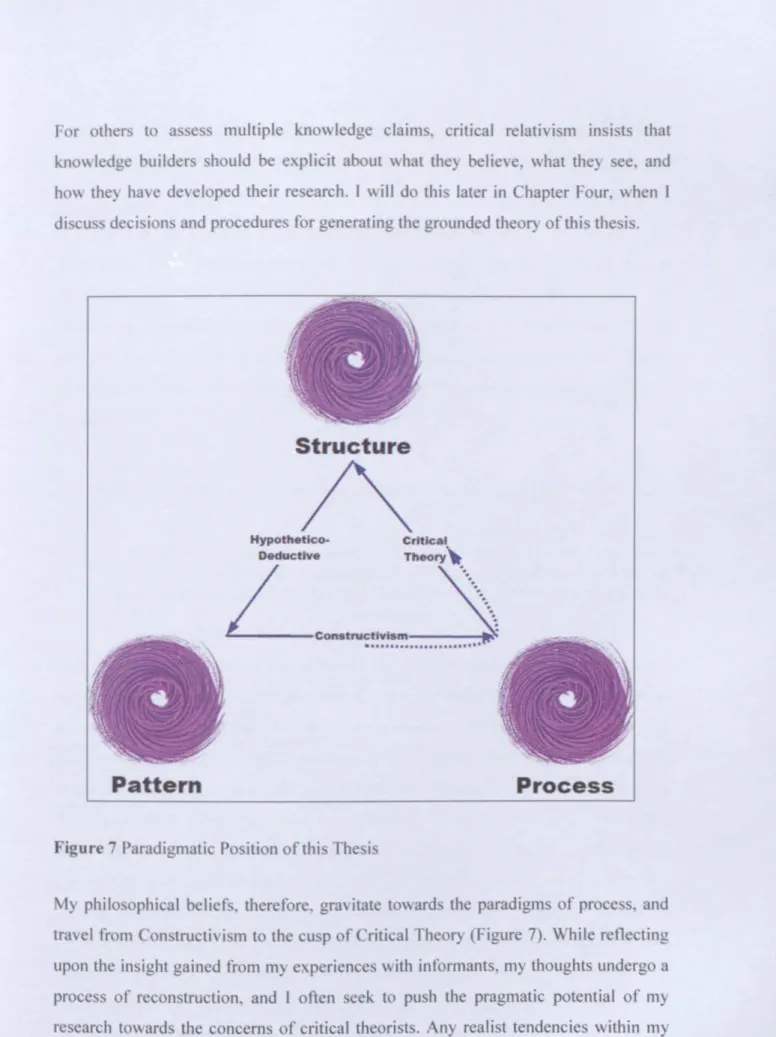
Figure 7Paradigmatic Position of this Thesis 31
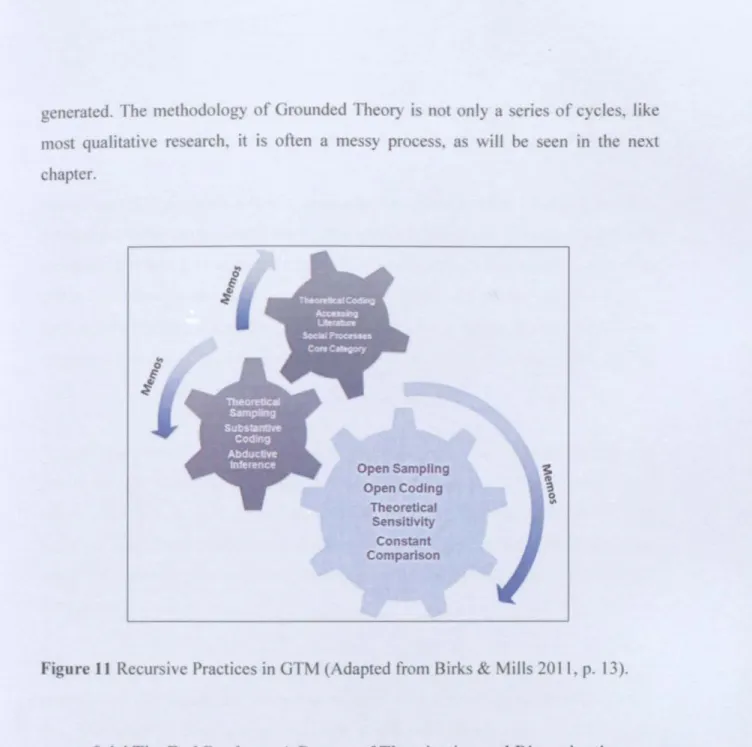
Figure 8Versions ofGTM mapped within Capra's Triad 44 Figure 9Example of Code Generated from Interview Data 51 Figure 10Coding Procedures in the Grounded Theory Methodology 53 Figure11Recursive Practices in GTM (Adapted from Birks& Mills 2011, p. 13) 56
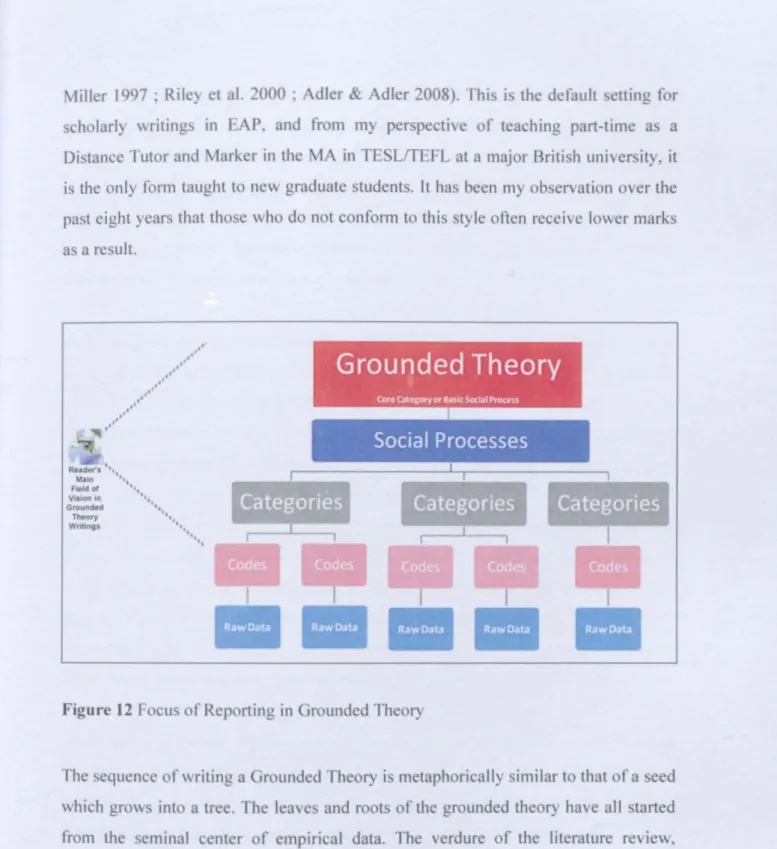
Figu re 12 Focus of Reporting in Grounded Theory 60
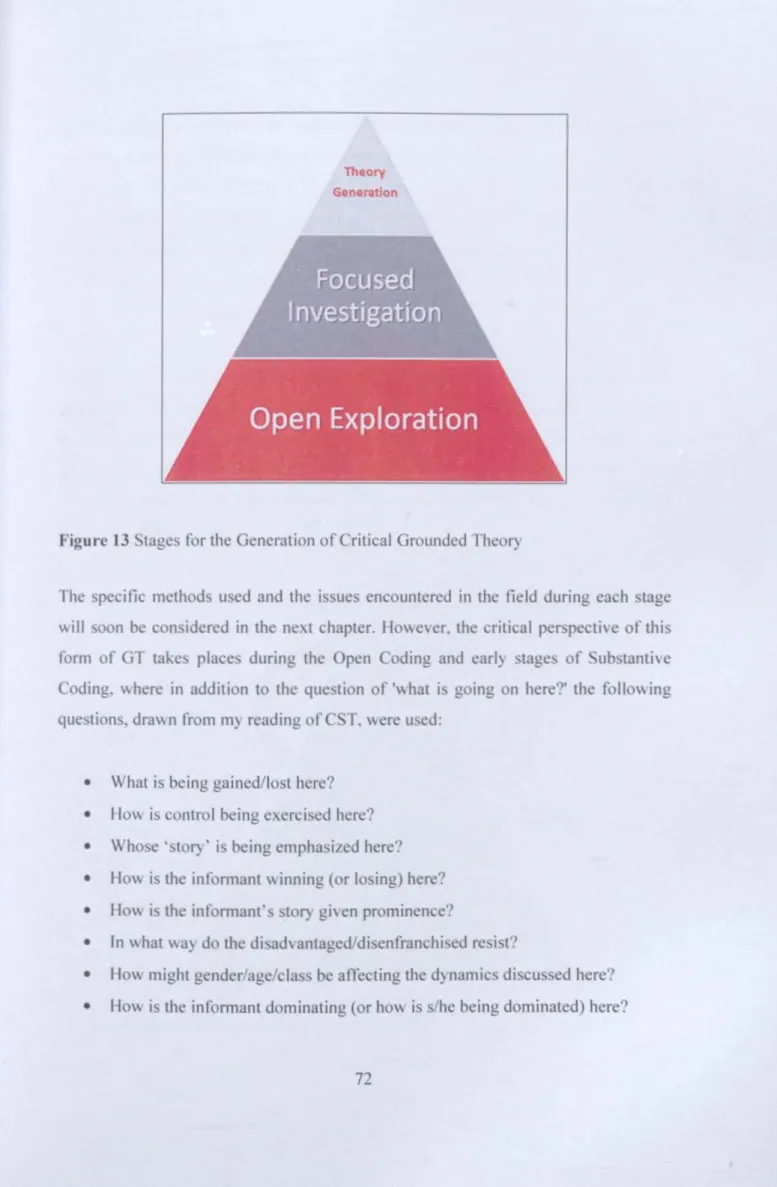
Figure13 Stages for the Generation of Critical Grounded Theory 72 Figure 14 Recursive Methodological Movement in Critical GTM 73 Figure15 Critical OTM Stages and Methods Used for this Thesis 78 Figure 16Materials Provided for the Repertory Grid Technique 87 Figure 17Providing Descriptive Elements for the Repertory Grid 88 Figure 18Choosing Random Elements to Generate Constructs 89
Figure 19Completed Bipolar Construct 90
Figure 20Example of PRINGRID Analysis inREP IV 1.12 92
Figure21 Adapted Repertory Grid for Exploratory Field Research 94
Figure22 Early Example of Open Coding 106
Figure 23 'Old School' Substantive Coding 123
Figure 24 Example of Substantive Coding 124
Figure 25 Messy Beginnings with Linked Substantive Codes in ATLAS.ti 125 Figure 26 Early Theoretical Codes Linked to a Social Process in ATLAS.ti. 128 Figure 27Recursive Patterns in Critical GT Construction 132 Figure 28 State Appropriations for Polaris State University 143 Figure 29Tracking the Growth of International Student Numbers (OECD 2009) .. 153
Figure 30A Conceptual HEI Typology 156
Figure31 Organizational Process Model of Corporatized HEls 160
Figure 32 An Extreme Exalnple of APM Utilization 163
Figure 33 Contemporary Western HE lalnpooned as Sausage Factory inTimes
Higher Education(Attwood 2008) 169
Figure 34A BLEAP Typology 179
Figure 35Social Processes for Blended EAP Professionals ...•...191 Figure 36Network of Theoretical Codes Linked to Hunting& Gathering 196 Figure 37Typicat" Training Seminar for Managing International Recruitment. 199 Figure 38PR Brochure showing a NUGIS 'International Instructor' with Secondary
Students 240
Figure 39NUGIS Schoolstay Student Engaged in Recruitment during the university
Open Campus (NUGIS Prolnotional Materials) 241
Figure 40 Students at NUGIS and Polaris Receiving Certificates of Appreciation for Participation in Service Learning-based Recruitment Projects (NUGIS and
Polaris PR Literature) 247
Figure 41 Contextual Dynamics and Theoretical Categories 253 Figure 42 Top Frequency List of Desirable Business-Related Skills and Assessed
Qualifications for NUGIS graduates by Managers of Prefectural Industries in 2010 (H22) and 2009 (H21)(N= 187, Non-Responders = 68 (H22) and 60 (H =
21) 279
Figure 43 Interconnected Theoretical Codes and Properties of Molding& Shaping ... 302 Figure 44 Survey results of desirable qualities for NUGIS graduates by regional
managers of hiring companies for 2008 (H20) and 2009 (H21), n=359 and 320,
respectively 331
Figure 45 Basic Social Process Trajectories ofBLEAPs in Corporatized HEls 349 Figure 46 Eliciting Elements of Observable Professional Activities 367
Figure 47 Eliciting and Rating Constructs 368
List of Tables
Table 1 Research Paradigms and their Implications for TESOL and EAP 25 Table 2 Core Methodological Characteristics of GTM 55
Table 3 Research Sites 82
Table 4 Totals and Types of Informants Interviewed 84 Table 5 Rep Grid Analysis and Memos (Enlarged Graph in Appendix B) 98 Table 6 Verbatim and Intelligent Verbatim (Hickley 2007) 101 Table 7 Garvin's Definitions of Quality in HE (1988) 165 Table 8 Concordance Sample Featuring International Student Numerification 265 Table 9 Analysis of 'Strategic' Using WordStnith Tools 4.0 (M. Scott 2005) 328
Part One
Theoretical and Methodological Framework
Chapter 1 Introduction
1.1 The Path of Qualitative Inquiry
The intellectual journey of qualitative research is replete with wondrous paths of exploration, hypotheses ending in surprising cul-de-sacs, and fortuitous turns of discovery. This thesis was originally intended to be a phenomenological study of the life worlds of international students and Teachers of English for Academic Purposes (TEAPs), had it not been for an experience that took place early in my PhD research, one which opened the way for new corridors of theoretical possibility.
Itwas the autumn of 2005, and I was somewhere over the American Midwest in the presidential plane of Polaris State University.' I had been accompanying the Dean of my university to check on a group of students that we had sent to Polaris for a semester-long study abroad experience. During our inspection tour, we viewed all aspects of the Polaris English for Academic Purposes (EAP) program, but we also gained rare glimpses into the inner workings of the administrative management at the university and new levels of access that had resulted in our invitation to accompany the President of Polaris to an exclusive resort and to witness him receive, on behalf of the university, a prestigious State Award in Total Quality Management.
The President and Dean were chatting while I stared below at the patchwork of fanus, fields and forests, deep in thought. What I had seen so far at Polaris had stimulated many questions regarding the changes that had only started to take place in Japanese Higher Educational Institutions (HEIs). Until recently, professional life for TEAPs at Japanese universities had been, as I was to learn later, similar to what had once been the norm for educators in British and American universities during the 1960s -- a professional life marked by plentiful economic support and teacher autonomy, but
1 All place names in this thesis have been anonymized.
also one of extreme variability in terms of teaching practices and research output (Miyoshi 2000 ; McVeigh 2002). After two decades of economic stagnation, the graying of the population and a rapid decline in the number of college-aged students, Japan was unable to support Higher Education (HE) as it had during the latter half of the 20th Century. With social, political and econOlnic considerations at the fore, the Ministry of Education, Sports, Science and Technology (MEXT) implemented plans in 2001 that called for the privatization of virtually every national university, introduced market-based mechanisms for the support of all private and national universities, and established the framework for a corporate model of HEI governance (Feller 2004 ; Yamalnoto 2004 ; Yoda& Harootunian 2006).
The results of the Ministry's historic policy shift started to be felt at my university, Nippon University of Global Information Studies (NUGIS), by early 2005. The changes, which were relnarkably similar to the observations of colleagues at other HEls across Japan, were those of increased teacher assessment by students and outside quasi-governmental organizations, growing amounts of administrative work of the type that had once been the domain of office support staff, decreased faculty governance and autonomy, the rise of a new managerial elite cOlnposed of administrators with more business experience than academic credentials, and the intensification of downward pressure, both on faculty and midlevel administrators, to find innovative ways to generate income, either through the attainment of research grants or through the development of attractive marketing strategies for increasing student recruitment. Newly hired TEAPs, both Japanese nationals and non-Japanese, began entering the .university on short-term, non-tenured track contracts and were being placed in new EAP units that were now under administrative management.
The plane began to experience some turbulence, causing a lull in the onboard conversation. The silence and shaking jolted my thoughts closer to the moment, to what I had seen earlier in the day during the visit to the EAP Unit at Polaris. While the students that we had sent to Polaris were receiving levels of service that far
exceeded what they would normally be given at NUGIS, my observations of the workload and other conditions of the TEAPs had raised quiet concern. The emotional strain of their crushing work schedules had an uncanny resemblance to what I had personally experienced in the UK, where I had taught EAP for several summers at the University of WensleydaIe. The summer presessional program at Wensleydale had all the hallmarks of what others have described as an academic sweatshop (Sharff &
Lessinger 1994), and it was surprising to see such similar conditions at an HEI on the other side of the world.
We landed early. Like a scene out of a movie, a chauffeur was waiting to take us to the resort. During the reception before the ceretnony, atnidst the clinking of wine glasses and sandwiched between the well-mannered mumble of politically influential regents, senior university administrators, and regional leaders of manufacturing and service corporations who were also there to receive awards in Total Quality Management, earlier thoughts of what I witnessed both at Wensleydale and with the TEAPs at Polaris returned, and sparked within me a growing sense of dissonance.
One regent from Polaris, who for many years earlier had served as a secret service bodyguard for several American presidents, told tne about recent policy decisions they had implemented that would have implications for the professional lives of TEAPs.He, as well as others that I met later, all expressed strong views about how EAP should be taught in order to facilitate an increased international student presence on campus. I found this to be highly curious, since with the exception of the President at Polaris, no one had ever taught EAP, and few that I spoke with seemed to realize what was needed to create an environment conducive for a proactive international student presence on campus.
I began to wonder if what I was experiencing at the ceremony was to be a harbinger of the future of Japanese HE. As I continued to observe what was taking place around me, a question began to reverberate through the halls of my mind. In the beginning, it
was something akin to 'whatis this?', but upon further reflection, coalesced into 'What is going on here?'
Figure 1 Author, Former Dean (now deceased) and Senior Polaris Adtninistrators at the State Quality Awards Ceremony in 2005.
The deceptive simplicity of this question, together with the increased access to administrative tnanagers charged with retooling EAP, and a heightened awareness that my own role as coordinator of the English language unit at NUGIS was somehow changing under me, combined to set me upon a new path of reflexive discovery that would take me through three countries and ten Higher Educational Institutions (HEls).
Shifting from phenOlnenology to a qualitative, exploratory methodology known as Grounded Theory, I interviewed ninety-eight informants representing TEAPs, their supervisors, international students studying English, and administrators tasked with managing the process of international education. This generated over 1300 pages of
transcripts, together with photos, videos, email correspondence, archives of professional journals, and a large number of observation notes. In the place of international students and TEAPs, the elnpirical data sparked my analytical interest in a new breed of EAP Inanager, one who is emerging from new organizational 'third spaces' (Whitchurch 2008) at HEls that are experiencing a confusing mix of corporatization, increased bureaucratization and managerial initiatives focused on innovation (Barnett 2011).
This thesis is located within the Sociology of English Language Teaching (ELT), and focuses upon issues pertaining to ELT management. The explanatory, interpretive and multidilnensional perspectives sourced for this work have contributed to the 'reconstructed logic' (Silverman& Marvasti 2008, p. 390) of an empirically grounded theory that has critical concerns for what will be introduced later as Blended EAP Professionals (BLEAPs) in corporatized HEls. Along the lines of a Critical Grounded Theory Methodology, I will use firsthand accounts and observational data to support a theory that reveals the core of what guided BLEAPs in this study, as well as basic social processes, challenges, strategies and contingencies that BLEAPs use in their attempts to both survive and thrive in their tertiary-level EAP units.
Far from being peripheral to the pedagogical concerns of EAP teachers, the issues studied in this thesis are central to the dynamics that form the scaffolding of their professional lives -- structures which often confine their existence and contribute to the emotional baggage many secretly carry into the language classroom. The topics will raise theawaren~ssof readers to the organizational changes that have taken place, or are currently taking place, in their Tertiary EAP Units, and seeks to aid readers in gaining a clearer picture of the sociological processes that are played out when the pressure to change the roles and expectations for TEAPs come from outside forces through the conduit of BLEAPs. In addition, the theory presented in this thesis will have data-driven implications not only for TEAPs who have found themselves suddenly 'raised up' as a BLEAP, it will also provide both TEAPs and others
involved in the task of EAP a greater sense of critical awareness, based upon real life field data, which can allow them either to tran form or to better negotiate the nature of their participation with the changes taking place in Tertiary EAP units in HEls around the \\orld. It is also hoped that, after reading this thesis, BLEAPs and TEAPs alike will be encouraged to consider ways of leveraging the Third Space for creating humane, emotionally intelligent and environments that motivate both teachers and students alike.
1.2Thesis Overview
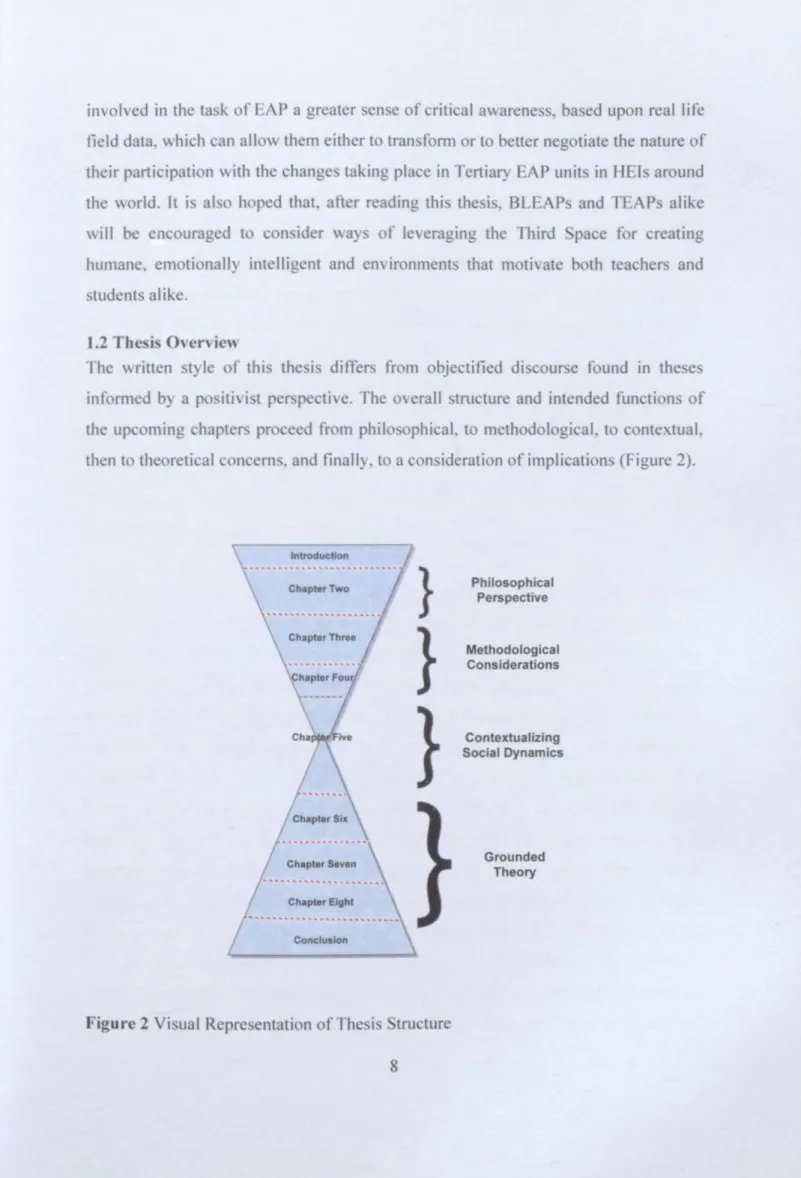
The written style of this thesis differs from objectified discourse found in these informed by a positivist perspective. The overall structure and intended functions of the upcoming chapters proceed from philosophical, to methodological, to contextual.
then to theoretical concerns, and finally, to a consideration of implications (Figure 2).
Grounded Theory Philosophical
Perspective
Methodological Considerations
Contextualizing Social Dynamics
Introduction
Chapter Two
}
Chapter Eight
Conclusion
Figure 2 Visual Representation of Thesis tructure
Paradigmatic beliefs shape not only the manner in which a researcher writes, they also infonn the manner by which a thesis is structured. Because this thesis derives from a perspective distinct from positivism, one focusing on interpretive, critical concerns, a considerable amount of 'unpacking' with regard to ontology, epistemology and methodology will need to be undertaken. As Goulding (2005) states, qualitative researchers, such as Grounded Theorists, must work far harder to make their case to colleagues who either do not understand their methods or who distrust the findings due to their different paradigmatic beliefs. In order to gain a hearing, one must first:
entertain complex philosophical debates about what constitutes reality, argue against relativistic concerns, [and] debate epistemological questions about the relationship between the knower and what can be known, before even ·getting to Inethodological issues (Goulding 2005, p.17).
Therefore, the first half of this thesis establishes a conceptual framework that will underpin Iny perspective and methodology.
In Chapter Two, I make explicit my own understanding of social reality and my rationale for an ecumenical perspective with regards to research methodologies. I will explain my rationale for choosing a qualitative approach, thus paving the way for Chapter Three, which provides a description of the Grounded Theory. The term Grounded Theory often 'refers both to a method of inquiry and a product of inquiry.
However, researchers commonly use the term to mean a specific mode of analysis' (Charmaz 2005, p. 507). Whenever possible I will delineate between Grounded Theory as an ongoing product of theorization (GT) and the Grounded Theory Methodology (GTM). I consider contemporary criticisms of GTM and explain how it has necessitated a writing style and organization that often differs from what is normally seen in positivist writings. However, because presently at least five major forms of the methodology are actively in use, I make note of key areas of methodological difference in order to delineate my decisions between the aspects of earlier Grounded Theory methodologies, and to establish my version of GTM, which is informed by Critical Social Theory (CST). Critical Grounded Theory embodies the
next stage in the ongoing evolution of GTM and represents one of the Inajor contributions of this thesis.
Qualitative researchers are often criticized by positivist researchers for not being explicit about their practices and procedures (Corbin & Strauss 1990 ; Marshall &
Rossman 2006, p. 10). Therefore, in Chapter Four, I seek to demystify the process by which I generated the Critical Grounded Theory of this thesis. Because qualitative research is 'data rich' (Carey, McKechnie & McKenzie 2001), I will explain the manner in which I condensed vast amounts of data collected during this research project into a form that would be understandable to readers. I strive to be reflexive about my developing skills as a grounded theorist and transparent about the challenges faced in the field. I explain the generaL environment in which this thesis was located and study the specific research tools used in the construction of the Grounded Theory. I describe how I gathered field data and wrestled with issues related to transcriptions and open coding. My rationale for tightening the initial research concerns during the stage of focused investigation, my use of conceptual metaphors to aid in the substantive and theoretical coding of my Grounded Theory, ethical dilemmas encountered during the course of my research, and my efforts at underpinning this study with good analytical practices, will all be considered. The Inanner in whichIaccessed scholarly literature and wrote the theoretical chapters will also be explained.
The second half moves beyond metaphysical and methodological issues to present the Critical Grounded 1heory of this thesis. As Aspinall (2009, p. 1) states, what is currently being experienced in HE and Tertiary EAP does not take place within a vacuum; it is inextricably linked to wider social, political and economic developlnents.
Itis for this reason that Chapter Five serves as a backdrop for concerns found within the informant-generated data, and critically locates this thesis within the social context of corporatization, massification, fiscal austerity in HE and the emergence of Blended Professionals in EAP. This discussion sets the stage for understanding how English
for Academic Purposes is being retooled for the needs of the new managers of corporatizedHEls, and for presenting the three social processes of BLEAPs specific to my grounded theory: The acquisition of valuable resources, or 'Hunting &
Gathering', constant assessment in order to satisfy stakeholder agendas, which I call 'Weighing & Measuring' and the attempt to redefine professional academic identities and activities in order that they can better fulfill the plans of stakeholders for the modem corporate university, or 'Molding & Shaping'. All of these processes are linked to the core social process of BLEAPs, which is that of 'Struggling to Manage and Lead.'
Chapters Six, Seven and Eight explain each of these social processes by describing their specific properties and by considering the impact these have had upon BLEAPs, TEAPs and International Students. The concluding chapter reveals the basic social process that links the processes of the previous chapters, and highlights the original contributions of this thesis to EAP management as well as to the Sociology of English Language Teaching. I will also consider how those involved in EAP might utilize this theory, and close with some suggestions for future investigation.
1.3 Looking Forward: An Interdisciplinary Perspective
This thesis is the result of a physical journey to various HEIs in Asia, Europe, and North America, but it is also the end result of an intellectual journey through scholarly research as varied as education, history, economics, nursing, psychology, management studies, organizational studies, TESOL, the philosophy of science, and critical theory. Far from being a sign of unbridled eclecticism, such interdisciplinarity with regard to the literature is a key feature of Grounded Theory research. Grounded Theorists enter the field and interact with informants before accessing any scholarly literature (Glaser 1992, pp. 31-33). During the process of listening to informants, theorists are compelled to reconsider any preconceptions they might have had, and use the findings of field research as clues for what literature to access. This will be revisited later, but readers should rest assured that this grounded theory focuses squarely on issues affecting Tertiary EAP in corporatizedHEls.Itis my hope that the
theoretical framework now to be presented will be both infonnative and useful to those involved in the task of both making and implementing policies that affect the future of Tertiary EAP at their institutions.
Chapter 2
First Principles: From Paradigm to Methodology
2.1 Introduction
EAP educators today rarely have the time to reflect upon the deep-seated beliefs informing their views on 'research' (Crookes 1997 ; Borg 2004 ; Borg 2007).
Metaphysical considerations about the nature of knowledge and existence, known respectively as epistemology and ontology, are seldom considered. Thinking about methodology, that is, the manner in which we study the social phenomena in our schools, and why we have chosen certain techniques for gathering data, referred to more succinctly as methods (Corbin & Strauss 2008, p. 1), are often pushed aside in the rush to address the more immediate tasks of 'designing studies, generating data and analyzing results' (P. Anderson 1986, p. 158).
And yet, despite such philosophical disengagement, Anderson (1986) maintains that important metaphysical beliefs shape our research choices and influence the standards by which we evaluate the work of others:
We all invoke implicit philosophies of science when we conduct studies, interpret results, criticize others' work, or decide between competing theories.
Epistemological issues can be viewed as prilnary because they underwrite all of the knowledge claims of a discipline (p. 158).
In addition, with the prevalence of critical, feminist and postmodemist perspectives in EAP (Phillipson 1993 ; Canagarajah 1999 ; Harwood & Hadley 2004 ; Pennycook 2005), it is important for teacher-researchers in EAP to be explicit about the paradigms supporting their philosophical views and research choices. Not doing so risks lnisunderstanding about the aims of one's qualitative research project. By making unseen axioms visible and by shaping the amorphous, chaotic fog of philosophical musings into a coherent form, teacher-researchers can make informed decisions about the potential usefulness of their findings and theoretical conclusions
(Cunningham & Fitzgerald 1996 ; Martin 2003 ; Borg 2004 ; Snape & Spencer 2004 ; Borg 2007).
This chapter presents the philosophical perspective that informs this thesis. Building upon a philosophical model known as autopoiesis, I employ conceptual metaphors to highlight the dynamic interaction between paradigmatic worldviews as necessary for supporting my position of Critical Realism. I discuss the reasons for taking a qualitative approach in this thesis and explain my choice of Grounded Theory as a mode of inquiry.
2.2 Paradigms and Conceptual Metaphors
The concept of paradigm, how to define it, and its influence in shaping research, have been topics of constant debate since the term becalne a household word through ThOinas Kuhn's, The Structure of Scientific Revolutions (Kuhn 1962/1996), and also because of the 'paradigm wars' that raged through the social sciences in the 1980s (Gage 1989). I draw upon Guba & Lincoln's (1998, p. 200) definition of paradigm to view it 'as a set ofbasic beliefs (or metaphysics) that deals with the ultitnates or first principles. It represents a worldview that defines, for its holder, the nature of the 'world,' the individual's place in it, and the range of possible relationships to that world and its parts, as, for exatnple, cosmologies and theologies do.' The manner in which paradigmatic beliefs operate is seen in Figure 3, which is represented as a vortex of swirling thoughts and restive discourse that both surround and influence researcher beliefs about ontology, epistemology and methodology.
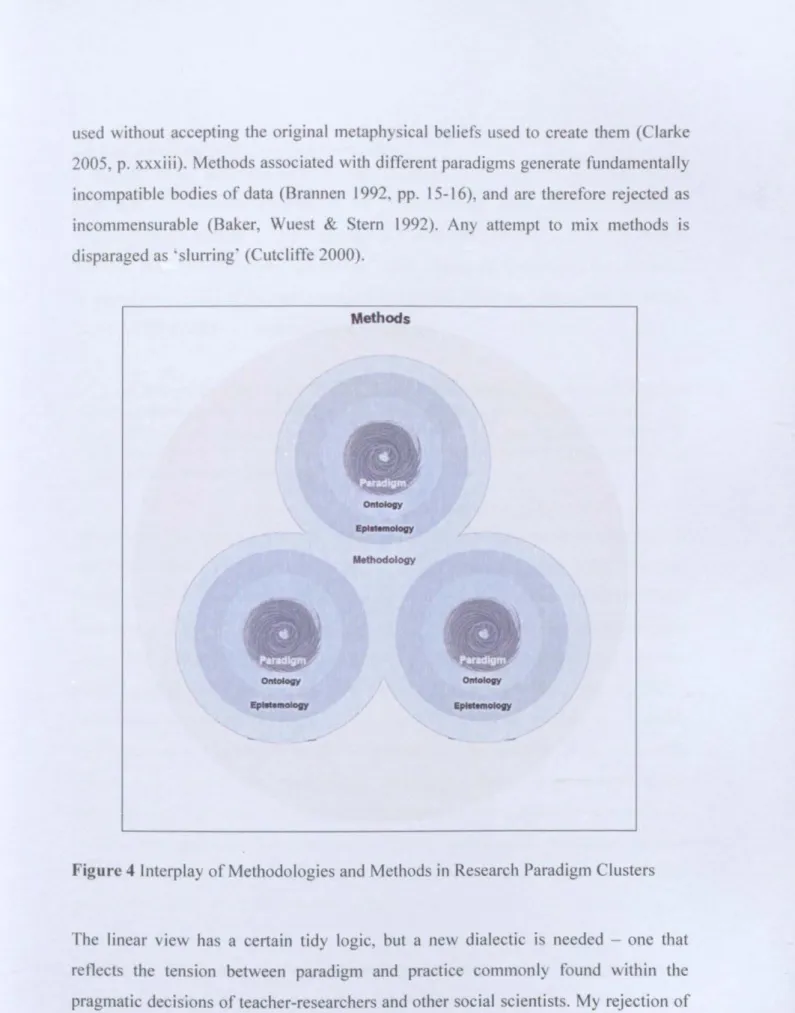
The ontology and epistemology of these paradigmatic beliefs exert tremendous conceptual gravitas over the way researchers frame their world (e.g. K. Richards 2003, pp. 32-33; Husen 2004, pp. 16-17; Locke 2005, p. 6). They are distinct from the additional band labeled more generally as 'methodology'. Like epistemologies, I believe that the methodologies that were originally associated with certain research traditions can become diffused and overlap with other research traditions (Figure 4).
This is why some research traditions, such as ethnography, symbolic interactionism or
phenomenology, which may be inspired by different epistemologie , may employ virtually identical methodologies (K. Richards 2003, pp. 13-14), albeit for very different purposes. This metaphor highlights process and the restive nature of paradigms, and has implications for methods as tools of knowledge production.
Ontology Epistemology Methodology
Figul'e3 Paradigms and Related Philosophical Concepts
My views on method utilization differ from some of the more traditional vOIces within the academy, who assert that paradigmatic beliefs limit one's choice of methods and approachcs (Burrell & Morgan 1979/2005 : Hughes 1990 ; Lincoln &
Guba 2000). According to this view, methodology as well as methods should be faithful to their paradigmatic heritage. lIughes (1990, p. II) and Connell, Lynch &
Waring (200I), are among those who suggest that paradigms run hierarchically, starting from the paradigm and working down to the level of method. This line of thinking supposes that research methods and methodologies are structured by one's epistcmology and ontology. Research methods are preset packages that cannot be
used without accepting the original metaphysical beliefs used to create them (Clarke 2005, p. xxxiii). Methods associated with different paradigms generate fundamentally incompatible bodies of data (Brannen 1992, pp. 15-16), and are therefore rejected as incommensurable (Baker, Wuest & Stern 1992). Any allempt to mix methods is di paraged as 'slurring' (Cutcliffe 2000).
Methods
-
Methodology
-- --
Figure 4 Interplay of Methodologies and Methods in Research Paradigm Clusters
The linear view has a certain tidy logic, but a new dialectic is needed - one that reflects the tension between paradigm and practice commonly found within the pragmatic decisions of teacher-researchers and other social scientists. My rejection of the linear view is framed within the matrix of autopoiesis.
2.3 The Autopoiesis of Research Paradigms
In the mid 1970s, philosophers of Biology Humberto Maturana and Francisco Varela proposed a theory with reference to the self-producing, self-constructing nature of living things (Maturana 1975 ; Maturana & Varela 1987 ; Cuff, Sharrock & Francis 2006, p. 108). Greek for 'self-generation', their Theory of Autopoiesis was extended . to explain processes of human cognition and social interaction (Maturana & Varela
1980). Maturana defined an autopoietic system as:
A composite unity whose organization can be described as a closed network of productions of components that through their interactions constitute the network of productions that produce them, and specify its extension by constituting its boundaries in their domain of existence (Maturana 1987, p.
349, in Mingers 2002, p. 294).
Autopoiesis has links to Systems Theory, in that both interpret the emergence of cOlTIplex entities and social processes as emanating frOITI smaller interactions (Larsen- Freeman 2007). Autopoietic thinking entered the social sciences through Niklas Luhmann, a Critical Theorist known for his long-standing intellectual struggle against Jurgen Habermas. Luhmann applied autopoiesis to comITIunication, social systems, policies and discourse (Luhmann 1994 ; Brans & Rossbach 1997 ; Arnoldi 2001 ; Luhmann 2001 ; Cuff, Sharrock & Francis 2006, p. 107). The notion of social, organizational and acadelnic discourse operating metaphorically as an autopoietic system is a helpful theoretical model, especially since it complelnents social constructivism and other contemporary theories on communication put forth by Giddens and Bhaskar. (Mingers 2002). This is additionally significant because Bhaskar and Giddens's philosophical perspectives have influenced scholars in TESOL and EAP (Crookes 1997 ; B. Morgan 1997a).
. Autopoietic theory was adopted by Organizational Theorists Sid Lowe and Adrian Carr (S. Lowe & Carr 2003 ; S. Lowe, Carr& Thomas 2004), who themselves were also influenced by the physicist, systems theorist and philosopher Frijof Capra. Capra
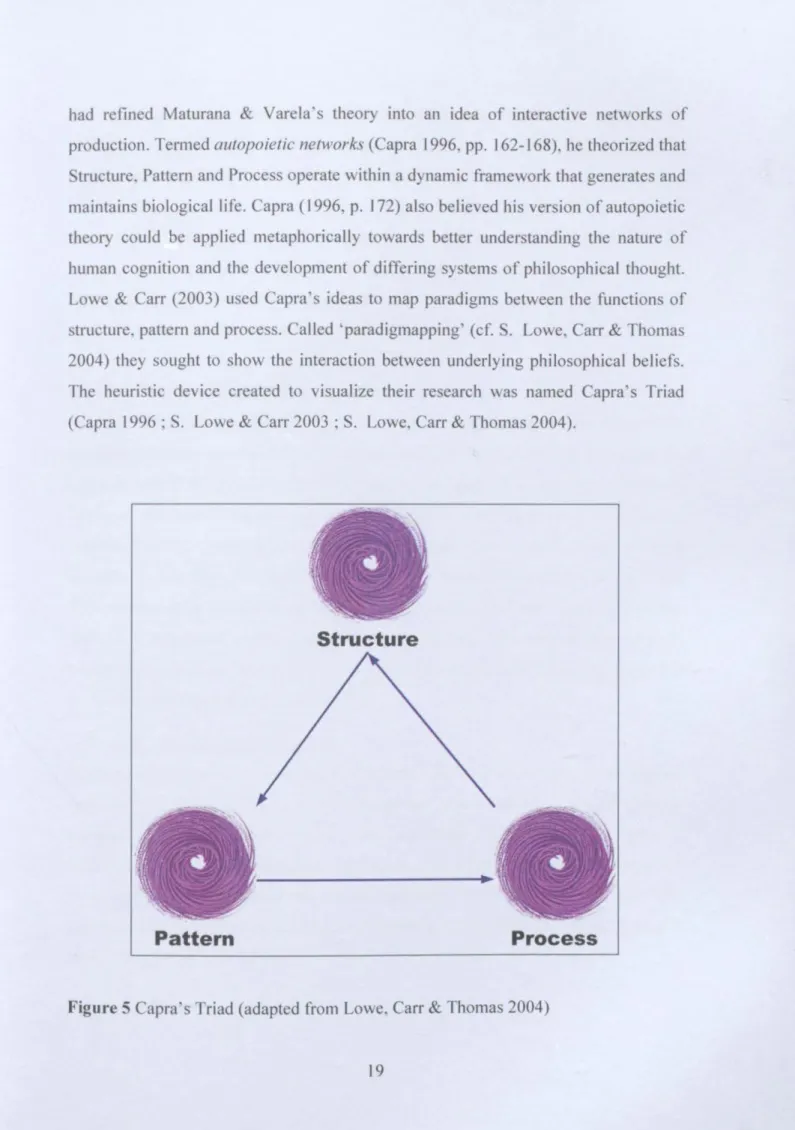
had refined Maturana & Varela's theory into an idea of interactive networks of production. Termedaulopoielic networks(Capra 1996, pp. 162-168), he theorized that Structure, Pattern and Process operate within a dynamic framework that generates and maintains biological life. Capra (1996, p. 172) also believed his version of autopoietic theory could be appl ied metaphorically towards better understanding the nature of human cognition and the development of differing systems of philosophical thought.
Lowe & Carr (2003) used Capra's ideas to map paradigms between the functions of
structure, pattern and process. Called 'paradigmapping' (cf. S. Lowe, Carr& Thomas 2004) they sought to show the interaction between underlying philosophical beliefs.
The heuristic device created to visualize their research was named Capra's Triad (Capra 1996 ; S. Lowe& Carr 2003 ; S. Lowe, Carr& Thomas 2004).
Structure
Pattern Process
Figure 5 Capra's Triad (adapted from Lowe, Carr& Thomas 2004)
A minor shortcoming I find in Lowe & Carr's (2003) use of the triad isin their static portrayal of philosophies and research traditions. I have modified Capra's Triad to emphasize the cyclical flow of concepts and research practices lnoving from structure to patterning, patterning to process, and process back to structure (Figure 5). This interaction between Structure, Pattern and Process has implications for recontextualizing the traditional divisions between ontology, epistemology, methodology and methods, and is essential scaffolding for the philosophical, methodological and theoretical framework of this thesis.
It will not be necessary to tire readers with yet another review of the aforementioned 'paradigm wars' (Gage 1989) that engulfed the methodological literature of the 1980s, a debate that many commentators today believed 'generated more heat than light' (S.
Lowe & Carr 2003, p. 1058). However, despite the spirit of uneasy detente in lnany
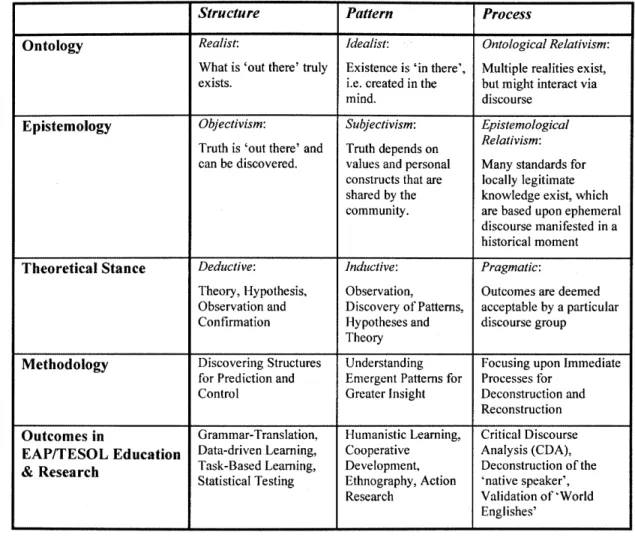
fields of the social sciences around paradigmatic worldviews and of tolerating lnultiple ways of construing social reality, the field of TESOL and EAP has relnained squarely fixated upon Structure to the exclusion of those with divergent perspectives.
This is why it is necessary to briefly consider aspects of each paradigm in my theoretical framework so that readers of this thesis, many who may ascribe to a lnore positivist perspective, can more fully understand the philosophical underpinnings and methodological itnperatives of this thesis.
2.3.1 Paradigms of Structure
There are many labels for Paradigms of Structure in the literature, the most common being what Goulding (2005, p. 17) calls positivism. The ontology associated with this paradigm cluster is realism, which in its most basic form is known as narve or empirical realism. This belief states that both a natural and social world is 'out there' separate and independent of us, whether we know it or not. Through the right methods, this reality can be discovered (Lincoln & Guba 2000, p. 165; Gall, Gall &
'Borg 2003, p. 14).
The epistemology of the paradigms of structure is objectivist, meaning that truth exists, and that knowledge of the truth can be discovered empirically. The role of the researcher is to transmit knowledge of the truth free of any value statelnents (S.
Hutchinson 1988, p. 124). The thinking is deductive, and research is designed either to prove or disprove hypotheses, thereby validating the development of truthful theories.
The methodology of social research associated with the paradigms of structure is usually quantitative in nature. Interviews or observational data are considered unquantifiable and unreliable, unless the data can be placed in a replicable matrix where discreet items can be counted or otherwise validated (Babbie 2004, p. 396).
Hard data emerges from removing variables through structured sets of widely- accepted methods, such as statistical studies or cross-sectional surveys. Truth is found in quantity, and for that reason, discovering overall trends in large populations is seen as more valid than what can be learned from studies with smaller salnples (BrYlnan 2001, pp. 284-285; Leedy & Ormrod 2001, pp. 193-194; L. Cohen, Manion &
Morrison 2003, pp. 169-171).
2.3.2 Paradigms of Pattern
This paradigm cluster studies the emergence of repeated activities and discourse within a socially constructed world. Human behavior is believed to emanate from a dynamic reality formed from multiple perspectives. Potter's (1996, p. 14) review identifies ten terms roughly synonymous with this paradigm, some of them being interpretivism, the qualitative paradigm, naturalism, phenomenology, humanism, hermeneutic and post-positivism. Regardless of the label, Sciarra (1999, pp. 40-41) states that Inost share strikingly similar features.
The ontology of these paradigms tends toward idealism, which states that an external 'reality, apart from a mind to perceive it, does not exist. The world is 'in there', that is, in the mind of the one who sees and thinks about what is happening. The mind is not the only source of reality-construction: there is something 'out there', but ultimately,
it cannot be perceived by observation alone (Guelke 1976, p. 170). Shared reality takes place through the creation of socially constructed symbols. Locke explains that social reality:
is not a given. It is built up over time through shared history, experience and cotnmunication so that what is taken for 'reality' is what is shared and taken for granted as to the way the world is to be perceived and understood (2005, p.
9).
Despite gradations of the finer details, the belief in reality as a mental construct is an important tenet common to all of these ontologies.
Epistemologically, this paradigtn is interpretivist in nature. Knowledge is believed to be shaped by the values and worldviews of like-minded groups of individuals (Moore 1989, p. 880; Michell 2003, p. 17). Knowledge is intersubjective and created through the ever-evolving consensus of many participants, including that of the researcher (Lincoln & Guba 2000, p. 165). Researchers operating from this paradigm are required to be critically self-aware - a practice known as reflexivity. Instead of deductively testing pre-existing theories, interpretivist researchers reflexively induce new theoretical concepts that occur during their interaction with the data. They attempt to reconstruct new understandings into a narrative discussing the possible 'whys' and 'hows' of the phenomenon being studied (Ritchie 2004, pp. 28-29).
Research methodologies in this paradigm are as much an art as a science, since social reality is viewed as fluid and emergent (Bryman 2001). This results in the flexible use of multiple methodologies. Denzin & Lincoln (2000a, p. 3) describe the researcher operating from this paradigm as a bricoleur, one who tinkers about and 'uses the tools of his or her methodological trade, deploying whatever strategies, methods or empirical materials as are at hand.' The focus of the research project is less predetennined in the beginning, but over titne, researchers explore various avenues of inquiry while abandoning others as dead ends. Various methods are used to investigate social phenomena, and the researcher can change directions, if
serendipitous events uncover issues that are core to understanding the study.
Methodologies, as explained by Potter (1996), are usually qualitative in nature. There is a preference for unstructured interviews, reflective journaling and observational techniques.
2.3.3 Paradigms of Process
Process paradigtns emphasize the chaos of human interaction and focus upon the imtnediacy of the present without interpreting underlying meanings. Paradigms clustering under this heading call into question the theories, findings or insights generated of those operating from the paradigms of structure and pattern:
The world is characterized by uncertain dynamic process rather than such certain structures. Process does not involve certainty or foundations and discourse is characterized by paradox, contradiction and indetenninate meaning. Language, as the principle vehicle of the cultural process, is uncertain and indeterminate because it is a process that reflexively contains its own antithesis and upon which meaning is politically imposed. The 'active' world is thus a chameleonic process without structure or certainty (S. Lowe 2001, p. 326).
Adherents of process advocate deconstructionism, the transgression of traditional academic conventions, anti-establishmentarianism and call for plurality in critical discourse, in order to extricate thetnselves frotn what they see as the domination of academic and socioeconotnic hegemonies.
This paradigmatic position is associated with the postmodernist work of Derrida, Baudrillard and Foucault, as well as Post-Structuralism, Deconstructionism, Orientalism and Literary Theory. Critical Social Theory (CST), which contributes to aspects of this thesis, also operate within the outer orbit of the paradigms of process, though some would protest this broad stroke of the brush, since voices within this community are disparate and willfully paradoxical. CST seeks to stimulate public awareness that results in social emancipation and constructive transformation (Geuss 1981, pp. 55-56; Agger 1991, p. 109; A. Carr 2005, p. 472). Critical Theorists, and their associated academic communities of Queer Theorists, Feminists, Post-
Colonialists and Neo-Marxists, ascribe to a critical realist (sometimes called historical realist) ontology, which Lincoln & Guba (2000, p. 165) define as 'a virtual reality shaped by social, political. .. and gender values; crystallized over time.' This puts these groups ontologically somewhere on the periphery of the paradigms of structure, even as most of their contribution is to process-based research (Firat & Venkatesh 1995, p. 248) through shared epistemological beliefs. How this is possible will soon be revealed.
Others who are more clearly devoted to the paradigms of process view ontological questions of reality as neither 'in there' nor 'out there', but instead,nowhere, until it is created by a particular group, and even this is historically inconclusive, highly contextualized and culturally limited (Grenz 1996, p. 7; Scheurich 2001, p. 33).
Multiple realities are layered one on top of another, each with something important to add.
Researchers uphold epistelnological relativism, which in relation to social inquiry, does not refer to cultural, Inoral or ethical relativism. Instead, it relates to multiple ways of knowing and doing. These manifold ways do not entail, as opponents claim, that wild fantasy, illogicality, sophilisln, nihilism or unbridled eclecticism are acceptable (Guba 1992, pp. 18-20). Richardson (2000) states that a relativist epistemology simply allows researchers:
to know 'something' without claitning to know everything. Having a partial, local, historical knowledge is still knowing. In some ways, 'knowing' is easier, however, because postmodernism recognizes the situational lilnitations of the knower (p. 928).
There is a preference, therefore, to emphasize theorizing as an active process rather than theory as a product. This deepens the sense of immediacy and the highlights restive, chaotic dynamics constantly at work within the socio-historical milieu.
Attention is paid to the 'variables' ignored by those dedicated to the paradigms of