CUBIC MODULAR EQUATIONS AND NEW
RAMANUJAN-TYPE
SERIES FOR $1/\pi$(TALK GIVEN AT THE CONFERENCE “TOPICS IN
NUMBER THEORY AND ITS APPLICATIONS”, RIMS,
KYOTO)
HENG HUAT CHAN AND WEN-CHIN LIAW
1. INTRODUCTION
In his famous paper (
$‘ \mathrm{M}\mathrm{o}\mathrm{d}\mathrm{u}\mathrm{l}\mathrm{a}\mathrm{r}$ equations and Approximations to
$\pi$”,
Ra-manujan offered 17 beautiful series for $1/\pi$. He then remarks that two of
these series, namely,
(1.1) $\frac{27}{\pi}=\sum_{k=0}^{\infty}(2+15k)\frac{(\frac{1}{2})_{k}(\frac{1}{3})_{k}(\frac{1}{3})_{k}}{(k!)^{3}}(\frac{2}{27})^{k}$
and
(1.2) $\frac{15\sqrt{3}}{2\pi}=\sum_{k=0}^{\infty}(4+33k)\frac{(\frac{1}{2})_{k}(\frac{1}{3})_{k}(\frac{2}{3})_{k}}{(k!)^{3}}(\frac{4}{125})^{k}$
where
$(a)_{0}=1,$ $(a)_{k}=(a)\cdot(a+1)\cdots(a+n-1)$,
ttbelong to the theory
of
$q_{2^{J}}’$. Ramanujan didnot elaborateon
what hemeantby “theory of $q_{2}$
”
$.$
R.amanujan’s
so-called$‘(\mathrm{t}\mathrm{h}\mathrm{e}\mathrm{o}\mathrm{r}\mathrm{y}$ of
$q_{2}$
” has recently been
developed by B. C. Berndt, S. Bhargava and F. G. Garvan (see TAMS, vol.
347, (1995), 4163-4244), after the discovery of the Borweins’ cubic theta
functions and is now known as “Ramanujan’s theory
of
ellipticfunction
toalternative base 3”.
In this talk, we will
see
how one canderivenew
series for $1/\pi$ whichbelongto the aforementioned theory. Our fastest convergent
new
series takes theform
(1.3) $\frac{2153559\sqrt{3}}{\pi}=\sum_{k=0}^{\infty}(a+bk)\frac{(\frac{1}{2})_{k}(\frac{1}{3})_{k}(\frac{2}{3})_{k}}{(k!)^{3}}(\frac{73-40^{\sqrt{3}}}{2^{1/3}\cdot 232(4+5\sqrt{3})})^{3k}$ ,
where
places ofaccuracies for $\pi$. As
a
corollary,we
have$\pi\simeq\frac{1781547\sqrt{3}+9255222}{3928247}$.
2. THE BORWEINS’ CUBIC SERIES
Let
$2F1(a, b;c;Z):= \sum_{k=0}^{\infty}\frac{(a)_{k}(b)_{k}}{(c)_{k}}\frac{z^{k}}{k!}$.
Further, let
$K(x):=2F1( \frac{1}{3}, \frac{2}{3};1;X),\dot{K}(x):=\frac{dK(x)}{dx}$,
and define the cubic singular modulus $\alpha_{n}$
as
the unique number satisfying$\frac{2F_{1}(\frac{1}{3},\frac{2}{3},1.\cdot,1.-\alpha_{n})}{2F1(\frac{1}{3},\frac{2}{3},1,\alpha n)}.=\sqrt{n}$, $n\in \mathbb{Q}^{+}$
The Borweins recorded in their book “Pi and the AGM” the following
gen-eral series for $1/\pi$:
Theorem 2.1. (The Borweins’ general “cubic” series
for
$1/\pi$)Set
$\epsilon(7\mathrm{t}_{)}^{\backslash }=\frac{3\sqrt{3}}{8\pi}\backslash /K(\alpha n)^{\backslash -2}J-\sqrt{n}(\frac{3}{2}\alpha_{n}(1-\alpha n)\frac{\dot{K}(\alpha_{n})}{K(\alpha_{n})}-\alpha_{n}\mathrm{I}$,
$a_{n}:= \frac{8\sqrt{3}}{9}(\epsilon(n)-\sqrt{n}\alpha_{n})$ , and $b_{n}:= \frac{2\sqrt{3n}}{3}\sqrt{1-H_{n}}$,
where $H_{n}:=4\alpha_{n}(1-\alpha_{n})$
.
Then$\frac{1}{\pi}=\sum_{k=0}^{\infty}(a_{n}+bnk)\frac{(\frac{1}{2})_{k}(\frac{1}{3})_{k}(\frac{2}{3})_{k}}{(k!)^{3}}H_{n}k$.
Note that from this general series,
we see
that in order to construct seriesfor $1/\pi$, it suffices to evaluate $\epsilon(n),$ $a_{n},$ $b_{n}$ and$H_{n}$ forvarious $n$
.
Ontheotherhand, since$b_{n}$ is dependent
on
$H_{n}$, andso
does$\alpha_{n}$, it suffices to compute$\epsilon(n)$and $H_{n}$ for various $n$
.
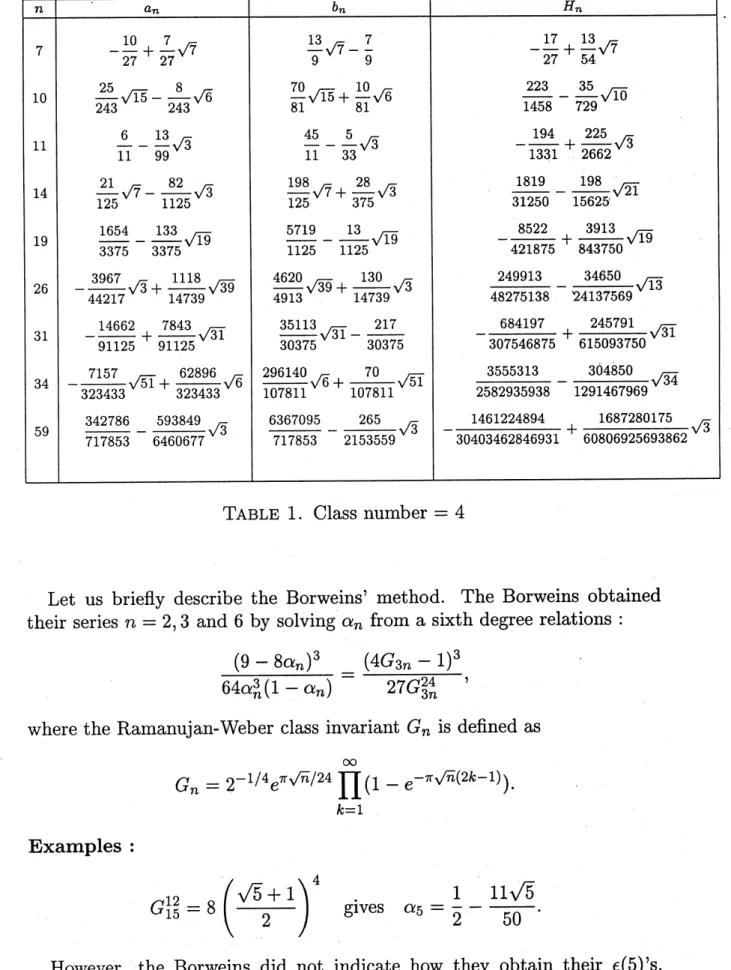
We have succeeded in using new moduIar equationsand Kronecker’s limit formula to compute $H_{n}$ and $\epsilon(n)$ for $n=7,10,11,14$,
19, 19, 26, 31, 34 and 59. Our nine
new
series then follow from the table:Our series (1.3) is the
case
$n=59$. Before the discovery of these newseries, there are only 5 known cubic series for $1/\pi$, namely $n=2,3,4,5$ and
6. Twoof which
are
alreadyinRamanujan’spaperwhile theother threewere
given by the Borweins in their book before the discovery of Ramanujan’s
alternative base theory. The Borweins discovered their series by solving
a
sixth degree polynomial expressing $\alpha_{n}$ in terms of Ramanujan-Weber class
TABLE 1. Class number $=4$
Let us briefly describe the Borweins’ method. The Borweins obtained
their series $n=2,3$ and 6 by solving $\alpha_{n}$ from a sixth degree relations:
$\frac{(9-8\alpha_{n})^{3}}{64\alpha_{n}^{3}(1-\alpha_{n})}=\frac{(4G_{3n}-1)3}{27G_{3n}^{24}}$ ,
where the Ramanujan-Weber class invariant $G_{n}$ is defined
as
$G_{n}=2^{-1}/4 \pi\sqrt{n}/24\prod e(1-e^{-}-)k=\infty 1)\pi\sqrt{n}(2k1$
.
Examples :
$G_{15}^{12}=8( \frac{\sqrt{5}+1}{2})^{4}$ gives $\alpha_{5}=\frac{1}{2}-\frac{11\sqrt{5}}{50}$.
However, the Borweins did not indicate how they obtain their $\epsilon(5)’ \mathrm{s}$.
They leave the computations of $\epsilon(n)$ as exercises. Their method cannot be
applied in our
case
since the class invariants $G_{3n}$are more
complicated. SoWe say that $\beta$ has degree $n$
over
$\alpha$ if(3.1) $\frac{K(1-\beta)}{K(\beta)}=n\frac{K(1-\alpha)}{K(\alpha)}$.
A relation between $\alpha$ and $\beta$ induced by (3.1) is known
as a
cubic modularequation. The first few modular equations
are
given by Ramanujan.For example, when $\beta$ has degree 2
over
$\alpha$$(\alpha\beta)1/3+\{(1-\alpha)(1-\beta)\}^{1}/3=1$.
In general,
we
haveTheorem 3.1. (Cubic Russell-type modular equations)
Suppose $p>3$ is an odd prime and $(p+\mathit{1})/\mathit{3}=N/s$ in lowest terms.
Sup-pose $\beta$ has degree $p$
over
$\alpha$.
Then the relation between$u=(\alpha\beta)^{S/}6$ and $v=\{(1-\alpha)(1-\beta)\}^{s/}6$
can
be given in theform
$B_{0}(v)u^{N}+B_{1(}v)u-1+\cdots+NB_{N(}v)=0$,
where $B_{0}(v),$
$\ldots,$$B_{N(v})$ are polynomials
of
degrees at most$N$ in $v$.
Next, define the multiplier
of
degree $n$ to be$m( \alpha,\beta)=\frac{K(\alpha)}{K(\beta)}$.
One
can
show that(3.2) $m^{2}( \alpha, \beta)=n\frac{\beta(1-\beta)}{\alpha(1-\alpha)}\frac{d\alpha}{d\beta}$.
From (3.2), we
see
that $m$ can be computed via differentiating a modularequation of degree $n$. This in turn allows
us
to conclude thatLemma 3.1. $\frac{dm(\alpha,\beta)}{d\alpha}$ can be expressed in terms
of
$\alpha$ and $\beta$.We
are
now ready to compute $\epsilon(n)$Theorem 3.2. (New
formula for
$\epsilon(n)$)$\epsilon(n)=\sqrt{n}\alpha n+\frac{3\alpha_{n}(1-\alpha_{n})}{4}\frac{dm}{d\alpha}(1-\alpha n’\alpha_{n})$.
This formula has
never
appeared in print. It shows that $\epsilon(n)$ can becomputed
once
we
know $\alpha_{n}$ and at leasta
modular equation of degree $n$.
This resultguarantees us a modular equation of prime degree and
so
$\epsilon(p)$can
be computed from $\alpha_{p}$. When $n=2p$,
as
in our table,we
can use modularequations of 2 and$p$ to evaluate $\epsilon(n)$ but
we
will not go into the details. It4. COMPUTATIONS OF
Theorem 4.1. Suppose the class number
of
the imaginary quadraticfield
$\mathbb{Q}(\sqrt{-3n})$ is
4
and that each genus in the class group contains a single class.Then $4H_{n}^{-1}$ is
of
theform
$a+b\sqrt{d}$, with $a$ and $b$ non-negative integers and$d\in\{2,3,6,p, 2p, 3p, 6p\}$.
This shows that 4$H_{n}^{-1}$ can be determined in a finite number of steps. So,
for example
4$H_{7}^{-1}=136.789534087679355\ldots=68+26\sqrt{7}$
.
$\alpha_{n}$ then follows from the $H_{n}$.
The proofof Theorem 4.1 follows from the fact that 4$H_{n}^{-11}=2+un+u_{n}-$,
where
$u_{n}= \frac{1}{27}(\frac{\eta(\sqrt{-n/3})}{\eta(\sqrt{-3n})})^{12}$
Here,
$\eta(\tau):=e^{\pi i\mathcal{T}/1}2k\prod_{=1}^{\infty}(1-e)2\pi ik\mathcal{T}$
.
Then, the fact that $u_{n}^{2}$ is a product of two fundamental units follows from
the following result which is a consequence ofKronecker’s limit formula:
Theorem 4.2. Let $\chi$ be a genus character arising
from
the decomposition$D_{K}=d_{1}d_{2}$. Let $h_{i,\chi}$ be the class number
of
thefield
$\mathbb{Q}(\sqrt{d_{i}}),$
$\omega_{2,\chi}$ be the
number
of
rootsof
unity in $\mathbb{Q}(\sqrt{d_{2}})$, and $\epsilon_{\chi}$ be thefundamental
unitof
$\mathbb{Q}(\sqrt{d_{1}})$
.
Suppose $[a]$ is an ideal class in $C_{K}$.
Set$F([a])=\sqrt{N([1,\tau])}|\eta(_{\mathcal{T}})|2$,
where $\eta(\tau)$ denotes the Dedekind $\eta$
-function
defined
by$\eta(z)=e^{\pi i}z/12k=1\prod^{\infty}(1-e)2\pi ikz$
and
$\tau=\frac{\tau_{2}}{\tau_{1}}$, $Im\tau>0$, where $a=[\tau 1, \tau 2]$.
Then