
Sodium deoxycholate synergistically enhances the antimicrobial activity of β-lactam antibiotics againstβ-lactamase-producing Staphylococcus aureus
6
0
0
全文
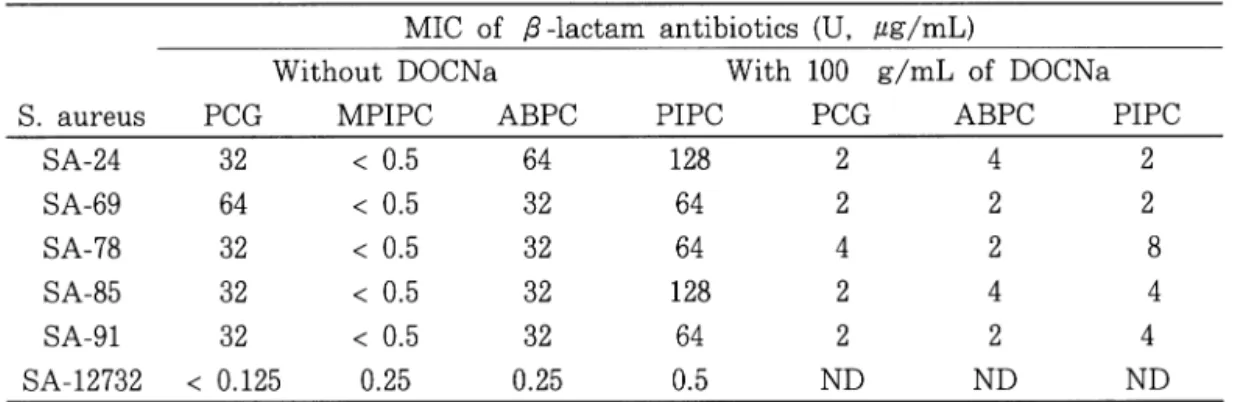
(2) 10. Hitoshi. Horie. at al.. Staphylococcus aureus is a facultative anaerobic Gram-positive coccal bacterium , and one of the most important bacterial pathogens (Eykyn et al. ; 1990, Schaberg et al. ; 1991). It is frequently part of the skin flora found in the nose and on skin. It may be the causative organisms in pneumonia, meningitis , empyema , endocarditis , or sepsis with suppuration in any organ. Although /3-lactam antibiotics such as benzylpenicillin (PCG) and ampicillin (ABPC) are effective against the S. aureus infection , penicillin-resistant S . aureus strains were found to produce a /3-lactamase (penicillinase) . The enzyme decomposes the [3 -lactam ring, and consequently $ -lactam antibiotics are inactivated. The appearance of i3 -lactamase-producing bacterial strains have diminished the usefulness of j3 -lactam antibiotics (Medeiros; 1984) . The [3 -lactamase-producing bacterial strains have a blaZ gene , which encodes the i3 -lactamase. expected by a combination with deoxycholic acid or sodium deoxycholate. In this study, we investigated the antimicrobial activities of sodium deoxycholate (because sodium deoxycholate dissolves in water more easily than deoxycholic acid) and the synergistic effects on the antimicrobial activities of /3 -lactam antibiotics against 13-lactamase-producing S. aureus strains of the combined use with sodium deoxycholate, aiming at developing new therapeutic agents or new approaches against infectious diseases caused by /3lactamase-producing bacteria. Five strains of penicillin-resistant S. aureus (SA24, SA-69, SA-78, SA-85 and SA-91) were isolated from five healthy adult volunteers (all males, 22to 50-year-old) . The SA-12732 strain was used as the standard strain, which was obtained from the National Institute of Technology and Evaluation Biological Resource Center, Chiba, Japan. These. (Okamoto antibiotics. strains. et al. : 1996) . Combination of $ -lactam with either sulbactam , tazobactam or. clavulanic acid, all of which are /3-lactamase inhibitors, is a useful therapeutic method for treating infections of /3-lactamase-producing bacteria (Rizwi et al. ; 1989, Maddux;. 1991) . However,. it was re-. ported that bacterial strains which acquired inhibitor resistance appeared (Blasquez et al. ; 1993 , Chaibi et al. ; 1999) . Drug resistance in pathogenic bacteria is a serious global problem. New therapeutic agents or new approaches are urgently needed for drug-resistant bacteria. Deoxycholic acid is one of the secondary bile acids, which are metabolic byproducts of intestinal bacteria. The compound is used in the emulsification of fats for absorption in the intestine in humans. Deoxycholic acid and sodium deoxychol ate, the sodium salt of deoxycholic acid, contain a steroid ring component, and they are often used as biological detergents to lyse cells and solubilize cellular and membrane components . The detergent property also confers potent antimicrobial activity, primarily through the lysis of bacterial membranes (Begley et al. ; 2005) . Actually, it has been reported that deoxycholic acid has an antibacterial effect on Helicobacter pylori (Itoh et al. ; 1999) . The refore, a synergistic effect on the antimicrobial activities of antibiotics against bacteria (especially multiple drug-resistant microorganisms) was. were. identified. by PCR analysis. for the. presence of the blaZ gene employing the primer pair described in our previous report (Horie et al. ; 2010) . The DNA fragment of 325 by of the blaZ gene was amplified in each of five penicillinresistant strains, but not in the standard strain (Fig.1) . Therefore, these penicillin-resistant strains should produce this ,8-lactamase and will be resistant to other $ -lactam antibiotics . The MICs (minimum inhibitory concentrations) of /3 -lactam antibiotics against those S. aureus strains are shown in Table 1. The MIC was determined by a. Fig. 1 PCR analysis of blaZ gene in S. aureus. Lane 1, 100-bp DNA ladder (molecular weight marker); lane 2, S. aureus SA-24; lane 3, SA69; lane 4, SA-78; lane 5, SA-85; lane 6, SA-91; lane 7, SA-12732. Expected size of PCR products (325 bp) is shown by arrow..
(3) Synergistic. effects. Table. of sodium. 1. deoxycholate. on antimicrobial. Effect of sodium deoxycholate to if?-lactam antibiotics. MIC. Without S.. aureus. PCG. of. in sensitizing. 13 -lactam. /3 -lactamase-producing. antibiotics. DOCNa. MPIPC. 11. activities. With ABPC. PIPC. (U,. gg/mL). 100. g/mL. PCG. S. aureus. of DOCNa ABPC. SA-24. 32. SA-69. 64. < 0.5. 32. SA-78. 32. < 0.5. 32. 64. 4. 2. 8. SA-85. 32. < 0.5. 32. 128. 2. 4. 4. 32. < 0.5. 32. 64. 2. 2. 4. 0.25. 0.25. 0.5. ND. ND. ND. SA-91 SA-12732. < 0.125. 64. 128. 2. 4. 2. 64. 2. 2. 2. PCG, benzylpenicillin (U/mL); ABPC, ampicillin ( ,ug/mL); MPIPC, oxacillin PIPC, piperacillin ( gg/mL); DOCNa, sodium deoxycholate; ND, not done. liquid. PIPC. < 0.5. microdilution. method. in. 96-well microtiter. plates according to the procedure recommended by the National Committee for Clinical Laboratory Standards (National Committee for Clinical Laboratory Standards; 1997) . Three kinds of ,8 -lactam antibiotics, PCG, ABPC and piperacillin (PIPC) , hardly showed any activity against such strains carrying the blaZ gene as described in Fig. 1. The MIC range of the three $ -lactams was 32 to 128 fLg/mL. On the other hand, the strains were highly susceptible to oxacillin (MPIPC) , because MPIPC is not decomposed by $ -lactamase. Thus, the results show that these strains indeed produce the j3 -lactamase. The standard strain showed high susceptibility against all antibiotics. The synergistic effects of the combined use of 100 aug/mL sodium deoxycholate on the antimicrobial activity of the /3 -lactam antibiotics against the [3 lactamase-producing S. aureus strains are shown in Table 1. The MIC of sodium deoxycholate against the strains was 500 iig/mL (data not shown). Sodium deoxycholate was used at a concentration at which the proliferation of S. aureus was not inhibited. The antimicrobial activities of three 13-lactams (PCG, ABPC and PIPC) against those strains were obviously enhanced in combination with 100 ktg/mL of sodium deoxycholate (Table 1 ) . The MIC range of the three [3 -lactams was 2 to 8 gg/mL. The synergistic effect was hardly observed with 50 gg /mL of sodium deoxycholate (data not shown). In addition, to elucidate the mechanism of the. ( gg/mL);. synergistic effects of sodium deoxycholate on the antimicrobial activity of the [3 -lactam antibiotics, the inhibitory effect of sodium deoxycholate against 13-lactamase activity was examined. Each S. aureus (SA-24, SA-69, SA-78, SA-85 or SA-91) was inoculated in 100 iLL of sensitivity test broth (ST-broth , Nissui Pharmaceutical Co . , Ltd . , Tokyo, Japan) with or without 100 ,ug/mL of sodium deoxycholate and cultured at 37° C for 24 h. Also, the cultivation medium to which 100 ,ug/mL of sodium deoxycholate was added after the cultivation period was prepared as a control. Each cultivation fluid was incubated with nitrocefin (Kanto Chemical Co. , Inc. , Tokyo, Japan) as a substrate of ,8 -lactamase at 37 ° C for 30 to 60 min . Absorbance at 492 nm was measured with a spectrophotometer. The test was performed three times independently and the data were analyzed using Student's t-test. A value of P<0.05 was considered as statistically significant . The cultivation fluid without sodium deoxycholate was observed to have high i3-lactamase activity (Fig. 2, white bar) , because the activity of i3 -lactamase was proportional to the absorbance (Zhao et al. ; 2002) . However, the activity decreased significantly (p<0. 01) when the medium containing 100 aug/mL of sodium deoxycholate was used for cultivation (Fig. 2, black bar). On the other hand, in the medium to which 100 lig/mL of sodium deoxycholate was added after the cultivation period , a significant decrease in activity was not observed (Fig . 2 , gray bar) ..
(4) 12. Hitoshi. Without With Added. Horie. at al.. DOCNa. DOCNa. during. cultivation. after. cultivation. DOCNa. Fig. 2 Inhibition effect of sodium deoxycholate against /3 -lactamase activity . Each S. aureus (SA-24, SA-69, SA-78, SA-85 or SA-91) was inoculated in 100 AtL of STbroth with (black bar) or without (white bar) 100 it g/mL of sodium deoxycholate and cultured at 37° C for 24 h. The cultivation medium to which 100 ALg/mL of sodium deoxycholate was added after the cultivation period was prepared (gray bar) as a control. Each cultivation fluid was incubated with nitrocefin as a substrate of /3 -lactamase at 37° C for 30 to 60 min. Absorbance at 492 nm was measured with a spectrophotometer. The test was performed three times independently. The mean and S.D. values are described.. Therefore , it is demonstrated that the sodium deoxycholate remarkably reduces the synthesis of the $ -lactamase in j3-lactamase-producing S . aure us, but does not suppress the ,8 -lactamase activity. Sodium deoxycholate is not a medical supply; therefore, its safety for the human body remains uncertain. Although further analysis is necessary, investigation of the synergistic effects of sodium deoxycholate. on the. antimicrobial. activity. is ex-. pected to be a new therapeutic method and may contribute to an effective utilization of $ -lactam antibiotics against infectious diseases caused by /3lactamase-producing bacteria.. addition , it is demonstrated that sodium deoxycholate remarkably reduces the synthesis of the [3 -lactamase in $ -lactamase-producing S. aureus, but does not suppress the /3 -lactamase activity. The combined use of sodium deoxycholate with '8 -lactam antibiotic is expected to be a new therapeutic method and may contribute to an effective utilization of /3 -lactam antibiotics against infectious diseases caused by /3 -lactamase-producing bacteria.. Acknowledgement This versity. work Joint. was supported Research. in part. by an Ohu. Uni-. Fund.. Conclusion The antimicrobial (PCG , ABPC and producing combined. activities of three [3 -lactams PIPC) against i3 -lactamase-. S. aureus were obviously enhanced by a use with sodium deoxycholate . In. References Begley. M, Gahan. CGM and. between. bacteria. and. Rev,. 625-651,. 2005.. 29,. Hill C. The interaction bile .. FEMS. Microbiol.
(5) Synergistic. effects. of sodium. deoxycholate. on antimicrobial. Blasquez J, Baquero MR, Canton I et al. Characterization of a new TEM-type $ -lactamase resistant to clavulanate, sulbactam, and tazobactam. Antimicrob Agents Chemother, 37, 2059-2063, 1993. Chaibi EB, Sirot D, Paul G and Labia R. Inhibitor-resistant TEM [3 -lactamase: phenotypic, genetic and biochemical characteristics . J Antimicrob Chemother, 43, 447-458, 1999. Eykyn SJ , William R and Gransden WR . The causative organisms of septicaemia and their epidemiology. J Antimicrob Chemother, 25, 41-58, 1990. Horie H, Sato H, Taya K et al. Enhancement effects of antimicrobial activities of 13-lactam antibiotics by combination with persimmon tannin against 13-lactamase- producing Staphylococcus aureus. J Hum Nurs Stud, 8, 2010. Itoh M, Wada K, Tan S et al. Antibacterial. 9 -16, action. of bile acid against Helicobacter pylori and changes in its ultrastructural morphology: effect of unconjugated dihydroxy bile acid . J Gastroenterol, 34( 5 ), 571-576, 1999. Maddux M . Effects of $ -lactamase-mediated antimicrobial resistance: the role of 13 lactamase inhibitors. Pharmacotherapy, 11, 40-. activities. 50, 1991. Medeiros AA. Beta-lactamases.. 13. Br Med Bull, 40,. 18-27, 1984. National Committee for Clinical Laboratory Standards. Methods for dilution antimicrobial susceptibility tests for bacteria that grow aerobically , 4 th ed . Approved standard . NCCLS document M 7 -A4, 1997. Okamoto R, Okubo T and Inoue M. Detection of genes regulating -lactamase production in Enterococcus faecalis and Staphylococcus aureus. Antimicrob Agents Chemother, 40, 2550-2554, 1996. Rizwi I , Tan AK , Fink AI and Virden R . Clavulanate inactivation of Staphylococcus aureus beta-lactamase. Biochem J, 258, 205209, 1989. Schaberg DR, Culver DH and Gaynes RP. Major trends in the microbial etiology of nosocomial infection. Am J Med, 91, 72S-75S, 1991. Zhao W-H, Hu Z-Q, Hara Y et al. Inhibition of penicillinase by epigallocatechin gallate resulting in restoration of antibacterial activity of penicillin against penicillinase-producing Staphylococcus aureus. Antimicrob Agents Chemother, 46, 2266-2268, 2002..
(6) 14. Hitoshi. Horie. at al.. (要 旨) 背 景 β一ラ ク タ マ ー ゼ産 生 黄 色 ブ ドウ球 菌 な どが 産 生 す る β一ラ ク タ マ ー ゼ は、 β一ラ ク タ ム系 抗 菌 薬 が 有 す. (minimum inhibitory concentration)法 で解析 し た。 ま た 、 デ オ キ シ コ ー ル 酸 ナ ト リウ ム に よ る β一ラ. る β一ラ ク タ ム 環 を 開 裂 させ る こ と で 、 そ の抗 菌 活 性. ク タマ ー ゼの 酵 素 活 性 阻 害 作 用 、 お よ び 同 酵 素 の 生 合. を 失 活 さ せ る。 そ の た め、 β一ラ ク タ マ ー ゼ産 生 菌 が 原 因 とな る感 染 症 に対 して 、 限 られ た 薬 剤 しか使 用 で. 成 阻害 作 用 に関 して、 ニ トロ セ フ ィ ンを 用 い た 吸 光 度. き な い の が 現 状 で あ る。 β一ラ ク タ マ ー ゼ産 生 菌 な ど の 多 剤 耐 性 菌 に よ る感 染 症 に対 し、 新 しい治 療 薬 や 治. 結 果 β一ラ ク タマ ー ゼ産 生 黄 色 ブ ドウ球 菌 に対 して 、 ほ とん ど抗 菌 活 性 を 示 さ なか った ペ ニ シ リ ン系 抗 菌 薬. 療 方 法 の 開 発 が 急 務 とな って い る。. が、 デ オ キ シ コー ル酸 ナ トリウ ム と併 用 す る こ とで 顕. 目的. 界 面 活 性 作 用 の あ る デ オ キ シ コ ー ル 酸 ナ ト リウ. 著 な 抗 菌 活 性 を 示 した。 この 抗 菌 活 性 の増 強 効 果 は 、. ム は、 抗 菌 活 性 も有 して い る こ とが 知 られ て い る。 本 研 究 で は 、 この 化 合 物 の β一ラ ク タ マ ー ゼ産 生 黄 色 ブ. デ オ キ シ コー ル酸 ナ ト リウム に よ る同細 菌 に対 す る β一 ラ ク タ マ ー ゼ の生 合 成 阻 害 作 用 に よ る もの で あ る こと. ドウ球 菌 に対 す る抗 菌 活 性 、 並 び に 同 化 合 物 と β一ラ. が 強 く示 唆 さ れ た。. ク タム 系 抗 菌 薬 とを併 用 した場 合 の 、 同 細 菌 に対 す る 抗 菌 活 性 相 乗 効 果 に っ い て解 析 を 行 い 、 本 化 合 物 が β一. 結 論 デ オ キ シ コ ー ル 酸 ナ ト リウ ム と β一ラ ク タ ム系 (ペ ニ シ リ ン系)抗 菌 薬 と の併 用 に よ る抗 菌 活 性 相 乗. ラク タマ ー ゼ産 生 細 菌 に よ る感 染 症 に対 し、 新 しい治. 効 果 に 関 す る研 究 は、 β一ラ ク タマ ー ゼ 産 生 黄 色 ブ ド. 療 薬 ・治 療 方 法 の 開 発 に結 び付 く可 能 性 に つ い て 検 討 を行 った 。. ウ球 菌 な ど の 多 剤 耐 性 菌 が 原 因 とな る感 染 症 に対 し、 全 く新 しい治 療 方 法 の開 発 や既 存 抗 菌 薬 の有 効 利 用 等. 方 法 β一ラ ク タマ ー ゼ 産 生 黄 色 ブ ドウ球 菌 に対 す る デ. に 結 びつ く可 能 性 が 期 待 さ れ る。. 測 定 法 で 解 析 した。. オ キ シ コ ー ル酸 ナ ト リウ ム の抗 菌 活 性 、 お よ び 同 化 合. キ ー ワ ー ド β一ラ ク タマ ー ゼ産 生 黄 色 ブ ドウ球 菌 、 デ. 物 と β一ラ ク タ ム 系(ペ. オ キ シ コ ー ル 酸 ナ トリ ウ ム、 β一ラ ク タ ム系 抗 菌 薬 、. ニ シ リ ン系)抗. 菌薬 とを併用. し た 場 合 の 抗 菌 活 性 相 乗 効 果 に つ い て 、MIC. 抗 菌 活 性 、blaZ遺 伝 子.
(7)
図


関連したドキュメント
Keywords: continuous time random walk, Brownian motion, collision time, skew Young tableaux, tandem queue.. AMS 2000 Subject Classification: Primary:
Applying the representation theory of the supergroupGL(m | n) and the supergroup analogue of Schur-Weyl Duality it becomes straightforward to calculate the combinatorial effect
Applications of msets in Logic Programming languages is found to over- come “computational inefficiency” inherent in otherwise situation, especially in solving a sweep of
To derive a weak formulation of (1.1)–(1.8), we first assume that the functions v, p, θ and c are a classical solution of our problem. 33]) and substitute the Neumann boundary
Shi, “The essential norm of a composition operator on the Bloch space in polydiscs,” Chinese Journal of Contemporary Mathematics, vol. Chen, “Weighted composition operators from Fp,
Variational iteration method is a powerful and efficient technique in finding exact and approximate solutions for one-dimensional fractional hyperbolic partial differential equations..
[2])) and will not be repeated here. As had been mentioned there, the only feasible way in which the problem of a system of charged particles and, in particular, of ionic solutions
After proving the existence of non-negative solutions for the system with Dirichlet and Neumann boundary conditions, we demonstrate the possible extinction in finite time and the
