81
*1 Graduate School of Medical Sciences, Tottori University, Yonago, 683-8503, Japan *2 Sanin Rosai Hospital, Yonago, 683-8605, Japan
*3 Department of Nursing Care Environment and Mental Health, School of Health Science, Faculty of Medicine, Tottori University, Yonago, 683-8503, Japan
E-Mail: [email protected] Original Paper
Factors Influencing the Happiness of Japanese Nurses:
Association with Work Engagement and Workaholism
Emiko SAIGA
*1,2and Shin-ichi YOSHIOKA
*3(Accepted December 5, 2020)
Key words: happiness, work engagement, workaholism, workplace, nurses
Abstract
This study aimed to investigate the personal characteristics and factors associated with work environment, work engagement, and workaholism that influence nurses’ happiness. Nine hundred and eighty nurses working at 10 hospitals and facilities in Tottori, Japan participated. The nurses completed a questionnaire about happiness, work engagement, workaholism, personal characteristics, and work environment. Happiness was assessed with the Satisfaction with Life Scale (SWLS), work engagement with the Utrecht Work Engagement Scale (UWES), and workaholism with the Dutch Work Addiction Scale (DUWAS). The SWLS scores showed a significant positive correlation with the UWES total scores and scores on the 3 subscales. They also showed significant, but in this instance, a weak negative correlation with the 2 subscales of the DUWAS. Only 58 (5.9%) nurses felt very happy and 450 nurses (45.9%) did not feel happy. Both SWLS and UWES scores were positively correlated with the workplace environment. The study showed that nurses’ SWLS was positively influenced by UWES but negatively influenced by DUWS. Although creating a sense of happiness at work is important, we believe that happiness is brought about by good relationships and a reasonable working style that does not lean towards workaholism.
1. Introduction
Humans are always striving to achieve happiness, and happiness has been studied since ancient times. According to a Japanese dictionary, happiness is defined as "a comfortable and satisfied state felt to be fun" (authors’ translation)1). English language-speaking regions also use the word "well-being" to refer to
happiness, as well as satisfaction and mental health2). In past decades, the empirical science of subjective
well-being has grown enormously all over the world, including Japan3). Japan has the highest longevity in
the world and is reported to be the safest country in the world. However, the World Happiness Report 20204) ranked Japan 62nd among 153 countries. Japan’s low happiness ranking is related to low scores in
health, subjective well-being, work-life balance, civic participation in politics, income, and wealth5).
as well as low job satisfaction and poor mental health7). Furthermore, nurses are known to have velatively
lower levels of happiness than average. Consequently, they are at risk of reduced satisfaction with life, burnout8,9), and frequent job changes10). Happiness is an important issue in all professions; however, it is
particularly important in the nursing profession because nurses’ level of happiness may be relevant for patient care11,12). However, nurses’ happiness was reported to be lower than the average and to decrease
with longer working hours13). Studies reported that nurses’ happiness is related to job satisfaction9,14).
Concerning the basic characteristics, Rahighee15) reported the association between happiness and the
characteristics of nurses and reported that happiness was not associated with age, sex, marital status, work history, or education but was associated with the workplace. Oates et al.16) also reported that happiness
was not associated with sex, age, household size, employment status, or years of employment. Khosrojerdi et al.14) stated that salary, ward, hours of work, and age were predictors of nurses’ well-being. In addition,
Scott17) reported that being happy at work is a fundamental element of a person’s life satisfaction. Ozkara
San11) reviewed literature on nurses’ happiness from online and manual searches and reported a concept of
nurses’ happiness that consists of personal factors, work characteristics, and work environment.
After 2000, "work engagement" was proposed as a new concept in mental health18). Employees with high
levels of work engagement feel proud and rewarded by their work, are enthusiastic about their work, derive vitality and vibrancy from their work, and are actively involved in their work. Factors affecting work engagement are related to organizational, work-related, and individual resources19). However, findings
on the relationship between work engagement and the personal characteristics of nurses are inconsistent. Regarding age and years of experience, some studies have reported that work engagement increased with age and years of experience20,21), while others found no differences22,23). No studies found differences between
men and women21). Some authors reported that work engagement among nurses with spouses was higher
than among those without spouses21), but others found no differences23). Regarding the presence or absence
of children, some research found higher work engagement in nurses with children than in those without21),
whereas others found no differences23). Regarding position, some studies reported that nurses working as
heads or deputy heads had higher work engagement than non-managerial staff21), but others reported no
differences22). Managers play an important role in work engagement because stress negatively affects it24,25).
Hall26) noted that engaged workers often feel stressed and are not necessarily happy. In addition, Kusago
and Yamamoto27) described the relationship between unhappiness and work, saying that even if people have
a well-paid job they can feel unhappy because of the content of their work.
The concepts of workaholism and burnout are known to be related to work engagement28). Workaholism
refers to the tendency to work excessively hard and compulsively. It differs from work engagement in that the attitude towards work is negative, even though the activity level is high29). Work is assumed to be
particularly closely related to happiness in nurses because they spend many hours at the workplace, and studies have examined the relationship between happiness, work engagement, and workaholism also in nurses8,9,30-33). In a study of workaholism among nurses, 6% of participants were at high risk for workaholism
and 40% were at risk for workaholism34). In a study of Japanese workers, workaholism was associated
with increased ill health and decreased life satisfaction, whereas work engagement was associated with increased life satisfaction and job performance35). Another study in nurses found that happiness and work
engagement were positively correlated and both were negatively correlated with burnout8,9,30-32). Nurses’
work engagement is known to be correlated with job satisfaction, job performance, happiness, health status, and the work environment33) and is known to be associated with turnover36-38). Currently, high turnover is
an important issue among nurses, especially new ones39), and researchers have identified a need to promote
health care among nurses to prevent turnover10).
Nurses’ happiness was found to be associated with work engagement, job performance and satisfaction, and turnover, and nurses’ intention to change jobs was negatively correlated with work engagement40,41).
Nurses with low work engagement and high workaholism are also more likely to switch jobs42). Many
engagement, previous studies21,43,44) also showed that it is increased by "work resources," such as supervisor
support, peer support, and work discretion, and "personal resources," such as self-efficacy and optimism. Therefore, this study investigated factors in nurses related to personal characteristics and workplace environment that affect subjective well-being as a measurement of happiness. The aim was to clarify the factors influencing nurses’ happiness associated with work engagement and workaholism, and work environment that enable nurses to thrive and engage in the workplace. In addition, the study also assessed the relationship between happiness, work engagement, and workaholism. The results of the study are used to clarify factors that can help nurses achieve happiness at work.
2. Methods
2.1 Participants
We randomly selected 50 hospitals and facilities in Tottori, Japan, and asked their nursing department directors or facility managers to cooperate with the study; 10 facilities agreed to participate. We included a total of 1322 nurses from these 10 facilities, which included general hospitals with more than 300 beds, specialized hospitals with fewer than 300 beds, independent hospitals, and non-hospital facilities.
2.2 Procedures
We sent copies of an anonymous, self-administered questionnaire to the consenting hospitals and facilities by mail and asked them to distribute the copies among their nurses. We enclosed a written request that described the purpose and ethical considerations of the study with a survey vote and asked the participating nurses to return the questionnaire by mail. The study was conducted from December 2014 to June 2015.
2.3 Measurements
2.3.1 Basic characteristics, workplace environment, and important sense of values on living
We examined the following basic characteristics: age, sex, length of nursing experience, marital status, children, position in the workplace, and type of facility. To assess workplace environment factors, we asked the nurses to use a 4-point Likert scale ranging from "Strongly agree" to "Strongly disagree" to rate their level of agreement with the following 6 statements: (1) I am working in a department that I wanted to join; (2) My workplace has a good work environment; (3) My supervisor is reliable; (4) I want to continue working in my current workplace as long as possible; (5) I have a good relationship with my coworkers and superiors; (6) I have someone that I can rely on for advice in my workplace.
2.3.2 Happiness
As a measure of happiness, we used the Japanese version of the Satisfaction with Life Scale (SWLS)2), a
well-known scale that evaluates well-being (originally developed by Diener et al.45)). The Japanese version of
the SWLS is a 5-item scale that uses the person’s own criteria to measure their global evaluative judgment of their overall life satisfaction. The scale has been used in a wide range of studies, and its reliability and validity have been confirmed46). Participants use a 7-point Likert scale ranging from 1 ("strongly disagree")
to 7 ("strongly agree") to indicate how much they agree or disagree with each of the 5 items on the scale. Total scores range from 5 to 35 and are differentiated as follows: (1) 30-35, very high score, highly satisfied; (2) 25-29, high score; (3) 20-24, average score; (4) 15-19, slightly below average in life satisfaction; (5) 10-14, dissatisfied; and (6) 5-9, extremely dissatisfied.
2.3.3 Work engagement
Work engagement was assessed with the Japanese version of the short form of the Utrecht Work Engagement Scale (UWES)18). The UWES includes 3 subscales that reflect the underlying dimensions of
engagement, i.e. vigor, dedication, and absorption. Each item is scored on a 7-point Likert scale ranging from 0 ("never") to 6 ("always"). The reliability and validity of the Japanese version of the UWES were confirmed by Shimazu et al.47). Total scores of the UWES range from 0 to 54 and are differentiated as follows: (1) 0-27,
low score (not engaged); (2) 28-35, average score; (3) 36-54, high score (engaged).
2.3.4 Workaholism
Workaholism was assessed with the Japanese version of the Dutch Work Addiction Scale (DUWAS)29).
This scale consists of 2 subscales, working excessively and working compulsively. Each subscale consists of 5 items that are rated on a 4-point Likert scale ranging from 1 ("totally disagree") to 4 ("totally agree"). The reliability and validity of the Japanese version of DUWAS were confirmed by Schaufeli et al.29).
2.4 Statistical analysis
Incomplete responses were excluded from the analysis. Quantitative variables were analyzed by calculating the mean, standard deviation (SD), median, and interquartile range (IQR) values. The normality of the distribution of the quantitative variables was examined by the Shapiro-Wilk test and normality graphs. The statistics for the three scales used in the study, SWLS, UWES, and DUWAS, were 0.993, 0.993, and 0.982, respectively. In addition, the significant probabilities of SWLS, UWES, and DUWAS were all less than 0.001 or less. Therefore, they were not normally distributed. As a result, the non-parametric tests were used for the statistical tests. To assess reliability, we examined the internal consistency of the total scores of the three scales (SWLS, UWES, and DUWAS) and the scores for each subscale using Cronbach’s alpha (α) coefficient. We examined the differences between basic characteristics and work environment-related factors from the SWLS with the Mann-Whitney U test or Kruskal-Wallis test. The groups were compared with a post hoc test, and Bonferroni’s test was performed in case of a significant result. We also analyzed the relationships between the scales and between workplace environment factors and each scale with Spearman’s rank correlation coefficient test. To test whether variables were independent, we used the chi-square test of independence. For statistical processing and analysis, we used the statistical software SPSS version 25, with a significance level of 5%.
2.5 Ethical considerations
We provided the nursing department directors or managers of the cooperating hospitals or facilities with written explanations of the study objective and methods. We also attached a letter to each copy of the questionnaire distributed to the nurses that requested their cooperation in the study and explained the study objective and methods. The letter specified that participation was voluntary and that choosing not to participate would not have any negative consequences, and it described privacy protection measures, including how data would be obtained and used and how questionnaires would be destroyed after data analysis was complete. We regarded each response submitted by a nurse as indicating consent to participate. The study was approved by the ethics committee of the Faculty of Medicine, Tottori University (approval number 2603).
3. Results
3.1 Participants
Among the 1,322 nurses working at the 10 hospitals or facilities that agreed to participate, 1,112 responded (response rate: 84.1%); 980 questionnaires (88.1%) had no missing data and were included in the analyses.
3.2 Basic characteristics of participants
Participant characteristics are summarized in Table 1. A total of 900 (91.8%) females and 80 (8.2%) males returned completed questionnaires. The largest age group was 30 to 39 years (n = 279, 28.5%), followed by 20 to 29 years (n = 270, 27.6%). The most frequent length of nursing experience was 11 to 20 years (n = 254, 25.9%), followed by 6 to 10 years (n = 170, 17.3%). More than half of the participants (n = 530, 51.1%) were married, and 537 (54.8%) had children. Most of the respondents were not managers or middle managers (n = 827, 84.4%) and most worked in a general hospital (n = 523, 53.4%).
Table 1 Demographic characteristics of nurses participating in a questionnaire survey on factors influencing happiness
Variables n (%) Sex Female 900 (91.8) Male 80 ( 8.2) Age (years) 20 - 29 270 (27.6) 30 - 39 279 (28.5) 40 - 49 213 (21.7) 50 - 59 186 (19.0) 60 ≤ 32 ( 3.3)
Years of nursing experience
0 - 3 154 (15.7) 4 - 5 94 ( 9.6) 6 - 10 170 (17.3) 11 - 20 254 (25.9) 21 - 30 162 (16.5) 31 ≤ 146 (14.9) Marital status Single 367 (37.4) Married 530 (51.1) Others (Divorced/Widowed) 83 ( 8.5) Have children Yes 537 (54.8) No 443 (45.2) Position Managers/Middle managers 153 (15.6) Others 827 (84.4) Institution General hospital 523 (53.4) Non-general hospital 251 (25.6) Independent hospital 190 (19.4) Others 16 ( 1.6)
3.3 Evaluation of the workplace environment
The ratings of the work environment are shown in Table 2. The majority agreed or strongly agreed with all the items: I am working in a department that I wanted to join (n = 542, 55.3%); my workplace has a good environment (n = 690, 70.4%); my supervisor is reliable (n = 714, 72.9%); I want to continue working in my workplace as long as possible (n = 633, 64.6%); I have a good relationship with coworkers and superiors (n = 744, 75.9%); and I have someone that I can rely on for advice in my workplace (n = 808, 82.4%).
3.4 Correlation and relationships between the scores for happiness (SWLS), work engagement (UWES), and workaholism (DUWAS)
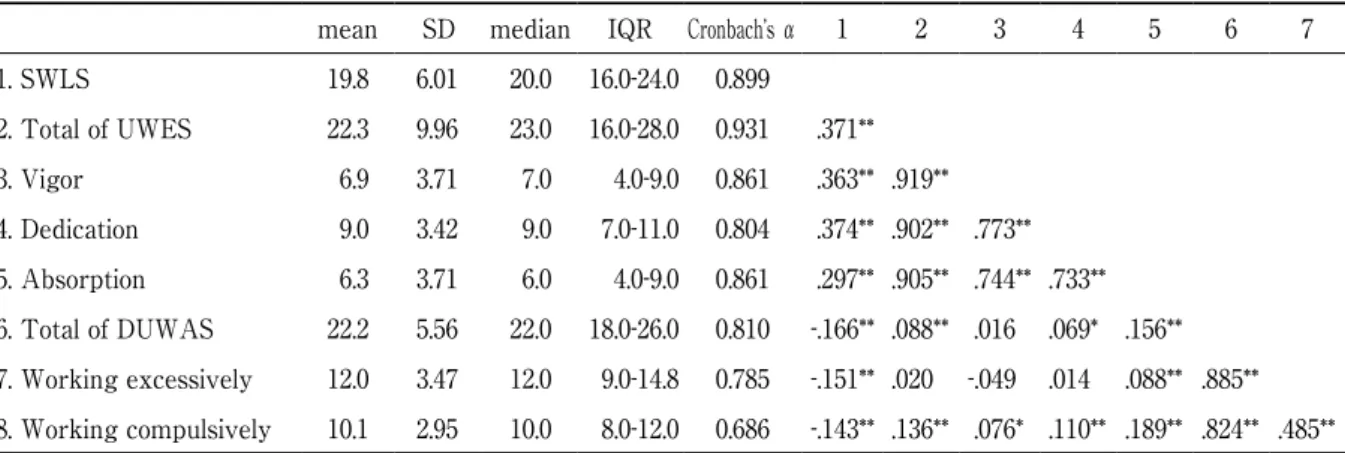
The means, SDs, medians, IQRs and reliability coefficients (Cronbach’s α) of the 3 scales on happiness (SWLS), work engagement (UWES total and the subscales vigor, dedication, and absorption), and workaholism (DUWAS total and the subscales working excessively and working compulsively) and the
Spearman’s rank correlations between the total and subscale scores are shown in Table 3. The SWLS scores showed a significant positive correlation with the UWES total score and with the score on the 3 subscales. Regarding correlations with the DUWAS, the SWLS scores were significant, but weak, and negatively correlated with the total score and with the score on the 2 subscales.
The relationship between rating levels on the SWLS and UWES is shown in Table 4. On the SWLS, 58 nurses (5.9%) strongly agreed that they felt very happy, and 530 (54.1%) strongly agreed, agreed, or felt neutral. In contrast, 450 nurses (45.9%) responded that they slightly disagreed, disagreed, or strongly disagreed that they felt happy. On the UWES, 92 nurses (9.4%) indicated a high level of engagement and 716 (73.1%) a low level. We found a significant association between happiness and work engagement (χ2(10)
= 93.128, P < 0.001).
Table 2 Evaluation by nurses (N = 980) of the workplace environment
Strongly
disagree Disagree Agree Stronglyagree I am working in a department that I wanted
to join. 234 (23.9) 204 (20.8) 284 (29.0) 258 (26.3)
My workplace has a good work
environment. 69 ( 7.0) 221 (22.6) 548 (55.9) 142 (14.5)
My supervisor is reliable. 81 ( 8.3) 185 (18.9) 477 (48.7) 237 (24.2) I want to continue working in my current
workplace as long as possible. 100 (10.2) 247 (25.2) 429 (43.8) 204 (20.8) I have a good relationship with my
coworkers and superiors. 44 ( 4.5) 192 (19.6) 591 (60.3) 153 (15.6)
I have someone that I can rely on for advice
in my workplace. 35 ( 3.6) 137 (14.0) 571 (58.3) 237 (24.2)
Table 3 Correlation between scores for happiness, work engagement, and workaholism in nurses (N = 980)
mean SD median IQR Cronbach’s α 1 2 3 4 5 6 7
1. SWLS 19.8 6.01 20.0 16.0-24.0 0.899 2. Total of UWES 22.3 9.96 23.0 16.0-28.0 0.931 .371** 3. Vigor 6.9 3.71 7.0 4.0-9.0 0.861 .363** .919** 4. Dedication 9.0 3.42 9.0 7.0-11.0 0.804 .374** .902** .773** 5. Absorption 6.3 3.71 6.0 4.0-9.0 0.861 .297** .905** .744** .733** 6. Total of DUWAS 22.2 5.56 22.0 18.0-26.0 0.810 -.166** .088** .016 .069* .156** 7. Working excessively 12.0 3.47 12.0 9.0-14.8 0.785 -.151** .020 -.049 .014 .088** .885** 8. Working compulsively 10.1 2.95 10.0 8.0-12.0 0.686 -.143** .136** .076* .110** .189** .824** .485**
SWLS: Satisfaction with Life Scale, UWES: Utrecht Work Engagement Scale, DUWAS: Dutch Work Addiction Scale, IQR: Interquartile range. Spearman’s rank correlation coefficient test. *P < 0.05, **P < 0.01.
3.5 Relationships between participant characteristics and the mean scores for happiness (SWLS), work engagement (UWES), and workaholism (DUWAS)
The relationships between SWLS, UWES, and DUWAS and participant characteristics is shown in Table 5. We found no significant differences in SWLS scores between males and females or between the various workplaces, but we did find significant differences in SWLS scores between age groups, years of nursing experience, marital status, children, and position. Nurses in their 20s and those with less than 3 years of nursing experience had the lowest SWLS scores. Married nurses had the highest SWLS scores, and nurses with children had higher SWLS scores than nurses without. SWLS scores were also higher for managers and middle managers than for other staffs.
Similar to the SWLS, in the UWES we found significant associations between age, years of nursing experience, marital status, children, position, and workplace. As age and years of experience increased, UWES scores increased. Regarding workplace, nurses working in non-hospital facilities had the highest scores on the UWES.
On the DUWAS, we found significant associations between age, years of experience, position, and workplace. Nurses with a higher total score were most likely to be in their 50s and to have fewer than 3 years or more than 31 years of experience. DUWAS scores were higher among managers than among non-managers and higher among nurses working at general hospitals and specialized hospitals than among those at other types of facilities.
3.6 Correlations between the mean scores for happiness (SWLS), work engagement (UWES), and workaholism (DUWAS) and work environment
The correlations between happiness, work engagement, workaholism, and workplace environmental factors are shown in Table 6. SWLS and UWES scores showed a weak positive correlation with positive ratings for all the workplace environment items. DUWAS scores were weak and negatively correlated with positive ratings of the workplace environment for all items except working in the chosen department. 4. Discussion
Nurses are in a profession that requires them to work closest to their patients on a daily basis. It is said that if the nurses who care for patients are not happy, they cannot make patients happy48). Happiness at
work includes more than job satisfaction and can range from being transient, e.g. momentary affect and emotion, to being longer lasting. Happiness can be measured at the level of the person, e.g. job satisfaction, commitment to the organization, job involvement, and unit, e.g. morale/collective job satisfaction and unit-level engagement. Factors that influence happiness at work include job satisfaction, organizational
Table 4 Relevance of each stage level on the scales assessing happiness and work engagement in nurses (N = 980)
UWES
P-value
low (%) average (%) high (%) Total (%)
SWLS Strongly agree 26 ( 2.6) 13 ( 1.3) 19 ( 1.9) 58 ( 5.9) χ2(10) = 93.128 Agree 92 ( 9.4) 38 ( 3.9) 27 ( 2.8) 157 (16.0) P < 0.001 Neutral 225 (23.0) 62 ( 6.3) 28 ( 2.9) 315 (32.2) Slightly disagree 208 (21.2) 37 ( 3.8) 13 ( 1.3) 258 (26.3) Disagree 122 (12.4) 22 ( 2.2) 5 ( 0.5) 149 (15.2) Strongly disagree 43 ( 4.4) 0 ( 0.0) 0 ( 0.0) 43 ( 4.4) Total 716 (73.1) 172 (17.5) 92 ( 9.4) 980 ( 100)
SWLS: Satisfaction with Life Scale, UWES: Utrecht Work Engagement Scale. P-value was estimated by
Table 5 Relationships between scores for happiness, work engagement, and workaholism and participant characteristics in nurses (N = 980)
Variables medianSWLSIQR statistics P-valueTest medianUWESIQR statistics P-valueTest medianDUWASIQR statistics P-valueTest
Sex 366361) 0.793 349341) 0.660 326391) 0.165
Female 20.0 16.0-24.0 23.0 16.0-28.0 22.0 18.0-26.0
Male 20.0 16.0-23.8 21.5 16.0-28.0 21.0 18.0-24.0
Age (years) 9.4532) 0.051 73.8532) < 0.001 24.8402) < 0.001
20 - 29 19.5a 15.0-22.3 18.5abcd 12.0-24.0 22.0 18.0-25.0
30 - 39 20.0a 16.0-25.0 23.0a 18.0-28.0 21.0ab 17.0-24.0
40 - 49 20.0 16.0-24.0 24.0b 18.0-30.0 22.0ac 18.0-27.0
50 - 59 20.0 16.0-24.0 25.0c 19.0-32.0 23.0bd 19.0-28.0
60 ≤ 19.0 16.0-21.8 28.0d 21.5-35.8 19.0cd 17.0-23.8
Years of nursing experience 14.0712) 0.015 55.0802) 0.015 12.7072) 0.015
0 - 3 19.0ab 15.0-22.0 18.5abc 13.0-25.3 22.0ab 18.0-26.3
4 - 5 20.0 16.0-24.0 20.5def 13.0-26.3 21.0 18.0-24.0 6 - 10 20.0a 16.0-25.0 21.0gh 16.0-26.0 21.0a 18.0-24.0 11 - 20 20.0b 17.0-24.0 24.0adg 19.0-28.0 22.0b 17.0-25.0 21 - 30 20.0 15.0-26.0 24.0be 18.0-30.3 22.0 18.0-28.0 31 ≤ 20.0 16.0-23.0 25.5cfh 19.0-33.0 23.0 19.0-27.0 Marital status 71.0232) < 0.001 44.3592) < 0.001 0.6762) 0.713
Single 19.0a 14.0-22.0 20.0ab 13.0-26.0 22.0 18.0-26.0
Married 21.0ab 17.0-26.0 24.0a 18.0-30.0 22.0 18.0-26.0
Others (Divorced/Widowed) 19.0b 14.0-21.0 23.0b 18.0-29.0 21.0 18.0-26.0 Have children 946571) < 0.001 868641) < 0.001 1201101) 0.791 Yes 21.0 17.0-25.0 24.0 19.0-31.0 22.0 18.0-26.0 No 19.0 15.0-22.0 20.0 13.0-26.0 22.0 18.0-26.0 Position 533671) 0.002 455171) < 0.001 431931) < 0.001 Managers/Middle managers 21.0 17.0-25.0 25.0 21.0-32.0 25.0 20.5-29.0 Others 20.0 16.0-23.0 22.0 15.0-27.0 21.0 18.0-25.0 Institution 6.2802) 0.099 11.8942) 0.008 17.1052) 0.001
General hospital 20.0 16.0-23.0 23.0a 16.0-28.0 22.0a 18.0-26.0 Non-general hospital 20.0 16.0-25.0 23.0b 15.0-28.0 22.0b 18.0-27.0 Independent hospital 19.0 15.0-24.0 22.0c 16.0-28.0 20.0ab 17.0-24.0
Others 21.5 18.3-26.0 31.5abc 25.0-33.0 20.5 15.0-25.8
SWLS: Satisfaction with Life Scale, UWES: Utrecht Work Engagement Scale, DUWAS: Dutch Work Addiction Scale, IQR: Interquartile range. 1)The statistics of Mann-Whitney U test. 2)The statistics of Kruskal-Wallis test. P-value was
estimated by Mann-Whitney U test or Kruskal-Wallis test. Post hoc test was performed by Bonferroni’s test.
There is a significant difference between alphabets listed in the means (P < 0.05).
Table 6 Correlation between the assessment of workplace environment, and happiness, work engagement and workaholism in nurses (N = 980)
SWLS UWES DUWAS
I am working in a department that I wanted to join. .157** .175** -.044
My workplace has a good work environment. .206** .267** -.193**
My supervisor is reliable. .120** .170** -.083**
I want to continue working in my current workplace as long as
possible. .162** .258** -.102**
I have a good relationship with my coworkers and superiors. .165** .167** -.140** I have someone that I can rely on for advice in my workplace. .168** .166** -.122**
SWLS: Satisfaction with Life Scale, UWES: Utrecht Work Engagement Scale, DUWAS: Dutch Work Addiction Scale. P-value was estimated by Spearman’s rank correlation coefficient test. **P < 0.01.
commitment, job involvement, engagement, thriving, vigor, and affect49). In the present study, we examined
the correlations between subjective well-being (assessed with the SWLS) as an indicator of happiness, work engagement (assessed with the UWES), and workaholism (assessed with the DUWAS) and found significant correlations between the SWLS total score and UWES total and subscale scores (Table 3). Our findings suggested that nurses’ happiness was correlated with work engagement.
Shimazu et al.35) investigated life satisfaction by assessing work engagement (with the UWES),
workaholism (with the DUWAS), and job satisfaction and reported that life satisfaction was positively correlated with work engagement and negatively correlated with workaholism. Their results were similar to the results of the present study (Table 3). Inaba30) investigated the relationship between female nurses’
happiness (assessed using subjective well-being), work status, daily living habits, and occupational stress and reported that the nurses with higher levels of happiness had higher levels of family satisfaction and work engagement.
With regard to happiness and work engagement, in the present study, few nurses (1.9%) had high scores for happiness and work engagement (Table 4). A slightly higher percentage (3.9%) had only average or low work engagement scores but high happiness scores; in contrast, nurses who had high scores for work engagement did not necessarily have high levels of happiness. The results of our study support the finding reported by Hall26).
Workaholism and psychological well-being have been reported to be negatively correlated with each other50). In the present study, we found that workaholism (a total score of DUWAS) was weak and negatively
correlated with happiness (SWLS) (r = -0.166, P < 0.01). We also found a significantly weak correlation between compulsive scores (r = 0.136, P < 0.01) for workaholism (DUWAS) and work engagement (a total score of UWES). Higher work-engagement scores were associated with higher happiness scores, but nurses working compulsively were somewhat inclined to decrease in happiness (r = -0.143, P < 0.01) and increase in work engagement (a total score of UWES) (r = 0.136, P < 0.01). We interpret these results as indicating that nurses put a lot of time and energy into their work and have strong internal motivation that drive them at work and that their sense of happiness decreases when they work too compulsively. Self-growth and lifelong learning are an obligation for nurses, so work outside of nursing care is likely to interfere with their work engagement. Workaholic nurses may have a diminished sense of happiness and need to be aware of this in the workplace.
The association between happiness and the characteristics of nurses has been well reported. In the present study, well-being was used as a measure of happiness and was not significantly associated with sex (U = 36636, P = 0.793). Although nurses in their 30s had significantly higher happiness scores than those in their 20s, we found no significant differences between the various age groups (H = 9.453, P = 0.051). By years of experience, nurses with 6 to 20 years of experience were more likely to be happy, while newer nurses with less than 3 years of experience were the least likely to be happy (H = 14.071, P = 0.015). With regard to marital status and children, married nurses with children also had higher levels of happiness (H = 71.023 for marital status, U = 94657 for children, P < 0.001 for both).
Regarding the relationship between work engagement and the personal characteristics of nurses, in the present study, we found no significant differences between male and female nurses (U = 34934, P = 0.660), but found that work engagement was lowest in nurses in their 20s and increased with age (H = 73.853, P < 0.001); workaholism also increased until nurses were in their 50s, but the lowest scores were found in nurses aged 60 years and above (H = 24.840, P < 0.001). We suggest that, depending on the demands of workplace, nurses are expected to show more engagement at work as they get older and are generally required to work in a workaholic manner. Work engagement was lowest in nurses with 3 years or less of work experience, but this age group had the highest scores for workaholism. We assume that new nurses are forced to work but may not enjoy their workplace or job and, as a result, may not be happy at work. In addition, we found that nurses with low work engagement and high workaholism were more likely to be considering changing jobs (r = 0.258, P < 0.01 for UWES, r = -0.102, P < 0.01 for DUWAS). The results of our
study also suggest that if new nurses with low work engagement and high workaholism are able to enjoy their work and feel happy, they will be less likely to leave their jobs. Our finding that work engagement was significantly associated with marital status (H = 44.359, P < 0.001) and children (U = 86864, P < 0.001) indicates that personal life enrichment is associated with work engagement.
We found a significant association of SWLS, UWES, and DUWAS with position. Managers were workaholics in their jobs (U = 43193, P < 0.001), but they showed high levels of work engagement (U = 45517, P < 0.001) and felt happy (U = 53367, P = 0.002). Managers play a major role in helping nurses thrive and be engaged in the workplace25). Therefore, managers themselves need to feel happy at work to support
nurses’ happiness and desire to continue to work.
This study was conducted among nurses who were working in various workplaces. We found no difference in happiness in terms of workplace type (H = 6.280, P = 0.099), but nurses working in non-hospital facilities were the most engaged in their work (H = 11.894, P = 0.008). Nurses working in general hospitals were more often workaholics than those in other workplaces (H = 17.105, P = 0.001). The impact of the workplace type on the work environment was found to be a significant factor in the association between position and work environment among non-managerial staff. Further research is needed to determine the relevance of the work setting for well-being and happiness among nurses.
In our study, half of the respondents reported that they were working in their preferred department, and 60% to 80% of the respondents agreed with the statements on other factors related to workplace environment (Table 2). Happiness, work engagement, and workaholism were all correlated with positive ratings of the work environment (Table 6). Workplace environment is associated with job satisfaction, human relations, and educational guidance structure, as well as with turnover. We found that working in the desired workplace, the presence of a trusted supervisor, and good relationships with colleagues and supervisors were associated with nurses feeling happier and more vibrant.
The current study has several limitations. First, we assessed happiness with the Satisfaction with Life Scale. Subjective well-being has been reported to be supported by 3 pillars—economic and social status, physical and mental health, and family and community relationships—and thus comprises more aspects than happiness51). In the future, studies of happiness should use scales other than the SWLS and examine other
aspects of happiness. Second, this study was conducted among nurses in one rural area, and a larger study is needed to identify factors related to the happiness of nurses throughout Japan. Third, besides nurses in hospitals the study included many nurses working in independent clinics and non-hospital facilities, which included home nursing facilities and various social welfare facilities. Because most of the nurses in this study were working at hospitals, future studies should include more nurses at other places of employment. In conclusion, our study found that work engagement positively influences work-related factors associated with nurses’ happiness. Our results also indicate that workplace factors have a strong influence on happiness and work engagement. Ensuring that nurses feel happy and strongly engaged in their work requires a good working environment, including good relationships at the workplace and a comfortable working style that does not lean towards workaholism.
Conflict of interest
The authors declare no conflict of interest. Acknowledgements
We would like to thank all the nurses who participated in this study and responded to the questionnaire. References
1. Niimura I ed : Kojien 7th ed. Iwanami Shoten, Tokyo, 2018. (In Japanese)
2. Oishi S : The Science of well-being: What we’ve learned from psychology. Shinyosha, Tokyo, 2009. (In Japanese, translated by the author of this article)
3. Diener E, Oishi S and Tay L : Advances in subjective well-being research. Nature Human Behaviour, 2, 253-260, 2018.
4. Helliwell JF, Huang H, Wang S and Norton M : Social Environments for World Happiness. In Helliwell JF, Layard R, Sachs JD and De Neve JE eds, World Happiness Report 2020. https://happiness-report. s3.amazonaws.com/2020/WHR20.pdf, 2020. (August 4, 2020)
5. OECD : How’s Life Japan. https://www.oecd.org/statistics/Better-Life-Initiative-country-note-Japan-in-Japanese.pdf, 2020. (In Japanese) (June 11, 2020)
6. Zhao SH, Shi Y, Sun ZN, Xie FZ, Wang JH, Zhang SE, Gou TY, Han XY, Sun T and Fan LH : Impact of workplace violence against nurses’ thriving at work, job satisfaction and turnover intention: A cross-sectional study. Journal of Clinical Nursing, 27, 2620-2632, 2018.
7. Khamisa N, Peltzer K, Ilic D and Oldenburg B : Work related stress, burnout, job satisfaction and general health of nurses: A follow-up study. International Journal of Nursing Practice, 22, 538-545, 2016. 8. Santos A, Castanheira F, Chambel MJ, Amarante MV and Costa C : Relational job characteristics and
well-being: A study among Portuguese and Brazilian hospital nurses. Stress and Health, 33, 415-425, 2017. 9. Uchmanowicz I, Manulik S, Lomper K, Rozensztrauch A, Zborowska A, Jolanta Kolasińska J and
Rosińczuk J : Life satisfaction, job satisfaction, life orientation and occupational burnout among nurses and midwives in medical institutions in Poland: A cross-sectional study. BMI Open, 9, e024296, 2019, https://doi.org/ 10.1136/bmjopen-2018-024296.
10. Hayes LJ, O’Brien-Pallas L, Duffield C, Shamian J, Buchan J, Hughes F, Spence Laschinger HK and North N : Nurse turnover: A literature review - an update. International Journal of Nursing Studies, 49, 887-905, 2012.
11. Ozkara San E : Concept analysis of nurses’ happiness. Nursing Forum, 50, 55-62, 2014.
12. Oates J : What keeps nurses happy? Implications for workforce well-being strategies. Nursing Management, 25, 34-41, 2018.
13. Kose BG, Balik T, Kurt S and Ozturk H : Happiness levels of the nurses working at a University Hospital. New Trends and Issues Proceedings on Advances in Pure and Applied Sciences, 10, 62-68, 2018.
14. Khosrojerdi Z, Tagharrobi Z, Sooki Z and Sharifi K : Predictors of happiness among Iranian nurses.
International Journal of Nursing Sciences, 5, 281-286, 2018.
15. Rahighee F : A descriptive study of nurses’ happiness at Shahid Sadoughi Hospital, Iran. Journal of Mental
Disorders Treatment, 1, 1-3, 2015, https://doi.org/10.4172/2471-271X.1000102.
16. Oates J, Jones J and Drey N : Subjective well-being of mental health nurses in the United Kingdom: Results of an online survey. International Journal of Mental Health Nursing, 26, 391-401, 2017.
17. Scott DE : Happiness at work. The Alabama Nurse, 35, 9, 2008.
18. Schaufeli WB, Salanova M, González-Romá V and Bakker A : The measurement of engagement and burnout: A two sample confirmatory factor analytic approach. Journal of Happiness Studies, 3, 71-92, 2002. 19. Shimazu A : Job stress and work engagement. Stress Science Research, 25, 1-6, 2010. (In Japanese with
English abstract)
20. Morishima M, Im Y and Uehara E : Work engagement in nurses without official titles. Bulletin of Kio
University, 16(2), 35-42, 2019. (In Japanese)
21. Nakamura M and Yoshioka S : Factors related to work engagement among nursing staffs working in a university hospital. The Journal of the Yonago Medical Association, 67, 17-28, 2016. (In Japanese with English abstract)
22. lnaba R and Mirbod SM : Status of implementation of job crafting among female hospital nurses. Japanese
Journal of Occupational Medicine and Traumatology, 67, 81-86, 2019. (In Japanese with English abstract)
23. Inoue M : Impact analysis of the implementation of the "variable shift system" for nurses in hospitals: Focusing on the long day shift. The Journal of the Kurume Medical Association, 80, 150-164, 2017. (In Japanese with English abstract)
among the nursing professionals. International Nursing Care Research, 10, 13-22, 2011. (In Japanese with English abstract)
25. García-Sierra R, Fernández-Castro J and Martínez-Zaragoza F : Work engagement in nursing: an integrative review of the literature. Journal of Nursing Management, 24, E101-E111, 2016.
26. Hall B : Employee happiness is not the same as employee engagement. https://www.interact-intranet.com/blog/ employee-happiness-is-not-the-same-as-employee-engagement/, [2017] (June 25, 2020)
27. Kusago T and Yamamoto K : Pilot survey on life experience: Exploring people’s "happiness" and "unhappiness". Report of Research Results on the Development of Human Development Index for Industrialized
Countries (HDI-I), 2011. http://www2.ipcku.kansai-u.ac.jp/~tkusago/pdf/japdf/reseach/reseach_of_
realization.pdf, 2011. (In Japanese, translated by the author of this article) (June 11, 2020)
28. Shimazu A : Towards healthy workers and workplaces: From a perspective of work engagement.
Japanese Journal of Occupational Medicine and Traumatology, 63, 205-209, 2015. (In Japanese with English
abstract)
29. Schaufeli WB, Shimazu A and Taris TW : Being driven to work excessively hard the evaluation of a two-factor measure of workaholism in the Netherlands and Japan. Cross-Cultural Research, 43, 320-348, 2009.
30. Inaba R : Study of the relationships between subjective well-being and working condition, lifestyle or work-related stress among female nurses. Journal of Japan Health Medicine Association, 27, 294-302, 2018. (In Japanese with English abstract)
31. Updayaya K, Vartiainen M and Samela-Aro K : From job demands and resources to work engagement, burnout, life satisfaction, depressive symptoms, and occupational health. Burnout Research, 3, 101-108, 2016.
32. Field LK : Happiness, work engagement and organisational commitment of support staff at a tertiary education institution in South Africa. SA Journal of Industrial Psychology, 37, 01-10, 2010.
33. Panthee B, Shimazu A and Kawakami N : Validation of Nepalese version of Utrecht Work Engagement Scale. Journal of Occupational Health, 56, 421-429, 2014.
34. Kunecka D and Hundert M : The extent of workaholism in a group of polish nurses. International Journal
of Health Planning and Management, 34, e194-e202, 2019.
35. Shimazu A, Schaufeli WB, Kubota K and Kawakami N : Do workaholism and work engagement predict employee well-being and performance in opposite directions? Industrial Health, 50, 316-321, 2012.
36. Ritter D : The relationship between healthy work environments and retention of nurses in a hospital setting. Journal of Nursing Management, 19, 27-32, 2011.
37. Han K, Trinkoff AM and Gurses AP : Work-related factors, job satisfaction and intent to leave the current job among United States nurses. Journal of Clinical Nursing, 24, 3224-3232, 2015.
38. Choi PP, Cheung K and Pang SMC : Attributes of nursing work environment as predictors of registered nurses’ job satisfaction and intention to leave. Journal of Nursing Management, 21, 429-439, 2013.
39. Brewer CS, Kovner CT, Greene W, Tukov-Shuser M and Djukic M : Predictors of actual turnover in a national sample of newly licensed registered nurses employed in hospitals. Journal of Advanced Nursing, 68, 521-538, 2012.
40. Tomietto M, Paro E, Sartori R, Maricchio R, Clarizia L, De Lucia P, Pedrinelli Finos R and on behalf of PN Nursing Group : Work engagement and perceived work ability: An evidence-based model to enhance nurses’ well-being. Journal of Advanced Nursing, 75, 1933-1942, 2019.
41. Forbes G, Freeman R, McCombes W and Humphris G : Job leaving intentions and occupation-related beliefs amongst preregistered dental nurses in Scotland: The mediating role of work engagement and prosomal accomplishment. Community Dentistry and Oral Epidemiology, 42, 11-19, 2014.
42. Fukuoka E, Taniguchi T and Kakehashi Y : The relationship between work engagement and a desire to leave employment among nursing staff: Including work-related stress. International Nursing Care Research, 12, 1-10, 2013. (In Japanese with English abstract)
43. Orgambídez-Ramos A and de Almeida H : Work engagement, social support, and job satisfaction in Portuguese nursing staff: A winning combination. Applied Nursing Research, 36, 37-41, 2017.
44. Shimazu A : Mental health in the workplace and individual and organizational activation: A work engagement perspective. The Japanese Journal of Occupational Health Nursing, 4, 334-337, 2012. (In Japanese, translated by the author of this article)
45. Diener E, Emmons RA, Larsen RJ and Griffin S : The satisfaction with life scale. Journal of Personality
Assessment, 49, 71-75, 1985.
46. Uchida Y and Oishi S : The Happiness of Individuals and the Collective. Japanese Psychological Research, 58, 125-141, 2016.
47. Shimazu A, Schaufeli WB, Kosugi A, Suzuki A, Nashiwa H, Kato A, Sakamoto M, Irimajiri H, Amano S, ...Kitaoka-Higashiguchi K : Work engagement in Japan: Validation of the Japanese version of the Utrecht Work Engagement Scale. Applied Psychology, 57, 510-523, 2008.
48. Um YR : Happiness of health professional teams. Journal of Japanese Nursing Ethics, 6, 92-95, 2014. 49. Fisher CD : Happiness at work. International Journal of Management Reviews, 12, 384-412, 2010.
50. Del Líbano M, Llorens S, Salanova M and Schaufeli WB : Validity of a brief workaholism scale. Psicothema, 22, 143-150, 2010.
51. Uchida Y : Happiness and happiness indicators of the Japanese. Psychology World, 60, 5-8, 2013. (In Japanese, translated by the author of this article)