Japan Advanced Institute of Science and Technology
JAIST Repository
https://dspace.jaist.ac.jp/
Title 資源限定状況下における医療サービスアクセス向上の
ための変革的医療サービスシステムモデルの研究
Author(s) Ahmed, Toufiq Citation
Issue Date 2017‑12
Type Thesis or Dissertation Text version ETD
URL http://hdl.handle.net/10119/15070 Rights
Description Supervisor:白肌 邦生, 知識科学研究科, 博士
Doctoral Dissertation
Transformative Service System Model for Healthcare Services Access in a Limited Resource Context 資源限定状況下における医療サービスアクセス向上 のための変革的医療サービスシステムモデルの研究
Toufiq Ahmed
Supervisor: Associate Professor Kunio Shirahada
School of Knowledge Science
Japan Advanced Institute of Science and Technology
December 2017
i
Abstract
In the past two decades, the world has seen tremendous changes in service economy, especially in the world’s most advanced economies countries. In advanced countries, it has estimated that the service sector contributing 70% to their GDP which finally influences individual and collective Well-being. On the other hand, though the service output is increasing in emerging economies, but still it is lower than the global average. Therefore, service research and implementation are required there in developing countries to foster GDP’s growth as well as individual and collective Well-being.
Researchers and scholars have been focusing service and service system research on its trends, challenges, diversion, dynamism, neglecting of service and service implementation process from the developed country perspective where vast resources are common. In this perspective, provided service is called knowledge-based service.
Knowledge based service is well integrated with two important components. These components are the technological intervention with service and development of skilled workforces in service system. On the other side, the unequal distribution of knowledge in developing countries leads to unequal economic growth and well-being there where limited resources contexts are the barrier. Surprisingly there is a fundamental lack of service research in a limited resource context. Therefore, service research in a limited resource context is required.
In a limited resource context, services cannot afford by government alone. Public, private, and non-profit organization provides services, collaborate with each other’s and improve well-being of citizens’. Along with government services, therefore it is important
ii
that non-profit organization provide effective service in a transformative way to increase the overall well-being of the communities and employees. To do so, non-profit organizations needs to develop, retain and sustain their skilled employees and improve their well-being as well.
A study in a limited resource context offers new grounds deriving five services research streams. Transformative service research (TSR) is one of them. TSR is aimed to improve well-being of individual, families, communities, collectives, and ecosystems. In service organization, well-being of employees is much more important to ensure better and quality services to be provided. Healthcare services provided by non-profit organization is one of the important transformative services in the developing countries perspective. Thereby, healthcare service is selected as the transformative service research for the present study.
The healthcare services in a limited resource context are associated with mountainous problems. These are including severe shortage of human resource for health, lack of access to healthcare service especially in rural and urban slum areas, lack of healthcare knowledge among service providers and recipients as well, and quick changes of technology uses in healthcare service provision. In addition, developing and retaining human resource for health in the healthcare system in a limited resource context is one of the major problem to provide continuous healthcare services. Due to these limitations, primary healthcare services are affecting to provide quality healthcare services and improving well-being as well. Therefore, healthcare service system need to consider innovative solution to create efficient and affordable services.
To provide innovative solution for healthcare service system and improving well- being in a limited resource context, the study adopts two important field of research concepts. The first one is transformative service research and the second is knowledge transfer in knowledge management concept. Therefore, the study aims to identify (1) factors affecting to retain human resource for health in healthcare service system, (2) factors affecting to transfer healthcare knowledge, and find out how healthcare knowledge transfer facilitates healthcare services access and improving well-being as
iii
transformative value in a limited resource context. The concept of transformative service research (TSR) and process of knowledge transfer in knowledge management cycle are applied to develop a healthcare knowledge transfer model in a limited resource context.
Therefore, finally the study aims to develop a model for transformative service system for healthcare services access in a limited resource context.
A qualitative semi-structured interview method was applied to achieve the main objectives. Two kinds of analysis process have been performed because of contributing to uncover novel causal factors, open new areas of research and result in more holistic thinking about health. This methodological approach is suitable for this study because, the nature of this study was to investigate about the work, life, careers, and challenges that employees are faces during work of service employees of healthcare services in a limited resource context.
The findings of study 1 revealed that BRAC uses a micro-credit system to support the provision of Shasthya Sebika in areas with limited resources. The Shasthya Sebikas share healthcare knowledge with the residents and earn money by selling medicine to them. They are not employees of BRAC. They are therefore motivated to work as well as to improve the health of people in their community. On the other side, ‘Shasthya Karmis’
are used mobile Health (mHealth) to transfer healthcare knowledge. The first way was the acquisition and provision of healthcare information, and the second was the keeping of patient records in the mobile-based computer system. In addition to providing support during home visits, the Shasthya Karmis’ provide support through their mobile phones.
Residents can contact them if they face difficulties with their health. Such support was made possible by the implementation of BRAC mHealth, a service used to keep client records and to build a comprehensive healthcare database, thereby providing point of healthcare services to community residents.
Finally, the study proposed ‘transformative service system model for healthcare services access in a limited resource context’ which can serve as a starting point to develop business and service strategies for access to healthcare services efficiently in a limited resource context with technological advancement and can be extended beyond the healthcare setting. The transformative service system model for healthcare services access should help to improve healthcare organization’s human resource management,
iv
knowledge management in healthcare organizations and improve healthcare services access as well.
Keywords: Healthcare, Healthcare Services, Knowledge transfer, Shasthya Sebika, Shasthya Karmi, BRAC HNPP, Limited resources, well-being
v
Acknowledgements
All praise to Allah, lord of the world and entirely merciful who guided us to the straight path. I owe enormous debt of thanks and gratitude to Almighty Allah, who provided me enough patience, strengths, blessings and answering my prayers throughout my doctoral journey and in my entire life. Without His kindness and mercy, I would not have been able to finalize my PhD dissertation.
It has been adventurous but wonderful journey for studying PhD and writing doctoral dissertation in Japan Advanced Institute of Science and Technology (JAIST).
During this journey, I have met with many interesting peoples, scholars and practitioners that I haven’t in my entire life before. It would not have possible without their active support, guidance, warm affectionate and help. I thank you all.
Firstly, I would like to express my deepest and heartiest gratefulness to my honorable supervisor Associate Professor Dr. Kunio Shirahada for his kind-hearted scholarly supervision, guidance, hand-to-hand teaching, and support in all ways that motivated and helped me to overcome the barriers happened during my doctoral research and dissertation writing. It is my good fortune to have him as my PhD supervisor. Without his scholarly guidance and support, I would not have concluded my research project. I have been influenced and improved my research maturity from his scholarly criticism, guidance, and encouragement. I would like to express my sincere gratitude to my co- supervisor Professor Dr. Michitaka Kosaka for his cordial support, kind cooperation and encouragement during my research activities.
I would like to extend my gratitude and thankfulness to all professors in JAIST who taught me during my doctoral study through their intellectual lectures. I would like to convey my special thanks to all members of Shirahada lab for their kind cooperation by providing intellectual taught, comments and suggestions during lab seminar that helped me to well-shaped my research idea. My heartiest thanks and gratitude to my minor research supervisor Professor Dr. Susumu Kunifuji. Without his cordial cooperation, guidance and motivation, I would not have finished my minor research
vi
project. I am thankful to the department of Information Science and Library Management at the University of Dhaka in Bangladesh for their kind acceptance as a visiting research student in their department.
I would like to convey my gratitude to Dr. Tapash Roy, program head of BRAC Health, Nutrition and Population Program in Bangladesh as well as his colleagues who made the work easier to collect data for my doctoral research from rural areas and urban slum areas in Bangladesh. Their kind cooperation made it possible to collect data.
I am very much grateful to all members of the dissertation examination committee who evaluated my doctoral dissertation. Their scholarly comments, advices and suggestions during my defense helped me to think and nurture research theories and models in depth. It would not have possible to improve my dissertation quality without their kind cooperation, advice and suggestions.
This study was financially supported by the Ministry of Education, Culture, Sports, Science and Technology (Monbukagakusho) Honors scholarship, Mitani Foundation scholarship, and Research Promotion Award (RPA) of JAIST, Japan. I am deeply grateful to these institutions/organizations for their financial support to carry on my doctoral research.
Finally, I would like to express my heartiest gratitude to my family members.
First and foremost, I am very much grateful to my parents Mohammad Rafikul Hoque and Jubeda Begum. Their everyday prayers always directed me in the right path and help me to go ahead. In the same time, I am grateful to my eldest sister Dr. Nasima Akhter and her husband Dr. Sufi Ahammad Hassan for their greatest contribution in my life which made me think different as well as helped me to step forward. I am very much grateful to my wife Irin Jahan who accompanied me throughout the study period and always motivated me to go ahead. Her unconditional support, love and encouragement helps me greatly to continue my doctoral research. My gratefulness to my son Arfan Ahmed who have had sacrificed his most of wonderful moments without me in his childhood. I would like to thank to my loving family for their sacrifices, support and understanding me always. I would like to extend my thankfulness and gratitude to those I have missed to mention here who kept me in their prayer, and supported me by their encouragements.
vii
Contents
Abstract --- i
Acknowledgements --- v
Contents --- vii
List of Figures --- xi
List of Tables --- xii
Chapter 1 Introduction --- 1
1.1 Background --- 1
1.2 Statement of the problem --- 3
1.3 Research objectives and research questions --- 4
1.4 Significance of the study --- 6
1.5 Structure of the study --- 7
Chapter 2 Literature Review --- 9
2.1 Service system perspective --- 9
2.1.1 The concept of service system --- 9
2.1.2 Defining the concept of well-being --- 12
2.1.3 Transformative service system for well-being --- 14
2.1.4 Transformative service system in healthcare services --- 16
2.2 Human resource management perspective --- 19
2.2.1 Human resource management and organizational outcomes --- 19
2.2.2 Work motivation and healthcare services --- 20
2.3 Knowledge management perspective --- 22
2.3.1 The nature of healthcare knowledge --- 22
2.3.2 Concept of knowledge management --- 24
viii
2.3.3 Mobile technology for healthcare knowledge transfer --- 28
Chapter 3 Research Methodology --- 32
3.1 Introduction --- 32
3.2 Study Area --- 33
3.2.1 Limited Resource Area --- 33
3.2.2 Selection Criteria of Study Area --- 34
3.2.3 Reason to Focus on ‘Knowledge’ --- 37
3.2.4 Knowledge vs Education --- 37
3.3 Shasthya Sebika Side --- 38
3.3.1 Sample and data collection procedure --- 39
3.3.2 Measurement --- 41
3.3.3 Data analysis --- 43
3.4 Shasthya Karmi Side --- 44
3.4.1 Data collection and sample characterization --- 44
3.4.2 Measurement --- 46
3.4.3 Data analysis --- 48
Chapter 4 Factors Affecting to Retain Human Resource for Health in a Limited Resource Context --- 49
4.1 Introduction --- 49
4.2 Objectives of the study --- 50
4.3 The overview of BRAC and BRAC HNPP system --- 51
4.3.1 About BRAC --- 51
4.3.2 Microcredit service system in BRAC --- 51
4.3.3 Healthcare service system in BRAC --- 52
4.3.4 Shasthya Sebika in healthcare service --- 53
4.4 Findings --- 56
4.4.1 Demographic findings --- 56
4.4.2 Findings from coding analysis --- 57
ix
4.5 Findings from co-occurrence analysis --- 65
Chapter 5 Factors Affecting to Transfer Healthcare Knowledge and Improving Well- being in a Limited Resource Context --- 67
5.1 Introduction --- 67
5.2 Objectives of the study --- 69
5.3 Findings --- 70
5.3.1 Demographic findings --- 70
5.3.2 Main findings from coding analysis --- 71
5.3.3 Well-being output --- 75
5.4 Main findings from co-occurrence analysis --- 76
5.5 Discussion and model development --- 79
5.6 Conclusion --- 81
Chapter 6 Transformative Service System Model for Healthcare Services Access in a Limited Resource Context --- 83
6.1 Concept --- 83
6.2 Practical implication --- 87
6.2.1 Model selection procedures from CHMI database --- 88
6.2.2 Different types of mHealth services models from CHMI database --- 90
6.2.3 Graphical comparison matrix among mHealth services models --- 101
Chapter 7 Conclusions, Implications and Limitations --- 106
7.1 Answer for research questions --- 106
7.1.1 SRQ 1: What are the key factors affecting to retain human resource for healthcare services in a limited resource context? --- 106
7.1.2 SRQ 2: What are the key factors affecting to transfer healthcare knowledge in a limited resource context? --- 108
7.1.3 SRQ 3: How does transformative action improve healthcare services access and well-being in a limited resource context? --- 109
7.1.4 MRQ: How to model a transformative service system for healthcare services access in a limited resource context? --- 110
x
7.2 Research implications --- 112
7.2.1 Implication for practice --- 112
7.2.2 Implication for future research --- 114
7.3 Limitations of the study --- 114
References --- 116
Appendices --- 129
Appendix A: Questionnaire set 1 (Shasthya Sebika Side) --- 129
Appendix B: Questionnaire set 2 (Shasthya Karmi Side) --- 130
Appendix C: Original outputs from co-occurrence analysis --- 132
xi
List of Figures
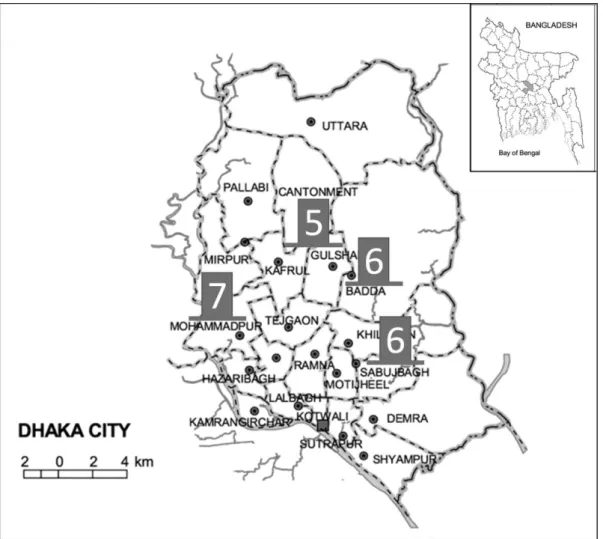
Figure 1-1 Overview of research questions for transformative service system model for healthcare services access in a limited resource context. ... 5 Figure 1-2 Structure of the study ... 8 Figure 2-1 A modified integrated knowledge management cycle (Adopted from Dalkir, 2005). ... 26 Figure 3-1 Study areas (Shasthya Sebika side). ... 40 Figure 3-2 Shasthya Karmis’ are attending in a meeting with regional manager at office.
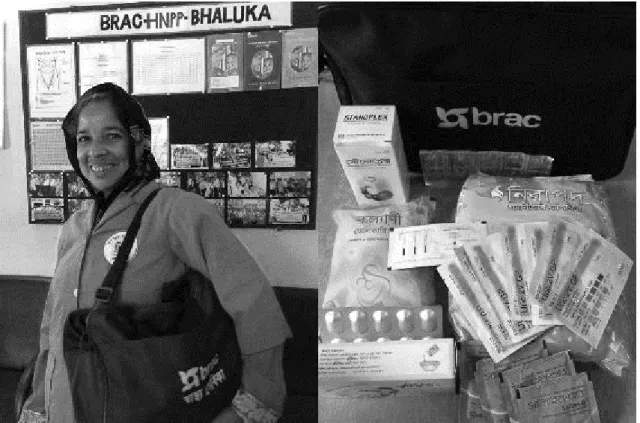
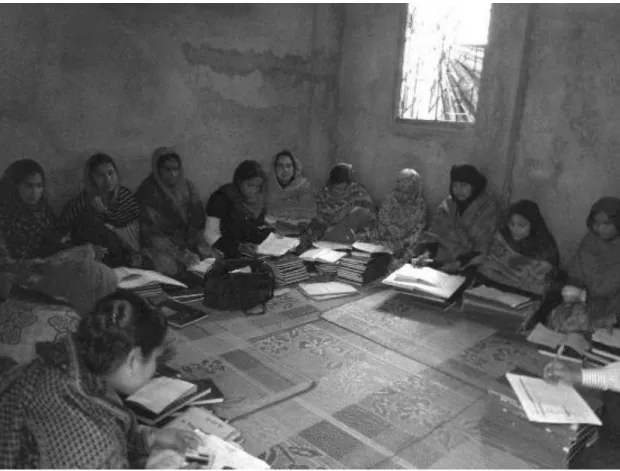
... 45 Figure 3-3 Study areas (Shasthya Karmi’s side). ... 46 Figure 4-1 Shasthya Sebikas selection procedure in BRAC healthcare service system (Source: Authors’ interview). ... 53 Figure 4-2 Shasthy Sebika (left), medicines and health commodities inside the Shasthya Sebikas’ carrier bag (right), (source: Authors’ interview). ... 54 Figure 4-3 Shasthya Sebikas’ are in refreshers training at regional office (source:
Authors’ interview). ... 55 Figure 4-4 Shasthya Sebika in BRAC healthcare service system (source: Authors’
interview). ... 56 Figure 4-5 Result of co-occurrence network analysis from Shasthya Sebika interviews.
... 65 Figure 5-1 Result of co-occurrence network analysis of Shasthya Karmi. ... 77 Figure 5-2 Healthcare Knowledge Transfer model. ... 79 Figure 6-1 Transformative service system model for healthcare services access in a limited resource context... 85 Figure 6-2 Comparison matrix based on ‘Development of Human Resource for Health’
and ‘Technology Intervention for Healthcare Service’ among healthcare services
models. ... 102
xii
List of Tables
Table 2-1 provides a list of latest definitions of service system. (Source: Adapted from
Barile and Polese, 2010). ... 11
Table 2-2 Examples of service systems with input resources, transformation and transformative outcomes. Source: Adopted from Fromm and Cardoso (2015, modified). ... 16
Table 3-1 Demographic and healthcare workforce statistics in grater Mymensingh District. ... 35
Table 3-2 Demographic statistics of major slum areas in Bangladesh. ... 36
Table 3-3 Part 3: Contents of healthcare service delivery in the limited resource context ... 42
Table 3-4 Work motivation and well-being outcomes ... 47
Table 4-1 Demographic analysis of Shasthya Sebikas. ... 57
Table 4-2 Factors affecting to retain human resource for healthcare in BRAC HNPP... 59
Table 4-3 Types of motivation and corresponding comments from Shasthya Sebika interviews. ... 61
Table 4-4 Descriptive statistics of Shasthya Sebika interview result. ... 66
Table 5-1 Demographic analysis of Shasthya Karmis’. ... 70
Table 5-2 Descriptive statistics of Shasthya Karmi interview result. ... 78
Table 6-1 CHMI Categorizations of innovations; Source: adopted from (Krubiner et al., 2016). ... 88
Table 6-2 Search criteria to find mHealth models in developing countries was as follows. ... 89
Table 6-3 Different types of mHealth services focused on maternal, newborn and child health. ... 90
Table 6-4 Co-ops, mission and resource integration including strategic partnership of healthcare models. ... 97
Table 6-5 Healthcare services models and practices adopted by non-profit organizations. ... 101
1
Chapter 1 Introduction
1.1 Background
Better healthcare service is not only a key element of human happiness and Quality of Life (QoL), but also determinants of changing people’s lives (Sweeney et al., 2015).
Therefore, a well-functioning healthcare service system is needed. Such a system requires a well-trained and adequately-paid workforce, well-maintained health facilities and technological support for delivering healthcare services at the point of time when the patient needs them. Therefore, attention should pay to healthcare services are needed in all countries around the globe.
Healthcare in developing countries in particular faces a number of challenges, including critical shortage of healthcare workforce, insufficient healthcare infrastructure, and low income per capita. The World Health Organization estimated that 4 million more health workers were needed in 2012 to resolve the shortage and that most of the shortages were in developing countries, resulting in higher mortality rates for mothers and children (World Health Organization, 2006). Sustainable development goal 3, which was recently announced by the United Nations (United Nations, 2015), aims “to ensure healthy lives and promote well-being for all at all ages”. Such goals are difficult to achieve due to the shortage of health workers. Therefore, developing countries with limited resources need to redesign their healthcare services system in order to address the human resource for health challenges.
Knowledge has been recognized as a unique source and key elements of
2
sustainable economic development and improvement of human well-being over the last decade (Nonaka and Takeuchi, 1995; World Bank, 1998). However, in most of developing countries, the unequal distribution of healthcare knowledge, which leads to unequal economic growth and health well-being (World Health Organization, 2004). To improve the situation of poor healthcare knowledge distribution, its services system should be considered to understand significantly what knowledge, how and who are providing to customers in a pluralistic environment.
With the rapid changes of technological innovation since late 20th century, there has been tremendous improvement of healthcare services delivery systems in the world.
This technological revolutionary change has been adopted and intervene in the worldwide.
Therefore, the technology giving the opportunity to well-function the healthcare delivery service systems in order to improve human quality of life and well-being. These technological innovations facilitating the access to healthcare services in multiple ways.
For example, technological intervention helping to deliver quality and point of healthcare services to those who are far from healthcare service areas, in remote areas, and among difficult to reach. In addition, this technology based healthcare service approach can become more accessible to service recipients by reducing time and cost of travel (Nadim et al., 2010). Among other technological innovations in healthcare, mobile phone technologies are being developed, used, and intervene with human resource for health (Braun et al., 2013). Healthcare services delivery through mobile phone is called mHealth.
Multiple mHealth intervention strategies have been applied for improving healthcare services and outcomes worldwide. In a review study (Klasnja and Pratt, 2012) identified five key intervention strategies and these are 1) tracking health information, 2) involving the healthcare team, 3) leveraging social influence, 4) increasing the accessibility of health information, and 5) utilizing entertainment. These strategies are actively providing healthcare services based on patients need and demands.
Implications of mHealth service provision to provide healthcare services in developing countries could be thought as the better way of alternative healthcare services (Motamarri et al., 2012). It has become most prominent way of health service delivery tool in a cost effective way in developing countries as they are integrating mobile phone with healthcare service delivery system (Istepanian and Lacal, 2003). In addition, mhealth services have identifies as an interactive and personalized healthcare service which aim
3
to provide universal access to healthcare services to any users at any time at any place (Akter et al., 2013). Therefore, the availability of mHealth services changing the healthcare service delivery pattern by reducing time, cost and proximity (Sukkird and Shirahada, 2015).
Most of existing mHealth services model were developed for direct customers’
benefits. For example, the Arua district in Uganda, a project named “the text to change”
have been implemented for its rural residence. The aim of the project was to increase the opportunity to acquire information on HIV/AIDS, collect data about it, and promote HIV/AIDS counselling and testing among residents in the district (Chib et al., 2013).
Similar campaign has been found in other developing countries such as “pregnancy care advice by SMS”, and “mobile phone health services” implemented by the directorate general of health service (DGHS) under the ministry of health and welfares of Bangladesh (World Health Organization, 2011a). However, previous studies have never tried to clarify how mobile-based healthcare knowledge transfer could contribute to improve access to healthcare services and well-being.
1.2 Statement of the problem
From the background of the study, we came to know that, healthcare sector in developing countries are facing many challenges including severe shortage of human resource for health, insufficient healthcare infrastructure, lack of healthcare competencies among service providers, and low income per capita. In addition, challenges from the patients’ sides such as socio-demographic factors including women’s education, lack of knowledge on basic healthcare management, and lack of knowledge on family planning are also great barriers to provide quality healthcare services. Due to these limitations, primary healthcare services are affecting to achieve the goals set by United Nations and countries itself. More particularly, the sustainable development goal (SDG) 3 has recently been announced by United Nations in 2015 (United Nations, 2015), which aim “to ensure
4
healthy lives and promote well-being for all at all stages”. These goals would be difficult to achieve due to these challenges facing in developing countries.
Healthcare sector facing the treat of new technology adoption and produce new services due to lack of technological skill. To address these challenges, healthcare service delivery system need to consider innovative solution to create efficient and affordable service. Managing and transferring the knowledge of service provider to recipients in order to improve quality of life can address these challenges to offer as innovative solution.
We believe that by identifying motivational factors affecting to retain human resource for health can be affording to provide healthcare services to unreached and unserved patients.
Retaining human resource for health and healthcare knowledge transfer from technology aspect could lead to bring transformative outcomes of improving healthcare service access and well-being. Combining these two concepts, we frame the problem from theoretical view of transformative service research and applying knowledge management (knowledge transfer) can lead to toward a transformative service system which tend to improve healthcare services access as well as well-being in a limited resource context.
1.3 Research objectives and research questions
Based on the challenges of severe shortage of human resource for health and lack of competencies among human resource for health, there is need to identify and develop transformative healthcare service system model to improve access to healthcare service delivery and well-being through providing an innovative solution in a limited resource context.
The first objective is to identify factors affecting to retain human resource for health in healthcare services in a limited resource context. The second objective is to identify factors affecting to transfer healthcare knowledge, and to find how healthcare knowledge transfer facilitate access to healthcare services and well-being as transformative value in a limited resource context. The concept of transformative service
5
research (TSR) and process of knowledge transfer in knowledge management cycle are applied to develop a healthcare knowledge transfer model in a limited resource context.
The third objective is to develop a model for transformative healthcare service system in a limited resource context.
Figure 1-1 Overview of research questions for transformative service system model for healthcare services access in a limited resource context.
Major Research Question (MRQ):
How to model a transformative service system for healthcare services access in a limited resource context?
Subsidiary Research Question (SRQ):
SRQ 1: What are the key factors affecting to retain human resource for healthcare services in a limited resource context?
SRQ 2: What are the key factors affecting to transfer healthcare knowledge in a limited resource context?
SRQ 3: How does transformative action improve healthcare services access and well- being in a limited resource context?
6
1.4 Significance of the study
The problems of healthcare services in a limited resource context are associated with lack of access to healthcare services in rural and urban slum areas, lack of healthcare knowledge among healthcare service providers as well as among recipients, and quick changes of the technology uses in healthcare service provisions. Knowledge transfer in healthcare service provision can identify appropriate healthcare knowledge what patient community want and ensure accessible services and improve well-being by transferring healthcare knowledge among rural and slum residence.
Through exploratory and qualitative in nature, the present study has revealed that healthcare organization motivates its health workers in its program and improves its service quality by providing healthcare knowledge transfer through an effective knowledge transfer system which designed to improve the quality of life in rural and slum areas. The healthcare organizations provide healthcare knowledge to health workers through training and workshops that useful for rural and slum residence. The collective well-being has improved by making awareness, perceived usefulness and apply this knowledge to rural and slum residence.
The proposed healthcare knowledge transfer framework and model for access to healthcare services in a limited resource context in healthcare service provision will bring certain benefits and lead to provide quality, effective and affordable healthcare services to rural and slum areas. Healthcare service practitioner and policy makers may become aware about key factors to retain health workers in healthcare service system and healthcare knowledge transfer based on technology in the healthcare service provision under limited resource context. A model toward access to healthcare service system in a limited resource context is a major feature of the present study break the new ground where relatively have paucity of research.
The present research could help both academic, practitioners and policymakers to advance and understanding the relationship between human resource for health, technological uses in healthcare service provision and well-being outcomes in healthcare services. Therefore, the present study is of significance to healthcare services under
7
limited resources for improving access to healthcare services, reducing healthcare knowledge gap and improving well-being in the rural and slum areas.
1.5 Structure of the study
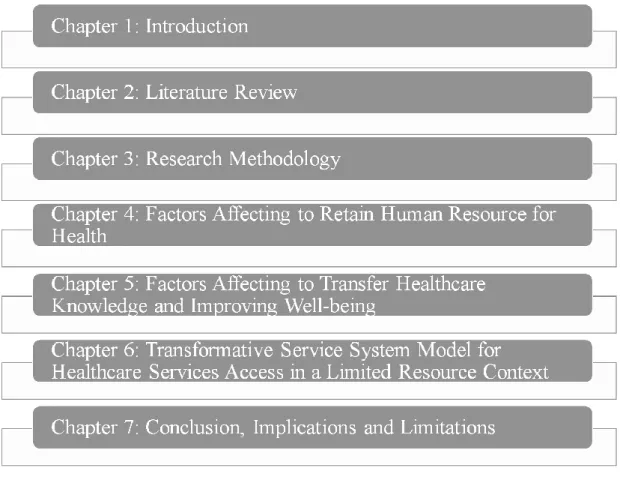
The dissertation is structured into Seven chapters which are ‘Background Introduction’, ‘Literature Review’, ‘Research Methodology’, ‘Factors affecting to retain human resource for health in a limited resource context’, Factors affection to transfer healthcare knowledge and improving well-being in a limited resource context’,
‘Transformative healthcare service system model’ and ‘Conclusion, Implications and Limitations’ as shown in figure 1-2. A brief explanation of each chapter is providing in the following sections.
‘Chapter 1: Background and Introduction’ is the introductory chapter contains the research background of healthcare services and challenges regarding the shortage of human resource for health in developing countries. It discusses about healthcare knowledge transfer, mHealth and improving well-being. The chapter also consists of research problem, research objectives and questions, and a general idea of the dissertation.
‘Chapter 2: Literature review’ introduces the literature with wide range of contents about the service, service system, concept of transformative service research, human resource management, knowledge management, knowledge transfer, technology based healthcare services and knowledge transfer and challenges.
‘Chapter 3: Research Methodology’ is about research methods used in each study conducted and enclosed in the dissertation.
‘Chapter 4: Factors affecting to retain human resource for health in a limited resource context’ is the first study identifies factor which facilitate to retain human resource for health in a limited resource context. His chapter sheds light on many important topics including about BRAC and BRAC healthcare service system, BRAC health workers ‘Shasthya Sebika’ and finally presented findings on how BRAC able to
8
retain human resource for health in the healthcare services system.
‘Chapter 5: Factors affecting healthcare knowledge transfer and improving well- being in a limited resource context’ is the second study identifies factors affecting healthcare knowledge transfer, and to find how healthcare knowledge transfer facilitate access to healthcare services and well-being as transformative value in a limited resource context. The study sheds light on healthcare knowledge transfer through mobile technology and well-being as transformative value. The chapter also consists a healthcare knowledge transfer model in a limited resource context.
‘Chapter 6: Transformative healthcare service system model’ aims to propose transformative healthcare service system model in a limited resource context.
‘Chapter 7: Conclusions, Implications and Limitations’ includes answer for research questions, implications and limitation of the study.
Figure 1-2 Structure of the study
9
Chapter 2 Literature Review
The aim of this chapter is to find out the research gaps from existing literature and make a position of the present study in the context from the perspectives of service system, human resource management, and knowledge transfer.
2.1 Service system perspective
2.1.1 The concept of service system
The term ‘service’ was first used in the 1930s, which arose from the US Department of Commerce’s Standard Industrial Classification to indicate the domestic economic activities (Fisk et al., 2013). Service defines by the American Marketing Association, Committee of Definitions (1960, p. 21) as “activities, benefits and satisfactions, which are offered for sale or are provided in connection with the sale goods”.
This definition shows the basic characteristics services; such as Intangibility, Heterogeneity, Inseparability, Perishability.
However, there is a need to see a service from the perspective of system. This is because service includes the process that providers and recipients interact, offer benefits and create values for each other by using people’s knowledge and skills (Vargo and Lusch,
10
2004). Grönroos (2008, p. 300) also stated service as, “a process that consists of a set of activities which take place in interactions between a customer and people, goods and other physical resources, systems and/or infrastructures representing the service provider and possibly involving other customers, which aims at assisting the customer’s everyday practices”. Consider an example of dental clinic service where service package includes interaction between dentist and patients, existing goods and physical resources (dental instrument, nurses or health assistant and clinic room where the service take place) and doctors skill which satisfy the patient being cured. In this perspective, services are not constant itself. It should change based on time, place and people’s performance.
According to above definitions, service can be thought as a process, having interaction between two parties, both parties will have benefited by using their skill and competencies, thereby doing their best performance in a competitive environment and provide superior value to service recipients.
Service system is a system which describes how services can be delivered to customers who wish to get it. Cardoso et al., (2015, p. 12) identified “a service system consists of elements (e.g., people, facilities, tools, and computer programs) that have a structure (i.e., an organization), a behavior (possibly described as a process), and a purpose.” In the modern service science, the understanding of service system is developed based on the principles of value co-creation. Maglio and Spohrer (2008, p. 18) stated that,
“a service system as a dynamic value co-creation configuration of resources, including people, organizations, shared information (language, laws, measures, methods), and technology, all connected internally and externally to other service systems by value propositions”. It indicates an integrated process with people, organizations, resources and technology which facilitates value co-creation that have dominated in developed economies. The definition of service systems is provided in the table 2-1.
Some of service systems are transformative by design and some of are potentially (Reynoso et al., 2015). Because, Reynoso et al., (2015) reported that transformative services create and promote social relationships and networks aiming to improve well- being among people, groups and communities. Therefore, it is important to address well- being related to healthcare service providers in a limited resource context. The focus on well-being of communities of healthcare service system has been gaining importance in the field of transformative service system. Transformative service system promoting
11
human well-being among individual and collectives. The concept and nature of transformative service system described in the next section.
Table 2-1 provides a list of latest definitions of service system. (Source: Adapted from Barile and Polese, 2010).
Definitions of Service System Authors Year
Service systems represent value co-creation configuration of people, technology, value prepositions connecting internal and external service systems, and shared information (e.g., language, laws, measures, and methods), like an assemblage of unites entities by some form of regular interaction or interdependence.
Spohrer, Maglio, bailey
and Gruhl 2007
Service Systems can simply be a software application, or a business unit with an organization, from a project team, a business
department, a global division; it can be a firm, institution, government agency, town, city or nation; it can also be a composition of numerous collaboratively connected service systems within and/or across organizations.
Qui, Fang, Shen and Yu 2007
Service systems act as resource integrators, understandable in terms of elements of a work system, within the organization and through the network enduring resource specialization, those operands and
operant, such as knowledge, skill, know-how, relationship, competences, people, products, money, etc.
Spohrer, Anderson,
Pass and Ager 2008
Every service system is both a provider and client of service that is connected by value prepositions in value chains, value networks, or value creating systems.
Vargo, Maglio and
Akaka 2008
A service system is any number of elements, interconnections,
attributes, and stakeholders interacting in a co-productive relationship that create value, in which principle interactions take place at the interface between the provider and the customer.
Spohrer, Vargo, Maglio
and Caswell 2008
12
Table 2-1 Continued
2.1.2 Defining the concept of well-being
The research interest on Well-being has been growing in recent decades among scholars (Bradley, 2015; Diener et al., 1999; Kahneman et al., 2003; King et al., 2014;
Ryan and Deci, 2001). Therefore, many scholars have attempted to define the well-being from various perspectives. It has been well recognized that the well-being is a multidimensional concept and consisting in what people do such as having a good job, expressing their political voice, or having freedom to choose (Stiglitz et al., 2010; Sukkird, 2016).
Definitions of Service System Authors Year
A service system primarily relates to customer-provider interactions as well as open system with it being capable of improving its own state and the one of another system though acquiring, sharing, or applying resources, with the aim of creating a basis for systematic service innovation.
Golinelli 2008
Service systems are a complex interplay between from and customer that form an open system which needs to be designed using the techniques of viable systems and systems dynamics, in which both parties are focused on achieving outcomes.
Ng and Maull 2008
Service system can be divided into "front stage" (about
provider/customer interactions) and "back stage" (about operational efficiency) and service performance relies on both of them, putting people (customers and employees), rather than physical goods, in the center of its organizational structure and operations. The smallest service system is a single person; the largest one is represented by the global economy. A service system essentially is a social-technical system, focusing on engineering and delivering services using all available means to realize respective values for both provider and customer.
Qiu 2009
Service systems can be represented as real networks, in which the same entities combine their strengths through direct and indirect connectivity, as they are oriented toward enduring competitiveness and daily interactions with other external interdependent service system.
Polese 2009
13
Bradley (2015) discussed about the subject of well-being in his prominent book named “well-being” and concluded that the concept of well-being usually focusses on human well-being. The definition of human well-being is not clear though there have been abundant literatures mentioning the most of its characteristics (McGillivray, 2006).
However, human well-being is a concept which refers to peoples positive attitude being satisfy in their life having “intellectual origin in philosophy, psychology, economics, political science and other discipline” (Hall et al., 2013, p.13). Therefore, the terms of quality of life, well-living, welfare, life satisfaction, living standard, etc. could be used to understand well-being in specific phenomenon and context (McGillivray & Clarke, 2006).
Since the concept of human well-being is abstract, it cannot be measured accordingly. It could be conceptualized which has been transformed time to time. It also can be shifted from one aspect to another; such as economics to non-economics. Thereby, there is no acceptable definition of human well-being (Diener et al., 1999, 1999; King et al., 2014). Indeed, “well-being is intangible, difficult to define and even harder to measure”
(Thomas, 2009, p.11). However, the concept of well-being has broadly defined, “the objective components of well-being include many material and social attributes of people’s life circumstances such as physical resources, employment and income, education, health, and housing. In contrast the subjective components of well-being are represented as individual’s thoughts and feelings about one’s life and circumstances, and the level of satisfaction with specific dimensions” (King et al., 2014, p.683).
Shed light on above position, it can be conceptualized that the human well-being is a broad concept that can be measured from multiple dimensions. Health is one of them which refers to actual physical health of individual (Judge et al., 2010). The World Health Organization defines health is “a state of complete physical, mental, and social well-being and not merely the absence of disease or infirmity” (World Health Organization). Thereby the level of individual’s well-being can be affected by the status of individual’s health.
For example, peoples living with diseases doesn’t enjoy the full of well-being. In contrast, people living with diseases free can enjoy the well-being. In this present study, the total well-being of rural and slum residence accounted their positive changes in health condition through the improvement of healthcare service accessibility; changes from
‘lack of access’ to ‘access’ and changes from worst condition to better condition.
14
2.1.3 Transformative service system for well-being
Ostrom et al., 2015 indicate the future service research priorities in the service field. According to that, service scholars will advance the field’s borders by making best contributions to practice, theory and societal well-being within the new technology- enabled, interconnected, and global context.
Improving human well-being is a big challenge for service providers (Rosenbaum and Smallwood, 2011), which has given rise to a new research field known as transformative service research (TSR). TSR is a research domain that seeks the relationship between service and well-being. TSR represents research agenda that focuses on creating uplifting changes and improvements in the well-being of consumer entities, individuals and eco-system (Anderson et al., 2013). The authors provide a framework for service research priorities where transformative service research agenda took place in the strategic research priority pane as improving well-being through TSR. Given the priority on TSR, scholars have identified wider space of future research focusing on the quality of service provision and the ways to improve both individual and collective well-being (Anderson et al., 2013; Rosenbaum & Smallwood, 2011).
TSR is a way to explore services as a driver of societal change to advance well- being for both individuals and collectives (e.g., families and communities); and, enhancing access to critical services (e.g., health care and education) and bring transformative outcomes for both (consumers and providers). Examples of service system with input resources, transformation and transformative outcomes provided in the table 2-2. In the context of TSR, attempts to understand well-being across different service phenomena including financial (Martin and Hill, 2015; Winterich and Nenkov, 2015), healthcare (Spanjol et al., 2015; Sweeney et al., 2015; Yao et al., 2015; Zayer et al., 2015), religion (Blocker and Barrios, 2015), multiple industries (Mirabito and Berry, 2015) and politics/government (Skålén et al., 2015) services have highlighted the system, community, organization and individual well-being outcomes. These researches facilitates our understanding the wide range of services phenomena including negative service and the relationship with well-being, the role of collectives in affecting well-being and consumer activities in service delivery which affects their well-being directly
15 (Anderson and Ostrom, 2015).
There have been studies on saving and financial satisfaction improving consumer’s well-being in a limited resource context (Martin and Hill, 2015). The study discovered that the saving improves individual well-being even under conditions of higher poverty. As societal poverty increases, the positive effect of saving on well-being increases. Regarding the financial well-being, Gao et al. (Guo et al., 2013) examined how consumers can engage in behavioral change counselling service in order to enhance well- being. The study revealed that consumer’s participation in service production, delivery and development could lead to socialize consumers and improve their own well-being and also result in higher satisfaction (Guo et al., 2013). Therefore, consumer’s participation is important to achieve the goal of improving well-being. One of the core areas of transformative service research is healthcare service. Research on health well- being has getting priorities among academic and policy makers (McColl-Kennedy et al., 2012).
16
Table 2-2 Examples of service systems with input resources, transformation and
transformative outcomes. Source: Adopted from Fromm and Cardoso (2015, modified).
2.1.4 Transformative service system in healthcare services
Transformative value has defined as a social dimension of value creation that generates individual and collective well-being (Blocker and Barrios, 2015). For instance, healthcare service research is considered as one of the emerging field of TSR where
Name of service Provider's resources Customer's resources Transformation Transformative
Hairdressing Service
Facilities (shop, chair, mirror), tools (scissors, combs, brushes), materials (shampoo, conditioners, colorant), competencies (skilled in hairdressing), hairdresser.
Customer him or herself.
Changes in hairstyle.
customer's Well- being
Car Service
Facilities (garage, lifting ramp), tools (wrench, hammer, screw, driver), materials (spare parts, oil), competencies (skilled and educated in in car repairing), mechanic.
Customer's car Changes car in good condition
Car owner's well- being
Healthcare Service
Facilities (hospital, operating rooms) Instruments
(stethoscope, syringe) Materials (medicaments, plasters, dressings,
disinfectants) Doctors, nurses, paramedics, administration
Customer (patient) him- or herself
Changes in health condition
Patients well- being
Electronic Service (e.g., stock report)
Computing infrastructure with internet connectivity (web server) Software application (web application) (No human resources)
Customer him- or herself Internet access device (personal computer, smartphone)
Change in level of information
Well-being of internet users
Education Service
Facilities
(school/college/university, classrooms) Instruments (chair, table, digital board,
multimedia) Materials (books, articles, lecture handouts) Teachers, staffs
Customer (students) him or herself
Getting education and gain skills &
competencies
Well-being of students
17
service provider and recipients can contribute individual and collective well-being through a process. Sweeny, Danaher, and McColl Kennedy (Sweeney et al., 2015) argue that, customer effort in value co-creation activities have a direct impact on satisfaction with the expecting service which improves quality of life. The authors analyzed patient activities across chronically ills such as cancer, heart disease, and diabetes disease settings.
The study findings show that patients activities within and outside the clinics are enhances individual quality of life.
Transformative value could generate from and in human and technology mediated healthcare services. For example, transformative value in healthcare have found in rural communities of Alaska in the United States of America (Charlesworth et al., 2016).
Government and nonprofit healthcare organizations providing ‘customer driven’
healthcare services through community health aids and community health practitioners (Golnick et al., 2012), health information technology (Lee et al., 2013), and NUKA system of care. Nuka system of care has been developed Southcentral Foundation at Alaska in the USA. The word NUKA is an Alaska Native word used for strong, giant structures and living things. The Nuka system of care is built upon three simple beliefs:
customer ownership, relationships, and whole system transformation. The mission of Nuka care system is to work together with the Native Community to achieve wellness through health and related services (Gottlieb, 2013). All these innovative approaches increased access to primary healthcare service delivery from 35% to 95%, reduced the number of individuals on behavioral health wait list from about 1300 to nearly zero in a year, and increased 25% of childhood immunizations. All of these transformative value improves collective well-being among Alaska native peoples (Gottlieb, 2013).
In other healthcare related studies, Yao, Zheng, and Fan (Yao et al., 2015) investigated well-being output through online social support which is important rout to improve stigmatized patients’ (hepatitis) healthcare conditions and generates hepatitis patients’ well-being. Similar study has investigated the role of social support perception and emotional well-being on online information seeking among breast cancer patients and found positive outcomes of emotional well-being (Kim et al., 2013).
Prior studies have investigated the effort of customer value co-creation activities, online social support, and health information technology effort on individual well-being outcomes such as improving individual quality of life. The most important issues on
18
enhancing access to critical services has been overlooked under the umbrella of TSR (Ostrom et al., 2015) Therefore, it is requiring to pay attention to investigate the most pressing issue on improving access to healthcare services in the limited resource context.
In particular, co-creation action in terms of knowledge and human resource in healthcare service is more important for improving well-being in developing countries with limited resources. Transformative service research about healthcare are insufficient in limited resource context in terms of knowledge and human resource to do a co-creation for making transformative value.
Peoples living in rural areas in developing countries where access to healthcare services are difficult due to limited resources. Considering the limited healthcare resources, the most effective support comes from volunteer health workers and improve health well-being among rural peoples affecting HIV/AIDS (Campbell et al., 2008). This volunteer service may facilitate access to healthcare services for HIV/AIDS patients and improve well-being among them.
In recent years, online social support has emerged in healthcare communities. Yao et al. (Yao et al., 2015) examined the detail effects of four categories of online social support on physical, psychological, and existential quality of life. The study findings show that the impact of emotional support on psychological quality of life is most effective. It means, the impact of emotional support from online supporter facilitates to improve psychological well-being. However, these previous researches have argued that providing overall effective support through volunteer health workers and emotional social support from online supporter may contributes improving disease specific and psychological well-being as healthcare outcomes. But, only limited studies tried to shed light on how healthcare knowledge transfer contributes to improve healthcare well-being of rural and slum residence in a limited resource context.
The problem in a limited resource context is to access healthcare services when patients need. Therefore, understanding the co-creation action in terms of knowledge and human resource in healthcare service which makes easy access to healthcare services as transformative value for the unreached and underserved peoples over other healthcare facilities is needed.
19
2.2 Human resource management perspective
2.2.1 Human resource management and organizational outcomes
Empirical evidence confirmed that why and how human resource management (HRM) ensure organizational outcomes through the effective use of human resource (HR) practices. Conventional HRM research has focused on the impact of HR practices on individual and organizational performance. Research has demonstrated that HR practices and, interpersonal and system trust lead to employee satisfaction, organizational commitment, and organizational performance (Gould-Williams, 2003). In an effort to clarify the relationship between HR management and organizational performance, several studies have explored multiple mediating paths and differentiated the effects of three dimensions of a HR system (skill-enhancing HR practices, motivation-enhancing HR practices, and opportunity-enhancing HR practices) on organizational performance (Jiang et al., 2012). In addition, industry capital intensity, growth, and differentiation have been found to affect the impact of HR systems on productivity (Datta et al., 2005).
These studies have shown that, the more that HR practices are in place, the more HR management outcomes are standardized, which significantly affects performance (Teclemichael Tessema and Soeters, 2006). Above these studies are conducted from the organizational perspective. Although several studies are extended the scope and examined the effects of HR management and HR practices at the organizational level in developed countries where tangible and intangible economic and infrastructural resources are available. Unconsciously the relationship between HR management and organizational outcomes in developing countries in a limited resource context are remained unexamined.
Therefore, the main focus of this study is HR management in a limited resource context where tangible and intangible economic and infrastructural resources are limited.
Firms and organizations operating in a limited resource context often pay low wages as a means to reduce costs and do not realize the need for HR development (Budhwar and Debrah, 2006). Therefore, the healthcare sector, and hospitals, in a limited
20
resource context are experiencing a shortage of skilled health workers. Despite the strong evidence for positive outcomes for HR management through the effective use of human resources in hospital settings, important issues were remained regarding the challenges to HR management and creating skilled workers in the healthcare sector (Cooke and Bartram, 2015).
Some researchers are argued for a link between HR management and patient mortality. West et al., (2002) revealed a strong relationship between HR practices and patient mortality in a hospital setting. They suggested that extensive training and appraisal systems and teamwork motivation may significantly affect hospital performance. In line with these findings, the behavioral aspect of HR management practices is positively related to levels of employee engagement, and engagement has been shown to mediate the link between motivation and self-reported individual performance (Alfes et al., 2013).
Moreover, HR practices such as training and development, occupational health and safety, and HR planning facilitate effective participation and engagement in the organization (Cavanagh et al., 2013). In contrast, creating sustainable employment opportunities for the unemployed in healthcare services and HR management in the healthcare sector is a big challenge. Given the importance on these challenges, several strategic approaches have been proposed such as employer engagement in skill development (McBride and Mustchin, 2013) and creation of an appropriate system for education having national and organizational levels (Cooke and Bartram, 2015).
2.2.2 Work motivation and healthcare services
Human resources play an important role in changing work practices in healthcare organizations. In a recent study McBride and Mustchin (2013) demonstrated that, “lack of capacity in terms of time and resources was a key factor that limited the development of an expanded role for HR that would have allowed them to be central actors in regulating changing work practices”. This means that management needs to increase capacity and improve capabilities if it wants to add value to service provision. Although there is a big debate in the literature regarding employees’ perception of the value added by HR
21
management to service provision. A recent study revealed a positive relationship between the management competencies of the employees’ HR staff and their perception of the value added, though the perception is mediated by the perceived quality and nonmonetary costs of HR management services (Meijerink et al., 2016).
In line with the literature, the study focuses on the role of employee motivation.
On the one hand, as previous research has suggested, three domains (skill, motivation, and opportunity) should lift up emotional performance, which affects customer service (Gabriel et al., 2016). Gabriel et al., (2016) posited that, “motivation-enhancing HR practices are more critical in jobs where a strong link exists between emotional performance and financial reward”. In addition, key observations of the ‘black box’ of an HR system showed that a strong following by hospital personnel of their supervisors’
motivational efforts positively affects performance (Boxall et al., 2011). On the other hand, research has empirically determined the role of non-financial incentives in motivation and found that they have a positive effect on the motivation of healthcare professionals (Mathauer and Imhoff, 2006).
HR management in a service-based organization needs to create a workplace that facilitates employee retention and promoted the provision of high quality services. A recent study suggested that, it is necessary to first develop an attractive workplace environment in order to meet the personal and organizational goals of healthcare professionals (Mathauer and Imhoff, 2006). A further study conducted in a hospital setting in a different region obtained evidence confirming that workplace empowerment creates a work environment that fosters professional nursing practice and promotes job satisfaction, which encourages nurses to remain and provide safe, high-quality health care in hospital (Laschinger et al., 2003). Therefore, motivation is important for HR practices.
Ryan and Deci (2000) has distinguished the different types of motivation based on the goals that motivate one’s to go for an action. These are intrinsic and extrinsic motivation. Intrinsic motivation is defined “as the doing of an activity for its inherent satisfactions rather than for some separable consequence” (Ryan and Deci, 2000, p.56).
Intrinsic motivation is a kind of motivation which allow person to learn and explore, and usually do not require extra incentives to do so. Because, intrinsic motivation motivates peoples to accumulate knowledge and skill. Extrinsic motivation which mainly refers to activities that is driven by external rewards such as money, reputation, grades, and praise.
22
Extrinsic motivation arises from outside the individual, as opposite to intrinsic motivation, which originates inside of the individual.
However, there have been few studies on the link between HR and motivation in healthcare service delivery in a limited resource context. This study addressed this shortfall by conducting two empirical studies enclosed in chapter 3 and chapter 4.
2.3 Knowledge management perspective
2.3.1 The nature of healthcare knowledge
Information and Knowledge is very closed to each other. Information is the pre- form of knowledge. According to Bose (2003), “well-managed information that is properly cataloged and structured, available and accessible by the right people and processes at the right time becomes knowledge”. Knowledge cannot create itself, it created by human interaction. Nonaka et al. (1994) reported in their work that the knowledge can be classified into two types; explicit and tacit knowledge. Explicit knowledge can express in words and communicated in linguistics. On the other hand, tacit knowledge is difficult or cannot be express in words and communicated through human interaction. It means, tacit knowledge is difficult to capture, it can realize more which supports Polanyi’s (1967) argument that “we can know more that we can tell”.
From above arguments, healthcare knowledge can be classified as explicit and tacit (Cheah and Abidi, 2001). The explicit healthcare knowledge is included knowledge that acquired from evidence-based medical literature, reviews, healthcare training and workshops, case studies and clinical practices. On the other hand, tacit healthcare knowledge is including knowledge that acquired from healthcare experts’ skill, clinical experience, judgement and intuition.
Clinical decision-making is a complex task and depends on the healthcare
23
knowledge and skills of healthcare service providers. Abidi (2008) has identified a variety of healthcare knowledge that directly contribute to clinical decision-making and care planning. These are including patient knowledge, practitioner knowledge, medical knowledge, resource knowledge, process knowledge, organizational knowledge, relationship knowledge, and measurement knowledge. However, it must be recognized by service providers in order to secure the longer-term of well-being of rural and slum residence in a limited resource context.
In line with the discussion of above literatures, the nature and characteristics of healthcare knowledge in the context of present study can be summarized as follows-
Healthcare service recipient’s knowledge: Patient’s knowledge refers to the health condition of the patient that healthcare service provider can understand what kind of disease or complexities are associated with his/her health. Patient’s knowledge drawn by healthcare service provider and documented in the register book as well as recorded in the medical record in order to get a complete picture of a patient.
Healthcare service provider’s knowledge: Tacit healthcare knowledge gain through practices and exercised while providing healthcare services to its recipients.
Healthcare service provider’s knowledge is acquired through training, workshops, observations and experiences.
Medical knowledge: Medical knowledge is the main knowledge domain of healthcare service delivery and treatment. In the context of present study, this area of knowledge is including prenatal and postnatal care, child nutrition, identify tuberculosis and basic healthcare management.
Resource knowledge: Resource knowledge indicates knowledge about existing resources in the healthcare service setting. Healthcare service providers should have up- to-date knowledge about healthcare resources that they can decide the right path of treatment to be provided (Abidi, 2008). These areas of knowledge are including medical diagnostic tools, medicine availability, appropriate number of stuffs, and healthcare service infrastructures.
Organizational knowledge: Abidi (2008) reported that the organizational knowledge indicates the knowledge transfers from one source to another and signify the healthcare service team members role in terms of healthcare knowledge flows within the organization.