Japan Advanced Institute of Science and Technology
https://dspace.jaist.ac.jp/
Title 固体触媒を用いるバイオマス由来化合物からのレブリ
ン酸とγ‑バレロラクトンの合成に関する研究
Author(s) Pham, Anh Son Citation
Issue Date 2014‑06
Type Thesis or Dissertation Text version ETD
URL http://hdl.handle.net/10119/12228 Rights
Description Supervisor:海老谷 幸喜, マテリアルサイエンス研究
科, 博士
Syntheses of Levulinic Acid and -Valerolactone from Biomass-derived Compounds Using Heterogeneous Catalysts
Ebitani Laboratory, s0940212, Pham Son Anh
INTRODUCTION
Cellulose Glucose 5-Hydroxyl-
methylfurfural
Levulinic acid
Formic acid
-Valerolactone
Hemicellulose
Hexose sugars Pentose
sugars
Glucose Manose Galactose Xylose
Arabinose Furfural Lignocellulosic
materials
Lignin Acid soluble products
H+ H+
H+
H+
Metal Catalyst
Selected Compounds Scheme 1. Conversion of biomass to levulinic acid and -valerolactone
The depletion of fossil resource reserves and the degradation of the environment stimulate the search for sustainable and renewable resources [1]. Various alternative energy sources have been developed, such as hydroelectric energy, wind power, geothermal energy, solar energy, and so on. Since the application of those energy sources might take longer than they are expected, the development of efficient processes to convert biomass resource into liquid fuels and valuable chemicals is a key research area in the next few decades.
The main purpose of this dissertation is the study on transformation of biomass-derived compounds to levulinic acid (LA) using heterogeneous catalysts as well as upgrading of LA to -valerolactone (GVL) over various supported metal catalysts using formic acid (FA) as the hydrogen donor source. LA and GVL have been identified as platform molecules for the synthesis of various organic chemicals for production of polymers, fuels, additives, organic solvent, etc [2]. Studies of thesis, therefore, focus on:
1. Investigation of the utilization of solid acid catalysts for synthesis of LA from 5-hydroxymethylfurfural (HMF), hexose sugars and other carbohydrates.
2. Preparation of solid base catalysts for isomerization reaction of glucose into fructose and further synthesis of LA from glucose in combination with solid acid catalyst.
3. Development of highly active and reusable supported metal catalysts for production of GVL from biomass- derived compounds.
ACHIEVED RESULTS
The first work describes the conversion of HMF and C6-sugars to LA in aqueous medium under mild reaction conditions. These are most active starting materials for hydration/dehydration reaction to LA. Among tested solid acid catalysts, Amberlyst 15 exhibited the highest performance. Under optimum reaction temperature (120 °C), Amberlyst 15 could convert 96% HMF to LA with 82% yield after 18 h, while Nafion 50 and SBA-SO3H gave lower LA yields (78%
and 63%, respectively). The effect of dehydration reaction conditions of fructose over solid acid catalysts was studied.
Maximum LA yield was 52%. In this reaction, large amount of undesired solid compounds, known as humins, were formed. After filtration to remove solids, LA could be easily isolated by vacuum rotary distillation method giving 47%
isolated yield. Reuse experiments show the slight decrease in activity of Amberlyst 15. After 6 runs, the LA yield decreased from 52 to 30%. These same reaction conditions were applied to hydrolysis and dehydration of other carbohydrate compounds (glucose, mannose, galactose, sucrose, cellobiose, inulin, cellulose). The hydrolysis of dimers or polymers to monosaccharides was quite easily. However, the conversion of glucose to LA at 120 °C took place very slowly and faster when increased reaction temperature to 150 °C. This problem showed that glucose is more stable than fructose in the dehydration reaction to LA and the isomerization of glucose to fructose is necessary for production of LA from glucose with benign conditions.
In the second work, zirconium carbonate (ZrC) as water-tolerant solid base catalyst was prepared by a simple method. XRD, FT-IR, TG and titration methods have been used to determine the characteristics of obtained catalysts.
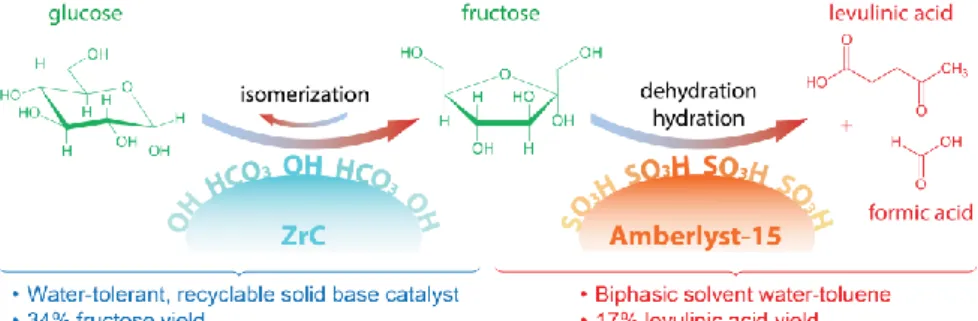
Figure 1. Utilization of both solid base and solid acid catalyst for converting glucose in to levulinic acid in one-pot reaction manner
The results showed that Zr-OH groups play as basic sites, the basic site amount of ZrC could be comparable with those of hydrotalcite and anionic ion-exchanged resin (Amberlyst A26OH). However, ZrC gave the highest performance in the glucose to fructose isomerization reaction with 34% fructose yield (at 45% glucose conversion). Hot filteration method was used to estimate the heterogeneity of catalyst. The recycling experiment showed that ZrC could retain its activity after the reaction, the fructose yield did not decrease significantly for 5 runs. ZrC could work together with acid catalyst for one-pot transformation of glucose to LA. In this reaction, ZrC participated in the isomerization stage to afford fructose from glucose before fructose was dehydrated over solid acid catalyst to give final product, LA. In the presence of ZrC, glucose could be converted to LA more easily even at mild reaction conditions. In the biphasic solvent of water/toluene, the reaction took place faster than in pure water solvent affording 17% LA yield.
Figure 2. Dehydration/hydrogenation of biomass-derived compounds to -valerolactone
The main works of last study were syntheses of GVL from hydrogenation of LA and dehydration/hydrogenation of fructose using FA as hydrogen source. In the first reaction, FA was utilized as hydrogen donor source, while it played two functions in the second reaction: acid catalyst and hydrogen source. At low temperature (120 °C), FA catalyzed the dehydration of fructose to LA before it was decomposed by metal catalysts at higher temperature (150 °C) to provide hydrogen to hydrogenation of LA that was obtained from previous step yielding final product, GVL. The screening metals and supports showed carbon and SBA-15 are the best supporting materials for Ru catalysts in the hydrogenation reaction of LA to GVL. I found that gold catalysts can decompose completely FA to CO2 and H2. They also possess good ability of LA hydrogenation to GVL. Under optimized conditions (FA/LA = 2, 150 °C and 5 h), Au/ZrO2 and Au/ZrC could enhance the hydrogenation of LA resulting 97% GVL yield. Recycling experiments show that Au-supported zirconium compounds have excellent recyclability. Gold metal species is not leached from solid catalysts during the reaction. Au- supported zirconium compounds are acid-tolerant catalysts and can be reused at least 5 times without significant loss of their catalytic activities. In the one-pot manner for production of GVL from fructose, Au catalysts also exhibit the better activity than Ru catalysts. The transformation of fructose by Au catalysts gave 48% GVL yield and recovered catalysts could be reused several times.
GENERAL CONCLUSION
Levulinic acid (LA) and -valerolactone (GVL) have been identified as important platform molecules for synthesis of chemicals, production of liquid fuels, solvents, additives, etc. In this research, LA is obtained by acid- catalyzed processes of HMF and fructose with 82 and 52% yields under optimum reaction conditions in water solvent, respectively. The obtained results also reveal that solid acid catalyst Amberlyst-15 can be recycled several times and is potential candidate for replacing homogeneous catalysts for production of LA.
The new solid base catalysts zirconium carbonate (ZrC) is successfully prepared by simple method. Its catalytic activity is tested in the glucose-fructose isomerization reaction. ZrC is truly solid base catalyst for glucose isomerization
affording 34% fructose yield. It can work in wide range of reaction temperature (80-140 oC) and can be recycled for many times without significant loss of activity. In biphasic solvent, the combination of ZrC with Amberlyst-15 gave 17% LA yield from glucose.
The upgrading of LA to GVL is performed by hydrogenation reaction over supported metal catalysts using formic acid (FA) as alternative hydrogen source. Zirconia-supported gold catalyst (Au/ZrO2) is found to be the excellent catalyst for decomposition and subsequent hydrogenation of LA to GVL with 97% yield. Au/ZrO2 is a highly stable, acid- tolerant catalyst and can be reused at least 5 times without significant loos of its activity. Au/ZrO2 is also the best catalyst for the one-pot transformation of fructose to GVL in water which provides 48% yield of GVL.
PROSPECT OF THIS THESIS
Scheme 2. Potential utilization of both solid acid-base catalysts and supported metal catalysts for production of LA and GVL from lignocellulosic materials.
From results achieved in the present thesis, this author suggests further progresses for upgrading of biomass- derived compounds to higher valuable chemicals as follows.
1. Application of solid acid catalyst for hydrolysis followed by dehydration reaction of lignocellulosic materials to LA at high temperature (150-200 °C). Combination of solid base and solid acid catalysts in an one-pot reaction to synthesis LA. The use of biphasic solvents (water-organic) may facilitate the reaction to occur faster toward the formation of product than in pure water solvent
2. SBA-15 has a potential to be used as support for grafting both of acidic site and basic site on its surface. This type of catalyst can act as duality acid-base catalyst and it is expected to have high efficiency for multiple-step reactions that require both of acid and base catalysts.
3. For the production of GVL, Ru/C has high activity and are well-known. However the application of this catalyst is restrained because it is easily poisoned by contaminations (humins) formed during the reaction. The regeneration of this catalyst usually required calcination in air and Ru/C is burnt under this condition. Ru/SBA has high activity that can comparable with that of Ru/C. Moreover, Ru/SBA possesses highly thermal stability that makes Ru/SBA easily to be regenerated by calcination. Consequently, Ru/SBA becomes greatly alternative candidate for replacing Ru/C in industry. Au supported on zirconia and zirconium carbonate are also potential catalysts for decomposition of FA and hydrogenation of LA because of its excellent activity and recyclability. Further studies are needed to understand clearly the effect of support to the activities of metal catalysts.
REFERENCES
1. M. Hook and X. Tang, Energy Policy, 2013, 52, 797 – 809; G. W. Huber, S. Iborra and A. Corma, Chem. Rev., 2006, 106, 4044–4098; P. Gallezot, Chem. Soc. Rev., 2012, 41, 1538–1558.
2. T. Werpy and G. Petersen. Top Value Added Chemicals from Biomass, NREL (Report No. DOE/GO-102004- 1992), National Renewable Energy Lab., Golden, CO (US), 2004. I. T. Horvath, H. Mehdi, V. Fabos, L. Boda and L. T. Mika, Green Chem., 2008, 10, 238–242.
TABLE OF CONTENT
Chapter 1. General Introduction ... 1 Chapter 2. Synthesis of Levulinic Acid from Biomass-Derived Compounds Using Solid Acid Catalysts ... 43 Chapter 3. Preparation of Zirconium Carbonate as Solid Base Catalyst for Glucose Isomerization and Levulinic Acid Production ... 65 Chapter 4. Production of-Valerolactone from Biomass-Derived Materials Using Supported Metal Catalysts ... 92 Chapter 5. General Conclusions ... 121
LIST OF PUBLICATIONS AND PRESENTATIONS Publications
1. Pham Anh Son, Shun Nishimura, Kohki Ebitani, “Production of -Valerolactone from Biomass-derived Compounds using Supported Metal Catalyst and Formic Acid as Hydrogen Source”, RSC Advances, 4, 10525- 10530, 2014.
2. Pham Anh Son, Shun Nishimura, Kohki Ebitani, “Preparation of Zirconium Carbonate as Water-Tolerant Solid Base Catalyst for Glucose Isomerization and One-pot Synthesis of Levulinic Acid with Solid Acid Catalyst”, Reaction Kinetics, Mechanisms and Catalysis, 111 (1), 183-197, 2014.
3. Pham Anh Son, Shun Nishimura, Kohki Ebitani, “Synthesis of Levulinic Acid from Fructose using Amberlyst- 15 as a Solid Acid Catalyst”, Reaction Kinetics, Mechanisms and Catalysis, 106 (1), 185-192, 2012.
Presentations
1. Pham Anh Son, Shun Nishimura and Kohki Ebitani, Synthesis of Levulinic Acid from D-Fructose using Solid Acid Catalyst, Hokuriku Research Conference - Japan Chemical Society, Kanazawa University, Ishikawa, Japan, 18 November 2011 (Poster presentation, No. J10).
2. Shun Nishimura, Hemant Choudhary, Pham Anh Son, Kohki Ebitani, Synthesis of Biomass-derived Organic Acids from Furan compounds in Aqueous Media with Heterogeneous Acid Catalyst, International Symposium on Acid-Base Catalysis, Tokyo, Japan, 13 May 2013.
3. Pham Anh Son, Shun Nishimura and Kohki Ebitani, Preparation of Zirconium Carbonate as Solid Base Catalyst for Aqueous Glucose-Fructose Isomerization and One-pot Conversion of Glucose into Levulinic Acid, International Symposium on Acid-Base Catalysis, Tokyo, Japan, 13 May 2013.
4. Pham Anh Son, Shun Nishimura and Kohki Ebitani, Preparation of Zirconium Carbonate as Solid Base Catalyst for Glucose Isomerization and Production of Value-added Compounds, IUPAC World Chemistry Congress, Istanbul, Turkey, 13 August 2013.
5. Kohki Ebitani, Hemant Choudhary, Jaya Tuteja, Pham Anh Son and Shun Nishimura, Transformations of Biomass-derived Compounds into Useful Chemicals using Heterogeneous Catalytic Systems, International Conference on Advances in Biothechnology and Bioinformatics (ICABB 2013), Pune, India, 25 November 2013.
KEYWORDS
Levulinic Acid Gamma Valerolactone Solid Acid-Base Catalysts Supported Gold Catalyst Biomass-derived Compounds