JAIST Repository
https://dspace.jaist.ac.jp/
Title 共有価値創造のための事業の実践と能力―タイ王国の
社会的企業の分析―
Author(s) Sinthupundaja, Janthorn Citation
Issue Date 2018‑09
Type Thesis or Dissertation Text version ETD
URL http://hdl.handle.net/10119/15516 Rights
Description Supervisor:神田 陽治, 知識科学研究科, 博士
Business practices and capabilities for shared value creation: Thai social enterprises
Janthorn Sinthupundaja
Japan Advanced Institute of Science and Technology
Doctoral Dissertation
Business practices and capabilities for shared value creation: Thai social enterprises
Janthorn Sinthupundaja
Supervisor: Professor Youji Kohda
School of Knowledge Science
Japan Advanced Institute of Science and Technology
September 2018
ABSTRACT
Global pollution, climate change, and environmental disasters have been highlighting the role of business innovation and practices and their impact on the economy, society, and environment. There has been a corresponding rise in social entrepreneurship, which aims at creating shared value among an entrepreneur, its stakeholders, society, and the environment. Social entrepreneurship represents an innovative process that drives social and environmental benefits. Although, a social enterprise’s primary purpose is to solve societal problems, it simultaneously needs to generate revenue for itself to survive through business practices that involve the combination of resources, the exploitation of opportunities for stimulating social change, satisfying social and environmental needs. Furthermore, the social entrepreneurship can be represented as a transitional vehicle leading to a new capitalist system for creating shared value.
Similar to other entrepreneurs, social entrepreneurs must acquire resources and develop appropriate capabilities for effectively using their resources to ensure a positive social and environmental impact occurred to the society and remain at a competitive advantage. Social entrepreneurs often operate in environments that make it difficult to acquire resources at reasonable costs while avoiding conflict with their social and environmental missions. The resource-based view (RBV) has always brought to research to understand how enterprises derive economic sustainability and remain competitive advantage from available resources and capability development. Nevertheless, regarding specialty and uniqueness of social enterprises, literature has been showing the idea that economic, environmental, and social resources are needed to manage and utilize simultaneously. In order to cover social and environmental constraints and resources, the extensions of the RBV (i.e., the natural resource-based view (NRBV) and social resource-based view (SRBV)) are also included in the study.
This dissertation aims to identify essential capabilities and supportive business practices that encourage shared value creation based on Thai social enterprises, and to provide guidelines to social entrepreneurs and other shared value-oriented entrepreneurs who want to advance the social and environmental conditions by creating shared value among themselves, society, and the environment.
Particularly, this dissertation attempts to address the major research question: “What are business practices and essential capabilities for creating sharing value for Thai social enterprises?”. This study used a combination of fuzzy-set qualitative comparative analysis (fsQCA) and case analysis as an analysis tool to explore the complex relationships between a set of capabilities (i.e., mission-driven management, stakeholder management, cross-sector collaboration management, and environmental management capabilities) and shared value creation (i.e., social, environmental, and economic value). Economic value refers to a social
enterprise’s benefits in order to survive, grow, and run the business smoothly. It relates to profitability- oriented goals such as making a profit and remain competitive advantage. Social value refers to benefits for society in order to resolve social problems around local communities such as enhancing community health and safety and uplifting well-being of local people. Environmental value relates to the betterment of the natural environment. It helps to resolve environmental problems around global communities such as reducing waste and pollution.
Due to the complex nature of social entrepreneurship, identifying alternative combinations of conditions provide a better solution for examining real-world phenomena because a viable outcome depends on combinations of several antecedents, not an individual condition. To the best of our knowledge, this is the first endeavor to employ asymmetric modeling (by using fsQCA) to assess antecedent capabilities of social entrepreneurship and shared value creation grounded in the stakeholder management theory, RBV, NRBV, and SRBV. The findings from fsQCA reveal various different pathways (combinations of capabilities) that lead to successful and fail social entrepreneurship, social, environmental, and economic value creation.
Moreover, the findings from extensive case analysis show the business practices that support these capabilities and encourage the opportunity for creating shared value.
Keywords: social entrepreneurship; creating shared value; Thai social enterprise; fuzzy set qualitative quantitative analysis (fsQCA); case analysis
DEDICATION
This dissertation is dedicated to my beloved father, mother, and two brothers.
ACKNOWLEDGMENTS
Writing a dissertation is a long journey and arduous task, it would be impossible to complete this dissertation without helps and supports from others. I would like to offer my sincere gratitude to all supportive and motivative people. Although, it would not be able to mention all these kind people here, I always felt thankful for them. All of above, most importantly, I would like gratefully and sincerely thank my family: my father, mother, elder and younger brothers for all unconditional love, support, encouragement, patient, and understanding.
My deepest heartfelt appreciation goes to Professor Youji Kohda, a kind and supportive supervisor, for all valuable comments and encouragement through three years of my doctoral program. I feel very happy and delight to do my Phd under his supervision. Without his continuous support, priceless scholarly discussion and dedicated time, I would not be able to learn and develop sufficient academic and life skills to accomplish the PhD study. In addition, I also would like to give special thanks to Associate Professor Kunio Shirahada, my second supervisor, as well as all examiners for their guidance, suggestion, and innovative idea. I extend my gratitude to the support from all committee members, Professor Naoshi Uchihira and Associate Professor Nam Van Huynh.
Importantly, I owe sincere thankfulness and appreciation to my supervisor, Associate Professor Navee Chiadamrong at Sirindhorn International Institute of Technology (SIIT), Thammasat University, Thailand, for his generous support and valuable suggestion. He strongly encourages and motivates me throughout the difficulties during the PhD life.
I would like to thank all professors at JAIST, as well as all staffs, colleges, and friends for their kindness, support, and cooperation. Especially, all members of Kohda Lab, I am grateful for their kind support, assistance, and innovative comments during our lab meetings. To all my friends, thank you for their friendship, support, inspiration, ideas, and advice. I simply could not have done this without you.
My special acknowledgment to a grant from the collaboration among SIIT, JAIST, and Thailand's National Electronics and Computer Technology Center (NECTEC). I would like to thank this collaborative program for providing me a great opportunity for academic and life-skill advancement.
TABLE OF CONTENTS
Chapter Title Page
Abstract ... i
Dedication ... iii
Acknowledgements ... iv
Table of contents ... v
List of figures ... ix
List of tables ... x
Chapter 1: Introduction ... 1
1.1 Background of the study ... 1
1.2 Problem statement and research gaps ... 3
1.3 Research objectives ... 7
1.4 Research questions ... 7
1.4.1 Major research question (MRQ) ... 7
1.4.2 Subsidiary research questions (SRQ) ... 7
1.5 Structure of the dissertation ... 8
Chapter 2: Theoretical background ... 10
2.1 Introduction ... 10
2.2 Corporate Social Responsibility (CSR) ... 11
2.3 Creating Shared Value (CSV) ... 12
2.4 Differences between CSR and CSV ... 13
2.5 Business model innovation for sustainability ... 16
2.5.1 Business model ... 16
2.5.2 Business model innovation ... 16
2.5.3 Business model innovation for sustainability ... 17
2.6 Social entrepreneurship ... 17
2.7 Stakeholder management theory ... 19
2.7.1 Economic dimension ... 19
2.7.2 Social dimension ... 20
2.7.3 Environmental dimension ... 20
2.8 Organizational resources ... 21
2.8.1 Resource-Based View (RBV) ... 21
2.8.2 Natural Resource-Based View (NRBV) ... 21
2.8.3 Social Resource-Based View (SRBV) ... 22
2.9 Organizational capabilities ... 22
2.9.1 Effects of a set of capabilities on social entrepreneurship ... 22
2.9.2 Effects of a set of capabilities, and social entrepreneurship on CSV ... 23
2.10 Within the context of Thailand ... 24
Chapter 3: Research methodology ... 26
3.1 Research design ... 26
3.2 Methodological sequences ... 28
3.2.1 Literature review ... 30
3.2.2 Problem statement ... 30
3.2.3 Research Design ... 30
3.2.4 Study 1 ... 31
3.2.5 Study 2 ... 31
3.2.6 Results integration and Discussion ... 32
3.2.7 Conclusion ... 32
3.3 Sub-studies research methods ... 33
3.3.1 Study 1: Examining combination of capabilities for social enterprises in creating shared value using fsQCA ... 33
3.3.2 Study 2: Investigating social enterprises’ business model for creating shared value based on case analysis ... 41
Chapter 4: Examining combination of capabilities for social enterprises in creating shared value using fsQCA ... 45
4.1 Research background... 45
4.2 Research objectives ... 46
4.3 Theoretical model ... 47
4.4 Necessity analysis in fsQCA ... 50
4.5 Sufficiency analysis in fsQCA ... 52
4.5.1 Pathways to high and low social entrepreneurship ... 52
4.5.2 Pathways to high and low social value ... 53
4.5.3 Pathways to high and low environmental value ... 54
4.5.4 Pathways to high and low economic value ... 55
4.6 Fuzzy XY plots ... 58
4.6.1 Fuzzy XY plots for high social value ... 58
4.6.2 Fuzzy XY plots for high environmental value ... 61
4.6.3 Fuzzy XY plots for high economic value ... 63
4.7 Evaluation of key tenets from complexity theory ... 67
4.8 Discussion ... 68
4.9 Summary ... 70
Chapter 5: Investigating social enterprises’ business model for creating shared value based on case analysis ... 72
5.1 Research background... 72
5.2 Research objectives ... 73
5.3 Analysis through the business model components ... 74
5.3.1 Analysis of Socialgiver ... 74
5.3.2 Analysis of Local Alike ... 75
5.3.3 Summary of cases ... 77
5.4 Discussion ... 79
5.5 Summary ... 81
Chapter 6: Discussion ... 82
Chapter 7: Conclusion ... 85
7.1 Theoretical implications ... 85
7.2 Practical implications ... 87
7.3 Limitations and directions for future studies ... 89
References ... 91
Appendices ... 100
Appendix A ... 101
Appendix B ... 106
Appendix C ... 109
Publications ... 126
This dissertation was prepared according to the curriculum for the Collaborative Education Program organized by Japan Advanced Institution of Science and Technology and Sirindhorn International Institution of Technology, Thammasat University.
LIST OF FIGURES
Figure 1.1: Research gaps... 6
Figure 2.1: Differences between CSR and CSV... 15
Figure 3.1: Research design ... 27
Figure 3.2: Methodological sequences ... 29
Figure 3.3: Necessary conditions ... 38
Figure 3.4: Sufficient conditions ... 38
Figure 4.1: Theoretical research model ... 49
Figure 4.2: Result of sufficiency analysis in the proposed model ... 57
Figure 4.3: Fuzzy XY plot of pathway 1 for high social value ... 58
Figure 4.4: Fuzzy XY plot of pathway 2 for high social value ... 59
Figure 4.5: Fuzzy XY plot of pathway 3 for high social value ... 60
Figure 4.6: Fuzzy XY plot of pathway 1 for high environmental value... 61
Figure 4.7: Fuzzy XY plot of pathway 2 for high environmental value... 62
Figure 4.8: Fuzzy XY plot of pathway 1 for high economic value ... 63
Figure 4.9: Fuzzy XY plot of pathway 2 for high economic value ... 64
Figure 4.10: Fuzzy XY plot of pathway 3 for high economic value ... 65
Figure 4.11: Fuzzy XY plot of pathway 4 for high economic value ... 66
Figure 5.1: Socialgiver business model ... 75
Figure 5.2: Local Alike business model ... 77
Figure 5.3: Business practices for shared value creation ... 81
LIST OF TABLES
Table 2.1: Differences between CSR and CSV ... 14
Table 3.1: List of social enterprises ... 34
Table 3.2: Raw data ... 35
Table 3.3: Measurement of variables and Cronbach's alpha values ... 36
Table 3.4: Descriptive statistics and calibration values ... 40
Table 4.1: Result of necessity analysis ... 51
Table 4.2: Result of sufficiency analysis for high and low social entrepreneurship ... 53
Table 4.3: Result of sufficiency analysis for high and low social value ... 54
Table 4.4: Result of sufficiency analysis for high and low environmental value ... 55
Table 4.5: Result of sufficiency analysis for high and low economic value ... 56
Table 5.1: Framework adapted from Bocken and Short (2016) ... 78
Table 6.1: Pathways of Socialgiver and Local Alike ... 84
Chapter 1 Introduction
This chapter aims to introduce basic concepts and provide an overview of the dissertation. The chapter begins with the background of the study briefly describing the evolution of social entrepreneurship in creating shared value (CSV) among the enterprise, society, and the environment. After that, the statement of problems and research gaps are provided and explained with a graphical illustration. Three research gaps are identified. As a consequence, the chapter indicates research objectives and research questions of the dissertation. Lastly, the chapter ends with an overall structure of this dissertation by shortly giving the idea of each chapter.
1.1 Background of the study
The issues of social and environmental challenges such as global pollution, climate changes, and poverty around the world have been connected to a role of enterprises and business management (Abdelkafi & Täuscher, 2016). Concerns of business practices and their impacts on society and the environment have been significantly increasing. In corresponding, the business idea of integrating social and environmental interests into a conventional business model has received considerable attention from academic and industrial research (Schaltegger et al., 2016).
Researchers suggest that business managers or entrepreneurs should run their business to gain benefits not only for themselves (e.g., maximizing their own’s profits) but also, at the same time, help to resolve social and environmental problems (Abdelkafi & Täuscher, 2016). There are a
number of studies suggesting that the performance of business does not solely rely on an economic dimension, social and environmental dimensions also significantly affect the business performance (Sheth et al., 2011). The business cannot operate well within a fail society or within a disaster condition of the natural environment. The business, society, and the environment need to support one another. From this point of view, the topics that relate to managing and balancing between business’s and society’s benefits through the business practices have been received attention from many researchers and practitioners (Wilson & Post, 2013).
Therefore, a fundamental shift towards a deeper integration of environmental and social issues and needs within business model, practices and innovation seems important (Boons &
Lüdeke-Freund, 2013). Business model innovation provides a framework for the business to re- design purposes of the business, value propositions, and the value creating processes (Bocken et al., 2014). This innovation is increasingly being known as a key to generating, integrating, and delivering greater economic, environmental, and social value through a firm's thinking and actions (Lüdeke-Freund, 2010; Bocken et al., 2014). It contributes to sustainable development while creating competitive advantages through delivering superior customer value (Bocken et al., 2014).
The concept of creating shared value (CSV) has been introduced, in which it emphasizes a shift of an academic and managerial focus in corporate social responsibility (CSR), to connecting the business’s interests (i.e., profits and competitive advantage) with social and environmental benefits. Corporate social responsibility is the business practices and policies that are implemented to improve societal and environmental conditions (Jackson & Apostolakou, 2010). However, the traditional practices of CSR have always been involved with clarities, donations, and other volunteering activities that exploit the business’ slack resources such as profits and time (Wójcik, 2015). Therefore, researchers argued that CSR cannot represent a sustainable practice (Visser, 2010). In addition, the concept of CSV provides a theoretical framework for an alternative CSR- entrepreneurship synergy such as social entrepreneurship (Raimi et al., 2015).
Concepts like social, green, triple-bottom-line, and sustainable business models were then introduced to describe new business logic that creates a positive impact for the business and society (Peredo & McLean, 2006).Corresponding, the concept of social entrepreneurship has been arisen to represent a new phenomenon that aims to solve organizational and societal (often including environmental) problems (Tepthong, 2014). Social entrepreneurship represents an innovative process that drives social and environmental value creation because its primary purpose is to solve
societal problems and simultaneously generate revenue for itself through business practices (Mair
& Marti, 2006; Morris et al., 2011; Felício et al., 2013). Furthermore, social entrepreneurship can be represented as a transitional vehicle that serve for the concept of creating shared value (Dembek et al., 2016). The concept of shared value suggests that the better the relationships of the business and the society, the better utilize of resources to create value for society and the environment, and simultaneously enhance the firm’s competitive advantage. In this dissertation, shared value refers to value creation for mutual benefits among the firm, society, and the environment, including economic, social, and environmental value. Economic value refers to an enterprise’s benefits in order to survive, grow, and run the business smoothly. It relates to profitability-oriented goals such as making profit and remain competitive advantage in the market. Social value refers to benefit for society, local people, local community in order to resolve social problems around local communities such as enhancing community health and safety and uplifting well-being of local people. Environmental value relates to the betterment for the natural environment. It also refers to resolve environmental problems around global communities such as reducing waste and pollution.
1.2 Problem statement and research gaps
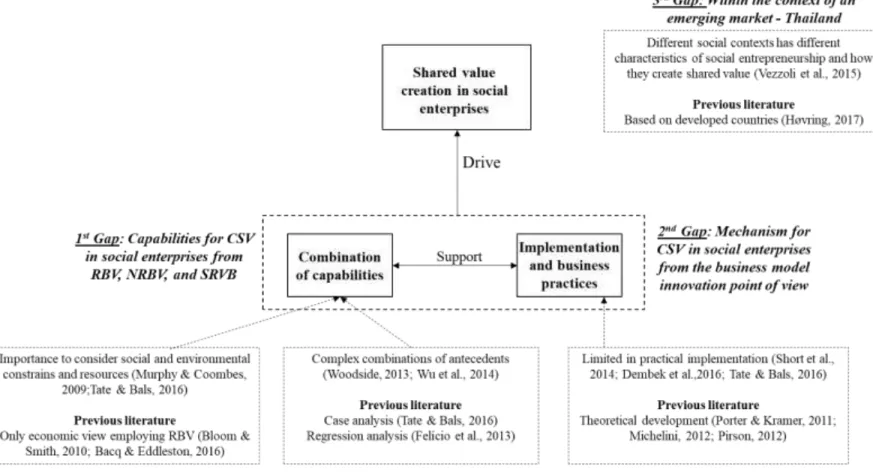
According to the theoretical background and literature review (see more details in Chapter 2: Theoretical background), this dissertation shed light on three research gaps, as summarized and demonstrated in Figure 1.1. Similar to other entrepreneurs, social entrepreneurs or other shared- value-oriented entrepreneurs must acquire resources and develop capabilities for their resources’
utilization to remain a competitive advantage and create shared value (i.e., social, environmental, and economic value for themselves, society, and the environment) (Bacq & Eddleston, 2016).
Although the social enterprise initially concerns about society and the environment, it also needs to achieve not only its social and environmental goals but economic goals in order to survive, grow, and sustain. Importantly, they have to cope with constraints and barriers because their initial goals are not just profit-oriented. It often operates in environments that make it difficult to acquire resources at reasonable costs to avoid conflict with their social and environmental missions (Zahra
& George, 2002).
Many previous business studies have focused on how firms achieve superior economic performance or sustain competitive advantage (Wernerfelt, 1984). The resource-based view (RBV) has always brought to research to as a theoretical framework to analyze based on available resources and capability development. Nevertheless, regarding specialty and uniqueness of social enterprises, studies has been showing that economic, environmental, and social resources are needed to manage and utilize simultaneously (Murphy & Coombes, 2009; Tate & Bals, 2016).
However, social and environmental resources and capabilities have been always overlooked by researchers and entrepreneurs (Bloom & Smith, 2010; Bacq & Eddleston, 2016). Limited number of studies have focused on the integration of economic, social, and economic resources and capabilities in social enterprises.
Apart from the gap from the theoretical perspective, another research gap regarding research methodology is also highlighted. Most of the studies empirically analyzed based on case analysis (Tate & Bals, 2016) and regression-based analysis (Felício et al., 2013). However, there are some limitations of these methods. For example, a regression-based analysis such as multiple regression or structural equation model is not capable of analyzing asymmetric data (non-normal distributed data) or equifinality (multiple solutions to the same outcome) (Fiss, 2007). A social enterprise depends on combinations of various antecedent conditions, not a single condition (Woodside, 2013; Wu et al., 2014). Thus, based on the literature gaps in the framework and methodological perspectives, the 1st research gap of this dissertation can be identified as presented in Figure 1.1. Respectively, this dissertation includes the RVB and its theoretical extensions including natural resource-based view (NRBV) and social resource-based view (SRBV) to cover all economic, social, and environmental layers of resources and capabilities. The dissertation employed Fuzzy Set Qualitative Comparative Analysis (fsQCA) as a tool to explore the complex relationships between capabilities and shared value in social enterprises.
Obviously, social enterprises aim to create positive changes in society and the environment, and attempt to create mutual benefits between the enterprises and their stakeholders. However, the concept of shared value in social entrepreneurship has been criticized in the literature and is still in a rather nascent stage (Crane et al., 2014). In addition, Dembek et al. (2016) and Tate and Bals (2016) claimed that there has been still a need to understand how the social enterprise create shared value. Many previous studies focused on definitions and theoretical development (Porter & Kramer, 2012). Despite theoretical developments, there is still a limited understanding of how the CSV
strategies might be undertaken in practice and how shared value is practically created (Short et al., 2014). This dissertation identifies the lack of implementation guidelines and mechanism in CSV as the 2nd research gap, as presented in Figure 1.1.
Furthermore, researchers have shown that a society in different social contexts has different characteristics of social entrepreneurship and CSV strategies depending on culture, historical background, and business practices. Many studies have been conducted in Western or developed countries (Høvring, 2017). Therefore, there is academic curiosity about social enterprises’ practices and their impacts within emerging market contexts that have different economic, social, and cultural background (Vezzoli et al., 2015). While, research of social entrepreneurship and shared value in emerging markets is limited, it is almost entirely absent in Thailand (Srinaruewan et al., 2015). Thai social enterprises create shared value. As an emerging country in Southeast Asia, public concerns on social and environmental issues in Thailand are somehow different from that of Western and developed countries due to unique characteristics of social enterprises in Thailand (Prayukvong & Olsen, 2009). While the interest of social entrepreneurship in Thailand has been significantly increasing, it remains ambiguous how it operates as well as what are required capabilities that act as a catalyst for shared value creation. The context of an emerging market, using Thailand as a representative, refers to the 3rd research gap, presented in Figure 1.1.
Figure 1.1: Research gaps
1.3 Research objectives
Apart from filling previously identified research gaps, this dissertation aims to achieve three overarching objectives, as listed below:
1) To identify essential capabilities of social enterprises that encourage shared value creation for the enterprises, society, and the environment
2) To understand the supportive business practices of the capabilities that enhance the opportunity for shared value creation
3) To provide initial guidelines and recommendations to social entrepreneurs and other shared value-oriented entrepreneurs who want to advance the social and environmental conditions by creating shared value
1.4 Research questions
As a result, in order to accomplish the research objectives, this dissertation attempts to address the following research questions which are divided into one major research question (MRQ) and three subsidiary research questions (SRQs). In order to be a successful social enterprise that create shared value among itself, society, and the environment, business practices and capabilities as practical guidelines are necessary.
1.4.1 Major research question (MRQ)
1) What are important capabilities and business practices for creating sharing value (CSV) in Thai social enterprises?
1.4.2 Subsidiary research questions (SRQ)
1) What are combinations of capabilities that facilitate shared value creation in social enterprises?
2) What are suggested business practices that enhance the opportunity for creating shared value?
3) How is shared value created from social enterprises’ practices?
1.5 Structure of the dissertation
The structure of this dissertation is organized as follows. This dissertation consists of 7 chapters. First, the dissertation starts with the introduction section. Next, theoretical background is discussed in Chapter 2. The following chapter illustrates the research methodology in chapter 3. As a consequence, Chapters 4 and 5 explain findings of study 1 (fsQCA) and study 2 (case analysis), respectively. Chapter 6 then discusses over all findings from both studies. Finally, the Chapter 7 explains the theoretical and practical implications, limitations, and directions for future studies.
Details of each chapter are explained as the following.
Chapter 1 introduces an overview of this dissertation including problem statement, research objectives, research questions, and structure of the dissertation. This chapter briefly explains the scope, goals, and importance of this dissertation.
Chapter 2 provides theoretical background based on literature review. The chapter presents the definitions of corporate social responsibility (CSR) and its challenges, creating shared value (CSV) and its transitions, business model innovation for sustainability, social entrepreneurship, stakeholder management theory, organizational resources from different points of views (i.e., resource-based view (RBV), natural resource-based view (NRBV), and social resource-based view (SRBV), organizational capabilities, and the uniqueness of the context of Thailand. This chapter aims to provide a better understanding of the theoretical foundations that are relevant and important to analyses and discussion of the dissertation.
Chapter 3 explains the research methodology, including research design, methodology sequences, and sub-studies research methods for each analysis. The chapter explains how this dissertation achieves research objectives and addresses major and subsidiary research questions.
The step-by-step diagram of research flowchart is also included in this chapter.
Chapter 4 presents the findings of Study 1 “Examining combination of capabilities for social enterprises in creating shared value using fsQCA”. The chapter includes research background, research objectives, theoretical model, findings, discussion, and a chapter’s summary. The main purpose of this chapter involves identifying different pathways from combinations of capabilities that are important for social entrepreneurship and social, environmental, and economic value creation based on the fsQCA. This chapter also provides the fuzzy XY plots to deeper analyze each suggested pathway. Findings emphasize the role of social entrepreneurship (comprising of social innovation and entrepreneurship-oriented practices) and combinations of capabilities (not an individual condition) for social entrepreneurship and shared value creation.
Chapter 5 focuses on the findings of case analysis that investigated into two social enterprises’ practices for CSV through business model innovation for sustainability framework and business model components lens (i.e., value proposition, value creation, and value capture). This chapter includes research background, research objectives, findings, discussion, and a chapter’s summary. After specifying the combination of capabilities in the previous chapter, this chapter aims to provide evidence associated with the essential business practices that support these capabilities and shared value from real cases in Thailand.
Chapter 6 discusses findings from all analyses. The chapter includes the integration of findings showing interrelation among studies and how they support one another to answers the major research question.
Chapter 7 highlights the theoretical implications, practical implications, limitations, and directions for future studies.
Chapter 2
Theoretical background
This chapter aims to provide the theoretical background, important concepts, and literature review that are related to the dissertation. The chapter includes ten subsections i.e., (1) introduction, (2) corporate social responsibility (CSR), (3) creating shared value (CSV), (4) differences between CSR and CSV, (5) business model innovation for sustainability, (6) social entrepreneurship, (7) stakeholder management theory, (8) organizational resources including resource-based view (RBV), natural resource-based view (NRBV), and social resource-based view (SRBV), (9) organizational capabilities, and (10) the context of Thailand.
2.1 Introduction
This chapter reviews relevant literature regarding important concepts and terminologies used in this dissertation. First, the concept of CSR, its definitions, evolutions, and challenges are presented prior to the introduction of the CSV concept. Basically, CSR is business’s practices and policies that aim for society and the environment (Jackson & Apostolakou, 2010). However, there are many constraints that restrict the traditional idea of CSR to fully create benefits for society and the environment. Therefore, the concept of CSV, which is the main focus of this dissertation, is described in the following section. The next section describes the development and importance of CSV and followed by the table illustrating the differences between CSR and CSV.
Next, literature review is presented to highlight the importance of the emergence of social entrepreneurship in CSV. This section starts from describing the definition of business model, business model innovation, and the business model innovation for sustainability. Basically, business model innovation refers to a new integrated logic of how a firm creates value and how it captures value, and the implementation of a business model that is new to the firm (Björkdahl &
Holmén, 2013). It provides a necessary idea to create changes for the firm and advancing benefits for society and the environment because technology or social innovation alone are not sufficient.
After this section, the concept of social entrepreneurship is introduced to describe its definition and explain a relationship between social entrepreneurship and CSV.
After that, the concept of stakeholder management theory is explained as a fundamental idea for economic, social, and environmental dimensions in shared value, organizational resources and capabilities. Organizational resources and capabilities of any type of businesses needed to be well managed and utilized in order to achieve the business’s missions. Particularly, due to specialty and uniqueness of social entrepreneurship, resources and capabilities requires special organizational capabilities and resources to cope with its missions, not only economic (i.e., making profit) but also social and environmental goals. Therefore, only RBV that emphasizes on the economic aspects to achieve a firm’s competitive advantage is not adequate for social entrepreneurship, the extensions of RBV (i.e., NRBV and SRBV) are added into this dissertation to cover social and environmental constraints, capabilities, and resources. Thus, this chapter also reviews relevant studies of organizational resources from RBV, NRBV and SRBV points of view, and essential capabilities for CSV.
Finally, the last section of this chapter explains why Thailand was selected as the representative of an emerging market and included in the analysis. The section describes the significance of the different context and the current status of social entrepreneurship in Thailand.
2.2 Corporate Social Responsibility (CSR)
Corporate Social Responsibility (CSR) generally refers to business practices, management, and policies that aim to enhance well-beings of society and improve environmental conditions (Jackson & Apostolakou, 2010). The concept of CSR is closely related to legitimacy, social and
environmental responsibility (Motilewa et al., 2016). Nevertheless, the definition of CSR has not been concluded into one absolute idea (McWilliams & Siegel, 2001).A broad definition of CSR has remained ranging from conceptual to practical ideas.
Initially, the concept of CSR was introduced to respond to stakeholders’ pressure.
Stakeholders such as customers and local people required a business to take a responsibility for its activities that negatively effect society and the environment. However, studies showed that there have been a number of challenges of the traditional perspective of CSR (Visser, 2010). First, the concept of CSR has mostly implemented in form of charity, philanthropy, donation, volunteering activities (Camilleri, 2017). These practices relate to usurping the businesses’ resources with little benefits really created for society, the environment, or even for the businesses. Second, the traditional perspective of CSR refers to practices that create social and environmental value without considering costs of effort (Voltan et al., 2017). The businesses scarify their profits for CSR activities in a hope that the practices and policies will create changes to society and the environment (Reinhardt et al., 2008). In addition, researchers argued that CSR practices cannot be sustain and continuously generate benefits because a business’s main purpose and social needs are far different (Visser, 2010).
2.3 Creating Shared Value (CSV)
Corresponding to challenges of the traditional practices of CSR, the concept of CSV has emphasized the relationship between the business, society, and the environment through the business practices and prism of value creation (Burke & Logsdon, 1996). The conventional CSR practices such as charities or volunteering activities should be broadened and amplified to create shared value among the business, society, and the environment (Abdelkafi & Täuscher, 2016).
The concept of creating shared value (CSV) was initially coined by Porter and Kramer (2011), aiming to provide an alternative business idea to resolve social and environmental problems through business practices, while at the same time these business practices also generate benefit for the business. Porter and Kramer (2011) suggested that the business can easily access to social and environmental resources when it concerns and try to address social or/and environmental issues.
The concept of CSV presents an innovative business practice and social responsibility that bridge
between social needs and business needs by balancing between social value, environmental value, and economic value (for the business such as making profits and remaining competitive advantage) (Høvring, 2017). Creating shared value can be referred to “the policies and operating practices that enhance the competitiveness of a firm while simultaneously advancing the economic and social conditions in the communities in which it operates” (Porter & Kramer, 2011). The CSV strategies consider the social responsibility that goes beyond required law and regulation (Voltan, 2017).
Specifically, the concept of CSV suggests the business to involve social and environmental issues into its goals and practices. It is internal-oriented management that focuses on sustainable value creation, rather than external-oriented practices (in CSR) that aim to create value temporarily (Tate
& Bals, 2016; Høvring, 2017). Importantly, the concept of CSV provides the theoretical framework for an alternative CSR-entrepreneurship like social entrepreneurship (Raimi et al., 2015).
2.4 Differences between CSR and CSV
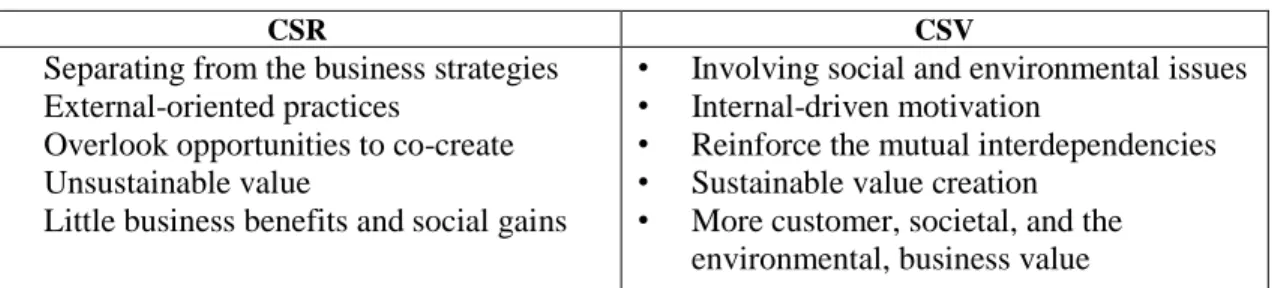
The differences between the traditional concept of CSR and CSV have been debated and mixed up (Wójcik, 2015). Some researchers have questioned about the newness of CSV and how this concept is differentiated from CSR (Crane et al., 2014). While, some researchers argued that the CSV concept represent an innovation, useful, and beneficial concept (Høvring, 2017). The main differences between CSR and CSV are presented in Table 2.1.
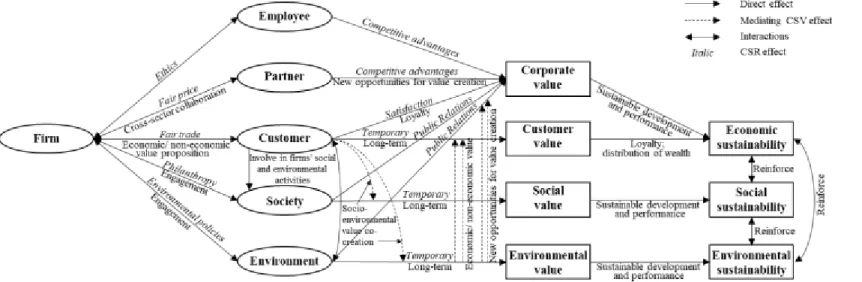
Furthermore, Figure 2.1 demonstrates the different impacts and value creation of CSR and CSV when the both concepts interact with stakeholders, including employees, partners, customers, society, and the environment. Italic words and sentences represents the traditional idea of CSR practices. Normal words and sentences represents the CSV practices.
Regarding CSR, firms conduct social and environmental activities from an external- oriented point of view. They treat their employees ethically according to the requirement of laws and other regulations and trade fairly with partners and customers. They also connect to the society and the environment by organizing charities and other volunteering activities for the community.
The firms’ environmental management focuses on public regulations and requirements from the government. From these kinds of practices, the corporate value, customer value, social, and environmental value are created only for a short period of time. When the CSR practices are over,
the society and the environment will no longer get benefits. This is because firms’ CSR policy only focus on legitimacy and stakeholder pressure.
In a contradictory, the concept of CSV closely engages with the society and the environment by including social and environmental problems into the core business policies. Firms connect with stakeholders and aim for generating mutual benefits. For example, firms allow local people to be their partners to increase their well-being, educate them which help to improve the social conditions. The CSV strategies encourage the mutual interdependencies between all stakeholders and the business (Abdelkafi & Täuscher, 2016).
Table 2.1: Differences between CSR and CSV
CSR CSV
• Separating from the business strategies
• External-oriented practices
• Overlook opportunities to co-create
• Unsustainable value
• Little business benefits and social gains
• Involving social and environmental issues
• Internal-driven motivation
• Reinforce the mutual interdependencies
• Sustainable value creation
• More customer, societal, and the environmental, business value
Figure 2.1: Differences between CSR and CSV
2.5 Business model innovation for sustainability
2.5.1 Business model
A business model refers to a representation of the underlying core logic of a firm and strategic choices for proposing, creating, and capturing value within a value network (Shafer et al., 2005; Osterwalder & Pigneur, 2010). It is how a firm defines its strategies to obtain competitive advantages and differentiates itself from others through the design of the products or services it offers to its customers, price strategies, and how the firm integrates its own value with those of other external stakeholders in a network to create new value (Bocken et al., 2014). A business model also describes how a firm creates value through the exploitation of business opportunities (Chesbrough, 2010; Amit & Zott, 2012; Rosca et al., 2017). Business model components includes value proposition, value creation, and value capture (Richardson, 2008). Value proposition refers to value that is offered to customers and other stakeholders (Boons & Lüdeke-Freund, 2013). Value creation includes resources and capabilities, the process of resource integration, and a position in the value network. It also refers to how value is created and delivered or the process of value co- creation by stakeholders (Bocken et al., 2017). Value capture signifies how a firm generates revenue and profits from the provision of value. It includes economic and non-economic values that are perceived by all members in the ecosystem (Richardson, 2008).
2.5.2 Business model innovation
Business model innovation represents an advanced business thinking, idea, and model that changes a way the business operates and manages (Björkdahl & Holmén, 2013). In contrast with product, service, and technological innovation, the concept of business model innovation is beyond a design of a new product/service/technology. It refers to different ways to create new value from existing resources, new ways to propose value to customers, and new ways to capture value. In other words, the business model innovation alters the core business thinking not just focuses on technology, products, and processes (Amit & Zott, 2012). The business model innovation has been claimed to unlock potential value from advanced technologies within limited resources and transform it into valuable products and services (Yang et al., 2017). Moreover, it has been considered to be an important lever for change in tackling pressing sustainability issues (Bocken &
Short, 2016). Furthermore, business model innovation has also been recognized as a key to the creation of sustainable business (Boons & Lüdeke-Freund, 2013; Frank et al., 2013; Carayannis et al., 2014).
2.5.3 Business model innovation for sustainability
A business model for sustainability is defined as a business model that concerns with social and environmental needs and simultaneously creates benefits for the business (Lüdeke-Freund, 2010). The core of a business model for sustainability is still creating customer value like general business models, but in which social value is embedded (Chesbrough, 2010; Osterwalder & Pigneur, 2010). A business model for sustainability can serve as a vehicle to coordinate technological and social innovations with system-level sustainability (Stubbs & Cocklin, 2008). It is necessary to consider the integration of economic, social, and environmental goals into a more holistic meaning of value in business models to develop a business model for sustainability (Schaltegger et al., 2012).
Therefore, business model innovation for sustainability can be defined as innovations that aim at creating significantly positive impact or those that at least have diminished the negative impact on the society and the environment by altering how the business propose, co-create, and capture value (Bocken et al., 2014). The business model innovation for sustainability considers both social and environmental benefits, not only aims at maximizing economic gains (Bocken et al., 2014). This may refer to changes in the design of a firm’s value propositions, the strategy for value creation, and how and what value is captured.
2.6 Social entrepreneurship
J. A. Banks first coined the terminology of social entrepreneurship in The Sociology of Social Movements in 1972, tried to differentiate from conventional entrepreneurship (Jones et al., 2010). However, the concrete definition was not provided. Therefore, there is no consensus definition. The literature contains numerous definitions of social entrepreneurship (Tepthong, 2014). It can be referred to entrepreneurs’ willingness to have fair practices in the society (Thake
& Zadek, 1997). Alternatively, Weerawardena and Mort (2006) provided the definition of social
entrepreneurship as an enterprise that aims to achieve social and environmental missions and these missions become a source of competitive advantage.
In this study, social entrepreneurship is defined as the business process that use, combine, and manage resources, idea, and capabilities to pursue opportunities for advancing the society and the environment for this sustainable social transformation and also to accomplish its commercial or economic goals (Tepthong, 2014; Carraher et al., 2016). The importance of social entrepreneurship is the balancing practices and management between its impact on economic and social development (Peredo & McLean, 2006). Social entrepreneurship can be considered as an innovative process and business model innovation that drives social and environmental value creation because of the initiative in seeking solutions to societal problems through its business practices (Mair & Marti, 2006; Morris et al., 2011; Felício et al., 2013). From this point of view, social entrepreneurship can be represented as a transitional vehicle leading to new capitalist system for CSV (Dembek et al., 2016).
Social entrepreneurship can be referred as a sub-discipline within entrepreneurship (Austin et al., 2006). Social enterprises need to develop its capacity to manage both business stakeholders such as trade partners and non-business stakeholders such as non-profit organization (NPOs) private business (Rey-Martí et al., 2016). Studies showed that social entrepreneurship composed of social-oriented and entrepreneur-oriented practices. Social innovation, proactiveness, and risk management are important components of social entrepreneurship. Social innovation is seen as the main criterion for social entrepreneurship to achieve social and environmental missions (Kraus et al., 2017). It relates the utilization of resources and capabilities in addressing social problems (Dwivedi & Weerawardena, 2018). Like other enterprises, social enterprises need to be proactive and manage risk to survive and to grow its business. Risk-taking involves making decisions from uncertainty choices and situations to minimize risks for business and all stakeholders (Weerawardena & Mort, 2006). Whereas, proactiveness reflects the tendency to actively scan the external environment, actively monitor external forces, and prepare for future uncertainty (Dwivedi
& Weerawardena, 2018). It involves forecasting both finance and non-finance to avoid surprises.
2.7 Stakeholder management theory
A stakeholder management theory refers to managing and balancing stakeholders’ interests rather than maximizing gains from them (Joyce & Paquin, 2016). Stakeholders are a group of individuals or organizations that connect and influence or is influenced by organizations’ goals and practices. Stakeholders can be consumers, employees, business partners, or others such as society and the government. Managing stakeholders is important for accessing and acquiring valuable resources. The stakeholder management theory plays a role emphasizing the relationship development with a network of social contacts that provides organizations with resources which can be converted into value (Schlange, 2009).
Particularly, a social enterprise finds it more difficult to manage stakeholders as compare to a conventional enterprise because it has to balance between social and economic value creation (Smith & Woods, 2015). Social enterprises need to consider a decision making that relates to both economic and social value creation and their impacts for society and the enterprise (Dacin et al., 2011). The barriers and constraints of social enterprises are more than those from the conventional enterprise due to more numbers of stakeholders involved such as local people or non-profit organizations. Moreover, Schlange (2009) suggests that a stakeholder environment of social enterprise involves higher levels of complexity. Successful relationship management relies on how well social enterprises manage the relationship with their stakeholders such as customers, suppliers, local people, NGOs and the government. In social entrepreneurship, the stakeholder management theory provides a framework that helps in connecting with broader stakoeholders and suggesting a direction for transforming intangible social and environmental issues into tangible economic and social stakeholder interests (Hossain et al., 2016). Considering stakeholders from economic, environmental, and social dimensions supports a more robust and holistic view of the enterprises’
practices (Joyce & Paquin, 2016).
2.7.1 Economic dimension
A social enterprise must acquire an ability to gain necessary profits and revenues in order to cover its operating costs to survive, expand, and run the business smoothly. The social enterprise needs to develop a good relationship with key economic-related stakeholders such as customers,
business partners, creditors, and other authorities. These stakeholders play a major role because they relate to main business operations (Schlange, 2009).
2.7.2 Social dimension
Regarding a social dimension, connecting and managing stakeholders (e.g., local people or NGOs) encourage mutual benefits and shared value creation. The social dimension of stakeholder management refers to enterprises' missions which focuses on creating benefits for its stakeholders and society more broadly. Social enterprises cannot survive when society or local communities fail.
Social enterprises’ activities also positively influence the well-being of society (Joyce & Paquin, 2016). From this perspective, value created from social enterprises covers a wider range of potential beneficiaries. Social enterprises can be viewed as stakeholder organizations because their assets and resource mainly based and owned by many stakeholders in a community rather than by a specific group of shareholders (Schlange, 2009). Social-related stakeholder management is a foundation for approaches for measuring social impacts through different indicators and standards such as ISO 26000 (Guidance on social responsibility).
2.7.3 Environmental dimension
An environmental dimension of the stakeholder management theory refers to natural and ecological value that social enterprises create through reducing negative environmental impact, increasing positive ecological value, and improving environmental degradation (Joyce & Paquin, 2016). The stakeholder theory regarding the environmental dimension shows the relationship development with environmental-related stakeholders such as environmentalists, NGOs, scientific communities, political parties, or a variety of dedicated pressure groups (Schlange, 2009). Different environmental standards and indicators such as environmental, social and governance (ESG) issue fundamentally developed from the stakeholder management theory.
2.8 Organizational resources
2.8.1 Resource-based view (RBV)
A resource refers to anything the firm receives in an exchange and give a strength or weakness. Grounded in the RBV, resources can be tangible resources such as machines or intangible resources such as experiences, motivation, relationships among of employees and with employers (Wernerfelt, 1984; Barney, 1991). The RBV argues that firms achieve competitive advantages through the application of resources that are valuable, rare, inimitable, and non- substitutable such as know-how and organizational learning (Wernerfelt, 1984; Branco &
Rodrigues, 2006; Hörisch et al., 2015; Fortis et al., 2018). The RBV thus portrays an organization as a bundle of resources and capabilities that are developed over time as the organization interacts with stakeholders (Bacq & Eddleston, 2016).
Analyzing social entrepreneurship through a theoretical framework of RBV emphasizes important capabilities on resources’ utility for financial performance (Bacq & Eddleston, 2016).
Since, the profit-making capabilities to generate revenues helps social entrepreneurship to pursue social and environmental missions (Miller & Wesley, 2010). Although social enterprises may not aim to get rid of their rivals, they need to remain competitive advantage (Desa & Basu, 2013).
2.8.2 Natural resource-based view (NRBV)
An NRBV framework is proposed as an extension to the RBV. While the RBV highlights the economic-oriented resources as an important element for a firm's competitive advantage and superior performance, the natural environmental resources and capabilities have been overlooked (Hart, 1995). Therefore, the NRBV extends to cover the capabilities to manage natural environmental resources and barriers by connecting and accessing to the natural resources (Cristina De Stefano et al., 2016). This view emphasizes the importance of natural environment management due to many environmental issues such as limited natural resources, climate change, and pollution (Tate & Bals, 2016).
The concept of the NRBV was broaden from the economic-oriented RBV to cover the natural and environmental concerns and link business with the natural world (Tate & Bals, 2016).
Regarding the domain of the NRBV, environmental resources and capabilities are important for the business to achieve a competitive advantage.
2.8.3 Social resource-based view (SRBV)
An SRBV extends from the RBV and NRVB to cover social resources and constraints by dealing with a wider range of stakeholders both from the business and non-business sectors such as local people or NPOs (Tate & Bals, 2016). The SRBV deals with social capabilities in the three areas i.e., commitments, connections, and consistency, in which Tate and Bals (2016) suggested that these social capabilities are important for economic, social, and environmental value creation (Jenkins & Fries, 2012)
2.9 Organizational capabilities
Certain capabilities are required for social entrepreneurship to manage, control, and deploy different tangible and intangible resources in economic, social, and environmental dimensions to enhance the ability of a social enterprise to achieve economic and social goals and gain a competitive advantage (Rey-Martí et al., 2016). In this study, four social entrepreneurship capabilities (i.e., mission-driven-, stakeholder-, cross-sector collaboration-, and environmental- management capabilities) were our main focus. They represent potential driving factors in the enhancement of social entrepreneurship for CSV and gaining a competitive advantage. These capabilities are in line with the RBV, NRBV, and SRVB in that they consider economic, social, and environmental perspectives.
2.9.1 Effects of a set of capabilities on social entrepreneurship
A mission is the important component of organizational philosophy that can enhance the common visions and understanding of the business role, purposes, and practices with respect to its stakeholders. It has potential to support social entrepreneurship for CSV (Grant & Sumanth, 2009).
The mission-driven management capability supports a decision-making process in social
entrepreneurship (Tate & Bals, 2016). However, in order to accomplish missions of social entrepreneurship, it is essential to consciously build up other capabilities in economic, social, and environmental dimensions. The stakeholder management capability has been shown to support social entrepreneurship in helping to respond to external pressures and incentives set by main stakeholders such as partners, customers, and shareholders. Cross-sector collaboration management connects the social enterprise to peripheral stakeholders (e.g., local people and NPOs), and helps the entrepreneur to take a leadership position in resolving social problems around local communities and enhancing social entrepreneurship. The capability of cross-sector collaboration helps to bridge the boundaries of the private, public, and non-profit sectors and to reconcile conflicting institutional goals, structures, and processes in a way that benefits social entrepreneurship (Pache & Santos, 2012). A business will most likely fail unless local social partners are brought into the business during the market creation and product development/distribution phases, so identifying these local social partners is one of the key capabilities for a social entrepreneur (Calton et al., 2013). Similarly, the environmental management capability supports social entrepreneurship by connecting the social enterprise to natural resources, such as ecological systems, and helps the entrepreneur to take a leadership position in resolving social and environmental problems in global communities.
2.9.2 Effects of a set of capabilities, and social entrepreneurship on CSV
Grounded in the RBV, NRBV, and SRBV, the influence of capabilities and social entrepreneurship on CSV in social, environmental, and economic (i.e. revenue- and competitive- advantage-related) dimensions is understood through the analysis of fundamental tangible and intangible resources and capabilities (Fortis et al., 2018). A clear mission that promotes social entrepreneurship appears to be an important element that contributes to the establishment of CSV practices. Incorporating a clear mission into a business’s strategy tends to obtain positive results for stakeholders and social rewards in forms such as an improved reputation and a perceived good image from customers (Flota Rosado & Ocampo Figueroa, 2016). These rewards can in turn generate a sustainable competitive advantage for the enterprises and develop a trusting network that is manifested both directly and indirectly in mutual benefits.
Based on the SRBV, a social capability is essential because it connects the enterprise with a wide range of stakeholders for assessing and exchanging valuable resources with one another.
Exchanged resources can include, from an economic perspective such as training sessions, materials and from a social perspective, such as cultural and social capital. These resources encourage more than just purely economic motives (Tate & Bals, 2016). Therefore, the ability to configure and manage the main stakeholders as well as cross-sector stakeholders by effectively managing social entrepreneurship appears to be another key capability that encourages CSV.
Exchanging resources with both business and non-business stakeholders becomes very important (Kolk & Lenfant, 2015). Aligning with non-business stakeholders, such as non-profit organizations (NPOs) or local communities, to access valuable resources that fit the enterprise’s mission and interests and maximizing that alignment is very important for CSV (Dees, 1998).
According to the NRBV, the social entrepreneurship capability of managing natural environmental resources can become valuable for CSV (Majumdar & Marcus, 2001). The environmental management capability, including practices such as regulating pollution and waste, employing more efficient operation and production, and reusing materials, may lower costs (Sharma & Vredenburg, 1998). It is also highly effective for creating and increasing positive reputations and perceptions from customers while simultaneously improving environmental conditions.
2.10 Context of Thailand
Researchers have shown that a society in different social and environmental contexts has different characteristics of social entrepreneurship depending on culture, historical background, and business practice. This leads to academic and practical curiosity about the operation and performance of the social enterprise and CSV in Thailand, an emerging market in Southeast Asia.
According to the (World Bank, 2016), Thailand can be categorized as an upper-income country and as a developing country, located in Southeast Asia. The impact of Thai social entrepreneurs in CVS may be different from other contexts (Srinaruewan et al., 2015).
Thai business model on social responsibility is unique and significantly influenced by Buddhist values, in which the practice of merit-making through philanthropy, charity, volunteering,
and sharing is a part of Thai culture (Prayukvong & Olsen, 2009). Nevertheless, Thai enterprises are moving toward integrating CSV into their core business practices leading to the significantly increase in the number of social enterprises in Thailand (Kraisornsuthasinee & Swierczek, 2009).
While the interest of social entrepreneurship and CSV in Thailand is increasing, it is ambiguous how the concept of CSV influence a social enterprise’s competitive advantage and performance as well as what are required capabilities that act as a catalyst.
Initially, Thai CSR appeared in Thai media in 2003 described as a new trend of global standard (Prachachart Turakij, 2003). After that, Thai CSR was pushed to public and private sectors both international and domestic organizations in implementation. Nowadays, the term CSR in Thailand is heavily visible and audible to the public. However, Thai CSR has been generally associated with reputation and image-building activities such as making donations and other societal marketing programs that appear in mass media. As a result, critics questioned whether these kinds of CSR activities could distinguish between CSR and public relations/societal marketing, and whether Thai CSR can really lead to economic, social, and environmental value creation that benefits the business, society, and the environment in a sustainable way (Srisuphaolarn, 2013). Obviously, CSR in Thailand is attempting toward solving social or/and environmental problems. It may be concerned with creating a better society and dealing with environmental issues such as pollution and waste. Nevertheless, little relatedness is made into core businesses when it comes to implementing a CSR strategy. Many businesses focus on how to manage profits and distribute a portion to society (Srisuphaolarn, 2013).
Thailand is the first country among the Southeast Asia that develops the social entrepreneurship when the 1998 Thai constitution initially promoted the participation of civil society and social initiatives. This served as a beginning of public interest to concern about social and environmental benefits, as well as enterprises’ economic benefits. However, social enterprises just came to public in a form of formal identification in 2010. Thai government has settled and helped to manage the network of social enterprises for solving Thai social and environment problems (Tepthong, 2014) by establishing the Thai Social Enterprise Office (TSEO), which was under the Thai Health Promotion Foundation Act in The Office of the Prime Minister Regulation of National Promotion of Social Enterprises 2011. The TSEO helps to develop and support Thai social enterprises networks.
Chapter 3
Research methodology
This chapter describes the research methodology in achieving the research objectives and addressing the research questions of the dissertation. The chapter starts with an overview of the research design explaining how this dissertation is organized and structured to answer each subsidiary research question that leads to the answers for the major research question. The research design is also illustrated in the figure. After that, the methodological sequences section is presented to express details of the research procedure. Finally, this chapter presents the sub-studies research methodology including sample, data collection, and method.
3.1 Research design
The problem statement, research gaps, theoretical background and relevant literature reviews in chapters 1 and 2 highlight the importance of economic, social, and environmental resources and capabilities in creating shared value among the social enterprise, society, and the environment. Further studies are needed to advance our understanding of social enterprises’
resources and capabilities that help in creating shared value. This also links to the dissertation’s major research question that attempted to identify “What are important capabilities and business practices for creating sharing value (CSV) in Thai social enterprises?”. In order to address this major research question, this dissertation is divided into two main studies, i.e., (1) the examination of capabilities for social enterprises in CSV using fsQCA based on 22 Thai social enterprises, and (2) the investigation of social enterprises’ business model for CSV based on analysis of two social
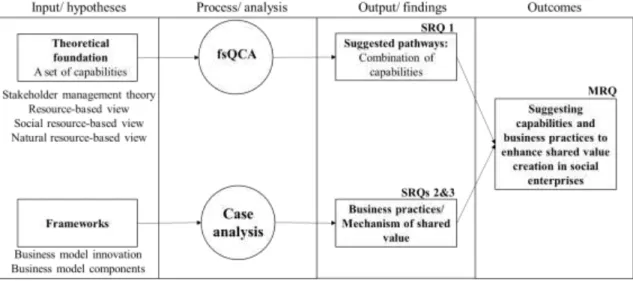
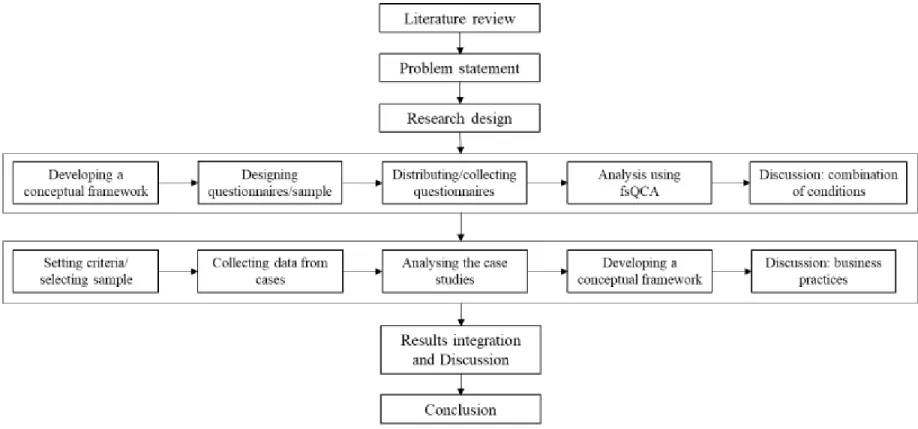
cases. The research design of this dissertation is summarized and demonstrated by an input-process- output-outcome diagram in Figure 3.1.
Figure 3.1: Research design
The analysis starts with identifying a set of capabilities based on stakeholder management theory, resource-based view (RBV), social resource-based view (SRBV), and natural resource- based view (NRBV) to cover economic, social, and environmental dimensions of capabilities that are important for social entrepreneurship and shared value. Then, the set of capabilities (i.e., mission-driven management, stakeholder management, cross-sector collaboration management, and environmental management capabilities, and social entrepreneurship) is empirically analyzed using fuzzy set qualitative comparative analysis (fsQCA) based on 22 social enterprises in Thailand.
This study employs the fsQCA as an analysis tool because it is suitable to explore complex relationships, support the theoretical hypotheses, access the complexity theory, and is capable to analysis a small to medium sample size. This first study aims to address the first subsidiary research question “What are combinations of capabilities that facilitate shared value creation in social enterprises?”. Findings provide the suggested pathways in a form of the combinations of capabilities that help social enterprises to create shared value. These findings are also expected to fill the first and third research gaps.
In corresponding to the findings from fsQCA, different sets of combinations of capabilities are suggested. The case analysis based on two Thai social enterprises aims to reveal the business