JAIST Repository
https://dspace.jaist.ac.jp/
Title 価値共創志向の電子的戦略ロードマッピングの研究
Author(s) Ateetanan, Pornprom Citation
Issue Date 2018‑09
Type Thesis or Dissertation Text version ETD
URL http://hdl.handle.net/10119/15515 Rights
Description Supervisor:白肌 邦生, 知識科学研究科, 博士
Value co-creation oriented strategic electronic roadmapping
Pornprom Ateetanan
Japan Advanced Institute of Science and Technology
Doctoral Dissertation
Value co-creation oriented strategic electronic roadmapping
Pornprom Ateetanan
Supervisor: Assoc. Prof. Kunio Shirahada, Ph.D.
School of Knowledge Science
Japan Advanced Institute of Science and Technology
September 2018
Abstract
Organizations are becoming increasingly aware of the importance of employee and performance in gaining and maintaining competitive advantage. Roadmapping is a human- centric strategic management technique to formulate organizational future planning. Typical roadmapping process is face-to-face workshop. There are research gaps need to be considered, while also focusing on the stakeholder value co-creation oriented and virtual approach with internet-based roadmapping that not only overcomes the limitation of space and time but also increases the degree of communication. There is need to overcome the limitation of space and time and the new approach of blending of human and electronic works in roadmapping process as well as the design of new perspective on roadmapping to create value co-creation oriented.
The research objectives are separated into three parts. The first part is to identify what stakeholders should do in co-creating value for planning innovative technologies throughout the roadmapping process. The concept of stakeholder value co-creation oriented roadmapping is proposed. The second part is to design the blending of human and electronic works into strategic planning process with electronic roadmapping to overcome the space and time limitations and increase the degree of communication among multi-stakeholders. The comparative effectiveness of face-to-face and electronic roadmapping was experimented. The last objective aims to identify and weight the factors influencing for the adoption of e-Roadmapping in organization.
In terms of research methodology, the study 1, the concept of value co-creation (VCC) roadmapping is developed. The case study of VCC roadmapping process is illustrated and participant-centric approach in roadmapping is presented. The study 2, the conceptual model of e-Roadmapping approach with describing characteristics, approach, collaboration tools and procedure are presented. Then the comparative experimental case on face-to-face and electronic roadmapping approach with mixed method research approach of quantitative and qualitative was conducted.
Lastly, we conducted experts and participants panel check to identify the initial factors influencing the adoption of e-Roadmapping to answer the second objective. The study 3, from the results of study 1 and study 2, the factors influencing the adoption of e-Roadmapping in organization is considered. To answer the research objective, we use expert checks-AHP framework to identify and weight the factors.
This research contributes to the field of strategic roadmapping and identifies the new perspectives on roadmapping as follows: 1) Integration with service management concept:
traditional strategic planning with roadmapping technique has limitations of information gathering, idea creation and implementation platform among stakeholders due to lack of value co-creation thinking. Service management concept is incorporated into roadmapping with value co-creation, resource integration, and collaboration platform to solve these limitations. The key behavioral factors affecting value co-creation oriented in strategic roadmapping are identified and can be encouraged for effective strategic roadmapping, 2) Blending and balancing with human and electronic embodiment of strategic roadmapping approach: the strategic electronic roadmapping conceptual model with electronic collaboration matrix makes the shifting from face-to-face to electronic roadmapping. It supports the value co-creation oriented in roadmapping with the superb coordination between face-to-face and electronic roadmapping process. The strategic electronic roadmapping can be conducted either real or cyberspace and enabled by electronic collaboration tools and platforms. The model allows roadmapping facilitator and participants to choose the approach and tools depending on the availability and appropriateness of workshops, organizations and participants, and 3) Implementing key factors of electronic roadmapping: the management implication of strategic electronic roadmapping can be exemplified with the influencing factors the adoption of electronic roadmapping in organization.
The synergies of factors among people, organizational culture, process and technology are measured. Executive and roadmapping team can further utilize these factors and weights for implementing electronic roadmapping in organization.
Keywords: Collaboration technology, Electronic roadmapping, Strategic electronic roadmapping, Strategic planning, Value co-creation
Dedicated to my beloved parents and family
Acknowledgements
I would like to express my special appreciation and thanks to my supervisor Assoc. Prof.
Kunio Shirahada. He has been a tremendous teacher for me. I would like to thank you for encouraging my study and for incubating me to grow as a researcher. I would like to sincerely thank Prof. Michitaka Kosaka, Prof. Naoshi Uchihira, and Prof. Yukari Nagai who undertook the responsibility of being my second supervisor and advisor for minor research project for their wisdom and knowledge in the areas of service knowledge, innovation management on service and technology, and human life design respectively.
I am truly thankful to all members of the examination committee who evaluated my Ph.D.
dissertation: Assoc. Prof. Kunio Shirahada, Prof. Youji Kohda, Prof. Asami Shikida, and Assoc. Prof. Eunyoung Kim for advising and polishing my dissertation even at hardship.
I also want to thank you for letting my defense be a memorial moment.
My thanks appreciation goes to my minor research supervisor, Sasiporn Usanavasin, Ph.D. of Sirindhorn International Institute of Technology (SIIT) Thammasat University and Thepchai Supnithi, Ph.D. of National Electronics and Computer Technology Center (NECTEC) National Science and Technology Development Agency (NSTDA) for their guidance, suggestion and encouragement. I would like to thank SIIT, JAIST, and NECTEC/NSTDA who provided the SIIT-JAIST-NSTDA scholarship for the Ph.D. program.
Very special thanks to my family. Words cannot express how grateful I am to my mother and brother & sister as well as my mother & brother/sister-in-law for all of the sacrifices that you have made on my behalf. My special thanks go to my wife who has preserved my long study journey away from home to my mother and our children who are the most value of our lives.
My thanks also go to Shirahada labmates for their continued assistance during the past three years. I also would like to give very special thanks to my lab mate, Mr. Nitipon Tansakul and batch mate, Ms. Ornin Srihakulung who spent many days and nights with and was my support in the moments when there was no one to answer my queries or concerns and encouraged me to strive towards my goal.
At the end, I would like express appreciation to all friends for being and supporting of my study life in Japan. Thanks for the help and friendship; I wish all of you a successful and happy life.
Content
Abstract ... i
Acknowledgements ... iv
Content ... v
List of figures ... viii
List of tables ... ix
Chapter 1 Introduction ... 1
1.1 Background ... 1
1.2 Objectives ... 4
1.3 Research questions ... 5
1.4 Structure of study ... 7
Chapter 2 Literature reviews ... 8
2.1 Roadmap and roadmapping ... 8
2.1.1 Framework ... 9
2.1.2 Process ... 10
2.1.3 Functions ... 10
2.1.4 Stakeholder management ... 11
2.2 Service management ... 13
2.2.1 Service-dominant logic (S-D logic) ... 13
2.2.2 Roadmapping in S-D logic perspective... 14
2.3 Collaboration technology ... 15
2.3.1 Information and Communication Technology (ICT)-based roadmapping... 15
2.3.2 Computer-supported collaborative work (CSCW) ... 16
2.3.3 Electronic (e)-Collaboration ... 17
2.3.4 Collaboration platforms ... 17
2.4 Summary ... 18
2.4.1 Gaps in existing literature ... 18
2.4.2 Summary ... 19
Chapter 3 Value co-creation oriented roadmapping ... 22
3.1 Research design ... 22
3.1.1 Methodology ... 22
3.1.2 Concept ... 23
3.1.3 Implementation ... 24
3.2 Case study ... 25
3.2.1 Research target ... 25
3.2.2 Procedure ... 26
3.3 Evaluation ... 30
3.4 Results ... 30
3.4.1 Observation of stakeholder VCC activities ... 30
3.4.2 Observation of team members in face-to-face wrap-up workshop ... 33
3.5 Discussion ... 34
3.5.1 Adoption of the concept of stakeholder VCC oriented roadmapping in technology-oriented organization ... 34
3.5.2 Lesson learned from stakeholder VCC oriented roadmapping ... 35
3.5.3 Role of roadmapping facilitator and online real-time social media platform supporting integration of resources ... 35
3.6 Summary ... 35
Chapter 4 Strategic e-Roadmapping ... 37
4.1 Research design ... 37
4.1.1 Methodology ... 37
4.1.2 Conceptualizing model of e-Roadmapping ... 38
4.1.3 Experimental design ... 41
4.2 Results ... 46
4.2.1 Conceptual model of e-Roadmapping and its effectiveness of experiment ... 46
4.2.2 Feedbacks on concerning issues of e-Roadmapping from experts ... 51
4.3 Discussion ... 54
4.3.1 The comparative effectiveness of face-to-face (F2F) and e-Roadmapping approach and its benefits ... 54
4.3.2 The blending of human and electronic works into roadmapping ... 55
4.4 Summary ... 56
Chapter 5 Factors influencing the adoption of e-Roadmapping ... 58
5.1 Research design ... 58
5.1.1 Methodology ... 58
5.1.2 Expert checks ... 59
5.1.3 Analytic Hierarchy Process (AHP) ... 60
5.2 Results ... 62
5.2.1 Expert checks ... 62
5.2.2 AHP model ... 65
5.2.3 AHP analysis ... 66
5.3 Discussion ... 68
5.4 Summary ... 68
Chapter 6 Conclusions ... 70
6.1 Answer for research questions ... 70
6.1.1 SRQ1: What stakeholders should do in co-creating value for planning innovative technologies throughout the roadmapping process? ... 70
6.1.2 SRQ2: How to blend human and electronic into strategic roadmapping approach? ... 71
6.1.3 SRQ3: What are the key factors influencing to the adoption of e-Roadmapping in organization? ... 72
6.1.4 MRQ: How to conduct value co-creation oriented strategic electronic roadmapping? ... 73
6.2 Theoretical implications ... 73
6.3 Management implications ... 74
6.4 Directions for future research ... 74
References ... 76
Appendix ... 91
Appendix A: Summary of research methods ... 92
Appendix B: Summary of studies, workshops, and activities ... 94
Appendix C: Questionnaire for the comparative effectiveness of face-to-face and e-Roadmapping process ... 96
Appendix D: Expert checks questionnaire ... 102
Appendix E: AHP Questionnaire survey Factors influencing the adoption of e-Roadmapping in organization... 107
List of Contributions ... 116
This dissertation was prepared according to the curriculum for the Collaborative Education Program organized by Japan Advanced Institute of Science and Technology and Sirindhorn International Institute of Technology, Thammasat University.
List of figures
Figure 1.1 Focus of study... 4
Figure 1.2 Research problems and studies ... 5
Figure 1.3 Overview of research questions... 6
Figure 1.4 Structure of study ... 7
Figure 2.1 The generic roadmap architecture ... 9
Figure 2.2 Roadmapping in S-D logic perspective ... 15
Figure 3.1 Stages and activities in stakeholder value co-creation in roadmapping process .... 32
Figure 4.1 The conceptual model of e-Roadmapping ... 38
Figure 4.2 Flow of roadmapping workshops ... 43
Figure 5.1 Expert checks-AHP methodology ... 58
Figure 5.2 Hierarchy structure of the AHP model ... 65
List of tables
Table 2.1 Factors influencing the adoption of roadmapping with collaboration technology .. 20
Table 3.1Workshop topics, activities, collaboration tools and outputs ... 29
Table 3.2 Examples of stakeholder value co-creation activities ... 30
Table 4.1 Tools of e-Collaboration in e-Roadmapping ... 40
Table 4.2 Experts demographic profile - Expert validation on e-Roadmapping approach ... 45
Table 4.3 Results from experiment ... 47
Table 4.4 Results from Paired T-test statistic with SPSS. ... 48
Table 5.1 Experts demographic profile - Expert checks on factor influencing ... 59
Table 5.2 The definition of each factor ... 60
Table 5.3 AHP Experts demographic profile ... 61
Table 5.4 Overall feedbacks - Expert checks ... 62
Table 5.5 Comments from experts categorized by factors and sub-factors ... 63
Table 5.6 The revision of the definition of each factor ... 65
Table 5.7 The weights of all factors and sub-factors in the hierarchy ... 66
Table 6.1 The combination of factors into group of people, process and technology ... 72
Chapter 1 Introduction
1.1 Background
The capability of organizations to create knowledge during the innovation process has been identified as a key resource in competitive advantage (Kazadi, Lievens, & Mahr, 2016).
People’s involvement during the innovation and strategic management process are also key factors (Kazadi et al., 2016; Kerr, Farrukh, Phaal, & Probert, 2013).
The term ‘roadmap’ is a graphic representation of routes or connections that show different developments over time and into the future; ‘roadmapping’ can be used to chart technologies or products, and to visualize complex operational strategies for a number of stakeholders in a standardized framework (Linnenluecke, Verreynne, Scheepers, & Venter, 2017).
For strategic planning, roadmapping is a technique that enables different groups to gain a consensus in organizational planning (Kerr, Phaal, & Thams, 2017). Many organizations have conducted roadmapping approaches to make better decisions for innovative technology development. The roadmap has been developed as a strategic tool to prepare for the uncertainty of technological innovation and social change.
Multiple people and stakeholders from different types of organizations have varying perspectives and potential to make contributions (Carayannis, Meissner, & Sokolov, 2016).
Multi-stakeholders coming from multiple sectors/disciplines expect to plan and generate ideas for innovative technologies in the roadmapping process. This is due to roadmaps relying heavily on the knowledge, skill, experience, and insights that stakeholders bring into the process (Ho & O'Sullivan, 2017). Moreover, Freeman, Harrison, Wicks, Parmar, and Colle (2010) described a theory suggesting organizations must understand stakeholder behaviours, values, and backgrounds. Thus, organizations need to make an effort to understand stakeholder’s knowledge and skill as well as values and backgrounds, thereby co- creating an improved roadmap for innovative technology planning.
Regarding the service concept with co-creation, service-dominant (S-D) logic has been suggested in service management, and can also be effective in technology management discipline. S-D logic views economic exchange as being based not on goods, but on the application of specialized knowledge and skills through needs, processes, and performances for the benefit of another entity or the entity itself (Ho & O'Sullivan, 2017; S. Vargo &
Lusch, 2004), which based on the win-win relationship (Joiner & Lusch, 2016).
Value co-creation (VCC) under S-D logic is a predominant service concept that describes collaboration between multi-sector stakeholders that creates mutual benefits (Sukholthaman
& Shirahada, 2016). Therefore we can synergize roadmapping as a knowledge creation process (Kamtsiou, Naeve, Stergioulas, & Koskinen, 2006) and value co-creation as a cooperative process (Romero & Molina, 2011) of innovation through stakeholder involvement. The service concept with VCC and resource integration among multi- stakeholders can effectively support efficient development, diffusion of innovation, and creation of innovative technologies, products, and services.
Incorporating stakeholder aspects for innovation is rapidly gaining momentum in organizations. There are always people behind new technology or innovation, and the role of people in competitiveness and collaboration for technology and service management is increasing (Jonas & Roth, 2017; Kazadi et al., 2016; Nardelli & Broumels, 2017; Pera, Occhiocupo, & Clarke, 2016; Romero & Molina, 2011; Stephen, Quan anh, Outi, & Gillian, 2016).
Strategic technology management toolkits play an important role in supporting a wide range of technology management decisions and processes. One of the key tools is roadmapping. Its importance as a strategic planning tool in industry and government is widely recognized and acknowledged (Ball et al., 2014; Geum, Kim, Son, & Park, 2013; Robert Phaal , Farrukh, &
Probert, 2011; Robert Phaal et al., 2016; Vatananan & Gerdsri, 2012; Yonghee, Seong-Pil, &
Karp-Soo, 2016).
The key factors leading to a successful roadmapping are the right process, data, and people (Vatananan & Gerdsri, 2012). Roadmapping can support underpinned principles of strategic management tools i.e. identified human-centric, workshop-based, and neutral facilitated and visual (Kerr et al., 2013). The roadmapping process runs as workshop-based whereby the key stakeholders and domain experts are brought together to capture, share and structure knowledge (Kerr, Phaal, & Probert, 2012). Roadmapping also promotes team interaction and participation; it improves communications, engagement and ownership within the process (Kerr et al., 2013; Toro-Jarrin, Idalia Estefania, & Güemes-Castorena, 2016; Yasunaga, Watanabe, & Korenaga, 2009; Yonghee et al., 2016). But in term of the applicable scope of the workshop-based approach, the default situation is a physical or face-to-face (F2F) meeting. There are limitations of space and time that decrease the degree of participation in the roadmapping process. The virtual setting and real-time online tools can support the process as mechanisms which allow participation from individuals who are not able to attend the meeting and need a chance to give their inputs and get involved in the roadmapping process (Kerr et al., 2013).
In the technology roadmapping and foresight research forum, there is a number of research opportunities mentioned. J. Lee, Kim, and Phaal (2012) suggested that the use of social networking and web-based forms of collaboration would serve and enhance the roadmap creditability. Information and Communication Technology (ICT)-based tools will be a driving force in the future development of foresight (Keller & von der Gracht, 2014) and ICT-based roadmapping would enhance the coordination and increase the productivity of planning activities (Rohrbeck, Thom, & Arnold, 2015). Raford (2015) suggested that the study of encouraging interactive socialization in F2F, online setting, form of blended workshops or online engagement should be conducted. Phaal (2018) also suggested that research and development should continue and link to work on application software and
digital technologies, which support roadmapping, and balance the blend of human and digital works.
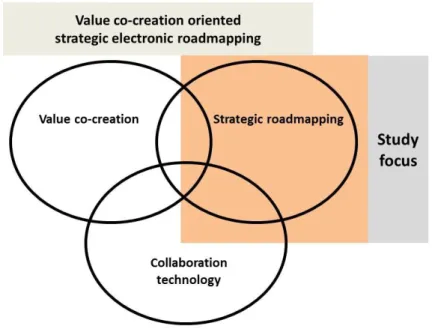
In summary, this study focuses on the overlap between strategic roadmapping, Value co-creation and collaboration technology within the context of strategic management research as shown in Figure 1.1
Figure 1.1 Focus of study
These highlighted research gaps need to be considered, while also focusing on the stakeholder value co-creation oriented and virtual approach with internet-based roadmapping that not only overcomes the limitation of space and time but also increases the degree of communication. There is need to overcome the limitation of space and time and the new approach of blending of human and electronic works in roadmapping process as well as the design of new perspective on roadmapping to create value co-creation oriented and uplifts the effective roadmapping stakeholders and organization.
1.2 Objectives
Based on the limitations on space and time and the degree of communication to support the organizational roadmapping process, there is a need to identify and develop a new perspective roadmapping model to organizational roadmapping for employee, stakeholder and organizational effectiveness through providing a flexible application.
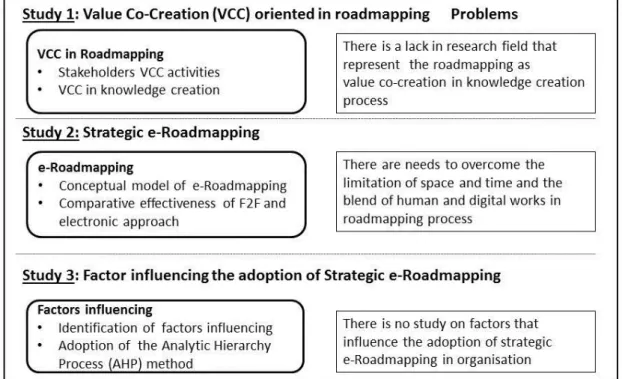
Research objectives of this study is separated into three part based on research problems represented in Figure 1.2.
The first objective is to study what stakeholders should do in co-creating value for planning innovative technologies throughout the roadmapping process. The concept of stakeholder value co-creation roadmapping is proposed.
The second objective is to design the blending of human and electronic into strategic planning process with electronic roadmapping to overcome the space and time and increase the degree of communication among stakeholders. The comparative effectiveness of face-to- face and electronics approach was experimented. The last objective aims to identify and weight the factors influencing the adoption of e-Roadmapping in organization.
Figure 1.2 Research problems and studies
1.3 Research questions
Research questions in this research can be divided into two parts, as represented in Figure 1.3. As presented in the figure, it is necessary to understand the relationships of human and electronic works in roadmapping. This study focuses on how collaboration technology can overcome the limitation of space and time and degree of communication.
In the first stage of study, we need to find the answers for these following questions “What stakeholders should do in co-creating value for planning innovative technologies throughout the roadmapping process”, “How to blend human and electronic into strategic roadmapping approach?”, and What are the key factors influencing to the adoption of e-Roadmapping in organization?.
After that, all findings from the first stage are incorporated to complete the process of the study, as represented on the right side of Figure 1.3 “How to conduct value co-creation oriented strategic electronic roadmapping?” which based on integrated concept of value co- creation, strategic roadmapping and collaboration technology.
Figure 1.3 Overview of research questions Major Research Question (MRQ):
How to conduct value co-creation oriented strategic electronic roadmapping?
Subsidiary Research Questions (SRQs):
1) What stakeholders should do in co-creating value for planning innovative technologies throughout the roadmapping process?
2) How to blend human and electronic into strategic roadmapping approach?
3) What are the key factors influencing to the adoption of e-Roadmapping in organization?
1.4 Structure of study
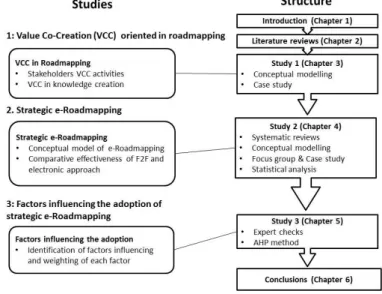
Structure of this study is separated into six chapters, as demonstrated in Figure 1.4, namely Introduction, Literature reviews, Value co-creation oriented roadmapping, Strategic e-Roadmapping, Factors influencing the adoption of e-Roadmapping, and Conclusion.
Figure 1.4 Structure of study
Details of Chapter 2 to 6 are briefly explained as follows;
‘Chapter 2: Literature reviews’ consists of details of related research and concepts, including Roadmapping, and collaborative technology. Related works and concepts discussed in this chapter are essential in supporting the modelling of value co-creation oriented roadmapping, and strategic e-Roadmapping.
‘Chapter 3: Study 1 - Value co-creation oriented roadmapping’ is the first phase that identifies related co-created activities in roadmapping process and concept of value co- creation oriented roadmapping as value co-creation in knowledge creation process.
‘Chapter 4: Study 2 – Strategic e-Roadmapping’ aims to develop the model of e-Roadmapping process and its effectiveness,
‘Chapter 5: Study 3 – Factors influencing the adoption of strategic e-Roadmapping’ focuses on the identification of factors influencing the adoption of e-Roadmapping in organization.
Chapter 6: Conclusions’ includes answers for research questions, theoretical implications, management implications and limitations of the study and future research.
The summary of research methods is shown in Appendix A.
Chapter 2
Literature reviews
This chapter aims to provide a foundation for the research carried out and reported in this dissertation in subsequent chapters. It is split into four main sections; 1) Roadmap and roadmapping, 2) Collaboration technology and 3) Summary.
2.1 Roadmap and roadmapping
A roadmap is a graphical representation of objects, such as markets, technologies, products or resources, and their linkages over time (Cuhls, Vries, Li, & Li, 2015); it is a metaphor for a graphic representation of routes or connections that show different developments over time and into the future (Linnenluecke et al., 2017). A roadmap facilitates mutual understanding and visualizes complex operational strategies among multiple stakeholders and works as a strategic management tool for an organization to integrate technology into business strategy and requirements (Gerdsri, 2013; Gerdsri, Kongthon, & Vatananan, 2013; Li, Zhou, Xue, &
Huang, 2016; Vatananan & Gerdsri, 2012).
Roadmapping is a human-centric strategic management technique that provides the opportunity to participate and engage with one another person or group aimed towards co- created solutions (Kerr et al., 2013). It is also one of the collaborative approaches for transforming organizational change reviewed by (Linnenluecke et al., 2017) and managing R&D planning as well as identifying the future of technological progress at government agencies and organizations (Yonghee et al., 2016). Roadmapping and related concepts are described in the following sub-section.
2.1.1 Framework
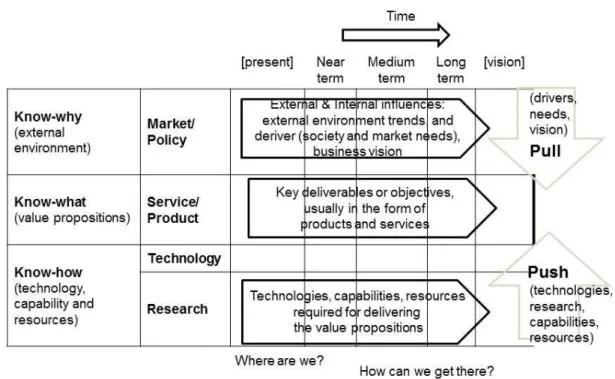
Roadmaps provide a framework within which various types of data and information can be stored, using the terms “know-why”, - what, -how, -when, -who, and –where” (R. Phaal, Farrukh, & Probert, 2005, p. 109). The development of roadmaps is typically an iterative process, which involves periodic review and improvement based on human interaction through meetings and workshops. Regarding the roadmap architecture’s visual dimension, it is in form of the generic roadmap framework presented in Figure 5.
Figure 2.1 The generic roadmap architecture
(Adapted from (Cho & Lee, 2014; Ilevbare, Probert, & Phaal, 2014))
This time-based, multi-layered structure drives data gathering and analysis in line with three key questions: 1) Where are we? 2) Where do we want to go? and 3) How can we get there?
(Ilevbare et al., 2014). The organization’s value propositions (Toro-Jarrin et al., 2016) in format of innovation ideas, products, or services are the key focus in a roadmap’s middle layer. The demand pull from social needs and technology push from research feeds are also considered due to the aim of generating new, innovative technology solutions for individuals and society.
2.1.2 Process
In the roadmapping process, there are four generic stages; initiation and planning, input and analysis, roadmap synthesis and output, and implementation of the roadmap (Gerdsri, Vatananan, & Dansamasatid, 2009; Ilevbare et al., 2014). The input and analysis stage is usually carried out in a workshop-based setting for capturing, sharing and creating knowledge from multiple stakeholders. There are two roadmapping workshop-based approaches (Gerdsri, 2013; R. Phaal, Farrukh, & Probert, 2001; Robert Phaal et al., 2011) which are S-Plan and T-Plan.
S-Plan focuses on general strategic challenges, typically at business, corporate, sector and policy level while T-Plan focuses on product-technology roadmapping. The roadmapping process can be customised to suit the particular application in terms of both architecture and process (Robert Phaal , Farrukh, Mills, & Probert, 2003)
2.1.3 Functions
In the context of supporting organizational activities, roadmapping acts as a focal point and promotes an organizational perspective. Roadmapping also enables different stakeholder groups to reach a consensus on how to appropriately move a creative idea and vision forward (Kerr et al., 2017). Roadmapping facilitates mutual understanding and visualizes complex operational strategies among multi-stakeholders, working as a strategic management tool for organizations to integrate technology into business strategy (Gerdsri, 2013; Li et al., 2016;
Vatananan & Gerdsri, 2012) and changing business requirements (Gerdsri et al., 2013).
The roadmapping process focuses on the sharing of perspectives between people, leading to improved communication, new insights, creativity, learning, and knowledge (R. Phaal et al., 2005). Roadmapping is knowledge creation process. Organizational technology roadmapping also can influence innovation, as roadmapping mediates the indirect relationship between organization foresight and innovation, while perceived organizational support has a moderating effect on the relationship between technology roadmapping and innovation (Yoon, Kim, Vonortas, & Han, 2017).
The concept of value co-creation (VCC) has been emerged in multi-disciplines and getting attention from academics and practitioners as evidenced by numerous studies (Rahman, Toufiq, & Shirahada, 2017). For the organization’s view, VCC is a predominant service
concept that describes the collaboration between multisector stakeholders that creates mutual benefits (Sukholthaman & Shirahada, 2016). VCC refers to organizations and customers who are identified as resources integrators (McColl-Kennedy, Vargo, Dagger, Sweeney, &
Kasteren, 2012). McColl-Kennedy et al. (2012) defined customer VCC as a ‘‘benefit realized from integration of resources through activities and interactions with collaborators in the customer’s service network’’ (p. 1).
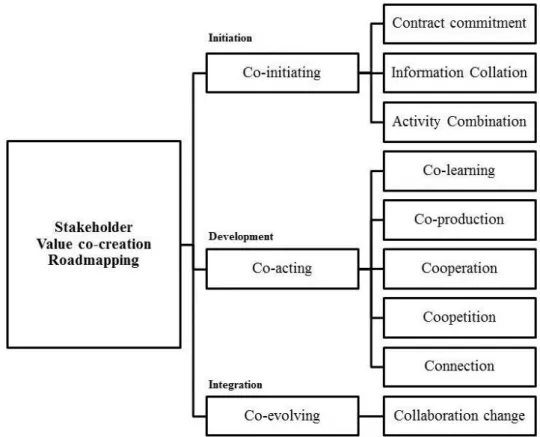
In roadmapping’s view, VCC is practically evidenced in the theme of participant co-created activities which can be categorized as follows: 1) co-learning: participants come from different sectors and backgrounds but they are willing to learn new principles, new working styles, and tools; 2) co-operating: participants have a common interest and willing to join the roadmapping—the participants know what value they can share to create a benefit for other stakeholders; 3) co-production: participants are willing to discuss and/or debate in each workshop, 4) comparing: the information and knowledge from several sources (i.e. academic, government policy, and industry) are compared, and 5) connecting: participants build and maintain their relationship through face-to-face (F2F), online and/or social media tools on an individual and group level to keep in touch and keep working.
2.1.4 Stakeholder management
A stakeholder is “any group or individual that can affect or be affected by the realisation of an organization’s purpose” (Freeman et al., 2010, p. 31). Stakeholder theory is used in many areas such as supply chain management (Busse, Regelmann, & Wagner, 2017), the electric vehicle industry (Lu, Rong, You, & Shi, 2014), the healthcare industry (Jonas & Roth, 2017), and scenario planning (Freeman et al., 2010).
In terms of knowledge and innovation creation, Jonas and Roth (2017) determined that stakeholder integration is implemented in the mode of reactive integration throughout the stages of idea generation, implementation, and testing. Thus, organizations must increase their efforts in understand stakeholder knowledge, skill, and experience as well as values and backgrounds, thereby co-creating improved organizational technology that is innovative.
However, no speculation has taken place concerning co-creation in stakeholder strategic planning, especially using the roadmapping technique.
Typically, the roadmapping process runs as workshop-based, whereby the key stakeholders and domain experts are brought together in order to capture, share, and structure knowledge (Kerr et al., 2012). Contributions from individuals and teams are necessary to assure the successful implementation of any project or process in an organization. Multi-stakeholders involved in roadmapping implementation come from different levels, expertise, and sub- groups both inter- and intra-organization. Gerdsri et al. (2009) identified the important and influential players: idea champions, champion team, roadmapping operation team, support team, and in-house facilitator or external roadmapping consulting team. For roadmapping in the government sector, the National Institute of Standards and Technology of USA, NIST (2010) identified different roles of government engagement in the roadmapping process:
convener/coordinator, technical leader, participant, facilitator, implementer/adopter, funder/enabler, technical advisor, coordinator of federal agency needs, and interested observer (Ho & O'Sullivan, 2017).
Regarding multi-stakeholders’ behavior, roadmapping is a human-centric strategic management technique that provides the opportunity to participate and engage with another person or group to co-create solutions (Kerr et al., 2013) and workshop-based whereby the key stakeholders and domain experts are brought together to capture, share and structure knowledge (Kerr et al., 2012). The process promotes team interaction and participation; it improves communication, engagement, and ownership (Kerr et al., 2013; Toro-Jarrin et al., 2016; Yasunaga et al., 2009; Yonghee et al., 2016).
Task-irrelevant behaviors are addressed primarily through active facilitation and group pressure to complete the task within time limits (Kerr et al., 2012). Petrick (2013) defined the interactive behaviors of stakeholders into three forms: coordination, collaboration, and cooperation that are included in organizational roadmapping. Activities in roadmapping need to be in co-creation form among multi-stakeholders. Then value co-creation of service concept should be applied.
2.2 Service management
2.2.1 Service-dominant logic (S-D logic)
At present, organizations have moved from manufacture to service sector as the global industry and business changed. The logic of service-dominant and value co-creation are moving forward.
The ‘service-dominant logic (S-D logic)’ perspective has recently emerged, focusing on intangible resources, the co-creation of value, and relationships (S. Vargo & Lusch, 2004). R.
Lusch and Nambisan (2015) suggest that S-D logic transcends the tangible-intangible and producer-consumer perspective. They also emphasis the conceptualization of service innovation as: 1) innovation as a collaborative process through an actor-to-actor (A2A) network, 2) service as the application of specialized competences for the benefit of another actor or the self and as the basis of all exchange, 3) the generativity unlocked by increasing resource liquefaction and resource density, and 4) resource integration as a way to innovate.
The integration of internal and external stakeholders is in line with resource integration in S-D logic. Stakeholder integration must be taken into account for innovative project and stakeholder management.
Regarding strategic and innovative thinking, S-D logic is a value creation process that is organizational, strategic, abductive (R. F. Lusch & Vargo, 2014). There are five ways in which S-D logic shapes an organization’s strategic thinking through service ecosystems:
collaboration, value proposing, designing, and configuring. Organizations can apply S-D logic as a strategy (R. F. Lusch & Vargo, 2014) by increasing of the effectiveness of the organization’s roles as an integrator of resources and a co-creator of value through service, skill, and experience exchange while creating value, which involves the integration of multiple resources by multi-stakeholders simultaneously or as part of an integrative process.
Furthermore, value co-creation (VCC) is a central concept of S-D logic and is accomplished through resource integration (S. Vargo & Lusch, 2004; S. L. Vargo & Lusch, 2008; S. L.
Vargo, Maglio, & Akaka, 2008). The concept of VCC has been extensively studied in service literature, VCC is defined as “benefit realized from integration of resources through activities and interactions with collaborators in the customer network” (McColl-Kennedy et al., 2012, p. 374).
For an organization, VCC refers to the collaboration of organization and customer, which are identified as resources integrators, implying mutual benefits from the service of the other through the integration of resources. Activities are defined as performing interactions on the ways individuals engage with others in their service network to integrate resources. VCC has emerged as multidisciplinary, receiving attention from both academics and practitioners, as evidenced by the number of VCC studies in many areas i.e. service ecosystems (Beirão, Patrício, & Fisk, 2016) , library and information services (Braun, Pereira, Sellitto, &
Borchardt, 2015; Rahman et al., 2017), healthcare (McColl-Kennedy et al., 2012), service marketing (Plé, 2016) , stakeholder management (Jonas & Roth, 2017; Merrilees, Miller, &
Yakimova, 2017; Nardelli & Broumels, 2017), social innovation (Polese, Botti, Grimaldi, Monda, & Vesci, 2018), service innovation (Fu, Wang, & Zhao, 2017), leadership (Nie, Shirahada, & Kosaka, 2013), and strategic partnerships (Dibley & Clark, 2011) .
In summary, the VCC process involves three elements: provider, receiver/user, and resources.
The provider plays the role of arranging resources and proposes value through their skill, knowledge, experiences, thereby facilitating VCC through the integration and application of resources and offering the customer to engage in VCC activities. Stakeholder involvement or active interaction is important in the VCC process in order to enhance user value (Rahman et al., 2017). Stakeholder interaction with service provider resources may co-create value by utilising their competences. However, VCC in the roles of stakeholder, provider, and technology, as well as multi-stakeholders, networks, and collaborative contexts, still need a deeper level of understanding (Ostrom, A., David E., Lia, & Christopher A., 2015).
Stakeholder VCC for organizational innovative technology creation remains open for study.
2.2.2 Roadmapping in S-D logic perspective
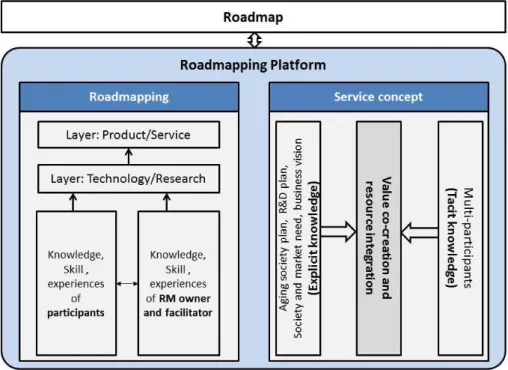
S-D logic concept is based on value co-creation and resource integration; it is in line with roadmapping as it needs resource which is knowledge, skill and experience from multi- participants. Value co-creation and resource integrator in service concepts can be described in roadmapping activities. Regarding service exchange platform of S-D logic, roadmapping also need collaboration platform to exchange, collaborate, communicated throughout the process.
Roadmapping in S-D logic perspective is shown in Figure 2.2.
Figure 2.2 Roadmapping in S-D logic perspective
2.3 Collaboration technology
2.3.1 Information and Communication Technology (ICT)-based roadmapping
ICT has a critical role to support organizations to achieve their goals. Even though online settings and solutions do not cover every user’s needs and cannot replace F2F interaction, they allow for addressing a large group of users with rich content and functionalities for search, recommendation, and interaction (Rohrbeck et al., 2015). In the roadmapping research forum, the scholars mentioned some research opportunities about ICT-enabled roadmapping. Lee et al. (2012) suggested that the use of social network service (SNS) and web-based forms of collaboration would enhance the roadmap creditability. ICT-based tools will be a driving force in the future development of foresight (Keller & von der Gracht, 2014). ICT-based roadmapping will enhance the coordination and increase the productivity of planning activities (Rohrbeck et al., 2015). Raford (2015) suggested that the study of encouraging interactive socialization in F2F, online settings, forms of blended workshops or online engagements should be conducted. Moreover, Phaal (2018) also suggested that works on application software and digital technologies which can support roadmapping and balance the blend of human and digital works are challenging. Wahl and Kitchel (2016) described the internet-based collaboration tools organized by asynchronous use (e.g. email, blogs, wikis, discussion boards), synchronous use (e.g. voice over internet protocol, web conferencing
systems, real-time collaboration), and hybrid use (e.g. shared spaces, text messaging, instant messages or chat). It is proven that ICT connects people across space and time in one common environment (González-Rojas, Correal, & Camargo, 2016) which is ubiquitous and accessible for anyone from any place at any time and any device.
The factors leading to adoption of ICT-based roadmapping in organizations are tools selection and supported software. Regarding roadmapping software, there is software on the market such as SharpCloud, Accolade, and Itonics (Abele, Hammann, et al., 2017; Abele, Schimpf, & Spielberger, 2017). In academia, there are a few roadmapping-supported software applications. S. Lee and Park (2005) and Tieju Ma, Yan, Nakamori, and Wierzbicki (2007) developed a web-based roadmapping support system and Lersmethasakul and Gerdsri (2015) designed a web-based application to determine the status of a roadmap. Finally, ICT, internet and software can be alternative supported tools to enable roadmapping in the organization and also need to be integrated with human aspects of roadmapping.
2.3.2 Computer-supported collaborative work (CSCW)
Regarding the co-working of humans and technology, the model of CSCW systems is made to consider the context of system usage. It is interdisciplinary research investigating collaborative work practices with the aim of designing collaborative technologies and examining the possibilities and effects of technological support for humans involved in collaborative group communication and work processes (Bowers & Benford, 1991). The CSCW Matrix created by (Johansen, 1988) is one conceptualization of CSCW which is categorized according to time and space and classified in four ways: synchronous (i.e. in the same place), synchronous (i.e.in different places), asynchronous (i.e. in the same place), asynchronous (i.e. in different places) (Penichet, Marin, Gallud, Lozano, & Tesoriero, 2007).
CSCW and internet-based tools as e-Collaboration has widely adapted to industry and academia to bring together individuals and groups to work in a common setting (Arinze, 2012; Wahl & Kitchel, 2016). There are past studies about CSCW in different aspects such as process and planning control, wastewater treatment, oil and gas production, vehicle control, security trading, diagnostic work, mobility work (Schmidt & Bannon, 2013), knowledge management (Ackerman, Dachtera, Pipek, & Wulf, 2013), multi-sited-design (Bjørn &
Boulus-Rødje, 2015), social computing (Koch, Schwabe, & Briggs, 2015), and business process (González-Rojas et al., 2016).
2.3.3 Electronic (e)-Collaboration
Electronic collaboration or e-Collaboration is described by (N Kock, Davison, Ocker, &
Wazlawick, 2001, p. 1) as “collaboration among individuals engaged in a common task using technologies” and not only limited to Computer Mediated Communication (CMC) or Computer Supported Cooperative Work (CSCW) but also online collaboration (Ned Kock &
Nosek, 2005). E-Collaboration is about information sharing among individuals and organizations for the purposes of planning, coordinating, planning, improving efficiency and effectiveness. Organizations exchange information through people, process and technology, and increasingly rely on e-collaboration software to make it happen.
Ostrand et al. (2016) describe the significance of e-Collaboration software consists of (1) name recognition, (2) interpersonal facilitation, (3) clarity/simplicity, (4) cost consideration, and (5) mobile accessibility. Lomas, Burke, and Page (2008) state that good e-Collaboration tools should provide (1) strong communication capability, (2) easy-to-understand interface, (3) ambient communications, (4) document construction, and (5) sharing documents and files.
The evolving area of ICT-supported collaboration represents a huge potential for organizations of all activities.
2.3.4 Collaboration platforms
Regarding service concept on value co-creation (VCC) refers to the collaboration of organization and stakeholders, which are identified as resource and knowledge integrators.
A common collaboration platform to integrate resources is needed. This platform can be either a physical (face-to-face) or virtual (electronic) platform. In terms of knowledge management, knowledge creation represents a continual process and effective management and creation of new knowledge is an integral part of any organization (Sujatha &
Krishnaveni, 2017).
Nonaka and Toyama (2003) defined ‘ba’ as a platform where information is given meaning through interpretation to become knowledge. Sujatha and Krishnaveni (2017) proposed
‘Cyber ba’ to configure this as a knowledge creation platform and enhance IT adaptability and work performance. Regarding value co-creation and co-innovation, Romero and Molina (2011) defined strategic networks such as collaborative network organizations and virtual communities as high-potential drivers. Mačiulienė and Skaržauskienė (2016) identified the
networked collaboration platforms as a source for improving and stimulating internal and external co-creation opportunities.
From the roadmapping aspect, a number of research opportunities mentioned (i.e. J. Lee et al.
(2012) suggested that the use of social networking and web-based forms of collaboration would serve and enhance roadmap creditability. Information and communication technology (ICT)-based tools will become a driving forces in the future development of foresight (Keller
& von der Gracht, 2014), and ICT-based roadmapping would enhance coordination, thereby increasing the productivity of planning activities (Rohrbeck et al., 2015). Raford (2015) suggested that the study of encouraging interactive socialization in face-to-face, online settings in the form of blended workshops or online engagement should be conducted.
Additionally, Phaal (2018) suggests research and development linked to work on application software and digital technologies should continue, which can support roadmapping and balance the blend of human and digital works.
As above previous studies mentioned, VCC process in roadmapping can be implemented via collaboration platforms, i.e. online communities and social networks. Electronic (e)- Collaboration (Choi & Ko, 2012; Munkvold, 2018) with IT-enabled collaboration, can promote innovative co-creation by using seamless collaboration and communication through online real-time tools, mobile applications, devices, and environments in the organizational innovation process (Boling et al., 2014; Wong, Peko, Sundaram, & Piramuthu, 2016).
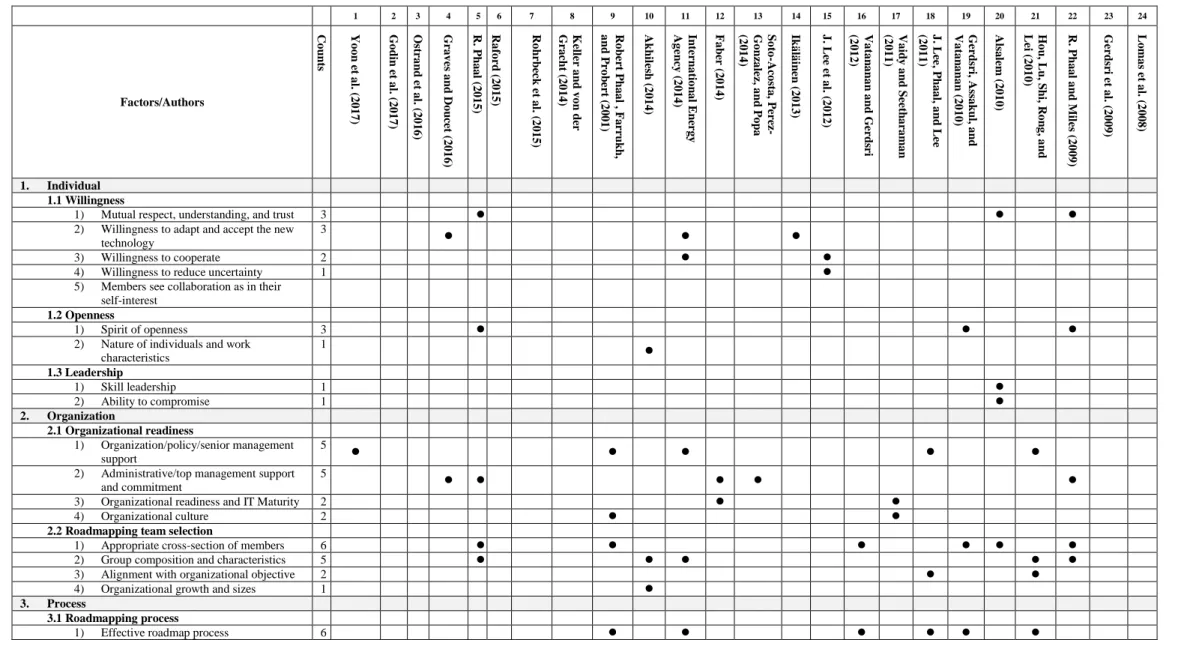
Therefore, Cyber ba, e-Collaboration, and IT tools can enable collaborative planning for creating organizational knowledge and innovative technology. For additional, we conducted literature review of the factors of roadmapping in combination with collaboration technology as shown in Table 2.1.
2.4 Summary
2.4.1 Gaps in existing literature
Scholars have successfully developed stakeholder theory and strived to apply the theories primarily at an organization level in terms of service, technology, and strategic management.
For collaborative strategic planning with roadmapping, the process of roadmapping is more valuable than the roadmap itself due to the communication, collaboration, and consensus generated among organizations and stakeholders (Lu et al., 2014). Moreover, roadmapping is
also searching for the integration of appropriate tools and concepts into the organizational roadmapping process and its operations (Vatananan & Gerdsri, 2012). However, the limitations of space and time decrease the degree of participation and need a mechanism to increase the degree of communication among stakeholders in the roadmapping process.
Virtual settings and real-time online tools can support the process, as these mechanisms allow participation from individuals who are not able to attend meetings (Kerr et al., 2013), providing the chance for all parties to actively provide their input and become involved in a seamless roadmapping process.
The first research opportunities exist for studying stakeholder management, service concept, service design, and innovation in the seamless roadmapping process. Based on this gap, the first research question of this study is what stakeholders should do in co-creating value for planning innovative technologies throughout the roadmapping process.
In another aspect with collaboration technology, the second research gaps need to be considered, while also focusing on the virtual approach with internet-based roadmapping that not only overcomes the limitation of space and time but also increases the degree of communication. There is a research opportunity on roadmapping for organizational strategic planning. Organizations can exchange information through participants, processes, and technologies, increasingly relying on CSCW and e-Collaboration tools to make strategic planning happen. This second study contributes to the development of ICT-enabled and internet-based strategic roadmapping, still an under-explored topic.
Lastly, the management implication of strategic electronic roadmapping can be exemplified with the influencing factors the adoption of electronic roadmapping in organization. The last key research question is how to conduct value co-creation oriented strategic electronic roadmapping.
2.4.2 Summary
This chapter has given an overview of strategic roadmapping, value co-creation and collaboration technology, and positioned these within the contexts of strategic planning. It has also identified a gap in knowledge, concerning how value co-creation oriented are addressed in strategic roadmapping, both in theory and practice. The conceptual approach will be discussed in detail in the following study by chapter.
Table 2.1 Factors influencing the adoption of roadmapping with collaboration technology
1 2 3 4 5 6 7 8 9 10 11 12 13 14 15 16 17 18 19 20 21 22 23 24
Factors/Authors
Counts Yoon et al. (2017) Godin et al. (2017) Ostrand et al. (2016) Graves and Doucet (2016) R. Phaal (2015) Raford (2015) Rohrbeck et al. (2015) Keller and von derGracht (2014) Robert Phaal , Farrukh, and Probert (2001) Akhilesh (2014) International EnergyAgency (2014) Faber (2014) Soto-Acosta, Perez-Gonzalez, and Popa(2014) Ikäläinen (2013) J. Lee et al. (2012) Vatananan and Gerdsri (2012) Vaidy and Seetharaman(2011) J. Lee, Phaal, and Lee(2011) Gerdsri, Assakul, andVatananan (2010) Alsalem (2010) Hou, Lu, Shi, Rong, andLei (2010) R. Phaal and Miles (2009) Gerdsri et al. (2009) Lomas et al. (2008)
1. Individual 1.1 Willingness
1) Mutual respect, understanding, and trust 3
2) Willingness to adapt and accept the new technology
3
3) Willingness to cooperate 2
4) Willingness to reduce uncertainty 1
5) Members see collaboration as in their self-interest
6) 1
7) 8) 9) 10) 11) 12) 13) 14) 15) 16) 17) 18) 19) 20) 21) 22) 23) 24) 25) 26) 27) 28) 29) 30) 1.2 Openness
1) Spirit of openness 3
2) Nature of individuals and work characteristics
1
1.3 Leadership
1) Skill leadership 1
2) Ability to compromise 1
2. Organization
2.1 Organizational readiness
1) Organization/policy/senior management support
5
2) Administrative/top management support and commitment
5
3) Organizational readiness and IT Maturity 2
4) Organizational culture 2
2.2 Roadmapping team selection
1) Appropriate cross-section of members 6
2) Group composition and characteristics 5
3) Alignment with organizational objective 2
4) Organizational growth and sizes 1
3. Process
3.1 Roadmapping process
1) Effective roadmap process 6