Japan Advanced Institute of Science and Technology
https://dspace.jaist.ac.jp/
Title 三元触媒作用のためのハイスループット実験の設計
Author(s) TRAN, PHUONG NHAT THUY Citation
Issue Date 2020‑09
Type Thesis or Dissertation Text version ETD
URL http://hdl.handle.net/10119/17005 Rights
Description Supervisor:谷池 俊明, 先端科学技術研究科, 博士
Doctoral Dissertation
Design of High-Throughput Experiments for Three-Way Catalysis
Thuy Phuong Nhat Tran
Supervisor: Assoc. Prof. Toshiaki Taniike
Graduate School of Advanced Science and Technology Japan Advanced Institute of Science and Technology
[Materials Science]
September 2020
Referee-in-chief: Associate Professor Toshiaki Taniike
Japan Advanced Institute of Science and Technology Referees: Associate Professor Yuki Nagao
Japan Advanced Institute of Science and Technology Associate Professor Shun Nishimura
Japan Advanced Institute of Science and Technology Associate Professor Dam Hieu Chi
Japan Advanced Institute of Science and Technology Associate Professor Keisuke Takahashi
Hokkaido University
Design of High-Throughput Experiments for Three-Way Catalysis
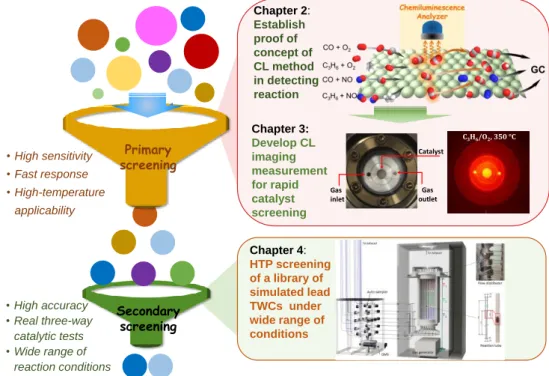
Tran Phuong Nhat Thuy 1720416 To meet the increasingly stringent legislation for the gasoline engine exhaust emission, the exhaust aftertreatment systems need a breakthrough in the research and development of three-way catalysts (TWCs). While the catalysis society has made enormous efforts focusing on materials aspects for seeking the best or novel catalyst formulations, the development in methodology aspects, especially high-throughput (HTP) approaches, has just emerged to hold a great promise in that regard. Even though HTP catalyst screening techniques have become a mature and well-established tools in many catalytic systems, their applications in the TWCs have been hardly reported due to both technical and material constraints. The diversity and complexity of the catalytic system and reaction conditions necessitate a primary screening technique to quickly and broadly screen a huge parametric space. This catalytic system also requires highly accurate screening tools to distinguish the activity in a one-digit difference, signifying the essential of implementing secondary screening with higher precision. Therefore, the aim of this thesis is to design an integrated HTP screening protocol for the development of the TWCs.
The upstream of the hierarchical HTP workflow is the primary catalyst screening, which typically requires a fast and non-intrusive technique being capable of truly parallelized screening, preferably based on an optical method. For that, a novel chemiluminescence (CL) method was developed with special emphasis on high- temperature gaseous catalysis. In Chapter 2, the proof of concept of the CL method was formulated by thoroughly studying the CL behavior of the catalytic oxidation of CO and C3H6 by of O2 and/or NO, which are the major processes in a catalytic converter, under both stoichiometric and non-stoichiometric conditions. In this stage, a CL instrument was developed based on the cooperation among a gas mixer, a custom-made CL analyzer using a photonmultiplier as a detector, and an on-line gas chromatography (GC) for simultaneous analysis of the effluent mixture from the CL reactor. The CL activity of these oxidation reactions was confirmed by temperature-ramping measurements, where the CL intensity showed an exponential behavior against the temperature irrespective of catalysts. Steady-state measurements demonstrated a linear relationship between the CL intensity and reactions rate regardless of stoichiometry, thus the CL intensity is a good measure of the reaction rate. The capability of the CL method in rapid catalyst screening was confirmed by a good linear correspondence between the CL intensity and the catalytic activity in C3H6 oxidation by O2 for a series of Rh-based catalysts In Chapter 3, a CL imaging instrument was designed for achieving primary screening of the TWCs. The CL imaging instrument was equipped a reactor cell for gaseous catalysis and electron multiplying charged-coupled device camera for single photon detection in the form of images. The CL imaging technique exhibited the feasibility of a simple, straightforward, and rapid evaluation of catalytic activity based on a good correlation between the CL intensity and the C3H6 conversion.
In addition, the one-to-one correspondence of the CL intensity obtained from the single and parallel measurement signified the great potential of the CL imaging technique in HTP catalyst screening. Chapter 4 describes the HTP secondary screening of a simulated lead TWCs library based on a HTP screening instrument featured with fully- automated catalytic evaluation of 20 reactor channels in a wide range of conditions with the aid of a quadruple mass spectrometer. The instrument allowed generation of a large
process-relevant dataset at high accuracy, which is satisfactory for the secondary screening. Three-way catalytic reactions were conducted in 49 conditions over 20 catalyst samples, affording 980 data points in one operation. The obtained dataset is of high quality and accuracy, and the catalyst performance (in terms of light-off temperature and width of stoichiometric window) were found consistent with literature data. The reaction conditions cover a wide range of temperature and air/fuel equivalence ratio , allowing the multi-aspect comparison of the TWCs.
Figure 1. The developed high-throughput approach for three-way catalyst.
Keywords: Three-way catalysts, high-throughput catalyst screening, chemiluminescence imaging, high-throughput screening instruments.
Primary screening
Secondary screening
Chapter 2:
Establish proof of concept of CL method in detecting reaction
Chapter 3:
Develop CL imaging measurement for rapid catalyst screening
Chapter 4:
HTP screening of a library of simulated lead TWCs under wide range of conditions
•High accuracy
•Real three-way catalytic tests
•Wide range of reaction conditions
•High sensitivity
•Fast response
•High-temperature applicability
Gas inlet
Gas outlet Catalyst
C3H6/O2, 350 °C
Preface
The present thesis is submitted for the Degree of Doctor of Philosophy at Japan Advanced Institute of Science and Technology, Japan. The thesis is consolidation of results of the research work on the topic “Design of High- Throughput Experiments for Three-Way Catalysis” and implemented during October 2017–September 2020 under the supervision of Assoc. Prof. Toshiaki Taniike at Graduate School of Advanced Science and Technology, Japan Advanced Institute of Science and Technology.
Chapter 1 is a general introduction, which explains fundamental as well as specific background of the research field, followed by the objective of this thesis.
Chapter 2 provides comprehensive understanding about the chemiluminescence behavior of the catalytic oxidation of CO and hydrocarbon, then demonstrating the potential of the chemiluminescence method on rapid catalyst evaluation. Chapter 3 reports the development of a chemiluminescence imaging instrument and its feasibility in primary catalyst screening for high-temperature gaseous catalysis.
Chapter 4 describes a high-throughput screening protocol for a library of three-way catalysts under wide range of reaction conditions. Finally, Chapter 5 summarizes the important findings and conclusions of this thesis. To the best of my knowledge, this work is original, and no part of this thesis has been plagiarized.
Tran Phuong Nhat Thuy
Graduate School of Advanced Science and Technology Japan Advanced Institute of Science and Technology September 2020
6
Acknowledgements
I wish to express my sincere gratitude and deepest appreciation to my supervisor, Associate Professor Dr. Toshiaki Taniike for his mentorship, encouragement, and guidance during the past five years. His endless enthusiasm, passion in science and working attitude has inspired me a lot in doing research. This work would never have been completed without his great help and advisor.
To the members of my review committee: Assoc. Prof. Yuki Nagao (JAIST), Assoc. Prof. Shun Nishimura (JAIST), Assoc. Prof. Dam Hieu Chi (JAIST), and Assoc.
Prof. Keisuke Takahashi (Hokkaido University), I would like express my grateful appreciation for their valuable time to read this thesis, their insightful comments and remarks to enhance the quality of this thesis from various perspectives.
I would also take an opportunity to express my sincere gratitude to Associate Professor Shun Nishimura for his enthusiastic guidance and valuable advices in my minor research project.
My special thanks also go to Senior Lecturer Patchanee Chammingkwan, Dr.
Ashutosh Thakur, and Dr. Toru Wada for their enthusiastic supports and advices.
I am heartily grateful to all members in Taniike laboratory for their kindness, great help and accompany not only in research but also in daily life.
I also show my heartiest thanks for Toyota Motor Corporation for their collaboration in doing the research.
I would like to thank the Ministry of Education, Cultures, Sports, Science and Technology of Japan for their scholarship during my stay in Japan.
7 I would like to express my sincere thanks to Japan Advance Institute of Science and Technology (JAIST) for giving me an excellence chance to join and do the most advanced research here. I deeply appreciate JAIST officials and JAIST staffs for their kind support all the time.
Lastly, I express my heartfelt gratitude to my family members for their unconditional love, taking care and encouraging me all the time.
TRAN PHUONG NHAT THUY
8
Table of contents
Chapter 1: General introduction ... 10
1.1. Exhaust emission and regulation ... 11
1.2. Early automotive catalysts ... 15
1.3. Three-way catalysts ... 18
1.3.1. Working principle ... 18
1.3.2. Formulation ... 21
1.3.3. Future perspectives ... 24
1.4. High-throughput experiments in heterogeneous catalysis ... 25
1.4.1. Impact of high-throughput screening on catalysis ... 25
1.4.2. Primary screening ... 28
1.4.3. Secondary screening ... 35
1.4.4. High-throughput screening in automotive catalysts ... 37
1.5. Purpose of the thesis ... 38
Chapter 2: Understanding chemiluminescence in catalytic oxidation of CO and hydrocarbons ... 45
2.1. Introduction ... 47
2.2. Experimental ... 50
2.2.1. Materials ... 50
2.2.2. Instrumental ... 50
2.2.3. Catalytic test ... 53
2.3. Results and discussion ... 57
2.4. Conclusions ... 70
Chapter 3: Development of Chemiluminescence Imaging Instrument for Rapid Catalysts Screening in Gas-Phase Reaction: A Case Study of Hydrocarbon Oxidation ... 74
9
3.1. Introduction ... 76
3.2. Experimental ... 79
3.2.1. Materials ... 79
3.2.2. Catalyst characterization ... 79
3.2.3. Instrumental ... 79
3.2.4. Catalytic test ... 81
3.3. Results and discussion ... 83
3.4. Conclusions ... 97
Chapter 4: High-throughput screening of a three-way catalyst library for automotive applications ... 100
4.1. Introduction ... 102
4.2. Experimental ... 104
4.2.1. Establishment of the simulated lead TWC library ... 104
4.2.2. Catalyst preparation ... 105
4.2.2. High-throughput screening system ... 106
4.2.3. Catalytic test ... 109
4.3. Results and discussion ... 111
4.4. Conclusions ... 124
Chapter 5: General summary and conclusions ... 129
5.1. Summary of the thesis ... 130
5.2. General conclusions and perspectives ... 131
List of Publications and Other Achievements ... 133
10
Chapter 1
General introduction
11 1.1. Exhaust emission and regulation
After the World War II, the motor vehicle manufacturing industry has witnessed a steady growth, amounting up to 98 million units produced worldwide in 2018 [1].
According the data reported in the first half of 2019, approximately 90% of global vehicles sale is internal combustion engine vehicles, which are mainly powered by gasoline [2]. Air quality deterioration caused by engine exhaust emission has then occurred as an inevitable consequence. In principle, the energy for the internal combustion engine vehicles is generated through the controlled combustion of gasoline, which is predominantly comprising hydrocarbons (HCs) such as paraffins, cycloalkane, olefins, and aromatics. The process yields complete combustion products of CO2, water as well as incomplete combustion products of CO (1–2 vol.%), unburned HCs (500–
1000 vppm), and low level of partially combusted oxygenates such as carboxylic acids, aldehydes or ketones [3]. During the combustion, NOx (100–3000 vppm) was also formed as a result of thermal fixation of N2 in the atmosphere at high temperature [4].
Three major pollutants contained in the gasoline engine exhaust are therefore CO, HCs, and NOx. CO has been best known for its toxicity to human health as just a few thousands ppm is lethal [5]. The toxicity level of HCs varies depending on the type of HCs. Benzene, for example, has been well-known as a carcinogen, and 80% of benzene in the atmosphere comes from the gasoline engine exhaust [6]. Alkenes can react with NOx to generate secondary pollution such as tropospheric ozone and photochemical smog [7]. Among NOx, NO2 is the most toxic as it can damage lung tissues and interfere with oxygen transport in blood via reaction with hemoglobin [8]. The interaction between HCs and NOx in the gasoline engine exhaust promoted by sunlight is primarily responsible for the photochemical smog, which is severe air pollution in many urban areas [9,10].
12 Legislation requirement
The first global action to raise the environmental awareness on the control of gasoline engine exhaust emission was initiated in 1970, when the US congress passed the comprehensive federal law called Clean Air Act (CAA) to regulate exhaust emission from the internal combustion engines. The CAA required the reduction of 90% of CO and unburned HCs by 1975 and 50% NOx by 1976 [11]. Initially, the automotive industry adopted this legislation by means of implementing several modifications in engine design and control technology to lower the exhaust emission. Despite some achieved emission improvements, these efforts could not alone satisfy the 1975 US Federal and Californian emission limits. As a result, a catalytic converter, which converts the pollutants in gasoline engine exhaust into less harmful compounds by catalyzing their redox reactions, was considered as the most efficient way forwards.
Since then to now, the continuing growth of the number of vehicles as well as the advancement of catalyst and engine technology has resulted in more and more stringent emission regulations. Figure 1.1 illustrates the annual changes in the emission standards for non-methane HCs and NOx in the US, implying that the exhaust emission control is one of the most rapidly developing technologies. The most updated standards are the California low-emission vehicle (LEVIII) and the Federal US Tier 3, which are described as the cumulative amount of non-methane HCs and NOx per km with the automotive catalyst durability of 150000 miles or 15 years. The Tier 3 regulation requests a decrease on the emission of these gases to 0.018 g/km by 2025, corresponding to over 99.5% reduction of CO, HCs, and NOx [12,13].
13 Figure 1.1. Fleet average non-methane hydrocarbons and NOx emission standard in the low-emission vehicles (LEV III) and Tier 3. The graph is plotted based on the data from Ref. [13].
The legislation requirement for automotive emission has become stricter also in other continents. The United Nations Economic Commission for Europe (ECE) instituted the Urban Driving Cycle ECE-15 in 1970 to describe the typical usage of vehicles in European cities [14]. At that time, the first base directive 70/220/EEC was introduced to set the emission standards for CO and HCs. The directive was then consolidated as 91/441/EEC in 1991, forming the EURO I, which was the first mandatory European vehicle emission standard [15]. In 1997, the New European Driving Cycle (NEDC) was updated and consisted of four repeated ECE-15 urban driving cycles and one Extra-Urban driving cycle, resulting in the EURO II standard.
Most recently, the NEDC was replaced by EURO 6 in 2014, in which vehicular CO, none-methane HCs, and NOx emission targets were set as 1.000, 0.068, and 0.060 g/km, respectively. The overview of EURO standards is given in Table 1.1 [15,16].
0 0.02 0.04 0.06 0.08
2014 2016 2018 2020 2022 2024 2026 HCs + NOx (g/km)
Model year
Passenger car, Light-duty truck 1
Light and medium-duty passenger vehicle
14 Table 1.1. European standards for gasoline fueled vehicles (g/km) [15].
Year CO HCs HCs + NOx NOx
EURO 1 1991 2.72 - 0.97 -
EURO 2 1996 2.2 0.5
EURO 3 2000 2.3 0.2 - 0.15
EURO 4 2005 1.0 0.1 - 0.08
EURO 5 2009 1.0 0.1 - 0.06
EURO 6 2014 1.0 0.1 - 0.06
In China, the China’s Ministry of Environmental Protection released the final China 6 light-duty vehicle regulations in 2016, phasing over two steps: China 6a regulations enforced in 2020, which was based on the EURO 6, and China 6b enforced in 2023. China 6a sets CO, non-methane HCs, and NOx emission targets of 0.700, 0.068 and 0.060 g/km, respectively. The regulation is much more tightened in China 6b, where the CO and HCs emission limits lower by 50% and NOx lower by 40%.
Furthermore, China 6b also limits the N2O emission level of 0.020 g/km [11,17]. In 2020, the Government of India has finalized their decision on the emission regulation to leapfrog from EURO 4-equivalent directly to EURO 6-equivalent standards. In the last updated regulation, the exhaust emission from light-duty gasoline automobiles is targeted using the modified NEDC as CO of 0.100 g/km, non-methane HCs of 0.068 g/km and NOx of 0.060 g/km [14,17]. These targets are very challenging and certainly require significant improvement in automotive catalysis technology.
From the overview of the legislation requirements for vehicle exhaust emission in different continents, it is clear that the regulations became globally more stringent in dealing with the rising levels of hazardous atmospheric pollutants due to rapid growth
15 of global vehicle sales, while the worldwide efforts to lower the emission is advancing.
In order to meet the newest regulations, it is required for the reduction of more than 99.5% of pollutants in tail pipe emission. This challenging task would emphasize the significance of continuous development of novel and highly durable automotive catalyst materials for the catalytic converter.
1.2. Early automotive catalysts
The motor vehicle manufacturing industry started to consider the development of an exhaust aftertreatment system in order to meet the increasingly stringent emission legislation, which could not be satisfied only with the engine modifications. During the adoption of the first CAA in 1970s, the main target of the catalytic converter was to achieve complete combustion of CO and HCs. On the other hand, the engine manufacturers employed a non-catalytic exhaust gas recirculation technique for NOx
removal: A certain amount of the exhaust containing N2, CO2, and H2O was recycled into a combustion chamber. This strategy helps improve the heat capacity and thus reduce the combustion temperature, leading to less thermal NOx formation [11]. For CO and HCs oxidation in the catalytic converter, base metal oxides and platinum group metals (PGMs) were proposed as two good candidates. Base metal oxide catalysts, basically containing nickel, cobalt or copper, are cost-effective and readily available;
however, they were found very sensitive to lead- and sulfur- poisoning and exhibited insufficient thermal durability [18,19]. The PGMs were attractive due to their excellent oxidation activity, despite their high cost and limited availability. According to a study of Kummer group in 1975 on the comparison of these two candidates for automotive catalysts, the PGMs were much more active in CO and HCs oxidation compared to the
16 base metal oxides [20]. Even though the low activity of the base metal oxides could be compensated by increasing their amount with a larger reactor volume, this solution would cause a space issue for the engine exhaust underfloor piping. During that period, considerable efforts were made to enhance the oxidation activity of base metal oxide systems, especially Cu-based catalysts; however, their usage as primary automotive catalysts for vehicle emission control has been hardly commercialized so far.
In the case of the PGMs, their mechanical and catalytic deterioration during the operation necessitated the use of supports and an immobilization method thereon. For this, -Al2O3 was employed to disperse the active metal species due to its high surface area and relatively good thermal stability. However, the sintering of - Al2O3 to a lower surface area was noticed after aging at high temperature (typically 900 °C), leading to the burial of the active species and preventing the access of the exhaust to them. These naturally resulted in a loss of catalytic activity [3]. Enormous research had been conducted toward minimizing the sintering of -Al2O3 and understanding its mechanism. It was found that proper incorporation of oxides such as La2O3, CeO2 or BaO during the preparation process exhibits an outstanding stabilizing effect on - Al2O3 and significantly slows down the sintering [21,22].
In parallel with the studies on the choice and combination of catalytic components as well as the suppression of deactivation, another important issue that the engine manufacturers had to address was how to position the catalyst in the exhaust.
The most conventional method was to use the beaded catalysts where stabilizing oxides and active species were loaded on -Al2O3 support. At that time, this conventional reactor design worked to attain sufficient CO and HCs removal efficiency. One considerable concern was the attrition of the beads induced by their motion against each
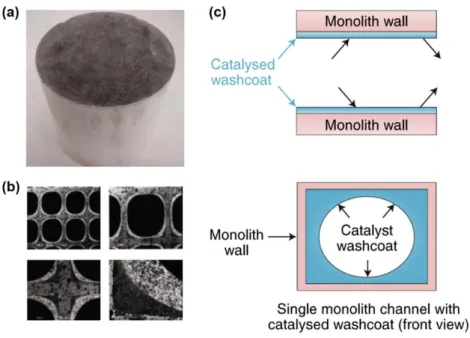
17 other under the gas flow and vibration of the vehicles. The occurrence of gas bypass also led to poor performance [3,19]. This issue was addressed by using a ceramic honeycomb monolith with a multi-channel structure (Figures 1.2a,b) [23]. A thin layer of -Al2O3 containing well-dispersed active metal species and stabilizers is deposited onto the channel walls, that is referred as a washcoat layer (Figure 1.2c). The high surface area of the washcoat enables high conversion despite low residence time. The monoliths are basically made of cordierite (2MgO·5SiO2·2Al2O3), a low thermal expansion ceramic material, which is able to provide sufficient mechanical strength and cracking resistance under thermally stressed conditions. This honeycomb design exhibits several advantages, including improved heat and mass transfer rates, low- pressure drop, increased flexibility in reactor design, and high adaptability to an exhaust manifold. Thus, the honeycomb monolith configuration was recognized as the optimal physical structure for the catalytic converters.
Figure 1.2. Catalytic converters with a honeycomb monolith configuration: (a) Cordierite honeycomb monolith, (b) SEM micrographs of a wash coated monolith, and
18 (c) schematic images of a wash coated monolith. The figure is reproduced from Ref.
[17].
In summary, the first-generation automotive catalysts were composed of Pt and Pd as catalytic active components, -Al2O3 as the support, CeO2, La2O3 or BaO as the stabilizer for the support. A ceramic honeycomb monolith was washcoated by the catalysts.
1.3. Three-way catalysts
1.3.1. Working principle
In the early 1980s, the emission regulations for NOx became more tightened and it became obvious that the non-catalytic exhaust gas recirculation system itself would not meet the demand of over 90% NOx conversion. At that time, Rh was recognized as an excellent catalyst for NO/NO2 reduction [24–27]. A bimetallic Pt/Rh catalyst then became predominated in automotive catalyst formulations, and a double-catalyst bed design was employed for the conversion of all three pollutants. The engine operated under slightly fuel rich condition, creating reducing atmosphere for NOx reduction by CO and HCs in the first Pt/Rh-containing bed. Subsequently, the second bed was supplied to oxidize the residual CO and HCs by air [28,29]. During practical operation of the double-catalyst bed, NH3 was formed as a by-product of NO reduction in the first bed, then the re-oxidation of NH3 occurred in the second bed, eventually leading to lower NO conversion at the end of the pipe [25]. This issue prompted the automotive industry to develop a single-catalyst bed capable of simultaneous removal of all three pollutants, so-called “three-way catalysts” (TWCs). A typical automotive catalyst design is schematically demonstrated in Figure 1.3.
19 Figure 1.3. Schematico cut away of a three-way catalytic conventer. The figure is reproduced from Ref. [3].
The uniqueness of the TWCs is that it works mainly around stoichiometric air/fuel (A/F) ratio that is suitable for the oxidation of CO and HCs and the reduction of NOx. The three-way catalytic converters require three major components [19]:
i) Electronic fuel injection
ii) Two O2 sensors placed at the inlet and outlet of the catalytic converter to measure the O2 content of the feed and the effluent.
iii) A feedback control loop to adjust the amount of fuel entering in the catalytic converter to keep the exhaust composition around the stoichiometric point. The signal from the O2 sensors is used for the feedback.
20 The stoichiometric value of the A/F ratio ((A/F)stoich.) is determined as follows: Octane (C8H18) is selected as a representative species for gasoline, its complete combustion by air is described by the following equation:.
𝐶8𝐻18+ 12.5 𝑂2 → 8𝐶𝑂2 + 9𝐻2𝑂
The (A/F)stoich. is then defined as:
(𝐴/𝐹)𝑠𝑡𝑜𝑖𝑐ℎ. = 𝑀𝑎𝑠𝑠 𝑜𝑓 𝑎𝑖𝑟
𝑀𝑎𝑠𝑠 𝑜𝑓 𝑓𝑢𝑒𝑙 ≈ 14.7
The ratio between the real feed and the stoichiometric feed is called the A/F equivalence ratio or lambda ():
𝜆 = (𝐴/𝐹) (𝐴/𝐹)𝑠𝑡𝑜𝑖𝑐ℎ.
Figure 1.4 describes typical performance of the TWCs at different A/F ratios as well as values: At < 1 (A/F < 14.7), the exhaust is fuel rich or O2 deficient, then the NOx reduction by HCs and CO readily occurs, whereas the CO and HCs oxidation are not completed due to the lack of O2. At > 1 (A/F > 14.7), the exhaust is fuel lean or O2 excess, then the oxidation reactions are predominant while the NOx reduction is sacrificed.
21 Figure 1.4. Typical performance of a three-way catalyst as a function of A/F ratio as well as value (A/F equivalence ratio). Green line demonstrates the stoichiometric condition, correponding to A/F = 14.7 and =1. The figure is reproduced from Ref.
[17].
1.3.2. Formulation
The chemistry on the TWCs has been acknowledged as one of the important subjects in the field of environmental catalysis [30]. Today the TWCs typically consist of: i) a honeycomb monolithic substrate made of a cordierite (2MgO·5SiO2·2Al2O3) or stainless-steel, ii) high-surface-area -Al2O3 as the support, iii) an oxygen storage material, iv) catalytic components (Pt, Pd and Rh), and/or v) a promoter. As the detailed description on the substrate, support and active species were provided in former parts,
22 this section will focus on a unique component of the TWCs, that is the oxygen storage material.
The A/F ratio adjustment in gasoline vehicles is essential as the operation of the TWCs is only performed in close proximity to the stoichiometric point. The O2 sensor and the feedback control loop themselves are not sufficient as a slight oscillation of the exhaust composition around the stochiometric point is frequently observed. This is mainly due to the response time of the O2 sensor and a time lag in the feedback system.
Therefore, it is necessary to auxiliarily supply a small amount of O2 to complete the oxidation of the unreacted CO and HCs under fuel-rich conditions. Conversely, it was also essential to consume O2 when the exhaust goes slightly oxidizing. This was accomplished by the development of an O2 buffer material, which was so-called an oxygen storage component (OSC) to buffer the gas composition perturbations [31,32].
CeO2 was found to have a proper redox response and has been the most commonly used OSCs in the modern three-way catalytic converters. CeO2 is able to store/release O2
with respect to the oxidizing/reducing conditions due to the Ce4+/Ce3+ redox cycle.
Under the shortage of O2 ( < 1), CeO2 is reduced to Ce2O3. This in turn supplies O2 to oxidize CO and HCs. When O2 becomes excess due to the perturbation, Ce2O3 is recovered to CeO2. The whole process is described in Figure 1.5.
23 Figure 1.5. The function of CeO2 as an oxygen storage component under a redox condition in the automotive exhaust application. The figure is reproduced from Ref.
[33].
The early implementation of the CeO2-containing TWCs showed that the interaction between noble metal and CeO2 is lost during the thermal ageing and this triggers the catalyst deactivation [34]. The catalyst deactivation was associated with the two different phenomena: i) sintering of noble metal particles resulting in a loss of metal surface area, and ii) sintering of CeO2 resulting in a deterioration in the oxygen storage capacity [35]. To address this issue, extensive efforts have been made to enhance the thermal stability of CeO2 based on finding stabilizers/promoters, and ZrO2 appeared to be the most efficient [35,36]. The presence of ZrO2 prevents the occurrence of undesirable reactions between CeO2 and Al2O3, avoiding the deterioration of Ce4+/Ce3+
redox couple due to the formation of the undesired CeAl2O3 mixed oxide [35–37].
Moreover, the incorporation of the smaller isovalent Zr4+ (ionic radius of 0.84 Å) into the CeO2 lattice (ionic radius of Ce4+ is 0.97 Å) generates defective sites which greatly
CO + CeO2→ Ce2O3+ CO2 CxHy+ CeO2→ Ce2O3 + CO2+ H2O
Ce2O3+ O2→ CeO2 Ce2O3+ NOx→ CeO2+ N2
Fuel rich (oxygen lean)
Fuel lean (oxygen rich)
24 promote the mobility of O2 from the bulk to the surface of CeO2. The diffusion rate of O2 was consequently improved, leading to the enhanced reducibility of Ce4+. Therefore, the oxygen storage capacity of CeO2-ZrO2 mixed oxide is much higher than those of pure CeO2 [37–39].
Besides the most important role as an O2 buffer, CeO2-based oxides also offer various benefits for the TWCs, such as i) promoting the metal dispersion, ii) improving the thermal stability of the -Al2O3 support by preventing its sintering, and iii) promoting the CO removal via oxidation with lattice O2.
1.3.3. Future perspectives
Nowadays, the stringent level of the emission regulations has been continuously rising due to the rapid increase in the number of vehicles. Therefore, the advancement of the automotive catalyst technology is further required to meet developing legislation worldwide. This fact makes the research on the TWCs remains a hot topic, as evidenced by hundreds of publications and patents released annually. The research on the TWCs not only provides significant contribution to the automotive industry, which is one of the largest economic sectors by revenue in the world, but also brings enormous benefits in the science of catalysis. It also carries out a great mission of environmental protection via catalysis. The methodology and strategies of catalyst tailoring, promoting, and stabilizing could be applied not only for the improvement of the TWCs but also for other catalyst systems, thus it helps to broaden the horizon of the catalytic research.
Major future targets of this hot research topic could be summarized as follows [22,29]:
25 i) Widening the operating window to provide more working space for the TWCs, and make the catalyst more tolerant to the oxygen perturbation in the exhaust during vehicle operation.
ii) Reducing or even replacing the loading of PGMs while maintaining the performance based on the usage of promoter.
iii) Reducing or replacing the usage of rare and expensive Rh in the TWC formulations by improving the catalytic performance of Pt or Pd in the NOx
reduction. The development and enhancement of Pd-only TWCs were also proposed [40,41].
iv) Improving the thermal stability as well as the lifespan of the catalysts.
v) Enhancing the selectivity of NOx reduction toward N2 as the only product.
This target is based on the observation that a considerable amount of N2O as a by-product was formed during the NOx reduction in the TWCs system.
1.4. High-throughput experiments in heterogeneous catalysis
1.4.1. Impact of high-throughput screening on catalysis
In 1970, industrial chemist Joseph J. Hanak, who is best-known for the successful synthesis and application of composition spreads or gradient libraries at the RCA-Laboratories Princeton [42], raised a controversial question about the real efficiency of the conventional approaches for the discoveries of new materials. One of his most famous quotes was that [42]: “…the present approach to the search for new materials suffers from a chronic ailment, that of handling one sample at a time in the processes of synthesis, analysis and testing of properties. It is an expensive and time-
26 consuming approach, which prevents highly-trained personnel from taking full advantage of its talents and keeps the tempo of discovery of new materials at a low level.” His statement is also critical in the field of heterogeneous catalysis, where the efficiency and speed of conventional approaches for catalyst preparation and evaluation are not satisfactory. While the knowledge could help scientists in experimental designs or objective identification, the parameter space to be explored is large even in the most well-understood catalytic reactions. Thus, in order to make discoveries, the scientists must navigate these unpredictable complex and diverse space to a limited database. This action could probably work for the optimization of known systems, where the synthesis- structure-property relationships were well-established. However, it would be inefficient for the optimization of systems where such relationships were not established due to the complexity of the relationships and simply due to the novelty of the systems. The latter scenario is far more dominant in the field of heterogeneous catalysis.
The research and development of the chemical and refinery industry have been facing the raising economic pressures of higher efficiency and productivity in an environmentally responsible manner. For that, the implementation of combinatorial or high-throughput (HTP) catalyst screening (these two terminology can be used interchangeably) becomes indispensable. HTP catalyst screening is a methodology that large and diverse catalyst libraries are parallelly produced, processed and evaluated for their performance in a HTP fashion. This approach was first addressed by Hanak in 1970, when he questioned about the above-mentioned issues of the traditional approaches. At that time, Hanak also introduced an integrated workflow for materials development with the following four major aspects: i) finish the preparation of an entire multicomponent system in just one experiment, ii) employ a simple, rapid, non- destructive and all-inclusive method for chemical analysis, iii) properties testing using
27 a scanning device, and iv) computer data processing. This workflow is a root for many research and development works for HTP catalyst screening today. However, his works went unnoticed for 25 years until a famous publication of Schultz et al. in 1995 reinitiated the HTP approach to materials discovery, including heterogeneous catalysts [43]. The concept of HTP catalyst screening had then started to broadly spread in the field of catalysis. In 1999, Jandeleit et al. published the first comprehensive review on the combinatorial approach in catalysis [44]. This review covered 207 publications on the developments and applications of a broad variety of HTP technologies, thus documenting the explosive growth of HTP catalyst screening as a new paradigm of the chemical and refinery industry.
Nowadays, HTP catalyst screening has been recognized as an indispensable tool for the catalysis research to accelerate the discovery of novel catalyst materials while optimizing the reaction conditions with minimal cost operation, time, and human intervention. HTP catalyst screening could also help better understanding about science of catalysis in several ways: The significant acceleration of the catalyst research could enhance the chance for the discovery of new or even unexpected catalysts, which possibly provide a breakthrough in our knowledge on that catalytic system. In addition, recently HTP catalyst screening techniques have been coupled with data science to explore trends and patterns hidden in big data, thus offering valuable strategy for the development of catalysts.
The workflow of the research and development in HTP catalyst screening (toward commercialization) generally consist of three distinct stages, which are illustrated as a hierarchical workflow in Figure 1.6.
28 Figure 1.6. Hierarchical workflow of high-throughput catalyst screening. The figure is reproduced from Ref. [45].
1.4.2. Primary screening
The first stage is known as primary screening. This stage is dedicated for the broad screening of a large and wide-ranging parameter space of the catalysis. The ultimate target of this stage is to discover truly novel and promising catalysts (so called
“leads”). While HTP researchers pursue to maximize the quality of the data and minimize the simplification of the catalytic conditions in primary screening, the substantial amounts of performed experiments make it challenging to acquire quality data at the conventional laboratory level. However, in some circumstances, to attain a sufficient throughput, one does not screen for the exact targeted properties, but rather screen for properties that are easier to achieve in HTP fashion instead [46,47]. The accuracy and throughput are balanced in a reasonable way so as to enhance the chance of success while reducing the risk of false negatives or positives. Qualitative trends
29 within the data are acquired in primary screening to remove some classes of catalysts from diverse libraries and to recognize potential leads to grow to a catalyst champion.
Optical screening techniques have been extensively employed in primary screening of heterogeneous catalysts due to their broad applicability, high speed, simple instrumentation, ability for in-situ analysis, non-invasive feature, and no requirement of sampling [48–51]. Typical examples of optical screening techniques for catalysts include infrared (IR) thermography [48,49,52–54] and laser-induced fluorescence imaging (LIFI) [48,55,56].
IR thermography is a truly parallel screening method applied for the rapid evaluation of the catalytic activity in exothermic reactions, where the temperature of the catalyst surface correlated with the reaction rate. The working principle of the IR thermography is based on the relationship between the radiation energy and the temperature of the catalyst surface, which is described in the following modified Stefan- Boltzmann equation [48]:
q = 𝑒 𝑇4
where q is the radiation energy emitted on the catalyst surface, T is the absolute temperature, e is the temperature- and composition-dependent emissivity of the catalyst surface, and is the Stefan-Boltzmann constant. The Stefan-Boltzmann equation shows that the radiation energy is extremely sensitive to the catalyst temperature, thus IR thermography can detect a very small temperature deviations. Olong et al. have employed emissivity-corrected IR-thermography (ecIRT) for the HTP screening of 207 catalyst in low-temperature soot oxidation [52]. The reliability of the obtained results was confirmed by a conventional thermal gravimetric analysis as both two techniques showed that the combination of Cu, Ce, Ag, and Co catalysts exhibited the best
30 performance for low-temperature soot oxidation. Weidenhof et al. utilized ecIRT for the rapid parallel screening of a library of HCs/NO oxidation catalysts [57]. One critical fact of the IR thermography as a tool of catalyst screening is that the visualization of reaction heats by IR thermography normally gives no information about the chemical composition of the product mixture.
Laser-induced fluorescence imaging (LIFI) is a powerful screening technique featured great sensitivity and high spatial and temporal resolutions [55,56,58]. The LIFI works based on the destruction or formation of chemical bonds that cause the modification of fluorescence properties of molecules. The region above the catalyst surface is irritated with an external laser source, allowing the detection of the fluorescence intensity of products and/or reactants by a charge-coupled device (CCD) camera, thus florescence imaging could be simultaneously acquired. Su and Yeung made pioneering works on the development of the LIFI as a HTP catalyst screening technique by taking the selective oxidation of naphthalene as an example [55,56]. They demonstrated that the LIFI technique can allow the in-situ screening of 15 binary vanadia-based catalysts in just 15 seconds. An obvious pitfall of the LIFI lies on its working principle that it requires a change of the fluorescence properties of molecules during catalytic reactions. Indeed, such reactions are limited especially in term of practical catalysis [48,49,59].
Chemiluminescence imaging
Chemiluminescence imaging has been recently emerged as a promising HTP optical screening technique in analytical-related fields. CL is the light emission, mainly in the visible or near-IR region, during the relaxation of excited molecular species
31 produced in the course of a redox reaction [59–61]. The first application of the CL method in heterogeneous catalysis was reported by Breysse et al. in 1976 [59]. The authors found that the catalytic oxidation of CO on ThO2 surface was accompanied by a specific luminescence, and the luminous intensity was proportional to the reaction rate. At that time, this important finding was mainly applied to fabricate sensors for gas detection [62,63]. This is because the CL-based optical sensing system has many advantages, such as high sensitivity, fast response, low natural background, no external excitation source, and simple instrumentation [64,65]. In spite of such advantages, the CL method had not been used as a catalyst screening technique until 2007, when Zhang et al. established a proof of concept for a CL imaging screening method. They used CL imaging for rapid evaluation of the activity of five supported gold catalysts in low- temperature CO oxidation [66]. They found that the brightness of the spots in the CL image was well correlated with the catalytic activities of the corresponding catalysts.
This work is acknowledged as a pioneering study on the application of the CL method in HTP catalyst screening.
Figure 1.7 illustrates a typical catalyzed oxidation process taking place on a solid surface, which could be divided into five steps:
(1) Diffusion of reactant (R) and oxidant (O) gases to the catalyst surface.
(2) Chemisorption of R and O (denoted as Rad and Oad).
(3) Interaction between Rad and Oad to generate ROad. (4) Desorption of ROad from the catalyst surface.
(5) Diffusion of product RO to the gas phase.
32 Figure 1.7. Oxidation reaction on a catalyst surface. The figure is reproduced from
Ref. [62]
The CL emission is then generated through two basic mechanisms: i) Radiation from excited species (luminescence is generated during the produced excited species decaying to the ground state; and ii) recombination radiation (the desorption of ROad is combined with annihilation of excitons, then the recombination of electrons and holes results in luminescence).
The choice of catalytic reactions is important to apply the CL method for catalyst screening. The key requirements for a reaction to produce light are described as follows:
33 i) The reactions must be exothermic to generate sufficient energy for the formation of an electronically excited state.
ii) The reaction exotherm needs to be efficiently transferred for the formation of an electronically excited state. If the energy is dissipated in a form of heat via vibration and rotational energy, the CL will not be emitted.
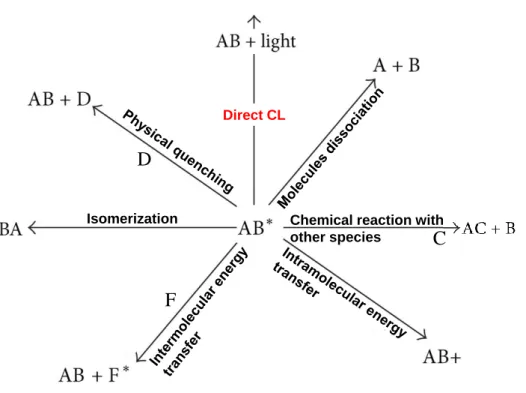
iii) Deactivation process of the excited species must be favorable to the photon emission rather than other competitive non-radiative processes (e.g. molecules dissociation, intramolecular energy transfer, intermolecular energy transfer, and so on). The different routes for losing energy of an excited species are summarized in Figure 1.8.
Figure 1.8. Different excited-state decay processes. The figure is reproduced from Ref. [67].
Direct CL
Chemical reaction with other species
Isomerization
D
F
C
34 As demonstrated by the work of Breysse [59], the CL intensity exhibits a linear correlation with the reaction rate. On the other hand, the reaction rate is a function of the reactant concentration, thus the CL method is applicable for quantitative analysis.
The advantages of the CL method that makes it promising in HTP primary catalyst screening can be summarized below:
i) High sensitivity: The detection limit of the CL method in the gas phase could reach the level of picomoles if the efficiency of the chemiluminescence reaction is sufficiently high.
ii) Truly parallel, non-invasive, and able for in-situ measurement.
iii) Simple instrumentation: To develop a HTP-CL screening measurement, the only requirement for the instrument is a transparent window of the reaction cell. The CL signal could be easily imaged by a CCD camera.
iv) Free from external radiation sources, scattering and background luminescence.
v) Able to identify a product mixture and provide selectivity information based on spectroscopic separation of reactions: The CL efficiencies and spectral shapes of the CL depend on the kinds of reactants, chemical processes and even catalysts.
To date, Zhang et al. has been only the group who attempted to employ the CL method in relation to catalyst screening. In fact, their conscious choice of the catalyst library (gold-based catalysts) and reaction (low-temperature CO oxidation) could significantly minimize challenges: CO oxidation is one of the most extensively used model reactions in gas-phase catalysis without any by-products and without multistep processes. The catalysis occurred in the temperature range of 140–180°C, which is regarded as relatively low in the field of catalytic gas-phase reactions. Moreover, in the
35 low-temperature conditions, the CL emission is not contaminated by the thermal radiations from the catalysts or even from reactor substances (so-called black-body radiation). Therefore, the CL method as an optical technique in HTP primary catalyst screening remained largely unexplored.
1.4.3. Secondary screening
The main tasks of the secondary screening are optimization and/or validation, rather than discovery, to generate reliable trends within the data as well as champion catalysts. The accuracy level of screening techniques employed in this stage should be at least as high as conventional methods. The significance of more realistic reaction test and precise catalyst synthetic protocols is also noticed in this stage. The demand of highly accurate and qualified data is often met by slowing down the screening and reducing the number of tested catalysts. Based on these requirements, the development of HTP secondary screening is often oriented to automated or parallel synthetic techniques at a laboratory scale and parallel reactor systems applicable for various reactions.
It must be noted that the input of secondary screening is either the leads obtained from primary screening process or others. The latter can be seen in some circumstance, where one can go directly to secondary catalyst screening when precision and quality of the data are more critical than the amount and broadness. When the secondary screening is connected with the leads generated from primary screening, its main purposes will be the validation of these leads and/or optimization to create champion catalysts.
36 Gas chromatography (GC) and mass spectrometry (MS) are often the choice of screening techniques in this stage. MS is a mature and widely employed methodology for HTP screening of a complex gas mixture in a sequential manner. Cong et al.
successfully demonstrated the potential of MS as a HTP screening technique in CO oxidation by O2/NO using a library containing 120 metal catalysts [68]. Reactants and products were sampled directly above the catalysts and injected to the mass spectrometer, where the sequential analysis took a minute per sample. Wang et al.
developed a HTP screening system for catalyst libraries that were produced by primary screening in aldol condensation of acetone by incorporation of an 80-pass reactor and a multistream mass spectrometer containing an automated 80-way valve [69]. Each reactor was connected to a capillary and the effluent gas mixture was individually transferred for analysis via the 80-way valve with a sampling time of 1−10 s. The HTP- MS screening system allowed sequential analysis of 80 reactors in 80 seconds to 13 mins. The requirement of sampling and sample withdrawal process could be regarded as the main drawback of MS toward HTP screening.
GC has also been acknowledged as a versatile screening technique in heterogeneous catalysis [70–76]. Hoffmann et al. developed a 49-channel parallel reactor for HTP screening of methane oxidation catalysts under conditions close to conventional ones [76]. A two-GC setup with a hot column and a cold column was connected to a three-way valve via capillaries attached to the outlet of each channel, allowing sequential analysis of 42 different catalysts at two different temperatures. A fast serial GC detection as a HTP secondary catalyst screening technique in the direct amination of benzene to aniline was demonstrated by Desrosiers group, allowing the screening of around 25000 catalyst samples per year [70]. A considerable challenge in
37 the application of GC to HTP catalyst screening is the long sampling time, which will be an obstacle for kinetic as well as catalyst deactivation studies.
1.4.4. High-throughput screening in automotive catalysts
As described in section 1.1, the increasingly stringent regulation on the automotive emission has served as one of the major impulses for the engine manufacturers and automobile researchers to keep searching for more efficient TWCs, especially better low-temperature activity and higher thermal durability. These goals have been pursued for a long period of time by many research groups worldwide with diverse strategies and directions, typically including: i) Optimization of the washcoat formulation by variation of different parameters (the choice of catalyst supports, the type and loading of noble metals, the type and loading of a promoter, and etc.); ii) appropriate synthesis methods (co-precipitation, impregnation, sol-gel, micro-emulsion, and so on); and iii) optimization of process conditions (calcination temperature, aging condition, and etc.) [77–80]. Likewise, it is obvious that the research and development of the TWCs needs to deal with a huge parametric space. In most of literature, the evaluation of newly generated catalysts is done successively from one catalyst to another, and the evaluation itself for each catalyst is time-consuming. This is because in laboratory scale, the performance of TWCs is often analyzed based on its light-off temperature (i.e. the temperature of 50% or 80% of reactants conversion) and the width of the operation window. The experiments to acquire these information need to be done separately. Considering these backgrounds, it is undoubtedly true that the HTP screening is indispensable in the research and development of the TWCs.
38 Despite the explosive growth of HTP catalyst screening techniques, attempts of applying a HTP approach in the research and development of TWCs has been relatively scarce. Some possible reasons could be: i) costs; ii) the requirement of online and time- resolved analytical techniques for all reactants and products; and iii) the lack of data acquisition in an automated sequence of process conditions.
To date, hte Aktiengesellschaft, one German company, has been the only group, who successfully applied a HTP approach in automotive catalyst screening [80-82].
Their testing unit consisted of a reactor block consisting of identical 48 channels and operated at isothermal conditions with the temperature range from 100 to 575 °C. The unit works in a way that reactant gas mixture is supplied to one channel selected at a time, and then the gas effluent is switched to a line for MS analysis. The same protocol is applied for other channels in a sequential mode.
1.5. Purpose of the thesis
The research and development of automotive catalysts need a breakthrough to meet the current and future emission targets. Enormous efforts have been devoted for a long period of time and worldwide in the materials aspect, especially for the optimization of the washcoat formulation via systematic variation of individual parameters in a huge parametric material space. The exploration in the materials aspect is moving forward when grouping these parameters and viewing them as a single page, but the whole picture of materials design for automotive catalysts is seemingly approaching saturation.
The ultimate purpose of this thesis is to develop a new approach for the research and development of automotive catalysts, more specifically the TWCs based on a
39 methodology aspect. Witnessed by the impressive growth of HTP catalyst screening techniques with substantial contributions in acceleration of catalyst discovery and optimization, I believe that similar achievements could be acquired when applying HTP catalyst screening in the field of three-way catalysis. Considering the large and diverse parametric space, the implementation of primary screening is essential to narrow down the library. Furthermore, since considerable endeavors have been made to enhance the catalyst performance at the level of one digit, the more detailed investigation in the secondary screening is also essential. Therefore, I aimed at designing and proposing HTP techniques and protocols for primary and secondary screening of the TWCs for the first time.
Major qualifications associated with the development of techniques in primary screening are fast, non-invasive, reliable, and truly parallel. Primary screening based on optical techniques exhibited a great potential in this regard, but it has just started and still remain an interesting field of the research. As reviewed in previous sections, even though already-established optical screening techniques are elegant, there is still a need for more straightforward, sensitive, simple, and in-situ screening techniques. I aimed to solve this challenge by the development of a novel HTP chemiluminescence (CL) imaging technique for oxidative catalyst screening with special emphasis on the application for high-temperature reactions. Since all elemental reactions occurring in the TWCs are sufficiently exothermic, the CL method is found relevant for detecting these reactions at the best time resolution of 1 s. To conduct secondary screening, a HTP screening instrument which consists of 20 parallel fixed bed reactors coupled with mass spectrometer was employed.
40 References
[1] I. Wagner, Worldwide automobile production through 2019 (2020) http://www.statista.com/statistics/262747/worldwide-automobile-production-since- 2000/
[2] F. Munoz, Internal Combustion Engines (ICE) counted for over 90% of global car sales in H1 2019, 2019. http://www.jato.com/internal-combustion-engines-ice- counted-for-over-90-of-global-car-sales-in-h1-2019/
[3] R.M. Heck, R.J. Farrauto, S.T. Gulati, Catalytic air pollution control:
commercial technology, John Wiley & Sons, 2016.
[4] Y.B. Zeldovich, Acta Physicochimica U.S.S.R 21 (1946) 577–628.
[5] J.A. Guzman, Critical Care Clinics 28 (2012) 537–548.
[6] A. Yardley-Jones, D. Anderson, D.V. Parke, Br. J. Ind. Med. 48 (1991) 437–
444.
[7] P.S. Monks, A.T. Archibald, A. Colette, O. Cooper, M. Coyle, R. Derwent, D.
Fowler, C. Granier, K.S. Law, G.E. Mills, D.S. Stevenson, O. Tarasova, V. Thouret, E.
von Schneidemesser, R. Sommariva, O. Wild, M.L. Williams, Atmos. Chem. Phys. 15 (2015) 8889–8973.
[8] N.M. Elsayed, Toxicology 89 (1994) 161–174.
[9] A.J. Haagen-Smit, C. Bradley, M. Fox, Ind. Eng. Chem. Res. 45 (1953) 2086–
2089.
[10] R.P. Wayne, Chemistry of atmospheres. I - An introduction to the chemistry of the atmospheres of earth, the planets, and their satellites, 1985.
[11] B.I. Bertelsen, Platinum Met. Rev. 45 (2001) 50–58.
[12] California Air Resources Board (2017) http://www.arb.ca.gov/html/lawsregs [13] Regulatory Background on the US Mobile Source Emission Control Program, MECA, 2019.
[14] T. Johnson, A. Joshi, SAE Int. J. Engines 11 (2018) 1307–1330.
[15] P. Greening, Top. Catal. 16 (2001) 5–13.
[16] R. Searles, Stud. Surf. Sc. Catal 116 (1998) 23–32.
[17] R.J. Farrauto, M. Deeba, S. Alerasool, Nat. Catal. 2 (2019) 603–613.
[18] M.V. Twigg, Catal. Today 163 (2011) 33–41.
[19] M.V. Twigg, Appl. Catal. B 70 (2007) 2–15.
41 [20] J.T. Kummer, Catalysts for the Control of Automotive Pollutants, American Chemical Society, 1975, 178–192.
[21] J. Kašpar, P. Fornasiero, N. Hickey, Catal. Today 77 (2003) 419–449.
[22] S. Rood, S. Eslava, A. Manigrasso, C. Bannister, Proc. Inst. Mech. Eng. D 234 (2020) 936–949.
[23] J.G. Cohn, Environ. Health Perspect. 10 (1975) 159–164.
[24] L. Hegedus, J.C. Summers, Platinum-rhodium catalyst for automotive emission control, Google Patents, 1978.
[25] M. Shelef, Catal. Rev. 11 (1975) 1–40.
[26] Z. Hu, Chem. Commun. (1996) 879–880.
[27] M. Shelef, G.W. Graham, Catal. Rev. 36 (1994) 433–457.
[28] A.M. Efstathiou, V.N. Stathopoulos, in Perovskites and Related Mixed Oxides (eds P. Granger, V.I. Parvulescu, V.I. Parvulescu and W. Prellier), 2015, doi:10.1002/9783527686605.ch26
[29] M. Konsolakis,. I.V. Yentekakis, in Perovskites and Related Mixed Oxides (eds P. Granger, V.I. Parvulescu, V.I. Parvulescu and W. Prellier), 2015 doi:10.1002/9783527686605.ch25
[30] J.N. Armor, Appl. Catal. B 1 (1992) 221–256.
[31] B. Harrison, A. Diwell, C. Hallett, Platinum Met. Rev. 32 (1988) 73–83.
[32] G.B. Fisher, J.R. Theis, M.V. Casarella, S.T. Mahan, The Role of Ceria in Automotive Exhaust Catalysis and OBD-II Catalyst Monitoring, SAE International, 1993.
[33] P. Li, X. Chen, Y. Li, J.W. Schwank, Catal. Today 327 (2019) 90–115.
[34] H. Permana, D.N. Belton, K.M. Rahmoeller, S.J. Schmieg, C.E. Hori, K.Y.S.
Ng, A. Brenner, SAE Transactions 106 (1997) 104–114.
[35] J. Kašpar, P. Fornasiero, M. Graziani, Catal. Today 50 (1999) 285–298.
[36] A. Trovarelli, Catal. Rev. 38 (1996) 439–520.
[37] P. Fornasiero, R. Dimonte, G.R. Rao, J. Kaspar, S. Meriani, A. Trovarelli, M.
Graziani, J. Catal. 151 (1995) 168–177.
[38] H.S. Gandhi, G.W. Graham, R.W. McCabe, J. Catal. 216 (2003) 433–442.
[39] N. Guillén-Hurtado, V. Rico-Pérez, A. Garcia-Garcia, D. Lozano-Castelló, A.
Bueno-López, Dyna 79 (2012) 114–121.
[40] S. Li, H. Zhang, Y. Dan, J. Deng, J. Wang, L. Xiong, Y. Chen, Mol. Catal.
482 (2020) 110696–110707.
42 [41] S. Matsuura, A. Hirai, K. Arimura, H. Shinjoh, Development of Three-Way Catalyst with Using Only Pd as Activator, SAE International, 1995.
[42] J.J. Hanak, J. Mater. Sci. 5 (1970) 964–971.
[43] X.-D. Xiang, X. Sun, G. Briceño, Y. Lou, K.-A. Wang, H. Chang, W.G.
Wallace-Freedman, S.-W. Chen, P.G. Schultz, Science 268 (1995) 1738–1740.
[44] B. Jandeleit, D.J. Schaefer, T.S. Powers, H.W. Turner, W.H. Weinberg, Angew.
Chem. Int. Ed. 38 (1999) 2494–2532.
[45] W.H. Weinberg, H.W. Turner, in High-Throughput Screening in Heterogeneous Catalysis (eds A. Hagmeyer, P. Strasser and A.F. Volpe), 2005 doi:10.1002/3527604103.ch1
[46] T.R. Boussie, G.M. Diamond, C. Goh, K.A. Hall, A.M. LaPointe, M. Leclerc, C. Lund, V. Murphy, J.A.W. Shoemaker, U. Tracht, H. Turner, J. Zhang, T. Uno, R.K.
Rosen, J.C. Stevens, J. Am. Chem. Soc. 125 (2003) 4306–4317.
[47] H.W. Turner, A.F. Volpe, W.H. Weinberg, Surf. Sci. 603 (2009) 1763–1769.
[48] S. Senkan, Angew. Chem. Int. Ed. 40 (2001) 312–329.
[49] E. Sasmaz, K. Mingle, J. Lauterbach, Engineering 1 (2015) 234–242.
[50] S.A. Schunk, D. Demuth, A. Cross, O. Gerlach, A. Haas, J. Klein, J.M. Newsam, A. Sundermann, W. Stichert, W. Strehlau, U. Vietze, T. Zech, in High-Throughput Screening in Heterogeneous Catalysis (eds A. Hagmeyer, P. Strasser and A.F. Volpe), 2005. doi:10.1002/3527604103.ch2
[51] W.F. Maier, K. Stöwe, S. Sieg, Angew. Chem. Int. Ed. 46 (2007) 6016–6067.
[52] N.E. Olong, K. Stöwe, W.F. Maier, Appl. Catal. B 74 (2007) 19–25.
[53] F.C. Moates, M. Somani, J. Annamalai, J.T. Richardson, D. Luss, R.C. Willson, Ind. Eng. Chem. Res. 35 (1996) 4801–4803.
[54] M.T. Reetz, M.H. Becker, K.M. Kühling, A. Holzwarth, Angew. Chem. Int. Ed.
37 (1998) 2647–2650.
[55] H. Su, E.S. Yeung, J. Am. Chem. Soc. 122 (2000) 7422–7423.
[56] H. Su, Y. Hou, R.S. Houk, G.L. Schrader, E.S. Yeung, Anal. Chem. 73 (2001) 4434–4440.
[57] B. Weidenhof, M. Reiser, K. Stöwe, W.F. Maier, M. Kim, J. Azurdia, E. Gulari, E. Seker, A. Barks, R.M. Laine, J. Am. Chem. Soc. 131 (2009) 9207–9219.
[58] J. Zetterberg, S. Blomberg, J. Gustafson, J. Evertsson, J. Zhou, E.C. Adams, P.- A. Carlsson, M. Aldén, E. Lundgren, Nat. Commun 6 (2015) 7076.