Title Effects of Solvent Engineering and Chemical Modification onthe Activity and Stability of Wheat β-Amylase( Dissertation_全文 )
Author(s) Bedada Tadessa Daba
Citation Kyoto University (京都大学)
Issue Date 2014-03-24
URL http://dx.doi.org/10.14989/doctor.k18315
Right
Type Thesis or Dissertation
Textversion ETD
Effects of Solvent Engineering and Chemical Modification
on the Activity and Stability of Wheat
-Amylase
BEDADA TADESSA DABA
Contents
Introduction 1
Chapter 1 3
Characterization and Solvent Engineering of Wheat -Amylase for Enhancing Its Activity and Stability Chapter 2 27
Kinetic and Thermodynamic Analysis of the Inhibitory Effects of Maltose, Glucose, and Related Carbohydrates on Wheat -Amylase Chapter 3 55
Interaction of Wheat -Amylase with Maltose and Glucose as Examined by Fluorescence Chapter 4 79
Chemical Modification of Wheat -Amylase by Trinitrobenzenesulfonic Acid, Methoxypolyethylene Glycol, and Glutaraldehyde to Improve Its Thermal Stability and Activity Summary 101
References 105
Acknowledgements 119
Abbreviations
AU arbitrary unit
BA -amylase
BacBA Bacillus -amylase
BBA barley -amylase
ME -mercaptoethanol
DMF dimethylformamide
DMSO dimethyl sulfoxide
EG ethylene glycol
EI enzyme-inhibitor complex
GA glutaraldehyde
Ka association constant
kcat molecular activity
Km Michaelis constant
mPEG 2,4-bis (O-methoxypolyethylene glycol)-6-chloro-s-triazine
pI isoelectric point
SBA soybean -amylase
SDS-PAGE sodium dodecyl sulfate polyacrylamide gel electrophoresis TNBS 2,4,6-trinitrobenzenesulfonic acid
Vmax maximum velocity
- 1 - Introduction
-Amylase (BA) [EC 3.2.1.2] or -1,4-glucan maltohydrolase is an exo-enzyme that catalyzes the cleavage of -1,4-glucosidic bonds of polysaccharides and liberates maltose from the non-reducing ends. It is a member of family 14 of the sequence-based classification of glycoside hydrolases (1). BAs are found in higher plants and certain bacteria, and there are some differences between bacterial and plant BAs in their ability to bind and hydrolyze raw starch (2). This binding ability is credited to a starch-binding domain located at the C-terminus of the sequence (3).
Enzymes can easily be denatured by a slight change of the environmental conditions such as temperature, pressure, pH, and ionic strength (4). However, stabilization of enzymes can be achieved in several ways: screening for more stable ones (from thermophiles and extremophiles), chemical modification, site-directed mutagenesis, immobilization, and solvent engineering or modifying the enzyme reaction conditions with stabilizing additives (5-10).
Unlike soybean, barley, and sweet potato, wheat -amylase (WBA) is not a common source of BA for starch-saccharification industries so far. However, the sources of BA supply have changed due to escalating prices of the major sources of BA. WBA is prepared from wheat bran, which is an industrial by-product in the production of wheat starch and gluten. It is a cheap alternative source of BA for industries. Nevertheless, it is relatively thermo-labile as compared with BAs of other crops and microbes.
- 2 -
conformation of enzymes. The inhibitor constant (Ki) values of inhibitors were affected
by changes in temperature (11, 12). pH alters the ionization of the functional groups and conformation of enzymes and hence, may affect substrate or inhibitor binding. The inhibition type by glucose, maltose, and cyclohexa-amylose on soybean -amylase (SBA) was pH dependent (13).
The fluorescence change of enzymes can be a good probe for examining the binding of substrates or inhibitors (14). A small change in the catalytic residue of subtilisin (Ser221 to Cys221) led to considerable decrease in its binding affinity to
Streptomyces subtilisin inhibitor (15). The changes in the states of tryptophan and
tyrosine residues of an enzyme may be associated with its activity.
Chemical modification is one of the techniques used in stabilizing enzymes, and various chemicals were identified that modify specific residues of enzymes and confer better stability. Among which, 2,4,6-trinitrobenzenesulfonic acid (TNBS), 2,4-bis (O-methoxypolyethylene glycol)-6-chloro-s-triazine (mPEG), and glutaraldehyde (GA) are known to make covalent interaction with the amino groups of enzymes (16-19). Stabilization and activation of WBA has practical applications for its use in food, bio-ethanol, and starch-saccharifying industries. In Chapter 1, the effects of various additives on the thermal stability and activity of WBA were evaluated through solvent engineering. In Chapter 2, the inhibitory interactions of maltose, glucose, and related carbohydrates with WBA; and the modes of inhibition by maltose and glucose, kinetics, and thermodynamic properties were examined. In Chapter 3, the interaction of WBA with maltose and glucose on the fluorescence intensity of WBA was evaluated. In Chapter 4, the effects of chemical modification of the amino groups of WBA by TNBS, mPEG and GA, on its thermal stability and activity were studied.
- 3 - Chapter 1
Characterization and Solvent Engineering of Wheat -Amylase for Enhancing Its Activity and Stability
Introduction
BA hydrolyses the -1,4-glucan bonds in amylosaccharide chains from the non-reducing ends and generates maltose. It has considerable industrial applications together with starch debranching enzymes and -amylases. However, the well-characterized BAs are neither active nor stable at higher temperatures > 65oC (20). In many findings, -amylase is more stable compared to BA of the same origin (4, 21,
22). Different techniques can be used to improve the thermal stability and activity of
enzymes. Various aspects of the techniques are considered to choose the proper ones. For instance, site-directed mutagenesis cannot be used in enzymes that are used in food industries. In solvent engineering, selection of appropriate additives is dependent on the nature of the enzyme and there are no established rules to select effective additives for improving enzyme functions (23). The thermostabily of BAs has been substantially enhanced by modifying the solvent with additives (23, 24).
In the hydrolysis of various polysaccharides, different amylases give oligosaccharides of specific length as end products. For this reason, amylases with unique properties need to be studied for their applications in various industries like in starch-saccharification, production of bio-ethanol, and food (25). The Topt of
- 4 -
Clostridium thermosulphurogenes BA is 75oC (20), T50 of barley -amylase (BBA) is
56.8oC, and that of SBA is 63oC (26).
Therefore, enhancing the activity and thermostability of WBA has good prospect for starch-saccharification industries. In this study, we used a commercially-available WBA preparation, Himaltosin, without further purification because it is already purified from other protein contaminants and utilized in industries. In this paper, we describe the kinetic and thermodynamic properties of WBA and improvement of its activity and thermostability via solvent engineering using various additives.
Materials and Methods
Materials - Himaltosin GS (Lot 2S24A), a commercial preparation of WBA, was
purchased from HBI Enzymes (Osaka, Japan). This preparation was filtered with a Millipore membrane filter (Type HA; pore size: 0.45 µm) and used without further purification. According to the manufacturer, the Himaltosin preparation contains 90% starch as a stabilizer, and all of the protein is BA and -amylase was not detected. Himaltosin was suspended in 20 mM sodium acetate buffer (pH 5.4) at 25oC to be 0.3 mg/ml. In this paper, this buffer is hereinafter referred to as buffer A. The WBA protein content was expected to be 0.03 mg/ml in the suspension and it was followed by filtration with Millipore membrane filter. However, the protein concentration in the filtrate was less than 10% of the expected content, suggesting that > 90% of the WBA protein was remained with starch on the filter. The WBA concentration was determined spectrophotometrically in buffer A using the absorbance (A) of 1.40 ± 0.02 at 281 nm
- 5 -
with a 1.0 cm light-path for the WBA solution at the concentration of 1.0 mg/ml (27). The molecular mass of 57.7 kDa for WBA was used to determine the molar concentration of WBA. Under the standard condition in this study, the concentration of WBA in the enzyme-reaction solution was set to 15-30 nM. The starch concentration due to the stabilizer starch (0.027%, w/v) was completely removed by filtration with Millipore membrane filter. Soluble starch (Lot M7H1482) as substrate and maltose (Lot M1F7568) as standard for the activity assay were obtained from Nacalai Tesque (Kyoto, Japan). The substrate has a weight-average molecular weight of 1.0 x 10⁶ according to the manufacturer, and thus the average degree of polymerization of glucose unit is estimated to be 6,000. Neocuproine-HCl (2,9-dimethyl-1,10-phenanthroline, Lot 032K2533) as coloring reagent B in the neocuproine method was from Sigma (St. Louis, MO, USA). Coloring reagent A (0.38 M Na2CO3, 1.8 mM CuSO4, and 0.2 M glycine) in
the neocuproine method and all other chemicals were purchased from Nacalai Tesque. All enzyme reactions were carried out in buffer A, pH 5.4.
Sodium dodecyl sulfate polyacrylamide gel electrophoresis (SDS-PAGE) -
SDS-PAGE was performed in a 10% polyacrylamide gel under reducing conditions (28). The Himaltosin preparation was suspended in buffer A to the concentrations of 1, 2, and 5% (w/v). The solution was filtered with a Millipore membrane filter (Type HA) and reduced by treatment with 10 mM dithiothreitol (DTT). The solution was applied to SDS-PAGE with a constant voltage of 150 V for 80 min. The proteins were stained with Coomassie Brilliant Blue R-250. The molecular-mass marker kit consisting of rabbit muscle phosphorylase b (97.2 kDa), bovine serum albumin (66.4 kDa), hen egg albumin (44.3 kDa), and hen egg white lysozyme (14.4 kDa) was a product of Takara Bio (Otsu,
- 6 - Japan).
Measurement of enzyme activity - Various initial concentrations of the soluble
starch substrate [0, 0.09, 0.45, 0.90, 1.13, 1.35, 1.80, 2.02, 2.25, 2.70, 2.93, and 3.15% (w/v)] in the reaction solution were prepared in buffer A at 25oC. The WBA solution in the same buffer was filtered with a Millipore membrane filter (Type HA) and kept in ice water for immediate use. The various concentrations of starch were hydrolyzed by WBA (30 nM) for 0, 2.5, 5.0, 7.5, and 10.0 min at 25oC. The reaction was stopped by adding 300 l of 0.1 M NaOH into 100 l of the enzyme-reaction solution. The amount of the reducing sugar produced in the enzyme-reaction solution was determined by the neocuploine method as follows (11). Reagent A and reagent B, 250 l each, were mixed with 50 l of the enzyme-reaction solution, boiled for 8 min, and diluted with 550 l of water after cooling in ice water. The activity was measured at 450 nm using a Beckman-Coulter DU 800 spectrophotometer (Batavia, IL, USA) (29, 30). The enzyme activity was determined by measuring the velocity (v) of reducing sugar production, and the reaction velocity was analyzed by the Michaelis-Menten kinetics. The maximum velocity (Vmax) and Michaelis constant (Km) were obtained from the v vs. the substrate
concentration ([S]o) plots using KaleidaGraph 4.1 (Synergy Software, Reading, PA,
USA). The molecular weight of WBA is 57,500 (31) and was used for the evaluation of the molecular activity (kcat).
The optimum temperature - Starch solution (900 l) in buffer A was mixed with the
WBA solution (0.15 M; 100 l) in the same buffer for 0, 2.5, 5.0, 7.5, and 10.0 min at 25oC after incubation at 15, 25, 35, 45, 55, 65, and 75oC in a water bath for 10 min. The
- 7 -
initial concentrations of starch and WBA in the reaction solution were 1.8% and 15.0 nM, respectively. The reaction was stopped by adding 300 l of 0.1 M NaOH into the enzyme-reaction solution (100 l). Then the enzyme activity was determined by the neocuproine method. The optimal reaction temperature at which WBA exhibited the highest activity was referred to as the Topt.
Thermal inactivation of WBA - The substrate and WBA solutions were prepared in
buffer A. The enzyme solution was incubated at 25, 35, 45, 55, and 65oC for 10, 20, and 30 min and cooled at 25oC for 3 min in a water bath. The substrate solution (2%, w/v; 900 l) was mixed with the heat-treated WBA solution (0.3 M; 100 l) at 25o
C and incubated for 0, 2.5, 5.0, 7.5, and 10.0 min. The initial concentrations of substrate and enzyme in the reaction solution were 1.8% (w/w) and 30 nM, respectively. The activity was assayed as aforementioned by the neocuproine method and the first-order rate constant k of the thermal inactivation was determined assuming pseudo-first order kinetics by plotting ln (v/vo) against the heat-treatment time (t) (Eq. 1), where v is the
initial velocity of the enzyme with heat treatment at each incubation temperature and vo
is that obtained without heat treatment and at 25oC. The activation energy Ea of the
thermal inactivation was obtained from the Arrhenius plot (Eq. 2), and the standard Gibbs energy difference of activation for thermal inactivation (△Go‡), the standard enthalpy difference of activation (△Ho‡
), and the standard entropy difference of activation (△So‡) were obtained from the Eyring plot according to Eqs. 3 and 4 (11, 32).
ln (v/vo) = -kt (1)
ln k = -(Ea/R)(1/T) (2)
△Go‡
- 8 - ln (hk/ kBT) = (△Ho‡/RT) + (△So‡/R) (4)
where kB, h, and R are the Boltzmann, Planck, and gas constants, respectively. T is
temperature in Kelvin.
Activation and thermostablization of WBA using additives - The WBA solution in
buffer A was mixed and incubated with equal volume of various additives in the same buffer at 25, 45, 55, and 65oC in a water bath for 30 min before hydrolyzing soluble starch. The initial concentrations of WBA and substrate in the reaction solution were 30.0 nM and 1.8%, respectively. The additive concentrations in the reaction solution were: 45.5, 91, 182, and 364 mM glucose, NaCl, and glycine; 45.5 and 91 mM
L-arginine; 0.9, 1.8, 3.6, and 45.5 mM of L-aspartate; 45.5 and 91 mM L-cysteine and glutathione (GSH); 0.18 and 0.45% (w/w) gelatin; 0.91, 1.82, and 5.5% (w/w) ethanol and 2-methyl-2-butanol (2M2B); 0.45 and 2.7% (w/w) dimethyl sulfoxide (DMSO) and dimethylformamide (DMF); and 0.91 and 5.5% glycerol, ethylene glycol (EG), and -mercaptoethanol (ME). Their effects on activation and thermal stabilization of WBA were examined. The enzyme-additive mixture solution (0.2 ml) was diluted with water (0.55 ml), and the enzyme activity was measured by the neocuproine method.
Results
Kinetic parameters of WBA - The WBA preparation, Himaltosin, showed a single
band in SDS-PAGE with molecular mass of 57.7 kDa (Fig. 1). This value is in good agreement with those (54.0-64.2 kDa) so far reported (27, 31). In this paper, we used
- 9 -
57.7 kDa for the molecular mass of WBA. This indicates that the Himaltosin preparation is composed of solely as a protein component, although it contains 90% (w/w) starch as a stabilizer. There was no starch carried over from the stabilizer starch into the reaction solution as examined by the starch-iodine reaction. Therefore, the enzyme preparation was treated as WBA without further purification.
The initial velocity (v) of the WBA-catalyzed hydrolysis of different concentrations of soluble starch was examined in buffer A at 25oC at the enzyme concentration of 30 nM. The dependence of v on substrate concentration exhibited Michaelis-Menten profile (Fig. 2). The Km, Vmax, and kcat were determined to be 1.0 ±
0.1 % (w/v), 2.8 ± 0.1 M s-1
, and 94 ± 3 s-1, respectively, by fitting the experimental data to the Michaelis-Menten equation.
Thermal inactivation of WBA - WBA at the concentration of 0.3 M was treated
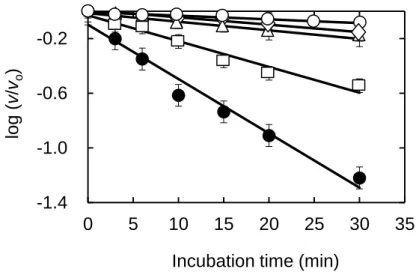
thermally as described in the Material and Methods section, and the WBA concentration in the enzyme-reaction solution was fixed to 30 nM. The enzyme activity decreased with the progress of the heat treatment at every temperature examined (Fig. 3). The enzyme activity in the hydrolysis of soluble starch was evaluated by measuring the initial velocity (v) in the same buffer at 25oC. The v value measured at the zero min incubation at each temperature was designated as vo. The relative activity (v/vo)
observed after incubation at various temperature decreased progressively with increasing the incubation time. The semi-log plots of v/vo against incubation time
showed linear relationship at the respective incubation temperatures (Fig. 3), indicating that the thermal inactivation process of WBA follows the first-order kinetics. The first-order rate constant (k) at the indicated incubation temperature was evaluated from
- 10 - the slope of the plot.
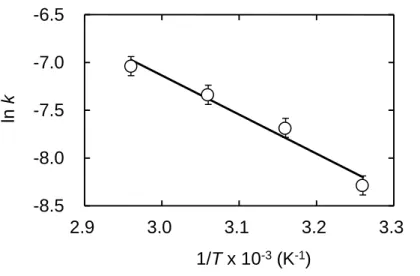
The activation energy Ea value of the thermal inactivation of WBA in buffer A was
36 ± 1 kJ mol-1 from the slope of the Arrhenius plot (Fig. 4). The △Go‡, △Ho‡, and T△So‡ values for the thermal inactivation were found to be 92 ± 1, 33 ± 1, and -59 ± 1 kJ mol-1 respectively, at 25oC from the slope of the Eyring plot (Fig. 5). As Ea is defined
theoretically as △Ho‡ + RT, the △Ho‡
value is calculated to be 34 ± 1 kJ mol-1, which is in good agreement with the value obtained from the Eyring plot.
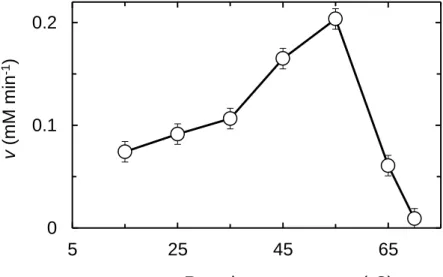
The optimum temperature of WBA - WBA activity was measured at various
reaction temperatures (Fig. 6). The maximal activity in starch hydrolysis was obtained at 55oC, being the optimum temperature (Topt) of this enzyme in buffer A, pH 5.4.
The T50 of WBA - The heat inactivation of WBA was studied by incubating the
enzyme at various temperatures for 30 min before hydrolyzing the substrate. The enzyme activity was observed to decline with heat treatment even at moderate
temperatures (45 and 55oC). The T50 of WBA, which is the temperature at which the
enzyme loses half of its activity with thermal treatment for 30 min was determined to be 50 ± 1oC (Fig. 7) by plotting the residual activities (%) against temperature of incubation. WBA has lost 30% of its activity at 45oC, 76% at 55oC, and 95% at 65oC after 30 min of incubation.
Effect of additives on WBA activity - The catalytic activity of WBA in starch
hydrolysis was examined in the presence of various additives at 25oC without heat treatment. Majority of the evaluated additives did not enhance the enzyme activity (Fig.
- 11 -
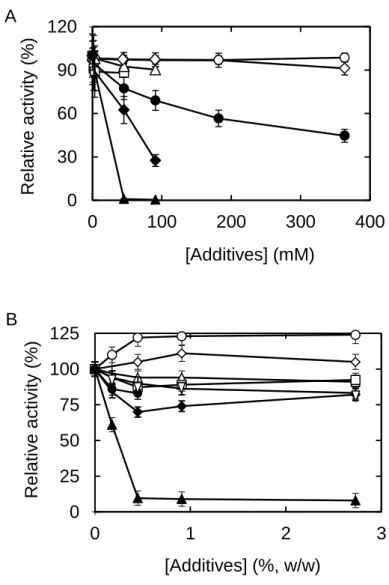
8). However, it was noted that ethanol at the concentration of 0.91-5.50%, w/w (or 0.2-1.2 M) enhanced the activity by 24% and low concentration (1.8%) of DMF by 11%. On the other hand, the activity was not much affected with the addition of NaCl and glycine up to 364 mM; and DMF, DMSO, and EG up to 5.5%. The addition of cysteine up to 91 mM and aspartate up to 45.5 mM showed no substantial effect on the activity, and gelatin (0.18-0.45%, w/w) had no effect either. The other additives inhibited the activity to varying degrees. Especially, the activity was reduced to almost 10% with the addition of 0.91-5.5%, w/w (or 0.11-0.71 M) ME; and to zero with 45.5-91 mM arginine. The activity decreased with increasing glucose and GSH concentrations, and 50% of the activity was lost with 182 mM glucose, and 75% with 91 mM GSH.
Effect of additives on the thermostabilty of WBA - The rate of starch hydrolysis by
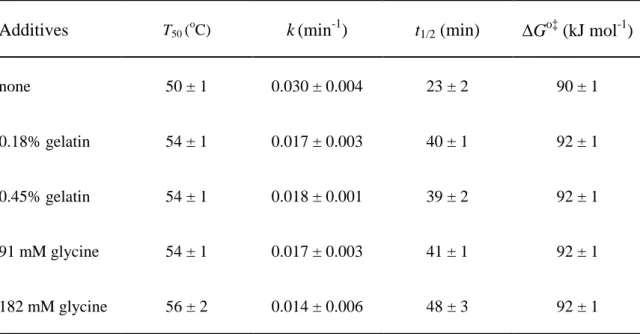
heat treated WBA was examined in solvent modified by various additives. Glycine was the best in improving the thermal stability of WBA followed by gelatin. The T50 of
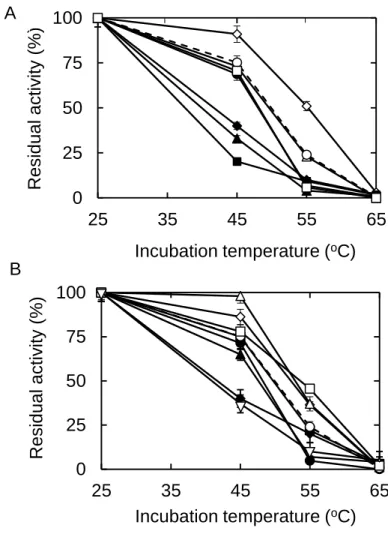
WBA was improved by 6oC with 182 mM glycine and by 4oC with 0.18% (w/w) gelatin (Fig. 9). The half-life of WBA was enhanced by 25 min and 17 min with glycine and gelatin, respectively, at 55oC (Table 1). It should be noted that the residual activities after thermal treatment at 45oC was 97% and 92% in the presence of 0.18% (w/w) gelatin and 182 mM glycine although it was only 75% in the absence of additives. Aspartate (45.5 mM) and DMSO (5.5%, w/w) had no effect on the stability of WBA. ME (0.91%), ethanol (0.91%), NaCl (182 mM), and arginine (45.5 mM) decreased the stability of WBA, and the T50 values were 46-47oC. Glucose (182 mM), cysteine (46
- 12 - Discussion
In general, depending on the nature and concentration of the additives, they affect the protein conformation in: (a) screening effect, where the electrostatic repulsion between similarly charged groups of proteins is reduced by cosolvent ions; (b) solvophobic effect, where ion pair formation occurs, favoring protein folding; and (c) modification of water structure leading to hydrophobic interactions in proteins (21, 33). The catalytic activity and thermostability of various enzymes were considerably enhanced through solvent engineering (10, 23, 24, 34, 35).
The Km (1.0 ± 0.1%, w/v) and kcat (94 ± 3 s-1) of WBA were evaluated at pH 5.4
and at 25oC using soluble starch as a substrate (Fig. 2). Similarly, the Km of
glutenin-adsorbed WBA was reported to be 0.15% (w/v) using soluble starch substrate (36), indicating that WBA (which is free in the reaction solution) used in our study has lower affinity to soluble starch as compared with WBA adsorbed on glutenin. The other available reports on the kinetic parameters of WBA were using maltotriose, maltoheptaose, amylodextrin, and amylopectin substrates under various reaction conditions (31, 37). The Km values of plant have been reported to be in the range of
0.2-0.7% (w/v) for soluble starch. The value obtained in this study is apparently higher than those. However, the kinetic parameters for WBA and other plant have not been examined under the same reaction conditions using the same soluble starch preparation. Therefore, it is not suitable to discuss the enzyme functions by comparing the kinetic parameters so far reported. In this paper, we have reported the kinetic parameters (Km
- 13 -
and kcat) of WBA obtained under the fixed conditions with the WBA and soluble starch
preparations in the same lot. It should be noted that the activity and stability of WBA are affected easily by additives in the reaction solution. This means that the kinetic parameters of WBA must be evaluated with the data collected from the experiments conducted carefully under the same conditions.
Thermodynamic parameters for the heat inactivation of WBA showed that the
T△So‡ value (-59 ± 1 kJ mol-1) was greater in magnitude than the △Ho‡ value (33 ± 1 kJ mol-1) and thus, it can be inferred that the heat inactivation of the enzyme is entropy-driven. The Topt of WBA is 55oC (Fig. 6). It has been reported that the Topt of
Sorghum bicolor cv BA is 50oC (22, 25, 38) while -amylase from the same cereal crop
has Topt of 70oC corresponding with the fact that BAs in most of the cases are lower in
thermostability than their respective -amylases of the same origin (21, 22). The T50 of
WBA was determined to be 50 ± 1oC (Fig. 7), which is lower than those of SBA, 63.2oC, and of BBA, 56.8oC (26).
In the present study, we have examined the effects of additives on the kinetic parameters and thermostability of WBA. The additives are supposed to have effects on the structures of WBA, soluble starch substrate, and bulk water. For example, when we observed decrease in activity by the addition of an additive, there might be some reasons considered such as inhibition of the enzyme by the additive, conformational changes of the enzyme and/or starch substrate by the additive, etc. Therefore, strict interpretation of the molecular effects of the additives on the activity and stability of WBA seems to be difficult, and further studies are needed. Thus, in this paper we tried to present the effects of the additives without describing the molecular-mechanistic insights of the cause for the effects, although some possible comments have been made
- 14 -
with references to other enzymes. The molecular-mechanistic study for the effects of the representative additives is required.
Ethanol enhanced the activity of WBA by up to 24%, and low concentration of DMF slightly enhanced it (Fig. 8). The activation of acetylcholinesterase (AchE) by ethanol was reported and explained as that it non-competitively alters the hydrophobic-interaction site and subsequently induces favorable conformation to the active site (39). However, higher concentration of ethanol had a destabilization effect on WBA (Fig. 9B). This agrees with a finding that, high concentration of ethanol (> 800 mM) can perturb the structure of water around hydrophilic area of AchE causing instability to the conformation of the enzyme (39). This might be the case for the effects of ethanol on WBA. These effects should be considered also from the viewpoint of solvent polarity. The effects of various alcohols on the enzyme structure and activity have been extensively studied with thermolysin, a thermophilic and halophilic metalloproteinase produced by Bacillus thermoproteolyticus. Thermolysin is remarkably activated and stabilized by neutral salts such as NaCl, and is inhibited by increasing concentration of alcohols and the degree of inhibition is dependent on the size of alcohols (40). Alcohol such as 2-methyl-1-propanol (2MP), which binds tightly to the active site inhibits thermolysin strongly, whereas alcohols with the sizes larger or smaller than 2MP bind weakly to the active site and inhibit thermolysin weakly (41). This suggests that enzyme activity could be controlled intentionally using additives with suitable sizes. These lines of evidences provide information for the optimal conditions for thermolysin-catalyzed synthesis of a precursor of the sweetener, aspartame (7). As shown with thermolysin to find the optimal conditions for its inhibition by alcohols, it should be possible to find the optimal conditions for industrial application of WBA by
- 15 -
examining the effects of alcohols on the activity and stability of WBA by systematically changing the size of alcohols.
Contrary to the effect of ethanol, the T50 of WBA is slightly improved by polyols,
indicating that polyols are WBA stabilizer. Our finding agrees with reports that solvent modification by sugars and polyols had marked thermal stabilization in various enzymes (4, 34). Polyols were explained to preferentially be excluded from the surface layer of the protein and form a water shell around the protein, so that the protein is preserved and the conformation becomes more rigid or stable (4, 34). Similar mechanism of stabilization by polyols was also reported for organic polar solvents (DMSO and DMF) (35), and polar organic solvents have conferred a slight thermostabilization to WBA. However, sugars, which are classified also as polyols, interestingly had no stabilizing effect on WBA in our study.
The activation and thermostabilization of WBA were tested using different additives with various values of empirical parameters of solvent polarity, ET(30) (42)
In particular, ethanol (ET(30) = 217 kJ mol-1), DMSO (189 kJ mol-1), DMF (183 kJ
mol-1), glycerol (238 kJ mol-1), EG (235 kJ mol-1), ME (224 kJ mol-1), and 2M2B (172 kJ mol-1) were examined at different temperatures. According to the results, the half-life time of WBA was enhanced at 55oC with ethanol. It is suggested that thermostabilization by additives could be induced by reducing the degree of water-solvation or deformation of a water shell around the protein. However, a solvent 2M2B with a low ET(30) value decreased the activity and stability of WBA (Figs. 8B
and 9B), suggesting that the effects of additives on the enzyme activity and stability are complicated and that the effect on the water-solvation might not be the main one (43).
- 16 -
followed by gelatin (Table 1) and the stabilization effects of various additive concentrations were presented in Fig. 9. It should be noted that the thermostability of WBA in the presence of favorable additives such as glycine and gelatin is almost comparable with that of SBA, which is widely used in starch-saccharification industry. This suggests that WBA could be applied more widely in food and bio-ethanol industries with employing suitable additives. A good empirical correlation between the relative stabilizing effects of glycine with the change in solvent-accessible hydrophobic surface area of the folded protein was reported (44). The possible protective effect of gelatin on penicillinase was stated that it combines with enzyme and form a thermostable complex (45).
Arginine was found to destabilize WBA in our study. Similarly, chloroperoxidase was confirmed to be inactivated by arginine mainly by the binding of a guanidinium group with the catalytic site (46). This inactivation effect might be the same as that given by the denaturant, guanidine hydrochloride namely, arginine might cleave the hydrogen bonds in the protein structure and increase the solubility of hydrophobic residues of the protein. On the other hand, arginine is known to work effectively in recovering human matrix metalloproteinase 7 from inclusion bodies (47). This suggests that arginine promotes unfolding the misfolded protein structure to lead it into the correctly folded form. While arginine seems to show multiple effects on protein stability depending on target proteins, it can be a good tool to increase the stability of WBA by selecting suitable conditions.
We tried to modify thiol groups of WBA using reducing agents like ME and GSH, whereas they destabilized WBA. This is because they attack disulfide bonds and expose proteins to heat denaturation and, hence reduces their thermostability (48). Probable
- 17 -
involvement of thiol groups in the catalytic activity of amylases has been suggested, although it is not known currently with WBA. The effects of ME and GSH should be considered in the future.
Various concentrations of NaCl exhibited destabilizing effect on WBA in our study. The following three possible reasons were suggested for salt-induced inactivation or destabilization effect on enzymes: (a) break weak hydrogen-bonds and disrupt the protein conformation, (b) attract water molecules and the enzyme coagulates by protein-protein hydrophobic interaction, and (c) high concentration of salt makes the enzyme more likely to bind with the salt ions instead of the substrate by electrostatic interaction (49). However, high concentration of neutral salts remarkably improves thermolysin activity (7, 8). The catalytic activity of thermolysin is enhanced by 4 times with the substitution of the active-site zinc with cobalt and further exponentially by NaCl up to 13-15 times (33).
It is well known that enzyme activity is controlled by the factors of enzyme structure and reaction environment. The structural factors and environmental factors are sometimes independent and sometimes closely connected. With their optimal combination, the optimal catalytic activity may be realized. Protein engineering (namely, site-directed mutagenesis and chemical modification) is a tool for changing the enzyme structure in a predictable and precise manner to effect a change on the catalytic process. Since the enzyme is even improved in only one side of a reaction, any changes in the rest of the reaction may also alter the catalytic process (50). Solvent engineering is a powerful tool in rational control of enzyme activity. In reality, both approaches are still somewhat difficult to confirm their effects, whereas they have been used successfully to alter the protein properties (51). At last, it should be reminded that the
- 18 -
protein-engineered enzymes are strictly prohibited for use in food processing in many countries in order to avoid unpredictable harms. Thus, solvent engineering must be an inevitable alternative to find the optimal conditions from the viewpoints of enhancing enzyme catalytic efficiency, guaranteeing safeness of the products, reducing the costs of production, etc. When the enzyme activity for its industrial application is increased by solvent engineering, the cost of the additive should be considered in the total cost, although it is generally much cheaper than that of the enzyme, and the improved enzyme activity and stability by the additive should decrease the enzyme amount needed and thus shortened the reaction time, which results in decreasing the running costs, utility, labor, etc.
In conclusion, it is clear that WBA is not stable at temperatures higher than 55oC from the thermodynamic parameters evaluated in this study. The thermal stability of WBA was improved by glycine and gelatin possibly through convening conformation of the enzyme and reducing the interaction of the protein with the solvent. Polyols and organic polar solvents (DMSO and DMF) also conferred slight stability to the enzyme while some evaluated additives have exhibited destabilizing effect. The thermodynamic parameters indicate that WBA is thermo-labile and sufficient stabilization was achieved by solvent engineering with additives and that the heat inactivation of WBA is entropy-driven. On the other hand, it was shown that the activity of WBA activity was enhanced by ethanol and DMF probably by altering the hydrophobic interaction and inducing favorable conformation to its active center. It is suggested that WBA would be applicable to a wide range of saccharification industries such as food and bio-ethanol production with employing suitable additives.
- 19 -
Table 1. Effects of selected additive concentrations on thermal stabilization of WBA after incubation at 55oC with the additives for 30 min prior to starch hydrolysis.
Additives T50 ( o
C) k(min-1) t1/2 (min) Go‡ (kJ mol-1)
none 50 ± 1 0.030 ± 0.004 23 ± 2 90 ± 1
0.18% gelatin 54 ± 1 0.017 ± 0.003 40 ± 1 92 ± 1
0.45% gelatin 54 ± 1 0.018 ± 0.001 39 ± 2 92 ± 1
91 mM glycine 54 ± 1 0.017 ± 0.003 41 ± 1 92 ± 1
182 mM glycine 56 ± 2 0.014 ± 0.006 48 ± 3 92 ± 1
The t1/2 is the time at which WBA loses half of its activity at 55oC, and ∆Go‡ is the
- 20 -
Fig. 1. SDS-PAGE of Himaltosin preparation. Molecular marker proteins (lane 1), Himaltosin preparation (w/v): 1% (lane 2), 2% (lane 3), and 5% (lane 4). The experimental conditions were given in the text (Materials and Methods).
- 21 -
Fig. 2. Dependence of WBA activity on substrate concentration. The substrate is soluble starch. The hydrolysis was carried out in 20 mM sodium acetate buffer, pH 5.4, at 25oC. The experiment was undertaken in triplicate.
[Starch]o (%, w/v) 0 1 2 3 4 5 6 1 2 3 0 v ( M s -1 )
- 22 -
Fig. 3. Progress of the decrease in WBA activity with thermal treatment duration. WBA (0.3 M) was treated at 25, 35, 45, 55, and 65o
C for 0-30 min in buffer A, pH 5.4. WBA activity in the hydrolysis of soluble starch was evaluated by measuring the initial velocity (v) in the same buffer at 25oC. The WBA concentration in the enzyme-reaction solution was 30.0 nM. The v value measured at 0 min incubation at each temperature was designated as vo. The logarithm of the relative activity [log (v/vo)] was plotted
against the thermal-treatment time. The markers show temperature (oC): 25, ; 35, ; 45, ; 55, □; and 65, ●. From these semi-log plots, the first-order rate constant for the thermal inactivation of WBA was evaluated at the specified temperature of the thermal treatment. 0 5 10 15 20 25 30 35 -1.4 -1.0 -0.6 -0.2 log ( v /vo )
- 23 -
Fig. 4. Arrhenius plot of WBA for the k of thermal inactivation. The rate constants were evaluated from the semi-log plots as shown in Fig. 3 obtained by thermal treatment of the enzyme at various temperatures. The reaction conditions were given in the Materials and Methods.
Fig. 5. Eyring plot of WBA for the k of thermal inactivation. The rate constants were obtained as described in Fig. 3 at each temperature. The thermodynamic properties of WBA thermal inactivation were obtained from this plot.
2.9 3.0 3.1 3.2 3.3 -8.5 -8.0 -7.5 -7.0 -6.5 ln k 1/T x 10-3 (K-1) 2.9 3.0 3.1 3.2 3.3 -26.6 -26.0 -25.4 -24.8 ln (hk /kB T ) 1/T x 10-3 (K-1)
- 24 -
Fig. 6. Effect of temperature on the initial velocity (v) of WBA in hydrolyzing soluble starch. The enzyme reaction was carried out at the temperature indicated. The initial concentrations of starch and WBA in the reaction solution were 1.80% (w/v) and 15.0 nM, respectively. The optimal temperature Topt was determined to be 55oC.
Fig. 7. Effect of thermal inactivation of WBA on the enzyme activity. The activity was assayed in buffer A (pH 5.4) in hydrolyzing starch after incubation at various temperatures indicated for 30 min. The reaction conditions are given in the Materials and Methods. The T50 was determined to be 50 ± 1oC.
0 0.1 0.2 5 25 45 65 v (m M m in -1) Reaction temperature (oC) 0 25 50 75 100 25 35 45 55 65 Resid u a l a ctiv ity (%) Temperature (oC)
- 25 -
Fig. 8. Effects of various concentrations of additives on the activity of WBA at 25oC. The concentrations were in mM and the symbols show additives (A): Gly, ◯; NaCl, ◇; Asp, □; Cys, Δ; glucose, ●; GSH, ◆; and Arg, ▲. The concentrations are in %
(w/w) and the symbols show additives (B): ethanol, ◯; DMF, ◇; DMSO, ; EG, □; gelatin, ●; glycerol, ◆; ME, ▲; and 2M2B, . The relative activity (%) of the enzyme obtained without additive was set as 100%.
0 30 60 90 120 0 100 200 300 400 Rela tiv e a ctiv ity (%) [Additives] (mM) 0 25 50 75 100 125 0 1 2 3 Rela tiv e a ctiv ity (%) [Additives] (%, w/w) A B
- 26 -
Fig. 9. Effects various additives on the thermal stabilization of WBA. Symbols for concentrations (mM) of additives (A): buffer, ○; 182 glycine, ◇; 45.5 Arg,
□
; 45.5 Asp, ; 182 NaCl, ●; 182 glucose, ◆; 45.5 Cys, ▲; and 91 GSH,■
. Symbols for concentrations (%, w/w) of additives (B): buffer, ○; 5.5 EG, ◇; 0.18 gelatin, ; 5.5 glycerol,□
; 0.91□
; ME, ●; 2.7 DMF, ◆; 0.91 ethanol, ▲; 5.5 DMSO,■
; and 5.5 2M2B, . Low concentrations of some additives were evaluated because of their solubility limit in buffer A (pH 5.4) at 25oC. The residual activity of WBA without additive was depicted in broken lines. The stability study was after 30 min of incubation. 0 25 50 75 100 25 35 45 55 65 Resid u a l a ctiv ity (%) Incubation temperature (oC) 0 25 50 75 100 25 35 45 55 65 Resid u a l a ctiv ity (%) Incubation temperature (oC) A B- 27 - Chapter 2
Kinetic and Thermodynamic Analysis of the Inhibitory Effects of Maltose, Glucose, and Related Carbohydrates on Wheat -Amylase
Introduction
BA is a member of family 14 of the sequence-based classification of glycoside hydrolases (1). The subsite affinities of BAs were evaluated in WBA by Kato et al. (31) and in SBA by Suganuma et al. (52). According to their reports, subsite 1 has the highest affinity to a glucose unit of the substrate among the five evaluated subsites and it plays an important role in the activity of the enzyme.
The inhibition kinetics of BAs by glucose (53), maltose and cyclohexa-amylose (54, 55) were examined. However, the binding sites of these inhibitors have not been established at the subsite level. The inhibition type by glucose, cyclohexa-amylose, and maltose on SBA was pH dependent (13). BBA, SBA, and WBA are well characterized plant BAs. The degrees of thermo-stability defined by T50, are 57oC for BBA, 63oC for
SBA (26) and 50oC for WBA in Chapter 1. We reported the effects of additives (carbohydrates, amino acids, organic solvents, proteins, detergents, salts, sugars, etc.) on the activity and stability of WBA in Chapter 1. It is interesting to note that 182 mM glycine and 0.18% gelatin stabilize WBA by increasing its T50 by 5oC, and that ethanol
enhance the activity of WBA by 24%, and low concentration of DMF slightly enhanced it. However, most of the evaluated additives in solvent modification in previous study
- 28 -
have no effects on stability, and have a decreasing effect on the activity. Among the additives examined, arginine, ME, glucose, and maltose inhibited WBA strongly as reported in Chapter 1. These lines of evidences suggest that the stability and activity of WBA could be changed by modification of the enzyme reaction system or solvent engineering.
The interaction of WBA with glucose and maltose is described by inhibition kinetics in this study. The temperature- and pH-dependences of the Ki and
thermodynamic parameters for the dissociation constants of the WBA-glucose and WBA-maltose complexes are shown. In addition to the inhibitory effects of glucose and maltose as the direct end-products of starch hydrolysis, the inhibition of WBA by fructose, difructose, sucrose, trehalose, cellobiose, acarbose, and 1-deoxynojirimycin were also examined. This study provides valuable information on the end-product inhibition of WBA in the process of starch hydrolysis and also on the interaction of WBA with various related carbohydrates.
Materials and Methods
Materials - Himaltosin GS (Lot 2S24A), a commercial preparation of WBA, was
purchased from HBI Enzymes (Osaka, Japan). WBA was purified from the Himaltosin preparation according to the method described previously in Chapter 1 to a homogeneous state as judged by SDS-PAGE with a molecular mass of 57.7 kDa. The preparation is composed of only WBA as a protein component. There was no starch carried over from the stabilizer starch contained in the Himaltosin preparation into the
- 29 -
purified WBA preparation as examined by the starch-iodine reaction. Therefore, the preparation was treated as WBA without further purification as mentioned in Chapter 1.
The molecular mass of 57.7 kDa for WBA was used to determine the molar concentration of WBA (31). The substrate has a weight-average molecular weight of 1.0 x 10⁶ according to the manufacturer, and thus the average degree of polymerization of the glucose unit is estimated to be 6,000. Soluble starch (Lot M7H1482), maltose (Lot M1B6462), glucose (Lot M3G8543), potassium iodide (Lot V1P5303), cellobiose (Lot M2G9713), and other chemicals were purchased from Nacalai Tesque (Kyoto, Japan) and iodine solution (Lot CEM7810), acarbose (Lot LAQ5872), difructose anhydride (Lot TLM1444), ,-1,1-trehalose (Lot PEH6208; hereinafter designated as simply trehalose), and 1-deoxynojirimycin (Lot DCL2444) were from Wako Pure Chemical (Osaka, Japan).
Inhibition of WBA by glucose, maltose, and other carbohydrates - WBA (1.6 M)
and various concentrations of glucose, maltose, and other carbohydrates were prepared in buffer A. The WBA solution (100 µl) was pre-incubated with 100 µl of the carbohydrates solutions at the initial concentrations of 0, 0.15, 0.31, 0.62, 1.23, and 2.33 M glucose; 0.15, 0.31, and 0.62 M maltose; 0.15, 0.31, 0.46, 1.17, and 1.75 M fructose; 0.04, 0.08, 0.12, 0.15, and 0.24 M difructose; 0.15, 0.31, 0.46, and 0.62 M sucrose; 0.15, 0.31, 0.46, 0.62, 1.11, and 1.66 M trehalose; 0.14, 0.28, and 0.42 M cellobiose; 0.004, 0.040, 0.080, 0.120, and 0.150 M acarbose; and 0.001, 0.002, 0.005, and 0.009 M 1-deoxynojirimycin for 5 min at 25oC before reacting with the substrate. The soluble starch solution 0.69% (w/v; 450 l) was mixed with the mixture (200 µl) of WBA and the carbohydrates and was hydrolyzed for 5 min in buffer A at 25oC. Therefore, the
- 30 -
WBA and soluble starch concentrations in the initial conditions of the enzyme reaction were 0.25 M and 0.69 % (w/v), respectively. The reaction was stopped by mixing the reactants (50 l) with 4.5 ml of 1 mM potassium iodide (KI) prepared in 0.1 N HCl. The absorbance was measured at 580 nm using a Beckman-Coulter DU 800 spectrophotometer (Batavia, IL, USA) (13, 56). Iodine staining is not preferable method for precise kinetic studies. Nevertheless, it was not possible to use the common product measurement methods such as neocuproine, DNS (dinitrosalicylic acid), and Somogi-Nelson (57) methods which are based on the determination of the reducing ends of the products because some of the carbohydrates examined possess reducing ends. The 50% inhibitory concentrations (IC50) of the carbohydrates are their
concentrations giving 50% of the activity observed in the absence of the carbohydrates.
Reversibility of WBA inhibition by glucose and maltose - Reversibility of the WBA
inhibition by glucose and maltose was examined through dialysis and dilution techniques. In dialysis, 1.6 M of WBA in buffer A was filtered through Millipore membrane filter (Type HA; pore size: 0.45 m) and kept in ice for immediate use. The filtered WBA solution (1 ml) was incubated for 5 min with 1 ml of buffer A, or 1 ml of 2 M glucose or 0.5 M maltose prepared in buffer A. The WBA-glucose or WBA-maltose mixtures were dialyzed using a dialysis membrane (Wako Chemicals, Kyoto) against buffer A 100-times the volume of the mixtures; the dialyzing buffer was changed 3 times with 2 h intervals at 4oC. Soluble starch (0.82%, w/v) was hydrolyzed by WBA for 10 min at 25oC. The reaction rate of substrate hydrolysis was determined using iodine staining method and the reaction rates of the dialyzed WBA in the presence of glucose and maltose were compared with the reaction rates in the absence of the
- 31 - inhibitors.
In the dilution method, the concentration of WBA 10 times higher than that described above was incubated with buffer A or with buffer A containing glucose or maltose at the initial concentrations of 18 mM and 0.18 M. After pre-incubation for 5 min, the WBA mixture with 0.18 M of glucose or maltose was 10 times diluted to 18 mM glucose or maltose with buffer A. The concentrations of the inhibitors (glucose and maltose) in the buffer were adjusted to attain the mentioned concentrations after dilution and 0.14 M WBA. The relative activities in the presence of the carbohydrates were calculated relative to the activity in the absence of the carbohydrates and the reversibility (%) of the 10 times diluted forms was calculated relative to the same lower concentrations of the carbohydrates before dilution (41). The same method was repeated to check the reversibility of WBA inhibition in the presence of various concentrations of glucose or maltose at pH 5.4, 25oC.
Temperature-Dependence of the Ki for the inhibition of WBA by glucose and
maltose - Various initial concentrations of carbohydrates in the enzyme reaction: 0.08,
0.15, 0.23, 0.31, 0.38, and 0.46 M glucose; 0.07, 0.08, 0.12, 0.15, 0.18, and 0.23 M maltose were prepared in buffer A at 15, 25, 35, and 45oC. Various initial concentrations of soluble starch: 0.35, 0.52, and 0.69% (w/v) were hydrolyzed by 0.32 M WBA pre-incubated for 5 min with various concentrations of glucose or maltose at each temperature. The initial velocity (v) of starch hydrolysis were determined from the reaction progress over 0.5-4.0 min and the reactant (50 l) was stopped by adding 4.5 ml of the 1 mM iodine solution. The Ki values at each temperature were determined
- 32 -
WBA-glucose and WBA-maltose complexes were determined from the van't Hoff plots (59), while the Gibbs energy changes (Go), and entropy changes (So) were determined from Eqs. 1 and 2 (59, 60).
G o = -RT ln Ki (1)
S o = (H o - G o)/T (2)
where R is the gas constant and T is temperature in Kelvin
pH-Dependence of Ki - Various initial concentrations of soluble starch: 0.35, 0.69,
1.04, 1.38, 1.73, and 2.08% (w/v) were prepared in 20 mM glycine-HCl buffer (pH 3.0), buffer A, and 20 mM borate buffer (pH 9.0) at 25oC following the method previously reported (61). WBA (0.32 M) in the respective buffers at each pH was pre-incubated with 0.31, and 0.62 M glucose; and 0.15, and 0.31 M maltose for 4 min at 25oC. The soluble starch solution (450 l) varying in concentration was mixed with 100 l of the pre-incubated WBA-glucose or WBA-maltose mixtures at pH 3.0, 5.4, and 9.0 at 25oC. The initial velocity (v) were determined from the reaction progress over 5 min. The absorbance was measured at 700 nm using a Beckman-Coulter DU 800 spectrophotometer. The inhibition type and Ki values at each pH was determined from
the Hanes-Woolf plots (62). The Ki values were calculated using Eqs. 3 and 4 for
competitive and uncompetitive inhibitors, respectively (63).
Ki = [I]o/ ((Km,app/Km) -1) (3)
Ki = [I]o/ ((Vmax/Vmax,app) -1) (4)
where, Km and Vmax are the Michaelis constant and maximum reaction rate observed in
- 33 - [I]o is inhibitor initial concentration.
Results
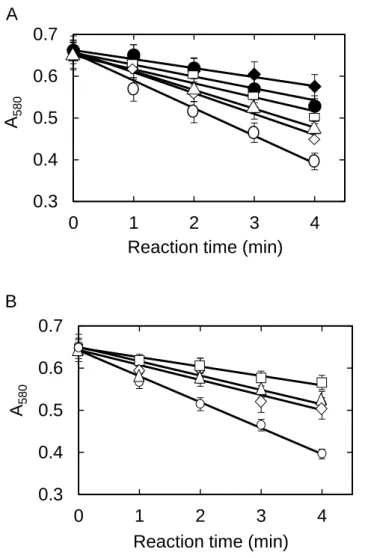
Inhibition of WBA by glucose, maltose, and other carbohydrates - The rate of
soluble starch hydrolysis by WBA was measured from the decrease in absorbance at 580 nm as described in the Materials and Methods. The catalytic activity of WBA was reduced by increasing the concentrations of maltose or other carbohydrates (Figs. 1). The inhibitory activities of fructose, sucrose, trehalose, difructose (-D-fructofuranose--D-fructofuranose-2’,1:2,3’-dianhydride shown in Fig. 2), cellobiose, and 1-deoxynojirimycin were comparatively weak. On the other hand, acarbose and maltose strongly inhibited WBA activity followed by glucose (Fig. 3A). The inhibition by acarbose, maltose, and glucose were significant with the IC50 values
of 0.06 0.01, 0.22 0.09, and 1.41 0.17 M, respectively. The IC50 values were not
attained by the other carbohydrates examined at the concentrations of their maximal solubility (Fig. 3B). The maximum degrees of inhibitions by 1-deoxynojirimycin, difructose, trehalose, sucrose, fructose, and cellobiose were around 30%, and the IC50
values were estimated to be: 9 mM, 0.3 M, 2 M, 0.5 M, 2 M, and 0.4 M, respectively. The IC50 values were the values of [I]o at which the fractional activity of WBA becomes
0.5 as shown in Fig. 3.
Reversibility of WBA inhibition by maltose and glucose - The reversibility of WBA
- 34 -
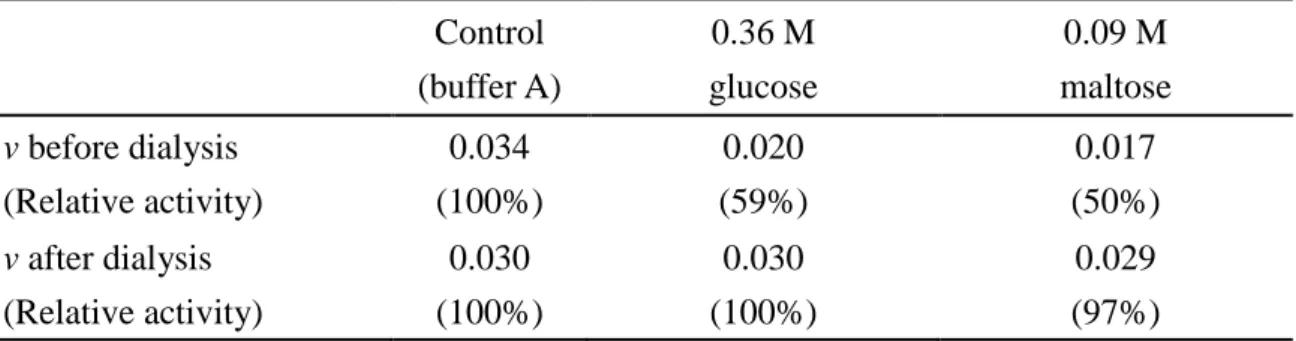
methods. The activity of WBA in the absence and presence of inhibitors was measured using blue value method (∆A580) after dialysis. The activity of WBA in buffer A
(control) was taken as 100%, and the reversibility in the presence of inhibitors after dialysis were calculated relative to the activity of the control (Table 1). The activity of WBA was completely restored through dialysis.
In the dilution method, the inhibitor concentrations were diluted 10 times and the effect of dilution was examined following the method described previously (41). The activity of WBA in the presence of 18 mM maltose was 86% relative to the activity observed in the absence of inhibitors. When 180 mM maltose was diluted to 18 mM, the activity recovered to 89%, and hence the reversibility was 103 ± 6%. In the same manner, various concentrations of glucose and maltose were studied and complete reversibility was observed through dilution (Table 2).
Temperature-Dependence of Ki - The temperature-dependence of the Ki values of
glucose and maltose at 15, 25, 35, and 45oC were estimated at pH 5.4 using Dixon plots (Figs. 4 and 5). The Ki values of both inhibitors increased slightly with increasing
temperature, indicating that the inhibitory activity of the inhibitors decrease with increasing temperature in the range of 15-45oC. The thermodynamic parameters: the Gibbs energy change (Go), enthalpy change (Ho), and entropy change (So) of the dissociation of the WBA-glucose or WBA-maltose complexes were determined at various temperatures (Table 3). The van't Hoff plots of the Ki values of WBA inhibition
by glucose and maltose with the slope -Ho/R were shown in Fig. 6.
- 35 -
glucose and maltose at 25oC were evaluated at pH 3.0, 5.4, and 9.0 using the Hanes-Woolf plots shown in Figs. 7 and 8. Here, we should note the difference between the inhibitory mechanisms of the competitive inhibition and uncompetitive inhibition. In the case of competitive inhibition, the inhibitor (I) binds only to the enzyme (E) to form the enzyme-inhibitor complex (EI) but does not bind to the enzyme-substrate complex (ES). In the case of uncompetitive inhibition, it binds only to the ES complex to form the enzyme-substrate-inhibitor (ESI) ternary complex but does not bind to E. Thus, the EI complex is not formed in uncompetitive inhibition, whereas the ESI complex is not formed in competitive inhibition. In other words, it binds to the active site of the enzyme in competitive inhibition, but binds to the secondary binding site other than the active site in uncompetitive inhibition. Glucose and maltose bind to the active site of WBA at pH 3.0 and 5.4, and bind to the secondary binding site of WBA at pH 9.0. In competitive inhibition, Km increases and Vmax remains constant while both the Km and
Vmax values decrease in uncompetitive inhibition. It is interesting to note that the Ki
values obtained at pH 5.4 for both glucose and maltose are slightly larger than at pH 3.0 and 9.0, suggesting that the inhibitory effects of glucose and maltose on WBA at pH 5.4 (which is the optimal pH of WBA) are lower than at pH 3.0 and 9.0, at which the enzyme activity is extremely low. The Ki values determined by the Hanes-Woolf plot
and Dixon plot for the respective inhibitors at pH 5.4 and 25oC are in good agreement. The Ki values of glucose and maltose in the WBA inhibition are considered to be the
dissociation constant (Kd) values for the WBA-glucose and WBA-maltose complexes.
Thus, the Go values of the dissociations of the WBA-glucose and WBA-maltose complexes can be determined from Ki values at each pH (Table 4).
- 36 - Discussion
Inhibition of WBA - The catalytic activity of WBA was noticeably inhibited in a
dose-dependent manner by acarbose, maltose and glucose. BAs from other crops such as soybean (13), sweet potato (64), and alfalfa (56) were reported to be inhibited by glucose and maltose. In the present study, other sugar analogues and sugar derivatives were systematically selected to evaluate their inhibitory effects on WBA, among which, only acarbose containing acarviosin (-amylase inhibitor) and maltose moiety was found to expressively inhibit WBA. However, this IC50 value of acarbose is very big in
view of pharmaceutical industries. The well-known -amylase inhibitor, acarbose was reported to competitively inhibit BBA (65). Acarbose analogues, containing cellobiose and lactose structures were potent competitive inhibitors of -glucosidase, and the lactose analogues were uncompetitive inhibitors of -galactosidase (66). On the other hand, fructose, sucrose, trehalose, difructose, 1-deoxynojirimycin, and cellobiose did not show substantial inhibition on WBA. However, the maximum solubility of cellobiose is very low even at high temperature and hence, difficult to evaluate its inhibitive power.
The respective IC50 and Ki values of maltose are 0.22 0.09 and 0.12 0.03 M and
that of glucose are 1.41 0.17 and 0.33 0.02 M at 25o
C, pH 5.4 (Fig. 3 and Table 3). The Ki values of 0.034 0.0 M for maltose and 0.32 0.08 M for glucose were reported
in SBA inhibition (13). This shows that maltose is stronger inhibitor than glucose of not only WBA but also of SBA. From the crystal structure study of maltose and glucose binding of BacBA, it was stated that glucose binds to subsite 1 and maltose binds to
- 37 -
subsites 1 and 2 of the active site (2). This attests that maltose binds at two subsites of BacBA at a time while glucose binds at only a single subsite. Therefore, the molar energy of maltose binding to the active site may be given as the sum of the molar energy of glucose moieties binding to subsites 1 and 2, while the molar energy of glucose binding is that to subsite 1. Hence, the inhibition of maltose is stronger than that of glucose. This is not always true if more than one maltose molecules that bind different binding sites or subsites are considered. In such cases, the binding affinities of the second binding site or subsites are enhanced in positive co-operativity and inhibited in negative co-operativity. By considering the binding modes of glucose and maltose by WBA to be similar to that of BacBA, we can estimate the molar binding energy of the glucose moieties to subsites 1 and 2 separately from Table 4. The binding energy of the glucose moiety to subsite 1 would be -3.43 and -2.33 kJ mol-1 at pH 3.0 and 5.4, respectively, and those to subsite 2 would be -1.81 and -2.20 kJ mol-1. From these values, it can be seen that the molar binding energy to subsite 1 is much lower in magnitude at pH 5.4 than at pH 3.0, although that to subsite 2 is higher at pH 5.4 than at pH 3.0, and the molar binding energy of maltose to the active site of WBA is slightly smaller at pH 5.4 than at pH 3.0 as shown in Table 4.
Reversibility of maltose and glucose inhibition - Inhibition of WBA by glucose and
maltose was completely reversible. We can also infer from reports (13, 55, 56) that the inhibition was reversible indicating that the molecular interaction between WBA and the sugars is not covalent. The reversibility of WBA inhibition by glucose and maltose was examined by dialysis. The dialysis was conducted at 4oC to avoid activity loss, and WBA activity was completely reinstated (Table 1). In dialysis, enzymes are restored
- 38 -
from the easily dissociable, non-covalently formed EI (67). The reversibility of WBA activity was also confirmed through dilution technique. Similar dilution principles were reported on the reversibility study of the inhibition of thermolysin (41) and neuraminidase (68) by alcohols. Contrary to the dialysis method, low concentration of the inhibitor remains in the reaction after dilution. Due to this fact, reversibility was calculated relative to the initially low inhibitor concentration the same as after 10 times dilution. It was explained that the drastic activation of neuraminidase activity after dilution could be because of the change in the conformation and hydrated state of the enzyme, in addition to the change in the viscosity of the reaction medium (68).
Temperature-Dependence of Ki - The Ki values of EI dissociations were affected by
the change in reaction temperature which influences the molecular activities of the solvent, enzyme, and inhibitors. It also affects the structure of the protein, which entails change in EI binding or dissociation (60, 69). The Ki values increased with temperature
(Table 3) which agrees with reports on various enzymes and inhibitors showing an increase in Ki with temperature (41, 59, 60, 69). The Ki values at various temperatures
were determined from the Dixon plots in this study following the method previously reported (58, 70). Kitagishi et al. (69) have recommended that inhibitor concentrations close to the Ki values should be used in order to determine the Ki values accurately and
in conditions where [E]o << [I]o, the Ki values can be obtained from the Dixon plot.
The concentration of enzyme is much less than the inhibitor concentrations in our study. Temperature variation exerted significant influence on the thermodynamic parameters of the EI complexes dissociations (Table 3). The positive Ho values of the dissociations of the WBA-glucose and WBA-maltose complexes indicate that the
- 39 -
dissociations were endothermic. The Go, a state function reaction change of the system determines the relative importance of the enthalpy and entropy terms as driving forces behind a particular reaction (71). The positive values of Go indicate non-spontaneous dissociations of the EI complexes. Since the enthalpy terms are greater in magnitude than the entropy terms, the EI dissociations are enthalpy-driven. The ΔGo values were found to decrease with increasing temperature. The source of the energy demand for the dissociations is the partial hydrogen-bond breakage in the system (72). The bindings of glucose and maltose to the active site of BacBA are mainly by hydrogen-bonds from the crystallographic study (2). It can be elucidated from these facts that there is hydrogen-bond cleavage with the dissociations of the WBA-glucose or WBA-maltose complexes. In general, the hydrogen-bond dissociation energies are 20 kJ mol-1 but it can span more than two orders of magnitude (about 8-100 kJ mol-1) depending on the nature of the interactions and environments (72). The Go required for the dissociation of the WBA-maltose complex is almost twice as that of the WBA-glucose complex (Tables 3 and 4), which is in good agreement with the structural compositions of the inhibitors.
pH-Dependence of Ki - The inhibition type of WBA by both glucose and maltose
was affected by pH. Both sugars behaved as competitive inhibitors at pH 3.0 and 5.4 at 25oC but exhibited uncompetitive type of inhibition at pH 9.0. Nomura et al. (13) reported that the inhibition type on SBA by maltose and cyclohexa-amylose was competitive at pH 5.4 but it was mixed-type by glucose at pH 5.4 (I binds both E and ES to form EI and ESI complexes), and competitive by both the sugars at pH 8 and form solely EI complexes. Change of the inhibition type based on pH was also reported
- 40 -
in aspartic protease (73) and pepsin (74). The isoelectric point (pI) value of WBA was reported to be 5.8 (75). The pKe1 (where the ionizable group 1 of SBA is deprotonated)
and pKe2 (where the ionizable group 2 of SBA is protonated) were 3.41 and 8.09 with pI
value of 5.63 (32, 76). This is to indicate that at pH 3.0, WBA has a net positive charge. In this state, both glucose and maltose bind to the active site. At pH 9 when the net charge of WBA becomes negative, the sugar molecules bind the secondary binding sites on the EI complex and behaved as uncompetitive inhibitors. According to the subsite model of amylases (31, 77), the inhibition type depends on the binding site of the inhibitors (78).
The Ki values of the dissociations of the WBA-glucose and WBA-maltose
complexes were also pH dependent (Table 4). The pH-dependences of Ki in various
enzymes and inhibitors were reported with the changes in Ki being different depending
on the response of particular enzymes to the pH changes (13, 58, 69, 73, 74). This phenomenon apparently suggests that pH either induces conformational or change in ionization states of binding residues of an enzyme. Our result in Table 4 shows that the inhibitive power of the inhibitors declines with increasing the activity of the enzyme at optimum pH.
In starch-saccharifying industries, maltose and glucose are continuously produced from the enzymatic starch hydrolysis process. Hence, studying the molecular interactions of these end-products and BA is worthwhile to search for suitable ways of enhancing production. This study thus, provides valuable information on the end-product inhibition of WBA, which has direct implication on the efficiency and cost of production. Mechanisms of reducing the inhibitory actions of glucose and maltose can be suggested like, continuous removal of the end-products from the reaction.
- 41 -
In conclusions, the end products of starch hydrolysis, maltose and glucose inhibit WBA dose-dependently and the interaction is reversible. The catalytic activity of WBA is more strongly inhibited by acarbose than by maltose and glucose. The Ki of glucose
and maltose are temperature dependent. The dissociations of the WBA-glucose and WBA-maltose complexes are endothermic. Both glucose and maltose bind the active site when WBA is protonated at pH 3.0 and 5.4 and to the secondary binding sites when its net charge becomes negative at pH 9.0. A change in pH affects the active site integrity in binding the inhibitors or induces a conformational change to WBA and hence, affects the type of inhibition. Therefore, both the temperature and pH of starch hydrolysis operations require careful manipulation to minimize end-product inhibition in starch-saccahrifying industries.
- 42 -
Table 1. The initial velocity and relative activity of WBA in the hydrolysis of soluble starch in the presence of glucose and maltose before and after dialysis.
Control (buffer A) 0.36 M glucose 0.09 M maltose v before dialysis (Relative activity) 0.034 (100%) 0.020 (59%) 0.017 (50%) v after dialysis (Relative activity) 0.030 (100%) 0.030 (100%) 0.029 (97%)
The initial concentrations of WBA and soluble starch in the reaction solution were 0.14 M and 0.82% (w/v), respectively. The activity of WBA pre-incubated with buffer A was considered as 100% and the activities in the presence of inhibitors were calculated relative to the control (buffer A).