はじめに 細胞内情報伝達,膜輸送,細胞骨格制御など多様な細胞 機能の過程で, 細胞質中の多くのタンパク質が生体膜に結 合する.この際に生体膜の一部である酸性リン脂質の多く がタンパク質と膜との結合を直接仲介する因子として重要 な役割を果たしていることが知られている1-3).こうした 酸性リン脂質に結合するタンパク質には大きく分けて二通 りある.一つのタイプはリン脂質の親水性部位を成す headgroup を特異的に認識し結合する構造(モチーフある いはドメイン)を持つもので,phospholipase C delta 1 の pleckstrin homology (PH) ドメイン (PHPLCδ1) などが代表 例である.PHPLCδ1は plasma membrane (PM) に局在する 酸性リン脂質 phosphatidylinositol-(4,5)-bisphosphate [PI(4, 5)P2] お よ び そ の headgroup に 相 当 す る D-myo-inositiol 1,4,5 trisphosphate に特異的に結合する2-6).この脂質特 異性のため PHPLCδ1は細胞内では PM に局在する.他に 特定の脂質の headgroup を認識することでその脂質が含 まれるオルガネラに局在するタンパク質ドメインは数多く 同定されている.第 2 のタイプは塩基性アミノ酸クラス ターによりリン脂質の酸性 headgroup と非特異的な静電 的結合をするもので K-Ras,Src,MARCKS などが含ま れる2,3).これらの多くは myristoylation,palmitoylation, prenylation などの脂肪酸による修飾も受けており,静電 的結合と疎水性結合の 2 つを介して脂質二重層に結合する .近年の研究によりレトロウイルス,特に HIV-1 の Gag タンパク質は,上記 2 タイプのリン脂質結合タンパク質の 特徴を併せ持ちつつ, さらに別のメカニズムで脂質特異性 を決定するタンパク質であることが明らかになりつつあ る. レトロウイルスの粒子形成はいくつかの構造的ドメイン を含む Gag タンパク質の発現により起こる7-9).主要な Gag タンパク質のドメインは matrix (MA),capsid (CA), nucleocapsid (NC) の 3 つであり(図1),これらの 3 ドメ インの持つ機能により ウイルス粒子形成過程のほぼ全て の段階(粒子放出を除く)が進行する.N 末端の MA ド メインは Gag の膜結合を仲介するほか,ウイルス糖タン パク質 Env の粒子への取り込みを促進する.Gag の膜結 合と前後して Gag は多量体化するが,これには C 末端側 の 2 つのドメイン CA と NC が関わっている.CA は Gag
総 説
3. レトロウイルス Gag タンパク質の膜結合
小 野 陽
Department of Microbiology and Immunology University of Michigan Medical School
ウイルス粒子形成が 細胞内のどの部位でおこるか,またそれがどのように決定されているかとい う点は,粒子形成・放出のみならず,細胞間伝播など粒子形成後の過程にも大きく影響するため,ウ イルス増殖の理解を深める上でも,また抗ウイルス薬の戦略を考える上でも重要な問題である.レト ロウイルスの粒子形成はウイルス構造タンパク質である Gag タンパク質の発現により起こる.HIV-1 の場合,Gag はその N 末端の MA ドメインを介して plasma membrane (PM) に結合・局在し,そこ でウイルス粒子を形成する.近年の研究により,この過程には PM 特異的なリン脂質 PI(4,5)P2が重 要な役割を果たしていることが明らかになって来た.本稿では,HIV-1 や他のレトロウイルスの MA が生体膜のリン脂質とどのように関わっているかについて,最近の知見を含めて紹介する.
連絡先
Department of Microbiology and Immunology University of Michigan Medical School Rm. 5736, Medical Science Building II 1150 W. Medical Center Dr.
Ann Arbor, MI 48109, USA TEL: 734-615-4407 FAX: 734-764-3562
E-mail: [email protected]
分子どうしの直接の結合を促進し,NC は共通の RNA に 結合することを通して,Gag 分子の高度多量体化を可能に すると考えられている.NC 中の Zinc finger モチーフによ り NC はウイルスゲノム RNA に高い親和性を持って結合 するが Gag の NC 依存的な多量体形成は非ゲノム RNA で も促進される. ウイルス粒子形成が細胞内のどの部位で起こるかは ウ イルス感染サイクル及びその 素過程を阻害する抗ウイル ス薬の開発を考える上で重要な問題である.なぜなら,ウ イルスが正常な細胞内部位で形成されることは粒子形成・ 放出の効率のみならず,細胞間伝播など粒子形成後の過程 に大きく影響するからである.HIV-1 の場合,自然宿主の 一つである T 細胞を含む多くの細胞では,粒子形成は PM 脂質二重層の細胞質側に結合した Gag が膜上で多量体化 し,続いて出芽することで起こる.マクロファージでは, ウイルス粒子の形成・集積が 細胞内部の膜で囲まれた空 間で見られるが10,11),この膜も少なくとも部分的には PM の一部が深く陥入したもので,PM と同質のものであるこ とが知られている12-14).PM でのウイルス粒子形成は Gag が PM 特異的に局在することによるが,この局在には MA と PM リン脂質との相互作用が重要な役割を果たしてい る.本稿ではこの相互作用について 近年明らかになりつ つあるメカニズムの詳細を紹介する. MA ドメインの膜結合シグナル Gag の膜結合には MA ドメインの N 末端 myristoyl 化
及び同じく MA 内の Highly Basic Region (HBR) の二つの シグナルが必要である(図 1).前者は疎水性結合を通して, 後者は 酸性リン脂質との結合を通して Gag の膜結合を促 進する.
いくつかの myristoyl 化されたタンパク質でみられるよう に,HIV-1 Gag の myristate moiety はタンパク質分子外に 露出 (exposed) した状態とタンパク質内に収納 (sequestered) された状態の二つの状態をとりうる .一般にこの二つの状態 間の移行は myristoyl switch と呼ばれる15-19).myristate moiety は露出した時に 脂質二重層に挿入されることを通 して myristoyl 化されたタンパク質の膜結合を促進すると 考えられるので,myristoyl switch はタンパク質の膜結合 を制御するメカニズムの一つとして知られている.HIV-1 Gag の場合,myristate moiety の露出は Gag の多量体化 (trimer など ) あるいは MA と PI(4,5)P2の結合(後に詳述) の際に起こることが MA の NMR 解析により明らかになっ て い る20,21). 一 方 HIV-2 や Mason Pfizer Monkey Virus (MPMV) の MA の 場 合 は,PI(4,5)P2の 結 合 は myristate moiety の露出を誘起しないことが同様の解析で示されて いる22,23).myristoyl switch で制御される他のタンパク質 (ARF-117),c-Abl16),recoverin15,18)など)と異なり,HIV-1 の MA の場合,myristate moiety の露出に大規模な構造変 化を必要としない20).したがって実際のウイルス粒子形成 過程で Gag 多量体化や MA-PI(4,5)P2結合による myristoyl switch の誘起がどの程度重要な役割を果たしているかは 不明である.実際に NMR24)や in silico25)の解析で,脂 図 1 HIV-1 Gag の膜結合シグナル SP1 SP2 MA CA NC p6 m 膜結合 Plasma Membrane局在 多量体化 粒子放出
HIV-1 Gag
gRNA結合 myristatemoiety highly basicregion (HBR)
17-KIRLRPGGKKQYKLK-31
膜結合シグナル
質二重層の存在下では myristate moiety の露出が自発的に 起こることが示されている. HIV-1 MA のもう一つの膜結合シグナルである HBR に ついては,生化学的解析や構造解析の結果に基づき, MA の表面に basic patch を形成して酸性リン脂質とのイン ターフェースを作り,酸性リン脂質との結合を通して Gag の膜結合を促進するだろうと当初より考えられて来た 26-28)(図 1).この考えは変異体の解析結果にも支持され ており,例えば, HBR 内に塩基性アミノ酸の変異を導入 すると,HIV-1 Gag が PM に結合する代わりに他のオルガ ネラに局在したり,膜結合せずに細胞質中に拡散したりす ることが知られている29-31).したがって,HBR が Gag を PM に導くのに中心的な役割を果たしているのは明らかで ある.更なる構造解析により,HIV-1 MA と同様の basic patch は大小の差こそあれ他のレトロウイルスの MA にも あることが明らかになっており32),また,いくつかのレ トロウイルスでは MA 内の塩基性アミノ酸残基の変異に より Gag の膜結合が低下したり細胞内局在が変化したり することが見られている33-39).したがって,塩基性アミ ノ 酸 残 基 を 介 し た 酸 性 リ ン 脂 質 と の 結 合 は myristate moiety を 持 た な い レ ト ロ ウ イ ル ス( た と え ば Rous sarcoma virus [RSV] や equine infectious anemia virus [EIAV])の MA にも共有される Gag 膜結合のメカニズム であるといえる.PM 脂質二重層の細胞質側 leaflet には phosphatidylserine (PS) や phosphoinositides の よ う な 酸 性リン脂質が含まれ,負電荷をもつので,正電荷を持つ塩 基性アミノ酸残基が MA の膜結合を促進するのは容易に 予測される.しかしながら,こうした酸性リン脂質は PM だけでなく,エンドソームやゴルジなど他の生体膜の細胞 質側 leaflet にも多く存在するため, PM 特異的な 局在を示 すレトロウイルスの場合,その MA が PM の 脂質に特異 性を示す可能性が考えられる.次節に述べるように, HIV-1 Gag の場合,実際にこの可能性が当てはまることが 示されている. Gag の膜結合と細胞内局在における PI(4,5)P2の役割 繰り返しになるが HIV-1 Gag は PM に局在し,その結果, HIV-1 の粒子形成は PM で起こる.過去 10 年ほどの研究 により,HIV-1 Gag がこのような局在を示すのは HIV-1 の MA HBR が PM 特異的な酸性リン脂質で phosphoinositide の一つである PI(4,5)P2と結合することによるということ が明らかになって来ている(図 2).HeLa 細胞や T 細胞を 用 い た 解 析 で polyphosphoinositide 5-phosphatase IV (5ptaseIV) の高発現により細胞の PI(4,5)P2を減少させると Gag の PM 結合が阻害され,Gag が細胞質にとどまるか, あるいは核近傍のオルガネラに局在することが観察されて 図 2 PI(4,5)P2 O P O¯ O¯ O O P O¯ O¯ O O P O O O¯ OH OH OH CH2CHCH2 O O sn-1 sn-2 1 2 3 4 5 6 C O C O headgroup (イノシトール環) アシル鎖
PI(4,5)P
2Plasma
Membrane
細胞外
細胞質
いる40,41).このような細胞では,ウイルス粒子形成・放 出 も 大 き く 減 少 す る34,40-43).HIV-2,murine leukemia virus (MLV),MPMV など他のレトロウイルスでも PI(4,5) P2の減少によりウイルス粒子形成が阻害されることが見 られている23,35,38,43).しかしながら,すべてのレトロウイ ルスの粒子形成が PI(4,5)P2依存的であるわけではなく, EIAV34)や human T-lymphotropic virus type 1 (HTLV-1)44) は 5ptaseIV の影響をあまり受けないことが報告されてい る.RSV の場合, 5ptaseIV 感受性・非感受性の解析結果 は報告によって異なり42,45),実験系の違いなどにより結 果 やその解釈に違いが出る可能性が考えられる.他のレ トロウイルスも含めて同一の実験系で比較することはどの ウイルスがどの程度 PI(4,5)P2依存的であるかを評価する 上で重要であろう. HIV-1 の MA HBR が phosphoinositide と結合する可能 性 は inositol polyphosphates が Gag の in vitro assembly に影響を与えるという報告で最初に示唆された46).その 後,protein footprinting や NMR による解析で,MA HBR が短いアシル鎖を持つ水溶性の PI(4,5)P2と直接結合する ことが示された21,47).SPR を用いた解析もこれを支持す る48).さらに,通常の長さのアシル鎖を持つ PI(4,5)P2を 含むリポソームを用いた生化学的解析により, PI(4,5)P2が リポソーム中にあると Gag のリポソーム膜への結合を強 く促進することが明らかになった29,49,50).加えて,放出 されたウイルス粒子のエンベロープ膜とウイルス産生細胞 の PM を比較した lipidome 解析で,前者は 後者より多く PI(4,5)P2を含み,この現象は MA 依存的であることが示 された43).これらの知見を総合すると,HIV-1 の MA HBR が PI(4,5)P2と結合することは確かであると考えられ る. Gag- PI(4,5)P2間の結合が静電的結合によってのみ起こ るものか,あるいは HBR と PI(4,5)P2の間に構造特異的な 関係があるのかについては,多少の議論が存在する.我々 を含む複数のグループの報告では,PI(4,5)P2を含むリポ ソームと palmitoyl-oleoyl-PS (POPS) のみを酸性リン脂質 として含むリポソームを 比較すると,全体の電荷を同等 にしても(一分子当たり PI(4,5)P2は +3 か +4,PS は +1), HIV-1 の MA を介した膜結合は前者とのみ効率的に起こる ことが観察されており,Gag と PI(4,5)P2の結合が静電的な ものだけによるのではないことが示唆されている29,51,52). しかし別のグループによる報告では,PI(4,5)P2の有無で大 きな差は見られず,PS のみを酸性リン脂質として含むリ ポソームでも相当の Gag 結合が検出された42).ただし, この違いは少なくとも部分的には PS のアシル鎖の違いに 起因すると考えられる.実際,同じグループが別の報告で POPS を使ったところ ,Gag のリポソーム結合はほとん ど検出されなかった49)(後述).上記の知見に加えて,我々 は,1)PI(4,5)P2と PI(3,5)P2 (headgroup を成すイノシトー ル環でリン酸残基の位置だけが異なる)を比較すると同じ 荷電にもかかわらず前者が後者より効率的に Gag をリポ ソームに結合させること29),そして,2)HBR 内の Lys と Arg を入れ替えると HBR 全体の電荷は変わらないにも かかわらず Gag の PI(4,5)P2依存性リポソーム膜結合が見 られなくなること53)も報告しており,総合すると,静電 的結合だけでなく HBR と PI(4,5)P2の headgroup の構造に 依存的な相互作用が両者の結合に重要な役割を果たしてい る可能性は高いと考えられる. リン脂質のアシル鎖による影響 短いアシル鎖を持つ水溶性の PI(4,5)P2を用いた前述の NMR 解析では,PI(4,5)P2の headgroup が HBR と相互作 用するだけでなく,sn-2 のアシル鎖が MA 内の cleft に位 置するアミノ酸残基と相互作用することが観察された21). この結果に基づき,Saad らは,PI(4,5)P2との結合の結果
図 3 レトロウイルス MA の globular domain 上にある basic patch
HIV-1
(PDB:2HMX) (PDB:1A6S)
RSV
HTLV-2
(PDB:1JVR) (PDB:2HMX)MLV
dioleoyl-PS は POPS より高い効率で Gag の膜結合を促進 することが示されている49).しかし現時点ではこの現象 を説明するメカニズムは明らかになっていない.これと関 連して,最近報告された NMR による解析では,PS や中 性リン脂質(phosphatidylcholine [PC],phosphatidyletha-noleamine などの zwitterionic headgroup を持つもの)の アシル鎖も MA のアミノ酸残基と相互作用することが観 察されている24).しかし,この相互作用が Gag の膜結合に 関してどのような意義をもつかは明らかになっていない. Gag の膜結合における MA-RNA 結合の役割 MA 内の塩基性アミノ酸残基はリン脂質に加えて RNA とも結合しうることが,HIV-1 を含むいくつかのレトロウ イルスで知られている47,55-61).HIV-1 MA の RNA との結 合はウイルスゲノム RNA の encapsidation に必要ではな いが62-64),RSV や bovine leukemia virus の場合,MA-RNA 間の相互作用はウイルスゲノム RNA の encapsidation や 二量体化,mRNA の翻訳制御などに関与していると報告 されている65-68).HIV-1 の場合,MA と RNA の間のイン ターフェースは HBR であり,in vitro の実験系だけでな く47,58,60,69,70),細胞質内でも50,71) RNA と結合しているこ とが示されている.我々は同じ HBR がリン脂質とも結合 することから,RNA が Gag の膜結合を制御するというモ デルを提示して来た.実際,rabbit reticulocyte lysate (RRL) sn-2 アシル鎖が cleft に収まることは Gag の PM 上での動 態に影響を及ぼすという仮説を提示している.一般に細胞 に存在する PI(4,5)P2の sn-2 アシル鎖は不飽和なものが多 く(図 2),lipid raft(ウイルス粒子形成を促進すると考 えられている PM の microdomain)とは親和性が低いと 考えられている.このことから,上記の仮説では,Gag が PI(4,5)P2と結合する際にその sn-2 アシル鎖を PM 中から 引き抜き MA 内に収納することにより,Gag-PI(4,5)P2の 複合体の lipid raft への移行が促進されると推論されてい る.しかしながら,giant unilamellar vesicle (GUV) を用い た in vitro の 系 で は, Gag の liquid-ordered phase (lipid raft のモデルとして扱われている)への結合は PI(4,5)P2 存 在 下 で 見 ら れ な か っ た52). ま た 細 胞 中 に 存 在 す る PI(4,5)P2のアシル鎖は NMR で使われた PI(4,5)P2のものよ り 2 倍以上長く,実際に MA 内の cleft に収まるかどうか, また脂質二重層からそのようなアシル鎖を引き抜くのはエ ネルギー的に可能か(前例はあるが),などの疑問もある. 現在のところ,リポソームを使った実験系では,Gag のリ ポソーム膜結合に対する PI(4,5)P2のアシル鎖の影響は検 出されておらず54),上記の可能性を支持する生化学的な 知見は得られていない. PI(4,5)P2以外のリン脂質のアシル鎖も脂質二重層の成分 によっては Gag の膜結合に大きな影響を及ぼす.酸性リ ン 脂 質 と し て PS の み を 含 む リ ポ ソ ー ム の 系 で は,
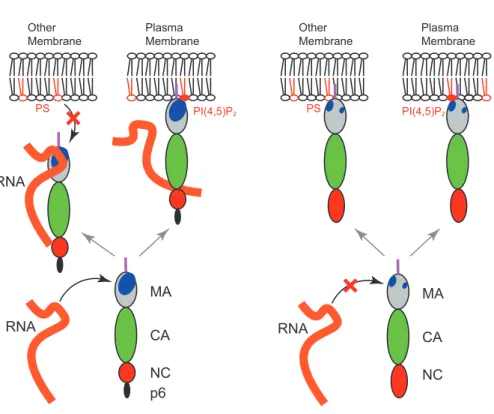
図 4 HIV-1 Gag と HTLV-1 Gag の膜結合に対する RNA の影響(作業仮説)
Plasma Membrane Other Membrane RNA
HIV-1
RNA MA CA NC p6 PI(4,5)P2 PSHTLV-1
RNA MA CA NC Plasma Membrane Other Membrane PS PI(4,5)P2ついては 少なくともこの細胞では HIV-1 と HTLV-1 の 間 に大きな違いは見られない44).それでは HIV-1 の PI(4,5) P2依存性にはどのような意味があるのであろうか.MA の構造を比較すると,HIV-1 と RSV には比較的大きな basic patch が見られるのに対し,HTLV-2(HTLV-1 の構 造は決定されていない)や MLV では小さな basic patch が MA 表面上の数カ所に散らばって存在しているように 見える32)(図 3).酸性アミノ酸残基を塩基性のものに置 換することにより HTLV-1 の MA において basic patch の 一つを拡大することを試みると,この変異体は RNA 阻害 に感受性を示すようになった (in revision).しかしこの変 異体は PI(4,5)P2存在下でも RNase 処理しない限りリポ ソームに結合することはできなかった.これらの結果に基 づいて推察すると,大きな basic patch をもつ HIV-1 や RSV は RNA による阻害に対応するために PI(4,5)P2を利 用する機能を獲得し,その結果として PM 特異的に局在す る能力を得た可能性が考えられる.一方,HTLV-1 や MLV は basic patch が小さいために RNA による阻害を受 けず,PI(4,5)P2を利用する必要がないのかもしれない(図 4).この場合,RNA は前述のような MA の cofactor では なく,ある程度以上の大きさを持つ basic patch に対する general な阻害因子であると考えることができよう. おわりに 上述の通り,レトロウイルスの Gag の膜結合には Gag の myristate moiety 付加・露出,HBR と酸性リン脂質の 相互作用,RNA による HBR の阻害など様々な要因が影響 することが明らかになりつつある.一方で,リン脂質のア シル鎖の役割,阻害作用を持つ RNA の特徴,異なる細胞 種でのこれらの因子の働きなど,不明の点も依然として多 く存在する.これらの点を明らかにすることは,RNA aptamer61)や低分子化合物76,77)による Gag の膜結合阻害 剤の開発を進めていくうえで大きな貢献となるのではない かと期待している. 謝辞 最後になりましたが,本稿を執筆する機会を与えてくだ さった松浦善治先生に心より感謝いたします. 校正時加筆 本文中で(in revision)とした知見は現在すでに論文と し て発表されています78).また , 最近 Bieniasz らによって , 細胞内で MA と結合している RNA は実際に tRNA である ことが示されました79).最後に本稿は我々の最近の英文 総説80)と内容的に重複する部分があることをおことわり 致します.
を 使 っ て in vitro 合 成 し た HIV-1 Gag は, 通 常 PC と POPS からなるリポソーム (PC+PS) に結合しないが,Gag を含む lysate を RNase 処理すると Gag が効率よくリポソー ム膜に結合するようになる50).この現象は NC ドメイン を欠損した Gag 変異体でも見られる50).これらの結果か ら,RNA は MA に結合することで PS などの酸性リン脂 質に MA が結合するのを阻害していると考えられる.一 方 PI(4,5)P2を含むリポソームの場合,RNase 処理してい ない Gag でも膜結合は見られるので,膜に PI(4,5)P2が含 まれている場合には Gag は RNA による膜結合阻害を乗り 越えることができると考えられる.同様の結論は他のグルー プによる精製した MA や核酸を使った系でも得られている 54).PI(4,5)P 2と RNA が MA HBR への結合で競合した場合, 前者が勝ることが間接的に示めされており69,72),RNA の 膜結合阻害効果が PI(4,5)P2 の有無で異なるのはこのため であろう.特筆すべきことに PS は細胞内に最も豊富にあ る酸性リン脂質であり,PM だけでなくエンドソーム・ゴ ルジなどの細胞内オルガネラにも存在する73-75).したがっ て,RNA は ,結果的に Gag が非特異的に細胞内オルガネ ラに結合するのを防ぎ,PI(4,5)P2を含む生体膜(つまり PM)に選択的に結合するのを助ける cofactor のような役 割を果たしていることになる(図 4).HIV-1 を発現して いる細胞質に由来する Gag も RRL で in vitro 合成した Gag と同じ性質を示すことから71),上記のような役割を 果たす RNA は細胞内に実際存在していると考えられる. RNase 処理した Gag の膜結合は細胞質中の濃度より低濃 度の tRNA を加えることで再び阻害されることが我々の PC+PS リポソームの系で明らかになった71).したがって, cofactor の役割を果たす RNA は tRNA である可能性があ る. 興味深いことに, RRL で合成した HTLV-1 Gag の膜結合 を 調 べ る と HIV-1 の MA と 異 な り,HTLV-1 の Gag は PI(4,5)P2非存在下でも高い効率で PC+PS リポソームに結 合 し,この結合に RNase 処理を必要としないことが明ら かになった44).同様の実験系ではさらに,RSV は HIV-1 と同様の PI(4,5)P2依存性及び RNA 阻害に対する感受性を 示す一方,MLV は HTLV-1 と同様に PI(4,5)P2非依存的で かつ RNA 阻害を受けないことが示された (in revision).こ れと呼応して,HeLa 細胞内では,HIV-1 及び RSV の Gag は PM にのみ局在するのに対し,MLV と HTLV-1 の Gag は PM だけでなく細胞内オルガネラにも分布することが明 らかになった (in revision).これらの結果を総合すると, レトロウイルスの MA には PI(4,5)P2依存・RNA 阻害感受 性のタイプと PI(4,5)P2非依存・RNA 阻害非感受性のタイ プがあり,この違いが細胞内局在のパターンに大きな違い をもたらすと考えられる.
MA の PI(4,5)P2や RNA との関わり方は HeLa 細胞内で の局在に影響を及ぼすが,最終的な粒子形成・放出効率に
GTPase: mechanisms of guanine nucleotide exchange and GTP-myristoyl switching. Cell 95, 237-248, 1998. 18) Ames, J. B. et al. Molecular mechanics of
calcium-myristoyl switches. Nature 389, 198-202, 1997. 19) McLaughlin, S. & Aderem, A. The
myristoyl-electro-static switch: a modulator of reversible protein-mem-brane interactions. Trends Biochem Sci 20, 272-276, 1995.
20) Tang, C. et al. Entropic switch regulates myristate exposure in the HIV-1 matrix protein. Proc Natl Acad Sci U S A 101, 517-522, 2004.
21) Saad, J. S. et al. Structural basis for targeting HIV-1 Gag proteins to the plasma membrane for virus assembly. Proc Natl Acad Sci U S A 103, 11364-11369, 2006.
22) Prchal, J., Srb, P., Hunter, E., Ruml, T. & Hrabal, R. The structure of myristoylated Mason-Pfizer monkey virus matrix protein and the role of phosphatidylinosi-tol-(4,5)-bisphosphate in its membrane binding. Jour-nal of molecular biology 423, 427-438, 2012.
23) Saad, J. S. et al. Structure of the myristylated human immunodeficiency virus type 2 matrix protein and the role of phosphatidylinositol-(4,5)-bisphosphate in membrane targeting. Journal of molecular biology 382, 434-447, 2008.
24) Vlach, J. & Saad, J. S. Trio engagement via plasma membrane phospholipids and the myristoyl moiety governs HIV-1 matrix binding to bilayers. Proc Natl Acad Sci U S A 110, 3525-3530, 2013.
25) Charlier, L. et al. Coarse-grained simulations of the HIV-1 matrix protein anchoring: revisiting its assem-bly on membrane domains. Biophysical journal 106, 577-585, 2014.
26) Zhou, W., Parent, L. J., Wills, J. W. & Resh, M. D. Iden-tification of a membrane-binding domain within the amino-terminal region of human immunodeficiency virus type 1 Gag protein which interacts with acidic phospholipids. J Virol 68, 2556-2569, 1994.
27) Hill, C. P., Worthylake, D., Bancroft, D. P., Christensen, A. M. & Sundquist, W. I. Crystal structures of the tri-meric human immunodeficiency virus type 1 matrix protein: implications for membrane association and assembly. Proc Natl Acad Sci U S A 93, 3099-3104, 1996.
28) Massiah, M. A. et al. Three-dimensional structure of the human immunodeficiency virus type 1 matrix pro-tein. Journal of molecular biology 244, 198-223, 1994. 29) Chukkapalli, V., Hogue, I. B., Boyko, V., Hu, W. S. &
Ono, A. Interaction between the human immunodefi-ciency virus type 1 Gag matrix domain and phosphati-dylinositol-(4,5)-bisphosphate is essential for efficient gag membrane binding. J Virol 82, 2405-2417, 2008. 30) Ono, A., Orenstein, J. M. & Freed, E. O. Role of the
Gag matrix domain in targeting human immunodefi-ciency virus type 1 assembly. J Virol 74, 2855-2866, 2000.
31) Yuan, X., Yu, X., Lee, T. H. & Essex, M. Mutations in the N-terminal region of human immunodeficiency virus type 1 matrix protein block intracellular
trans-文献
1 ) Lemmon, M. A. Membrane recognition by phospholip-id-binding domains. Nature reviews. Molecular cell biology 9, 99-111, 2008.
2 ) McLaughlin, S. & Murray, D. Plasma membrane phos-phoinositide organization by protein electrostatics. Nature 438, 605-611, 2005.
3 ) McLaughlin, S., Wang, J., Gambhir, A. & Murray, D. PIP(2) and proteins: interactions, organization, and information flow. Annual review of biophysics and biomolecular structure 31, 151-175, 2002.
4 ) Lemmon, M. A., Ferguson, K. M., O'Brien, R., Sigler, P. B. & Schlessinger, J. Specific and high-affinity binding of inositol phosphates to an isolated pleckstrin homol-ogy domain. Proc Natl Acad Sci U S A 92, 10472-10476, 1995.
5 ) Garcia, P. et al. The pleckstrin homology domain of phospholipase C-delta 1 binds with high affinity to phosphatidylinositol 4,5-bisphosphate in bilayer mem-branes. Biochemistry 34, 16228-16234, 1995.
6 ) Kavran, J. M. et al. Specificity and promiscuity in phosphoinositide binding by pleckstrin homology domains. The Journal of biological chemistry 273, 30497-30508, 1998.
7 ) Balasubramaniam, M. & Freed, E. O. New insights into HIV assembly and trafficking. Physiology (Bethesda) 26, 236-251, 2011.
8 ) Bieniasz, P. D. The cell biology of HIV-1 virion gene-sis. Cell Host Microbe 5, 550-558, 2009.
9 ) Sundquist, W. I. & Krausslich, H. G. HIV-1 assembly, budding, and maturation. Cold Spring Harbor perspec-tives in medicine 2, a006924, 2012.
10) Pelchen-Matthews, A., Kramer, B. & Marsh, M. Infec-tious HIV-1 assembles in late endosomes in primary macrophages. The Journal of cell biology 162, 443-455, 2003.
11) Raposo, G. et al. Human macrophages accumulate HIV-1 particles in MHC II compartments. Traffic 3, 718-729, 2002.
12) Bennett, A. E. et al. Ion-abrasion scanning electron microscopy reveals surface-connected tubular con-duits in HIV-infected macrophages. PLoS pathogens 5, e1000591, 2009.
13) Deneka, M., Pelchen-Matthews, A., Byland, R., Ruiz-Mateos, E. & Marsh, M. In macrophages, HIV-1 assembles into an intracellular plasma membrane domain containing the tetraspanins CD81, CD9, and CD53. The Journal of cell biology 177, 329-341, 2007. 14) Welsch, S. et al. HIV-1 buds predominantly at the
plas-ma membrane of priplas-mary huplas-man plas-macrophages. PLoS pathogens 3, e36, 2007.
15) Tanaka, T., Ames, J. B., Harvey, T. S., Stryer, L. & Ikura, M. Sequestration of the membrane-targeting myristoyl group of recoverin in the calcium-free state. Nature 376, 444-447, 1995.
16) Nagar, B. et al. Structural basis for the autoinhibition of c-Abl tyrosine kinase. Cell 112, 859-871, 2003. 17) Goldberg, J. Structural basis for activation of ARF
pendent plasma membrane localization of the Rous sarcoma virus Gag protein. J Virol 87, 3609-3615, 2013. 46) Campbell, S. et al. Modulation of HIV-like particle
assembly in vitro by inositol phosphates. Proc Natl Acad Sci U S A 98, 10875-10879, 2001.
47) Shkriabai, N. et al. Interactions of HIV-1 Gag with assembly cofactors. Biochemistry 45, 4077-4083, 2006. 48) Anraku, K. et al. Highly sensitive analysis of the
inter-action between HIV-1 Gag and phosphoinositide derivatives based on surface plasmon resonance. Bio-chemistry 49, 5109-5116, 2010.
49) Dick, R. A., Goh, S. L., Feigenson, G. W. & Vogt, V. M. HIV-1 Gag protein can sense the cholesterol and acyl chain environment in model membranes. Proc Natl Acad Sci U S A 109, 18761-18766, 2012.
50) Chukkapalli, V., Oh, S. J. & Ono, A. Opposing mecha-nisms involving RNA and lipids regulate HIV-1 Gag membrane binding through the highly basic region of the matrix domain. Proc Natl Acad Sci U S A 107, 1600-1605, 2010.
51) Carlson, L. A. & Hurley, J. H. In vitro reconstitution of the ordered assembly of the endosomal sorting com-plex required for transport at membrane-bound HIV-1 Gag clusters. Proc Natl Acad Sci U S A 109, 16928-16933, 2012.
52) Keller, H., Krausslich, H. G. & Schwille, P. Multimeriz-able HIV Gag derivative binds to the liquid-disordered phase in model membranes. Cellular microbiology 15, 237-247, 2013.
53) Llewellyn, G. N., Grover, J. R., Olety, B. & Ono, A. HIV-1 Gag associates with specific uropod-directed microdomains in a manner dependent on its MA high-ly basic region. J Virol 87, 6441-6454, 2013.
54) Alfadhli, A., Still, A. & Barklis, E. Analysis of human immunodeficiency virus type 1 matrix binding to membranes and nucleic acids. J Virol 83, 12196-12203, 2009.
55) Chang, C. Y. et al. HIV-1 matrix protein repositioning in nucleocapsid region fails to confer virus-like parti-cle assembly. Virology 378, 97-104, 2008.
56) Cimarelli, A. & Luban, J. Translation elongation factor 1-alpha interacts specifically with the human immu-nodeficiency virus type 1 Gag polyprotein. J Virol 73, 5388-5401, 1999.
57) Hearps, A. C., Wagstaff, K. M., Piller, S. C. & Jans, D. A. The N-terminal basic domain of the HIV-1 matrix protein does not contain a conventional nuclear local-ization sequence but is required for DNA binding and protein self-association. Biochemistry 47, 2199-2210, 2008.
58) Lochrie, M. A. et al. In vitro selection of RNAs that bind to the human immunodeficiency virus type-1 gag polyprotein. Nucleic acids research 25, 2902-2910, 1997.
59) Ott, D. E., Coren, L. V. & Gagliardi, T. D. Redundant roles for nucleocapsid and matrix RNA-binding sequences in human immunodeficiency virus type 1 assembly. J Virol 79, 13839-13847, 2005.
60) Purohit, P., Dupont, S., Stevenson, M. & Green, M. R. port of the Gag precursor. J Virol 67, 6387-6394, 1993.
32) Murray, P. S. et al. Retroviral matrix domains share electrostatic homology: models for membrane binding function throughout the viral life cycle. Structure (Camb) 13, 1521-1531, 2005.
33) Callahan, E. M. & Wills, J. W. Repositioning basic resi-dues in the M domain of the Rous sarcoma virus gag protein. J Virol 74, 11222-11229, 2000.
34) Fernandes, F. et al. Phosphoinositides Direct Equine Infectious Anemia Virus Gag Trafficking and Release. Traffic 12, 438-451, 2011.
35) Hamard-Peron, E. et al. Targeting of murine leukemia virus gag to the plasma membrane is mediated by PI(4,5)P2/PS and a polybasic region in the matrix. J Virol 84, 503-515, 2010.
36) Manrique, M. L., Celma, C. C., Gonzalez, S. A. & Affranchino, J. L. Mutational analysis of the feline immunodeficiency virus matrix protein. Virus Res 76, 103-113, 2001.
37) Soneoka, Y., Kingsman, S. M. & Kingsman, A. J. Muta-genesis analysis of the murine leukemia virus matrix protein: identification of regions important for mem-brane localization and intracellular transport. J Virol 71, 5549-5559, 1997.
38) Stansell, E. et al. Basic residues in the Mason-Pfizer monkey virus gag matrix domain regulate intracellu-lar trafficking and capsid-membrane interactions. J Virol 81, 8977-8988, 2007.
39) Le Blanc, I., Rosenberg, A. R. & Dokhelar, M. C. Multi-ple functions for the basic amino acids of the human T-cell leukemia virus type 1 matrix protein in viral transmission. J Virol 73, 1860-1867, 1999.
40) Monde, K., Chukkapalli, V. & Ono, A. Assembly and replication of HIV-1 in T cells with low levels of phos-phatidylinositol-(4,5)-bisphosphate. J Virol 85, 3584-3595, 2011.
41) Ono, A., Ablan, S. D., Lockett, S. J., Nagashima, K. & Freed, E. O. Phosphatidylinositol (4,5) bisphosphate regulates HIV-1 Gag targeting to the plasma mem-brane. Proc Natl Acad Sci U S A 101, 14889-14894, 2004.
42) Chan, J., Dick, R. A. & Vogt, V. M. Rous sarcoma virus gag has no specific requirement for phosphatidylinosi-tol-(4,5)-bisphosphate for plasma membrane associa-tion in vivo or for liposome interacassocia-tion in vitro. J Virol 85, 10851-10860, 2011.
43) Chan, R. et al. Retroviruses human immunodeficiency virus and murine leukemia virus are enriched in phos-phoinositides. J Virol 82, 11228-11238, 2008.
44) Inlora, J., Chukkapalli, V., Derse, D. & Ono, A. Gag Localization and Virus-like Particle Release Mediated by the Matrix Domain of Human T-Lymphotropic Virus Type-1 Gag are Less Dependent on Phosphati-dylinositol-(4,5)-bisphosphate than Those Mediated by the Matrix Domain of Human Immunodeficiency Virus Type-1 Gag. J Virol, 2011.
45) Nadaraia-Hoke, S., Bann, D. V., Lochmann, T. L., Gudleski-O'Regan, N. & Parent, L. J. Alterations in the MA and NC domains modulate
phosphoinositide-de-Sequence-specific interaction between HIV-1 matrix protein and viral genomic RNA revealed by in vitro genetic selection. Rna 7, 576-584, 2001.
61) Ramalingam, D. et al. RNA aptamers directed to human immunodeficiency virus type 1 Gag polypro-tein bind to the matrix and nucleocapsid domains and inhibit virus production. J Virol 85, 305-314, 2011. 62) Poon, D. T., Li, G. & Aldovini, A. Nucleocapsid and
matrix protein contributions to selective human immunodeficiency virus type 1 genomic RNA packag-ing. J Virol 72, 1983-1993, 1998.
63) Reil, H., Bukovsky, A. A., Gelderblom, H. R. & Got-tlinger, H. G. Efficient HIV-1 replication can occur in the absence of the viral matrix protein. The EMBO journal 17, 2699-2708, 1998.
64) Wang, C. T., Zhang, Y., McDermott, J. & Barklis, E. Conditional infectivity of a human immunodeficiency virus matrix domain deletion mutant. J Virol 67, 7067-7076, 1993.
65) Garbitt, R. A., Albert, J. A., Kessler, M. D. & Parent, L. J. trans-acting inhibition of genomic RNA dimeriza-tion by Rous sarcoma virus matrix mutants. J Virol 75, 260-268, 2001.
66) Gudleski, N., Flanagan, J. M., Ryan, E. P., Bewley, M. C. & Parent, L. J. Directionality of nucleocytoplasmic transport of the retroviral gag protein depends on sequential binding of karyopherins and viral RNA. Proc Natl Acad Sci U S A 107, 9358-9363, 2010.
67) Parent, L. J. et al. RNA dimerization defect in a Rous sarcoma virus matrix mutant. J Virol 74, 164-172, 2000.
68) Wang, H., Norris, K. M. & Mansky, L. M. Involvement of the matrix and nucleocapsid domains of the bovine leukemia virus Gag polyprotein precursor in viral RNA packaging. J Virol 77, 9431-9438, 2003.
69) Alfadhli, A. et al. HIV-1 matrix protein binding to RNA. Journal of molecular biology 410, 653-666, 2011. 70) Cai, M., Huang, Y., Craigie, R. & Clore, G. M.
Structur-al basis of the association of HIV-1 matrix protein with DNA. PLoS One 5, e15675, 2010.
71) Chukkapalli, V., Inlora, J., Todd, G. C. & Ono, A. Evi-dence in support of RNA-mediated inhibition of phos-phatidylserine-dependent HIV-1 Gag membrane bind-ing in cells. J Virol 87, 7155-7159, 2013.
72) Jones, C. P., Datta, S. A., Rein, A., Rouzina, I. & Musi-er-Forsyth, K. Matrix domain modulates HIV-1 Gag's nucleic acid chaperone activity via inositol phosphate binding. J Virol 85, 1594-1603, 2011.
73) Yeung, T. et al. Membrane phosphatidylserine regu-lates surface charge and protein localization. Science 319, 210-213, 2008.
74) Stace, C. L. & Ktistakis, N. T. Phosphatidic acid- and phosphatidylserine-binding proteins. Biochimica et biophysica acta 1761, 913-926, 2006.
75) Leventis, P. A. & Grinstein, S. The distribution and function of phosphatidylserine in cellular membranes. Annu Rev Biophys 39, 407-427, 2010.
76) Alfadhli, A. et al. Analysis of small molecule ligands targeting the HIV-1 matrix protein-RNA binding site. The Journal of biological chemistry 288, 666-676, 2013. 77) Tateishi, H. et al. Design and synthesis of lipid-cou-pled inositol 1,2,3,4,5,6-hexakisphosphate derivatives exhibiting high-affinity binding for the HIV-1 MA domain. Organic & biomolecular chemistry 12, 5006-5022, 2014.
78) Inlora, J., Collins, D. R., Trubin, M. E., Chung, J. Y. & Ono, A. Membrane Binding and Subcellular Localiza-tion of Retroviral Gag Proteins Are Differentially Reg-ulated by MA Interactions with Phosphatidylinositol-(4,5)-Bisphosphate and RNA. mBio 5, 2014.
79 Kutluay, S. B. et al. Global Changes in the RNA Bind-ing Specificity of HIV-1 Gag Regulate Virion Genesis. Cell 159, 1096-1109, 2014.
80) Olety, B. & Ono, A. Roles played by acidic lipids in HIV-1 Gag membrane binding. Virus Res 193, 108-115, 2014.
Membrane Binding of Retroviral Gag Proteins
Akira ONO
Department of Microbiology and Immunology University of Michigan Medical School
Location of virus assembly in infected cells has major influences on efficiencies of virus assembly and release and on post-assembly processes including cell-to-cell transmission. Therefore, for better understanding of virus spread and for developing new antiviral strategies, it is important to elucidate mechanisms by which the subcellular site of virus particle assembly is determined. Retrovirus particle assembly is driven by viral structural protein Gag. In the case of HIV-1, Gag binds to the plasma membrane (PM) via the N-terminal MA domain and forms nascent particles at this location. Recent studies reveled that PM-specific phospholipid PI(4,5)P2 plays an important role in directing Gag to the PM through its interaction with MA. In this review, I will summarize our current understanding of relationships between retroviral MA domains and phospholipids in cellular membranes and discuss possible mechanisms by which lipids and other factors regulate membrane binding and subcellular localization of retroviral Gag proteins.