Listening and Reading Comprehension Strategies
for Teaching TOEIC and TOEFL Effectively
Mohammad Umar FAROOQ
Achieving a higher score on TOEIC and TOEFL seems to be a challenging task for Japanese students as manifested by a recent test scores where Japanese speakers in both tests were rated among the lowest in the world. The aim of this article, therefore, is an attempt to develop students’ listening and reading comprehension as required in such standardized exams. Employing a previously reported ‘goal-oriented framework’, ‘Bingo’ concept has been utilized to introduce a new listening strategy which demands students to interact and focus attentively in a game-like learning atmosphere. On the other hand, ‘modification of words’ in a written text strategy informs students to im-prove reading comprehension in a similar way, where students learn how to interact with the text using a discourse approach focusing on its grammatical, collocational, and textual patterns to grasp the meaning. Both the strategies have been specifically designed to maintain students to work willingly, independently, and with a feeling of satisfaction. Simplified activities, along with suggestions for teachers on how to use the activities in a classroom setting effectively are provided.
Significance of the study
A brief look around us will show that almost all Japanese: old or young, man or woman, student or worker, housewife or office lady have one thing in common in that each has a small cellphone in hand in the form of an i-phone, smart-phone, galaxy or some sort of touch panel. Same can be said for English learning all over Japan in that academic institutions: elementary schools, junior high schools, high schools, colleges and universities, private English schools, companies, long-life education centers, all
have been working hard to establish English related programs simply because of its much demand that has been increasing rapidly. This interest and demand of mastering English by every Japanese is aided even bigger programs by Japanese government such as 2020 Tokyo Olympic. Below are information that show the significance of English education in Japan.
Besides recent 5th and 6th grade English study in national elementary schools throughout Japan at least one lesson per week, based on the information provided by Miura (1997), Johnson (1995), O’Sullivan (1994), and Wadden (1993) Japanese students overall spend 6 years in junior and high schools comprising a variety of les-sons of spoken and written English per week or more both by Japanese and foreign instructors. Communicative or verbal English lessons have particularly been supported by the JET (2011) programs for the past 24 years. Additionally, English seems to be the only language which has been widely taught in almost all levels of Japanese academic institutes: private, national, prefectural universities, junior and professional colleges, and for most of the cases, as a required course at least for freshmen, and according to FD Foramu (1999), and Wordell and Gorsuch (1992) even in some kin-dergartens. National Center Test for University Admissions (2011) is another recent and crucial effort in which English is given a priority by most of the applicants in that a large number of them are partially accepted in universities merely on the bases of its success. Needless to remark that English is the most important exam besides the Japanese language exam among national, prefectural and private universities’ entrance examinations. I wonder if any university in Japan has ever announced to replace this English exam system by one of any other important and popular languages such as Chinese, French or German.
We often hear news about the increase of foreign residents in Japan. There was an increase of approximately10% of foreign population in the year 2004-2005 according to the ‘Guide to Official Statistics in Japan’ (2011), and the Justice Ministry (Japan Today, 2011) as ‘The number of registered foreign residents in Japan hit a record high of 2,217,000 at the end of 2008, marking an increase of around 50% in the last decade’. On the other hand, there is a large group of foreign residents in Japan includ-ing (1) language teachers along with their families, (2) foreign students, researchers, international academic and business conferences’ participants in national and private universities and big enterprises, and (3) international marriages spouses whose number has been increasing rapidly. For instance, currently in Nagoya University there are
over 1300 foreign students from 78 countries studying in various faculties of Nagoya University (Wikipedia, 2011). This increase might be due to the introductions of G30 educational programs, aiming to educate foreign students by competing with the ones in English speaking countries, and popularity of the university’s six noble prize winners. To this end, these foreign residents in Japan need to communicate in English which obviously makes the English education much more demanding than ever.
Nevertheless, there is another important educational area where English is getting more attention in recent years in Japan. This specifically relates to standardized English exams. Although there are a large number of such exams, Japan mainly focusses on in the order of TOEIC, TOEFL and Eiken as informed by STEP information (2000), and Jackson (2000). The TOEFL and TOEIC seem to be so essential that certain universities made it even a requirement for their students to attain a certain score as a criteria to graduate (NUFS, 2011). At the national level, efforts have been made, but at the moment at an early stage, to use the TOEFL score to enter into Japanese universities, and for applicants of government employment (Japan Time News, 2015). However, Lougheed (1992) informed that among the scores of speakers of nineteen different non-English first languages, overall TOEFL score for Japanese learners sta-tistically proved weakest. Additionally, Mathew (2007), more recently, reported that ‘the average TOEIC scores in Japan are among the lowest in the world, lower than many countries that are much poorer.’ Furthermore, Japan seemed to be continued to rank among the worst-scoring countries as regards TOEFL in that according to ETS data ‘out of 30 Asian countries with TOEFL examinees in 2009, Japan ranked second from the bottom.’ as reported by Japan Time News (2015); and according to Asian Scientist (2011) while amongst world 163 countries in 2011, Japan ranked 135th in the TOEFL. Same is the case with the TOEIC where Japanese test-takers of TOEIC ‘ranked 40th among 48 countries in 2013.’ (Japan Real Time, 2013). As is widely known, the demand, however, is that these standardized tests, for instance, TOEIC has been the bases of most Japanese companies to send their employees abroad, and TOEFL a must for any non-native speaker to enter in a university degree program of an English speaking country, and the required score is almost impossible to get by ordinary Japanese students or even graduates.
Significance of the problem
Standardized exams textbook study
Almost 95% books relating to a standardized exam of English mainly comprise lis-tening and reading comprehension sections, one/two practice tests, and CDs containing recording of the listening sections. They are written by professional writers and are extremely useful for the students. However, in practice the books are in so detail that it’s almost impossible to cover all the contents in one semester of 15 lessons each of 90 minutes duration, and guarantee to get a higher or target score. The students learn with efforts but may forget as they proceed from chapter to chapter. For instance, imagine if a baseball player is instructed on how to hit a ball and provided with all the required information, but he mainly practices just hitting the ball. He will certainly be an expert in that individual activity or skill and can get benefit from it, however, his success in a baseball tournament will be uncertain. Common sense informs that the possibility of winning the tournament is very little simply because he has not trained himself in that way. He hasn’t learnt all the rules, neither has he practiced himself on how to work under pressure and use tournament time effectively, neither has he leant the techniques of winning a game. Have you ever experienced watching test takers taking a nap during the exam, then suddenly wake up and start working on the test? The reason could be that they are trained to practice merely from part to part, but when they sit in the actual exam they get exhausted by spending too much efforts at the beginning of the test which generally relates to listening comprehension. Therefore, if the students from the very beginning were trained to attempt a test as a whole and complete the entire test in one sitting by following all the rules, it would certainly help them get better scores in the actual exam. Keeping in mind the difficul-ties outlined above, a complete new approach to have students get a higher score on a standardized test of English has been developed by practically testing for several years as a case study and reported previously (adapted from Farooq, 2015: 22-23).
Listening comprehension
Same can be said for listening and reading comprehension which are core parts of any standardized English exam. For instance, most of the books on developing listening comprehension have been designed in a way where students merely listen to a piece of information in the form of conversation (more than 2 people), dialog (2 people) or an announcement/lecture/commentary/instruction spoken at a normal speed. After
listening to information, the students are asked to respond to certain written/spoken questions related to the spoken information. The task doesn’t attract the test takers prior to the main test at the learning stage and they don’t study willingly with full efforts and motivation and gradually give them up. In the listening comprehension the speed of speaking is so fast that they are unable to catch, neither do they know the techniques of catching a normal speed talk. Finally, the entire process make them extremely bored, tiresome and uninteresting during the exam. Very few students learn about the minute/specific detail of a listening task by repeatedly listening to it as it won’t force them to do so. Consequently, they don’t feel any attraction towards it.
Reading comprehension
On the onset, it is worth to mention here that the reading comprehension texts in standardized exams are essentially authentic (Grundy 1998, 7) as opposed to modi-fied texts which are specifically design to keep readers’ need and abilities in mind. In other words, modified texts are much easier than the authentic ones. All standard-ized tests demand a clear understanding of authentic texts, the ones used in everyday life. In this regard, based on the information obtained from a questionnaire given to Japanese students (see Farooq, 1999: Appendix C) indicates that the majority have a habit of reading slowly (01); and believe that to improve reading it is important to read aloud (02) and to focus mainly on learning vocabulary (07, 10). The information while reflecting the way they have been taught so far also manifests their difficulties in reading. It is highly probable that these learners responded while imagining non-authentic texts, and if non-authenticity of texts is taken into consideration, it may add to their reading difficulties especially in terms of unknown vocabulary which is essential to be taken into account when employing authentic materials in the classroom.
Reading comprehension is usually the last part of any standardized exams and generally have longer texts with complicated grammatically structure and vocabulary, and consequently besides being hard to grasp in the allowed time limit, they are boring and tiresome as well. As we can see from the outcomes of the above questionnaire, Japanese students habitually read slow and grasp the meaning of a text through a heavy use of a dictionary. Since written texts are longer and don’t give enough time to fully understand, Japanese test takers are exhausted and feel extremely sleepy which are generally out of their control. This is much to do with how a student is trained in understanding an authentic text. Besides comprising unfamiliar vocabulary and
gram-matical structures, written texts are structured and relate to other parts, for instance, the beginning might connect to the ending, and the ending may relate the middle parts, which doesn’t require a skill of knowing words and grammar, but need the skill of locating the discourse or the pattern of the entire text. Very few Japanese students in my experience are informed or taught in school that almost all written texts have some sort of pattern. A hold on patterns in English texts (see Mikulecky and Jeffries 1986, 1996) and a practice to recognize them can save much of the test takers time.
A rationale for the objective of the study
To this end, keeping the above difficulties in mind, the present article aims to in-troduce a new strategy/approach to deal with the listening and reading comprehension sections of a standardized test of English for the reasons as follows:
01. The Framework (Farooq 2015) to maintain a higher score on standardized exams such as TOEFL/TOEIC, has been basically designed to have students work alone, and it’s hard to use in a classroom.
02. Even if the framework is used in a classroom, it is extremely time consuming for a teacher alone to answer students’ questions in the limited classroom time of 90 minutes per week.
03. To respond to students queries needs a lot of preparation on the part of the teacher, and even with complete preparation it is unlikely to give students a satisfac-tory explanation because of students’ individual English abilities, background knowledge and experience. If students don’t get a satisfactory answer, in the extreme case, it may create boredom on the part of the students and gradually may demotivate them.
04. Although textbooks outline listening section’s transcripts, listening speed, words and expressions’ sound especially when words are mixed up cannot be understood merely through looking at the transcripts. This difficulty can be minimized by the use of i-phone/any sort of sound machine, however, finding the exact location of the question relating to sound is again a time consuming process.
05. As mentioned above, the framework guides/forces students to take risk and study independently by learning from their mistakes. In the presence of a teacher it is highly probable that majority of students depend mainly on the teacher or ask even for very small things. This way, learning cannot be taken place.
individually, it not only destroys the purpose of the students to come the class, it also question the role of the teacher in such a classroom in that he/she has not much to do for the entire classroom time. Lastly and most importantly, almost all universities have scheduled prescribed TOEFL and TOEIC classes for their students. In some cases, these classes are required in that the students not only receive credits, they also get some sort of scholarship/financial assistance for attending study abroad programs (see JASSO, 2015 (a), 2015 (b)).
A goal-oriented framework for educating EFL learners
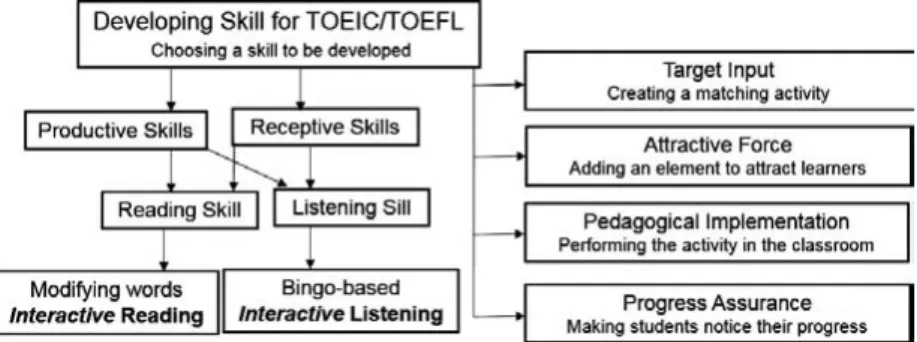
A theoretical framework named The Goal-oriented Framework for Educating EFL
Learners has been previously developed (Farooq 2012) and practically tested in a classroom setting (Farooq 2013) will be employed in the current article with minor modification. For convenience of the readers, here is a brief introduction of its im-portant parts. At the initial stage (Fig. 1, left block), the framework requires a user/ teacher to choose a skill he/she is aiming to teach in the class. Basically, the sills are categorized as Productive or Receptive. As the name suggests, in the former case, a learner makes efforts to produce a piece of information verbally or on a piece of paper. In the latter case, the learner just sits quiet and receives a piece of information verbally or looking at it. In this skill, the learner does not make any specific effort with someone to produce anything. The present study is basically aimed to develop students’ receptive skills of listening and reading.
Once the skill has been chosen, the next step is to find an activity that matches with students’ English level (Fig. 1, right block) This may mean, any activity too easy or too
difficult for the students must be avoided. The activity can be taken from a textbook or specifically created by the teacher, and can be anything from cards to handouts. The activity is then required to be added by an attractive force. The attractive force can be defined as a trick/method/technique that matches students’ interests and enable them to work harder, longer and independently. For instance, in a routine listening task students listen to a piece of information, a dialog or an announcement and then answer questions relating to the contents of the dialog. However, if students before listening to the dialog are given a set of questions, and during listening the dialog they work on finding/circling the answers, this new setting can be said to comprise an attractive force for the students. This could be a difficult task for new users. With this setting, the next stage is the implementation of the activity in actual classroom to see how it works. This is to be noted that the framework simply guides the user in a direction where he can enjoy teaching more systematically and make the learning more lively interesting and at the same time motivating for the students. When the activity is over, the next stage requires its user to see whether students have noticed any progress by themselves. This is likely to be done by asking students on a piece of paper after the activity. This again could be a hard task for new users as there are limited ways to have students notice their progress. Finally, in the last stage, it must be justified by the user partly through linguistic theories and partly by other means (e.g. user observation) whether students got any achievement.
Research question
The specific research question will be addresses as follows. Will the newly devel-oped listening and reading comprehension activities help Japanese students get higher/ targer score on a standardized exam of English?
In this regard, the article will first, outline the activities for developing listening and reading comprehension; next, answer the above research question in the light of linguistic theories; and last, discuss the outcomes of the study.
Strategies for listening compression
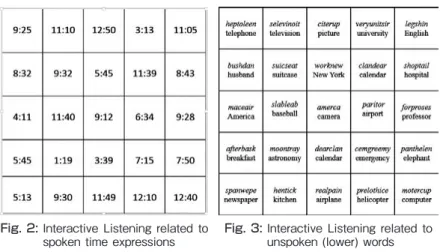
This section informs 3 types of sample activities to develop specific listening at a normal speed of speaking from basic to advance levels. The first activity (basic level) focuses on numbers and how they were used in natural communication; the second one (intermediate level) is the description of business vocabulary/terms; and
the last one (advanced level) uses the information taken from a TOEIC test, part 2, Questions-Answers.
Interactive listening activity I: Expressions [basic level]
Introduce students some time expressions and how they were expressed in spoken English (Fig. 2). Choose 25 different time expressions, and dictate at a normal speed to the students. Ask students to prepare a Table of total of 25 boxes with 5 rows and 5 columns as is commonly used in a Bingo game. At this stage, students can interact with the teacher to get the correct time related information. Lastly, write down all the 25 correct expressions on the board. Students write the 25 time expressions in the boxes at their own choice, however, they are responsible to write the expressions correctly, otherwise, they will lose the Bigo-based listening activity.
Time expressions can be spoken and transferred to the students in several differ-ent ways depending on its listening objectives. For instance, the teacher simply says expression as is done in a Bingo game. This may means that the students are listening when it is spoken in isolation – in the absence of other words around it. Another way would be that the teacher comment on his/her daily schedule such as ‘ I usually wake up around 9:25 (spoken at the end)./ Last Sunday, I had an appointment at 9:25 sharp with a friend of mine (spoken in the center)/ 9:25 is the usual time, I leave home for work (spoken at the beginning)’. The information can also be transferred in the form of a mini dialog invented and spoken by the teacher at the time of speaking as below at a normal speed.
Fig. 3: Interactive Listening related to unspoken (lower) words Fig. 2: Interactive Listening related to
A: What time do you sleep every day? B: Around 12:50.
A: Around what? B: 12:50.
A: Did you say 12:15? B: No, 50, five zero.
A: Oh, okay I see, 12:50, thanks.
Students can be interrupted and interacted with the teacher and ask for repetition, confirmation, clarification, getting the correct meanings, and even request the teacher to write on the board. However, they are not allowed to make any mistake, and must get the information by making individual efforts if they want to win the game. At the end of a spoken expression, the teacher must write the correct expressions on the board. Students who mistakenly check the time box loses two points: one the real answer, and the other one circled by the student. Bingo can be done just by First BINGO time as is the case in real Bingo game, or can be continued as long as students wish/demand.
Interactive listening activity II: Descriptions [intermediate level]
The difference between the current activity and the one outlined in the previous section is that the students in this activity do not listen the correct word/answer directly, they were given several examples/hints/description/meanings related to the word but the word itself. The actual word is hidden and the students have to interact with the teacher to find what the correct answer is so that they can circle it (Fig. 3). The explanation/description of the word is given from specific to general or more clear gradually. See the examples below related to the word veryunitsir’ (Fig. 3: First row and fourth column) with the answer as ‘university’.
1. It is very wide and beautiful
2. You can meet many young people there. 3. You can also make many new friends there. 4. It is usually closed on Sundays and holidays. 5. It has many teachers, and a library to study. 6. You all study there
At the beginning, students are required to fill in the 25 blank boxes with the words spoken by the teacher (upper). All the words must be spoken at a normal/natural speed with a minimum pause after each word. Students are allowed to interact in the same way as before. Finally, all the words must be written on the board and in students boxes in the way they prefer.
Interactive listening activity III: Questions and Responses [advanced level]
The listening activity in this section directly uses the answers of the TOEIC test, Par 2 of the Listening Comprehension section: Questions/Answers (Tayler 2006). At the beginning, the teacher dictates all the 25 answers of the questions (Fig. 4). The information must be given at a normal speed of communication with the interaction of the students and the teacher, and at the end confirming from the board written by the teacher. In the same way as in the previous activities I-II, the teacher asks a question and the students find the matching answer from the possible 25 answers as below. T: Did you get up early this morning?
S1: Parson me?
T: Did you get up early this morning? S2: Please say again slowly.
T: Did you get up early this morning? [Fig. 4: 4th row, 4th column: ‘No, I got up late’] S3: Oh, okay I see.
An introduction of the (1) difference between Slow and Fast speech in English, and (2) expressions required to use by the students when the communication breakdowns or to negotiate meaning in real-life interaction is an essential part prior to the Interac-tive Listening Activities I to III (Farooq 2013: 39-41).
Strategies for reading comprehension
A written text, chosen by the teacher, is distributed to all the students. Each stu-dent is then required to modify the text in a way she/he likes but is not allowed to make a major change. Simply speaking it could be anything from changing words to correcting where the words have been affected or needed modification according to grammar and/or sentence structures. Below is a randomly chosen text (Fig. 5), and has been modified in four different ways according to the number of replaced words.
Original text
The text in Fig. 5 (Kelly & Kelly, 1991: 192) seems to be one of the shortest text of 102 words and has been chosen because of simplicity. The text relates to a first date or happening a boy and girl met for the first time, and how they spent their time and what the girl hopes about her boyfriend.
Fig. 5: Original text without any modification
Modified text A
The text A is the simplest modification of the original text where only 10 words have been modified. The words were mainly the nouns (week, train, Saturday, Motoharu, bicycle and games) along with a verb (ride on) and adjectives (short, shorter, always) commonly used in ever day communication. This is a simple modification which even a beginner won’t find any problem to develop provided she/he understands the meaning of the original text- the main objective of the activity. The modified words ar not connected to other parts of the discourse or the entire paragraph. However, the last sentence relates to the personality of the boyfriend and to core meaning of the discourse.
Modified text B
The text B comprises 20 modified words basically the same kinds as in A, however, the number of verbs and adjectives has been increased along with the inclusion of some negative contents words (uninteresting, rude, quieter and boring). The entire discourse has also been changed in that the contents provides a negative impression of the customer.
Fig. 7: Middle section of the texts O2, A2, B2, C2, D2
Modified text C
The text C, besides being longer of 30 words, a number of changes has been found: almost all nuns, verbs, adjectives and phrases have been increased. The discourse/ genera is different than that in the texts A and B along with a formal expression (would like to).
Modified text D
Obviously, the text D has most modified words both in length (40 words), content and variety, for instances, changes in pronouns (girlfriend, she, my), prepositions (in), nouns phrases (waiting line), tense (has been), contrast (shorter, but beautiful). Moreover, the genera has been completely changed as compared with the ones in A, B and C (Figs. 6-8) in that how and when both she and he met, who initiated the talk at first meeting and the boyfriend hope about her.
Analysis and Discussion
The sole purpose of the study was to develop listening and reading comprehen-sion strategies for the students to get a higher/target score on a standardized exam of English employing the goal-oriented framework for educating Japanese EFL learners.
The specific question addressed was ‘Will the newly developed listening and read-ing comprehension activities help Japanese students get a higher/target score on a standardized exam of English?’ The question can be answered affirmative. Detailed discussion relating to the response of the question will be informed below keeping into consideration the (i) prevailing linguistic theories, and (ii) specific examples of the related methodologies/strategies/activities presented in the previous sections.
Listening comprehension
On the onset, it is worth to mention here that all the listening activities and the way they are presented to and practiced by the students clearly manifest that they are not receptive in nature/function, but productive listening activities in that students interact with the teacher before making a decision on a correct response. During listening activities students interact using certain prompts (e.g. Would you please say that again slowly?). The prompts relate to the concept of negotiation of meaning between speak-ers according to Chaudron (1993), and as reported by Nunan (1989, 1991) they are known as comprehension check, clarification request, and confirmation check; and
the preponderance of modified interaction – in which the teacher created a two-way information gap among participants – could be regarded as ”successful classroom second language acquisition”. As they are commonly used in natural communication, they give students confidence on their listening. Hence students employing this new strategy, listen to a piece of information with a clear purpose in mind. Furthermore, since the whole class is participating together, it assures that even less able students can also join. However, here may be a question that needs clarification. As we all know, that standardized listening tasks are much faster and more complicated in terms of contents then how this simple listening training can possibly help students in actual exams? As the activities are designed from basic to advance (Figs. 2-4), students learn in stages and get used to the level of difficulty that gradually increases. With this classroom experience when students listen to the tapes alone for practice, same habit of interaction is likely to force them to listen to a conversation/task again and again.
The habit formation through Bingo-based listening will assist them when they study alone outside a classroom. Without this classroom listening training it is unlikely that students will listen to a tape repeatedly, instead merely listen to the tape just once, and ultimately will look at the transcripts – an easier way to get through a problem or get the required answer. In fact, a Bing-based listening might be more challenging since in actual exam students choose an answer among 4 choices (A, B, C, D) while the Bingo makes them to focus on 25 choices at the same time, at least at the beginning.
The word Bingo sounds non-academic, but it certainly attracts both students and the teacher. Students already know its basic rules, interest and excitement. For the teacher, it minimizes the load of giving directions. Since teacher, while directing an activity, does not read a pre-decided dialog, but instead creates in real time, so if a request of repetition comes, he/she is forced to create another dialogue which would be different in contents and level of difficulty than the previous one. Hence, students experience new language along with new contents and make efforts to understand all in a limited time. This entire process makes their listening skills better than before.
Another remarkable feature of the activities is that they cover almost all the contents of a standardized exam of English. Almost all the exams require describing pictures/ graphics/graphs/charts, vocabulary (general, academic, business), announcement (1 speaker), dialogues (2 speakers), and conversations (3 or more speakers). The role of teacher is challenging as he has to create all situations alone. Bingo serves as an attractive force (Fig. 1) to the students. I am certain in the absence of a Bingo-based
listening, this kind of activity will be least attractive, demanding and successful. In this connection, Willis (2001: 14) advocates that ‘success and satisfaction are key factors in sustain motivation. If students feel they have achieved something valuable, through their own efforts, they are more likely to participate the next time.’ Teacher has a choice to make the listening more challenging. For instance, by dividing the whole class in two groups, and directing this activity with one group and leaving the other group free to break the silence. This means, performing the Bingo-based listen-ing in the presence of natural noise/disturbance. In fact, there is no limit of variations in Bingo-based activities.
Lastly, the activities help students as regards motivational force. The outcomes of Bingo is an example of the students’ achievements of ‘Intrinsic’ ‘Motivation’ which concerns behavior preformed for its own sake in order to experience pleasure and satisfaction such as the joy of doing a particular activity or satisfying one’s curiosity (Dornyei 2001: 11).’ Furthermore, Willis (2001: 11) suggested three essential condi-tions to be met in order for anyone to learn a language with reasonable efficiency: ‘Exposure’ to a rich and comprehensible input of real and spoken language in use; ‘Use’ of the language to do things (i.e. exchange meanings); and ‘Motivation’ to listen and read the language and to speak and write it (i.e. to process and use the exposure). Bingo-based listening activities along with their procedures comprise all the above features: Exposure – students listen to language spoken by the teacher as contrast to a tape-recorder sound; Use – students involve in winning the game saying ’reach’ and then ‘bingo’ as a final product of the interaction; and Motivation – students interact with the teacher as opposed to a tape recorder where students have given just one choice to listen.
Reading comprehension
We all know that EFL students in general and Japanese students in particular highly dependent on vocabulary (Farooq, 1999. Appendix C: 05, 07, 08, 09, and 10), try to read every word (01), and read slow to understand the contents (04). This means they unconsciously believe that a language, especially the written one, can be learned in isolation. However, Nunan (1991) informs us that learning of a language is an organic process rather than a linear one in that structures are not learned in isolation, but that they interact with each other. This means if someone wants to improve reading, he/ she can get more benefit if she/he uses a discourse approach. This further means all
parts of a passage can be seen as connected, in a simplified way like [word-phrase-statement-paragraph-passage]. The activities of reading comprehension in this study has been designed on this belief. The modified texts (Figs. 6-8: A, B, C, and D) seems to be simple but it needs a lot of work to modify especially when the number of modified words increases. As the entire passage is connected, any change in a single word effects the entire passage and requires a certain level of knowledge of vocabulary, grammar, and sentence structures. This means, as was the case of listening, the activities here are not simply receptive, they are productive in nature, and hence help students to understand the texts more deeply and in an interesting way as they interact with all the parts of a passage. If carefully designed, they can help in many practical ways. The following will be a respond to the questions: In what ways, the activities can possibly help students to develop their reading comprehension (1) in general, and (2) specifically in standardized language exams?
Even a brief look at the modified texts in Figs. 6-8 above can tell that their modification gives rises to several questions in mind. First, is the target word a noun, verb, adjective, adverb or a phrase of any one it? Next, is the word a happy (positive meaning) or unhappy (negative meaning) word (Farooq 2001)? Then, is it a singular, plural, particle, pronoun, its tense, and its gender? After that, what word comes next to it, and how it is attached to the word next to it? Probably, how it re-lates to the entire paragraph, passage and discourse? While doing this simple word modification exercise, he might notice some special features for the first time. For instance, Collocation (Sinclair 1997), Patterns of Writing, and Signal Words in a pas-sage (Mikulecky and Jeffries 1986, 1996). It is worth to mention here, a majority of students are unaware that a written English text has patterns and they often used by native speakers in authentic texts (e.g. newspapers, magazines, business reports) in every day correspondence simply because the patterns are well organized and help understand the passages more quickly and easily. Details of them with examples do not allow us to outline here because of space limitation. In the literature, commonly used patters are seven types namely Chronical/Time, Compare and Contrast, Order
and Importance, Sequence, Spatial, Cause and Effect, Problem and Solution (see Reading Worksheets). They might have different names. Besides, other patterns could be existed within a pattern. Each is likely to be recognized by some associated signal words. Students simply need to find the signal words, for instance, first, second, third may indicate a Sequence; 1:00, 2010, 10 years ago might indicate Chronical/Time;
And, the words same, different may show the pattern is Compare and Contrast. So, students while modifying a text by simply replacing words unconsciously think about the word, its location, its relationship with others words, words around and far from it. This entire process help them notice the existence pattern in a text.
Another important area where students are also unaware and can be benefited through this exercise is the concept of Collocation (Sinclair 1997). It is consisted of two or more words. These words are commonly used and appear together in a text. For instance, in a collocation of adjective + noun: strong coffee is natural, but
powerful coffee does not appear in native speakers’ writing. The original text above has collocation such as long black hair, stop smoking, next to, very interesting, for a
drive. As mentioned above, Japanese students depends mainly on bilingual dictionar-ies and unconsciously make mistakes. Standardized exams’ reading comprehension passages heavily contain collocation words. Therefore, in the activities A-D, students are forced to think, analyze and make a decision to the word they are going to choose, and hence notice collocation rules naturally. For instance, ‘brown beard’ or ‘brown hair’ are natural, but ‘blue beard’ or ‘green hair’, although comprising adjective + noun, sound odd as they hardly occur in real life (Fig. 7). Similarly, ‘wears mustache’ (verb+ noun) may sound natural, but the collocation ‘paints/pastes/fixes mustache’ do not suit. Here simply grammatical rules don’t work, and hence problematic for grammar-based English learners. Besides collocation, this exercise teaches students grammar rules as well. For instance, He/him needs a male name she/her that of a female; a singular/plural pronoun requires a singular/plural verb form: he loses/we
usually go (Fig. 7). In fact, there is no doubt and it also makes sense that this simpli-fied exercise makes students notice every minute detail relating to (1) grammatical rules, (2) collocation, (3) sentence to paragraph to entire passage to a long discourse, and (4) their existing textual patterns.
Concerning the response to the second question above ‘In what ways, the activi-ties can possibly help students develop their reading comprehension in standardized language exams, for instance say TOEIC?’, teachers on the onset are required to select a variety of reading passages including business notices, articles, reports, let-ters, and commercials from the prescribed textbooks. The passages are then assigned to students essentially in accordance with their proficiency levels (see Fig. 1). The passages are modified by the students employing appropriate words and expressions by observing all rules of grammar, sentence patterns, collocation, and textual
pat-terns. The passages are submitted to the teacher and returned with corrections and feedbacks. Although it may give extra work to the teachers, it provide confidence to the students and encourage them to work harder in each new passage. The outcomes in the form of modified passages manifests an example of student’s achievements of ‘Intrinsic Motivation’ which concerns behavior preformed for its own sake in order to experience pleasure and satisfaction such as the joy of doing a particular activity or satisfying one’s curiosity (Dornyei 2001: 11).’ Furthermore, according to Willis (2001: 14) success and satisfaction are key factors in sustain motivation. If students feel they have achieved something valuable, through their own efforts, they are more likely to participate the next time.
To conclude, if a learner believes that the learning of a language (especially the written one) is an organic process rather than a linear one in that structure – in terms of grammar, collocation, and textual patters – are not learned in isolation, but that they interact with each other (Nunan 1991: 148), then he/she could be benefited in this direction if they are provided mainly with the input (see an example in Fig. 4) to work on it critically, first for the meaning in Krashen’s sense (Krashen 1982), and
then for understanding the existing structures (Willis and Willis 1996). Moreover, Ellis (1997) informing the importance of input, states that the acquisition may be facilitated by teaching explicit knowledge through Conscious Raising (CR) tasks assisted by the operations of ‘noticing’ and ‘comparing’, which are considered necessary for acquisition to take place, and that the input can become implicit knowledge when the operation of ‘integrating’ is added. It can be argued that in the exercise above a student uses all the operations that are noticing, comparing and integrating, and hence can be benefitted. If carefully planned, the strategies reported in this study can help Japanese students to deal with listening and reading sections of any standardized exams of English. This is especially important in the light of the information provided by the education ministry (Japan Times 2015) relating to high school English-proficiency scores as ‘ The test carried out last summer at 480 randomly selected public high schools found that third-year high school students’ English skills in listening, speaking, reading and writing were far below government targets. In each section, a majority of students scored at or below the equivalent of Grade 3 on the Eiken Test in Practical English Proficiency. The results were much lower than the government’s hope of having 50 percent of high school graduates scoring at Eiken Grade 2 or pre-2, the levels above Grade 3.’
Conclusion
Achieving a higher score on TOEIC/TOEFL or any standardized exam is a chal-lenging and demanding task in general and for Japanese students in particular as specifically manifested by a recent test scores where Japanese speakers in both the tests were rated among the lowest in the world. Employing a previously reported ‘goal-oriented framework’, the aim of this article, therefore, is to develop students’ listening and reading comprehension by introducing some new learning strategies. In this regard, ‘Bingo’ concept has been utilized to introduce a new ‘Bingo-based listening strategy’ which obviously demands students to listen attentively in a game-like learn-ing atmosphere. On the other hand, modification/replacement of words/phrases in an authentic written text strategy informs the students to improve reading comprehension in a similar way. Students interact with the text using a discourse approach which forces them to focus on its grammatical structures, collocation, and existing textual patterns. Both the strategies have been specifically designed to maintain students to work willingly, independently, and with a feeling of satisfaction. Simplified activities (Figs. 2-8), along with suggestions for EFL/ESL teachers on how to use the activities in a classroom setting effectively, are provided.
Recommendation of further study
As suggested in the goal-oriented framework (Farooq 2012) in the form of ‘Peda-gogical Implementation; Performing the activity in the classroom’ (see Fig. 1), is a recommendation for further study in the light of proponents of the classroom research Nunan (1991), Ellis and Hedge (1993) and Ellis (1997) suggestions that “claims made by SLA researchers outside the classroom can be settled only by validating studies inside the classroom” should be to implement the designed strategies and the associ-ated sample activities in the actual classroom setting along with an examination of the students’ ‘Progress Assurance: making students notice their progress’.
References
Asian Scientist. 2011. ‘TOEFL: Singapore Third Worldwide In English Proficiency Test, Top In Asia’ http://www.asianscientist.com/2011/04/academia/toefl-singapore-worldwide-english-proficiency-top-asia/
Chaudron, C. 1993. Second Language Classrooms: Research on teaching and Learning: Cam-bridge: Cambridge University Press.
University Press.
Ellis, R. 1997. SLA Research and Language Teaching. Oxford: Oxford University Press. Ellis, R. and Hedge. 1993. ‘Talking shop Second language acquisition research: how does it
help teachers? An interview with Rod Ellis’. ELT Journal. 47(1): 3-11.
Farooq, M. 1999. ‘Analyzing and raising students’ awareness of textual patterns in authentic texts’. Essay Bank. Birmingham: CELS. University of Birmingham.
Farooq, M. 2001. ‘A Context-based Approach for Expanding Vocabulary’. Research Bulletin of Aichi Women’s Junior College. General Education and Interdisciplinary Research. 37: 127-146. Farooq, M. 2012. “Developing a Goal-Oriented Framework for Educating Japanese EFL Learners
“. NUAS. The Journal of Liberal Arts. 8: 23-44.
Farooq, M. 2013. “Classroom Testing of the Goal-Oriented Framework “. NUAS. The Journal of Liberal Arts. 9: 33-53.
Farooq, M. 2014. “A Simplified Curriculum and Methodology for Study Abroad Programs”. NUAS. The Journal of Liberal Arts. 10: 1-23.
Farooq, M. 2015. “Maintaining a Higher Score on Standardized Exams of English”. NUAS. The Journal of Liberal Arts. 11: 13-34.
FD Foramu 1999. ’98 Dai 4 kai FD Foramu Hokokushu (Reports from the 4th Forum on the
Faculty Development of 1998). Zaidan Hojin Daigaku Konsoshiamu Kyoto (Kyoto: The Foundation of Universities Consortium).
Grundy, P. 1998. Newspapers. Oxford: Oxford University Press. Guide to Official Statistics in Japan. 2011. http://www.stat.go.jp/english/
Jackson, A. 2000. ‘Picture Storytelling in the Eiken Test’. The Language Teacher. 24: 17-18. Tokyo: The Japan Association for Language Teachers.
Japan Real Time. 2013.’ Japan Ranks 40th of 48 Countries in TOEIC Scores’. http://blogs.wsj. com/japanrealtime/2014/07/18/japan-ranks-40th-of-48-countries-in-toeic-scores/ Japan Today. 2011.
Japan Times News. 2015. ‘Abe wants TOEFL to be key exam’. http://www.japantimes.co.jp/ news/2013/03/25/national/abe-wants-toefl-to-be-key-exam/#.VfOArG_osqK
JASSO. 2015 (a). ‘About JASSO’. http://www.jasso.go.jp/about_jasso/index_e.html
JASSO. 2015 (b). ‘JASSO Funding for Japanese Students.’ http://www.titech.ac.jp/english/ enrolled/tuition/jasso/index.html
JET. 2011. http://www.jetprogramme.org/e/introduction/index.html
Johnson, K. 1995. Understanding Communication in Second Language Classrooms. Cambridge: Cambridge University Press.
Kelly, Charles, I. & Kelly, Lawrence, E. 1991. Practical Things. Nagoya. P,O. Box. Higashi-ku, Nagoya.
Krashen, Stephen D. 1982. Principles and practice in second language acquisition. Oxford. Pergamon Press.
Lougheed, L. 1992. TOEFL Prep Book. Englewood Cliffs: New Jersey. Regenrs/Prentice Hall. Matthew, W. 2007. ‘J-myth 5: TOEIC scores prove low Japanese English ability’. http://www. seekjapan.jp/article/1271/J-myth+5:++TOEIC+scores+prove+low+Japanese+English+ability Mikulecky, B. and Jeffries, L. 1986. Reading Power. Wokingham: Addison-Wesley.
Mikulecky, B. and Jeffries, L. 1996. More Reading Power. Wokingham: Addison-Wesley. Miura, T. 1997: ‘An Analysis of “Aural/Oral Communication A” English Textbooks in Japanese
Upper Secondary School’. Unpublished M.A. dissertation. Centre for English Language Studies. Birmingham: The University of Birmingham.
National Center Test for University Admissions. 2011. http://www.dnc.ac.jp/ NUFS. 2011. http://www-e.nufs.ac.jp/index.html
Nunan, D. 1989. Understanding Language Classrooms. Hertfordshire: Prentice Hall. Nunan, D. 1991. Language Teaching Methodology Hertfordshire: Prentice Hall International. O’Sullivan, J. 1994. Teaching English in Japan. Brighton: In Print Publishing Ltd.
Reading Worksheets. ‘Patterns of Organization’. http://www.ereadingworksheets.com/text-structure/patterns-of-organization/
Sinclair, J. 1997. Corpus, Concordance, Collocation. Oxford: Oxford University Press. STEP Information 2000. http://www.eiken.or.jp/index1.html.
Tayler Anne 2006. Target TOEIC (2nd Edition). Compass Publishing.
The Japan Times, 2015. http://www.japantimes.co.jp/opinion/2015/03/28/editorials/disappointing-levels-english/#.Vfesu2_osqL
Wadden, P. 1993. (Ed.). A Handbook for Teaching English at Japanese Colleges and Universi-ties. Oxford: Oxford University Press..
Wikipedia, 2011.
Willis, J. 2001. A Framework for Task-Based Learning. Longman.
Willis, D. and Willis, J. 1996. ‘Consciousness-raising activities in the language classrom’. In Willis, J. and Willis, D. (Eds.). Challenge and Change in Language Teaching. 63-76. Oxford: Heinemann.