We held the workshop entitled "Vietnamese Economic Development and Its Problems" at our university, Tokyo Joho University in Chiba pref., Japan, on August 23, 2006.
In the morning session, Prof. Dr. Nguyen Van Trinh and Dr. Nguyen Tien Dung, Vietnam National University, Hochiminh, Faculty of Economics, made the presentation about 'On the Foreign Investment in Vietnam'. And in the afternoon session, Professor Hitokoto, Tokyo Joho University, performed the research report about conditions regard-ing 'Acceptance of Japanese Management System in Vietnam'.
In these days, Japanese, especially economic stakeholders and interests, continue to pay big attention to cheap Vietnamese labor costs and economic development. Additionally, Vietnamese interests hold a lot of expectation concerning about FDI(Foreign Direct Investment)and ODA etc. from Japan in order to take off underdeveloped stage.
Since Doi Moi in 1986, The Socialist Republic of Vietnam chose the route to design economic development by adopting market economy. Afterwards, Vietnamese Government has positively tried to get economic assis-tances, FDI and ODA, and non governmental assistances(including goods and service). As a result, Vietnam has achieved high rate of economic development among four countries, CLMV.
After 2000, Growth rate of Vietnamese GDP were 6.78%(2000), 6.89%(2001), 7.08% ( 2002), 7.34%( 2003), 7.69%( 2004), So
Vietnam had showed good performance.
And yet, Vietnamese Government has got many problems to be solved at the same time.
These problems will be researched by our future collaborated study. And we will make clear the point with much effort.
Finally, Hitokoto's research paper will be published on the next Journal of Tokyo University of Information Sciences.
On the Foreign Investment in Vietnam
Nguyen Van Trinh
*Nguyen Tien Dnng
*After 20 years of the economic reform, the foreign sector has become an organic component of Vietnam's economy and contributed a lot to the economic growth.
In comparison with other countries and regions, Vietnam has achieved a positive growth.
In the agricultural sector,the manufacturing sector, service sector, Each sector has achieved the economic growth.
Especially the manufacturing sector's growth is characteristic of Vietnam's progress. Keyword:Vietnamese economy, economic growth, industrial production, economic sector
2006年12月11日受理
**ベトナム国家大学
**Vietnam National University
ベトナムへの海外からの投資に関して
Nguyen Van Trinh and Nguyen Tien Dnngドイモイ以降の20年間に、外資部門はベトナム経済の有機的な構成要素となり、経済 成長にも貢献してきた。
他地域・国と比べてもベトナムは高い経済成長を維持してきている。農業、製造業、 サービス部門はそれぞれ成長を続けているが、特に、製造業の成長が特徴的である。 キーワード:ベトナム経済,経済成長,工業生産,経済セクター
foreign sector has become an organic compo-nent of Vietnam's economy and contributed a lot to the economic growth. In present years, the Vietnamese economy maintained a growth rate higher than previous years and in com-parison with other countries in region and the world. Over the last 5 years from 2001 to 2005 Vietnam's GDP has always achieved a positive growth with an average of 7.51% per year, including agriculture−forestry−fishery up 5.4% per year, manufacturing−construction up 10.2% per year, trading−service up 7.6% per year.
than the 2004 rate of 7.79%. The growth rate was 4.1% in the agricultural sector, 10.72% in the manufacturing and construction and some 8.41% in the service sector. The industrial pro-duction was stable and gained high growth rate. Its output rose by 17.2%(in 2004: 16.6%), including 10.1% in the state−owned industrial sector(in 2004:12.2%); 25.1% in the private sector(in 2004:23.5%)and 18.7% in the for-eign sector(in 2004:16.2%).{Table 1 & 2 }.
Until July 20, 2006, the whole country had licensed more than 6,427 foreign direct invest-ment projects with total registered capital
Table 2 : Gross output of industry in Vietnam by economic sectors 2001-2005(At con-stant 1994 prices) Year 2001 2002 2003 2004 2005 Total (VND Trill) 227.3 261.1 305.1 355.6 416.9 Growth rate (%) 14.6 14.9 16.9 16.6 17.2 Total (VND bil) 93.4 105.1 117.6 132.0 145.3 Growth rate (%) 12.7 12.5 11.9 12.2 10.1 Total (VND Trill) 53.6 63.5 78.3 96.7 121.0 Growth rate (%) 21.5 18.5 23.3 23.5 25.1 Total (VND Trill) 80.3 92.5 109.2 126.9 150.6 Growth rate (%) 12.6 15.2 18.1 16.2 18.7
Gross out Economic sector
State Non-state Foreign
Source : 2005 Statistic Yearbook.
Table 1 : Vietnam's GDP by economic sectors from 2001 to 2005 (At constant 1994 prices)
Year 2001 2002 2003 2004 2005 Total (VND bil) 292,535 313,135 336,242 362,435 393,025 Growth rate (%) 6.89 7.04 7.38 7.79 8.44 Total (VND bil) 65,618 68,283 70,827 73,917 76,945 Growth rate (%) 2.98 4.06 3.73 4.36 4.10 Total (VND bil) 106,986 117,082 129,399 142,621 157,907 Growth rate (%) 10.39 9.44 10.52 10.22 10.72 Total (VND bil) 119,931 127,770 136,016 145,897 158,173 Growth rate (%) 6,10 6,54 6,45 7,26 8,41 GDP Economic sector
Agriculture Manufacturing service
54.634 billion USD including 25.966 billion USD in realized capital. In the 6 months of 2006, Vietnam's foreign direct investment attraction still shows promising signs. In this span, there were 367 new projects, bringing the total FDI capital to 2.772 billion USD. Table 3 indicate that foreign direct investment has been focused mainly on manufacturing and con-struction with 4,344 projects and total regis-tered capital of US$ 33.28 billion, accounting for 60.91% of the country's total FDI capital; service having 1,280 projects and total regis-tered capital of US$ 17.47 billion, or 32% of the country's total FDI capital attraction. At pre-sent, the preferred agriculture−forestry−fish-ery attracted only 803 projects, most of which were of small size, so their registered capital only estimated US$ 3.8 billion, accounting for
6.95% of country's FDI capital.
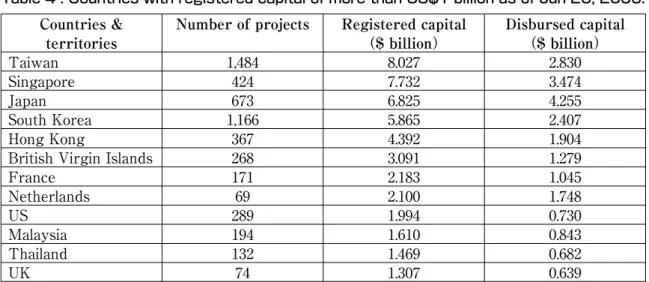
After eighteen years of implementing the Law on Foreign Investment in Vietnam (since 1987), as many as 64 countries and ter-ritories has poured their capital in Vietnam. Among them, Asian investors account for 76.3%(4,909 projects)of total projects and 69% of total registered capital(US$ 37 billion). EU investors implement some 8.8% of total projects(566 projects)and 14.6% of reg-istered capital($US 8 billion); the United State of American takes 4.5% of projects(289 projects)and 3.6% of total registered capital ($US 1.99 billion). There are 12 countries and territories having registered investment capi-tal of more than one billion USD each. Seven come from Asian countries, 4 from the Europe. {See table 4 }
Table 3 : Vietnam's FDI from 1987 to Jul 20, 2006 by sector
Sector
1. Industry
Oil & Gas Light industry Heavy industry Food industry Construction
2. Agriculture
Agriculture & forestry Aquaculture
3. Service
Transport, post & telecom Hotel & tourism
Banking & finance
Culture, health & education New urban area
Office building & apartment
IZ & EPZ infrastructure construction Others Total Number of projects 4.344 31 1,815 1,880 274 344 803 690 113 1,280 178 164 63 219 5 117 20 514 6,427 Registered capital ($ billion) 33.280 1.993 8.946 15.011 3.233 4.096 3.863 3.553 0.309 17.490 3.191 3.258 0.810 0.938 2.865 4.056 1.020 1.348 54.634 Disbursed capital ($ billion) 17.807 4.458 3.152 6.157 1.869 2.169 1.796 1.637 0.158 6.362 0.711 2.140 0.621 0.307 0.51 1.662 0.518 0.349 25.966
attracted foreign investment. However, invest-ment capital has been distributed unevenly, but concentrated mainly on large cities and provinces having favorable infrastructures, especially on the southern vital economic region consisting of Ho Chi Minh city, Dong Nai, Ba Ria-Vung Tau, Binh Duong, Long An, Binh Phuoc, Tay Ninh and Tien Giang, making up 66.4% of the country's FDI projects(4,269 projects)and 59% of country's total FDI capi-tal(US$ 32.3 billion); the northern vital
eco-Duong, Vinh Phuc and Quang Ninh making up 18.28% of the country's FDI projects(1,175 projects)and accounting for 26.12% of total FDI capital(US$ 14.27 billion). Table 5 indi-cates foreign direct investment of Vietnam's top ten cities and provinces.
The forms of foreign investment have seen drastic changes over the past 18 years. In early years of economic renovation, joint ven-ture was the most attractive form, but in pre-sent years, the wholly foreign-invested form
Table 4 : Countries with registered capital of more than US$1 billion as of Jun 20, 2006.
Countries & territories Taiwan Singapore Japan South Korea Hong Kong
British Virgin Islands France Netherlands US Malaysia Thailand UK Number of projects 1,484 424 673 1,166 367 268 171 69 289 194 132 74 Registered capital ($ billion) 8.027 7.732 6.825 5.865 4.392 3.091 2.183 2.100 1.994 1.610 1.469 1.307 Disbursed capital ($ billion) 2.830 3.474 4.255 2.407 1.904 1.279 1.045 1.748 0.730 0.843 0.682 0.639
Source : Vietnam Investment Review, Aug 14-20, 2006, p.20.
Table 5 : Top ten cities and provinces in FDI attraction as of July 20, 2006
Cities & provinces
Ho Chi Minh City Ha Noi Dong Nai Binh Duong Ba Ria−Vung Tau Hai Phong Long An Hai Duong Vinh Phuc Thanh Hoa Number of projects 2,006 708 733 1,146 125 201 113 88 101 21 Registered capital ($ billion) 13.136 9.903 8.792 5.271 3.210 2.094 0.883 0.865 0.800 0.721 Disbursed capital ($ billion) 6.173 3.485 4.016 1.904 1.255 1.233 0.336 0.387 0.413 0.410
becomes common, accounting for 70% of total projects, 44% of registered capital and 35% of realized capital.
Reasons for these achievements by the foreign sector are as follows :
−The Vietnam's socio-political environment is considered as stable and healthy. Security for FDI projects is ensured.
−Vietnam gained high growth rates in sev-eral consecutive years.
−Investment legislation has been amended regularly in an effort to create better condi-tions for all companies. Major infrastructure projects are carried out every year. Fees of services needs for the business circle, such as telecommunications, water and power, air transport, etc., are cut according to a reason-able track to help investors reduce cost and improve their competitiveness.
In the other hand, foreign sector also revealed some signs of stagnations, limi-tations and shortcomings as follows :
−The sum of US$ 5.72 billion worth of FDI registered in 2005 marks its recovery from years of stagnation(in 2004:US$ 4.2 billion, in 2003:US$ 3.14 billion, in 2002:US$ 2.96 bil-lion and in 2002:US$ 3.2 bilbil-lion), but this fig-ure is equal to the sum attracted in 1994 and half the sum of 1996(US$ 9.73 billion).
−The structure of foreign investment dis-closed much irrationality. If examining FDI flows by sector, foreign investment capital flows are focused only on the industry and service, while foreign investment in the agri-culture, forestry and fishery attract fewer pro-jects.
−Regarding investors, there are two short-comings : investment from developed
coun-tries, which have advantages of source tech-nologies including the US, Japan, EU remains a modest share and slow rise. Proportion of technology-intensive projects by multinational companies is still small, which limit effects of technology transfer on the local economy.
−In respect of investment by region, FDI are focused only on vital economic zones, espe-cially in the south while the northern moun-tainous areas, central coastal provinces, the Central Highland and the Mekong Delta lure fewer projects.
−Vietnam has tried its best to improve the quality of human resource in recent years but it fails to meet requirement posed by foreign investors.
−The quality of public services in Vietnam is very poor. At present, only 25% of the road network is blacktopped; airports are small and routes offered by airlines are limited. In addi-tion, seaports in Vietnam are very small in comparison with regional countries.
CONCLUSION
These facts show that the Vietnamese busi-ness environment for foreign-invested compa-nies contains many shortcomings and prob-lems that require overall and consistent solu-tions, as follows :
The First, about tax policy : Removing lim-its on expenses involved in the calculation of taxable income. At present, the Company Income Tax Law(2003)allowed local ones to enjoy tax reduction to a certain extent and forced the foreign-invested ones to pay more in this tax. For example, the income tax rate on foreign companies whose 50% of their out-put is for export increases from 10% to 20% and from 10% to 28% on developers of indus-trial parks and export processing zones. In
companies for the whole duration of their investment projects was limited to 10 to 15 years based on the nature and location of the projects. The Decree 164/2003 reduces the tax exemption time to four years and allows a tax reduction of 50% for the next nine years. This makes many investors unhappy and many of them have decided to transfer their projects to neighboring countries, such as China, Thailand.
The Second, about production cost. At pre-sent, increases in prices of many services, such as water and power supply, transport, fuel, etc, have made market prices rise and compa-nies face with more difficulties. One of that cause increases in prices is the monopoly of state-owned companies. For example : At recent survey of rent of office buildings shows that the rent for offices in Ho Chi Minh City ranks fifth in the world(US$ 28.05 per sp.m. on average). Regarding the living standard that is based on the per capita GDP, the Vietnam's personal income is 15 lower than the Japanese one. So, the rent of office in Ho Chi Minh city based on the living standard will be US$ 28.05 x 15 = US$ 420.75 while the office rent in Tokyo where the office area is considered as most expensive on the world is only US$ 102.38 per square meter.
Thus, privatization of state-owned compa-nies is a good measure to remove the monop-oly, especially in services and good needed for production. The Government had better accel-erate this program at any cost. A part from, encouragements must be offered to private companies that in infrastructure building, transportation and good distribution.
The Third, about administrative machinery.
At present, Vietnam's customs service is still
next is land clearance and compensation pay-ment before realizing any project. In addition, the lack of agreement among governmental bodies and public services also cause many troubles for foreign-invested companies. Administrative reform must aim at facilitating operation and business of citizens and compa-nies instead of consolidating the power of pub-lic organization or protecting stakes.
The Fourth, about developing human resource. The human resource must meet requirements by foreign investors in terms of skills, discipline and price. In the long-run, the Government should adopt policies to train the human resource in technical and business knowledge.
Reference
1.Doan Thi Hong Van(2004), "Measures to improve foreign investment in Vietnam”,
Economic development Review, 117, pp. 14-17.
2.Tran Nguyen Ngoc Anh Thu(2004), "Problems with business climate for for-eign−invested companies in Vietnam",
Economic development Review, 118, pp. 17-19.
3.Vu Anh Tuan(2004), "Problems with the development of industrial parks and export processing zones", Economic devel-opment Review, 114, pp. 4-5.
4.Nguyen Van Trinh(2003), "Financial solution to infrastructure projects in an effort to attract more foreign investment,
Economic development Review, 111, pp. 4-5.
5.Nguyen Sinh Cuc(2005), "An overview of the Vietnamese economy in 2004 and its prospects in 2005", Economic
develop-ment Review, 125, pp. 5-7.
6.Tran Ngoc Tho(2005), "How to attract foreign investment", Economic develop-ment Review, 126, pp. 2-3.
7.Vuong Trong Sanh(2005), "Devoloping industrial parks as a means of mobilizing sources of capital", Economic development Review, 128, pp. 4-5.
8.Phan Phuong Diem(2005), "Foreign direct investment in tourism: Review and perspective", Economic development Review, 128, pp. 12-14.
9.Nguyen Sinh Cuc(2005), "Vietnam's eco-nomic restructuring in 20 years of renova-tion", Economic development Review, 132, pp. 23-25.
10.Nguyen Khanh Duy(2006), Prospect of the FDI flow in Vietnam in 2006-2010,
Economic development Review, 141, pp. 16-19.