Enzymatic Conversion of Cellulose Pretreated by Amino Acid Ionic
Liquid/Cosolvent System
March 2017
Juan TAO
CONTENTS
INTRODUCTION 1
CHAPTER I 6
Superior cellulose-protective effects of cosolvent during enhanced dissolution in imidazolium ionic liquid 1.1 Results and discussion 8
1.2 Experiments 20
CHAPTER II 22
Novel cellulose pretreatment solvent: phosphonium-based amino acid ionic liquid/cosolvent for enhanced enzymatic hydrolysis 2.1 Results and discussion 24
2.2 Experiments 38
CHAPTER III 43
Enzymatic synthesis of methyl β-D-glucoside directly from cellulose pretreated with bio-compatible amino acid ionic liquid/cosolvent 3.1 Results and discussion 43
3.2 Experiments 54
CONCLUSIONS 56
REFERENCES 58
ACKNOWLEDGMENT 67
INTRODUCTION
Cellulose is the most abundant renewable resource on the earth and the utilization of it for high value-added products is of great importance.However, the highly compact structure of cellulose due to the numerous intra- and intermolecular hydrogen bonds makes it difficult to dissolve in water and many traditional organic solvents, which seriously limit the innovation and modification of natural cellulose for its advanced application.
Ionic liquids (ILs), which are composed of anions and cations, have attracted a lot of attention owing to their strong solubilization ability, adjustable structure, and recyclability. Swatloski et al. (2002) first reported the dissolution of unmodified cellulose in ILs, and numerous ILs have since been designed to improve cellulose and lignocellulosic biomass solubility under various conditions, such as under microwave heating and ultrasonic irradiation (Mikkola et al. 2007; Ninomiya et al. 2013). In particular, Fukaya et al. (2006) reported superior solubility of polysaccharides in a halogen-free IL, 1,3-dialkylimidazolium formates. Vitz et al. (2009) found that 1-ethyl-3-methylimidazolium diethyl phosphate was best suitable for the dissolution of cellulose due to the low melting point and the low viscosity of the resulted cellulose solution facilitates handling. Xu et al. (2010) added inorganic salts, including LiCl, to enhance the dissolution of cellulose.
Previous studies also revealed that cosolvents can increase dissolution efficiencies of ILs. Gericke et al. (2011) studied the miscibility of cosolvents with cellulose/IL solutions and found that polar cosolvents minimized the viscosity of the solutions. Rinaldi (2011) worked with amide-related solvents such as
1,3-dimethyl-2-imidazolidinone (DMI), which swell cellulose at 100 °C, and subsequently added a minor amounts of molar fraction of 1-butyl-3-methylimidazolium chloride ([Bmim]Cl) or 1-ethyl-3-methylimidazolium acetate ([Emim]OAc) helped dissolving cellulose instantaneously. Xu et al. (2013) found that 1-butyl-3-methylimidazolium acetate ([Bmim]OAc)/dimethyl sulfoxide (DMSO) effectively dissolved cellulose in 15% concentration at ambient temperature. DMSO improved solubility by increasing the concentration of free AcO anions from dissociated IL. However, to the best of our knowledge, the effects of cosolvents on the regenerated cellulose have not been studied in this context. In our previous studies (Qu et al. 2013a), dimethylacetamide (DMAc) and pyridine served as cosolvents to dissolve and acetylate ball-milled wood at room temperature (r.t.) for NMR analysis of cell wall components. These cosolvents not only increased the solubilization efficiency but also showed protective effects on cell wall components.
Many ILs suitable for cellulose dissolution containing an imidazolium ring and/or halogen are not environmentally compatible or they are even toxic (Kumar et al. 2011; Ma et al. 2014). Therefore, the development of eco-friendly and biocompatible ILs is urgently required. Amino acid ionic liquids (AAILs) are not only halogen free but also have lower viscosity than conventional ILs at r.t. (Kagimoto et al. 2006; Jiang et al. 2008). They have the potential to be an ideal solvents for cellulose and are expected to
DMSO permits cellulose dissolution at r.t. (Ohira et al. 2012b). It was reported that N-methyl-N-(2-methoxy-ethyl)-pyrrolidin-1-ium 2,6-diaminohexanoate ([P1ME][Lys]) dissolves lignin below 60 °C, but requires 80 °C for cellulose dissolution (Hamada et al. 2013). Liu et al. (2012) prepared a series of r.t.-ILs based on cholinium as the cation and amino acids as the anion but the cellulose was scarcely soluble (<5 mg/g) in [Ch][AA].
AAIL pretreated celluloses have been submitted to further enzymatic hydrolysis by commercial cellulases produced from Trichoderma or Aspergillus species (Ohira et al. 2012a; Liu et al. 2012). Cellulase contains three major components, endoglucanase (EG), cellobiohydrolase (CBH), and β-glucosidase (BGL). The common mechanism of enzymatic hydrolysis of cellulose to glucose involves actions of the three components. Endoglucanases randomly cleave β-1,4-glycosidic bonds of amorphous cellulose to create new chain ends. Cellobiohydrolases cleave the reducing or non-reducing ends of crystalline cellulose chains to cellobiose. β-Glucosidases hydrolyze cellobiose to glucose (Zhang et al. 2006; Dutta et al. 2014). It is known that conversion of pretreated cellulose to glucose occur with a higher conversion ratio than that for untreated cellulose. Mizuno et al. (2012) reported that pretreatment by [N221ME][Ala] was least effective among the tested ILs in terms of crystallinity decrement and hydrolysis speed of the regenerated cellulose. The complete reaction from cellulose pretreated by AAIL to glucose at r.t. has not been investigated.
Alkyl glucosides are biodegradable nonionic surfactants that have been applied in many fields, including for detergents, cosmetics, food, and pharmaceuticals (Matsumura et al. 1990). Methyl β-D-glucoside, one of the short-chain alkyl glucosides, has been
2001; Rather et al. 2012). Methyl β-D-glucoside is also a good model compound to
elucidate the reaction mechanisms of cellulose (Kruså et al. 2005; Carlsson et al. 2006; Fan et al. 2015).
Traditional glycosylation methods are chemical processes that require complex protection and deprotection of hydroxy groups to obtain the desired products (Schmidt 1986). In addition, these processes often require strong acid or acid resin (Brochette et al. 1997; Dora et al. 2012; Ignatyev et al. 2010; Villandier and Corma 2010). The enzymatic synthesis of alkyl glucosides has received a great deal of attention for producing desired products in one step (Vic and Thomas 1992; Yi et al. 1998; Matsumura et al. 1999; Ducret et al. 2002; Svasti et al. 2003; Vijayakumar et al. 2007; Rather et al. 2010). However, despite numerous studies on enzymatic methods, cellulose is rarely used as a starting material. Glucose, cellobiose, p-nitrophenyl β-D-glucopyranoside (pNPG), and other soluble carbohydrates are more common in
synthetic processes, probably because of their greater accessibility to enzymes.
Consequently, in this study, the protective effects of cosolvent on regenerated cellulose dissolved by traditional ILs/cosolvents was first investigated. Then AAILs were synthesized combined with cosolvents as cellulose pretreatment solvent for subsequent enzymatic hydrolysis. Based on those results, methyl β-D-glucoside was
characterized in terms of degree of polymerization (DP), FTIR spectral data, and data of thermogravimetric analyses (TGA).
In chapter II, the potential of phosphonium-based AAILs as new pretreatment solvents for the enzymatic hydrolysis of cellulose should be evaluated. Three AAILs with tetrabutylphosphonium as the cation and a natural amino acid as the anion ([TBP][AA]) are in focus (Kagimoto et al. 2006). Furthermore, a novel [TBP][AA] with N,N-dimethylglycine as the anion ([TBP][DMGly]) was synthesized for the first time, which is potentially more stable than [TBP][AA] because the reactive amino group is protected by methyl groups. This may suppress side reactions of cellulose during the dissolution or pretreatment. All four AAILs should also be tested with six cosolvents with Avicel as model cellulose. The DPs of the corresponding regenerated celluloses will be reported and their susceptibility to enzymatic hydrolysis. The latter step was also conducted without removing the AAILs to evaluate the compatibility between cellulase and AAIL/cosolvent.
In chapter III, the purpose was to use cellulose as a starting material to enzymatically synthesize methyl β-D-glucoside. Eco-friendly phosphonium-based
AAIL/cosolvent systems served as cellulose pretreatment solvents, which demonstrated higher compatibility with cellulase than imidazolium- and halogen-based ILs. The experimental design was aiming at the utilization of commercial cellulase without any modification. Moreover, the effect of IL pretreatments and methanol concentrations should be evaluated on the formation of methyl β-D-glucoside. The mechanism of
methyl β-D-glucoside formation from cellulose will be discussed and a preparative-scale
CHAPTER I
Superior cellulose-protective effects of cosolvent during enhanced dissolution in imidazolium ionic liquid
Several polar organic solvents were examined as cosolvents of traditional IL, [Amim]Cl to improve the cellulose solubility at lower temperatures. The solubilization efficiency of each solvent systems was tested. The protective effects of cosolvent on cellulose during dissolution process was evaluated through the IR, TGA and DP analysis.
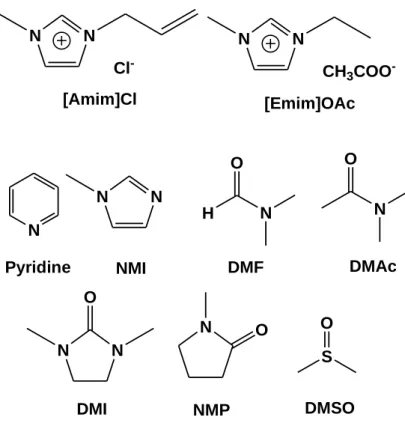
N Pyridine NMI H N O N O N N O N O S O NMP DMSO DMF DMAc DMI N N Cl -N N CH3COO -[Amim]Cl [Emim]OAc N N
1.1 Results and discussion
Effects of cosolvents in [Amim]Cl
Several aprotic polar organic solvents, including pyridine, N-methylimidazole (NMI), DMF, DMAc, DMI, N-methyl-2-pyrrolidone (NMP), and DMSO (Figure 1) were examined as cosolvents for the dissolution of cellulose (Avicel PH 101, DP = 208) in [Amim]Cl (Table 1).
Without cosolvents, [Amim]Cl required heating to 60 °C to dissolve 8% cellulose (Table 1, entries 1, 2), reflecting a melting temperature of 52 °C and maintenance of the solid phase up to 55 °C. Dissolution times decreased with increasing temperature (Table
1, entries 3, 4), and 8% cellulose was dissolved in 10 min at 100 °C. Moreover, with
increasing dissolved cellulose concentrations, the solutions become viscous, and prohibited stirring at cellulose concentrations higher than 8%.
All cosolvents (Table 1) were miscible with [Amim]Cl, and kept the liquid state at r.t. The solubilization efficiency of the IL was increased by the cosolvents at lower temperatures. Specifically, dissolution temperature was decreased to 30 °C in the presence of the amines, pyridine and NMI, which have lone-pair electrons on their nitrogen. These basic solvents were also miscible with [Amim]Cl at 30 °C, which is due to the donation of lone-pair electrons to H-2 of the imidazolium ring of the IL (Gericke et al. 2011). The lone pair electrons may also form hydrogen bonds with hydroxyl
only 3% at 30 °C (Table 1, entries 5–8). Increasing proportions of [Amim]Cl in mixed solvent systems led to increased solubilization efficiencies (Table 1, entries 9, 10), with 12-15% cellulose dissolution at 30 °C in [Amim]Cl/NMI at 1.5 g/0.5 g.
DMI, DMAc, DMF, and NMP have similar amide or urea (carbamide) functional groups (Figure 1), which were also miscible with [Amim]Cl at 30 °C. Among amide-related cosolvents, NMP shows the highest solubilization efficiency (Table 1, entries 13, 14), with 8-10% cellulose dissolution in [Amim]Cl/NMP at 1 g/1 g. Increased proportions of [Amim]Cl also increased solubilization efficiency, with 12-15% cellulose dissolution in [Amim]Cl/NMP of 1.5 g/0.5 g at 30 °C (Table 1, entries 15, 16). DMI and DMAc had slightly weaker cosolvent solubilization efficiencies than NMP (Table 1, entries 18 to 21), and both [Amim]Cl/DMI (1 g/1 g) and [Amim]Cl/DMAc (1 g/1 g) completely dissolved 5-8% cellulose at 30 °C, whereas [Amim]Cl/DMF (1 g/1 g) dissolved only 3-5% cellulose (Table 1, entries 22, 23). The effective cosolvent can be estimated from empirical Kamlet-Taft solvent parameters (Rinaldi 2011; Gericke et al. 2011). The present amide-related cosolvents have zero hydrogen bond donor ability (acidity; α), relatively high hydrogen bond acceptor ability (basicity; β), and high polarizability (π*). These properties are similar to those required for effective dissolution of cellulose in polar ILs without cosolvents. Highly basic (high β value) ILs with low viscosity have good cellulose solubilizing properties under mild conditions (Fukaya et al. 2008). Thus, addition of amide-related compounds as cosolvents may strengthen interactions between ILs and cellulose hydroxyl groups. Accordingly, mixed solvent systems dissolved more cellulose than neat ILs, although not all amide-related solvents contributed to solubilization efficiency of ILs. For
example, tetramethylurea, which is more basic than DMAc (Rinaldi 2011), is not miscible with [Amim]Cl under the same conditions and indicates the presence of a non-cyclic structures.
The aprotic polar organic solvent DMSO was miscible at various proportions (Gericke et al. 2011), and was the most effective cosolvent for dissolving cellulose in [Amim]Cl at 1 g/1 g (Table 1, entries 24, 25). Specifically, [Amim]Cl/DMSO (1 g/1 g) dissolved 10-12% cellulose at 30 °C, whereas [Amim]Cl/NMI (1 g/1 g) and [Amim]Cl/NMP (1 g/1 g) dissolved only 8-10%. Higher proportions of [Amim]Cl in mixed solvent systems also improved solubilization efficiency, with 12-15% cellulose dissolution in [Amim]Cl/DMSO (1.5 g/0.5 g) (Table 1, entries 26, 27). Co-solvents, DMSO, NMI and NMP were equally effective at 1.5 g/0.5 g.
Furthermore, lowering amounts of [Amim]Cl decreased solubilization efficiency. At 0.5 g/1.5 g, [Amim]Cl/NMI (0.5 g/1.5 g) dissolved only 3-5% cellulose (Table 1, entries 11, 12). [Amim]Cl/NMP or [Amim]Cl/DMSO did not dissolve even 1% cellulose (Table 1, entries 17, 28). These data indicate that effective cosolvents are required to keep ILs in a liquid state, and to achieve solubilization at lower temperatures and that [Amim]Cl contributed significantly to the dissolution of cellulose in these mixed solvent systems.
Table 1 Dissolution and regeneration of Avicel PH101 (DP = 208) in [Amim]Cl with cosolvent Entry Cosol- vent [Amim]Cl/ cosolvent (g/g) Cellu- lose (wt%) Temp. (°C) Time (h) Solu- bility Yield (%) DP 1 - 2/0 5 50 24 - ND ND 2 - 2/0 8 60 24 + + + 97.5 203 3 - 2/0 8 80 8.25 + + + 95.9 194 4 - 2/0 8 100 0.6 + + + 96.8 207 5 Pyridine 1/1 5 30 24 + 96.4 ND 6 Pyridine 1/1 3 30 10 + + + 99.7 198 7 NMI 1/1 10 30 24 + + 95.8 201 8 NMI 1/1 8 30 24 + + + 97.5 192 9 NMI 1.5/0.5 15 30 24 + + 97.6 203 10 NMI 1.5/0.5 12 30 24 + + + 99.5 197 11 NMI 0.5/1.5 5 30 24 + + 98.3 194 12 NMI 0.5/1.5 3 30 24 + + + 99.4 195 13 NMP 1/1 10 30 24 + + 98.2 201 14 NMP 1/1 8 30 24 + + + 99.2 195 15 NMP 1.5/0.5 15 30 24 + + 96.4 213 16 NMP 1.5/0.5 12 30 24 + + + 98.0 202 17 NMP 0.5/1.5 1 30 24 - ND ND 18 DMI 1/1 8 30 24 + + 97.1 202 19 DMI 1/1 5 30 24 + + + 96.2 197 20 DMAc 1/1 8 30 24 + + 98.2 205 21 DMAc 1/1 5 30 24 + + + 93.7 198 22 DMF 1/1 5 30 24 + + 95.9 198 23 DMF 1/1 3 30 24 + + + 96.8 199 24 DMSO 1/1 12 30 24 + + 99.1 199 25 DMSO 1/1 10 30 24 + + + 97.4 203 26 DMSO 1.5/0.5 15 30 24 + + 96.4 203 27 DMSO 1.5/0.5 12 30 24 + + + 99.8 206 28 DMSO 0.5/1.5 1 30 24 - ND ND
Note: + + +, samples were completely dissolved and the solution was transparent; + +, samples were dissolved and the solutions were a little hazy; +, samples were partly dissolved and solutions were hazy; - , samples were not dissolved; ND, not determined.
Dissolution of pulp in [Amim]Cl or [Emim]OAc with cosolvents
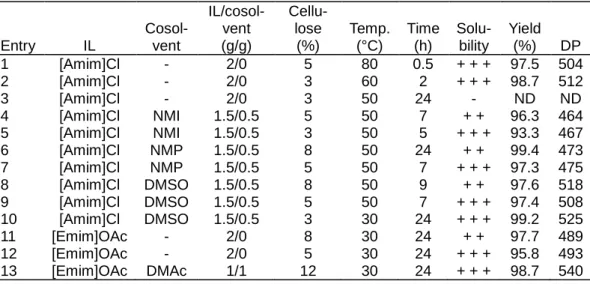
As the most effective tested solvents, NMI, NMP, and DMSO greatly increased the solubility of cellulose (Avicel PH101, DP = 208) to 12-15% in [Amim]Cl at 30 °C. Thus, in further experiments, these cosolvents were tested on filter paper pulp with a higher DP value (DP = 538) (Table 2). Without cosolvents, [Amim]Cl dissolved up to 5% pulp at 80 °C, and only 3% at 60 °C (Table 2, entries 1-3). These three cosolvents also decreased the dissolution temperature of pulp in [Amim]Cl; and whereas 3-5% pulp dissolved in [Amim]Cl/NMI at 1.5 g/0.5 g at 50 °C (Table 2, entries 4, 5), 5-8% pulp was dissolved in [Amim]Cl/NMP (1.5 g/0.5 g) at 50 °C (Table 2, entries 6, 7). Moreover, [Amim]Cl/DMSO had higher solubilization efficiency for filter paper pulp (Table 2, entries 8–10), and at 1.5 g/0.5 g dissolved 3% pulp completely at 30 °C, and 5-8% at 50 °C. At 30 °C, only DMSO was an effective cosolvent for the pulp in [Amim]Cl.
[Emim]OAc has a stronger solubilization efficiency than [Amim]Cl, but gives a dark solution and leads to acetylation of lignocelluloses (Qu et al. 2013a). Thus undesirable side reactions occur. In [Emim]OAc without cosolvent, 5-8% of the filter paper dissolved at 30 °C (Table 2, entries 11, 12). In contrast, with DMAc ([Emim]OAc/DMAc), 12% of the pulp dissolved completely without color formation at 30 °C (Table 2, entry 13). The combination of [Emim]OAc and DMAc shows the
Table 2 Dissolution and regeneration of filter paper pulp (DP = 538) in ionic liquids with cosolvent Entry IL Cosol- vent IL/cosol- vent (g/g) Cellu- lose (%) Temp. (°C) Time (h) Solu- bility Yield (%) DP 1 [Amim]Cl - 2/0 5 80 0.5 + + + 97.5 504 2 [Amim]Cl - 2/0 3 60 2 + + + 98.7 512 3 [Amim]Cl - 2/0 3 50 24 - ND ND 4 [Amim]Cl NMI 1.5/0.5 5 50 7 + + 96.3 464 5 [Amim]Cl NMI 1.5/0.5 3 50 5 + + + 93.3 467 6 [Amim]Cl NMP 1.5/0.5 8 50 24 + + 99.4 473 7 [Amim]Cl NMP 1.5/0.5 5 50 7 + + + 97.3 475 8 [Amim]Cl DMSO 1.5/0.5 8 50 9 + + 97.6 518 9 [Amim]Cl DMSO 1.5/0.5 5 50 7 + + + 97.4 508 10 [Amim]Cl DMSO 1.5/0.5 3 30 24 + + + 99.2 525 11 [Emim]OAc - 2/0 8 30 24 + + 97.7 489 12 [Emim]OAc - 2/0 5 30 24 + + + 95.8 493 13 [Emim]OAc DMAc 1/1 12 30 24 + + + 98.7 540 For explanation of solubility see Table 1.
FT-IR spectral analyses
FT-IR spectra of the original microcrystalline cellulose and selected regenerated celluloses from [Amim]Cl (Table 1, entry 3), [Amim]Cl/DMSO (Table 1, entry 25), and [Amim]Cl/NMI (Table 1, entry 8) are presented in Figure 2. No regenerated celluloses shows non-cellulose peaks, thus a severe degradation of cellulose did not occur during dissolution, although it is possible that byproducts were washed out through the regeneration process. Compared with the original microcrystalline cellulose (cellulose I), the examined regenerated celluloses from IL/cosolvent solvent systems shows characteristic features of cellulose II and/or amorphous cellulose (Liang and Marchessault 1959a, 1959b; Nelson and O’Connor 1964). This is consistent with observations of regenerated celluloses from ILs without cosolvent (Zhang et al. 2005; Azubuike et al. 2012). The intensities of β-glycosidic linkages at 897 cm-1 in cellulose II and amorphous cellulose are reportedly stronger than for cellulose I (Nelson and O’Connor 1964), and this tendency was also observed in regenerated celluloses. There is also an obvious difference between cellulose I and cellulose II at 1111 cm-1 (C-O and C-O-C ring stretching vibrations).Whereas the band at 1111 cm-1 is strong for the original cellulose, it was almost undetectable for regenerated celluloses, and became a shoulder similar to spectra for cellulose II and amorphous cellulose, which is due to changed hydrogen bonds (Nelson and O’Connor 1964). At 1430 cm-1 (CH
celluloses. However, the OH region of regenerated celluloses differs little among the samples recovered from various cosolvent systems. Regenerated cellulose from [Amim]Cl/DMSO shows a similar band to that of original cellulose, but that is shifted to higher frequencies. In contrast, cellulose from [Amim]Cl/NMI shows small shoulders at 3436 and 3476 cm-1, probably due to intramolecular hydrogen bonding of OH in cellulose II (Marchessault and Liang 1960).
4000 3500 3000 2500 2000 1500 1000 3436 3476 3330 1430 1111 %T Wavenumber (cm-1) Original cellulose [Amim]Cl/DMSO [Amim]Cl [Amim]Cl/NMI 897
Figure 2 FT-IR spectra of original cellulose (Avicel PH101) and regenerated cellulose
DP of regenerated celluloses
The DPs of underivatized celluloses determined in copper (II) ethylenediamine are presented in Table 1. As visible, the DPs of regenerated cellulose from IL/cosolvent systems are slightly lower than those of original cellulose. The results are dependent on the IL/cosolvent ratios, concentrations of cellulose, and the cosolvent type. In amine containing solvent systems (Table 1, entries 6–12) the effects are pronounced, but less visible in DMSO containing solvent systems (Table 1, entries 24–27).
DP decrements are greater for filter paper than for crystalline cellulose (Table 2), probably because the latter was already degraded. Specifically, DP of recovered pulp was decreased by up to 14% in the presence of NMI and NMP at 50 °C (Table 2, entries 4–7), but only by 2.4% in the presence of DMSO at 30 °C (Table 2, entry 10). The protective effects of DMSO (Table 2, entries 8–10) are partly due to the lower dissolution temperatures for the [Amim]Cl/DMSO solvent system. Decreases in DP of regenerated celluloses from [Emim]OAc were 8-9%, even at 30 °C (Table 2, entries 11–12). However, no decreases in DP of recovered cellulose from [Emim]OAc/DMAc at 30 °C were observed (Table 2, entry 13). These results are consistent with the observations of Qu et al. (2013b), who found insignificant MW decrements during dissolution and/or acetylation of cell wall components in [Emim]OAc/DMAc. The mechanisms of the distinct cellulose-protective effects of DMAc in [Emim]OAc are not yet known.
Thermogravimetric analysis (TGA)
[Amim]Cl/DMSO (Table 1, entry 24) were characterized by TGA (Figure 3, Table 3). The decomposition patterns of the celluloses are similar. However, regenerated celluloses have lower and wider ranges of decomposition temperatures compared with the original cellulose. These data are in agreement with previous reports of regenerated celluloses from [Bmim]Cl without cosolvent (Swatloski et al. 2002; Azubuike et al. 2012).
TGA demonstrates that regenerated celluloses from [Amim]Cl decomposes at lower temperature than those from [Amim]Cl/DMSO, with 10% weight losses at 284 °C and 294 °C, respectively. Moreover, TGA curves of cellulose from [Amim]Cl/DMSO are similar to that of original cellulose, but differ significantly from regenerated celluloses from ILs without cosolvent (Swatloski et al. 2002). The thermal stability of regenerated cellulose recovered from [Amim]Cl/DMSO is significantly higher than that without DMSO. This is probably because DMSO suppresses side reactions of cellulose during dissolution. Clearly, DMSO increases dissolution efficiencies of [Amim]Cl at lower temperatures, and protects cellulose during the dissolution process.
0 100 200 300 400 500 0 20 40 60 80 100 Wei ght (%) Original cellulose Temperature (oC) [Amim]Cl [Amim]Cl/DMSO
Figure 3 TGA curves of original cellulose (Avicel PH101) and regenerated celluloses
Table 3 Thermal parameters of original and regenerated celluloses (Avicel PH101)
Para- meters Orig. cellulose Regenerated cellulose [Amim]Cl [Amim]Cl/ DMSO(1:1) T5% (ºC) 292 275 279 T10% (ºC) 306 284 294 T50% (ºC) 330 321 331
Note: T5%, T10%, and T50% are the temperatures at which 5%, 10%, and 50% weight loss was observed, respectively.
1.2 Experiments
Materials:
Microcrystalline cellulose Avicel PH-101 (Sigma-Aldrich Co., St. Louis, MO, USA) and filter paper pulp (Toyo Roshi Kaisha Ltd., Tokyo, Japan) were dried under vacuum over phosphorus pentoxide (P2O5) at r.t. for 24 h before use. The ILs [Amim]Cl and [Emim]OAc were purchased from Ionic Liquids Technologies GmbH (Heilbronn, Germany) and Sigma-Aldrich (St. Louis, MO, USA), respectively, and were used without purification (Figure 1). All other chemicals (Wako Pure Chemical Industries, Osaka, Japan) were reagent grade and were used directly.
Solubility of cellulose in IL/cosolvent
Cellulose (0.01 g) was added to 1 g IL/cosolvent and magnetically stirred at 30 °C. When the resulting solution became transparent, another 0.01 g cellulose was added. This procedure was repeated until the solution became hazy or the viscosity of the solution became very high for stirring. The solubility was calculated based on the total amount of added cellulose until the solution became transparent within 24 h.
DP measurements
regenerated cellulose was dried under vacuum over P2O5 at r.t. for 24 h. The viscosimetric DP determination was performed in copper (II) ethylenediamine solution. Each sample was measured in triplicate and the DPs are the averages of three runs.
Infrared (IR) spectra
IR were recorded in an instrument (Spectrum 100; Perkin-Elmer, Santa Clara, CA, USA) at 4 cm-1 resolution by attenuated total reflection (ATR) technique.
Thermogravimetric analysis (TGA)
TGA was performed by means of a Shimadzu DTA-50 TG analyzer (Shimadzu Corporation, Kyoto, Japan) at a heating rate of 10 °C/min under nitrogen atmosphere. Samples of 1–2 mg were heated from r.t. to 500 °C.
CHAPTER II
Novel cellulose pretreatment solvent: phosphonium-based amino acid ionic liquid/cosolvent for enhanced enzymatic hydrolysis
AAILs, more eco-friendly ILs with lower viscosity at r.t., were synthesized as cellulose pretreatment solvent for enhancing enzymatic hydrolysis. However only AAILs could not dissolve cellulose even at higher temperature. When some organic solvents mentioned in chapter I was added as cosolvents of AAILs, the systems could effectively dissolve cellulose at 30 °C. The cellulose solubility of AAIL/cosolvent and the subsequent enzymatic hydrolysis were studied. The compatibility between cellulase and AAIL/cosolvent was evaluated by conducting dissolution and enzymatic hydrolysis of cellulose in a one-batch process.
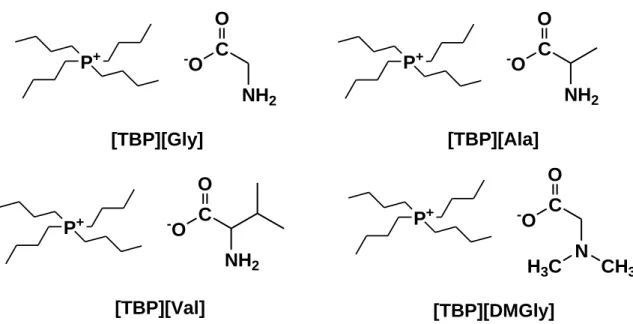
P+ -O C O NH2 P+ -O C O NH2 P+ -O C O NH2 P+ -O C O N H3C CH3 [TBP][Gly] [TBP][Ala] [TBP][Val] [TBP][DMGly]
2.1 Results and discussion
Phosphonium-based AAILs as cellulose solvents in the presence of a cosolvent
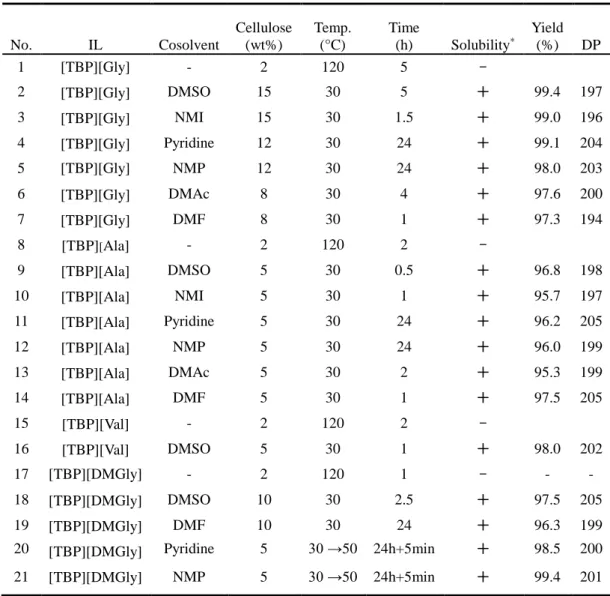
The potential of tetrabutylphosphonium-based AAILs, including [TBP][Gly], [TBP][Ala], [TBP][Val], and [TBP][DMGly], as cellulose solvents was evaluated with and without a cosolvent, as shown in Table 4. The cosolvents were aprotic polar organic solvents, including a neutral solvent (DMSO), basic solvents (pyridine and NMI), amide-related solvents (DMF and DMAc) and NMP.
Herein, three [TBP][AA] were selected from the 20 [TBP][AA] containing natural amino acids, because of their low viscosity as it is one of the requirements for effective cellulose dissolving. The reported viscosities of [TBP][Gly], [TBP][Ala], and [TBP][Val] at 25 °C are 415, 344, and 423 cP, respectively, which are lower than those of other [TBP][AA] (Kagimoto et al. 2006). The potentially less reactive novel [TBP][DMGly] was synthesized and also tested. However, without cosolvent, all of the AAILs failed to dissolve cellulose (Avicel), even at 120 °C (Table 4, entries 1, 8, 15, and 17). Therefore, the above mentioned aprotic polar organic solvents served as cosolvents because they increased the solubilization efficiency of [Amim]Cl for cellulose dissolution.
Table 4 Dissolution and regeneration of cellulose (Avicel PH101, DP = 208) in ILs with cosolvents. No. IL Cosolvent Cellulose (wt%) Temp. (°C) Time (h) Solubility* Yield (%) DP 1 [TBP][Gly] - 2 120 5 - 2 [TBP][Gly] DMSO 15 30 5 + 99.4 197 3 [TBP][Gly] NMI 15 30 1.5 + 99.0 196 4 [TBP][Gly] Pyridine 12 30 24 + 99.1 204 5 [TBP][Gly] NMP 12 30 24 + 98.0 203 6 [TBP][Gly] DMAc 8 30 4 + 97.6 200 7 [TBP][Gly] DMF 8 30 1 + 97.3 194 8 [TBP][Ala] - 2 120 2 - 9 [TBP][Ala] DMSO 5 30 0.5 + 96.8 198 10 [TBP][Ala] NMI 5 30 1 + 95.7 197 11 [TBP][Ala] Pyridine 5 30 24 + 96.2 205 12 [TBP][Ala] NMP 5 30 24 + 96.0 199 13 [TBP][Ala] DMAc 5 30 2 + 95.3 199 14 [TBP][Ala] DMF 5 30 1 + 97.5 205 15 [TBP][Val] - 2 120 2 - 16 [TBP][Val] DMSO 5 30 1 + 98.0 202 17 [TBP][DMGly] - 2 120 1 - - - 18 [TBP][DMGly] DMSO 10 30 2.5 + 97.5 205 19 [TBP][DMGly] DMF 10 30 24 + 96.3 199 20 [TBP][DMGly] Pyridine 5 30 →50 24h+5min + 98.5 200 21 [TBP][DMGly] NMP 5 30 →50 24h+5min + 99.4 201 *Note: +, sample was completely dissolved and the solution was very clear; -, sample was not dissolved.
[TBP][Gly], which contains the simplest amino acid, was the most effective AAIL solvent in combination with a cosolvent (Table 4, entries 2–7). [TBP][Gly]/DMSO and [TBP][Gly]/NMI dissolved 15% cellulose, whereas [TBP][Gly]/pyridine and [TBP][Gly]/NMP dissolved 12% cellulose. DMAc and DMF were also effective, and 8% cellulose was dissolved in [TBP][Gly]/DMAc and [TBP][Gly]/DMF.
[TBP][Ala] has the lowest viscosity, but its solubilization efficiency was not as high even with a cosolvent. All combinations of [TBP][Ala] with the six cosolvents resulted in 5% cellulose dissolution at 30 °C (Table 4, entries 9–14). DMSO exhibits the highest solubilization efficiency with the shortest dissolution time. The combination of [TBP][Val] with DMSO was also investigated, but also resulted in 5% cellulose dissolution (Table 4, entry 16).
The potential of the novel IL [TBP][DMGly] as a cellulose solvent is listed with the entries 18–21 (Table 4). [TBP][DMGly]/DMSO dissolved 10% cellulose in 2.5 h, whereas [TBP][DMGly]/DMF required 24 h to dissolve the same amount. Pyridine and NMP were less effective: 5% of cellulose was not completely dissolved in [TBP][DMGly]/pyridine or [TBP][DMGly]/NMP at 30 °C within 24 h and required additional heating at 50 °C for 5 min to complete the dissolution. Again, DMSO was most effective. The solubilization efficiency of [TBP][DMGly] was sufficiently high in the presence of a cosolvent, although [TBP][DMGly] was less effective than
showed that polar organic cosolvents not only increase cellulose solubility in [Amim]Cl but also exhibit protective effects preventing DP decrement.
[TBP][Gly] displayed the highest solubilizing efficiency in combination with a cosolvent. It has been reported that the effectiveness for cellulose dissolution of an IL is estimated from the Kamlet–Taft parameters (α: hydrogen bond acidity, β: hydrogen bond basicity, and π*: dipolarity) (Fukaya et al. 2008; Brandt et al. 2010). Particularly, a high β value is desirable for effective cellulose dissolution. The value of β is generally affected by the anion in ILs. Therefore, the solubilization efficiency of [TBP][AA] should depend on the nature of the amino acid. The β values of [TBP][Gly], [TBP][Ala], and [TBP][Val] are 1.11, 1.03, and 0.78, respectively (Spange et al. 2001). Thus the highest solubilization ability of [TBP][Gly] in the presence of a cosolvent can be reasonably explained by its highest β value. The length of the alkyl chain in the IL anion may also affect the dissolution owing to its steric effect (Zhao et al. 2013). Anions with a longer alkyl chain have a negative effect on the interaction between the anion and the hydroxy protons of cellulose. Accordingly, the highest dissolution efficiency of [TBP][Gly] can also be explained by the absence of alkyl side chain in glycine.
The key role of cosolvents is obvious with the ILs in focus, and DMSO turned to be the most effective one. Several research work was already dedicated to this topic (Andanson et al. 2014; Ohira et al. 2012b; Rinaldi 2011; Gericke et al. 2011). One of the theories is that cosolvents decrease the viscosity of ILs and improve the mobility of free ions in ILs, and contribute in this way to the interaction between IL and cellulose. The anions in ILs disrupt the hydrogen-bonding network of cellulose (Xu et al. 2013) and DMSO has exceptionally high efficiency for cellulose swelling, which facilitates
dissolution (Fidale et al. 2008). In combination with tetrabutylphosphonium-based AAILs, cosolvents also decrease the viscosity.
Effect of [TBP][Gly]/DMSO ratio on dissolution of cellulose
The effects of the AAIL/cosolvent ratio were examined with [TBP][Gly]/DMSO at 30°C, while proportion of the IL was changed from 0% to 100% (Figure 5). Neat [TBP][Gly] and neat DMSO did not dissolve cellulose at all, however, with increasing IL moiety in the IL/DMSO the dissolution efficiency improved. With the combination [TBP][Gly]/DMSO (50:50), 15% of cellulose was dissolved but with a proportion of IL higher than 70%, cellulose became insoluble again.
0 10 20 30 40 50 60 70 80 90 100 0 2 4 6 8 10 12 14 16 18 C el lulose ( %)
Proprotion of [TBP][Gly] in [TBP][Gly]/DMSO (%, w/w) 30oC 50oC
Figure 5 Solubility of cellulose in [TBP][Gly]/DMSO with different mass ratios at
The results can be summarized that cosolvents improve dissociation and solvation of AAILs, and that the solvated AAILs plays a key role in dissolving cellulose. Moreover, the viscosity decrement of the solution in an IL/cosolvent system is also important. At 50 °C, the viscosity of the solvent systems is relatively low, but nevertheless the solubilization efficiency was worse than that at less than 30% of [TBP][Gly] at 30 °C. No doubt, further studies are necessary to understand this observation.
Enzymatic hydrolysis of original cellulose by cellulase RS and purified cellulase R-10 Optimization of enzymatic hydrolysis by cellulase was performed using original cellulose (Avicel) as substrate for 24 h incubation in pH 4.5 acetate buffer at 50 °C (Figure 6). Typically, the enzymatic hydrolysis rate was faster by using cellulase RS than by purified cellulase R-10. A significant higher glucose yield of 79% was obtained by cellulase RS, compared to 36% by purified cellulase R-10. Therefore, cellulase RS was chosen for the further studies.
0 4 8 12 16 20 24 0 20 40 60 80 100 Glu c o s e ( %) Time (h) Cellulase RS Purified cellulase R-10
Figure 6 Enzymatic hydrolysis of cellulose (Avicel PH101) to glucose in acetate buffer
(0.1 M, pH 4.5) at 50 ºC using cellulase RS and cellulase R-10. Error bars show the standard deviation of twice runs.
Effect of AAIL/cosolvent pretreatment on enzymatic hydrolysis
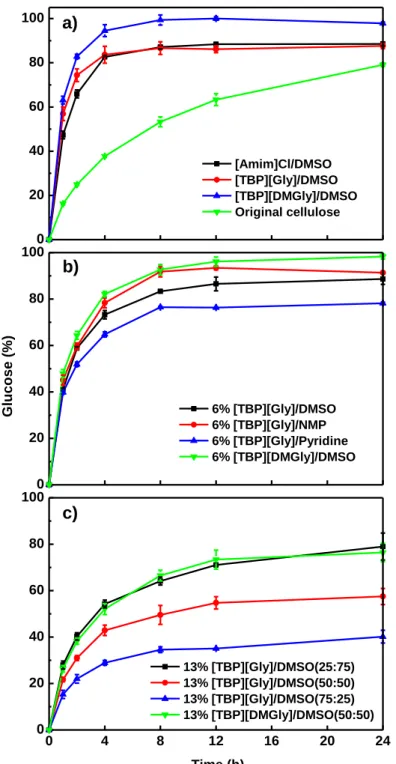
Cellulose was dissolved in phosphonium-based AAILs/DMSO, and acetate buffer was then added to regenerate cellulose. The regenerated cellulose was hydrolyzed by cellulase for 24 h in acetate buffer at 50 °C after removing the residual AAIL and DMSO by washing, as shown in Figure 7a) and Table 5. For comparison, the original cellulose and cellulose pretreated by [Amim]Cl/DMSO were also subjected to enzymatic hydrolysis.
0 20 40 60 80 100 0 20 40 60 80 100 0 4 8 12 16 20 24 0 20 40 60 80 100 b) [Amim]Cl/DMSO [TBP][Gly]/DMSO [TBP][DMGly]/DMSO Original cellulose a) G lu c o s e ( % ) 6% [TBP][Gly]/DMSO 6% [TBP][Gly]/NMP 6% [TBP][Gly]/Pyridine 6% [TBP][DMGly]/DMSO Time (h) 13% [TBP][Gly]/DMSO(25:75) 13% [TBP][Gly]/DMSO(50:50) 13% [TBP][Gly]/DMSO(75:25) 13% [TBP][DMGly]/DMSO(50:50) c)
Figure 7 Enzymatic hydrolysis of cellulose (Avicel PH101) in acetate buffer (0.1 M, pH
4.5) or in AAIL/cosolvent buffer solution at 50 ºC. a) Hydrolysis of original cellulose and regenerated cellulose pretreated by IL/DMSO (50:50) in acetate buffer. b) Hydrolysis of regenerated cellulose pretreated by AAIL/cosolvent (50:50) in 6% AAIL/cosolvent (50:50) buffer solution. c) Hydrolysis of regenerated cellulose in 13% AAIL/cosolvent buffer solution; pretreated by [TBP][Gly]/DMSO (25:75), (50:50), (75:25), and [TBP][DMGly]/DMSO (50:50). The error bars show the standard deviations of triplicate experiments.
Table 5 Initial conversion rate of cellulose to glucose
No. Pretreatment Details of enzymatic hydrolysis*
Initial conversion rate (%/h) 1 - buffer 16.3 2 [Amim]Cl/DMSO (50:50) buffer 47.3 3 [TBP][Gly]/DMSO (50:50) buffer 56.9 4 [TBP][DMGly]/DMSO (50:50) buffer 63.1 5 [TBP][Gly]/DMSO (50:50) 6% [TBP][Gly]/DMSO (50:50) in buffer 41.1 6 [TBP][Gly]/NMP (50:50) 6% [TBP][Gly]/NMP (50:50) in buffer 45.1 7 [TBP][Gly]/pyridine (50:50) 6% [TBP][Gly]/pyridine (50:50) in buffer 39.8 8 [TBP][DMGly]/DMSO (50:50) 6% [TBP][DMGly]/DMSO (50:50) in buffer 48.0 9 [TBP][Gly]/DMSO (25:75) 13% [TBP][Gly]/DMSO (25:75) in buffer 28.0 10 [TBP][Gly]/DMSO (50:50) 13% [TBP][Gly]/DMSO (50:50) in buffer 21.7 11 [TBP][Gly]/DMSO (75:25) 13% [TBP][Gly]/DMSO (75:25) in buffer 15.3 12 [TBP][DMGly]/DMSO (50:50) 13% [TBP][DMGly]/DMSO (50:50) in buffer 26.4 *Note: Enzymatic hydrolysis was conducted in acetate buffer or in AAIL/cosolvent buffer solution at pH 4.5 and 50 °C.
The initial hydrolysis rate (glucose yield after 1 h) was significantly increased by all the IL pretreatments (Table 5). Clearly, the hydrogen bonding in the supramolecular structure of cellulose is altered by dissolution in the AAIL/DMSO system and thus the cellulose became more accessible for cellulase (Auxenfans et al. 2012; Cui et al. 2014; Ebner et al. 2014).
Cellulose pretreated by AAILs/DMSO displays a higher initial hydrolysis rates than that pretreated by [Amim]Cl/DMSO. Significantly, almost complete conversion of cellulose to glucose was achieved by a [TBP][DMGly]/DMSO pretreatment. The efficiency of cellulase is correlated with the residual amount of ILs associated with regenerated cellulose. Imidazolium- and halogen-based ILs were reported to decrease the cellulase activity (Bose et al. 2012; Li et al. 2013). Even trace amounts of these ILs may worsen significantly the cellulase activity (Zhao et al. 2009) and this makes an extensive removal necessary of the residual IL before enzymatic conversion (Datta et al. 2010; Shi et al. 2013). This seems to be not the case in the experiments in the present paper, where only a simple regeneration and washing processes was applied. The finding that the enzymatic efficiency was highest with [TBP][DMGly]/DMSO may be due to the compatibility of [TBP][DMGly] with cellulase.
Figure 7b) shows the enzymatic hydrolysis of regenerated cellulose in 6%
AAIL/cosolvent buffer solutions. When compared with the above data obtained after removing the AAILs/cosolvent by washing, negative effects on the initial hydrolysis rate were observed (Table 5). However, the final conversion to glucose was not affected very much. During 24 h, the conversions rate were 98% and 89% in 6% [TBP][DMGly]/DMSO and 6% [TBP][Gly]/DMSO, respectively. Accordingly, it is
possible to conduct the dissolution and enzymatic hydrolysis of cellulose in one batch process with phosphonium-based AAILs. The cosolvents also affect the activity of cellulase significantly. In 6% [TBP][Gly]/pyridine, the glucose yield was 78% in 24 h, i.e. ca. 10% lower than the in case of 6% [TBP][Gly]/DMSO or 6% [TBP][Gly]/NMP. Some organic solvents are also reported to decrease the activity of β-glucosidase (Rather et al. 2012).
The effects of the AAIL/cosolvent ratios on the hydrolysis of regenerated cellulose from AAILs were also examined (Figure 7c), while the ratio of [TBP][Gly] to DMSO was especially relevant. Both the final glucose yield and the initial glucose production rate decreased drastically at elevated mass ratios of the IL. When the IL/DMSO ratio was 25:75, 79% glucose yield was obtained in 13% IL/DMSO buffer solution, whereas the yield was 40% in 13% IL/DMSO (75:25). The higher compatibility of [TBP][DMGly] with cellulase was further proved by the experimental results according to which the glucose yield was 76% in 13% [TBP][DMGly]/DMSO (50:50), whereas the yield was 58% in 13% [TBP][Gly]/DMSO (50:50).
Enzymatic hydrolysis of cellulose using purified cellulase R-10
The extended enzymatic hydrolysis of original and regenerated cellulose from [TBP][Gly]/DMSO (50:50) using purified cellulase R-10 was conducted (Figure 8).
0 4 8 12 16 20 24 0 20 40 60 80 100 G lu c o s e ( % ) Time (h) Original cellulose [TBP][Gly]/DMSO
Figure 8 Enzymatic hydrolysis of original and regenerated cellulose (Avicel PH101)
pretreated by [TBP][Gly]/DMSO at 50 ºC in acetate buffer (pH 4.5) using purified cellulase R-10.Error bars show the standard deviation of twice runs
2.2 Experiments
Materials:
Cellulase (Onozuka RS) was purchased from Yakult Pharmaceutical Industry Co., Ltd. (Tokyo, Japan). The enzymatic activity was 16,000 filter-paper units (FPU)/g. The optimum pH and temperature of the enzyme were determined by the glucose yield after 48 h incubation of Avicel PH-101 as substrate; the highest glucose yield was obtained at pH 4.5 and 50 °C (Figure 9 and Figure 10). These results are consistent with those obtained from the supplier (optimum pH: 4.0–5.0; optimum temperature: 50–60 °C). The average protein content (0.237 mg/mg, two measurements) of Onozuka RS was determined according to the Bio-Rad Protein Assay procedure (Bio-Rad, Hercules, CA, USA) with bovine gamma globulin as the standard. Cellulase (Onozuka R-10) (Yakult Pharmaceutical Industry Co., Ltd. Tokyo, Japan) was purified before use. The commercial cellulase R-10 (500 mg) was dissolved in 30 mL distilled water and stirred for 30 min and then transferred to a centrifugal concentrator of Vivaspin Turbo 15 (Sartorius Stedim Biotech GmbH, Goettingen, Germany), and centrifuged at 4000 rpm for 30 min. The concentrated solution of purified cellulase R-10 was freeze dried under vacuum. The average protein content of purified cellulase R-10 was 0.387 mg/mg determined by the same method as Onozuka RS.
3 4 5 6 7 0 20 40 60 80 G lu c o s e ( % ) pH
Figure 9 Enzymatic hydrolysis of cellulose (Avicel PH101) to glucose at 50 °C in
acetate buffer with different pH values using cellulase Onozuka RS
35 40 45 50 55 60 65 0 20 40 60 80 Glu c o s e ( %) Temperature (°C)
Figure 10 Enzymatic hydrolysis of cellulose (Avicel PH101) to glucose in acetate
Typical procedure for the preparation of [TBP][AA]
To a stirred solution of the amino acid (36.3 mmol) in water (11 mL), an aqueous solution of [TBP][OH] (40%, 8.29 g, 30 mmol) was added dropwise at r.t. After gentle mixing for 10 min, water was removed by a rotary evaporator at 50 °C. The crude IL was washed with acetonitrile and methanol (3:2, v/v) to remove excess amino acid. Finally, the product was dried under vacuum for 24 h at 70 °C (Kagimoto et al. 2006). For the synthesis of [TBP][DMGly], [TBP][OH] and N,N-dimethylglycine ethyl ester were stirred at 70 °C for 2 h and the excess ester was removed by extraction with ethyl acetate. The structure of [TBP][AA] (Figure 4) was confirmed by 1H NMR spectra (Bruker AVANCE II 400 FT-NMR (400 MHz) spectrometer). Chemical shifts and coupling constants are reported in δ values (ppm) and Hz, respectively. [TBP][Gly]: (DMSO-d6) δ 0.82 (12H, t, J = 7.2 Hz, -CH2CH3×4), 1.27–1.39 (16H, m, -CH2CH2-×4), 2.10 (8H, m, PCH2-×4), 2.53 (2H, s, -CH2COO). [TBP][Ala]: (DMSO-d6) δ 0.82 (12H, t, J = 7.2 Hz, -CH2CH3×4), 0.88 (3H, d, J = 6.8 Hz, -CH(CH3)-), 1.27–1.39 (16H, m, -CH2CH2-×4), 2.06–2.13 (8H, m, PCH2-×4), 2.68 (1H, q, J = 6.8 Hz, -CH(CH3)-). [TBP][Val]: (DMSO-d6) δ 0.56 (3H, d, J = 6.8 Hz, -CH(CH3)2), 0.69 (3H, d, J = 6.8 Hz, -CH(CH3)2), 0.82 (12H, t, J = 7.2 Hz, -CH2CH3×4), 1.27–1.39 (16H, m, -CH2CH2-×4), 1.78 (1H, m, -CH(CH3)2), 2.10 (8H, m, PCH2-×4), 2.48 (1H, s, -CHCOO). [TBP][DMGly]: (CDCl3) δ 0.87 (12H, t, J = 6.9 Hz, -CH2CH3×4), 1.38–1.44 (16H, m,
stirred until the solution became clear. Then, acetate buffer (0.1 M, pH 4.5, 2.8 mL) was added with vigorous stirring for 30 min. Regenerated cellulose was triturated by spatula. The suspension was centrifuged at 4000 rpm for 20 min and the regenerated cellulose was then washed with distilled water (2.4 mL) three times to remove residual IL and cosolvent. This washing procedure was omitted when the compatibility of cellulase and the IL was examined. Finally, acetate buffer (0.1 M, pH 4.5, 2.4 mL) was added to adjust the total volume of the enzymatic solution to 2.8 mL. The pH was adjusted to 4.5 with a small amount of additional acetic acid if necessary.
Enzymatic hydrolysis was conducted at 50 °C and 200 rpm by adding 2.1 mg cellulase (protein content: 0.5 mg) (Ohira et al. 2012a). At a given time interval, 50 µL of the reaction solution was withdrawn and the reaction was quenched by heating at 105 °C for 5 min. Before analysis by HPLC, all the samples were filtered by a syringe filter (pore size 0.2 μm, Advanced Microdevices Pvt. Ltd, Ambala, India). Each experiment was conducted in triplicate.
Quantification of glucose by HPLC
Glucose was monitored by high-performance liquid chromatography (HPLC), equipped with an RI detector (JASCO, Hachioji, Japan) and an Asahipak NH2P-40 3E (3.0 mm ID × 250 mm L) column (Shodex, Tokyo, Japan). Acetonitrile/water (65:35, v/v) served as the mobile phase (0.32 mL/min). The retention time of glucose was 10.08 (±0.39%) and its yield was determined by the following equation:
Where Yglc is the yield of glucose, and Ccell and Cglc are the concentrations of cellulose and glucose, respectively, in mg/mL.
CHAPTER III
Enzymatic synthesis of methyl β-D-glucoside directly from cellulose pretreated with bio-compatible amino acid ionic liquid/cosolvent
On the base of chapter I and chapter II, a new approach for enzymatic synthesizing methyl β-D-glucoside was proposed based on commercially available cellulase and
cellulose pretreated with AAIL/cosolvent. Preparative-scale synthesis from 1 g cellulose with reduced amount of cellulase was also conducted in this chapter. The additional studies with cellobiose and glucose as substrates has been studied to explore the formation of methyl β-D-glucoside from cellulose.
3.1 Results and discussion
Enzymatic synthesis of methyl β-D-glucoside from regenerated cellulose pretreated by
AAIL/cosolvent.
It was already demonstrated that TBP-based AAIL/cosolvent is a new effective pretreatment solvent for enhanced enzymatic hydrolysis of cellulose because of its higher compatibility with cellulase. Hence, phosphonium-based AAIL/cosolvent systems were further applied to the synthesis of methyl β-D-glucoside from regenerated
cellulose and MeOH. Cellulose was pretreated with combinations of [TBP][Gly] with cosolvent, DMSO, NMI, or NMP as illustrated in Figure 1. For comparison served a conventional IL, [Amim]Cl/DMSO. The MeOH content was 22.5% (v/v) in acetate buffer (pH 4.5), which corresponds to a substrate (glucose residue) to MeOH ratio of 1:125.
formed effectively (Figure 11a), along with a quite low yields of glucose (Figure 11b) and cellobiose (Figure 11c). Only 6% total enzymatic conversion was observed in the presence of MeOH, whereas 80% glucose yield was attained in 48 h for the enzymatic hydrolysis of untreated cellulose under the same conditions but without MeOH (Figure
11a). These results indicate that MeOH reduces the enzymatic activity of cellulase and
diminishes the total conversion of cellulose. Harmful effects of organic solvents on enzyme activities are well known (Castro and Knuborets 2003; Fernández-Lucas et al. 2012).
In contrast, to the best of our knowledge, this is the first study to demonstrate that methyl β-D-glucoside can be efficiently synthesized from regenerated celluloses
pretreated with IL/cosolvent systems. With [TBP][Gly]/DMSO, [TBP][Gly]/NMI, and [TBP][Gly]/NMP, the yields of methyl β-D-glucoside reached 37%–40% accompanied
by glucose yields of 46%–48%. Total conversions rates reached 85%–86%, which were much higher than those of untreated cellulose, because hydrogen bonding of the original cellulose was altered by the IL/cosolvent pretreatments and the disordered cellulose structure was more accessible to cellulase (Cui et al. 2014; Mai et al. 2014). In addition, pretreatments with [TBP][Gly]/cosolvent were more efficient, and the yields of methyl β-D-glucoside were approx. 10% higher than those by [Amim]Cl/DMSO, which can be
0 10 20 30 40 50 0 10 20 30 40 50 0 8 16 24 32 40 48 0 5 10 15 20 25 30 Me th yl β-D -g luc o s ide ( %) [TBP][Gly]/DMSO [TBP][Gly]/NMI [TBP][Gly]/NMP [Amim]Cl/DMSO Original cellulose a) Glu c o s e ( %) [TBP][Gly]/DMSO [TBP][Gly]/NMI [TBP][Gly]/NMP [Amim]Cl/DMSO Original cellulose b) Ce ll o b ios e ( %) Time (h) [TBP][Gly]/DMSO [TBP][Gly]/NMI [TBP][Gly]/NMP [Amim]Cl/DMSO Original cellulose c)
Figure 11 Effects of cellulose pretreatments on the yields of a) methyl β-D-glucoside, b)
glucose and c) cellobiose by enzymatic conversion of regenerated cellulose at 50 ºC in acetate buffer (pH 4.5) with 22.5% (v/v) methanol. Error bars show the standard deviation of triplicate runs.
Effect of methanol contents on synthesis of methyl β-D-glucoside
Methanol was the main reactant in the enzymatic synthesis in focus. However, as pointed out, MeOH has clear harmful effects on cellulase activity. Hence, it is essential to optimize the MeOH content for the enzymatic synthesis of methyl β-D-glucoside.
Cellulose pretreated by [TBP][Gly]/DMSO was washed with water and subjected to enzymatic treatments in acetate buffer with 13.5%–27% (v/v) MeOH (Figure 12). The yield of methyl β-D-glucoside clearly increased with increasing MeOH content from
13.5% to 22.5%, and the maximum methyl β-D-glucoside yield of 40% was observed
upon incubation for 24 h (Figure 12a). Higher MeOH contents led to more interaction with cellulose, as reflected by the higher methyl β-D-glucoside yield. However, a
significant decrease in the yield of methyl β-D-glucoside was observed for 27% (v/v)
MeOH. In contrast, the glucose yields showed a reverse tendency and were the highest for 13.5% MeOH. The total conversion rates of regenerated cellulose were relatively constant between 85% and 95% for MeOH contents of 13.5%–22.5%. For MeOH contents of 13.5% and 18%, the formation of methyl β-D-glucoside appeared to be
completed in 12 h, and a decrease in the yield of methyl β-D-glucoside was observed, as
shown in Figure 12a). This indicates that with prolonged incubation, the hydrolysis of methyl β-D-glucoside to glucose became pronounced, particularly at low MeOH
0 10 20 30 40 50 0 10 20 30 40 50 60 70 0 8 16 24 32 40 48 0 5 10 15 20 25 30 35 M e th y l β -D -g lu c o s id e ( % ) 13.5% (v/v) Methanol 18.0% (v/v) Methanol 22.5% (v/v) Methanol 27.0% (v/v) Methanol a) Gluc o s e ( %) 13.5% (v/v) Methanol 18.0% (v/v) Methanol 22.5% (v/v) Methanol 27.0% (v/v) Methanol b) Ce ll o b ios e ( %) Time (h) 13.5% (v/v) Methanol 18.0% (v/v) Methanol 22.5% (v/v) Methanol 27.0% (v/v) Methanol c)
Figure 12 Effects of methanol concentrations on the yields of a) methyl β-D-glucoside,
b) glucose and c) cellobiose by enzymatic conversion of regenerated cellulose pretreated by [TBP][Gly]/DMSO. The conversion was conducted at 50 ºC in acetate buffer (pH 4.5) with 13.5-27.0% (v/v) methanol. Error bars show the standard deviation of triplicate runs.
Exploration of the formation of methyl β-D-glucoside
It was particularly significant to determine how methyl β-D-glucoside is formed by
cellulase from insoluble cellulose, because this is the first study with this regard. In light of the synthesis of alkyl β-D-glucoside with almond β-glucosidase and soluble glucose
(Papanikolaou 2001; Ducret et al. 2002), we estimated that glucose formed from cellulose might act as a glycosyl donor. Thus, regenerated cellulose was first enzymatically hydrolyzed by cellulase to glucose for 4 h, and then MeOH was added and the incubation was continued for an additional 44 h, as shown in Figure 13. Surprisingly, a high glucose level (83% at 4 h) was maintained, with only a slight decrease during incubation, while only a limited amount of methyl β-D-glucoside was
formed. Thus, the glucose formed from cellulose was not a main precursor for the reaction in focus.
0 8 16 24 32 40 48 0 20 40 60 80 100 Y ie ld ( % ) Time (h) Glucose Cellobiose Methyl β-D-glucoside
Figure 13 Yields of glucose, cellobiose and methyl β-D-glucoside by enzymatic
conversion of regenerated cellulose from [TBP][Gly]/DMSO. The conversion was conducted at 50 ºC in acetate buffer (pH 4.5). Methanol (22.5%, v/v) was added after 4 h incubation. Error bars show the standard deviation of triplicate runs.
Next, cellobiose and glucose, which are the main products from the saccharification of cellulose, were selected as substrates for the synthesis under the same incubation conditions. As shown in Figure 14, the formation of methyl β-D-glucoside from
cellobiose followed a time course similar to that from regenerated cellulose, associated with a higher initial formation rate and higher yields. In contrast, the rate of conversion of glucose to methyl β-D-glucoside was quite low, particularly during the first 4 h. These
results are interpreted that cellulose is first enzymatically hydrolyzed to cellobiose and then the formed cellobiose is converted to methyl β-D-glucoside by transglycosylation
(Figure 15). The transglycosylation of cellobiose would produce both methyl β-D-glucoside and glucose at a 1:1 ratio. At the same time, cellobiose was also simply
hydrolyzed to glucose in this highly aqueous solution. This explains why, despite a high total conversion of regenerated cellulose (>85%), methyl β-D-glucoside was obtained at
a relatively lower yield (<44%). Further research is necessary to achieve a higher conversion rate of cellulose to methyl β-D-glucoside.
0 8 16 24 32 40 48 0 10 20 30 40 50 Me th y l β-D -g luc o s ide ( %) Time (h)
Regenerated cellulose from [TBP][Gly]/DMSO Cellobiose
Glucose
Figure 14 Effects of substrates on the yield of methyl β-D-glucoside. The enzymatic
conversions were conducted at 50 ºC in acetate buffer (pH 4.5) with 22.5% (v//v) methanol using regenerated cellulose from [TBP][Gly]/DMSO, cellobiose and glucose. Error bars show the standard deviation of triplicate runs.
O O O OH OH HO OH OH HO n O O O OH OH HO OH OH HO HO O HO OH HO OH O OCH3 HO OH HO OH Cellulose Cellobiose OH Glucose Methyl -D-glucoside OH O
Figure 15 Plausible mechanism for the enzymatic synthesis of methyl β-D-glucoside
Preparative-scale synthesis of methyl β-D-glucoside from cellulose
Preparative-scale synthesis of methyl β-D-glucoside was performed under the same
conditions as in case of analytical experiments, but the amount of cellulase was reduced. Compared with the small-scale experiments, the initial production rates for both methyl β-D-glucoside and glucose clearly decreased because of the small amount of cellulase,
as shown in Figure 16. However, the yields of methyl β-D-glucoside and glucose after
48 h of incubation were 36% and 46%, respectively, which were comparable to the yields for small-scale synthesis, namely, 40% and 46%, respectively. Methyl β-D-glucoside could be isolated by column chromatography at 33% isolated yield.
0 8 16 24 32 40 48 0 10 20 30 40 50 Y ield ( %) Time (h) Methyl β-D-glucoside Glucose Cellobiose
Figure 16 Preparative-scale synthesis of methyl β-D-glucoside from regenerated
cellulose from [TBP][Gly]/DMSO. Time curves of the formation of methyl β-D-glucoside, glucose and cellobiose during incubation at 50 ºC in acetate buffer (pH
4.5) with 22.5% (v/v) methanol. Error bars show the standard deviation of duplicated runs.
3.2 Experiments
Enzymatic synthesis of methyl β-D-glucoside from cellulose
Cellulose (18 mg) was mixed with IL/cosolvent (1:1, w/w, 180 mg) in a screw-capped vial, and stirred magnetically at 30 °C for 30 min. Distilled water (1.4 mL) was added with vigorous stirring for 30 min. The suspension was centrifuged at 4000 rpm for 20 min and then the regenerated cellulose was washed with water (1.4 mL) three times to remove the residual IL and cosolvent. Acetate buffer (0.1 M, pH 4.5) and 13.5%–27% MeOH (v/v) were added to a total volume of 2 mL. The enzymatic synthesis was performed with agitation (200 rpm) at 50 °C by adding 2.1 mg of cellulase (the protein content was 0.5 mg). At given time intervals, 50 µL of reaction solution was withdrawn, and heated at 105 °C for 5 min to inactivate cellulase. All experiments were conducted in triplicate.
Preparative scale synthesis of methyl β-D-glucoside from cellulose
Preparative-scale synthesis of methyl β-D-glucoside was established under
conditions optimized through the small-scale experiments. The amount of enzyme was decreased to one-third of that in the small-scale synthesis. Cellulose (1 g) was pretreated with 10 g of [TBP][Gly]/DMSO (1:1, w/w), and then distilled water (100 mL) was added with vigorous stirring to regenerate cellulose. After vacuum filtration, the
After 48 h, the solution was filtrated through a G5 sintered glass filter to remove unreacted cellulose. The filtrate was concentrated in a rotary evaporator under reduced pressure at 50 °C. The product was purified on a silica gel column (silica gel 60N, 63–210 µm, 60 g, 18 cm × 3.2 cm) with ethyl acetate/2-propanol/water (16:3:1, v/v/v) to give methyl β-D-glucoside (397 mg, 33%). The preparative-scale synthesis was repeated twice.
The 1H nuclear magnetic resonance (NMR) spectrum of methyl β-D-glucoside was
recorded on a Bruker AVANCE II 400 FT-NMR (400 MHz) spectrometer. 1H NMR (D2O) δ 3.04 (1H, dd, J = 8.0, 9.2 Hz, H-2), 3.16 (1H, t, J = 9.2 Hz, H-4), 3.22–3.27 (1H, m, H-5), 3.27 (1H, t, J = 9.2 Hz, H-3), 3.36 (3H, s, OCH3), 3.51 (1H, dd, J = 5.9, 12.3 Hz, H-6b), 3.71 (1H, dd, J = 2.2, 12.3 Hz, H-6a), 4.16 (1H, d, J = 8.0 Hz, H-1).
Quantification of methyl β-D-glucoside and cellobiose by HPLC
Methyl β-D-glucoside and cellobiose were monitored by HPLC same as chapter II.
The retention times were 6.37 min (±0.31%), and 12.39 min (±0.29%), respectively. Their yields were determined by the following equation:
Yglucoside (%) = (Cglucoside×162/194)/Ccell×100%, Ycellobiose (%) = (Ccellobiose×162/171)/Ccell×100%,
where Yglucoside and Ycellobiose are the yields of methyl β-D-glucoside and cellobiose, The Cglucoside, Ccell, and Ccellobiose are the concentrations of methyl β-D-glucoside,
CONCLUSIONS
Cellulose was pretreated by IL/cosolvent and then enzymatic convert to glucose and methyl β-D-glucoside in this study.
CHAPTER I
All of the cosolvents tested in this investigation, including pyridine, NMI, DMF, DMAc, DMI, NMP, and DMSO, effectively decreased dissolution temperatures of crystalline cellulose to 30 °C in [Amim]Cl. Moreover, increased proportions of [Amim]Cl in the mixed solvent systems contributed to solubilization efficiency, and the solubility of microcrystalline cellulose reached 12–15% at 30 °C in [Amim]Cl/NMI, [Amim]Cl/NMP and [Amim]Cl/DMSO at 1.5 g/0.5 g. TGA shows that thermal stability of the regenerated cellulose from [Amim]Cl/DMSO is significantly higher than that without DMSO. In case of filter paper pulp, NMI, NMP, and DMSO effectively decrease the dissolution temperature, as well. Significant decrease in DP was observed for NMI and NMP, but not for DMSO. Finally, [Emim]OAc/DMAc dissolved 12% filter paper pulp at 30 °C without DP decrement, whereas [Emim]OAc dissolved only 5–8% pulp at 30 °C and led to 8–9% decrease in DP. In conclusion, some cosolvents including DMSO and DMAc increase solubilization efficiency and have superior cellulose-protective effects during enhanced dissolution of cellulose in ILs.
particular, a novel AAIL, [TBP][DMGly], was the most effective in the presence of DMSO leading to nearly 100% conversion of cellulose to glucose. The biocompatibility of [TBP][DMGly] with cellulase was higher than that in the case of the other ILs. In this system, it was possible to dissolve and hydrolyze cellulose in one batch process. The ratio of [TBP][Gly] to DMSO greatly affects the dissolution efficiency and enzymatic hydrolysis of cellulose and this ratio can be easily adjusted according to the requirements.
CHAPTER III
Pretreatments with AAIL/cosolvent were essential for the enzymatic synthesis of methyl β-D-glucoside from cellulose, and the initial formation rates and yields increased
dramatically. The methanol content was one of the key factors for the effective synthesis, because methanol is not only an important reactant but also has an inhibitory effect on cellulase activity. Exploration of the formation route provides valuable insights into the highly efficient synthesis of methyl β-D-glucoside from cellulose.
REFERENCES
Andanson, J.M., Bordes, E., Devémy, J., Leroux, F., Pádua, A.A.H., Gomes, M.F.C. (2014) Understanding the role of co-solvents in the dissolution of cellulose in ionic liquids. Green Chem. 16:2528-2538.
Auxenfans, T., Buchoux, S., Djellab, K., Avondo, C., Husson, E., Sarazin, C. (2012) Mild pretreatment and enzymatic saccharification of cellulose with recycled ionic liquids towards one-batch process. Carbohyd. Polym. 90:805-813.
Azubuike, C.P., Rodríguez, H., Okhamafe, A.O., Rogers, R.D. (2012) Physicochemical properties of maize cob cellulose powders reconstituted from ionic liquid solution. Cellulose 19:425–433.
Bose, S., Barnes, C.A., Petrich, J.W. (2012) Enhanced stability and activity of cellulase in an ionic liquid and the effect of pretreatment on cellulose hydrolysis. Biotechnol. Bioeng. 109:434-443.
Brandt, A., Hallett, J.P., Leak, D.J., Murphy, R.J., Welton, T. (2010) The effect of the ionic liquid anion in the pretreatment of pine wood chips. Green Chem. 12:672-679.
Brochette, S., Descotes, G., Bouchu. A., Queneau, Y., Monnier, N., Petrier, C. (1997) Effect of ultrasound on KSF/O mediated glycosylations. J. Mol. Catal. A: Chem. 123:123-130.
![Table 1 Dissolution and regeneration of Avicel PH101 (DP = 208) in [Amim]Cl with cosolvent Entry Cosol- vent [Amim]Cl/ cosolvent (g/g) Cellu- lose (wt%) Temp](https://thumb-ap.123doks.com/thumbv2/123deta/7673095.1212220/13.892.169.726.265.789/table-dissolution-regeneration-avicel-cosolvent-entry-cosol-cosolvent.webp)
![Figure 2 FT-IR spectra of original cellulose (Avicel PH101) and regenerated cellulose from [Amim]Cl/DMSO, [Amim]Cl, and [Amim]Cl/NMI](https://thumb-ap.123doks.com/thumbv2/123deta/7673095.1212220/18.892.163.750.148.691/figure-spectra-original-cellulose-avicel-regenerated-cellulose-amim.webp)

![Figure 5 Solubility of cellulose in [TBP][Gly]/DMSO with different mass ratios at 30 º C and 50 º C](https://thumb-ap.123doks.com/thumbv2/123deta/7673095.1212220/31.892.166.725.158.579/figure-solubility-cellulose-tbp-gly-dmso-different-ratios.webp)