INTRODUCTION
Clear cell sarcoma (CCS), also known as mela-noma of soft parts, typically presents in the deep soft tissues of the lower extremity, in close proximity to tendons, fascias, or aponeuroses. Young adults are preferentially affected and the clinical course is often marked by regional and distant metastases with a reported 5 - year survival rate of 50 - 60%. Most CCS show immunoreactivity for melanoma markers, such as HMB45, and contain melanosomes. Indeed, most CCS share a melanocytic gene expression signature with melanomas. However, CCS are also geneti-cally distinct from melanomas, as they lack BRAF
mutations and show, in most cases, a recurrent chro-mosomal translocation t(12 ; 22)(q13 ; q12), result-ing in the fusion of EWS gene on 22q12 with the ac-tivating transcription factor - 1 gene (ATF1) on 12q13 (1, 5).
Primary CCSs of the gastrointestinal tract are rare. Gastrointestinal CCS includes a histologic vari-ant rich in osteoclast - type givari-ant cells which uni-formly express S100 protein. As a result of its rar-ity in the gastrointestinal tract, the differential diag-nosis of CCS in this site includes more common mesenchymal of neuroectodermal neoplasms, such as gastrointestinal stromal tumors, Shwannoma, car-cinoid, or metastatic melanoma (1 - 4).
We report a case of early - stage Clear cell sar-coma (CCS) of the small intestine detected by18F
-fluoro - 2 - deoxy D - glucose Positron Emission To-mography/Computed Tomography (FDG - PET/CT) during comprehensive examination of an inflamma-tory reaction.
CASE REPORT
Clear-cell sarcoma of the small intestine detected by
FDG-PET/CT during comprehensive examination of an
inflammatory reaction
Kaori Terazawa
1), Hideki Otsuka
2), Naomi Morita
1), Kyo Yamashita
1), and
Hiromu Nishitani
2) 1)Department of Radiology,Tokushima University Hospital, and2)
Department of Radiology, Institute of Health Biosciences, the University of Tokushima Graduate School, Tokushima, Japan
Abstract : Clear-cell sarcoma (CCS) is a rare, malignant, soft-tissue tumor, which involves the extremities, particularly the foot and foot joint tendons and aponeuroses. It is mor-phologically similar to but histochemically distinct from malignant melanoma. CCS arising in the gastrointestinal tract has rarely been reported. The prognosis of CCS is reportedly poor because of the high incidence of metastases at the time of initial diagnosis and the high frequency of recurrence. We report a case of early-stage CCS of the small intestine detected by18F-fluoro-2-deoxy D-glucose Positron Emission Tomography/Computed
To-mography (FDG-PET/CT) during the comprehensive examination of an inflammatory re-action. In this case, FDG-PET/CT clearly visualized the lesion, which was difficult to de-tect by contrast CT. J. Med. Invest. 56 : 70-75, February, 2009
Keywords : clear-cell sarcoma, gastrointestinal tract, FDG-PET/CT, malignant melanoma
Received for publication September 2, 2008 ; accepted October 2, 2008.
Address correspondence and reprint requests to Kaori Terazawa, Department of Radiology, Tokushima University Hospital, Kuramoto cho, Tokushima, 770 8503, Japan and Fax : +81 88 -633 - 7174.
CASE REPORT
The patient was a nursing student in her early twenties with no particular chief complaint. During practical training, she noted that her erythrocyte sedimentation rate (ESR)was elevated, and visited the Department of Internal Medicine of our hospital one month later. At the first examination, her C -reactive protein (CRP) was 3.7 mg/dl (normal!0.3 mg/dl), and ESR 80 mm/h (normal range, 3 - 15 mm/h). For the differential diagnosis of infection, collagen disease and malignant tumor, plain chest CT and a planar gallium whole-body scan were per-formed, but no causative lesions were identified. Dur-ing subsequent follow-up, her inflammatory reac-tion persisted (CRP 6 - 9 mg/dl, ESR 100 - 130 mm/ h). Nine months after the first examination at the Department of Internal Medicine at our hospital, she developed common cold symptoms and a low -grade fever, and showed a persistently high CRP ; therefore, she was admitted to the same department for further evaluation.
On admission, her temperature was 37.6"!, blood pressure 120/80 mmHg, and pulse 84 bpm and regular. The palpebral conjunctivae were anemic. The throat was not red. No cervical lymphadenopa-thy was noted. The heart and breath sounds were normal. The abdomen was flat and soft, with no ten-derness. No edema or joint pain was present. She experienced no weight loss. No motor or sensory deficit was identified.
On admission, blood tests showed microcytic ane-mia, thrombocytosis and elevated CRP (15.5 mg/ dl) which meant chronic inflammatory reaction. However rheumatoid factor (RF) was slightly ele-vated, and antinuclear antibody was positive, it was difficult to determine the cause on inflammatory re-action collagen disease. Contrast CT of the chest, abdomen and pelvic region was performed, which suggested small lymph node lesions around the pel-vic arteries (Fig. 1). Although the small intestinal le-sion existed at that time, we could not detect it. The patient did not have much fat in the abdominal cav-ity, therefore, the organs were in close proximity to each other, and the small intestinal lesion was en-hanced similar to the normal intestine. Therefore, it was difficult to detect the lesion only by contrast CT. The mild common cold symptoms noted on ad-mission suggested the presence of infection, but an-tibiotic administration did not improve the low-grade fever or CRP level. To exclude blood disorders, bone marrow aspiration was performed, but no
abnormalities were found. The inflammatory reac-tion had increased for about 1 year, but various ex-aminations revealed no abnormalities we could de-tect. Thus, to search for infectious foci and neoplas-tic disease again, we performed FDG - PET/CT.
FDG-PET showed an abnormal, mass-like up-take (*Standarized Upup-take Value (SUV)max 10) on the right side of the pelvic cavity and another nodu-lar uptake (SUVmax 3.3) anterior to the sacral bone (Fig. 2). The abnormal uptake in the right pelvic cavity corresponded on CT to a structure that consisted of soft tissue density areas mixed with low -density areas (Fig. 3). The presacral uptake corre-sponded to soft - tissue densities on CT (Fig. 4). A second look at the admission CT scans in compari-son with the abnormal uptake in the right pelvic cav-ity on FDG-PET showed a solid, contrast-enhanced, mass - like structure in the intestinal lumen or wall, at about the same level (Fig. 1a). The presacral up-take corresponded on CT to soft - tissue densities that apparently surrounded the blood vessels, which suggested soft - tissue tumors including malignant lymphoma (Fig. 1b). However, the SUVmax of 3.3 was not high enough to confidently diagnose ma-lignancy. The presacral uptake might be reactive lymph nodes caused by long-term inflammatory
aa
b b
Fig. 1. (a) Upon admission, contrast CT suggested lymph node enlargement around the arteries anterior to the sacral bone (arrow). (b) Arrow indicates the neoplastic lesion that was diffi-cult to detect upon admission.
reaction.
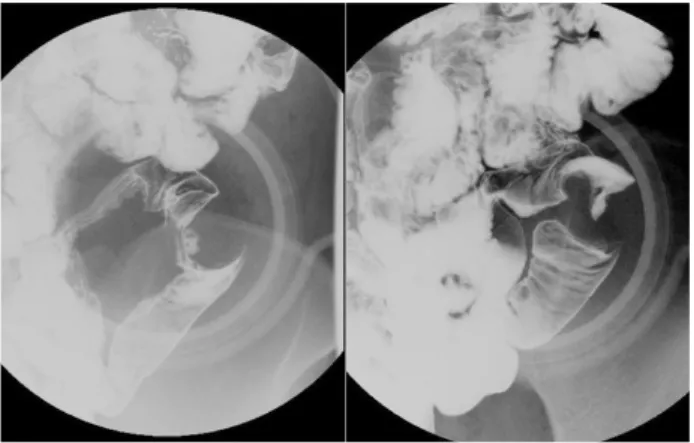
Barium contrast radiography of the small intestine revealed an approximately 2.5 cm submucosal mass
with a surface depression and good passage of bar-ium through this region (Fig. 5).
Laparoscopic, segmental small - intestine resection was performed about 1 month after admission. Dur-ing surgery, a 4 cm tumor was found about 150 cm proximal to the end of the ileum. In addition to the presacral lymph nodes observed on FDG-PET/CT, many of the mesenteric lymph nodes were enlarged. Some of these nodes were submitted for frozen sec-tion diagnosis, but no malignant lesions were found. Frozen section examination of the small intestinal tumor suggested malignant lymphoma. Based on these findings, some of the lymph nodes with FDG uptake were collected, and small intestinal re-section was performed.
The resected specimen contained a 3 cm tumor with a surface ulcer that corresponded to the depres-sion on Barium contrast radiography of the small intestine. On the cut surface, the tumor involved the muscular layer, but left the serosa intact (Fig. 6). Histopathological examination revealed a sub-mucosal, nodular lesion composed of short, spin-dle - shaped cells with clear cytoplasm. As many as 7-9 mitotic figures per high-power field (magnifica-tion
!
400) were seen, which suggested malignancy (Fig. 7b). Osteoclast - like, multinucleated giant cells were present among tumor cells (Fig. 7a). Since the origin of the tumor could not be identified by H - E staining alone, immunostaining was performed. AsFig. 2. FDG - PET maximum intensity projection (MIP) images showed a strong, mass- like uptake on the right side of the pelvic cavity and a nodular uptake anterior to the sacral bone. Low -level uptake in the right pelvic cavity corresponded to the ovary on CT.
aa bb cc
Fig. 3. (a) FDG - PET revealed abnormal uptake (SUVmax 10) in the right pelvic cavity. (b) Uptake corresponded on CT to a structure that consisted of soft tissue density areas mixed with low density areas, which suggested a small intestinal lesion. (c) FDG -PET/CT image resulting from (a) superimposed on (b).
aa bb cc
Fig. 4. (a) FDG - PET showed uptake (SUVmax 3.3) anterior to the sacral bone. (b) Uptake corresponded to soft- tissue density on CT. (c) FDG - PET/CT image resulting from (a) superimposed on (b).
a result, the tumor cells were positive for S - 100 protein (Fig. 8a). Reverse Transcriptase-Polymerase Chain Reaction (RT-PCR) was performed, suggest-ing a translocation resultsuggest-ing in EWS-ATF1 gene fu-sion (Fig. 8b).
These findings led to the diagnosis of CCS. No malignant features were observed in the surgically resected lymph nodes with increased FDG uptake, as detected by FDG - PET/CT.
FDG - PET/CT, performed 3 months after sur-gery, revealed no abnormal uptake suggestive of metastasis or recurrence (Fig. 9). The presacral lymph nodes, which had exhibited abnormal uptake before surgery, were reduced in size, and showed no detectable uptake, which suggested that the pre-operative uptake was due to inflammation (Fig. 10). After surgery, the ESR and CRP returned to normal. Currently, 2 years after surgery, the patient is free from recurrence and metastasis.
Fig. 6. The resected specimen contained a 3 cm tumor with a surface ulcer. On the cut surface, the tumor involved the mus-cular coat, but left the serosa intact.
Fig. 5. Small intestinal fluoroscopy revealed an 2.5 cm submu-cosal mass with a surface depression in the ileum.
aa
b b
Fig. 7. (a) Histopathological image of the tumor at low mag-nification (
!
100). Osteoclast- like, multinucleated giant cells were present among tumor cells. (b) At high magnification (!
400), a submucosal, nodular lesion composed of short, spindle - shaped cells with clear cytoplasm was observed.aa
b b
Fig. 8. (a) Histopathological immunostaining view at high mag-nification (
!
400). The tumor cells were positive for S - 100 pro-tein. (b) RT-PCR showed EWS - ATF1 fusion gene.DISCUSSION
The incidence of CCS of gastrointestinal tract ori-gin is much lower, in the small intestine, large in-testine and stomach, in decreasing order of fquency. The tumor grows transmurally, and is re-portedly often associated with ulceration and lymph node metastasis. Molecular detection of the EWS/ AFT1 fusion gene establishes the diagnosis (1 - 4). Comin, et al. (5) reported 16 patients who were di-agnosed with gastrointestinal CCS. Their mean age was 39 years, and the tumor was found frequently in women, mostly in the small intestine, had a mean diameter of 3 cm, and was frequently associated with ulceration and full-thickness invasion. In many patients, CCS starts with disturbed passage of stools and weight loss, but laboratory tests, including blood tests, reveal no abnormalities in some pa-tients. Local lymph node metastasis or mesenteric dissemination is observed in about half of the pa-tients at the time of diagnosis, and liver metasta-sis, peritoneal dissemination, pancreatic metastametasta-sis, or lung metastasis in most patients. The present CCS arose in the small intestine of a young woman, similar to previously reported cases, but the lesion was localized in the small intestine, with no metas-tasis, as demonstrated by biopsies of the enlarged lymph nodes. In this case, a planar gallium whole -body scan was negative at the first examination. Contrast CT of the chest, abdomen and pelvic re-gion performed after 1 year, but it was difficult to detect the small intestinal lesion. The patient did not have much fat in the abdominal cavity, therefore all the organs were in close proximity to each other, and the lesion was enhanced similarly to normal in-testine. To establish the reason for the increased inflammatory reaction, we performed FDG - PET/ CT, which revealed obvious abnormal uptake. Nei-ther FDG - PET/CT nor contrast CT contributed to the diagnosis, but FDG - PET/CT was useful for de-tecting the lesion. Hereafter, FDG - PET/CT might help to detect the small intestinal lesion such as gastrointestinal stromal tumors, carcinoid, or me-tastatic melanoma, which is difficult to distinguish from normal intestine as our case. Besides, FDG -PET/CT might be helpful in detecting postopera-tive recurrence of CCS of gastrointestinal origin. Our literature search revealed reports of the use-fulness of FDG - PET/CT in the detection of post-operative recurrence of CCS that developed in the soft tissue of bone (6), but no detection of CCS of gastrointestinal origin.
Fig. 9. FDG-PET MIP image obtained 3 months after sur-gery. No abnormal uptake suggestive of metastasis or recur-rence was observed.
aa
b b
Fig. 10. Axial view images of FDG PET/CT after 3 months after surgery.(a) Presacral lymph nodes, which had exhibited abnormal uptake before surgery, showed no detectable uptake. (b) Upon CT, the presacral lymph nodes were reduced in size.
In conclusion, we report a patient with small intes-tinal CCS that was detected by FDG-PET/CT. Gas-trointestinal CCS is a very rare, malignant tumor that is often advanced at the time of diagnosis. In this patient, FDG-PET/CT, performed during com-prehensive examination of a prolonged inflamma-tory reaction, clearly visualized the lesion, which was difficult to detect by other imaging techniques, and therefore had a marked clinical impact.
*Supplementary explanation of standardized uptake value (SUV).
SUV=tissue concentlation (KBq/ml)/injected FDG dose (KBq)/body weight (g)
A popular usage of SUVs is their capability in helping to distinguish between benign and malig-nant lesions. For example, a study might find an SUV of 2.5 as appropriate for separating certain be-nign and malignant lesions. Caution, however, must be exercised using such a cutoff outside of the in-stitution and the application for which it was deter-mined (7).
REFERENCES
1. Antonescu CR, Nafa K, Segal NH, Cin PD, Ladanyi M : EWS-CREB1 : A recurrent variant
fusion in clear cell sarcoma association with gastrointestinal location and absence of melanocytic differentiation. Clin Can Res 12 : 5356 -5362, 2006
2. Huang W, Zhang X, Li D, Chen J, Meng K, Wang Y, Lu Z, Zhou X : Osteoclast-rich tumor of the gastrointestinal tract with features resem-bling those of clear cell sarcoma of soft parts. Virchows Arch 448 : 200-203, 2006
3. Dow N, Giblen G, Sobin LH, Miettinen M : Gastrointestinal stromal tumors : Differential di-agnosis. Semin Diagn Pathol 23 : 111-119, 2006 4. Zambrano E, Mugica MR, Franchi A, Rosai J : An osteoclast - rich tumor of the gastrointesti-nal tract with features resembling clear cell sar-coma of sofr parts : reports of 6 cases of a GIST simulator. Int J Surg Pathol 11 : 75-81, 2003 5. Comin CE, Novelli L, Tornaboni D, Messerini
L : Clear cell sarcoma of the ileum ; report of a case and review of literature. Virchows Arch 451 : 839-845, 2007
6. Ngunyen BD, Roarke MC, Ram PC : PET moni-toring of clear cell sarcoma of tendons and ap-oneuroses. Clin Nuc Med 32 : 415-417, 2007 7. Thie JA : Understanding the Standardized
Up-take Value, Its Methods, and Implications for Usage. J Nucl Med 45 : 1431-1434, 2004