Endocrine Journal 1996, 43(6), 715-718
NOTE
A Case
Report
of an Elderly
Patient
with Acromegaly
MIcHIKO WADA, HIROYuKI AZUMA, HIROsHI BANDO, YASuMI SHINTANI, SHIRR SAITO, MASAHARU TAMAKI*, AND HIROKO ARII
First Department of Internal Medicine, School of Medicine, The University of Tokushima, Tokushima 770, and *Tamaki Hospital , Tokushima 779-31, Japan
Abstract. We encountered a 91-year-old patient with acromegalic features. The serum levels of growth hormone (GH) and insulin-like growth factor-I (IGF-I) were increased to 23.3 ng/ml and to 268 ng/ml, respectively. Both thyrotropin-releasing hormone and luteinizing hormone-releasing hormone tests demonstrated a 2-3 fold increase in the serum GH level. Magnetic resonance imaging disclosed a pituitary mass in the enlarged sella. The patient was diagnosed as having acromegaly due to overproduction of GH from a pituitary tumor. She manifested cardiac hypertrophy with severe aortic stenosis and mild hypertension, but without diabetes mellitus. After the administration of octreotide subcutaneously at a dose of 25 to 50 jig daily for 20 days, the serum GH level increased transiently but decreased rapidly to approximately half the initial level, and suppression of the GH level persisted thereafter for over 2.5 months. This patient seems to be the oldest patient with acromegaly among those reported in Japan.
Key words: Acromegaly, Advanced age, Octreotide
(Endocrine Journal 43: 715-718,1996)
ACROMEGALY is characterized by hypersecre-tion of growth hormone (GH) and a slowly progressive clinical course. GH excess causes or-ganomegaly and excessive growth of soft tissues. The earliest clinical manifestation is changes in the facial features and extremities. We encountered a 91-year-old woman with acromegalic facial features and a high serum GH level. She had hypertension and cardiac hypertrophy with aortic stenosis, in contrast to the known characteristics in which ac-romegalic patients have a shortened life span mainly due to death as a result of cerebrovascular disease, heart disease and malignancy [1-5]. We describe here in this case of acromegaly in an eld-erly patient and discuss her long clinical course.
Received: March 13, 1996 Accepted: June 10, 1996
Correspondence to: Dr. Michiko WADA, First Department of Internal Medicine, School of Medicine, The University of Tokushima, Kuramo-cho 3, Tokushima 770, Japan
Case Report
A 91-year-old woman visited our hospital be-cause of fever, cough and sputum in April, 1995. She was admitted for treatment of acute bronchitis and congestive heart failure. She had undergone an operation for uterine myoma at the age of 55 years. At the age of 62, she had been diagnosed with uterine carcinoma and had received radia-tion therapy.
On this admission, her height and body weight were 142 cm and 50 kg, respectively. Her body temperature was 37.9 °C, and pulse rate 98/min with regular rhythm. Her blood pressure was 154/ 94 mmHg. She had a typically acromegalic face with a big nose, thick lips and soft tissue thicken-ing. Piping rales were audible in both lungs. A systolic murmur was audible in the aortic area and along the left sternal border. Her abdominal find-ings were normal.
716 WADA et a!.
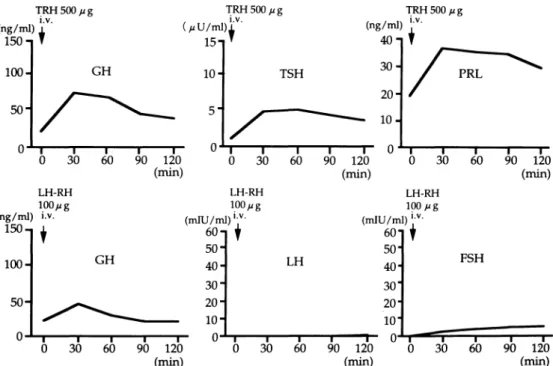
sedimentation rate was 50 mm/h and the C reac-tive protein concentration was 6.1 mg/dl. Fasting plasma glucose was 107 mg/dl and hemoglobin Aic was 5.5%. Endocrinological examination dis-closed that serum GH and insulin-like growth factor-I (IGF-I) levels were elevated, to 23.3 ng/ml and to 268 ng/ml, respectively. Serum prolactin was 22.7 ng/ml. The serum LH and FSH were very low, being less than 0.5 mIU/ml and 0.5 mIU/ ml, respectively (Table 1). Serum GH was increased in response to the TRH (500 ,ug, i.v.) and the LH RH (100 µg, i.v.) tests. The serum LH and FSH did not respond to LH-RH (Fig. 1).
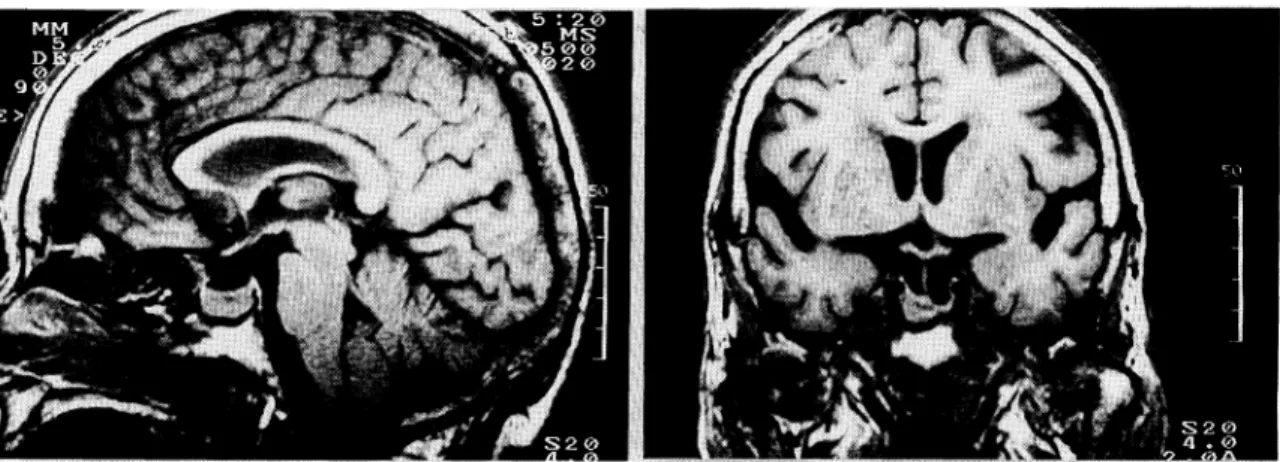
Magnetic resonance imaging (MRI) revealed a pituitary mass in the sella turcica which enlarged and extended ventrally (Fig. 2). Radiographs of both hands and feet disclosed bony tufting at the ends of the terminal phalanges. Heel pad thick-ness was increased to 26 mm. Chest X-ray disclosed cardiomegaly and pulmonary congestion. From these results, a diagnosis of acromegaly due to a GH-secreting pituitary adenoma was made.
On the echocardiogram the aortic valves were seen to be extremely thickened and their openings were constricted, based on which aortic stenosis was diagnosed. The left ventricular wall was
mas-sively thickened to 21 mm with concentric
hyper-trophy, and the left ventricular cavity was small.
She was given an antibiotic and diuretic and
digi-talis treatment,
resulting in improvement
in the
acute bronchitis and heart failure.
Since she had severe aortic stenosis and marked
left ventricular hypertrophy, we selected octreotide
as the pharmacologic
therapy,
rather than
bro-mocriptine. A single 50 jig subcutaneous injection
(s.c.) of octreotide was followed by a decrease in
serum GH (Fig. 3). Octreotide was then started at
a dose of 25 ,ug s.c. once each day. After receiving
octreotide
injections for 20 days, she was
dis-charged
from our hospital
due to personal
circumstances
in August, 1995. Serum GH and
IGF-I remained at approximately half of the initial
Table 1. Serum hormone levels on admission
Fig. 1. Results of TRH test (upper panel) and LH-RH test (lower panel). The serum GH level was increased in response to TRH and LH-RH.
ELDERLY PATIENT WITH ACROMEGALY 717
levels after discontinuing the octreotide therapy (Fig. 4). At present, we are observing her course without medication.
Discussion
A follow-up study of Japanese patients (n=979)
with acromegaly
that we performed
in 1991
re-vealed that the mean age at the diagnosis
of
acromegaly was 44.5 years and that at death was
59.0 years [5]. Other papers [1-4] reported ages
similar to those we found. The oldest acromegalic
patient in Japan was reported to be 83 years old
(unpublished data), although it is unknown
wheth-er this patient
is still alive or not.
Among
Caucasians, the oldest patient with acromegaly was
less than 85 years old at the time of death [2, 4] and no patient over 90 years of age has been re-ported until now [1-5]. The estimated mean duration until the diagnosis of acromegaly was found to range from approximately 7 to 10 years [1-5]. In this patient, the acromegaly might have started at the end of the patient's 8th decade or the beginning of the 9th, because her foot size had increased 1.5 cm in 10 years. In any event, she seems to be the oldest reported patient with ac-romegaly.
The main complications of acromegaly are dia-betes and hypertension [1-5]. It has not been clarified whether these complications increase the death hazard of patients with acromegaly [1, 2, 4], but the mortality in acromegaly is higher than that of the general population [1-4]. Furthermore, the Fig. 2. Sagittal (left) and coronal (right) T1-weighted MR scans of the head.
enlarged sella turcica.
A pituitary mass is seen in the
Fig. 3. Serum GH level changes in response to octreotide. The level of serum GH was decreased after subcutaneous injection of 50 , zg of octreotide.
Fig. 4. Clinical course of the patient. The serum levels of GH and IGF-I were decreased after the administration of octreotide.
718 WADA et al.
major causes of death in acromegalic patients are
cerebrovascular
and heart diseases [1-5], and this
patient presented with severe aortic stenosis and
cardiac hypertrophy.
She might have remained
living for such a long time because of the late
on-set of her disease, the relatively slow growth of
the tumor, and the small amount of GH produced,
as well as the mild degree of hypertension
uncom-plicated
by diabetes
mellitus.
The slightly
increased GH level may be beneficial for elderly
patients in terms of activity in daily life, although
the amount of her daily exertion has been
gradual-ly reduced since she fractured a femur at the age
of 84.
Surgical resection of the tumor should be
cho-sen first when possible, but some patients need to
receive only medication. We chose octreotide
ther-apy in consideration
of her age and cardiac
hypertrophy.
Patients with acromegaly are
gener-ally treated with a injection of 100-200 µg octreotide
two or three times daily for at least 4 weeks.
Oct-reotide can lower the level of GH to less than 10
ng/ml and that of IGF-I to the normal range in
approximately
half of acromegalic patients, being
more effective than bromocriptine [6, 7]. In this case, the total dosage of octreotide was small, be-cause the treatment was started at 25 ,ug octreotide once daily and administration lasted only for 20 days. Nevertheless, the treatment was effective in decreasing serum GH and IGF-I, suggesting that the tumor was sensitive to octreotide and might decline into partial necrosis. Unfortunately, we were not able to evaluate the change of the pitu-itary tumor by MRI after the treatment with octreotide. We previously reported two types of GH-secreting pituitary adenomas with different pathological findings and clinical courses [8, 9]. Her pituitary tumor may be a type 2 pituitary ade-noma, in view of the slow clinical course and the satisfactory suppression of serum GH by octreotide, although we have had no opportunity to examine the pituitary tumor. In addition, the gonadotro-phs seem to be suppressed by the GH-secreting adenoma, resulting in the low levels of serum LH and FSH. Since no side effect of octreotide was noticed during the treatment, we consider oct-reotide to be safe and effective even in elderly acromegalic patients.
References
1. Alexander L, Appleton D, Hall R, Ross WM, Wilkinson R (1980) Epidemiology of acromegaly in
the Newcastle region. Clin Endocrinol 12: 71-79.
0 2. Bengtsson B-A, Eden S, Ernest I, Oden A, Sjogren B
(1988) Epidemiology and long-term survival in romegaly. A study of 166 cases diagnosed between
1955 and 1984. Acta Med Scand 223: 327-335. 3. Etxabe J, Gaztambide S, Latorre P, Vazquez JA
(1993) Acromegaly: An epidemiological study. J Endocrinol Invest 16:181-187.
4. Bates AS, Van't Hoff W, Jones JM, Clayton RN (1993) An audit of outcome of treatment in acromegay. Q J Med 86: 293-299.
5. Saito S, Yokogoshi Y, Shimizu N (1991) Report of investigation on long-term survival in pituitary diseases. Folia Endocrinol Japon 67: 263-276
(In Japanese).
6. Jackson IMD, Barnard LB, Lamberton P (1986) Role of a long-acting somatostatin analogue (SMS
995) in the treatment of acromegaly. Am J Med 81: 94-99.
7. Melmed S (1990) Acromegaly. N Engl J Med 322: 966-977.
8. Sano T, Ohshima T, Yamada S (1991) Expression of glycoprotein hormones and intracytoplasmic
tribution of cytokeratin in growth producing pituitary adenomas. Pathol Res Pract 187:
530-533.
9. Bando H, Sano T, Ohshima T, Zhang C-Y, Yamasaki R, Matsumoto K, Saito S (1992) Differences in
logical findings and growth hormone responses in patients with growth hormone-producing pituitary