INTRODUCTION
The ABO blood group system was discovered by Austrian scientist, Karl Landsteiner, who found three different blood types (A, B and O) in 1900 from serological differences in blood called the Land-steiner Law (1). In 1902, DesCasterllo and Sturli dis-covered the fourth type, AB (2). The ABO blood group is most important among the 29 blood group systems (Table 1), and consists of four antigens (A, B, O and AB) (3, 4). In 1924, Felix Bernstein pre-dicted by extensive family studies that the mecha-nism of inheritance involved in three alleles at the ABO locus (5). Furthermore, the structure and bio-chemical characteristics of the ABO antigens were elucidated by many investigators.
The genes of ABO blood group has been deter-mined at chromosome locus 9 (6-9), and Yamamoto,
et al. cloned and determined the structures. It has
made it possible to analyze genetically ABO blood group antigens using molecular biology techniques (7, 10 - 18).
SEROLOGY OF ABO BLOOD GROUP
SYS-TEM
The ABO blood group is determined by the pres-ence of A and B antigens on the surface of the red blood cells, and of anti - A or anti - B antibodies in the serum. Thus, the red blood cells of blood type A possess antigen A and the serum containing anti - B antibody. Similarly, blood type B has antigen B and anti - A antibody. Blood type AB contains both A and B antigens but no antibodies. Blood type O has no antigens but contains both anti - A and anti - B antibodies. Anti - A and anti - B antibodies are usu-ally IgM type, and not present in newborns, but
REVIEW
Biological and clinical aspects of ABO blood group
system
Eiji Hosoi
Department of Cells and Immunity Analytics, Institute of Health Biosciences, the University of Tokushima Graduate School, Tokushima, Japan
Abstract : The ABO blood group was discovered in 1900 by Austrian scientist, Karl Land-steiner. At present, the International Society of Blood Transfusion (ISBT) approves as 29 human blood group systems. The ABO blood group system consists of four antigens (A, B, O and AB). These antigens are known as oligosaccharide antigens, and widely ex-pressed on the membranes of red cell and tissue cells as well as, in the saliva and body fluid.
The ABO blood group antigens are one of the most important issues in transfusion medicine to evaluate the adaptability of donor blood cells with bone marrow transplan-tations, and lifespan of the hemocytes.
This article reviews the serology, biochemistry and genetic characteristics, and clini-cal application of ABO antigens. J. Med. Invest. 55 : 174-182, August, 2008
Keywords : ABO blood group, glycosyltransferase, ABO allele, cisAB allele, PASA : PCR amplification of spe-cific alleles
Received for publication June 16, 2008 ; accepted July 23, 2008. Address correspondence and reprint requests to Eiji Hosoi, Ph.D., Department of Cells and Immunity Analytics, Institute of Health Biosciences, the University of Tokushima Graduate School, Kuramoto - cho, Tokushima 770 - 8509, Japan and Fax : +81 - 88 - 633 - 9070.
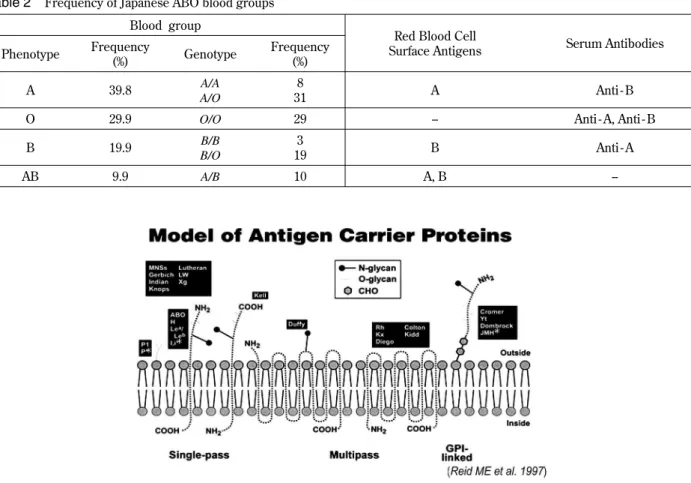
appear in the first year of life. It is possible that the antibodies are produced against food and environ-mental antigens (bacterial, viral or plant antigens) (19, 20), which are similar in structure to A and B antigens. This is summarized in Table 2 (21).
BIOCHEMISTRY
1) ABO blood groupA) Model of antigen carrier proteins
Blood group antigens are surface markers on the
red cell, and consist of proteins and carbohydrates attached to lipids or proteins. A model of the mem-brane components carrying blood group antigens is shown in Figure 1 (22).
B) The structure and biosynthesis of ABO antigens ABO antigens are one of the oligosaccharides an-tigens (23). These anan-tigens are widely expressed on the membranes of red cell and tissue cell as well as, in the saliva and body fluid (24).
As shown in Figure 2, the first step in the biosynthesis of ABO antigens is the addition of a L -fucose in α1"2 linkage on terminal galactose (Gal) Table 1 ISBT Human Blood Group Systems
ISBT No. System name ISBT symbol Locus ISBT No. System name ISBT symbol Locus ISBT No. System name ISBT symbol Locus
001 ABO ABO 9 011 Yt YT 7 021 Cromer CROM 1
002 MNS MNS 4 012 Xg XG X 022 Knops KN 1
003 P P1 22 013 Scianna SC 1 023 Indian IN 11
004 Rh RH 1 014 Dombrock DO 12 024 Ok OK 19
005 Lutheran LU 19 015 Colton CO 7 025 Raph RAPH 11
006 Kell KEL 7 016 Landsteiner
-Wiener LW 19 026
John Milton
Hagen JMH 15
007 Lewis LE 19 017 Chido/Rodgers CH/RG 6 027 I I 6
008 Duffy FY 1 018 H H 19 028 Globoside GLOB 3
009 Kidd JK 18 019 Kx XK X 029 Gill GIL 9
010 Diego DI 17 020 Gerbich GE 2
Figure 1. Model of RBC membrane components that carry blood group antigens.
!: Blood group collections or high indence antigen. The Ch/Rg and Sciamma blood group system are not shown in this figure.
Table 2 Frequency of Japanese ABO blood groups Blood group
Red Blood Cell
Surface Antigens Serum Antibodies Phenotype Frequency (%) Genotype Frequency (%) A 39.8 A/A A/O 8 31 A Anti - B
O 29.9 O/O 29 -- Anti - A, Anti - B
B 19.9 B/B
B/O
3
19 B Anti - A
--of a common precursor attached to lipids or pro-teins by α1,2 - fucosyltransferase (H transferase), resulting in the H antigen. Six different types of the common precursor structure are known (25) ; Type 1 (Galβ1!3GlcNAcβ-R) and Type 2 (Galβ1!
4GlcNAcβ-R) sequences are the main structures. Type 1 is substance in secretions and tissues, and Type 2 is an antigen on the surface of the red blood cells. A, B and O (H) antigenic structures on the surface of red cells are defined as carbohydrate determinants, GalNAcα1!(Fucα1!2)3Galβ1!4 GlcNAcβ-R, Galα1!(Fucα1!2)3Galβ1! 4GlcNAcβ-R, and (Fucα1!2)Galβ1!4GlcNAcβ-R, respec-tively, which are synthesized from the H antigen structure by the action of specific glycosyltrans-ferase products of ABO genes. The A and B alleles encode glycosyltransferase (α1,3 -N- acetylgalacto-saminyltransferase (A transferase) and α1,3 - ga-lactosyltransferase (B transferase)), which catalyze the addition of specific sugars, N - acetylgalacto-samine (GalNAc) and galactose (Gal) residue, re-spectively, in a α1!3 linkage on terminal Gal of H antigen (6, 26 - 28). Since O allele encodes proteins without glycosyltransferase (O transferase) func-tion, H antigen is the only ABO structure present in blood type O (29).
C) Structure of the ABO gene locus
Human ABO genes are located in chromosome 9q34.1 - q34.2(6 - 9) and consists of 7 exons distrib-uted over 18 kb of genomic DNA. Exon 7 contains most of the largest coding sequence. Exon 6 con-tains the deletion found in most O alleles. The ex-ons range in size from 28 to 691 bp (29).
The ABO locus has three main allele forms, A, B, and O. A and B alleles have seven nucleotide substitutions (297A!G, 526C!G, 657C!T, 703G!
A, 796C!A, 803G!C and 930G!A). Four nucleo-tide substitutions (526C!G, 703G!A, 796C!A and 803G!C) are translated into different amino acid substitutions (Arg526Gly, Gly703Ser, Leu796Met and Gly803Ala). These substitutions determine the specificities of glycosyltransferases. The A allele encodes A transferase catalyzing the addition of GalNAc residue, and the B allele encodes B trans-ferase catalyzing the addition of Gal residue, re-spectively, in a α1!3 linkage on terminal Gal of the H antigen. On the other hand, the O allele dif-fers from the A allele by a single nucleotide dele-tion of guanine (G) at posidele-tion 261. This deledele-tion causes a frame - shift and results in a loss of trans-ferases activity (Figure 3) (29 - 31).
2) Subgroups
A) Subgroups of A and B
An ABO blood group subtype is called a sub-group and/or variant. Subsub-groups of ABO are dis-tinguished by decreased amounts of A, B or O (H) antigens on red blood cells. The most common are subgroups of A and B.
Blood type A appears to have the most variation in subgroups. Blood type A with a normal quantity of antigen is called A1, and is distinguished from
subgroups. Subgroups are classified by the quan-tity of A antigen, and the amount of A antigen de-creases in the order A1, A2, A3, Ax, Aend, Am, Ael. In
Europeans, approximately 80% of blood type A and AB belong to A1, the remaining 20% are either A2
or A2B (in Japanese it is approximately 0.2%) (32,
33).
In general, serologic distinction between A1and
A2 is based on the agglutination of A1 red blood
cells but not A2cells with anti - A1lectin (extract of
Dolichos biflorus seeds) (34). Recently, the se-quence of A2allele coding blood type A2 has been
molecular genetically analyzed, and shown to have a single base deletion near the carboxyl terminal. The deletion causes a frame - shift and results in a loss of A2 transferase activity. This deletion of A2
allele made it possible to analyze genetically blood
type A2 (35). Similarly, subtypes of blood type B
are classified by the quantity of B antigen, and the amount of B antigen decreases in the order B, B3,
Bx, Bm, Bel. The expression of A or B antigens is
summarized in Table 3 (36, 37).
B) Subgroups of AB
Blood type AB is classified into nine subtypes (AxB, A1Bx, AmB, A1Bm, AelB, A1Bel, cisA2B3, cisA2B,
cisA1B3) by the quantity of A or B antigen. In
par-ticular, cisAB is a very rare phenotype and has three blood types, cisA2B3(A2B3/O ), cisA2B (A2B3/
B ), cisA1B3(A2B3/A1). Detecting this AB variant is
Figure 3. Structure of the ABO gene locus and nucleotide sequences of A, B and O alleles.
Diagram of exon organization of the protein coding sequences (upper shaded).!; Entirely different deduced amino acid sequence in O alleles due to frame - shifting caused by a single base deletion (lower).
Table 3 Expression of ABO antigens per red blood cell surface Blood group type Expression
A1 A1 A2 A2 A1B A1B A2B A3 Ax Aend Am Ael adult newborn adult newborn adult newborn adult 810,000 250,000 240,000 140,000 460,000 240,000 120,000 7,000 1,400 1,100 200 100 " " " " " " " " " " 1,170,000 370,000 290,000 850,000 290,000 100,000 10,000 4,400 1,900 1,400 B B A1B adult newborn adult 610,000 200,000 310,000 " " " 830,000 320,000 560,000
very important, especially in blood transfusion and in dissolving a problem of paternity in the ABO blood group system.
In 1964, Seyfried, et al. reported a family con-sisting of a woman with AB, her husband with blood type O, and daughter with blood type AB. They described the strange inheritance of blood type A and B and suggested that these specificities might be coded by genes located on the same chro-mosome (38).
In 1966, Yamaguchi, et al. reported a family which consisted of three children with blood group A2B3
born to a father (blood type O) and mother (blood group A2B3). This family lived in Tokushima
Pre-fecture in Japan. This finding showed that the A and B genes were located on the same chromo-some. They proposed the name ‘‘CisAB’’ to dis-tinguish it from ordinary AB, namely ‘‘Trans AB’’ (39). It has been reported that the frequency of this phenotype is apparently higher in Tokushima, Ishikawa and Kagawa Prefectures than in other prefectures in Japan. For example, the frequency of the cisAB phenotype in Tokushima Prefecture (0.017% - 0.02%) is about 11 times as high as that in
Osaka Prefecture (0.0014% - 0.0017%)(40, 41). Fur-thermore, it is interesting that some cisAB fami-lies in other prefectures had actually moved from Tokushima over the last several generations. These findings suggest that families with the cisAB blood phenotype might have common ancestors.
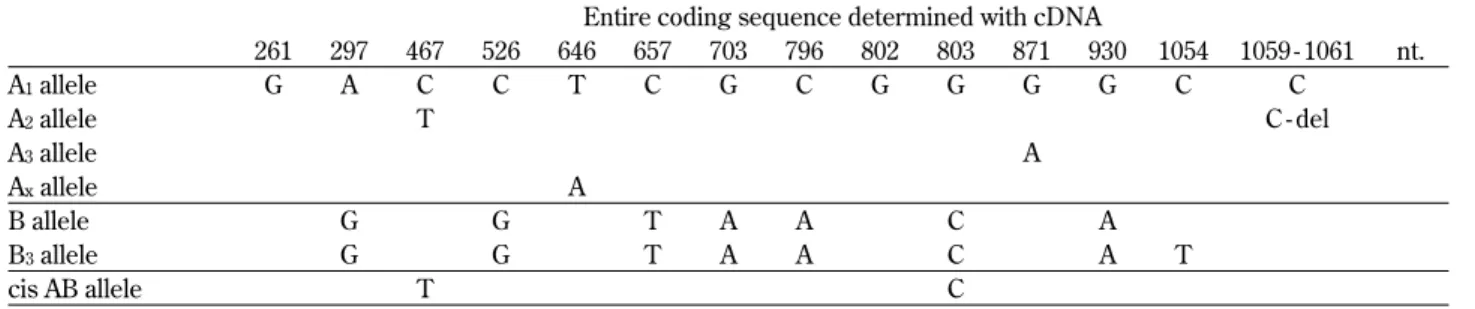
Recently, the nucleotide sequence of the coding region in the last two coding exons of ABO genes from cisAB individuals was determined. CisAB (A2
B3) alleles were identical to one another while
dif-ferent from the A1 allele by two nucleotide
tutions (Figure 4). Both of these nucleotide substi-tutions result in amino acid substisubsti-tutions (42). The first substitution is identical to that previously found in the A2allele, corresponding to the cisAB (A2B3)
allele encoding a glycosyltransferase that is capable of synthesizing both A and B antigens (17, 18, 35).
Therefore, the phenotype of the ABO blood group system, such as subgroups of A, B and AB, have been realized by changes in the cDNA se-quence, for example, base substitution or deletion. Comparison of the nucleotide sequences of alleles in A, B and AB subgroups is summarized in the Table 4 (43 - 45).
Figure 4. Structure of the ABO gene locus and nucleotide sequences of A, B and cisAB alleles. Diagram of exon organization of the protein coding sequences (upper shaded).
Table 4 Comparison of the nucleotide sequences of alleles in A, B and AB subgroups
Entire coding sequence determined with cDNA
261 297 467 526 646 657 703 796 802 803 871 930 1054 1059 - 1061 nt. A1allele G A C C T C G C G G G G C C A2allele T C - del A3allele A Axallele A B allele G G T A A C A B3allele G G T A A C A T cis AB allele T C
GENETIC ANALYSES OF ABO BLOOD
GROUPS AND THEIR APPLICATIONS
FOR CLINICAL STUDIES
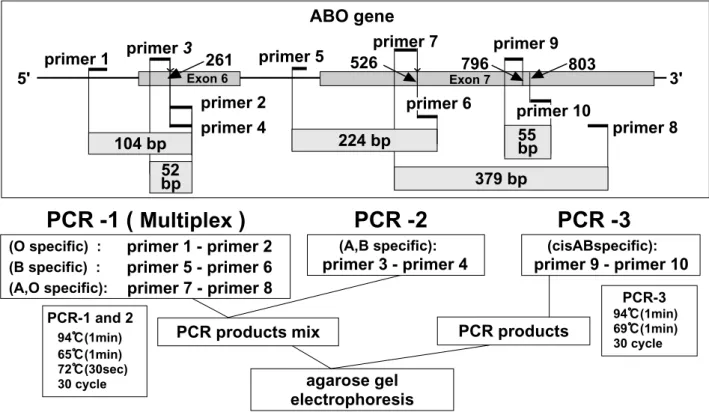
Gene technology using PCR has markedly ad-vanced in recent years and has been introduced into clinical laboratories. Accordingly, genotypes of the ABO blood group have been analyzed using polymerase chain reaction - restriction fragment length polymorphism (PCR - RFLP), PCR - direct sequencing, PCR - single strand conformation poly-morphism (PCR - SSCP), and PCR - amplification of specific alleles (PASA). PCR - RFLP, PCR - direct se-quencing and PCR - SSCP methods require 2 - step procedures, and then not ease to be used in clini-cal laboratories. The PASA method is based on the fact that PCR amplification occurs only when the 3’ endbase of the primer is matched to the nucleo-tide of No. 261, 526, 796 or 803 (the sites of amino acid substitutions) of ABO allelic cDNA, and three of five regions of allelic DNAs were co - amplified in single PCR (multiplex PCR) in our study (8, 12 -16). ABO and cisAB blood group genotypes were
directly determined, based on the molecular size of allele - specific amplification products. The PASA method requires only about 4 hours from the start of PCR to the end of analysis. Therefore, PASA method is rapid, simple and useful for detecting the genotype of ABO and cisAB blood groups in com-parison with PCR - RFLP, PCR - direct sequencing and PCR - SSCP methods and used widely through-out the research and clinical laboratories.
The scheme of the method of amplification and the analysis of specific ABO and cisAB alleles us-ing the PASA method are shown in Figure 5 (14).
1) ABO genotyping
As shown in Figure 6 (13), all genes of the six major ABO genotypes, A/O , A/A, B/O , B/B , O/O
and A/B were amplified ; three specific bands (379,
104 and 52bp) for A/O , two specific bands (379 and 52bp) for A/A, four specific bands (379, 224, 104 and 52 bp) for B/O , two specific bands (224 and 52bp) for B/B , two specific bands (379 and 104 bp) for O/O and three specific bands (379, 224 and 52bp) for A/B .
Figure 5. Scheme of method of amplification and analysis of specific ABO alleles using the PASA method.
3’ endbase of primer 2, 3 and 4, 6, 7, 9 and 10 corresponded to the nucleotide sequences of O, A and B, B, A and O, and cisAB alleles, respectively. Primer 1, 5 and 8 corresponded to nucleotide sequences of the ABO allele. Allele - specific DNA fragments of O allele (104 bp), A and B allele (52 bp), B allele (224 bp), A and O allele (379 bp), and cisAB (55bp) were amplified by PCR with 5 pairs of primers (primer 1 and 2, primer 3 and 4, primer 5 and 6, primer 7 and 8, and primer 9 and 10), respectively. Three (104bp, 224bp and 379bp) of five fragments were co-amplified in a single PCR - 1 (multiplex - PCR).
2) cisAB genotyping
As shown in Figure 7 (13, 14), all genes of the three major cisAB genotypes, A2B3/O , A2B3/A1 and
A2B3/B were amplified ; four specific bands (379,
104, 52 and 55 bp) for A2B3/O , three specific bands
(379, 52 and 55 bp) for A2B3/A1 and four specific
bands (379, 224, 52 and 55 bp) for A2B3/B .
Table 5 summarizes all possible specific band pat-terns of the ABO genotype obtained with the PASA method. ABO and cisAB blood group genotypes were directly determined, based on the molecular size of allele - specific amplification products. The analysis of nucleotide sequence in three major subjects in the cisAB blood group revealed chimeric structures of the A allele and B allele on the same gene.
Table 5 Partterns of PASA method for all possible ABO genotypes
bp (Allele specific band) A/O A/A B/O B/B O/O A/B
cisAB
A2B3/O A2B3/A1 A2B3/B
(a) 379 (A,O specific) + + + -- + + + + +
(b) 224 (B specific) -- -- + + -- + -- -- +
(c) 104 (O specific) + -- + -- + -- + --
--(d) 52 (A,B specific) + + + + -- + + + +
(e) 55 (cisAB specific) -- -- -- -- -- -- + + +
+, Presence of the expected specific ABO gene type fragment. --, Absence of the expected specific ABO gene type fragment. (a), Specific band A and O alleles by using primers (7 and 8). (b), Specific band B allele by using primers (5 and 6). (c), Specific band of O allele by using primers (1 and 2). (d), Specific band of A and B alleles by using primers (3 and 4). (e), Specific band of cisAB allele by using primers (9 and 10).
Figure 6. Electrophoretic patterns of PCR products in the six major ABO geno-types. Genomic DNA extracted from leukocytes was amplified by the PASA method using 4 primer sets (primer 1 and 2, primer 3 and 4, primer 5 and 6, and primer 7 and 8). M, Hae III digest of Plas-mid pBR322 (marker).
Figure 7. Electrophoretic patterns of PCR products in the three major cisAB genotypes. Genomic DNA extracted from leukocytes was amplified by PASA method using 5 primer sets (primer 1 and 2, primer 3 and 4, primer 5 and 6, primer 7 and 8, and primer 9 and 10). M, Hae III digest of Plasmid pBR322 (marker) ; upper panel : ABO allele specific ; Lower panel : cisAB allele specific.
REFERENCES
1. Landsteiner K : Zur Kenntnis der antifermen-tativen, lytischen und agglutinierenden Wirkun-gen des Blutserums und der Lymphe. Zen-tralbl Bakteriol 27 : 357 - 362, 1900
2. von Decastello A, Sturli A : ”Ueber die Isoag-glutinine im Serum gesunder und kranker Menschen”. Mfinch med Wschr 49 : 1090 -1095, 1902
3. Lewis M, Anstee DJ, Bird GWG, Brodheim E, Cartron JP, Contreras M, Crookston MC, Dahr W, Daniels GL, Engelfriet CP, Giles CM, Issitt PD, J!rgensen J, Kornstad L, Lubenko A, Marsh WL, McCreary J, Moore BPL, Morel P, Moulds JJ, Nevanlinna H, Nordhagen R, Okubo Y, Rosenfield RE, Rouger Ph, Rubinstein P, Salmon Ch, Seidl S, Sistonen P, Tippett P, Warker RH, Woodfield G, Young S : Blood group terminology 1990. The ISBT Working Party on Terminology for Red Cell Surface Antigens. Vox Sang 58(2) : 152 - 69, 1990 4. Daniels GL, Fletcher A, Garratty G, Henry S,
J!rgensen J, Judd WJ, Levene C, Lomas -Francis C, Moulds JJ, Moulds JM, Moulds M, Overbeeke M, Reid ME, Rouger P, Scott M, Sistonen P, Smart E, Tani Y, Wendel S, Zelinski T : International Society of Blood Transfusion. Blood group terminology 2004 : from the International Society of Blood Trans-fusion committee on terminology for red cell surface antigens. Vox Sang 87 : 304 - 316, 2004 5. Bernstein F : Ergebnisse einer biostatistischen
zusammenfassenden Betrachtung, ber die er-blichen Blutstrukturen des Menschen. Klin Wochenschr 3 : 1495 - 1497, 1924
6. Watkins WM : Biochemistry and genetics of the ABO, Lewis, and P blood group systems, In : Advances in Human Genetics (Harris H & Hirschhorn K eds.). Plenum Press, New York, 1980, pp.136 - 136
7. Larsen RD, Ernst LK, Nair RP, Lowe JB : Mo-lecular cloning, sequence, and expression of a human GDP L fucose : βDgalactoside 2 -alpha - L - fucosyltransferase cDNA that can form the H blood group antigen. Proc Natl Acad Sci USA : 87(17) : 6674 - 6678, 1990
8. Yamamoto F, Hakomori S : Sugar - nucleotide donor specificity of histo - blood group A and B transferases is based on amino acid substitu-tion. J Biol Chem 265 (31) : 19257 - 19262, 1990 9. Bennett EP, Steffensen R, Clausen H, weghuis
DO, Geurts van kessel A : Genomic cloning of the human histo - blood group and locus. Bio-chem Biophys Res Commun 206 (1) : 318 - 325, 1995
10. Ferguson - Smith MA, Aitken DA , Grouchy J : Localization of the human ABO : Np - 1 link-age group by relational assignment of AK - 1 to 9q34. Hum Genet 34 (1) : 35 - 43, 1976
11. Yamamoto F, Clausen H, White T, Marken J, Hakomori S : Molecular genetic basis of the histo - blood group ABO system, Nature 345 : 229-233, 1990
12. Hosoi E, Yoshimoto K : Genetic analysis of the genotype of ABO and cisAB blood group. Jpn J Clin Pathol 41 (10) : 1133 - 1140, 1993
13. Hosoi E : Direct determination of ABO and cisAB blood group genotypes using polymerase chain reaction amplification of specific alleles (PASA) - method. Jpn J Clin Pathol 44 (8) : 783 - 790, 1996
14. Hosoi E : Genetic analyses of the ABO blood groups and application of the clinical laborato-ries. Jpn J Clin Pathol 45(2) : 148 - 156, 1997 15. Hosoi E, Hirose M, Hamano S, Kuroda Y :
De-tection of histo - blood group ABO mRNA in human chronic myeloid leukemia cell lines us-ing reverse transcription - polymerase chain reaction (RT PCR). Cancer Lett 133(2) : 191 -196, 1998
16. Yamamoto F, Hakomori S : Sugar - nucleotide donor specificity of histo - blood group A and B transferases is based on amino acid substi-tution. J Biol Chem 265 (31) : 19257 - 19262, 1990
17. Ogasawara K, Yabe R, Uchikawa M, Saitou N, Bannai M, Nakata K, Takenaka M, Fujisawa K, Ishikawa Y, Juji T, Tokunaga K : Molecular genetic analysis of variant phenotypes of the ABO blood group system. Blood 88 (7) : 2732 -2737, 1996
18. Ogasawara K, Yabe R, Uchikawa M, Bannai M, Nakata K, Takenaka M, Takahashi Y, Juji T, Tokunaga K : Different alleles cause an im-balance in A2 and A2B phenotypes of the ABO blood group.Vox Sang 74(4) : 242 - 247, 1998 19. Andersson M, Carlin N, Leontein K, Lindquist
U, Slettengren K : Structural studies of the O -antigenic polysaccharide of Escherichia coli O86, which possesses blood - group B activity. Carbohydr Res 185 : 211 - 223, 1989
20. Aspinall, G. O., Monteiro, M. A : Lipopolysac-charides of Helicobacter pylori strains P466
and MO19 : structures of the O antigen and core oligosaccharide regions. Biochemistry 35 (7) : 2498 - 504, 1996
21. Japanese Red Cross Society HP : http : //www. jrc.or.jp/active/blood/knowledge/type.html. 22. Reid ME, Lomas - Francis C : The Blood Group
Antigen : Facts Book, Academic Press, New York, 1997, p.5
23. Watkins WM : Molecular basis of antigenic specificity in the ABO, H and Lewis blood group systems ; Montreuil H, Vliegenhart JFG, Schachter H(eds) Glycoproteins. Elsevier, Am-sterdam, 1995, pp.313 - 390
24. Zmijewski CM : Immunohematology 3rd ed. : Appleton Century Crofts New York, 1978 25. Oriol R : Genetic control of the fucosylation of
ABH precursor chains. Evidence for new epis-tatic interactions in different cells and tissues. J Immunogenet 17(4 - 5) : 235-245, 1990 26. Hakomori S : Philip Levine award lecture :
blood group glycolipid antigens and their modi-fications as human cancer antigens. Am J Clin Pathol 82(6) : 635 - 648, 1984
27. Schachter H, Michaels MA, Tilley CA, Crookston MC, Crookston JH : Qualitative dif-ferences in the N - acetyl - D - galactosaminyl-transferases produced by human A1 and A2
genes. Proc Natl Acad Sci 70(1) : 220 - 224, 1973 28. Poretz RD, Watkins WM : Galactosyltrans-ferases in human suBmaxillary glands and stomach mucosa associated with the biosyn-thesis of blood group B specific glycoproteins. Eur J Biochem. 25(3) : 455 - 462, 1972
29. Yamamoto F, McNeill PD, Hakomori S : Genomic organization of human histo - blood group ABO genes. Glycobiology 5(1) : 51 - 58, 1995
30. Yamamoto F, Clausen H, White T, Marken J, Hakomori S : Molecular genetic basis of the histo - blood group ABO system. Nature 345 : 229 - 233, 1990
31. Yamamoto F, Hakomori S. : Sugar - nucleotide donor specificity of histo - blood group A and B transferases is based on amino acid substi-tutions. J Biol Chem 265(31) : 19257 - 19262, 1990
32. Sturgeon P, Moore BP, weiner W : Notations for two weak a variants : Aend and Ael. Vox Sang 9 : 214 - 215, 1964
33. Reed TE, Moore BP : A new variant of blood group A. Vox Sang 9 : 363 - 366, 1964
34. Bird GW : Relationship of the blood sub-groups A1, A2 and A1B, A2B to haemagglutinins
pre-sent in the seeds of Dolichos biflorus. Nature 170(4329) : 674, 1952
35. Yamamoto F, McNeill PD, Hakomori S : Hu-man histo - blood group A2 transferase coded
by A2allele, one of the A subtypes, is
charac-terized by a single base deletion in the coding sequence, which results in an additional do-main at the carboxyl terminal. Biochem Bio-phys Res Commun 187(1) : 366 - 374, 1992 36. Economidou J, Hughes - Jones NC, Gardner
B : Quantitative measurements concerning A and B antigen sites. Vox Sang 2(5) : 321 - 328, 1967
37. Cartron JP, Gerbal A, Hughes - Jones NC, Salmon C : ’Weak A’ phenotypes. Relationship between red cell agglutinability and antigen site density.I mmunology 27(4) : 723 - 727, 1974 38. Seyfried H, Walewska I, Werblinska B : Un-usual inheritance of ABO group in a family with weak B antigens. Vox Sang 9 : 268 - 277, 1964
39. Yamaguchi H, Okubo Y, Hazama F : Another Japanese A2B3 blood - group family with the
propositus having O - group father. Proc Jpn Acad 42 : 517 - 520, 1966
40. Okubo Y, Tomita T, Seno T, Yokoishi F, Fukui M, Bando K : Serological findings and distri-bution in Tokushima Prefecture of Cis AB. Jap J Med Technol 28 : 66, 1979
41. Yamaguchi H : A review on ABO variants and rare bloods. Jap J Med Technol 34(1) : 3 - 10, 1985
42. Yamamoto F, McNeill PD, Kominato Y, Yamamoto M, Hakomori S, Ishimoto S, Nishida S, Shima M, Fujimura Y : Molecular genetic analysis of the ABO blood group system : 2. cis AB alleles. Vox Sang 64(2) : 120 -123, 1993
43. Yamamoto F : Molecular genetics of the ABO histo blood group system.Vox Sang 69(1) : 1 -7, 1995
44. Oriol, R : In molecular basis of human blood group antigens.(Cartron, J.- P. and Rouger, P. eds), Plenum Press, New York, 1995, pp.37 - 73 45. Lowe, JB : In molecular basis of human blood group antigens.(Cartron, J.- P. and Rouger, P. eds), Plenum Press, New York, 1995, pp.75 -115