関係性理論を枠組みとしたコード・スイッチングの
語用論的解釈
著者
山本 雅代
雑誌名
総合政策研究
号
44
ページ
85-91
発行年
2013-10-30
URL
http://hdl.handle.net/10236/11402
1. Code-switching
Bilinguals who switch codes in their utterances are often assumed to lack proficiency in one or both of their languages (Barron-Hauwaert, 2004). They are considered to have an insufficient vocabulary at their disposal or not to have “mastered” grammatical rules. In this view, they cannot help switching codes to compensate for deficiencies in one language or the other.
This may actually apply to some bilinguals. Such examples are likely to be found among those who are in the process of developing two languages. In such cases, code-switching2 probably is adopted
as “a strategy bilingual children resort to in order to compensate for gaps in lexical development” (Montrul, 2008, 96). Another example may be the case of subtractive bilinguals, whose home language has been forcibly replaced by a more prestigious one (Lambert, 1990). They may make use of
code-1. Although, for the sake of succinctness, this paper uses the term “code-switching” to refer only to switches between two distinct “languages,” it does not exclude other types of codes, such as different varieties of a language. Actually, Blom & Gumperz (1972), one of the pioneering works on code-switching, was a study of switching between the standard Norwegian language (“Bokmål”) and one of its local northern dialects (“Ranamål”). 2. Distinguishing it from “code-switching,” Jisa (2000) has referred to this type of switching as “code-mixing,” which is “something that the bilingual
child will eventually overcome through further mastery and acquisition of both languages” (p. 1364).
関係性理論を枠組みとした
コード・スイッチングの語用論的解釈
Code-switching accounted for by Relevance
Theory
山 本 雅 代
Masayo Yamamoto
Code-switching is one of the linguistic activities commonly observed among bilinguals1.
Al-though researchers do not seem to have reached a consensus as to terms and their definitions, they have been trying to determine the factors that may trigger switches and searching for rules that regulate them. Code-switching is frequently considered an indication of inadequate acquisition of one or both languages. In this paper I would first like to make a quick sketch of code-switching and then, from the viewpoint of Relevance Theory, propose an alternative ex-planation for why some bilinguals adopt code-switching in their communication with other bi-linguals. The author hopes that this proposal, using the insights of Relevance Theory as another possible explanation for code-switching, will be of some help in deflating this presumption of deficiency.
キーワード: コード・スイッチング、関係性理論、バイリンガル Key Words : code-switching, Relevance Theory, bilingual
86
Journal of Policy Studies No.44 (July 2013)
switching to supplement their possibly impoverished vocabulary in their weakening home language, or they may switch codes in the process of replacement “as the bilingual increasingly loses control over the conditions that constrain mixing (Selinger & Vago, 1991:6).
However, this deficiency-centric view has been shown to be far from the truth in other bilinguals; Appel and Muysken (1987:117) claim that “[t]he opposite turns out to be the case.”
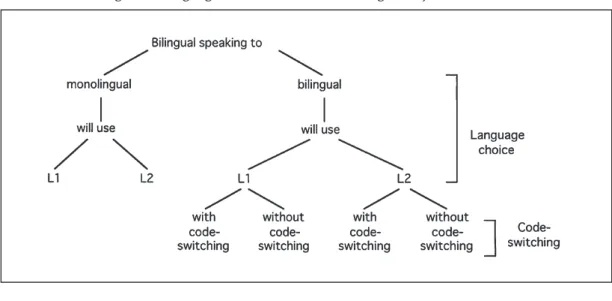
This opposite view of code-switching as a voluntarily activity has been articulated by Grosjean (1982), who maintains that code-switching is “a very important aspect of bilingualism” (p. 145). He has laid out a scheme of a two-stage process in bilinguals’ language selection, in which “code-switching” is distinguished from “language choice,” as shown in Figure 1 below.
First a bilingual will select a base language for use, depending on whether she or he is talking with a monolingual or another bilingual. If the interlocutor
is also a bilingual, both speakers will negotiate which language, L1 or L2, should be used as the base language for their conversation. In the course of conversation they then will switch as necessary to meet the demands of the situation.
2. Some proposed explanations for
code-switching
Why would bilinguals switch codes, then, if they are proficient enough to carry on the whole conversation in either language and their language choice is at their disposal? What reasons could there be behind code-switching? Several possible explanations have been proposed (e.g., Appel & Muysken, 1982; Grosjean, 1982; Myers-Scotton, 1993, 2006; Auer, 1998; Ggardner-Chloros, 2009).
In answering their self-imposed question of why people switch languages, Appel and Muysken (1982), summarizing previous research findings, present some probable functions of switching3, (pp. 118-120):
3. Appel & Muysken (1987) refers to switches by different terms, depending on where the switches occur: code-switching for those between sentences and code-mixing for those “in the middle of a sentence” (p. 118)
• the referential function: to compensate for a lack of knowledge/facility in one of the languages involved • t he d i rect ive f unct ion: to exclude /i nclude
participants from/in a conversation
• the expressive function: to emphasize a dual identity
• the phatic function: to change the tone of a conversation
• the metalinguistic function: to comment on the language involved
• the poetic function: to heighten the artistic effect Except for the referential function, all the other functions are most likely the result of code-switching voluntarily produced.
According to Myers-Scotton (1993:1), code-switching is “a means to index the nuances of social relationships by exploiting the socio-psychological associations of the languages employed.”
Likewise, in his summary of previous research, Grosjea n (1982) lists some possible reasons for switching, mainly from the sociolinguistic perspective:
• Fill a linguistic need for a particular lexical item, set phrase, discourse marker, or sentence filler • Continue the last language used (triggering) • Quote someone
• Specify addressee
• Qualify the message: amplify or emphasize (“topper” in argument) • Specify speaker involvement (personalize message) • Mark and emphasize group identity (solidarity) • Convey confidentiality, anger, annoyance • Exclude somebody from the conversation • Change role of speaker: raise status, add authority, show expertise (p.152)
In his study of French-Dutch code-switching by bilinguals in Brussels, Treffers-Daller (1992) found that intrasentential code-switching occurs less frequently when “bilingualism is not considered to be emblematic of the local identity” (p.155). This finding offers a piece of evidence to support the assertion that bilinguals switch codes to mark their group identity.
Bilinguals may also switch codes to neutralize some negative effects caused by particular words or phrases in one of their languages. Bilinguals can, for example, replace a taboo word in one language with an expression from the other language that conveys a similar meaning but is not considered taboo.
By now we should be fully convinced that code-switching is not mere compensation for “deficiencies” in one of the bilinguals’ languages involved, but is a strategy voluntarily produced to achieve some purposes that bilingual interlocutors have set.
3. Another proposed explanation for
code-switching, from the perspective
of Relevance Theory
Relevance Theory, put forth by Sperber and Wilson (1986), tries to explain how we understand utterances. According to this theory, we interpret every utterance in the expectation that it has optimal relevance. That is, we form an assumption in the expectation that it will interact with our existing assumptions to yield adequate contextual effects for the minimum necessary processing. Let us take a look at an example of ambiguity below.
(1) You’re not going to eat it? (2) It is too hot to eat.
(3a) The second speaker does not want to eat it yet, because it (is exceedingly hot and) may burn her
88
Journal of Policy Studies No.44 (July 2013)
or his mouth.
(3b) The speaker does not have an appetite for any kind of food because of the hot weather. If the speaker utters (2) with a bowl of steaming soup, the hearer is more likely to select assumption (3a) rather than (3b). How so? According to Sperber and Wilson, we form assumptions in the expectation that they will interact with our existing assumptions to yield a contextual effect. From observation (4), we access existing assumptions (5) and (6).
(4) Steam is coming out of the bowl that the speaker is holding.
(5) Something that is steaming is likely to be hot. (6) We will get burned if we put something
exceedingly hot in our mouth.
Assumption (3a) interacts with (5) and (6) to yield a contextual effect at minimum cost.
Code-switching does impose on bilinguals a certain processing cost. According to the two-switch hypothesis proposed by Macnamara (1967), bilinguals develop a certain switching mechanism with two switches for their language processing, one for input and the other for output. The results of experiments conducted by Macnamara et al (1968) and Macnamara & Kushnir (1971) suggest that it takes bilinguals a certain amount of time to switch from one language to the other, with 0.2 seconds required for each input and output switch. Kolers (1966, 1968) also reported that it takes 0.3 to 0.5 seconds for both switches to work. More recent studies conducted by Soares & Grosjean (1984, reported in Grosjean, 2008) and by Domenighetti & Caldognetto (1999, also reported in Grosjean (2008) found that it took the bilingual participants
significantly longer to react to their assignments in a code-switched condition than in a monolingual condition.
Why, then, do bilinguals “bother “ to switch codes in their discourse, even when it would be feasible to complete their utterances only in one language, as monolinguals do? If bilinguals willingly switch codes in spite of the possible extra processing cost, this processing effort must be justified with some benefit. What might the benefit be?
(7) A: What are you going to do on New Year’s Day?
B: Oh, all the stuff you are expected to do on OSHOGATSU.
Both A and B are talking about the same day, the first day of the year. B could have easily repeated the label of that day in English that A used, “New Year’s day,” as A said, or could have changed to another appropriate expression in English, such as “on that day.” Instead, B code-switched into Japanese and selected the Japanese label, “OSHOGATSU.”
It is most likely that speakers of Japanese, especially those who were born and raised in Japanese culture, would access certain contextual information evoked by the word, distinct from those that may be derived from “New Year’s Day.” Actually, in her study conducted over half a century ago, Ervin-Tripp (1968) found that Japanese “war brides” residing in the United States tended to use Japanese words in their English speech when they were asked to describe culturally loaded topics such as Japanese New Year’s Day.
Both the speaker and the hearer hope that the assumption being processed is relevant. In order to assure this, bilinguals utilize any means at their
disposal, one of which could be code-switching. Code-switching itself probably does not directly maximize relevance. Instead, according to Sperber & Wilson (1986), it may help determine “a range of possible contexts” (p. 141), from which a particular context that will maximize relevance is to be selected. In the present example, by switching from English to Japanese, the speaker hopes that the hearer will choose the most appropriate range of possible contexts (i.e. the range of contexts which includes information referring to what Japanese people usually do on OSHOGATSU in Japan, not what Americans do on New Year’s Day in the US). If the speaker had not switched, as in (8), the hearer might have accessed (9) and formed an assumption like (10). It is unlikely that the hearer would have accessed (11) and formed an assumption like (12), since adequate contextual effects would not be provided.
(8) Oh, all the stuff you are expected to do on New Year’s Day.
(9) People in the States generally watch football games on TV all day.
(10) B is probably going to watch football games on TV all day.
(11) People in Japan generally eat traditional O S H O G A T S U f o o d s , p l a y s o m e t r a d it iona l ga me s, a nd v isit f r iend s to exchange the customary greeting for this occasion, “AK EMASHITE OMEDETOU GOZAIMASU.”
(12) B i s p r o b a bly goi ng t o e a t t r a d it io n a l OSHOGATSU foods, play some traditional games, and even visit her/ his fr iends to exchange the customary greeting for this occasion, “AK EMASHITE OMEDETOU GOZAIMASU.”
Not every speaker of a particular language is expected to always form the same particular assumptions merely because they share the same language. If they were, Sperber and Wilson wouldn’t have had to theorize about relevance in the first place. The same can be said for bilinguals. Bilinguals are not necessarily expected to form the same assumptions from the context accessed as a result of switching. They may even access a different assumption, such as (13). Then (14) may be a more appropriate assumption being derived.
(13) People in modern Japan are not that traditional anymore and do not enjoy those traditional things that people in the older days used to do. Nowadays they just watch TV.
(14) B is going to just sit in front of the TV and watch it all day.
What, then, do the speaker and the hearer hope to achieve by switching codes? Instead of switching codes, the speaker could have said something like (15).
(15) Oh, all the traditional stuff people in Japan are expected to do on New Year’s Day, which is quite different from what people in the States are likely to do.
However, (15) provides no increase in contextual effects, since both the speaker and the hearer already share the knowledge that New Year’s Day and OSHOGATSU signify the same day but provide different contexts from which different assumptions might be derived.
Relevance Theory claims that, by using what Sperber & Wilson term an “ostensive” stimulus,
90
Journal of Policy Studies No.44 (July 2013)
the speaker tries to achieve two intentions, the informative and the communicative. The former is “to make manifest to her audience a set of assumptions [I]” and the latter is “to make her informative intention mutually manifest” (Sperber & Wilson, 1986:163).
Code-switching may function as an ostensive stimulus in bilingual discourse. By switching codes, the bilingual speaker intends to make manifest to the bilingual hearer a set of assumptions [I] that is different from what might have been but for the codes having been switched, and also to inform the hearer of the speaker’s informative intention. Sperber & Wilson (1986) claim that one’s own native language is the most powerful stimulus in ostensive communication and, thus, code-switching must also be powerful enough to attract the hearer’s attention. In other words, by switching codes, the bilingual speaker hopes to direct the bilingual hearer toward a path worth pursuing to access the range of contexts from which the most appropriate set of assumptions can be derived with the minimum processing.
In spite of its extra processing costs, switching codes is the most economical means at the speaker’s disposal to lead the hearer in the desired direction. The hearer tries to select a context that will maximize relevance, and code-switching helps her/him to do so.
Even if there is a possibility that different assumptions may be drawn (i.e. (14) and (12)), since the context that the hearer brings to bear (i.e. (13)) may not be exactly the same as the one envisaged by the speaker (i.e. (11)), the assumption will still be within a range where a certain degree of contextualization is achieved. The hearer who is guided in the right direction by switching codes never would form an assumption like (10).
4. Closing remarks
This paper began with a quick sketch of code-switching and reviewed some proposed explanations to account for why bilinguals switch codes, then proposed another possible explanation for code-switching in light of Relevance Theory.
Code-switching is commonly, if not customarily, used between bilinguals in their communication, or even among a mixed group of speakers at different proficiency levels in the given languages (Nishimura, 1997). It is often taken as evidence of code-switchers’ linguistic deficiencies and cited as a detrimental consequence of acquiring two languages. The author hopes that the present proposal, using the insights of Relevance Theory as another possible explanation for code-switching, will be of some help in deflating this deficiency accusation.
References
Appel, R., & Muysken, P. (1987). Language contact and
bilingualism. London: Edward Arnold.
Auer, P. (Ed.). (1998). Code-switching in conversation:
Language, interaction and identity. London: Routledge. Barron-Hauwaert, S. (2004) Language strategies for
bilingual families: The one-parent-one-language approach. Clevedon: Multilingual Matters.
Blakemore, D. (1992). Understanding utterances: An
introduction to pragmatics. Oxford: Blackwell. Blom, J-P., & Gumperz, J. (1972/2000). Social meaning in
structure: code-switching in Norway. In J. J. Gumperz & D. Hymes (Eds.), Directions in sociolinguisitcs, 407-437. NY: Holt, Rinehard, and Winston. [Reprint in Wei, L. (Ed.). (2000). The bilingualism reader. London: Routledge.].
Ervin-Tripp, S. M. (1968). An analysis of the interaction of language, topic, and listener. In J. A. Fishman (Ed.),
Readings in the sociology of language (pp.192-211). The Hague: Mouton.
Gardner-Chloros, P. (2009). Code-switching. Cambridge: CUP.
Grosjea n, F. (1982) . Life with t wo languages : An
introduction to bilingualism. Cambridge: Harvard University Press.
Grosjean, F. (2008). Studying bilinguals. Oxford: OUP. Jisa, H. (2000). Language mixing in the weak language:
Evidence from two children. Journal of Pragmatics,
32, 1363-1386.
Kolers, P. (1966). Reading and talking bilingually. The
American Journal of Psychology, 79, 357-376. Kolers, P. (1968). Bilingualism and information processing.
Scientific American (March), 218, 78-86.
Lambert, W. E. (1990). Persistent issues in bilingualism. In B. Harley, P. Allen, J. Cummins & M. Swain (Eds.),
The development of second language proficiency
(pp.201-218). New York: Cambridge University Press. Macna ma ra , J. (1967) . T he bi l i ng ua l’s l i ng u ist ic
performance: A psychological overview. Journal of
Social Issues, 23(2), 58-77.
Macnamara, J., Krauthammer, M., & Bolgar, M. (1968). Language switching in bilinguals as a function of stimulus and response uncertainty. Journal of
Experimental Psychology, 78, 208-215.
Macnamara, J., & Kushnir, S. L. (1971). Linguistic independence of bilinguals: The input switch. Journal
of Verbal Learning and Verbal Behavior, 10, 480-487. Mont r ul, S. A. (20 08) . Incomplete acquisition in
bilingualism: Re-examining the age factor. Amsterdam: John Benjamins.
Myer s- Scot ton, C. (19 93) . S o ci a l m ot iva t io n for
codeswitching: Evidence from Africa . Oxford: Clarendon Press.
Myers-Scotton, C. (2006). Multiple voices: An introduction
to bilingualism. Malden, MA: Blackwell.
Seliger, H. W., & Vago, R. M. (1991). First language
attrition. Cambridge: Cambridge University Press.
S p e r b e r, D. , & W i l s o n , D. (19 8 6 ) . R e l e v a n c e :
Com m u nicat ion a n d cognition . Ox ford : Basil Blackwell.
Treffers-Daller, J. (1992). French-Dutch codeswitching in Brussels: Social factors explaining its disappearance. In C. M. Eastman (Ed.), Codeswitching (pp.143-156). Clevedon: Multilingual Matters.