Exploring the hierarchical and situational concept of skill
Yuichi MATSUMOTO
This paper discusses the concept of skill by reviewing researches on skill acquisition and learning. Changes in the managerial and organizational environment influence the style of personnel management, and people are forced to pay attention to and be aware of their own skill building. However, the concept of skill still remains ambiguous, and even methods for building skills have only distinguished between on-the-job training (OJT) and off-the-job training (Off-JT). Research on organizational learning abounds and has uncovered interesting findings; however, there still remains a dearth of research on skill.
It is also important to focus on the relationship between skill and career. When planning our working career, we need to think about what skills we possess. However, in career theories, until recently, skill building for autonomous career planning has not been researched (Matsumoto, 2008a, 2008b). Actually, when researching the topic of career, the consideration of skill and skill building is indispensable. Therefore, it is necessary to reconsider the concept of skill and consider career design theory based on the skill acquisition theory. This will provide more practical insight for researching the concept of skill.
In the following section, we review literature on the concepts of skill in the areas of psychology, management, and the labor economy. We then provide some original definitions of the concept of skill, after which we review relevant literature on skill in cognitive psychology. We then proceed to review literature on situated cognition and skill, in order to support our proposed concept of the hierarchical and situational features of skill. Finally, we discuss the actual concept of skill.
What is skill?
The term “skill” is popularly defined as an expression of humans’ ability (especially working ability), and has been used in a variety of research. In statistical analyses, skill has been used both as an independent variable and a dependent variable. However, there are not many researches that discuss the concept of skill itself. Ambiguity with regard to the definition of skill is one of the factors preventing the progress of research in the area of skill. Another obvious reason that not much research on skill has been conducted is the concept’s implicit nature. Although the concept of skill has been discussed in numerous researches, not many fields have attempted to define it. Most of these attempts have been made in the field of psychology. Until the 1970s, in psychology, research on skill mainly consisted of motor
skills-based research that investigated the accuracy of movement. After the 1970s, research on skill began to include perceptual skills-based research that investigated the cognitive processes of information processing, and perceptual-motor skills research that investigated the relationships between perceptual and motor skills. This research increased in the wake of the “cognitive revolution” (Gardner, 1985), and flourished in the field of cognitive sciences. In the following section, we review this research on skill.
Skill in psychology
Mace (1950) considered the concept of skill by classifying it into three different types: physical skills, intellectual skills, and social skills. He considered physical skills to be “the ability to produce some required effect, or group of effects, through bodily movements guided by sensory and perceptual cues” (p.126). Intellectual skills, according to Mace, encompass “generalized knowledge and imagination,” whereas social skills are a “subtle emotional reaction to personality and subtle expressions of personality.” Experts use these skills effectively, as one skill, without distinguishing them from each other. Indeed, Mace (1950) claimed that situational information and general knowledge are required to control physical skills. Guthrie (1952) defined skill as the ability to be able to achieve a goal with maximum accuracy and minimum energy and time. His definition suggested that skill is a kind of an ability through which people can accomplish certain tasks. Lashley (1951) characterized skill as a “syntax of action.” He claimed, “Temporal integration is not found exclusively in language; the coordination of leg movements in insects, the song of birds, the control of trotting and pacing in a gaited horse, the rat running the maze, the architect designing a house, and the carpenter sawing a board present a problem of sequences of action which cannot be explained in terms of successions of external stimuli” (p.113). This implies that it is necessary to conceptualize an action not as a collection of single actions but as a sequential movement. Lashley (1951) also advocated the importance of considering temporal control in skilled action and cognitive control processes that control sequences of movement.
Fitts (1965), too, conceptualized skill as a process that includes a feedback process. Fitts and Posner (1967) considered the concept of skill in greater detail. According to them, skilled performance has three features: it involves organization, goal directedness, and the utilization of feedback. The first feature of skill, namely, that it involves organization, refers to the fact that “skilled performance always involves an organized sequence of activities” (p.1); this is similar to the view presented in Lashley (1951), which emphasizes the importance of conceptualizing an action as a sequence of movement. The second feature, namely, that of goal directedness, refers to the fact that “skilled behavior is not just organized. It is organized with a purpose. It is goal-oriented” (p.2); thus, the organization of skilled behavior is tied in with a goal. Fitts and Posner (1967) claimed that the third feature of skill, namely, that it
involves the utilization of feedback, is highly important. Based on these three elements, Fitts and Posner attempted to classify skill. They first classified “universal skills” as “a number of basic human functions, however, appear to be innate, in that they are basic properties of the maturing nervous system”, for example, “breathing, digesting, coughing, and other complex reflexive activities necessary to life itself” (p.3). Universal skills are distinguished from “learned skills,” which are acquired by learning. Learned skills include perceptual-motor skills and language skills, and “perceptual motor skills can be broken down further into three more specific categories of performance: gross bodily skills, manipulative skills, and perceptual skills” (p.4). Bodily skills are used in the “processes involved in maintenance of upright position and in locomotion” (p.4), and are the origin of an athlete’s excellent motor ability. Perceptual skills enable a person to perform perceptual-motor activities as well as engage in the processes necessary for language. Manipulative skills, according to Fitts and Posner (1967), enable people to manipulate words, symbols, and also involve other types of skill. Fitts and Posner (1967) claimed the “hierarchical and sequential organization of skills”; manipulative skills seem to be meta-level skills and seem to control other skills in response to movement, perception, and situation.
Then, Fitts and Posner (1967) proposed that skills are learned in three stages. In the first stage, called the cognitive stage, an initial repertoire of subroutines (meaning “short, fixed sequences of operation” or movement) are selected from the available ones that have been previously developed. During this phase, it is necessary to attend to cues, events, and responses that later go unnoticed. This stage is the stage during which new movements are learned with intense practice. In the second stage, called the associative stage, “old habits which have been learned as individual units during the previous phase of skill learning, are tried out and new patterns begin to emerge.” Several movements performed together form sequences, the level of failure is reduced, the level of accuracy increases, and the appropriate sequence is added on to the person’s repertoire. The third and final stage, called the autonomous stage, is the stage characterized by an increase in autonomous action, low response time, and effectiveness, and, at the same time, is “less directly subject to cognitive control, and less subject to interference from other ongoing activities or environmental distractions” (pp.11–15). Thus, Fitts and Posner (1967) proposed the stage model of skill learning as well as the concept of the hierarchical and sequential organization of skills.
Welford (1970, 1976) provided a clear and concise definition of skill. At the outset, Welford (1970) compared the industrial perspective of skill and the psychological perspective of skill. According to the former, “A man is regarded as skilled when he is qualified to carry out trade or craft work involving knowledge, judgment, accuracy and manual deftness usually acquired as the result of a long training” (p.21). Welford (1970) argued that skill was built by training, more specifically, long-term training. On the other hand, the psychological
perspective conceptualizes skill as being broader than does the industrial perspective, in two ways, as claimed by Welford (1970). First, Welford stated, “Skill in the psychological sense can exist in the performance of many jobs which in industry would be graded as semi-skilled or unskilled” (p.22). Thus, it follows that in the psychological view, highly skilled individuals, those still being trained and building their skills, and even unskilled individuals should be treated in skill researches. Thus, dealing with the concept of skill requires considerable insight. Second, “the psychological use of the term covers so-called ‘mental’ operations as well as manual” (p.22). Welford (1970) considered mental operations as a skill, that is, as the cognitive processes of skill. However, Welford (1970) argued that both views have certain common characteristics. These common characteristics are as follows:
1. Both views essentially consider skill as involving the building of an organized and coordinated activity in relation to an object or a situation and therefore conceptualize skill as involving the entire chain of sensory, central, and motor mechanisms that underlie performance.
2. Both views claim that a skill involves understanding the object or situation and that the form of the action is gradually built up in the course of repeated experience.
3. Both views claim that skill has a serial quality in the sense that within the overall pattern of a skill, many different processes or actions are ordered and coordinated in a temporal sequence (p.22).
The first point alludes to the perceptual and motor aspects of skill, the second point makes reference to the learning mechanism that can be mastered through understanding and repetition, and the third point refers to the sequential nature of skill. It is highly suggestive that all these three characteristics of skill include reference to the term “situation”; this alludes to the “situated” aspect of skill.
Then, Welford (1976) defined skill as follows: “Skill lies in the use of capacities efficiently and effectively as the result of experience and practice” (p.14). This definition suggests two things: first, it suggests that the possession of a skill supposes experience and practice, and, second, it suggests that the concept of skill encompasses not only the possession of ability but also its use, and more so, efficiently and effectively. Thus, it is evident that Welford’s (1976) precise definition of skill is significant for discussing the concept.
Singleton (1978, 1979, 1981, 1983), in his book “The study of real skills,” also analyzes the concept of skill on the basis of various case studies. He pointed out four characteristics of skilled behavior (Singleton, 1978, p.5) :
1. It is continuous, there is always an extensive overlap and interaction. Even in principle, it cannot be analysed by separation into discrete units along either space or time axes 2. It involves all the stages of information processing indentifiable in the organism,
basically inputs, processing and outputs
3. It is learned and therefore highly variable within and between individuals 4. There is a purpose, objective or goal providing meaning to the activity
Similar to Welford’s (1970) view, the first point suggests that skilled behavior involves a sequence of skills. The second point implies that skill is grasped and mastered through the cognitive processing of information. The third point suggests that skill is built by learning; this is one of the basic findings of expert-novice research on skill. The fourth point basically implies that skill requires purpose or a goal, and is, in other words, goal-oriented. Then, in Singleton (1981), skill is defined as “a way of modeling human behaviour which takes particular account of learning and purpose” (p.5). Singleton’s definition, according to which skill is goal-oriented and stems from a certain amount of learning, is similar to other definitions of skill by Fitts and Posner (1967) and Welford (1976).
Singleton (1978) classified the concept of skill on the basis of two dimensions. The first dimension is the perceptual skill-motor skill dimension. He stated the following with regard to this: “…human information can be conceived as starting with diffuse streams of data which are filtered, combined and focused on a decision, following which there is divergence again into the multiplicity of actions consequent upon the decision. The translation of the incoming data into the decision requires perceptual skill, the translation of the decision into complex bodily activity requires motor skill” (p.9). This perceptual-motor dimension is popular in theories of skill. Perceptual skills are at a higher level than are motor skills, and motor skills are automatic, unconscious, and tacit. The second dimension is derived from the viewpoint that skilled behavior requires a high level of information processing. Singleton divided skill into “input dominated skills,” “output dominated skills,” and “cognitive skills.” Singleton (1978) described the three types of skills as follows: “typifying the output dominated skills are the fast motor skills found in ball games and industrial assembly operations. There are input dominated skills such as those required in industrial inspection and monitoring tasks. There are skills where the input is obvious, the output is trivial and the skill depends on the differential weighting and combinations of inputs or assemblies of inputs, in other words on information processing. These are called thinking or cognitive skills” (p.5). Input dominated skills are strongly perceptual, and output dominated skills are strongly exemplified in motor skills. However, the important point here is that Singleton (1978) established the hierarchical model of skill. In other words, cognitive skills are meta-skills, and serve to control the other two skills (i.e., the perceptual and motor skills). Before elaborating further on cognitive skills,
Singleton (1978) discusses the distinction between “knowing that” and “knowing how” when considering cognition. He states the following: “‘Knowing that’ is unfortunately much the commoner state in our society, it is theoretical and academic, it enables one to write and discuss, to pass examinations and to acquire prestige but not necessarily to operate effectively in the real world. In contrast ‘knowing how’ is direct and operationally based – it involves personal involvement and successful experience, such knowledge cannot necessarily be demonstrated verbally and it is not readily transmitted to others, this is cognitive skill. ‘Knowing that’ is important, it facilitates communication and provides understanding, it is the business of the critics as opposed to the artist, the spectator as distinct from the player. It is not skill” (p.5). This distinction is derived from discourses in philosophy, for example, those presented in Ryle (1949) and Polanyi (1966). Singleton (1978) claimed that cognitive skills require a higher level of cognitive processing and involve various types of knowledge as well as information about the situation or context. Furthermore, Singleton (1978) also advocated that cognitive skills involved “knowing how” because of their implicitness and that they did not involve “knowing that.” His concept of cognitive skills and hierarchical model of skill has much value for discussing the concept of skill.
Colley and Beech (1989) presented several arguments with regard to cognitive skills and claimed the following: “A mutually exclusive typology of cognitive skills is not possible, since cognitive tasks vary on a number of different dimensions all of which are relevant to the way in which they are learned” (p.3). Then, they proposed six dimensions of skills derived from the nature of a task: (1) simple-complex, (2) divergent-convergent, (3) algorithmic-heuristic, (4) inductive-deductive, (5) open-closed, and (6) universal-specialized. The simple-complex dimension indicates the regulation of a higher level of skill, based on the reasoning that it is not possible to perform a large number of complex tasks while it is possible to perform many simple tasks perfectly. The inductive-deductive dimension is relevant to research on the problem solving of experts (e.g., Larkin et al., 1980), while the open-closed dimension refers to “performance in a predictable (closed) environment and performance in an unpredictable (open) environment” (p.4), and connotes the relationship of skill to the factor of situation.
A research that presents useful discussions on the concept of skill is Anderson (1980). Anderson refers to the concept of skill in cognitive psychology. He claimed, “Our knowledge can be categorized as declarative knowledge and procedural knowledge. Declarative knowledge comprises the facts we know, procedural knowledge comprises the skills we know how to perform” (p.222). This dichotomy can be traced to Ryle (1949), who claimed the following: “Intelligent cannot be defined in terms of ‘intellectual,’ or ‘knowing how’ in terms of ‘knowing that’” (p.32). He denied the traditional idea that made methods by combining propositional knowledge and claimed that “knowing that” and “knowing how” should be
distinguished clearly. Then, Winograd (1976, 1978) used the terms “declarative” and “procedural” in researches on a language-understanding program. Anderson (1980) used both terms in research on knowledge.
Anderson (1980) argued that there are two kinds of knowledge, stating the following: “Most declarative knowledge can be expressed verbally while much procedural knowledge cannot” (p.223), and it was this procedural knowledge that constituted skill. This alludes to the implicit nature of skill. Furthermore, Anderson proposed the concept of “cognitive skills,” that is, “the ability to perform various intellectual procedures” (p.223). He indicated that procedural knowledge refers to knowledge about a certain procedure, and (a part of) declarative knowledge is used in successfully carrying out procedures. Further, cognitive skills involve the ability to use both types of knowledge in accordance with various situations. Anderson (1980) also assumed that skill was a hierarchical concept.
Then, based on Fitts and Posner (1967), Anderson proposed that there were three stages involved in learning a skill. The first stage is called the cognitive stage and Anderson stated the following about this stage: “Most skill learning begins with an instructional or study phase in which the learner is either instructed in the task or studies it himself and tries to understand it” (p.226). Learners process mainly declarative knowledge in this stage. Anderson described the next stage, the associative stage, by using the analogy of driving a car. He stated the following: “First, errors in the initial understanding are gradually detected and eliminated. So, I slowly learned to coordinate the release of the clutch in first gear with the application of gas in order not to kill the engine. Second, the connections among the various elements required for successful performance are strengthened. Thus, I no longer had to sit for a few seconds trying to remember how to get to second gear from first” (p.226). Further, declarative knowledge is converted to procedural knowledge during the associative stage. The knowledge that guides behavior is procedural knowledge. The third and final stage is called the autonomous stage. Anderson states the following about this stage: “In this stage, the procedure becomes more and more automated and rapid. No sharp distinction exists between the autonomous and associative stages. The autonomous might be considered an extension of the associative stage. Because facility in the skill increases, verbal mediation in the performance of the task often disappears at this point. In fact, the ability to verbalize knowledge of the skill can be lost altogether” (p.226–227). Automatization is an area of skilled behavior research (e.g., Schneider and Shiffrin, 1977; Gentner, 1988; Spelke et al., 1976), and provides an explanation of how skill becomes implicit. Anderson’s (1980) three-stage model of skill learning is derived from Fitts and Posner’s (1967) model; however, he clarified the process of skill learning by distinguishing skill in terms of the declarative-procedural knowledge dimension and through his research on automatization.
intelligence (AI), and human beings, on the basis of which they developed a five-stage model of skill learning to discuss the progress of AI and computers. According to their five-stage model, a learner undergoes five stages—“the novice stage,” the advanced beginner stage,” “competence stage,” “proficiency stage,” and “expertise stage”—before mastering a skill.
In the first stage (the novice stage), “the novice learns to recognize various objective facts and features relevant to the skill and acquires rules for determining action based upon those facts and features” (p.21). In this stage, what the novice learns is so simple that he/she can learn and can recognize or apply what he/she has learned to problems without thinking about the overall situation. Dreyfus and Dreyfus (1987) called this feature “context-free,” and claimed that it helps the novice to learn the skill. However, this feature results in the novice learning only a few skills, and novices can only superficially learn what they are supposed to master.
In the second stage (the advanced beginner stage), the learner is able to understand the skill in a larger context. Further, Dreyfus and Dreyfus stated, “Through practical experience in concrete situations with meaningful elements, which neither an instructor nor the learner can define in terms of objectively recognizable context-free features, the advance beginner starts to recognize those elements when they are present” (p.22). In this stage, the learner understands not just context-free elements but also situational elements, and can respond to things, depending on the particular situation. The first and second stages emphasized context-free rules or elements. From the overall perspective, these are more routine processes and are adequate for the learner to understand the elements of the situation. Then, with these elements, the learner begins learning more inferior skills and gradually progresses to learning superior ones. Soon, the learner begins noticing situational elements and the relationship between situational elements and the behavior these elements warrant.
Dreyfus and Dreyfus stated the following about the third stage (the competence stage): “With more experience, the number of recognizable context-free and situational elements present in a real-world circumstance eventually becomes overwhelming” (p.23). This indicates that the process of learning a skill is not linear and that this stage is characterized by stagnancy and distress. To overcome this problem, the learner begins to become aware of the goal and plan. Dreyfus and Dreyfus (1987) claimed the following: “By first choosing a plan to organize the situation, and by then examining only the small set of factors that are most important given the chosen plan, a person can both simplify and improve his performance” (p.24). The necessity of selecting and following a plan has been researched in problem solving (e.g., Miller et al., 1960; Hayes-Roth and Hayes-Roth, 1979), as well as in the context of learning a skill in order to create a situation of learning. However, Dreyfus and Dreyfus (1987) criticized this excessively reductionistic stance, claiming, “All intelligent behavior is of the problem-solving form” (p.24). The importance of a goal in learning a skill is also
discussed in Guthrie (1952) and Fitts and Posner (1967). Dreyfus and Dreyfus (1987) claimed, “A competent performer with a goal in mind sees a situation as a set of facts” (p.24); therefore, a goal plays the role of helping a person to understand a situation.
In the fourth stage, (the proficiency stage), the learner progresses further, although the progress is slightly different from what we would expect. Dreyfus and Dreyfus state the following: “Usually the proficient performer will be deeply involved in his task and will be experiencing it from some specific perspective because of recent events. Because of the performer’s perspective, certain features of the situation will stand out as salient and others will recede into the background and be ignored. As events modify the salient features, plans, expectations, and even the relative salience of features will gradually change” (p.28). The learner seems to acquire a kind of “engrossment” derived from the experience, knowledge, and concentration with regard to the task. We tend to believe that the more the learner learns the skill, the greater will be the improvement in his/her ability to understand various situations. However, on the contrary, during the stage of proficiency, the learner focuses on the elements or information that he/she needs in order to focus on the specific situation. Dreyfus and Dreyfus (1987) called this decision-making style the “Hamlet model,” on account of the “the detached, deliberative, and sometimes agonizing selection among alternatives,” and described the other type of ability of experts as “holistic similarity recognition,” namely, “the intuitive ability to use patterns without decomposing them into component features” (p.28). This ability makes the learner intuitive as well as enables him/her to get immersed in the situation, grasp the elements of the situation, and make accurate decisions.
In the fifth and final stage (the expertise stage), “an expert generally knows what to do based on mature and practiced understanding. When deeply involved in coping with his environment, he does not see problems in some detached way and work at solving them, nor does he worry about the future and devise plans” (p.30). Dreyfus and Dreyfus (1987) first cited the ability to make accurate decisions as the skill necessary for an expert and then cited engrossment as another necessary skill. This feature involves automatization, confidence, and speed. Dreyfus and Dreyfus stated the following with regard to this: “When things are proceeding normally, experts don’t solve problems and don’t make decisions; they do what normally works” (p.30–31). Evidently, such behavior is derived from a large amount of experience, but experts’ behavior can hardly be described logically and clearly. In the final stage, the implicitness of skill increases greatly. This enables experts to act in response to the situation. Dreyfus and Dreyfus stated the following about this: “With enough experience in a variety of situations, all seen from the same perspective or with the same goal in mind but requiring different tactical decisions, the mind of the proficient performer seen to group together situations sharing not only the same goal or perspective but also the same decision,
action, or tactic simultaneously comes to mind. An immense library of distinguishable situations is built up on the basis of experience” (p.32). This situational ability is an important characteristic of experts. Hatano and Inagaki (1986) also proposed two types of knowledge, namely, routine expertise and adaptive expertise, which are derived from the corresponding types of experts: routine experts and adaptive experts. Hatano and Inagaki (1986) described these types of experts as being at a stage at which they will become experts and described an adaptive expert as one who can select a solution in response to a changing situation.
Skill in management and labor economics
There are not many studies on skill in management theory because research on organizational learning is the mainstream research topic, and these researches deal with knowledge (e.g., Duncan and Weiss, 1979; Nonaka and Takeuchi, 1995) or adaptation (e.g., Cyert and March, 1963; March and Olsen, 1976) or types of learning (Argyris and Schön, 1974; 1978). Consequently, not much research has been conducted on the concept of skill.
Based on his research on the ability of administrators, Kats (1955) proposed that there are three types of skills: technical skills, human skills, and conceptual skills. Technical skills involve “an understanding of, and proficiency in, a specific kind of activity, particularly one involving methods, processes, procedures, or techniques” (p.34). These are skills, using which one can obtain results in one’s work. Human skills involves “the executive’s ability to work effectively as a group member and to build cooperative effort within the team he leads” (p.34). These skills are a kind of social skill for an administrator and are related to organizational behavior. Conceptual skills refer to “the ability to see the enterprise as a whole; it includes recognizing how the various functions of the organization depend on one another, and how changes in any one part affect all the others; and it extends to visualizing the relationship of the individual business to the industry, the community, and the political, social, and economic forces of the nation as a whole” (pp.35–36). These three types of skills are related to each other, and their importance differs in the lower and top levels of processing. The skills proposed by Katz (1955) are based on the skills of an administrator; however, this is also a limitation of the research, as it limits its applicability.
However, more researches on the concept of skill have been conducted in the field of labor economics. Braverman (1974) began discussing the concept of skill by classifying division of labor into “social division of labor” and “detailed division of labor.” The former involves people’s engagement in various types of work in society, and the latter involves “the breakdown of the processes involved in the making of the product into manifold operations performed by different workers” (p.72). The problem is that the “detailed division of labor” subdivides not only labor processes but also the skill of workers. Braverman’s (1974) criticism was that “while the social division of labor subdivides society, the detailed division
of labor subdivides humans” (p.73), which sounds the alarm for a decline in skill level. Koike (Koike, 1991, 1994; Koike and Inoki, 1990) investigated the domestic and international industries and proposed the concept of “intellectual skills,” which refer to the ability of “dealing with changes and problems” (Koike, 1991, p.63). Based on Braverman (1974), he argued about the concept of skill, stating that work can be divided into two major categories, namely, usual operations and unusual operations, on the basis of the view of career as a horizontal career span and vertical career span. Developing technology results in the replacement of technicians with machines, and intellectual skills are highly suitable for dealing with changes and problems in uncertain situations. Moreover, intellectual skills are developed through OJT; Koike (1994) pointed out that “with advances in computerization intellectual skills will grow in importance” (p.74). Then, Koike suggested three ways of building intellectual skills: through broad OJT, supplementary OJT, and short inserted Off-JT. First, broad OJT refers to training wherein “a worker experiences not only the major jobs in his own workshop but also, over a long term, the many jobs in a couple of other workshops which are closely related in technology” (p.48). This type of training equips workers with skills for multiple workplaces and intellectual skills. In supplementary OJT, “workers participate in the maintenance workers’ job” (p.49). The production workers observe the maintenance workers as they (the maintenance workers) work, and engage in the work along with them. Finally, the production workers do the work by themselves. This type of training is very useful for building intellectual skills because it enables workers to observe the workplace not only from the production perspective but also from the maintenance perspective. The third type of training, namely, short inserted Off-JT, is necessary for workers “to theorize and systematize the experience that workers have acquired” (p.50). The concept of intellectual skills is extremely simple, but it reflects the reality of industrial factories and also has high theoretical validity because the concept of intellectual skills being hierarchical in nature is similar to the concept advocated in psychological research, namely, that of skill being a hierarchical concept.
Definition of skill
We reviewed a number of researches on the concept of skill. On the basis of this, the following are some of the features of skills that emerged:
Skill is derived from practice and experience.
Skill is not only a work capability such as the ability to engage in craft work, but also encompasses the ability to make an intended performance.
Skill is an automated ability to save cognitive resources.
Skill has a hierarchical structure: it involves abilities to make intended performances and involves a meta-level ability that enables a person to choose one from among many subordinate skills to respond to the situation.
Considering these features, there are two types of skills. The first type of skill is “subordinate skills,” Which are the skills referred to in perceptual-motor researches. It is defined as follows:
The ability to quickly and accurately make an intended performance that is acquired by practice and experience.
First, as Welford (1970) and Singleton (1978) pointed out, subordinate skills are not innate and are acquired through practice and experience. Lashley (1951) observed that subordinate skills require a sequence of movement, and Fitts and Posner (1981) observed that they needed intention and performance. Third, skill is an automated ability. The implicitness of skill stems from the automatization of movement that is claimed by Fitts and Posner (1981) or Anderson (1980). This implies that skill does not require much attention in order to be used. To understand this feature of skill, it is useful to refer to the concept of “cognitive resource” proposed by Kahneman (1973). Humans’ ability to recognize is limited as explained by the concept of bounded rationality (Simon, 1957). This limitation is classified as a physical limitation (we cannot look backward without twisting our neck) and a cognitive limitation. Kahneman (1973) expresses this as the limitation of cognitive resources; human beings need to economize on cognitive resources. Automatization is the mere economization of cognitive resources.
The second type of skill is “situational skills.” These are meta-skills that enable one to choose an adequate subordinate skill in response to a situation. This is similar to Hatano and Inagaki’s (1986) concept of “adaptive expertise,” Anderson’s (1980) concept of cognitive skills, and Koike’s (1996) concept of intellectual skills: just like these concepts, situational skills are at a higher level than are subordinate skills. However, situational skills are unique and different from these concepts of skill because of the feature of situational response and its broader purpose toward performance. Situational skills are defined as follows:
The ability to choose and use subordinate skills (the ability to quickly and accurately make an intended performance that is acquired by practice and experience) in response to a changing situation.
acquiring them without subordinate skills would amount to mistaking the means for the end. High mastery of skill is a condition for acquiring both types of skills.
Significance of hierarchy and situational factors in the concept of skill
In this section, we discuss the meaning of these two features—hierarchical and situational—of skill in greater detail. These features are extremely important for our concept of skill. We try to discuss the meaning of the situational factor in the context of situated cognition researches (Matsumoto, 2003) and of the meaning of hierarchy in the context of career theories (Matsumoto, 2008a, 2008b).
Situated cognition researches and skill
The situational factor is essential for discussing the concept of skill and is the result of various researches on situated cognition. There were a series of changes and developments in research in the field of cognitive science until Gardner’s (1985) investigation. He called this radical development in the field of cognitive science the “cognitive revolution.” The field of psychology developed rapidly in the twentieth century owing to the emergence of “behaviorism” (Watson, 1930) after the long reign of psychoanalysis. However, the tremendous popularity of behaviorism resulted in the erroneous belief that all things could be caught through the stimulus-response association (S-R paradigm); this belief prevented the field of psychology from developing further. Cognitive science developed from these series of theoretical confrontations. The first feature of this new perspective is the assumption of “representation”. Gardner stated the following: “For scientific purposes, human cognitive activity must be described in terms of symbols, schemas, images, ideas, and other forms of mental representation” (p.39). This is the basic research plan for cognitive science. The second feature of this new perspective is the computer analogy. Gardner (1985) stated, “In addition to serving as a model of human thought, the computer also serves as a valuable tool to cognitive scientific work” (p.40). Neisser (1967) called this “program analogy,” and pointed out its usefulness. This analogy developed not only the field of cognitive psychology but also other fields of cognitive science such as brain science, neuroscience, AI, philosophy, epistemology, philology, and anthropology. This interdisciplinary approach is the main feature of cognitive science and the reason for the radical development in the field. Further, Norman (1980) indicated twelve issues that cognitive science should tackle. One of these issues is the concept of skill.
The first study on skill seemed to be Brian and Harter (1889), which was a study on the skill of a Morse code technician. Research on skill increased in the 1970s. Solso (1995) argued that research on skill that focused on experts could be classified into two types. The first type focused on determining the origin of high performance by investigating geniuses or
comparing experts and novices. The second type involved observing the mastery process that novices undergo while performing a certain task. Both methods have merits and demerits. Glaser and Chi (1988) proposed seven features of experts (pp.xvii–xx):
1. Experts excel mainly in their own domains.
2. Experts perceive large meaningful patterns in their domain.
3. Experts are fast; they are faster than novices at performing the skills of their domain, and they quickly solve problems with little error.
4. Experts have superior short-term and long-term memory.
5. Experts see and represent a problem in their domain at a deeper (more principled) level than novices; novices tend to represent a problem at a superficial level.
6. Experts spend a great deal of time analyzing a problem qualitatively. 7. Experts have strong self-monitoring skills.
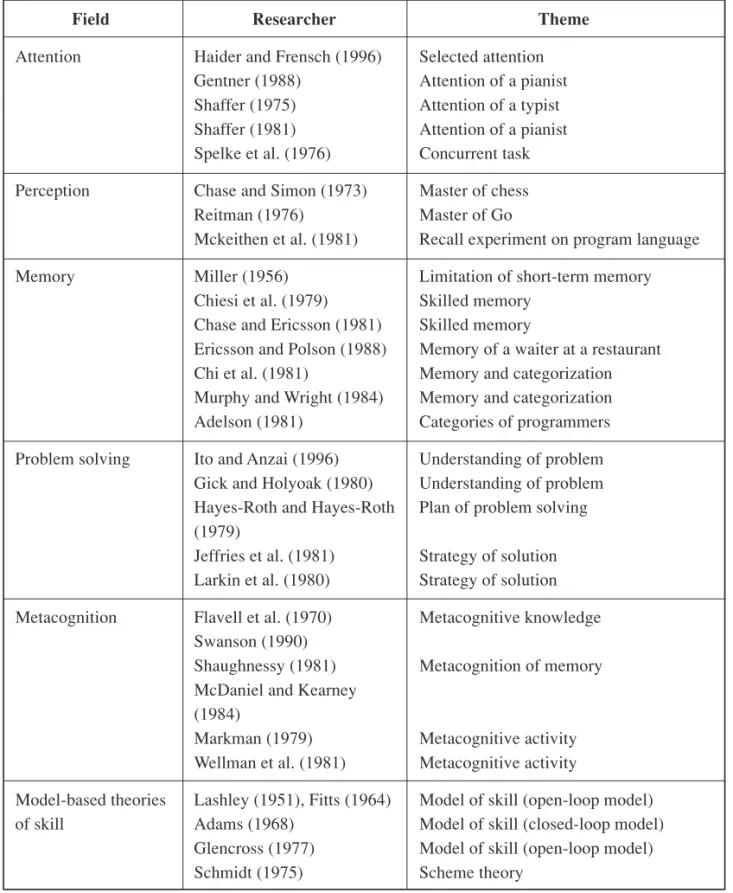
These features of experts have influenced research in various fields of cognitive science, such as perception, memory, problem solving, attention, metacognition, and the model-based theories of skill. Matsumoto (2003) classified the researches on skill in all these fields. The researches listed in table 1 show that skilled behavior can be achieved by the integration of various cognitive elements.
In the 1980s, various problems in the field of cognitive psychology were discussed. One problem pertained to the research methods used to conduct experiments in laboratories and the information processing paradigm. Neisser’s (1976) criticisms were as follows: “Within that laboratory, its basic assumptions go little further than the computer model to which it owes its existence. There is still no account of how people act in or interact with the ordinary world” (pp.67); further, he claimed, “Cognitive psychologists must make a greater effort to understand cognition as it occurs in the ordinary environment and in the context of natural purposeful activity” (p.7), thereby emphasizing the necessary of ecological validity.
The other problem in the field of cognitive psychology pertained to the neglect of situational factors. In earlier research, Gardner (1985) described this problem as “de-emphasis on affect, context, culture, and history” (p.41), and criticized research in the field, stating that “since these factors are central to human experience, any science that attempts to exclude them is doomed from the start,” or “it is wrong to bracket these dimensions artificially” (p.42).
The answer to these criticisms is that situated cognition research developed in the 1990s, as a disciplinary research activity to understand the “cognition of everyday scene” in terms of the relation between the subject and situation. Voss et al. (1995) expressed surprise over this series of research, stating, “Although psychology has been experiencing a cognitive
Table 1: Researches on skill in cognitive psychology
Field Researcher Theme
Attention Haider and Frensch (1996) Selected attention Gentner (1988) Attention of a pianist Shaffer (1975) Attention of a typist Shaffer (1981) Attention of a pianist Spelke et al. (1976) Concurrent task Perception Chase and Simon (1973) Master of chess
Reitman (1976) Master of Go
Mckeithen et al. (1981) Recall experiment on program language Memory Miller (1956) Limitation of short-term memory
Chiesi et al. (1979) Skilled memory Chase and Ericsson (1981) Skilled memory
Ericsson and Polson (1988) Memory of a waiter at a restaurant Chi et al. (1981) Memory and categorization Murphy and Wright (1984) Memory and categorization Adelson (1981) Categories of programmers Problem solving Ito and Anzai (1996) Understanding of problem
Gick and Holyoak (1980) Understanding of problem Hayes-Roth and Hayes-Roth Plan of problem solving (1979)
Jeffries et al. (1981) Strategy of solution Larkin et al. (1980) Strategy of solution Metacognition Flavell et al. (1970) Metacognitive knowledge
Swanson (1990)
Shaughnessy (1981) Metacognition of memory McDaniel and Kearney
(1984)
Markman (1979) Metacognitive activity Wellman et al. (1981) Metacognitive activity
Model-based theories Lashley (1951), Fitts (1964) Model of skill (open-loop model) of skill Adams (1968) Model of skill (closed-loop model)
Glencross (1977) Model of skill (open-loop model) Schmidt (1975) Scheme theory
revolution since the 1950s, the most recent decade has produced what may be termed a sociocultural revolution” (p.174). Then, situated cognition research deals with learning as the main theme and provides various suggestions to skill researches.
Brown et al. stated the basic assumption of situated cognition researches as follows: “Learning and cognition, it is now possible to argue, are fundamentally situated” (Brown et al., 1989, p.32). Collins et al. (1989) and Brown et al. (1989) proposed “cognitive apprenticeship” as a new style of learning based on situated cognition. Collins et al. (1989) compared schooling to traditional apprenticeship and attempted to integrate both in their attempt to explain cognitive apprenticeship. According to this theory, “conceptual and factual knowledge thus are learned in terms of their uses in a variety of contexts, encouraging both a deeper understanding of the meaning of the concepts and facts themselves and a rich web of memorable associations between them and problem-solving contexts” (p.457). Learning a skill or knowledge has a situated nature and also involves acquiring conceptual and factual knowledge. Rogoff (1990) claimed that in the process of cognitive apprenticeship, learners required guided participation. Guided participation is presented as “a process in which caregivers’ and children’s roles are entwined, with tacit as well as explicit learning opportunities in the routine arrangements and interactions between caregivers and children” (p.65); this makes it easy for learners to learn in a community or organization through cognitive apprenticeship. These researches indicate that learners’ behavior is always situated, especially in a situation in which a skill is being used.
The idea that skill or knowledge is basically situated developed into the concept of “organizational memory.” Orr (1990) investigated a community of photocopier repair technicians and advocated the concept of “community memory.” With regard to this research, Orr stated, “Machine problems may actually be problems in the social relationship between customer and machine, and a large part of service work might better be described as the repair and maintenance of the social setting” (p.168). This point of view originated from Orr’s observations of the community of photocopiers. In the community of photocopiers, knowledge about repairing copiers is shared among the entire community, and every copier is aware of who knows what knowledge. The copiers work by using knowledge in the community memory and construct it by discussing their repairing experiences with each other. Orr (1990) stated that technicians displayed their skills by using situated knowledge.
Researches on situated cognition also suggest that learning occurs through a process wherein individuals work together. Hutchins (1989) observed how large ships are navigated and how navigation teams are organized, and proposed the concept of “socially distributed cognition.” In large ships, the members of navigation teams cannot see each other. Each one sticks to his/her job and the large ship is navigated safely. Hutchins (1989) describes this mechanism as follows: “In the team performance configuration, in the place of an executive
we find an interrelated set of functional units. Each team member does a part of the job only when certain conditions appear in the task environment. Coordination among the activities of the team members arises because some of the conditions for each team members’ actions are produced by the activities of the other members of the team” (p.208). This implies that situated actions are closely linked and interdependent, and members act by using information about the situation. Then, Hutchins discussed two elements as being the key to successful navigation. One is the “overlapping distribution of knowledge.” Past experience results in members of a navigation team acquiring several types of skills. Hutchins (1989) claimed the following: “There is substantial sharing of knowledge between individuals with the task knowledge of more expert performers completely subsuming the knowledge of those who are less experienced” (p.212). This point is also discussed by Koike (1996) as an important factor for the effectiveness of Japanese factories. The second important element in successful navigation is “open interaction.” The members of a navigation team, who have different experiences, often communicate, help, and learn. They work in positions close to each other and interact within a certain range in the workplace (this boundary is called “horizon of observation”). Hutchins (1989) proposed the importance of the situated feature of navigation and also the importance of acquiring skills in navigation.
The more sophisticated framework of learning in a community or workplace is the concept of “legitimate peripheral participation” proposed by Lave and Wenger (1991). They constructed this theory by referring to ethnographic research, and discussed the reconstruction of apprenticeship. In the framework of legitimate peripheral participation, “learners inevitably participate in communities of practitioners and … the mastery of knowledge and skill requires newcomers to move toward full participation in the sociocultural practices of a community” (p.29). Learners are allowed to stay in the community of practitioners and learn (or “steal”) knowledge and skills by performing one of the jobs there. This is referred to as the legitimacy of participation. Then, learners begin engaging in work from the periphery of the community and act toward full participation. Lave and Wenger (1991) considered this as “actors’ learning trajectories” (p.36). They equated learning and participation. Furthermore, participation in a community is a process of learning and helps learners to develop an identity. Lave and Wenger (1991) conceptualize identity as “long-term, living relations between persons and their place and participation in communities of practice”; further, according to them, “identity, knowing, and social membership entail one another” (p.53). Legitimate peripheral participation is excellent according to the view that assumes the trinity of acquiring skill, participating in a community, and constructing identity. This theory proposed applying the concept of situated learning to researches on skill.
Wenger (1998) and Wenger, McDermott, and Snyder (2002) developed the framework of legitimate peripheral participation into a useful concept, namely, “communities of practice.”
This concept is defined as “groups of people who share a concern, a set of problems, or a passion about a topic, and who deepen their knowledge and expertise in this area by interacting on an ongoing basis” (Wenger, McDermott, and Snyder, 2002, p.4); further, communities of practice require a domain, community, and practice. The difference between communities of practice and legitimate peripheral participation is that the latter is characterized by formability, which means communities of practice are able to be formed in organization. On the other hand, in communities of practice, boundary, locality, identity, meaning, and learning are established through practice in the community and other means. With regard to learning, Wenger (1998) claimed that learning could not be designed but could design the mode of belonging to a community. Communities of practice facilitate learning, and Wenger, McDermott, and Snyder (2002) applied to knowledge management, four things that communities of practice can do (p.14):
1. Connect local pockets of expertise and isolated professionals;
2. Diagnose and address recurring business problems whose root causes transcend team boundaries;
3. Analyze the knowledge-related sources of uneven performance across units performing similar tasks and work to bring everyone up to the highest standard;
4. Link and coordinate unconnected activities and initiatives addressing a similar knowledge domain.
Researches on communities of practice shifted their focus from skill to knowledge while comparing communities of practice to legitimate peripheral participation; however, communities of practice was originally a concept to facilitate learning. It has various implications for research on skill.
Career theories and the concept of meta-skill
The hierarchical feature of skill has been classified in terms of three features. The first feature is the cognitive feature of meta-skills; this has already been discussed and refers to the use of subordinate skills in order to perform and to the use of situational skills as meta-skills, whereby the person chooses the subordinate skill according to the situation. This hierarchical concept can be seen in Anderson (1980). The second feature is the portable feature of meta-skills. This concept appears in researches of firm-specific skills, which can be used only in certain firms. Becker (1964) and Doeringer and Piore (1971) have discussed the effectiveness and training costs of such skills. In arguments concerning firm-specific skills, “uniqueness” or “originality” have been categorized as the positive functional aspect of firm-specific skills, and particularly from a career-related perspective, “portability” or “currency” has been
identified as the dysfunctional aspect of such skills. In the field of organizational behavior, the low currency of firm-specific skills has been recognized as being due to employees’ side bets (Becker, 1960) and has been further studied in relation to turnover or organizational commitment. Matsumoto (2003, 2004) claims that these two aspects of firm-specific skill delineated in the studies on them need to be discriminated. Third, career theories ascribe an organizational feature to the concept of skill. This is similar to “learning how to learn”, and is a perspective that considers meta-skill as a way to adapt to an organization, as discussed by Mirvis and Hall (1996). It is necessary for individuals to learn meta-skills and to adapt to an organization so that they can survive in a boundaryless environment. In the following, based on Matsumoto (2008a, 2008b), we explain the concept of meta-skill in career theories.
Researches on skill in the field of career have been developed, with some delay, from career theories because of the lack of improvement in learning theory. Sonnenfeld and Kotter (1982) reviewed career theories and classified them into four types on the basis of the approaches they adopt (pp.34–35):
1. The social structure approach (1890s–) 2. The individual traits approach (1920s–) 3. The career stage approach (1950s–) 4. The life cycle approach (1970s–)
A fifth approach, the boundaryless career approach (1990–), should also be added to the four abovementioned approaches. Each period witnessed various researches utilizing the abovementioned approaches as follows: the social structure approach (Guest, 1954; Blau, 1956; Schneider and Lysgard, 1953), the individual traits approach (Holland, 1985; Cattell, Day, and Meeland, 1956), the career stage approach (Havighurst, 1953; Super, 1953, 1957; Super and Born, 1970; Super, Savicas, and Super, 1996; Schein, 1978, 1990), and the life cycle approach (Erikson, 1967; Erikson and Erikson, 1997; Levinson, 1978). In the series of career theories, learning became an important topic after Schein (1978). Schein proposed a nine-stage model of career and used skill and learning as the staple concepts in it, especially in the third stage, namely, “basic training”; he proposed that building skill is the key to adapting to an organization. In his research of “career anchors,” two of eight career anchors— technical/functional competence and general managerial competence—are based on abilities, and one of three questions is related to skill and knowledge.
Then, the series of researches by Krumboltz (Krumboltz, 1966; Krumboltz and Thoresen, 1969; Krumboltz, 1979; Mitchell and Krumboltz, 1996; Mitchell, Levin, and Krumboltz, 1999; Krumboltz and Levin, 2004) also dealt with learning as the main topic of the theory. Krumboltz’s theory was the social learning theory of career decision-making (SLTCDM),
derived from Bandura’s (1977) social learning theory. According to the SLTCDM, learning could be divided into direct learning and observed learning and both these were applied to career theory; the two corresponding learning experiences (instrumental learning experiences and associative learning experience) were based on task approach skills. Skill, in Bandura’s theory, had a broader meaning and included not just ability but also values, habits, perception, and cognitive processes. Then, beliefs (both about oneself and the environment), task approach skills (results as well as precedential factors), and actions resulted from learning. The SLTCDM first developed into the “planned happenstance theory” and later into the career competence theory.
However, learning and skill have been discussed using concrete images, based on researches on the boundaryless career. Arthur and Rousseau (1996) advocated the importance of learning, stating, “The boundaryless career perspective suggests that people take responsibility for their own career futures. If they are to do so, ‘cultivating networks’ and gaining access to other people’s knowledge and resources are fundamental steps” (p.11). This point is related to situated cognition and Arthur and Rousseau actually cited it from Brown and Duguid’s (2000) research on communities of practice. Then, various researches on the boundaryless career (e.g., Saxenian, 1996; Raider and Burt, 1996), transition researches (e.g., Bridges, 1980; Nicholson, 1984; Nicholson and West, 1989) regarded learning as important because it is a useful concept to design the boundaryless career.
Furthermore, some researches have dealt with not only skill but also meta-skill and career competence as the keys to surviving a boundaryless career. Mirvis and Hall (1996) claimed that a boundaryless career “makes people’s know-how, self-direction, and learning-ability the core competencies,” and “the ability to learn-how-to-learn will be crucial to their success in cobbling together an enriching career path” (p.240). Meta-skills to adapt to a new organization every time the workplace changes is the key to a “protean career” (Hall, 1976), and the hierarchy of skill is discussed in career theories as a means of adapting to the workplace. Mirvis and Hall (1996) conceptualized meta-skills as the ability to learn “reskilling” (p.240) in relation to a firm-specific skill.
Mitchell, Levin, and Krumboltz (1999) also discussed the meta-level of competence in the extension of the SLTCDM by Mitchell and Krumboltz (1996), and proposed the “planned happenstance theory.” This is “a conceptual framework extending career counseling to include the creating and transforming of unplanned events into opportunities for learning” (p.117); the basic concept of this theory is similar to the concept of meta-skill, that is, learning how to learn. For career succession planning, it is necessary to interpret “undecided” with an “open-minded.” To do so, Mitchell, Levin, and Krumboltz (1999) proposed “five skills to recognize, create and use chance as career opportunities.” These are as follows (p.118):
1. Curiosity: exploring new learning opportunities; 2. Persistence: exerting effort despite setbacks; 3. Flexibility: changing attitudes and circumstances;
4. Optimism: viewing new opportunities as possible and attainable; 5. Risk Taking: taking action in the face of uncertain outcomes.
The above skills have their roots in the concept of task approach skill of the SLTCDM and are more akin to mindset rather than skill. The planned happenstance theory is a starting point for researches on career competence.
Arthur, Claman, and DeFillippi (1995) also advocated a career competence theory called the “intelligent career theory.” The main feature of this theory is that it considers learning as the main factor and considers the interaction between skill and other factors. Arthur, Claman, and DeFillippi derived three career competencies from Quinn’s (1992) “intelligent enterprise” framework; these competencies are three types of “knowing”; knowing how, knowing why, and knowing whom. Knowing how refers to “skills and knowledge a person brings to a firm’s overall know-how,” knowing why refers to “the nature and extent of a person’s identification with the employing firm’s culture,” and knowing whom refers to “the set of interpersonal relationships an employee contributes to a firm’s networking activities” (pp.9–10). Arthur, Claman, and DeFillippi (1995) claimed that accumulating these three career competencies leads to benefits for both firms and individuals in a new career paradigm. Moreover, Defillippi and Arthur (1996) pointed out that voluntarism with regard to choice, market discipline to deepen their value, leverage of competencies, collaboration through interpersonal networks, and resiliency to upgrade skill were values common to a competency-based, boundaryless career. Waterman, Waterman, and Collard (1994) claimed that Personnel who embody these characteristics constitute a career-resilient workforce. Furthermore, Eby, Butts, and Lockwood (2003), and Parker, Khapova, and Arthur (2007) propose that over time, the three ways of knowing interact with each other. This idea is a very thought provoking one for researches on skill.
Research on skill and competence in career theory reinforce the idea of hierarchical skill. In other words, meta-skills are conceptualized as enabling one to adapt to an organization, or learning how to learn. These concepts serve to expand the scope of research on the concept of skill.
Conclusion
This paper discussed the concept of skill by reviewing various literatures and proposed the hierarchical and situational model of skill and two types of skills: situational skills and subordinate skills. The paper then proceeded to review additional literatures to reinforce the
proposed model, especially its hierarchical and situational features. We believe that this concept of skill has plenty of scope for further research.
The recent problem pertaining to research on skill concerns verifying the validity of the concept and qualitatively and quantitatively investigating it. We have already investigated some analyses on the relationships among skill, commitment, and career variables (Matsumoto, 2007; Matsumoto, Kato, and Suzuki, 2007) and strongly believe that the concept of skill, especially that of situational skill, is useful not only for research on skill and learning but also for research in the fields of organizational behavior and career. In the future, we also intend to apply the concept of skill to other fields, for example, that of knowledge management.
References
Adams, J. A. (1968), “Response feedback and learning,” Psychological Bulletin, vol.70, pp.486-500.
Adelson, B. (1981), “Problem solving and the development of abstract categories in programming languages”, Memory & Cognition, Vol.9, pp.422-433.
Anderson, J. R. (1980), Cognitive psychology and its implication, W. H. Freeman and Company.
Argyris, C. and Schön, D. A. (1974), Theory in practice, Jossey-Bass.
Argyris, C. and Schön, D. A. (1978), Organizational learning: A theory of action perspective, Addison-Wesley.
Arthur, M. B., Claman, P. H. and DeFillippi, R. J. (1995), “Intelligent enterprise, intelligent career”, Academy of Management Executive, 9(4), pp.7-20.
Arthur, M. B. and Rousseau, D. M. (1996), “The boundaryless career as a new employment principle”, Arthur, M. B. and Rousseau, D. M. (Eds.), The boundaryless career: a new employment principle for a new organizational era, Oxford University Press, pp.3-20.
Bandura, A. (1977), Social learning theory, Prentice-Hall.
Becker, G. S. (1964), Human Capital, Columbia University Press.
Becker, H. S. (1960), “Note on the concept of commitment” American Journal of Sociology, Vol.66, pp.32-40.
Blau, P.M. (1956), “Social mobility and interpersonal relations”, American Sociological Review, Vol.21, pp.290-295.
Braverman, H. (1974), Labor and monopoly capital, Monthly Review Press.
Bridges, W. (1980), Transitions, Addison-Wesley.
Brown, J. S., Collins, A. and Duguid, P. (1989), “Situated cognition and the culture of learning”, Educational Researcher, Vol.18, pp.32-42.
Brown, J. S. and Duguid, P. (2000), The social life of information, Harvard Business School Press.
Bryan, W. L. and Harter, N. (1899), “Studies on the telegraphic language: The acquisition of a hierarchy of habits”, Psychological Review, Vol.6, pp.345-375.
Cattrell, R.B., Day, M. and Meeland, T. (1956), “Occupational profiles on the 16 personality factor questionaire”, Occupational Psychology, Vol.40, pp.16-19.
Chase, W. G. and Ericsson, K. A. (1981), “Skilled memory,” Anderson, J. A. (Ed.), Cognitive skill and their acquisition, Lawrence Erlbaum Associates, pp.141-189.
Chase, W. G. and Simon, H. A. (1973), “Perception in chess,” Cognitive Psychology, Vol.4, pp.55-81.
Chi, M. T. H., Feltovich, P. J. and Glaser, R. (1981), “Categorization and Representation of physics problem by expert and novices,” Cognitive Science, vol.5, pp.121-152.
Chiesi, H. J., Spilich, G. J. and Voss, J. F. (1979), “Acquisition of domain-related information in relation to high and low domain knowledge”, Journal of Verbal Learning and Verbal Behavior, Vol.18, pp.257-273.
Colley, A. M. and Beech, J. R. (1989), “Acquiring and performing cognitive skills,” Colley, A. M. and Beech, J. R. (Eds.), Acquisition and performance of cognitive skills, John Wiley and Sons, pp.1-16.
Collins, A., Brown, J. S. ,and Newman, S. E. (1989), “Cognitive apprenticeship: Teaching the craft of reading, writing and mathematics”, Resnick, L. B. (Ed.), Knowing, learning, and instruction: Essays in honor of Robert Glaser, Lawrence Erlbaum Associates, pp.453-494.
Cyert, R. M. and March, J. G. (1963), A behavioral theory of the firm, Prentice-Hall.
DeFillippi, R. J. and Arthur, M. B. (1996), “Boundaryless contexts and careers: A competency-based perspective”, Arthur, M. B. and Rousseau, D.M. (Eds.), The boundaryless career: a new employment principle for a new organizational era, Oxford University Press, pp.116-131.
Doeringer, P. and Piore, M. (1971), Internal labor and Manpower Analysis, Heath.
Dreyfus, H. L. and Dreyfus, S. E. (1986), Mind over Machine: The Power of Human Intuition and Expertise in the Era of the Computer, Free Press.
Duncan, R. and Weiss, A. (1979), “Organizational learning: Implications for organizational design”, Research in Organizational Behavior, Vol.1, pp.75-123.
Eby, T. E., Butts, M. and Lockwood, A. (2003), “Predictors of success in the era of the boundaryless career”, Journal of Organizational Behavior, Vol.24, pp.689-708.
Erikson, E. H. (1967), Childfood and society, W. W. Norton & Company.
Erikson, E. H. and Erikson, J. M. (1997), The life cycle completed, W. W. Norton & Company.
Ericsson, K. A. and Polson, P. G. (1988), “A cognitive analysis of exceptional memory for restaurant orders”, Chi, M. T. H., Glaser, R. and Farr, M. J. (Eds.), The nature of expertise, Lawrence Erlbaum Associates, pp.23-70.
Fitts, P. M. (1964), “Perceptual-Motor skill Learning”, Melton, A. W. (Ed.), Categories of human learning, Academic Press, pp.243-285.
Fitts, P. M. and Posner, M. I. (1967), Human Performance, Brooks/Cole Publishing.
Flavell, J. H., Friedrichs, A. G. and Hoyt, J. D. (1970), “Developmental Changes in memorization process”, Cognitive Psychology, Vol.1, pp.324-340.
Gardner, H. (1985), The Mind’s New Schience: A History of Cognitive Revolution, Basic books.
Gentner, D. R. (1988), “Expertise in typewriting”, Chi, M. T. H., Graser, R. and Farr, M. J. (Eds.), The nature of expertise, Lawrence Erlbaum Associates, pp.1-22.
Gick, M. L. and Holyoak, K. J. (1980), “Analogical Problem Solving”, Cognitive Psychology, Vol.12, pp.306-355.
Glaser, R. and Chi, M. T. H. (1988), “Overview”, Chi, M. T. H., Glaser, R. and Farr, M. J. (Eds.), The nature of expertise, Lawrence Erlbaum Associates, pp.xv-xxviii.
Glencross, D. J. (1977), “Control of skilled movements”, Psychological Bulletin, vol.84, pp.14-29.
Guest, R.H. (1954), “Work careers and aspirations of automobile workers”, American Sociological Review, Vol.19, pp.155-163.
Guthrie, E. R. (1952), The psychology of learning (2nd edition), Peter Smith.
Haider, H. and Frensch, P. A., “The role of information reduction in skill acquisition,” Cognitive Psychology, Vol.30, pp.304-337, 1996.
Hatano, G. and Inagaki, K. (1986), “Two cources of expertise”, Stevenson, H., Azuma, H. and Hakuta, K. (Eds), Child development and education in Japan, W. H. Freeman and Company, pp.262-272.
Hall, D. T. (1976), Careers in organization, Scott, Foresman.
Havighrst, R. J. (1953), Human development and education, Longmans, Green & Co.
Hayes-Roth, B. and Hayes-Roth, F. (1979), “A cognitive model of planning”, Cognitive Science, Vol.3, pp.275-310.
Holland, J. L. (1985), Making vocational choices: a theory of careers, 2nd edition, Prentice-Hall.
Hutchins, E. (1989), “The technology of team navigation”, Galegher, J., Kraut, R. and Egido, C. (Eds.), Intellectual Teamwork: Social and Technical Bases of Cooperative Work, Lawrence Erlbaum Associates, pp.191-220.
Jeffries, R., Turner, A. A., Polson, P. G. and Atwood, M. E. (1981), “The prosesses involved in Designing software”, Anderson, J. R. (Ed.), Cognitive Skills and Their Acquisition, Lawrence Erlbaum Associates, pp.255-283.
Kahneman, D. (1973), Attention and Effort, Prentice-Hall.
Katz, R. L. (1955), “Skills of an effective administrator”, Harvard Business Review, Vol.33, pp.33-41.
Koike, K. (1994), “Learning and incentive systems in Japanese industry”, Aoki, M. and Dore, R. (Eds.), The Japanese firm: Sources of competitive strength, Oxford University Press, pp.41-65.
Koike, K. and Inoki, T. (1990), Skill formation in Japan and sougheast asia, University of Tokyo Press.
Krumboltz, J. D. (1966), Revolution in counseling: implication of behavioral schience, Houghton Mifflin.
Krumboltz, J. D. (1979), “A social learning theory of career decision making”, Mitchell, A.M., Jones, G.B. and Krumboltz, J.D. (Eds.), Social learning and career decision making, Carroll Press.
Krumboltz, J. D. and Thoresen, C. E. (1969), Behavioral counseling: cases and techniques, Holt Rinehart and Winston.
Krumboltz, J. D. and Levin, A. S. (2004), Luck is no accident, Impact Publishers.
Larkin, J., McDermott, J., Simon, D. P. and Simon, H. A. (1980), “Expert and novice performance in solving physic problem”, Science, Vol.208, pp.1335-1342.
Lashley, K. S. (1951), “The problem of serial order in behavior”, Jeffress, L. A. (Ed.), Cerebral mechanisms in behavior: The hixon symposium, John Wiley, & Sons, pp.112-146.
Lave, J. and Wenger, E. (1991), Situated Cognition: Legitimate Peripheral Participation, Cambridge University Press.
Levinson, D. J. (1978), The seasons of man’s life, Alfred Knopf.
Mace, C. A. (1955), “The analysis of human skills”, Occupational Psychology, Vol.24, No.3, pp.125-140.
March, J. G. and Olsen, J. P. (1976), Ambiguity and choice in organizations, Universitetsforlaget.
Markman, E. M. (1977), “Realizing that you don’t understand: A preliminary investigation”, Child Development, Vol.48, pp.986-992.
Matsumoto, Y. (2003), Soshiki to ginou (Skill and organization), Hakuto Shobo. (Japanese)
Matsumoto, Y. (2004), “A study about firm-specific skills”, The Review of Business and Economics: The University of Kitakyushu, Vol.39, pp.7-24. (Japanese)
Matsumoto, Y. (2005), “Beyond the firm-specific skills-Discussion from a perspective of cognitive organizational theory”, The Review of Business and Economics: The University of Kitakyushu, Vol.40, pp.57-71. (Japanese)
Matsumoto, Y. (2007), “Statistic analysis of skill acquisition in Co-op”, Review of Consumer Co-operative Studies, Feb. 2007, pp.33-40. (Japanese)
Matsumoto, Y. (2008a), “Skill and learning in career theory: A study for theoretical integration”, Journal of Business Administration: Kwansei Gakuin University, Vo.56, No.1, pp.71-103. (Japanese)
Matsumoto, Y. (2008b), “Skill and learning in career theory: A study for theoretical integration (II)”, Journal of Business Administration: Kwansei Gakuin University, Vo.56, No.2, pp.65-116 (Japanese) Matsumoto, Y., Kato, I. and Suzuki ,R. (2007), “Are we bad dancers? Skills and their influence on careers
in Japan”, submitted to 23rd EGOS Colloquium, July 5-7, in Vienna, Austria.
McDaniel, M. A. and Kearney, E. M. (1984), “Optimal learning strategies and their spontaneous use: The importance of task-appropriate processing”, Memory & Cognition, Vol.12, No.4, pp.361-373.