Effects of the Bimoraic Foot on Japanese
Perception of Rhymes from Japanese and English
Sequences
journal or
publication title
Ex : エクス : 言語文化論集
number
6
page range
1-22
year
2009-04-30
URL
http://hdl.handle.net/10236/2347
on Japanese Perception of Rhymes
from Japanese and English Sequences
Hiromi Otaka
0. IntroductionIn poetry, every language has developed a way of creating repetitive patterns of sound as a literary ornament.1) This phonetic artifice, which
is based on the repetition of two sounds which are close enough to each other to be perceived, is known as “rhyme,” “alliteration,” “assonance,” or “consonance,” depending on the location of the repeated sounds.
The repetition of an identical sound appeals to the ear because of the echoing effect. There are four types of repetitions:
1. “Alliteration” is the repetition of the sound of an initial consonant or consonant cluster in stressed syllables (e.g., Sink or swim, Green as grass, Sing a song of sixpence). There is usually stress on the repeated syllables, but this is not always the case (e.g., Political policy poem). 2. “Rhyme” consists of the same vowel and coda sounds in the terminal
syllables of two or more words (e.g., Perish or publish, Health is better than wealth.). In poetry, a rhyme which is in the final syllable(s)
1) According to Epsy (1986: 4), rhymes first appeared in church Latin around 200 AD. Rhymes were not yet common in ancient Greek, and there is no evidence that rhymes were used in classic Latin poetry, either.
of a verse is called “end rhyme” or “tail rhyme.” This is the most common form of rhyme in poetry. On the other hand, a rhyme which is between a word which is at the end of one line and another word which is in the interior of the same or another line is called “internal rhyme” or “middle rhyme.”
3. “Assonance” is the repetition of vowel sounds in non-rhyming words (e.g., Mellow wedding bells, The crumbling thunder of seas).
4. “Consonance” is the repetition of identical consonants that occurs anywhere within the words except at the beginning position (e.g., Short and sweet, live and leave).
Although these phonetic artifices are most often used in poetry, in modern times, they are also often used in many other forms of prose, such as news headlines, buzzwords, nursery rhymes, corporate business names, literary titles, the naming of comic book characters, and advertising. This is because this phonetic artifice (henceforth called “rhyme” as a generic term for all four phonetic devices listed above) can phonologically influence listeners to perceive rhythm by comparing the similarities and differences between the rhyming words. Thus, rhymes can be used as powerful mnemonic devices. Rhymes also highlight semantic differences between words because at the phonetic level, the listener notices both the similarity of the rhyming word-final syllables and the difference of the initial consonants, which shows the semantic difference.
However, the Japanese language seems to be vastly different from English in terms of the frequency of occurrence of rhymes. Japanese speakers do not produce rhymed sequences as often as English speakers do in their daily life. In addition, internal rhymes used in English (e.g., in the proverb Friends in need are friends indeed) and alliteration (e.g., in comic book
characters’ names like Mickey Mouse and King Kong) are not likely to be fully appreciated by Japanese learners of English, as will be confirmed later through an experiment.
Furthermore, the fact that in English, consonance and assonance are not as frequently used as alliteration and end rhyme (Preminger and Brogan 1993) implies that consonance and assonance are more useful as structural elements than alliteration and end rhyme. This is probably because consonance and assonance provoke a more subtle effect than alliteration and end rhyme. Thus, it is worthwhile to explore the reason why the degree of perceptibility varies depending on the type of rhyme.
There are two research questions for this study:
1. Why are Japanese speakers not able to fully perceive English rhymes?
2. Why does the degree of perceptibility of a rhyme vary depending on the type of rhyme, regardless of the language?
The goal of this study is to explore the reasons for these two research questions by means of an experiment with Japanese-speaking informants. It is hypothesized that particular characteristics of Japanese phonology may prevent Japanese listeners from being able to notice the echoing effects in English rhymes.
In this study, the differences in perceptibility of rhymes, both between the types of rhymes and between Japanese and English languages are explained by means of statistical probability, along with the effect of linguistic units such as feet, words, and phrases. Feet are phonological units related to rhythm, while words and phrases are syntactic units. What is common to them is that they are all chunks with two necessary parts, a beginning and an ending.
The result of this experiment is that the bimoraic foot in Japanese plays a key role for Japanese listeners to perceive rhymes. This also implies that the foot is an important phonological structure in Japanese, as was claimed in the past literature (Liberman and Prince 1977, Selkirk 1980, Tateishi 1989, Poser 1990, Ito 1990, Mester 1990, Sato 1993, Kurisu 1994, 1996). Thus, this can be a supportive study for these in terms of the existence of the bimoraic foot in Japanese.
1. Possible factors that affect the perceptions of rhymes
Rhyming structures vary dramatically among languages. Japanese for example, is not an inflected language such as Italian, in which a word may rhyme simply because it has the same grammatical form as another (e.g., end rhymes based on verbal inflection such as “-are,” “-ato,” and “-ando”). There are innumerable possible rhymes in Italian which occur simply by coincidence. On the contrary, grammatically-oriented rhymes are much rarer in English because English has lost nearly all of its inflection system. Thus, rhymes in English have a rather higher degree of perceptibility compared to rhymes in Italian. This shows that the degree of rhyme perceptibility may vary among languages.
Grammatically-oriented rhymes are not perceptible enough for the listeners to perceive them as effective poetic devices. The same thing can be said for rhymes in Japanese. For example, in Japanese, every sentence ends with the syllable “ta” if it is in the past tense because /ta/ is a past/perfect tense marker which is added to a verbal root at the end of a sentence. But no Japanese listener would regard the repetition of /ta/ as an end rhyme because the repetition of /ta/ in past tense sentences is not because of the speaker’s intention but because of a grammatical rule.
Therefore, it can be said that sequences which have an identical sound cannot always be perceived to be a rhyme unless the speaker’s intention has been fully recognized from the rhyme. That is why the effect of English speakers’ perception of English “punning rhymes” such as bare / bear and flower / flour is much more subtle compared to rhymes which have an imperfect match in sound, such as green / fiend. Even though punning rhymes are also called “rich rhymes,” “perfect rhymes,” and even “true rhymes,” the perceptibility of this type of rhyme among English listeners is actually not so “rich,” “perfect,” or “true” compared to the other types of rhymes.
In addition to the effect of the speaker’s intentions mentioned above, some linguistic factors (such as syntactic boundaries, for example) also affect the listener’s recognition of rhymes. In English alliteration, identical sounds always occur at the beginning of words (e.g., Watchful waiting, Nattering nabobs of negativism) because words are syntactic units which are syntactically independent of each other within a sentence and because the beginning and ending sounds of units in series have special cognitive discernability, and therefore, are more memorable than sounds which are located in other positions for internal rhymes. Thus, it can be claimed that the location of repeated sounds occurring within words or phrases is a factor that affects the degree of perceptibility of rhymes.
Phrases involving alliteration among both stressed and unstressed syllables, as in Political pólicy poem and McDónald’s massacre, for example, seem to provoke a more subtle effect compared to the previous examples (Wátchful wáiting, Náttering nábobs of négativism) because the location of stress agrees with the location of the rhyming syllable in the latter but not in the former. This is probably because stress is closely related to the
location of the feet, which are rhythmic units in English. Thus, it can be assumed that feet are another factor that affects the degree of significance of rhymes.
Lastly, the distance between two rhyming sounds is another significant factor for the repetition to be discernable because of the restriction of short-term memory capacity.
2. Rhymes in Japanese
The method of rhyming in Japanese is somewhat different than rhyming in English. Following are four examples of traditional Japanese verses quoted from Hyakunin Isshu (“An anthology of Wakas written by one hundred poets”) compiled by the famous poet Fujiwara no Teika (1162–1241) during the Kamakura era (1185–1333). The four poems below were written by Shokushinai Shinnō (1149–1201), Ki no Tomonori (c. 850–c. 904), Kawara no Sadaijin (822–895), and Mibu no Tadamine (active 898– 920), respectively. They all lived during the Heian period (794–1185). Notice the rhyming sounds which are underlined in the verses below:
1. Tama no o yo Taena ba taene Nagarae ba
Sinoburukoto no Yowarimozo suru (by Shokushinai Shinnō) 2. Hisakata no Hikari nodokeki Haru no hi ni
Shizu kokoro naku Hana no chiruran (by Ki no Tomonori) 3. Michinoku no Shinobu modizuri Tare yue ni
Midare someni shi Ware nara naku ni (by Kwara no Sadaijin) 4. Ariake no Tsurenaku mie shi Wakare yori
Akatsuki bakari Ukimono ha nashi (by Mibu no Tadamine)
In the first example, the consonants /t/ and /n/ are alliterated. The voiceless stop consonant /t/ occurs three times and the alveolar nasal
consonant /n/ occurs six times. However, the /n/’s seem to give a more subtle effect than /t/ because the /t/’s are all followed by the same vowel, but the /n/’s are followed by different vowels. In addition, the syllable /ta/ always occurs at the beginning of phrases (bunsetsu in Japanese, which consist of a word plus a postposition), unlike the syllables beginning with /n/. The more a sound is repeated within a line, the greater the perception of the rhyme, but this is only the case if the identical sounds occur at the same location in a certain unit, i.e., either at the beginning or at the end of words or phrases. Therefore, it can be assumed that if /ta/ occurred only twice rather than three times in this verse, less Japanese listeners would notice the rhyme from the verse (cf. the significance of the rhyme in Example 2, in which the syllables /hi/ and /ha/ are repeated only twice for each). This is because the degree of perceptibility of a rhyme is related to the degree of “markedness”; i.e., the less marked (or the more probable) a rhyme is, the less it is perceived. That is why in Example 1, the repetition of the syllable /ta/ is more perceptible than the single onset consonant /n/. This is because the event that the combination of two sounds (/t/ and /a/) occurs three times is more marked (i.e., less probable) than the event that an onset consonant occurs twice in a sequence.
In Example 3 above, a rhyme occurs on the final vowel (/i/) three times in this phrase, but the perceptibility of this rhyme is very subtle compared to the rhyme in Example 1. This is because in Japanese, rhymes which are either on an onset consonant, a mid vowel, or a final vowel are not very perceptible compared to rhymes which are on a whole syllable. That is why in Example 4 above, the rhyme of final /i/ is not very perceptible to Japanese listeners, even though this vowel occurs four times in this phrase. However, the rhyme of the entire syllable /shi/ as well as the rhyme of
/ri/ are very perceptible in this phrase because they are both rhymes on the terminal syllables of words or phrases. In fact, as will be discussed in detail later, rhymes in sequences which correspond to bimoraic feet are the most perceptible to Japanese listeners.
In both Japanese and English, rhymes are used not only in poetry, but also in other forms of prose. For example, Interu haitteru (“Intel inside”) and Doosuru aifuru (“What would you do with Aifuru?”) are expressions which have been broadcast as catch phrases in recent TV commercials in Japan. These catch phrases are appealing to the Japanese audience because it is easy to notice the end rhymes from these phrases, which makes these phrases very easy to memorize.
As these examples show, Japanese end rhymes often involve two syllables (or VCV moras). This type of end rhyme is called “feminine rhyme” (or “double rhyme”) in English (e.g., profession / discretion) as opposed to “masculine rhyme,” in which only one syllable rhymes, and the two words end with the same vowel-consonant combination (e.g., sublime / crime). In Japanese, feminine rhyme attracts the listeners’ attention because in Japanese, rhyming on two final syllables is more marked (less probable) than rhyming on only one syllable.
However, the above explanation based on markedness (statistical probability) does not explain why in English, masculine rhyme is just as acoustically appealing as feminine rhyme. Thus, it is important to answer these two questions:
1. Why does Japanese rhyme usually occur on a syllable as a minimum set, but not on an onset consonant or the following vowel?
2. Why are feminine rhymes preferred over masculine rhymes in Japanese?
3. Foot structure that affects the perception of rhymes
As has been mentioned above, rhymes on a whole syllable which consist of an onset consonant plus a vowel (called “reverse rhyme” in English) are much more frequently used than alliteration in Japanese, but this is not the case in English. In fact, reverse rhyme sometimes occurs in English as well (e.g., Time and tide wait for no man.), but it is quite rare in English. This is because the repeating of an identical onset consonant or consonant cluster is discernible enough as a rhyme for English listeners.
As for end rhyme in Japanese, usually two successive syllables which are at the end of a word or phrase are echoed with the counterparts of another word or phrase (i.e., feminine rhyme), but in English, usually only the terminal part of the last syllable (i.e., a stressed nucleus plus the following coda consonants) is echoed with the counterpart of another word or phrase (i.e., masculine rhyme). This difference in the frequently-used type of end rhyme can be partially explained by the difference in foot structure between the two languages. As was discussed in Poser (1990), Japanese feet are always bimoraic, whereas there are several different types of English feet (i.e., one stressed syllable followed by zero to 4 unstressed syllables) and in English, a foot composed of only one stressed syllable is not rare at all because there are many monosyllabic words in English (e.g., Ben told Sam four lies, too.), but this is not the case in Japanese. Most monosyllabic words in Japanese originate from Proto-Japanese (e.g., /te/ “hand,” /me/ “eye,” /ki/ “tree,” /ti/ “blood”) and the number of monosyllabic words is much less than the number of polysyllabic words in Japanese. In addition, monosyllabic words cannot constitute an entire foot in Japanese, whereas they can in English. (This will be discussed in more detail later.) These are probably the reasons why English speakers are more sensitive to
the constituents of syllables (i.e., onset, nucleus, and coda) than Japanese speakers.
Stress can be a cue of the beginning of a foot in English. That is why an alliteration which occurs only on stressed syllables (e.g., Full fathoms five thy father lies, by Shakespeare) has greater perceptibility in English than an alliteration which includes at least one non-stressed syllable (e.g., Political policy poem). Note that in the former case, the repeated sounds are at the beginnings of both the words and the feet. However, the latter case of alliteration is also perceptible to a limited extent, even though the repeated sound /p/ is not always at the beginning of the feet. Therefore, it can be assumed that alliteration in which repeated sounds occur on stressed syllables which are located at the beginning of words are the most perceptible.
Note that the likelihood that the listener will recognize a rhyme may be higher in the case in which both of the repeated sounds occur on the first syllable of the words and both of these first syllables are stressed syllables. This is because in this case, the location of the rhyming sounds are at the beginning of the words as well as the beginning of the feet, which highlights the position of the sounds as the onset of the rhythmic units (i.e., the feet). 4. A probabilistic analysis of rhyme perception
In the above discussion, it was argued that the location of repeated sounds is a factor that affects the probability that an identical sound is repeated across words or phrases. The lower this probability is, the more marked the occurrence of the repetition of a sound is considered to be, and therefore, the greater the perceptibility of the rhyme.
sound is repeated twice in English and Japanese alliteration. There are three types of onset consonant structures in English (C, CC, and CCC), but there are only two types of onset structures in Japanese (C and CC). In English, for syllables that have an initial C, there are 22 different consonants. If the onset is a cluster of CC, there are 20 possible combinations of consonants.2) And if the onset is CCC, then there are 8
possible combinations.3) Since these three kinds of events are independent,
the probability of getting any combination of onset consonants is 1/50 (because 22+20+8=50). Thus, the probability of identical onset consonants or consonant clusters on two independent syllables is 1/50.
On the other hand, in Japanese, if the onset structure consists of only C, there are 18 kinds of consonants,4) and if it is CC, then there are 6
combinations.5) These two events are independent, so the probability of
having an identical consonant or consonant cluster on two independent syllables is 1/24.
Note that the probability of the same onset occurring in English is less than half as much as the probability in Japanese. Therefore, it can be assumed that the repetition of an identical onset consonant in English has a greater effect on making the listener aware of the alliteration than in Japanese.
2) They are /pl/, /pr/, /tr/, /tw/, /kl/, /kr/, /kw/, /bl/, /br/, /dr/, /dw/, /gl/, /gr/, /gw/, /fl/, /fr/, /θr/, / θ/ θw/, /ʃr/, and /hw/.
3) They are /spl/, /spr/, /str/, /skr/, /skw/, and /skj/.
4) They are /k/, /s/, /t/, /n/, /m/, /h/, /j/, /r/, /w/, /ʃ/, /ts/, /tʃ/, /g/, /z/, /d/, /b/, /dʒ/, and /dz/. 5) They are /kj/, /tj/, /nj/, /hj/, /mj/, and /rj/.
5. Experiment: Exploring the effect of the bimoraic foot on Japanese perception of rhymes
5.0 Goal and hypothesis
The goal of the present experiment is to examine how often Japanese listeners perceive to hear a rhyme when they hear the repetition of an identical sound given in various positions within a syllable, a word, or a phrase. Since the foot is a linguistic unit, the first and last positions within each foot are more perceptible than middle positions. In addition, when the boundary of a word corresponds to that of a foot, the beginning segment of the word is the most discernible. Thereore, it is hypothesized that the bimoraic foot should influence Japanese perception of rhymes.
It should be noted that in Japanese, there are many words (including morphemes) that are monosyllabic but contain two moras (e.g., /seN/ “thousand,” /hoo/ “law”). Based on the hypothesis mentioned above, it is predicted that rhymes on those monosyllabic bimoraic words (or morphemes) will be most easily perceived by Japanese listeners.
5.1 Method and procedure
One hundred and ninety nine informants, who were all native Japanese speakers, all university students 18 to 20 years old with no hearing disability participated in this experiment of rhyme perception. After listening to a short lecture about rhymes, they were asked to listen to 30 Japanese phrases which each contained a rhyme, as listed in Table 1 below,6) and
subsequently to mark the phrases which they perceived to contain a rhyme. Actually, all of the 30 items contain a rhyme, and the rhymes occur in
6) The items 3, 6, 7, 8, and 10 to 21 are quoted from Yama-a's homepage established in 2001 (http://homepage2.nifty.com/yama-a/essay0204x.htm). He, whose name is somehow withheld in his home page on the net, is a poet and researcher of Japanese rhymes.
various different positions among the 30 phrases.
The translations of Item 1 to Item 22 are shown under each item in Table 1. The items from 23 through 30 are all possible Japanese names for people consisting of a surname followed by a given name.
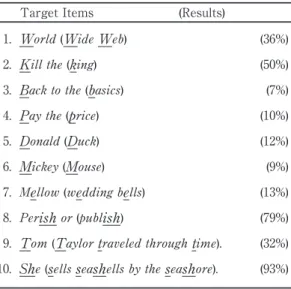
After this experiment was carried out, a similar experiment with the same informants but with English rhymes instead of Japanese rhymes was conducted in order to examine Japanese perceptions of English rhymes. The tested materials are shown in Table 2 below, along with the results listed as percentages of rhyme perception for each item.
Each of the 40 target phrases and sentences were given partially in writing and partially orally because when phrases and sentences are given orally in isolation, it is sometimes not easy to understand the meaning correctly. The word(s) which are between the parentheses in each item were only given orally. The other words of each item (the words which are not in parentheses) were given both orally and written. Before the experiment started, the informants were given a sheet of paper on which the phrases and sentences were written in Japanese except for the blank parts in the parentheses. As shown in Tables 1 and 2 below, the parts which contained the repeated sounds were not given in writing because then the informants could have easily seen the rhymes simply by noticing the repeated letters.
5.2 Results and analysis
The percentages listed next to each item in Tables 1 and 2 below are the proportion of informants that claimed that there was a rhyme in the phrase. For example, 46% of the informants (i.e., 92 out of 199) perceived to hear a rhyme in the first target phrase (Tamani nonde ne tamagozake).
Table 1 A list of the target items for the experiment of Japanese perception of Japanese rhymes
Target Items (Results) 1. Tamani nonde ne (tamagozake) (46%)
“You should sometimes drink Tamagozake.” 2. Boohanishiki, mappu de (appu) (82%)
“We can be more cautious against thefts by using a map.” 3. Shuukyuuitsuka, kuru made (matsuka) (54%)
“Let’s wait until two-day-work week begins.” 4. Sebun (irebun) (57%)
“Seven-Eleven”
5. Ooi Okkake (Otojiroo) (21%) (An imaginary name of a man) 6. Puro no michi, hate wa (michi) (52%)
“There is a long way to go to become a professional.” 7. Rinku keesai, kyoka wo (kudasai) (72%)
“Give me a permission to post the link information on the web.” 8. Shitsu no kodawari nakushicha (owari) (31%)
“You’ll get lost if you stop sticking to the quality.” 9. Haru no teki wa mikka (hare nashi) (6%)
“In spring, good weather seldom lasts more than three days.” 10. Hakone (Hachiri no Hannjiroo) (25%)
(An imaginary name of a man)
11. Mikata wa tayoo, sore ga (juuyoo) (72%)
“Importantly, there is always more than one view for things.” 12. Danjo no chigai, mushi wa (yuugai) (45%)
“It’s no use ignoring the difference between men and women.” 13. Kuruma tebanashi kane ni kae, chokinhataite (amerika e) (44%) “I went to the U.S. with the money obtained in exchange for my car.”
14. Kikai sonkai, (naoru kai) (75%)
“Can the machine out of order be surely fixed?” 15. Oira ga mura no sonchoo, okuni no shiji ni (hankoo) (17%)
“The chief of our village is against the order from the government.” 16. Kagami miru toki, “a”tto (odoroki) (18%)
“I’m surprised at me in the mirror.” 17. Odai wo dookoo iwazu ni (tookoo) (85%)
“Contribute to a publisher without regard to the title.” 18. Hakone (Hechima no Huutaroo) (4%)
(An imaginary name of a man)
19. Anata no hyooka ikaga de (shooka) (72%) “I wonder how people have evaluated you.” 20. Kono ohanashi, odai wa (nashi) (53%) “This story doesn’t have any title.” 21. Kikai sonkai, (naorunkai) (82%)
“Can the machine out of order be surely fixed?” 22. Sebun irebun, ii (kibun) (85%)
“Seven Eleven, how convenient!” 23. Makino (Makiko) (60%)
24. Matsuoka (Misako) (0%) 25. Takeshita (Takako) (12%) 26. Hiroyama (Takehiro) (16%) 27. Akiyoshi (Kiyoshi) (91%) 28. Takahashi (Hiroshi) (10%) 29. Ootake (Masatake) (56%) 30. Akasaka (Takanori) (2%)
Table 2 A list of the target items for Japanese perception of English rhymes
Target Items (Results)
1. World (Wide Web) (36%)
2. Kill the (king) (50%)
3. Back to the (basics) (7%)
4. Pay the (price) (10%)
5. Donald (Duck) (12%)
6. Mickey (Mouse) (9%)
7. Mellow (wedding bells) (13%)
8. Perish or (publish) (79%)
9. Tom (Taylor traveled through time). (32%) 10. She (sells seashells by the seashore). (93%)
Results
1. As for alliteration, the more complex the structure of the sequence (in terms of the number of moras involved: C > CV > CVCV), the more perceptible the rhyme. This can be claimed based on these results: a. for C: (18) Hakone Hechima no Huutaroo (4%) and
(24) Matsuoka Misako (0%)
b. for (C)V: (5) Ooi Okkake Otojiroo7) (21%), (9) Haru no tenki wa
mikka hare nashi (6%), (10) Hakone Hachiri no Hanjiroo (25%), (25) Takeshita Takako (12%)
c. for CVCV: (1) Tamani nonde ne Tamagozake (46%) and (23) Makino Makiko (60%)
7) The type of rhyme here may also be regarded as “assonance” according to the definition given in Section 0.
The means of the results from the three categories (C, CV, and CVCV) are 2%, 16%, and 53%, respectively.
2. For end rhyme, the more moras the rhymed sequence contains, the greater the perception of the rhyme is: CV > VCV > CVCV > VCVCV. This can be claimed based on these results:
a. For CV: Item 28 (mean 10%)
b. For VCV: Item 15 and 16 (mean 18%)
c. For CVCV: Items 3, 6, 7, 8, 11, 12, 14, 29 (mean 57%)
d. For VCVCV: Items 2, 4, 13, 17, 19, 20, 21, and 27 (mean 71%)
3. The rhyming sequences which correspond to bimoraic feet such as CVN, CVV (a consonant followed by a diphthong), and CVR are greater in rhyme perception than CVCV. For example:
a. CVN in Items 4 and 22 (mean 71%) b. CVV in Items 7, 14, and 21 (mean 76%) c. CVR in Item 11 (72%)
d. CVCV in Items 3, 6, 8, and 29 (mean 48%)
The mean of the perception rates of types a, b, and c was 73%, but the perception rate of type d was only 48%. (Note: p < 0.05 using a T-test analysis.) This result shows that there was a significant effect of the bimoraic foot on rhyme perception in Japanese.
4. The more times a sound sequence is repeated within a phrase, the greater the rhyme perception rate. This can be claimed based on the following results:
Final CVC repeated two times: (4) Sebun Irebun (57%)
Final CVC repeated three times: (22) Sebun Irebun iikibun (85%)
Initial CV repeated two times: (25) Takeshita Takako (12%)
Initial V repeated three times: (5) Ooi Okkake Otojiroo (21%)
5. Rhymes which are at the beginning and ending positions in an utterance are more perceptible than rhymes which were in mid-utterance. This can be claimed base on the comparison between the results from the names: (25) Takeshita Takako (12%), (28) Takahashi Hiroshi (10%), and (30) Akasaka Takanori (2%). These are all one-syllable rhymes, but they
differ in the position where the rhyme occurs. In the first two names, the rhyme occurs on the first syllable of the surname and the given name, but in the third name, the rhyme occurs on the second syllable of the surname and the given name. The rhyme perception rate in the former was much greater than that in the latter (12% and 10% compared to only 2%).
6. The farther the distance between the two rhyming sounds, the lower the perception rate of the rhyme. This can be claimed based on the results of (9) Haru no teniki wa mikka hare nashi (6%) vs. (25) Takeshita
Takako (12%).
Regarding Japanese perception of rhymes from English phrases and sentences, the data obtained from Table 2 above show the following results: 7. The phrases which consist of CV (reverse rhyme) have more perceptible
rhymes than the phrases in which the onset is simply a consonant (C). For example, the result of (2) Kill the king. (50%) was much higher in
rhyme perception rate than any of the following: World Wide Web (36%),
(3) Back to the basics (7%), (4) Pay the price. (10%), (5) Donal Duck (12%),
and (6) Mickey Mouse (9%).
8. The rate of rhyme perception from (8) Perish or publish was much higher (79%) than the perception rate of all other phrases except the
last one (She sells seashells by the seashore: 93%). This is because /r/ and /l/ are regarded as the same sound (allophones) in Japanese, which causes the rhyme to be perceived as occurring on a CVQCV sequence containing three moras.
9. Assonance is not as perceptible as end rhyme; cf. (7) Mellow Wedding bells (13%).
10. The higher the number of repeated sounds, the greater the degree of rhyme perception. For example, the rhyme perception rates of (1) World
Wide Web (36%), (9) Tom Taylor traveled through time. (32%), and (10) She
sells seashells by the seashore. (93%) were significantly higher than the perception rates of all other phrases except the phrases and sentences which contain rhyming CV sequences.
6. Conclusion
Based on the results discussed above, it has been shown that Japanese perception of rhyme is influenced by the following four factors. (However, the ranking of these four factors from most influential to least influential is not known.)
(1) The position of rhyming sounds in a phrase or sentence: Sounds which are in the initial and final positions within a phrase are much more perceptible than sounds which are in the middle of a phrase. This is probably because sounds which are in the initial and final positions are more easily remembered than the sounds which are in the middle of a phrase. Therefore, syntactic units such as morphemes, words, and phrases are influential to the perception of a rhyme because these units have boundaries within a sequence. (2) The probability that an identical sound is repeated: The Likelihood
that Japanese listeners notice a rhyme from an utterance can be explained by statistical probability. The less likely the repetition of a sound due to chance alone, the more likely that it is perceived as an intentional rhyme. For example, a rhyme which occurs on two segments is more perceptible than a rhyme occurring on only one segment.
(3) The foot: Every language has its own rhythm, and the recognition of rhyme is influenced by the rhythmic units of the language. This is because rhythmic units make boundaries in each sequence. Therefore, when the repeated sound is the beginning or ending sound of a foot, it is most likely to be perceived as being a rhyme.
(4) The distance between the repeated sounds: The greater the distance between repeated sounds, the less likely a rhyme is perceived. This is because of the limit of short-term memory.
The results obtained from this experiment indicate that there is a significant effect of bimoraic feet on rhyme perception. The foot in Japanese is necessarily bimoraic, whereas the foot in English consists of several types (either a stressed CV or a stressed CV followed by 1 to 4 unstressed syllables). As was revealed in this experiment, Japanese listeners seldom notice English alliteration when only a consonant is repeated (e.g., as in Mickey Mouse) unless a whole syllable consisting of at least CV is repeated (e.g., Kill the king). However, even a reverse rhyme on CV is much less perceptible to Japanese listeners than on (C)VCV. This is true for Japanese listeners’ perception of both Japanese rhymes and English rhymes. In fact, the most perceptible type of rhyme for Japanese listeners is a repeated sequence which corresponds to a bimoraic foot. For example, consider the phrases Sebun Irebun and Odaiwo dookoo iwazuni tookoo. In these phrases,
the sequences /buN/ and /koR/ are rhyming sounds which are bimoraic feet.
The same thing can be said for end rhymes in English. They need to be placed in the same position within each feet in order for them to be perceptible to English listeners. For example, in the phrase Perish or publish, the rhyming sounds (-ish) are both located in the second syllable position of the feet which each consist of a stressed syllable followed by an unstressed syllable. Another example is the sentence A friend in need is a friend indeed, in which the rhyming sounds are both located in the first syllable position of the feet which each consist of one stressed syllable.8) These two examples
show the influence of feet on English speakers’ perception of rhymes as well as on Japanese speakers’ perception of rhymes.
Refferences
Epsy, W. (1986) Words to Rhyme With: A Rhyming Dictionary: World Almanac Education
Ito, J. (1990) “Prosodic minimality in Japanese,” In K. Deaton, M. Noske and M. Ziolkowski (eds.) CLS 26-11: Papers from the Parasession on the Syllable in Phonetics and Phonology, pp. 213-239.
Kurisu, K. (1994). “Further evidence for Bi-moraic foot in Japanese,” Proceedings of the International Conference on Spoken Languages Processing, Yokohama 1, pp. 367-370.
───── (1996). “A cross linguistic study of prosodic unit in Japanese and English,” Gengo Kenkyuu (‘Langauge Studies’), 109, p. 179.
───── (1998). “Root fusion in Sino-Japanese,” Onin Kenkyuu (‘Phonological Studies’) 1, The Phonologica Society of Japan, pp. 91-97.
Liberman, M. and A. Prince (1977). “On stress and linguistic rhythm,” LI 8, pp. 249-336. Mester, A. (1990) “Patterns of truncation,” Linguistic Inquiry 21, 3, pp.78-485.
8) In fact, the part “need is a” constitutes a foot which consists of a stressed syllable followed by two weak syllables, but when this proverb is read, a pause is usually inserted between “need” and “is” so that the listeners can more easily notice the rhyme.
Sato, Y. (1993) “The duration of syllable-final nasals and the mora hypothesis in Japanese,” Phonetica 50, pp. 44-67.
Selkirk, E. O. (1980) “The role of prosodic categories in English word stress,” LI 11, pp. 563-605.
Tateishi, K. (1989) “Theoretical implications of the Japanese musicians’ language,” WCCFL 8, pp. 384-398.
Poser, W. J. (1990) “Evidence for foot structure in Japanese,” Language 66, pp. 78-105. Preminger, A., and T. V. F. Brogan (1993). The Princeton Encyclopedia of Poetry and
Poetics, Princeton University Press.