Doctoral Thesis
The influence mechanism of internet
Word-of-Mouth on Consumer Behavior; A
contrastive study between Japan and China on
tablet marketing
September 2016
Doctoral Program in Technology Management
Graduate School of Technology Management
Ritsumeikan University
Doctoral Thesis Reviewed
by Ritsumeikan University
The influence mechanism of internet
Word-of-Mouth on Consumer Behavior; A
contrastive study between Japan and China on
tablet marketing
(インターネット口コミ(Word-of-Mouth)が消
費者行動へ及ぼす影響のメカニズム:日中タブ
レット市場の対照研究)
September 2016
2016 年 9 月
Doctoral Program in Technology Management
Graduate School of Technology Management
Ritsumeikan University
立命館大学大学院テクノロジー・マネジメント研究科
テクノロジー・マネジメント専攻博士課程後期課程
ZHANG Haibin
ジャン ハイビン
Supervisor: Professor ISHIDA Shuichi
研究指導教員:石田 修一 教授
I Contents
Chapter 1. Introduction ... 1
1.1Background ... 2
1.1.1 Internet development ... 2
1.1.2 Internet community and communication ... 3
1.2. Research gaps and significance of research ... 7
1.2.1 Theoretical significance ... 7
1.2.2 Practical significance ... 8
1.3 Study objective and originality ... 10
1.4 Research methods and technical approach ... 11
1.4.1 Research methods ... 11
1.4.2 Technical approach ... 13
1.5 Chapter structure ... 14
Chapter 2 Literature review ... 16
2.1 Definitions of Word-of-Mouth and internet Word-of-Mouth ... 16
2.1.1Traditional Word-of-Mouth ... 16
2.1.2 Internet Word-of-Mouth ... 17
2.1.3 Platform for online Word-of-Mouth communication ... 18
2.1.4 New features of eWOM ... 20
2.2. History of WOM research ... 24
2.3 Theoretical basis for WOM research ... 27
2.3.1 Elaboration likelihood model ... 27
2.3.2 Attribution theory ... 30
2.3.3 Perceived quality theory ... 32
2.3.4 Search cost theory ... 33
2.4 Research about impacts of online Word-of-Mouth on consumer purchasing behaviors ... 35
2.4.1 Information acceptance model ... 36
2.4.2 Other Word-of-Mouth communication theory ... 38
2.4.3 Studies of culture ... 41
2.5 Summary of literature review ... 42
Chapter 3. Hypothesis ... 43
3.1 Analysis of factors affecting word-of-mouth acceptance of consumers ... 43
3.2 Disposition to trust ... 44
3.3 Involvement research ... 45
3.4 Quantity of positive word of mouth ... 47
3.5 Multimedia expressing ... 50 3.6 Trust ... 53 3.6.1 Definition of trust ... 53 3.6.2 Effect of trust ... 56 3.6.3 Dimensions of trust ... 57 3.6.4 Ability trust ... 58
II
3.6.5 Integrity trust ... 59
3.7 Usefulness ... 59
3.8 Relations among trust, usefulness and purchase intention... 61
3.9 Culture differences ... 63
3.10 Summary of hypothesis... 64
Chapter 4. Methodology ... 66
4.1 The selection of research methodology, product, and platform. ... 66
4.2 Questionnaire design ... 67
4.3 Questionnaire development ... 68
4.4 Collection data ... 70
4.5 Data analysis method ... 71
4.5.1 Reliability and validity test ... 71
4.5.2 Calculation methodology of hypothesis 15... 72
4.5.3 Calculation methodology for hypothesis 16 ... 74
4.5.4 Test methods for the rest hypothesis ... 76
Chapter 5. Data analysis ... 78
5.1 Descriptive statistics ... 78
5.2 Reliability and validity test ... 79
5.3 Results of hypothesis test ... 86
Chapter 6. Results and discussion ... 93
6.1 Significant and partial significant discussion ... 93
6.2 Discussion on coefficients ... 96
6.2. 1 Positive WOM quantity ... 96
6.2.2 Multimedia expression ... 97
6.2. 3 Sub-dimensions of trust and usefulness on purchase intention ... 99
6.2.4 Differences between Chinese and Japanese ... 99
6.3 Other discussion:combination of two dimensions of trust and purchase intention ... 101
Chapter 7. Conclusion ... 102
7.1 Summary of findings and contribution ... 102
7.2 Implications... 104
7.3 Limitations ... 105
Appendix A. Questionnaire and questions’ references ... 106
1
Chapter 1. Introduction
Underscoring its important role in business activities, word-of-mouth is generally the preferred method by most consumers for collecting information when they lack it on a particular topic. According to previous research, as it is the least biased according to consumers, word-of-mouth is more believable versus other information sources (Paul et al., 1991; Richins, 1983). Thanks to this perceived advantage, the Internet plays a critical role in today’s economic and social life and has become almost indispensable for daily communication. This phenomenon and the increasing number of Internet users have contributed to the growing influence of networked communications, shifting traditional word-of-mouth to a new form called Internet word-of-mouth (eWOM). Visible eWOM, which supports anonymity and asynchronous communication distribution, attracts a wider range of consumers, thereby becoming important as it affects business performance. Practitioners and marketing scholars increasingly pay attention to eWOM. Since 2000, more and more domestic and foreign scholars have been engaged in the study of eWOM marketing, but the applicable of the results require further development.
Online WOM marketing can succeed by following the “spread” rule, namely, guiding the spread of those in favor of the enterprise. Previous research mainly focuses on the motives behind its spread, the factors associated with this, the influences on consumer psychology and behavior, and business performance. As part of a consumer's psychology and behavioral response, WOM is notably associated with social and cultural backgrounds. In the past, few scholars have undertaken the study of cultural differences in the context of WOM in terms of its influence on procurement. No comparison has been made on differences in WOM between two culturally distinct countries such as China and Japan. However, cultural differences may result in different WOM marketing. Thus, there is need for more research on difference in the acceptance and spread of eWOM between China and Japan to more
2
accurately direct marketing theory and practice in those countries.
1.1Background
1.1.1 Internet development
A Chinese statistical report on the Internet (China Internet Network Information Center, 2016) illustrates that Chinese Internet users reached 688 million users at the end of December 2015. This is the largest number in the world and represents 50.3% of the national population. The number of Internet users and its growth rate in China increased significantly since 2005. Furthermore, enterprises and individual businesses accessing the Internet through fixed and mobile broadband increased 86.3% and 23.9%, respectively. The online market represents 33.8%. At the same time, online sales rose 32.6%. With the development of 4G communication technology, it is obvious that the Internet will play an increasingly important role in commerce.
East Asia has the most Internet users among all countries. Japan has the third highest number of Internet users in this region at 101 million, according to statista.com 2016. At the end of June 2014, Japanese IP addresses had reached 40 million and average connection speed had exceeded 15 megabits per second. From those data, we see that the Internet in Japan is also very important for businesses and in our daily lives.
An investigation of global statistics indicates that India is the second country with the most Internet users at 375 million, covering 28% of its population.
Figure 1-1. Number of internet users in China and Japan
According to recent demographic data, individuals aged 55 years old represent
0 200 400 600 800
Number of Internet Users in million
China Japan
3
the largest share of the population using the Internet in Japan, and most of these users are male. In terms of reasons for using the Internet, most Japanese users are searching for information and location services. 73.6 percent of Internet users in Japan watch online video content via different devices.
In 2014, more than 54% of the Japanese users connected to the Internet via their mobile phones. In addition, among those aged 18 to 24, most such young people frequently use smart phone apps in their daily lives. On average, they spend 114 minutes using smart phone apps. The most popular app in Japan is the social network app called LINE. It reached 21.2 million users by the end of October 2013.
Additionally, in 2014, Japanese retailing income from e-business achieved 70.33 billion dollars. This is the strongest e-business market in the word. According to data on industry development, most of the online population (79%) spent money on digital products. Over 50% of Internet consumers compared products when they shopped on the Internet. Books, computer hardware, and apparel are very popular items on the Internet. The most favored website in the e-market in Japan is Rakuten; number two is the U.S. company Amazon.
1.1.2 Internet community and communication
The evolution process of human societies has fully embodied a demand and dependency on interpersonal interactions. In addition, key changes have occurred to such interactions due to the development of the Internet, among which the appearance and rapid growth of a virtual community is a typical one (Armstrong & Hagel, 1996). A virtual community is based on a computer-mediated interaction space among individuals (Lee, Vogel, & Limayem, 2003). Moreover, it is formed through long-term discussions about shared topics among a large number of individuals, in which interpersonal interactions are shaped within the cyberspace, thus sharing emotions among them. The members of the virtual community abide by the same regulations and share a common language, environment, values, and hobbies (Rheingold, 1993). In addition, the virtual community has become a kind of interactive platform in
4
cyberspace with strong vitality built by computer mediation and exerting an increasingly important effect on human conduct through its speedy development.
With the rapid development of networked technology, community applications have become more and more mature so that the Internet has stepped into an era of community. From well-known community applications such as BBS, Alumni Record, Blog, SNS to Personal Space to the emerging community management topics including the community enterprise, community advertisements, community investments, and community aggregation, academic and entrepreneur circles have been focused on these issues for a long time now. As a significant element of the core competiveness of a website, the virtual community, supported by Internet technology, has achieved high-speed development, becoming a new emerging environment for human life while providing a wide platform for the spread of eWOM.
Moreover, with the popularity of the Internet and the increase in the number of “netizens,” the influence of the spreading of this network has grown stronger. Additionally, the application of new technology has blurred the concepts of “online” and “offline” such that consumers in this era are fond of continually surfing the Internet, depending significantly on the network in both their work and personal lives. Moreover, the growth in various communication platforms such as review sites, social websites, and micro-blogs and blogs has enabled people to record and share their own experiences and thoughts online anytime and anywhere and to obtain certain self-satisfaction through the echoes of these and the replies from other users. They can acquire relevant spiritual or material rewards through their remarks, thereby arousing their enthusiasm to continue to share their thoughts so that the spread of this information will be faster and faster.
At the same time, final consumer decisions are increasingly influenced by eWOM such that individual consumer information will be processed and arranged through eWOM, which then plays a role as an important indicator for consumers faced with choices and other actions. A global survey on advertising credibility by Nielson in 2014 showed that 91% of Chinese online consumers trust products recommended by others to different degrees; and 78% of consumers investigating
5
information trust the suggestions shared by others on the Internet, regardless whether the suggestions are from someone familiar or a stranger. The rapid growth of the Web 2.0 has vigorously pushed forward the spread of online reviews on the Internet as these online reviews can effectively express consumers’ thoughts and criticisms of products and services. They have widely appeared on the Internet including on retailer websites, online discussion forums, blogs, social networking sites, and online review platforms (Trusov et al., 2009; Zhang et al., 2010).
The importance of eWOM has already become evident in that the Internet is now a significant channel in spreading communication media, specifically, as a tool of two-way communication. Moreover, it has been dubbed the fifth media after broadcast TV, advertising, newspapers, and cable (Lv Yilin, 2008). Its development can be seen as one of the science and technology revolutions that have exerted a great effect on humans following the invention of the computer. Since its earliest military application to its current evolution, both academic and e-commerce applications have come together on the shared Internet platform. Thus, with the integration of communication, telecommunications, and new media, people today depend more and more on the Internet in their daily lives. The spreading of eWOM is not limited by time or location, so information can spread at an amazing speed, dwarfing other media channels. Moreover, such information is simultaneously spread to numerous audiences as “rolling snowballs” at the speed of “one to a million”; this speed and its influence is incomparable to traditional media. As a result, eWOM has become a research theme studied by many experts and scholars (Cheung et al., 2009; Park et al., 2007; Zhang & Watts, 2008).
With the approaching era of Web 2.0, consumers have more opportunities to share their shopping experiences while, at the same time, enjoying the convenience of online shopping. They can express their concerns and realize self-value by sharing their consumption experiences, which are often dubbed as eWOM. Because such information is based on consumers’ insights about the consumption process and the use of products, it holds more affinity and credibility than advertisements from the sellers and can even replace and surpass the function of relatives or friends’
6
suggestions in the traditional WOM environment.
A survey based on 58 countries showed that: 68% of consumers trust remarks on the Internet; and more than 40% of the online shoppers in China pay attention to remarks made by other consumers each time before they buy a product. Such product comments can even surpass advice from friends and experts, and have become an important information source in decision-making in the online shopping process. Additionally, a survey based on British and U.S. consumers showed that goods that attained highly positive comments increase by 55% the researcher’s willingness to buy them (Econsultancy, 2010). This influence can be directly reflected in the market: a large number of studies have shown that eWOM represented by online reviews can determine the destiny of products and even companies to some degree (Chevalier & Mayzlin, 2006).
The large influence of online reviews and the intense competition among shopping websites, has forced companies to recognize that their online reviews can be a valuable information source. At the same time, the growth in the number of online reviews and the variety of venues and review forms, though providing convenience for consumers and creating value for websites and relevant stakeholders, have led to the following challenges:
(1) Excessive information has caused the phenomenon of eWOM overload. High cognitive costs are spent when consumers are searching for information they really need, and the anxiety of consumers in the search process also has increased.
(2) As networked information, such as comments on products exerts direct influence on a brand and the sales of a company, some sellers and companies have begun to control the comments to increase their sales and improve profits. According to scholars studying Amazon.com, about 10.3% of the comments are controlled by the sellers (Hu N et al., 2012). Such manipulative conduct not only lowers consumer satisfaction with shopping but also becomes a serious attack on the image of the shopping website and its brands.
(3) The online review systems of shopping websites largely copy the most famous international e-commerce websites. These sites follow the same process of
7
revealing and collecting comments and thus lack any adjustment mechanism to address different countries’ domestic cultures and consumers’ behaviors. Therefore, the effectiveness and rationality of this process design may be questionable. Apart from cultural adjustments, the effectiveness of the review system is often influenced by factors in the system and consumer recognition.
The above challenges have influenced the shopping experiences of consumers as well as raised their suspicions about eWOM and platform operators who are the basis of the online reviews. As objective evidence confirming this trend, in a survey aimed at Chinese consumers by Nielson, the results indicate that although online consumers’ comments are still considered credible information, however, incredibility is increasing compared to information from other forms (Nielson, 2014).
1.2. Research gaps and significance of research
1.2.1 Theoretical significance
According to WOM studies, today, WOM is the main factor affecting consumer psychology and behavior. However, other studies have generally neglected WOM, or have focused solely on the analysis of positive and negative WOM, with few studies addressing how multimedia WOM affects consumer behavior, or the transmission mechanism of WOM. Multimedia WOM has become the new form that represents eWOM. In addition, with the popularity of the Internet, it has gradually become the key resource for consumer information. By combining knowledge in the fields of communication, marketing, sociology, and psychology, along with previous study results, a communication effect mechanism model for eWOM can be designed that is conducive to the research and development of theories for WOM marketing and Internet marketing. Although some studies confirm that cross-cultural WOM has a different influence on different consumers, analysis on the specific influencing factors is still needed. The characteristics of the sources of WOM, the information shared,
8
and the receivers of the information, all have an impact on the WOM communication effect according to communication process theory. However, studies around the aforementioned three variables are still in the early stages and lack a comprehensive discussion, especially regarding eWOM in different countries.
Existing studies agree that culture is a key factor affecting consumers, meaning, that due to different cultures, consumers respond to the same information differently. Currently, studies on eWOM are mainly designed for one country, and there are few transnational studies. Moreover, previous study results may not be applicable in different cultural environments based on individual unique consumption concepts and attitudes toward the Internet. By studying consumer characteristics in different countries, we can verify and improve the theories of previous WOM studies.
One aspect of eWOM is that once accessed consumers may copy the information! They may paste this information on other websites or virtual communities, and may tell their friends. Hence, eWOM communication is an online and offline interaction process; especially, multimedia WOM, which frequently attracts consumer interest, making the drive to communicate stronger. The study of the re-communication drive of eWOM consumers can improve theories around WOM. Online WOM is both a resource and a result, which can be communicated online and offline.
1.2.2 Practical significance
The unique advantage of the Internet as a medium brings out new characteristics of eWOM compared to traditional WOM such as: tangibility, easily copied, timelessness, wide influence. Discussing the effect of eWOM on behaviors of consumers in different countries clearly differentiates the study of eWOM from traditional WOM. This then enables a better understanding of the WOM information enjoyed by consumers in different countries and how eWOM is an attraction among users.
9
the management of eWOM to provide a more favorable network platform for consumers. They can thereby better communicate WOM information and enhance its influence. One of the characteristics of the new economy on the basis of networked technology is the interaction between enterprises and their clients that enables one-to-one communications, thus bringing them closer together so enterprises can provide consumers with better service. Thus, the value of the Internet is brought to the forefront among enterprises; however, network marketing activities are still weak and remain largely focused on Internet advertising. By discussing in detail the effect of eWOM on consumer behaviors, enterprises can be motivated to fully supervise and monitor eWOM of their products and business and respond accordingly. Online WOM is regarded as central for an enterprise brand and its goodwill. Critical problems cited through WOM should be identified to carry out effective management. For the effective management of eWOM, it is important to solve a problem at its source. This means that enterprises will be required to do the work necessary to achieve a minimum of negative WOM caused by the enterprises themselves. Additionally, for negative WOM caused by consumers, enterprises will need to communicate comprehensive information through integrated mediums for consumers’ product involvement and information distribution to weaken any negative WOM. In sum, discussing the effect of eWOM and related variables on consumers is useful for enterprises wanting to strengthen their business and consumer communications.
Online WOM is also not limited to the Internet. Consumers not only publish their experiences and emotions online but also spread information received from the Internet offline. Thus, enterprises should realize that although the Internet is just one channel for consumers to obtain information, it can also capture information obtained by consumers from other media. Therefore, a study on the communications effect of eWOM can enable enterprises to include the management of eWOM in its overall framework of marketing communications management.
10
1.3 Study objective and originality
The study objective of this thesis, focused on electronic retail, is to investigate the mechanism of business interaction and mutual effect between clients and service enterprises in an online e-commerce platform environment. Specifically, from the viewpoint of clients, the study reveals how eWOM influences purchasing behaviors of consumers and identifies the factors influencing eWOM; from the viewpoint of enterprises, the study reveals how enterprises influence client attitudes and behaviors by controlling eWOM to improve sales. Although there are studies that have explored the effect of eWOM on consumers and the effect of culture on consumers, respectively, these have neglected to focus on cross-cultural issues and synergies between them.
This study will address the gaps of current studies:
(1) Existing study conclusions around eWOM and consumer behaviors are not perfect. At present, many studies emphasize the positive effect of eWOM on consumer behaviors, but there are still many different views around the influencing mechanism; there is, in particular, a lack of study on the influencing mechanisms in different cultures; partly the result of different product types and customer groups. This study uses personal consumer electronics as its subject: specifically, the tablet computer. In this way, the study will enable comparability in the assessment of eWOM in different countries and the potential differences in the customers in the two countries. In addition, this study also discusses the overall trend of WOM communication among customers and compares its impact on both countries.
(2) Insufficient research on the impact of Internet multi-media WOM marketing. This study believes that the content of online reviews is not the only standard that influences customers' choices. The manner and methods of information delivery and presentation also shape customers’ opinions. This study explores the means of giving an opinion about a personal electronic product and their diversity and influence on different customers in a diversified information context.
11
consumer trust has not been sufficiently studied for its role in online marketing. Consumer trust consists of different dimensions. Some recognition at various sub-levels of a product helps establish a consumer’s trust in the product’s online reputation. This study analyzes the relationship between eWOM marketing and consumer trust at each sub-level. It further explores the two dimensions of trust, namely, competence-based trust and integrity-based trust, and their effects on purchase intention and WOM communication.
Based on the above, this research tries to answer the following research questions: 1. How does eWOM influence purchase intention and disseminate intention and what is the influence mechanism?
2. What kind of WOM can stimulate consumer’s purchase intention?
3. Are there any differences in the responses to the above questions in different countries?
1.4 Research methods and technical approach
1.4.1 Research methods
Given the extensive use of the Internet, WOM advertising is becoming increasingly inevitable for all enterprises, whether or not they are engaged in network marketing. By drawing theories from subjects such as marketing and communications, this study investigates what kind of planned consumer behaviors a product’s online reputation could lead to and any specific influencing factors. The research methods can be summarized as follows: 1) establishing the research theme and methods based on understanding the WOM phenomena online and reading related articles; 2) proposing research models and hypotheses based on the theories and practical research of WOM communication; 3) collecting data through surveys and questionnaires; and 4) analyzing and drawing conclusions and suggestions according to the analytical results.
12
The abundant research on conventional WOM can be used as a reference in the further study of eWOM communications. Meanwhile, attention should be paid to the distinct nature of the Internet and its impact on WOM communications. In most cases, conventional WOM communication is confined to a limited area geographically, whereas eWOM communication is able to transcend the limit of social networks (mainly in the form of one-on-one or group communications). Conventional WOM is intangible and relies on the individual experience and impressions of consumers. The information might be distorted or blurred during the course of transmission. Internet WOM is materialized through various content and is able to convey much more diversified information vividly, increasing its appeal to consumers. As a result, research on eWOM should take into account the intrinsic properties of this media. The quantitative and visual clues employed in eWOM communication are key factors in shaping a consumer’s psychology and behavior around a purchase decision. Based on the extent of their exposure to the Internet, consumers will form varied opinions towards products in terms of the above-mentioned aspects.
This study will enrich research on eWOM communication through its analysis of what impact negative WOM could have on consumer behavior based on grounded theories and any specific influencing factors. Interviews with representative consumers indicate that intention to purchase and recommend are the leading consumer behaviors. Research targeted at these two intentions make up the most representative studies of the information spread via WOM. Examining the application of grounded theories, such research shows that communicators, the content of WOM communications, the recipients, and their mutual relations are all factors that influence consumers’ purchase and recommendation intentions. Trust is a conduit for eWOM to influence consumer behavior. This study establishes a theoretical model on the basis of relevant papers and research findings applied from grounded theories. This study collects data online and verifies the relations among variables based on data analysis via SPSS15.0, smart PLS, and fsQCA. It further investigates a difference in the impact of WOM communication on consumer intentions between Chinese and Japanese consumers.
13
The conclusion of the analysis not only supplements studies of eWOM communication but also provides guidance for enterprises to conduct eWOM marketing. Taking into account all influencing factors and their reciprocal relations, the study concludes with management advice to enterprises on potential measures to take to combat negative eWOM communication.
1.4.2 Technical approach
The study investigates the influence of WOM communication on consumer behaviors and intentions and in the process employs theories of management, marketing, communications, psychology, and other related disciplines. Subject to the content and purpose of the study, the objective is to combine theories with practical analysis. Theoretical research is mainly captured based on a literature review and summary of past studies on conventional and eWOM communication, eWOM communication and consumer behaviors, etc., to lay the foundation for practical analysis. Practical analysis is mainly addressed by applying grounded theory and verification to the data collected.
Literature review: This study has compiled Chinese and foreign research related to negative eWOM communication (conventional and eWOM communication, influencing factors, and consumer behavior or intentions, etc.). The studies on eWOM communication have been chosen on the basis of conventional WOM communication, capturing studies on defining concepts and variable selection. In addition, we have collected and read classic and cutting-edge papers in management, marketing, communication, psychology, and other disciplines, to enable a broader understanding and a theoretical framework for the context of this study. On the basis of the literature review and in line with cases in China, the study sets up a conceptual model on the influence of eWOM communication on consumer behavior and intentions. The design of the research variables in the model mainly refers to relevant research findings, with individual correction for representativeness.
14
Qualitative empirical research: Through the literature review, we know that there is scant literature on cross-culture eWOM. At the same time, we have studied grounded theories to identify the features of consumers in the cultural environments in the two countries. Grounded theories mainly include the following two questions: 1. What are the behavioral intentions of consumers once they experience negative eWOM? 2. What causes such behavioral intentions? The model concept is established on the basis of the literature review and the study of grounded theories. Additionally, during the questionnaire design stage, the questionnaire is revised through small-scale interviews to gain advice on its content and form. With the fuzzy data analysis results, questionnaire answers are converted to Boolean logic symbols to study pattern matching. We obtain macro-conclusions for the qualitative research with this method. Therefore, the qualitative empirical research includes the grounded theory, small-scale interviews, and fuzzy qualitative analysis.
Quantitative empirical research: The quantitative empirical research mainly consists of questionnaire research, information collection, and data processing, as well as the verification of all the hypotheses of the model using statistical analysis tools. The preliminary questionnaire is designed on the basis of the literature review and the questionnaire is pretested through the small-scale interviews for revision. The formal questionnaire is revised again on the basis of the pretest results analysis. Finally, the first hand data are obtained through online surveys. With corresponding data analyzed by statistical software, the hypotheses are confirmed. The methodology used in this quantitative research includes descriptive statistics analysis, factor analysis, regression analysis, PLS-SEM analysis, and fsQCA.
1.5 Chapter structure
This research declared research purpose and research question in chapter 1. Next, chapter 2 analyzed the research background and relevant theories. Research gap are found in this chapters. Based on chapter 2, chapter 3 putted forward hypotheses.
15
Chapter 4 explained research method and how to collect data. In chapter 5, an illustration about measurement standard is given. This chapter also showed data test results. For chapter 6, results are discussed in detail. Finally, chapter 7 concluded findings and implications.
16
Chapter 2 Literature review
2.1 Definitions of Word-of-Mouth and internet Word-of-Mouth
2.1.1Traditional Word-of-Mouth
Arndt (1967) characterized Word of Mouth (WOM) as oral, person-to-person communication between a receiver and a communicator whom the receiver perceives as non-commercial, regarding a brand, product, organization or service. The traditional WOM doesn’t mean the product information issued through media from the merchants. It could be either positive or negative. WOM is a formalized marketing trial, from the perspective of marketing, designed to stimulate consumers to discuss brand, product and service. Westbrook (1987) defined WOM as: Informal communications directed at other consumers about the ownership, usage, or characteristics of particular goods and services and/or their sellers. Westbrook’s definition expands the scope of WOM communication medium, but merely emphasizing “informal communications” while verbal communication being ignored. Buttle (1998) argued that WOM can be mediated by electronic means. He also noted that “informal communications” might not be all inclusive; arguing the fact that more and more companies had adopted viral marketing practices which blurred the boundary between commercial messages and WOM. According to Helm and Schlei (1998), WOM is used to describe: Various verbal communications between groups such as the product provider, independent experts, family and friends and the actual or potential consumer. The novelty of their definition manifests itself in the examination of WOM from the angle of groups, highlighting the group behavior feature of WOM communication.
Emanuel Rosen (2000) stated WOM pertains to person-to-person communications and reviews about a brand, a given product, service or company in any given time. Rosen’s view enriched the WOM content and regarded WOM
17
communication as a whole, which can be both single and continuous.
2.1.2 Internet Word-of-Mouth
With the prevalence of Internet and progress of information technology, some consumers post and forward various reviews concerning enterprises via the Internet. Virtual interaction between people is rapidly spreading (Goldsmith,2006)as the traditional WOM is transformed into the new form of Internet WOM, the scope and depth of which have also increased. Consumers can transmit and receive Internet WOM information via blog, BBS, product forum, newsgroups, instant messaging, Email, etc. The disagreements concerning the name of computer-mediated WOM in previous literature are shown as below: e.g., Internet Word of Mouth, online Word of Mouth, Word of Mouse, Electronic Word of Mouth, Virtual Word of Mouth, etc. But in general, given that the research of Internet WOM is in still in the preliminary stage and relevant papers are still few in quantity, the definition remains to be unified. Above names can be found in various research essays, all of which will be referred to in this research. In the research of causes and effects of WOM in health care industry, Gelb and Johnson (1995) indicated that information communication via Internet also stays within the range of WOM. This is the early cognition of Internet WOM when the Internet has just spread worldwide.
Stauss (1997, 2000) explored the business opportunities and threats triggered by increased consumer online communication, and this is the earliest research on Internet WOM from the perspective of marketing and management. Stauss (1997) argued that with the exponential growth of the Internet, consumers are able to globally share their perceived service quality, which also constitutes a form of WOM communication. Hanson (2000) defined computer-mediated Internet WOM communication as online WOM or electronic WOM, meaning Internet-mediated WOM communication via email, user groups, online forum, portal discussion areas, etc. He also believed that WOM communication on the Internet creates faster and wider interpersonal WOM
18
communication effect. Chatterjee (2001) characterized Internet WOM as information exchange between consumers through platforms such as bulletin board or person-to-person chat, etc.
Henning Thurau et al. (2004) pointed out that the emergence of Internet enables previous real and potential customers to browse the webpage to collect product information provided by other consumers, and endows them the opportunity to share their own experience, opinion and relevant knowledge about a specific subject, which produces electronic WOM. Internet WOM can be disseminated through online forum, news group, BBS, etc. It can be seen that previous research on the definition of WOM is similar to traditional WOM in connotation, both pertaining to enterprise operation-related information disseminated among consumers, which will impact other consumers’ purchase decisions. The emphasis of Internet WOM refers to the Internet medium as well as its new features arising from the advantage of information spreading via the Internet. Owing to the features of Internet medium, the mode of transmission & manifestation and impact speed & scope of Internet WOM distinguish themselves distinctly from those of traditional WOM.
To sum up, this research will define Internet WOM as: Information regarding organization, brand, product and service released and spread by Internet users through various synchronous or asynchronous Internet communication channels. It is manifested in the form of texts, images, symbols, videos or any of their combination. Internet WOM and traditional WOM are similar in content, but differ significantly in the mode of manifestation.
2.1.3 Platform for online Word-of-Mouth communication
Internet’s openness and connectivity enable consumers not only to exchange product information, share experience and knowledge, recommend products and express dissatisfaction, but to search reviews concerning their interested products and enterprises. The platform for online WOM communication also has a variety of forms,
19
such as E-mail, BBS, brands’ official website and comprehensive online shopping website, etc. With the development and popularization of Web2.0 technology, blog, microblog, twitter, facebook and other socialized media also grow into hot WOM communication channels. With the growing number of online WOM communication participants, the form of online WOM is becoming complicated, which can realize different functions. According to Kiecker and Cowles (2001), online WOM is classified into four types:
(1) Spontaneous WOM: Customers use their own medium and technology to build a communication platform to release information. For starters of WOM, it merely takes little cost to effect the purpose of wide spread.
(2) Quasi-spontaneous WOM: Customers use pre-built online platform to release WOM. Typically, for instance, are the customer reviews published on the shopping websites such as Taobao and Jingdong. Although the spread platforms of WOM are limited, customer can still publish their reviews freely. Quasi-spontaneous WOM has strong pertinence, exerting major influence on customer purchase decisions.
(3) Independent or Third Party-sponsored WOM: Online WOM provided by specific interest groups such as evaluation report on specific goods provided by web portals. This kind of WOM may involve product’s commercial publicity or promotion, therefore its influence tends to rely on the publisher’s professional degree as well as customers’ trust to the publisher.
(4) Corporate sponsored WOM: Specialized platform for issuance of WOM funded by the enterprise. The enterprise may use the method of payment to encourage customers to release information, which can produce false reviews with advertising nature.
Litvin, Goldsmith and Pan (2008) divided online WOM from two dimensions, i.e. information interaction and information exchange. Based on the dimension of information interaction, online WOM platforms with synchronous interactivity include instant messaging, chat rooms and newsgroup; while online WOM platforms with asynchronous interactivity contain blogs, virtual community, review sites of
20
shopping websites and email. Based on the dimension of information exchange, many-to-many mode of online WOM platforms include newsgroups, blogs and virtual community; one-to-many model of online WOM platforms include chat rooms and review sites of shopping websites; and one-to-one mode of online WOM platforms contain instant messaging and email. Particularly, online review is an important form of online WOM and its release channels are mainly the official websites for products or third party online shopping sites. Online reviews, compared with other forms of WOM, can be longer preserved and displayed to those with specific needs and preferences; besides, they are readily accessible. Hence online reviews become one of the decisive factors for customers to purchase the goods (Dellarocas C, 2003). Park.D.H (2007) indicated that online review has a dual role: it provides oriented information as information source, and serves as a recommendation for future consumers.
2.1.4 New features of eWOM
While changing the way of human’s entertainment, education and work, the Internet has had great effect on the consumers’ behavior. And the spreading behavior of consumers’ word of mouth is no exception. It is obviously that the development of Internet has brought the revolution of word of mouth. With the emerging of the network technology, the spreading of word of mouth information was no longer limited with the face-to-face contact among people. The consumers can not only look for the various information of the WOM, but also express their own comments, suggestions and experiences through the different network channels such as the instant messaging service and emails. Therefore, the interaction and communication of EWOM are conducted in the open public environment compared with the traditional word of mouth. And both the scope and influence of the spreading cannot be matched by the traditional ones. In other words, the influence factors in the EWOM spreading will be more diverse so that the effectiveness will grow greater.
21
Dellarocas (2003) put forward that: due to the distinctive characteristic of network, the word of mouth spreading has been attached with new meaning. And because of this, there are some new features showed in the EWOM.
First, the subjectivization and de-massified of EWOM communications. Internet as a new means of communication, each individual node can share the information that flaws on the network; and this break the dominance in traditional transmission structure. The platform internet transmission provided can allow the users to express their opinions, even to establish their own web pages or specific topic discussion area, and this means any individual can become a center or individual on the Internet, namely, subjectivization. Such special form of information “decentralization” and “decentralized” lowers the guard degree of Internet information and frees the individual speech without restraint. The advantage is less susceptible to authority or ideology, but its disadvantage is difficult to control and irresponsible remarks more likely to occur. With the development of network these features will be more obvious and it is impossible to appear all-round control center to monitor and select the spread of information.
Second, the anonymity of EWOM subject. Consumer send EWOM information through the network channels and they can send the information to their friends and relatives through instant messaging, e-mail and so on, but more often through all kinds of public network platform such as blog, electronic bulletin boards and virtual communities to send EWOM information. Since such open network platform does not require the users to verify the real name registration or friends, the sender and recipient names generally use undercover ways to communication in this kind of network communication, which means that users can post anonymously to broadcast their opinions to all the net users. The anonymity of EWOM subject can protect the privacy of the sender so that it removes the fear or pressure to obtain the freedom of expression in some degree. The communication content in this condition is more than traditional conversation and the discussion topic is broader than interpersonal communication. The anonymity provides information publishers with more freedom. Gelb & Sundaram (2002) summed up the effects of anonymity as: first, the sender is
22
more willing to publish negative information; second, the sender is more likely to provide sincere advices and recommendations and not fraud or mislead others; third, both tow sides don’t know each other and this eliminate the interest relation and the concern about human relationship so that the sender can freely speak which help to spread more real information and improve the credibility of EWOM. But on the other hand the anonymity of online EWOM also increases the possibility that the sender spreads false information. For consumers, the enterprises can make online reviews pretending consumers to propagate their product quality for enhancing their reputation. And it is possible to send negative EWOM to defame the competitor reputation, and this also reduces the credibility of EWOM information (Smith et al., 2005). Therefore, the influences of anonymity are two sides. Zhang Xiaofei and Dong Dahai (2009) also agreed that because of the anonymity, it is uncertain whether EWOM has the non-commercial property of traditional WOM.
Third, the diversity of the communication channels and forms. Due to the network of EWOM object transmission, EWOM present the diversity in media channel and EWOM forms.
The diversity of media channels. Different from the traditional WOD from ——face to face communication, IWOD realize information exchange by the network media such as MSN, QQ, e-mail, message board, WeChat, Fetion, blogs and online web. The diversity of communication media endows IWOD with synchronism and asynchronism. Consumers can use instant communication tools such as QQ or MSN to achieve the similar synchronous communication with the traditional WOD. And they also can use blogs, online communities, BBS and so on to achieve asynchronous communication, which exchange participants don’t have to be synchronous in a communication context, with more flexible distribution of their time. The spread of EWOM has been beyond the limit of time and space and the communication has become more and more convenient. The other hand, EWOM is not subject to the external environment and the communicators and recipients’ situation such as their mood, facial expression and behavior.
23
language form between the consumers and this kind of mouth information is perishable. But EWOM is essentially a multimedia digital information forms, mainly in the form of sound, images, text, music, video and so on. Digital and multimedia forms of EWOM is not only easy to save but also more vivid, which is good for the consumers multiply and precisely understanding the content of WOM and expand the influence of WOM to a great extent. In addition, the content of written text usually is more logical than word of mouth conversations in face to face (Bickart & Schindler, 2001 ). And EWOM information can be reused or permanently saved through storage or backup, which provides a great convenience for academic researchers and the measurement of enterprises’ WOM. And this also makes the EWOM become the hot issue of marketing.
Forth, the width of EWOM spread. Network is a transmission means without limit and every individual node can share the information that flaws on the network. The flow of information is not limited by the geographic boundaries and the speed is very rapid. And it is difficult to avoid spreading for this flow of information, even with regulatory restrictions. Fischer (1984) believed that this technology features can help people to find similar people and form group beyond geographical limit. Most of the interaction formed in this group shows the “weak ties” relation (Granovetter, 1973). “The strength of weak ties” theory (Granovetter, 1973) support that the weak ties formed in virtual network have better effect in information spread compared with the strong ties formed by traditional interpersonal communication.
Meanwhile, due to the digital EWOM contents and asynchronous spread of EWOM based on internet culture, the EWOM contents can be stored for long periods and both sides can send or receive the exchange information without time limit. With the popularization and development of internet and technology, the time cost and opportunity cost for the consumers to spread EWOM has become lower and lower. Because it is easy to copy, reference or share EWOM information, EWOM almost spread to infinite wide range of time and space in “weak ties” virtual network with the speed of spread of virus. Therefore, the EWOM influence expands to unprecedented scale.
24
Fifth, the interactivity of EWOM. One of the biggest differences between the network and traditional spreading modes is the network’s personal interaction and internet interaction, which will influence the participators in the spreading process more accurately effectively and break the absolute boundary between the spreader and receiver originally. Through the network, the users will not only interact with the computer platform, but also communicate with all the wired host computers rand other users, which will achieve the functions such as file transfer, changing the limitation in the one-way traditional spreading. This function of interactivity can not only transfer the mastership used in the spreading, but also make the individualization of information possible. In addition, with the interaction of the audio effects, the network users will communicate with the computers directly with their sense and recognition, adding the effect f use. The two-way interaction has changed the distribution of power in the mastership of spreading that it can enable the original information receivers to counter, balance or reverse the unbalanced relationship of spreading modes again with an identity of the publishers. As the science has developed continuously and the loading capacity of the network has become higher and higher, the barriers in the technology of convenience and diversity in the interactivity has been gradually weakened. As a result, a large number of users can conduct their work at the different network ports simultaneously. And the function of interactivity that the network users can make use of will be more evident in the condition that there is no barrier in the time and across the space or in the acquisition of information. (Gualtieri, 1998)
2.2. History of WOM research
As the first person who undertook the academic research on word of mouth, Asch (1956) published an academic paper in relation to the same with Brooks (1957). Over the next decade, no academic works were born. In the decades following the period, although the study of word of mouth continues in marketing, but it is only
25
taken as a variable of a new product diffusion model in most studies. In the 1990s, there was significant increase of paper concerning word of mouth research. They, however, all focused on client relationship management and customer loyalty. At that time, the knowledge of the essence of word of mouth still conformed to opinions of scholars in the 1950s and 1960s. In recent years, with the development of Internet technology, there is new propagation mode for word of mouth and increasing attention from academic circle on word of mouth on the network. In research field of word of mouth marketing, there is an emerging research trend focusing on word of mouth in virtual community against an Internet environment. Stauss (1997, 2000) discusses about commercial opportunity and threat resulting from boundary less dialogue and communication among consumers through the Internet. This is the earliest research into online word of mouth. Seen from the arrangement of previous literature, the year of 2000 is the watershed in marketing research on online word of mouth. Before that year, scholars scarcely paid attention to online word of mouth; but then relevant articles increase year after year.
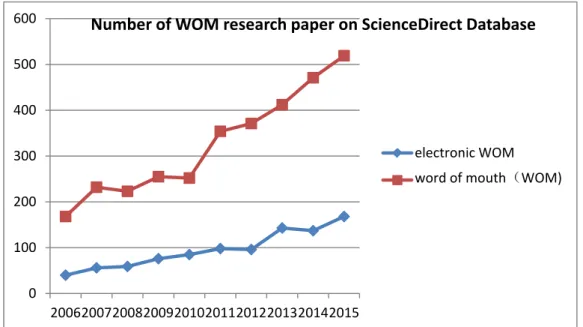
Using word of mouth/online word of mouth/ virtual word of mouth/ electronic word of mouth as key words, the author has searched the title of article in ScienceDirect database, and the number of related articles after 2006 is respectively 5602, 2685, 1037 and 1788. In addition, research results from 2006 to date increase year after year. The following figure shows the number of articles concerning word of mouth and electronic word of mouth of each year after 2006. It shows that research on online word of mouth marketing is a hot field.
26
Figure 2-1. Number of WOM research paper on ScienceDirect Database In relevant research, works done on individual difference of network consumer, measurement of online word of mouth and virtual community account for a certain proportion. Enterprise manager shall continuously supervise the online word of mouth of his company and service (Stauss, 1997). Navid Godes and Dina Mayzlin (2004) research into the measurement of word of mouth communication through thousands of online news groups of different topics. Zhuang Hejun (2007), whose research object is online word of mouth of shopping website against an Internet environment, believes that credit evaluation resulting from uncertainty of online information and anonymity of information dissemination should be the key point in word of mouth research. Wang Tao and Li Yanping (2007), whose research object is participant in virtual community, discuss about how characteristics of recommender in virtual community such as relationship intensity and perceived expertise influence the effect of recommendation. Neveen F, Awad and Arik Ragowsky (2008) pay attention to cultural influence of gender on relationships between online word of mouth and e-commerce trust. In current research on online word of mouth marketing, some focus on the influence upon purchasing behavior and will of consumer. Smith (2002) researches into the influencing mechanism of recommend information by ordinary consumer in virtual community upon consumer’s decision. Komiak (2002) researches the influencing mechanism of characteristic cognition of consumer concerning
0 100 200 300 400 500 600 2006 2007 2008 2009 2010 2011 2012 2013 2014 2015
Number of WOM research paper on ScienceDirect Database
electronic WOM word of mouth(WOM)
27
automatic recommend information in e-commerce (internalization and familiarity) upon his usage intention and purchasing decision. Yang Xuecheng and Qian Minghui (2006) set forth the connotation of online word of mouth and describe its categories, and furthermore analyze the influence of online word of mouth upon consumer’s decision. Chen Beilei (2008) discussed the cause and influencing factors for passing messages through virtual platform as a common consumer of virtual community, and influencing mechanisms of the new information formal for purchase decisions of consumers under the new era.
According to the research results of traditional word of mouth and Internet word of mouth, the studies for the spread of word of mouth are more than that of Internet word of mouth, which mainly refer to the research results of traditional word of mouth. In the past, the study of Internet word of mouth referred to theoretical knowledge of Management, Marketing, Sociology, Psychology and Communication. Comparative studies designed for Internet word of mouth by the scholars are few, let alone the study for cross-cultural word of mouth. Therefore, further researches on the studies for the spread of cross-cultural Internet word of mouth, influencing mechanism on consumer behavior and marketing strategy of enterprise word of mouth are needed.
2.3 Theoretical basis for WOM research
2.3.1 Elaboration likelihood model
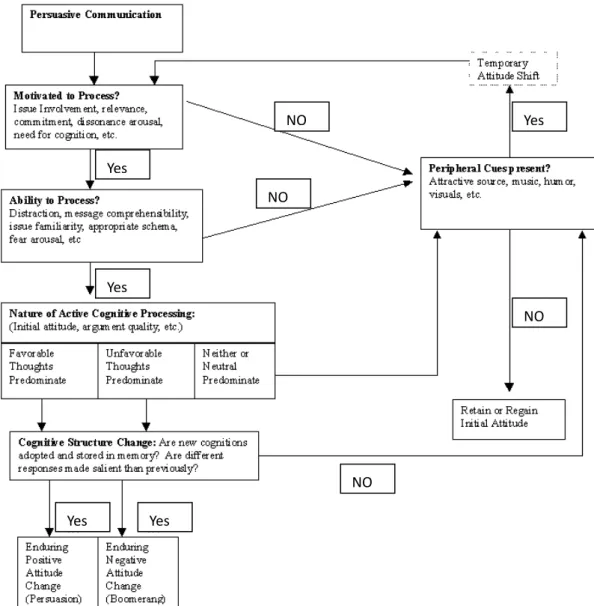
Put forward by Psychologist Petty and Cacioppo (1981), Elaboration Likelihood Model (“ELM” for short) is the most influential theoretical model in consumer information processing. The variance concerning personal motivation and ability determines the different approaches to information processing. According to Elaboration Likelihood Theory, (Central route) and (Peripheral route) are the two extremes of information processing methods.
28
more attention to product-related information and make careful considerations to assess and understand the product; pertinent and persuasive information will lead to better product belief and positive brand attitude.
Peripheral route states that a person with relatively weak motivation and ability tends to lack faith in the product, therefore direct persuasion will not be likely to produce brand attitude and purchase intention. Hence, attitude is mainly decided by emotional clues in the context, rather than pertaining to the thought about information argument. The basic principle of ELM model is: Different persuasion methods rely on the possibility of elaborate processing for disseminated information. When the possibility of elaborate processing is high, central route of persuasion will be particularly effective; but when the possibility is low, peripheral route will work.
ELM has two important contextual variables in Figure 2-2, which may affect the choice of route. One is involvement: whether the receiver self has the motive of information processing; the factor impacting the receiver motivation lies in the degree of correlation between information and receiver, namely, the degree of involvement of the information receiver. The other is self-efficacy: whether the receiver owns the ability to process information, the influencing factor of which lies in the degree of information acquisition by the receiver. When the involvement degree and self-efficacy shows high, the mode of central route is inclined to be employed for information processing, that is, to make decision after careful consideration according to the information content. Therefore when the involvement degree and self-efficacy shows high, the change of cognition leads to the change of belief and attitude, which ultimately results in behavior change. And when the involvement degree and self-efficacy shows low, the information processing is inclined to be conducted based on the peripheral attributes of the product or service. Therefore after the person with low involvement degree and self-efficacy has changed the belief, then the behavior is changed, and finally comes the change of attitude.
This research involves consumers’ processing of Internet WOM information, and the content conforms to the theoretical framework of ELM. The influencing process of Internet WOM on consumers’ behavior intention is exactly the process for
29
consumers to receive and process WOM information. Referring to ELM, confronted with Internet WOM, consumers’ product involvement, will affect their behavior intentions. But ELM only takes receiver factors into consideration, while ignoring the factors concerning information sender.
Figure 2-2. ELM model
Source: Petty, R.E., Kasmer, J., Haugtvedt, C. & Cacioppo, J. (1987)
NO Yes NO NO NO Yes Yes Yes Yes
30
2.3.2 Attribution theory
Deriving from relevant research of social psychology, attribution theory has now evolved into a theory frequently applied to psychological science and even humanistic and social science research, management science research and educational science research with over forty years’ development and improvement. Its relevant research results have laid a solid foundation for mankind’s social behavior of learning about and understanding themselves.
Heider is the first social psychologist that has explored attribution theory. As the founding father of this theory, he has investigated what motivates people to attribute and how they attribute.| In 1958, Heider first proposed the concept of attribution theory in his work “Interpersonal Relation Psychology” and defined himself as the attributer who is able to deduce stable psychological traits in a general sense following observation clues (Heider, F., 1958). The general definition of attribution by social psychologist is: Attribution refers to the process of deducing and explaining the reasons hidden behind the extrinsic behaviors by conducting behavioral analysis on other people or the attributer himself/herself. (David Myers, 2006). As a significant component of social cognition, attribution has always been a much-debated issue in the field of social psychological research. In summary, attribution is the psychological process of explaining and deducing reasons.
Attribution research in its early stage mainly revolves around the prerequisite and process of attribution with its focus on exploring the influential factors behind people’s behavior of attributing certain events or behaviors to certain reasons as well as identifying attribution approaches. Heider mainly investigates attribution process in his research on attribution. He only develops interest in observed motivations of a behavior rather than the true motivations. He believes that a critical part of attribution process is confirming that a certain behavior is caused by individuals or external environment.
He also holds that personal determinative factors of one’s behavior are personality, character, motivation, emotion, attitude, state of mind, efforts and ability,
31
etc. While one major environmental determinative factor of one’s behavior is situational factor, e.g. difficulty of a task, rewards and punishment of an event and luck, etc. (Heider, F., 1958). Jones and Davis developed Heider’s theory in 1965 with an equal emphasis on research of attribution process, expecting to establish a theory that systematically explains the relevant deduction process taking place when the perceiver extrapolates the intention of the actor according to their movement. Kelley’s covariance principle and attribution cube model display the internal processing on the result of a certain behavior, which in other words is a detailed process of attribution, by exploring how people make causal judgment according to the consistency, coherency and difference information (Kelley, 1973).
Bernard Weiner (1974) proposed an attribution model, arguing that individual’s explanation on success and failure more or less falls into four categories: (1) personal ability; (2) invested efforts; (3) task difficulty; (4) luck. Among these factors, ability and efforts describe the “intrinsic reasons” behind one’s characteristics; difficulty and luck, as extrinsic factors, indicate the “extrinsic reasons”. Weiner further categories the four explanations: Ability and task difficulty are stable factors while invested efforts and luck are unstable factors. Weiner believes that the intrinsic & extrinsic factors and stability as two measuring dimensions of attribution are independent of each other, which impact the creation and quality of achievement motivation respectively.
The stability dimension may greatly influence the expectation or prediction of success in similar situations in the future. If one attributes the success of a certain task to stable factors, i.e. he/she possesses a strong capability or the task is easy for him to complete, he/she will certainly expect to succeed in situations alike in the future. If one attributes the success of a certain task to unstable factors that may vary with the environment, i.e. he/she works hard or is lucky enough, obviously he/she will not be certain of another success in the future. Conversely, if the failure of a certain task is attributed to the stable factors that are hard to change, i.e. one’s poor ability or impossible tasks, the person will naturally predict failures for following tasks; if the failure of a certain task is attributed to the unstable factors, i.e. bad luck or insufficient
32
investment of efforts, the person will be more positive of future success.
Targeted at the effect of Internet word of mouth on consumer behaviors, the study employs attribution theory to analyze the influence of consumers’ attribution on their behavioral intentions.
2.3.3 Perceived quality theory
Consumers’ opinions on products are based on their perception on the products and service. Grönroos (1988) defines perceived quality as “consumers’ comparison on their expected service and the actual service performance they have received”. If consumers perceive that the service they have received is higher than their expectation, they would identify it as sound and satisfactory, otherwise as poor and unsatisfactory. Perceived quality originates from the asymmetry of information held by providers and consumers. Generally speaking, providers hold relatively complete information while information held by consumers is incomplete. This is the very reason why enterprises have a better knowledge of their products and service than customers, resulting in the customers’ disadvantaged position in the game played between the two parties. If customers don’t have complete information of the products, they will perceive the risks engendered by uncertainty and their behaviors will be influenced correspondingly.
To reduce the perception risk created by information asymmetry, customers will assess product or service quality through certain “information clues”. Olson & Jacoby (1972) group the clues that reflect product quality into internal clues and external clues. Internal clues are characteristics that are directly related with products, for example, raw materials, specifications, appearance and processes; external clues are not physical components of products and are barely related with product performance, for example, product price, brand and seller reputation, etc. Since it is easier for general customers to judge from external clues than internal clues, customers base their judgment on external clues more when they are provided with insufficient
33 information (Brucks M.et.al, 2000).
In many cases, customers regard price as a critical criterion for product quality measurement and would believe that a product with a higher price among its competitors would certainly have a superior quality. When choosing specific products, sometimes customers would prefer those with higher price to lower the risk of encountering low-quality products. Dodds.et.al (1991) discovered that when price is the sole clue, consumers would judge the product quality by its price; nevertheless, when other information clues are available, price’s influence on quality assessment will be weakened. When customers are relatively familiar with the product and service (when they are in command of much knowledge), they will conduct quality judgment by leveraging other external clues. Thus it reduces the influence of price. Therefore the study has paid extra attention to eliminating disturbing effect of product prices in its design.
2.3.4 Search cost theory
Information economics argue that information contains value. By obtaining information, people are able to judge more reasonably and thus making the right choice and enhancing economic efficiency consequently. Based on the hypothesis of rational behavior, people will seek maximized benefits with limited resources. (Cao, 2011) In the initial stage of information acquisition, the marginal benefits of information searching efforts show an increasing tendency with diminishing resources; when cognitive effectiveness peaks with continuously loaded information, the marginal benefits demonstrate a declining tendency afterwards. When the marginal benefits of information searching efforts equate with those of information acquisition, the searching efforts will pause as it is a critical point where the maximum benefits are achieved.
If Search Cost Theory is applied to online shopping, customers not only need to collect basic product information online, but also other useful information to aid
34
purchasing decision-making. In this process, the search cost of information should not be ignored. The search cost mentioned in economics refers to that brought about by price dispersion in a free market. The search cost incurred by online shopping has three sources: (1) The information obtained by customers and the information owned by the website are asymmetric, prompting customers to collect more information to eliminate the asymmetry; (2) Different customers may perceive different benefits on the same kind of product and they will adapt their searching process according to their own perceived benefits, giving rise to cost differences; (3) Too much information available online brings uncertainty to customers. The process of risk aversion requires time and efforts to handle and condense information, which are search cost. Generally speaking, search cost can strike a functional equation with time cost, price cost and risk cost and their relation is demonstrated as follows:
Cs= f (T, P, R)= Ct + Cp + Cr
In the function, Cs represents the search cost, Ct represents price cost; Cr represents risk cost. There is a functional equation between Ct, Cp and Cr and t, the search time. As time is a scare resource, neither being able to be accumulated or saved yet influencing customers’ perceived benefits, it is a major influential factor on information search cost. (Zhang Yahui, 2008) suggests that minimizing search time and shopping risk are effective ways to minimize search cost. Establishing quickly-responsive, highly-efficient and customized websites which provide detailed product profiles to attract customers is one way to provide customers with switching cost and thus attracting a stable customer pool. However, some scholars argue that online shopping channels provide convenience for consumers to search for product information, which reduces the search cost substantially and raise their possibility of shifting to other products and enterprises (Cao Lei, 2011).