Malaysia’s BOT method implementation for
highway development projects
by
Raja Khairul Anuar Bin Raja Abd Karim
March 2012
Thesis Presented to the Higher Degree Committee of Ritsumeikan Asia Pacific University
in Partial Fulfilment of the Requirements for the Degree of Master of Science in International Cooperation Policy
ii CONTENTS CERTIFICATION vi ACKNOWLEDGEMENT vii ABSTRACT viii TABLES x FIGURES xi
LIST OF ABBREVIATION xii
CHAPTER 1:INTRODUCTION 1
1.1 Background 1
1.2 Research Questions 6
1.3 Objective of the Thesis 8
1.4 Significance of the Research 9
1.5 Research Methodology 9
1.6 Limitation of the research 10
1.7 Organization of Thesis 11
CHAPTER 2: LITERATURE REVIEW 13
2.1 Introduction 13
iii
2.3 Definition and concept of PPP 14
2.4 Rationale of PPP in Infrastructure Development 25
2.5 BOT as one of the many PPP models/arrangements 29
2.6 Definition and concept of BOT 33
2.7 General literatures on BOT 34
2.8 Literatures on BOT implementation in Malaysia 48
2.9 Assessment of past Literature 53
CHAPTER 3: BOT HIGHWAY DEVELOPMENT IN MALAYSIA 57
3.1 Introduction 57
3.2 Malaysia’s Background 57
3.3 Road Network in Malaysia before Highway Development 60
3.4 Development of Highway before the Privatization 66
3.5 Malaysia’s Privatization Policy: The Beginning of Privatized
Highways 69
3.6 BOT Arrangement for Highway Development in Malaysia 71
3.7 Implementation of BOT Highway Development in Malaysia 72
iv 3.7.2 Agencies Involved in BOT Highway Development
in Malaysia 77
3.7.3 BOT highway Implementation Process 81
3.7.4 Toll Rate Determination in Malaysia’s BOT
Highway Projects 86
3.8 Case Study 1: The North South
Expressway (NSE) 89
3.9 Case Study 2 : The Kuala Lumpur-
Kuala Selangor Highway 100
CHAPTER 4 : ANALYSIS OF THE IMPLEMENTATION OF BOT
METHOD IN HIGHWAY DEVELOPMENT IN MALAYSIA 105
4.1 Introduction 105
4.2 Analysis of Malaysia’s BOT Highway Development
as a Proces 105
4.3 Review Of Prominent Characteristics in
Malaysia’s BOT highway 110
4.4 Suggested Good Implementation Framework for BOT 110
v
BOT implementation Approach 112
4.5.1 No Specific Law Governing BOT Implementation
in Malaysia 112
4.5.2 Management of Unsolicited Proposals 117
4.5.3 Government’s measures to protect the concession
company 124
4.6 The Connection and Effect of The Traits To Malaysia’s BOT
Highway Development 128
CHAPTER 5: CONCLUSION 131
5.1 Malaysia’s BOT Highway Project as a Process 131
5.2 Malaysia’s BOT Highway Project : Successful Implemention or Failure 132
5.3 Policy Recommendations 136
5.4 Future Directions 138
vi CERTIFICATION
I certify that this is my own work and has not been submitted in any form for another degree or diploma at any university or other institute of tertiary education. This Master’s thesis contains ideas and information derived from published and unpublished work of different authors which have been acknowledged in the text and list of references.
Raja Khairul Anuar B.R.A.K 51210007
vii ACKNOWLEDGEMENT
My first and foremost gratitude to Allah the almighty and the exalted for
giving me the strength and health to complete the thesis. Without His blessings
this thesis will not materialized. I also realized that this thesis is the culmination
of the assistance and guidance of many parties to which I am greatly indebted and
with great honour I would like to express my gratefulness.
Sincerest thanks and appreciation to my helpful supervisor, Professor
Shunso Tsukada for his guidance and patience in helping me accomplish the task
of writing this thesis.
Heartiest appreciation to the Government of Malaysia especially to the
Public Service Department for giving me this opportunity and supported me
throughout this experience.
Deepest thanks and love to my parents for their support and
encouragement throughout these two years of study.
Warmest appreciation and love especially to my wife, Nurulain Binti
Bachok who stood by me and supported me unconditionally throughout my study
and the writing of this thesis for without her, this will be a very hard to
accomplish.
Also to my friends in APU who with their wisdom and ideas have
contributed in one way or another and assisted me greatly.
And lastly to my first son who with Allah’s grace will see the world next
March, your arrival has been my biggest motivation for this and I dedicated this
viii ABSTRACT
Malaysia has embarked on highway privatization program starting from 1985 with
the launch of its privatization policy. The privatization method of choice for
highway development has been the Build-Operate-Transfer (BOT) method where
the government of Malaysia allow the private sector to develop the highway and
in return gives them toll charging rights. Based on this method, Malaysia has
succeeded in building 30 highways forming a complete network of 1600
kilometres in length connecting almost all part of the Malaysian Peninsular. The
number of projects implemented in Malaysia suggests that there is a particular
way of method of implementation being applied in Malaysia which has made it
successful in this endeavour. Further study shows that even though Malaysia is
successful in developing its highway networks trough BOT implementation
process, some of its particular implementation method is not positively
contributing the overall success of the process. The selected traits of no specific
BOT law in place, propensity towards unsolicited proposal and adoption of over
ix countries. The result shows that in the case of Malaysia, the success of highway
x TABLES
Table 2.1: PPP Contract Model According To Privatization Path 30
Table 3.1: Malaysia’s Road Development Growth (1966-2005) 63
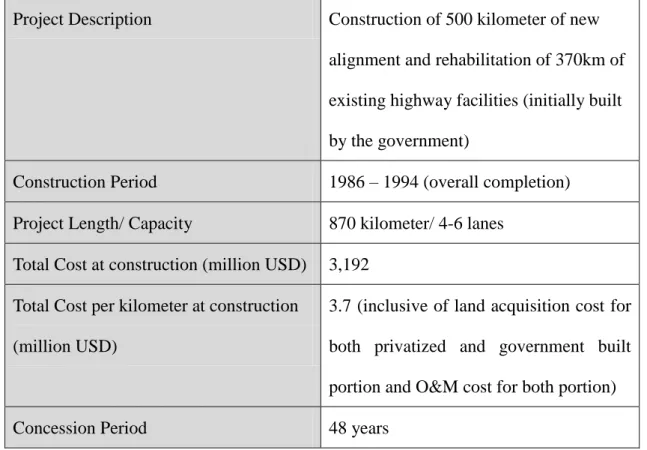
Table 3.2: Details of The NSE Project 89
Table 3.3: Characteristics of the Proposals Received for NSE Privatization
Exercise 92
Table 3.4: Comparison Between Publicly Procured Portion and BOT portion
Of NSE………..98
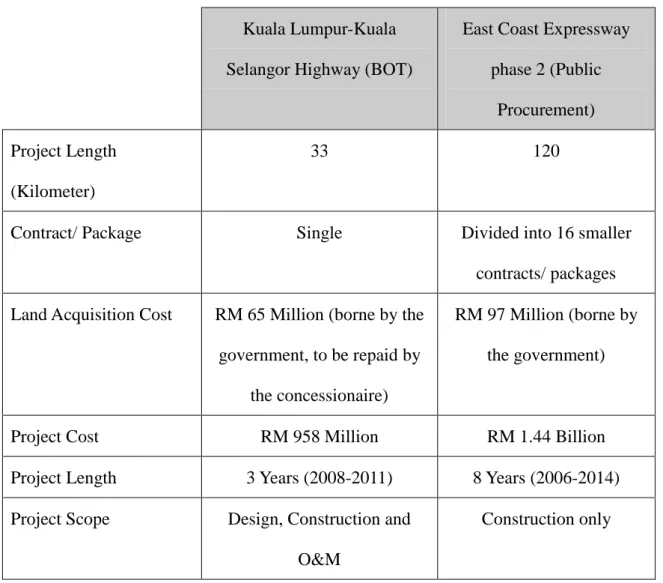
Table 3.5: Comparison Between KL-KS Highway (BOT) and East Coast
Expressway Phase 2 (Publicly Procured)……….103
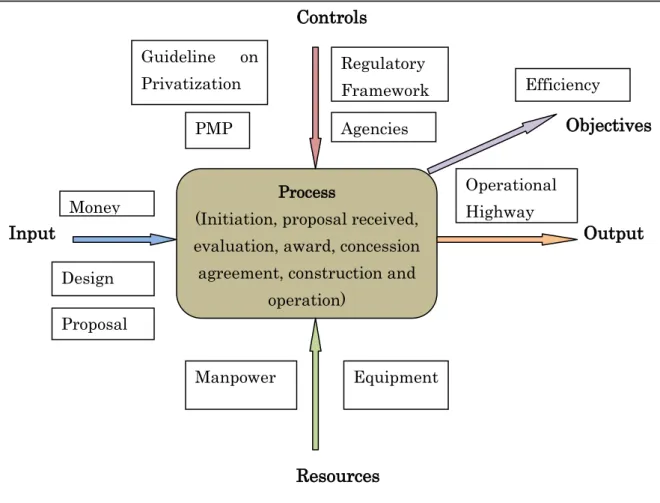
Table 4.1: Comparison of Malaysia’s Process of BOT Highway development
And Suggested Good Process Model………108
Table 4.2: Good BOT Implementation Matrix and How Malaysia Compares
To It 111
Table 4.3: Some Cases of the Private Initiated BOT Highways
xi FIGURES
Figure 2.1: PPP Methods and the Degree of Privatization Achievable 31
Figure 2.2: Category of PPP Arrangement According to Degree of Private
Sector’s Involvement and Allocated Risk 32
Figure 3.1: Malaysian Road Development Expenditure 1966-2005 63
Figure 3.2: Major Federal Routes in Peninsular Malaysia 65
Figure 3.3: Number of Registered Vehicles in Malaysia (1970-2007) 67
Figure 3.4: BOT highway implementation process in Malaysia 86
Figure 4.1: Analysis of Malaysia’s BOT Highway Implementation using
xii LIST OF ABBREVIATION
3PU Public Private Partnership Unit
ADB Asian Development Bank
BOT Build-Operate-Transfer
BOLT Build-Operate-Lease-Transfer
BOO Build-Operate-Own
EPF Employee Provident Fund
EPU Economic Planning Unit
GoM Government of Malaysia
GoP Guideline of Privatization
HNDP Highway Network Development Plan
HPU Highway Planning Unit, Ministry of Works
JIBC Japan Bank for International Co-operation
MHA Malaysia’s Highway Authority MOW Ministry of Works
MOF Ministry of Finance
NSE North South Expressway
xiii PPP Public Private Partnership
ROT Rehabilitate-Operate-Transfer
UNCITRAL United Nations Commission on International Trade Law
UNECE United Nations Economic Commission for Europe
UNDP United Nations Development Programme
1 CHAPTER 1:INTRODUCTION
1.1 Background
A good, interconnected road network system is a requirement for any country
in the world. Road networks will enable the movement of people and goods efficiently
and this ability is crucial as it in turn enable economic activities such as trade. As a
nation develops, so will its need for efficient road transportation. Increase in traffic and
trade volume among others leads to the need for an increase in traffic efficiency. The
roads need to be wider, with more lanes to cater for higher volume of traffic and in the
same time longer to connect more places and ultimately shorten the travelling time. In
order to fulfill these needs, a nation has to upgrade its road networks to highway
networks. These supersized road networks will enable greater volume of human and
material movement with higher efficiency across the land. Highways are the backbone
of a country’s transportation system (Maw, Nakamura and Okamura, 2007). Highways, together with other economic infrastructure like bridges, ports and airports, are
considered part of the public capital. As such, the effects of public capital (including
2 Aschauer (1989) in a study utilising a production-function approach for the US between
1949 and 1985 discovered that close to four percent increase in multifactor productivity
is achievable with a ten percent increase in public capital stock while another study by
Garcia-Mila and McGuire (1992) resulted with the finding that greater output of state
economies is attainable with larger expenditures spent on highways.
Infrastructure provision (including highway) is a large scale endeavour which
require a massive amount of budget, planning and administration. Agrawal, Gupta, &
Gupta (2011) stated that “ Infrastructure projects are complex, capital intensive, having long gestation period and involve multiple risks to the project participants”(p.52). Due
to this, the task of providing infrastructure is traditionally that of the government as the
government is able to utilize its planning and administrative capabilities in undertaking
infrastructure development. According to Bonnafous and Jensen (2004) public
authorities were generally in charge of financing and building new infrastructures.
However, infrastructure development is also financially taxing to the government. That
is why even when infrastructure development has a positive effect on the economy, no
government can afford to concentrate all its resources towards the provision of
infrastructure. Any government in the world will have to balance between the need for
3 providing healthcare and education. The economic rule of resource scarcity will limit its
capability to do so. Government’s income is usually derived from taxation and as such
increasing taxation is usually the main way it can increase its’ revenue. Levy (1996)
stated that “Infrastructure development has been the responsibility of public agencies. And taxes collected by local and central government have provided the funds by which
infrastructure projects have been built” (p. viii). However, raising taxes is not something
that can be easily done. Levy (1996) further added “citizen resistance is increasing to
the imposition of added taxes as a means of obtaining more money for a variety of
government projects” (p.11). Many governments have come to realize that the tax base alone cannot fund the enormous needs for infrastructure (UNECE, 2008). Therefore, the
government usually faces a financial shortcoming or a funding gap in infrastructure
development.
The government or the public sector is socially and economically obligated to
provide highways and other infrastructures in a nation. However, the private sector
shares none of this obligation. The private sector is mainly concerned with the profit
making aspect in any task it undertakes. Its source of revenue is not from taxation and
thus it is not bound by limitation faced by the public sector. By creating a cooperative
4 something which has been traditionally the role of public sector, the public sector can
tap into the resources of the private sector. This synergy between the public and private
sector in infrastructure development will enable the public to utilize the resources of the
private sector, in term of finance and efficiency, to overcome the problem of the funding
gap. On the other hand, this cooperation will allow the private sector to enter into
infrastructure development. This arrangement of public and private sector’s cooperation
is called Public Private Partnership or PPP.
The concept of partnership between public and private sector is a concept
taking many forms of arrangement. Essentially, it is an arrangement by which private
parties participate in, or provide support for the provision of infrastructure-base services
(Ng & Loosemore, 2006). In many countries worldwide, the provision of public
infrastructure and related services are carried out using a Public-Private Partnership
(PPP) approach (Olson, Guthrie and Humphrey, 1998). PPP covers many forms of
arrangement and BOT is one of them. Many developed and developing nations are now
utilizing PPP arrangements such as BOT as a solution for the problem they face in the
provision of infrastructure and services (Liu and Yamamoto, 2009).
As a country moving towards developed state, Malaysia has been embarking
5 the Peninsular Malaysia. Malaysia is strategically located between Thailand in its North
and Singapore in its South, therefore a complete network of highways traversing from
the North to the South will allow it to fully capitalize on the economic potential of its
geographical location. Like other nations, Malaysia too faced the problem of increasing
deficit in the public sector, it jumped onto the privatization bandwagon with a national
shift towards utilization of private sector’s resources for development (Yaacob and
Naidu, 1997). Through Built Operate Transfer (BOT) model, the Malaysian government
has succeeded in building major highways interconnecting all parts of West Malaysia
(Alfan, 2007). The model used is the appointed concession company will build the
highway and will operate it along an agreed concession period. In return, the company
will be allowed to collect toll from the highway users.
Malaysia’s experience with BOT in highway development has been largely considered as a success (Handley, 1997). However, there are also contradicting views on
Malaysia’s BOT highway such as the preference for no competitive bidding which reflects the lack of transparency (Hensley and White, 1993) and public disagreement
around the issue of toll charges and revisions (Aziz, 2002). This myriad of view on
Malaysia’s BOT highways shows Malaysia has both managed to successfully
6 length of operational highways) and at the same time, not being able to adapt certain
aspect in its framework that causes criticisms of its implementation.
1.2 Research Questions
Malaysia has aggressively embraced the path of privatization since it launched
the privatization program in 1985. Especially in the field of infrastructure provision,
more specifically on highway development, Malaysia has adapted BOT procurement
scheme for the development of all its highway projects since. The success of building
25 interstate and urban highways amounting to 1634 kilometers1 length with several more in the pipeline shows that Malaysia has managed to fully utilize BOT for her
highway needs. This feat is remarkable considering that Malaysia is a developing
country and the privatization program has only started not more than three decades ago.
Based on the success of Malaysia, this research is undertaken with the goal of
answering these research questions :
I. How does Malaysia implement its highway development projects using BOT
method and can this method be viewed as a process?
II. How does these aspects of Malaysian BOT highway development process (the
7 lack of specific PPP or BOT law, propensity of private sector to initiate project,
handling of unsolicited proposals and government guarantee against
concessionaire risks) differ from the process of BOT highway development of
other countries in the world and?
To answer the first research question, the research will study the development of
highway projects in Malaysia through the viewpoint of a process. The Merriam-Webster
Dictionary (2010) in one of its definition of process defines it as “a series of actions or
operations conducing to an end”. According to BusinessDictionary.com (2011) process is a “Sequence of interdependent and linked procedures which, at every stage, consume
one or more resources (employee time, energy, machines, and money) to convert inputs
(data, material, parts, etc.) into outputs2. These outputs then serve as inputs for the next stage until a known goal or end result is reached”. Therefore, to analyze the BOT
highway development in Malaysia in a clear and logical manner, the BOT highway
development is viewed as a process with the procedures (steps taken from the initiation,
selection, award, construction and completion of the highway projects), resources
(parties involved and their responsibilities), and inputs examined in detail. By utilizing
the process viewpoint, the second research question can be answered in a precise
8 manner whereas the process of highway development using BOT method in Malaysia
can be compared with the similar process in other countries especially by focusing on
selected procedures in the process which shows the most differences. Additionally, by
examining and answering the two research questions, the research will also be able to
understand what the reasons of the differences are and how these reasons affect the
process of BOT highway development in Malaysia.
1.3 Objective of the Thesis
The BOT model used in Malaysia’s highway projects has its own unique
characteristics which differ from the accepted practice in some other countries. Even
though Malaysia’s BOT model has succeeded in building extensive highway networks, it is crucial to understand the differences between it and the other model used in other
similar highway projects in other countries and how these differences have affected the
BOT implementation itself in terms of cost, time and project delivery. Furthermore,
available literatures suggested that the right framework and initiatives must be taken by
both parties in BOT to ensure its success. Thus, this thesis is written with the ultimate
objective of studying and comparing the implementation and the difference in
9 Malaysia and other countries based on several selected aspect of Malaysia’s BOT highway development.
1.4 Significance of the Research
Outcome of this research is hoped to reveal the differences between the
implementation methods of BOT in Malaysia and other countries based on selected
implementation aspect. By recognizing the differences, advantages on these differences
that are beneficial in various aspects can be identified and applied towards the
betterment of BOT implementation in Malaysia.
1.5 Research Methodology
This research is a qualitative research with the objectives of gathering available
data and material pertaining to the implementation of BOT highway development in
Malaysia and analyzing the characteristics of it. The research will be entirely based on
existing facts and will be executed through the approach of an informational paper and
will be conducted through qualitative method using comparative analysis. Ragin (2000)
stated that using the set-theoretic character of comparative analysis, this method will
derive from its own case-oriented nature, in this case by means of comparing selected
10 (namely the lack of specific PPP or BOT law, propensity of private sector to initiate
project, handling of unsolicited proposals and revenue guarantee to concessionaire) with
practices of other countries based on available information. Information will be gathered
from existing books, journals, articles, publications and other sources available both
online and offline. For information pertaining to Malaysian BOT highway, interviews
were conducted with officers from the Public Private Partnership Unit of The Prime
Minister’s Department of Malaysia and Ministry Of works Malaysia. Findings of these methods will later be studied and presented and conclusion will be derived from them.
1.6 Limitation of the research
To study in depth of the implementation method of BOT highway development
in Malaysia is quite a challenge due to several factors. First being that the subject itself
is immensely complex and involves many dimensions such as politic and administration.
Some matters concerning tolled highway development in Malaysia are still considered
as classified matter. This is further compounded by the fact that to get a thorough view
on Malaysia’s BOT highways, information must be gathered from both the public and private sector whereas the public sector itself consisted of several government agencies.
Based on these conditions, it has been quite difficult for me to obtain the information
11 highway projects, I had to rely only on available resources online and offline. Thus, this
research substantially depended on secondary sources in the form of books, journals,
newspapers and internet. Admittedly, these constraints have made it especially difficult
for the researcher to produce a meaningful research. Furthermore, this researcher is also
constrained by his lack of experience in conducting such research. All of these factors
have contributed to the researcher not being able to accomplish commendable standard
for this study. However, despite all these limitations, it is hoped that this research will
contribute to the body of knowledge available on the subject of Malaysia’s BOT highway development.
1.7 Organization of Thesis
The structure of this thesis is it is organised into five chapters. Chapter one
briefly introduce the privatization of highway through BOT scheme and its
implementation in Malaysia. Chapter two reviews available past literatures on the
concept of PPP and BOT and related aspect of its implementation in Malaysia’s highway developments. Based on the assessed literatures, a framework of study is
presented. In Chapter three, detailed analysis on how BOT highway project is
undertaken in Malaysia is presented from start to finish with attention being given to
12 implementation highlighted in chapter three will be analysed and compared with
corresponding traits from various countries’ BOT projects. Finally, in chapter five, conclusion of the thesis will be provided by discussing the findings of this thesis. The
logic of arranging this thesis in this manner is to show the objective of this research, its
background and the available literatures and knowledge around it, the reason for
Malaysia’s decision to engage in BOT highway development process in term of its history and development need, the process undertaken by Malaysia and how procedures
in that process compares to other countries and lastly to analyse Malaysia’s experience in that process.
13 CHAPTER 2: LITERATURE REVIEW
2.1 Introduction
This chapter explains the main concept of Public Private Partnership (PPP)
which encompasses the Build Operate Transfer (BOT) method, the crux of this research,
through the compilation and review of various available literature resources.
Furthermore, literatures on BOT implementation in highway development in Malaysia
are also reviewed to get a clearer picture of what has already been studied about it and
how this research can complement to the available body of knowledge on this topic. The
importance of this chapter is that it defines the major concepts of the subject matter of
this thesis and provides a conceptual background for the in depth discussion and
analysis about BOT highway development in Malaysia in chapter 3 and 4.
2.2 Introduction of PPP Concept
Public Private Partnership (PPP) in infrastructure development has been
viewed as an alternative solution towards the problem of public sector’s shortage of
fund and capacity to deliver infrastructure provision effectively. BOT method is one of
the specific arrangements under the umbrella term of PPP. The increasing number of
14 has resulted in various literatures written about it. Some literatures were also written on
various aspects of Malaysia’s highway projects developed using BOT arrangement. As this research is aimed specifically at studying the method of implementation of BOT
highway development in Malaysia, review on the literatures available both online and
offline on PPP, BOT and BOT (and privatisation) of highway development in Malaysia
is undertaken. Furthermore, summary and analysis on these literatures is conducted.
2. 3 Definition and concept of PPP
The concept if Public Private Partnership or PPP is fundamentally one which
involve the public sector and private sector working together in various type of
arrangements in delivering or provision of public infrastructure or services. However, in
available literatures, it has been stated that giving specific definition of PPP that is
suitable in all forms and aspects of its implementation is not an easy task. Supporting
this argument, several literatures have expressed the difficulty of giving a definition to
PPP. Weihe (2006) stated that PPP is a concept that is debatable and not well described.
Weihe added that “often the definitions put forward are so open-ended and inclusive that they do not clarify much of the confusion that exists around the PPP concept”
(Weihe, 2006: 3). According to Ziekow and Windoffer (as cited in Arnold and Kehl,
15 versatility of the concept, usually involving various aspects of it. Breaking down the
term PPP itself will show three main components which made up the whole concept.
While public and private can easily be defined as the public sector (government) and the
private sector, partnership is a concept that requires a better understanding. This is
important as the essential concept of Public Private Partnership is that of a partnership.
The World Bank (1998) defined partnership as "a collaborative relationship between
entities to work toward shared objectives through a mutually agreed division of labour."
One of the definitions of partnership according to The Merriam-Webster Dictionary
(2010) is "a relationship resembling a legal partnership and usually involving close
cooperation between parties having specified and joint rights and responsibilities".
According to UNDP3, “the term public-private partnership (PPP) is used to describe a spectrum of possible relationships between the government (the public sector) and other
organisations that are not government (the private sector) to carry out a project or
provide a service”.
In academic and scholarly literature, the definition of PPP varies between one
literature to the other. Several points of view pertaining to the concept of relationship in
PPP emerged; with three most eminent are that of PPP as a relationship of client-service
16 provider, PPP as a form of cooperation or collaboration between the two sectors and
PPP as a contractual arrangement. The first conceptual definition of PPP is that it is a
relationship or client-supplier or seller-purchaser in which the private sector plays
the role of service provider to the client (public sector). OECD supported this
definition of PPP as follows:
“… an agreement between the government and one or more private partners (which may include the operators and the financers) according to which the
private partners deliver the service in such a manner that the service delivery
objectives of the government are aligned with the profit objectives of the
private partners and where the effectiveness of the alignment depends on a
sufficient transfer of risk to the private partners (OECD, 2008, p. 17).
Ng and Loosemore (2006) described PPP as “essentially an arrangement by which
private parties participate in, or provide support for the provision of infrastructure-base
services”. They asserted that basically, by this definition, as opposed to the traditional
arrangement in which the public sector procure the infrastructure asset, the public sector
in PPP is procuring a sequence of services (planning, design, construction etc) from the
private sector; with the final objective of procuring infrastructure asset, and the
17 Ter-Minassian (2006) stated that PPP is an “arrangements where the private sector
supplies infrastructure assets and services that traditionally have been provided by the
Government….stress long-term service delivery rather than asset creation; services can be provided to the government or directly to final consumers”. Bashiri, Ebrahimi,
Fazlali, Hosseini, Jamal, & Salehvand, (2010) in further support of this notion defined
PPP as:
“a service contract between a public authority and a private sector concessionaire, where the public authority pays the concessionaire to deliver
infrastructure and related services, Typically, the concessionaire, who builds
the infrastructure asset, is financially responsible for its condition and
performance throughout the asset lifetime, or the duration of the agreement, or
it describes a government service or private business venture which is funded
and operated through a partnership of government and one or more private
sector companies.” (Bashiri, Ebrahimi, Fazlali, Hosseini, Jamal, & Salehvand, 2010:5)
The view of PPP as a relationship of client-service provider is further supported by
Leidel & Alfen, (2009) which stated that in the definition of PPP, there is a broad
18 private (commercial) partner and both parties jointly accept the risk involved with the
objective of achieving the wanted results, especially in public policy sectors. Schmidt &
Moisa (2004) offered a slightly different definiton, in which in PPP; private sector is
taking the role of service provider for services normally associated with the public
sector.
The second conceptual definition of PPP is that it is a cooperation or
collaboration between the two sectors. There are several proponents of this definition,
among them Liu and Yamamoto (2009) who defined PPP as a form of cooperation
between public and private sector; a partnership model rather than a purchaser-seller
relationship. In their word, PPP is “a form of collaboration between the public and
private sectors for the purpose of providing public services which have been
traditionally provided only by the public sector”( Liu and Yamamoto, 2009: 223). This view of a partnership concept of PPP is also embraced by The Agency for Public Private
Partnership, Republic of Croatia4 in its definition of PPP as follows:
“Public-private partnerships are just what the name implies, partnership between private and public partners whereby the resources, risks and rewards
of both the public partner and private company are combined to provide greater
4
19 efficiency, better access to capital, and improved compliance with a range of
government regulations regarding the environment and workplace”.
The concept of PPP as a close cooperation with mutual objective is also shared by
Grimsey and Lewis (2004) who defined PPP as “a risk-sharing relationship based on a shared aspiration between the public sector and one or more partners from the private
and/or voluntary sectors to deliver a publicly agreed outcome and/or public service”
(Grimsey and Lewis, 2004: x). This view of reciprocity or interdependency between
public and private sector in PPP is supported by Kooiman (2003) which characterized
PPP as a relationship of combined and collective administration, involving the
participation of both parties : ‘‘Such interactions between public and private, expressed
in concrete forms of public-private collaboration or co-operation, are often referred to as
PPPs’’ (Kooiman, 2003: 102). The idea of cooperation and mutual governance in PPP arrangement is further supported by Klijn and Teisman (2002) in which in PPP, both the
public and private sector work together as a cohesive unit in a collaborative relationship,
rather than client-employer arrangement. In their own word, PPP is “ a cooperation
between public and private actors with a durable character in which actors develop
mutual products and/or services and in which risk, costs, and benefits are shared” (Klijn and Teisman, 2004).
20 The Canadian Council for Public-Private Partnerships5 supported the concept of cooperation in its definition of PPP as follows “A cooperative venture between the
public and private sectors, built on the expertise of each partner, that best meets clearly
defined public needs through the appropriate allocation of resources, risks and rewards”.
This definition is also mirrored by The Efficiency Unit of The Government of Hong
Kong which expressed PPP as “arrangements where the public and private sectors both bring their complementary skills to a project, with varying levels of involvement and
responsibility, for the purpose of providing public services or projects6”. The German Federal Department of Transportation, Construction and Real Estate (BMVBW) in the
“Federal Report on PPP in Public Real Estate, Part I: Guideline” published in 2003 (as cited in Alfen et al., 2009) gave the official definition of PPP as
“The term PPP refers to a long-term, contractually regulated cooperation between the public and private sector for the efficient fulfillment of public
tasks in combining the necessary resources (e.g. knowhow, operational funds,
capital, personnel) of the partners and distributing existing project risks
appropriately according to the risk management competence of the project
partners.” ( Alfen et al., 2009: 4)
5
http://www.pppcouncil.ca/resources/about-ppp/definitions.html
21 Mitchell-Weaver and Manning (1991) views PPP as a compendium of conceptional
relations involving the private and public sector. Further support of the notion of
cooperative relationship in PPP can be found in the writings of Kolzow (1994) which
defines PPP as an organizational framework between the public and the private sector in
which both have a mutual obligation towards achieving shared objectives which have
been collectively decided and agreed upon. Skelcher (2005) also supported the idea of
some form of mutually beneficial cooperation in PPP. In his word “PPPs combine the resources of governments with those of private agents (business or not for-profit bodies)
in order to deliver societal goals” (Skelcher, 2005: 347). To Van Ham & Koppenjan
(2001), the concept of PPP is that of a “cooperation of some sort of durability between public and private actors in which they jointly develop products and services and share
risks, costs and resources which are connected with these products (Van Ham &
Koppenjan, 2001:598).
The third concept that has been used to define PPP is that of contractual
relationship between the public and private sector. The National Council for
Public-Private Partnership’s7 definition of PPP supported this concept of contractual relationship. Its definition of PPP is as “a contractual agreement between a public
22 agency (federal, state or local) and a private sector entity. They added that through this
agreement, the skills and assets of each sector (public and private) are shared in
delivering a service or facility for the use of the general public. In addition to the
sharing of resources, each party shares in the risks and rewards potential in the delivery
of the service and/or facility”. The Federal Highway Administration (FHWA) in
defining PPP stated that “…are essentially contractual arrangements between the public
and private sectors that allow a single private entity to assume significant control of, and
risk for, multiple elements of a project, including design, construction, financing,
operation and maintenance8”. ADB (2006) defined PPP as “ a contractual partnership between the public and private sector agencies, specifically targeted towards financing,
designing, implementing and operating infrastructure facilities and services that are
traditionally provided by the public sector”(p.15). This definition is also embraced by UNECE which defines PPP as:
“innovative methods used by the public sector to contract with the private sector, who bring their capital and their ability to deliver projects on time and
to budget, while the public sector retains the responsibility to provide these
services to the public in a way that benefits the public and delivers economic
23 development and an improvement in the quality of life”. (UNECE, 2008:1)
Although there are many definitions of PPP, some literatures agreed that some
characteristics can be attributed to PPP. For example, Fourie and Burger (2000) defined
two main characteristics of PPP which are true partnership and the transfer of risk to the
public sector. True partnership encompassed sharing of mutual goal albeit the distinct
roles of the parties in the partnership. Therefore, they argued that mere outsourcing of
government service to the private sector does not embody true partnership because in
doing so, there may not be a mutually agreed goal. This is also true for cases where
the private sector only plays the role of funder or financier of the service. The second
main characteristic of PPP according to them is the assignment of risk to the public
sector as it will be the impetus of effective commitment of the private sector. Arnold &
Kehl (2010) listed down six inherent characteristics of PPP. First, PPP should be a
mutual interdependancy between both public and private sector and the nature of this
relationship must be cooperative. Second, this relationship should aim for lastingness
and inclusiveness. Third, significant portion of the shared objective in the partnership
must be executed by the private sector. Fourth, equal partake of the obligations in the
partnership between both sectors. Fifth, both sides in the partnership should pursue the
24 characteristic of PPP is that the stipulation for the objective to be achieved in the
partnership (infrastructure development or service) must be output-oriented or in their
word “the public authority only determines what the result should be instead of regulating how the performance is realised.” (Arnold & Kehl ,2010:8). Continuing on
the characteristics of PPP, Peters (1998) stated that “what we can do is to develop a set
of characteristics that appear to be involevd in most partnership arrangements and also
appear to ber necessary to their formation and maintenance” (p.12). He asserted that there are five important characteristics of PPP which are required to enable its formation
and will decide on its success. First, the partnership in PPP should consist of two or
more collaborators and public sector must be one of them. Second, each party in the
partnership must be one with authority to negotiate and make decisions. Third, the
colaboration in PPP should be continous and lasting. Fourth, each party contributes
towards the significance of the relationship by adding value to it and lastly, there is a
mutual obligation and commitment of the parties towards the end result of the
partnership.
Based on the literatures and sources available, PPP encompasses a wide
spectrum of activities in its “partnership”. Thus, it is not easy to simply pin one definitive concept to it as PPP varies across geographical and project perimeter. The
25 essential part of PPP according to available literatures is involvement of public and
private sector and some sort of partnership arrangement between them, whereas this
partnership must be meaningful and more than just the transfer of obligation from the
public sector to the private or simply private sector paying for infrastructure and service
provision.
2.4 Rationale of PPP in Infrastructure Development
Although many literatures dicussed vaious rationale why PPP arrangements are
used all over the world, this research will only look at two rationales for its
implementation in infrastructure development (including highway) which are
overcoming public sector’s budget constraint and achieving greater efficiency.
The first rationale for implementing PPP as supported by many literatures
available is to overcome the problem of government’s budget constraint in facing
growing infrastructure need. ADB (2006, 2007) acknowledged the challenges
confronting governments in providing adequate funding for the provision and up
keeping of the infrastructure required to sustain the growing needs of the population.
The dependency of governments on public funds to satisfy these needs, in addition to
26 These conditions create the inclination to bring the private sector’s financial resources
into infrastructure development. According to ADB, “PPP may be able to mobilize previously untapped resources from the local, regional, or international private sector
which is seeking investment opportunities”(ADB, 2007:3) and “PPPs allow
governments to overcome their budgetary and borrowing constraints and raise finance
for high-priority public infrastructure projects. Essentially, governments are able to use
private finance through PPPs to build infrastructure projects that would previously have
been built by the public sector using public sector finance” (ADB, 2006: 22). Sarmento (2010) stated that the huge investment requirement of infrastructure projects is not
something that can be afforded by many governments and because of this, PPP assists in
sufficing this infrastructure funding gap. Similarly, McBrady (2009) mentioned that as
the funding resource of PPP projects are partly from private capital, the government is
able to provide and develop infrastructure and services at a lower initial cost. He added
that “Particularly in the case of costly infrastructure projects, sharing financing burdens with private entities can significantly reduce budget constraints” (McBrady, 2009: 3)
Another study by Shinohara (1998) which focused on the impact of PPP towards
Japan’s social infrastructure and public service suggested that PPP approach is a way to harness private sector’s resources in funding, management and technology for the
27 efficient delivery of public service such as highway development projects. Thus, thus
prominent notion of Public Private Partnership as an enabler to the government to
overcome the problem of limited resource has been studied by a growing number of
researches.
Higher efficiency in projects and service delivery has also been associated
by several literatures as the rational of PPP. Several points of view have been
associated with the idea of increased efficiency in PPP. First, the view that the
participation of private sector player in PPP will bring with it the management and
technical skills not available in the public sector, or in other word, PPP will be able to
fully utilize the skills of private sector. One literature which supported this view is
(Kumaraswamy & Zhang, 2001) who asserted that correctly planned and executed PPP
will result in higher efficiency compared single handed implementation by either public
or private sector themselves, as “The private sector, with its wide range of management, commercial and technical skills, spurred on by the profit motive and unencumbered by
layers of bureaucracy, can reputedly perform certain tasks more efficiently than the
government thereby offering potentially huge benefits to the public” (Zhang and Kumaraswamy, 2001:351). The next prominent view is that increased efficiency is
28 participation. The Hong Kong Institute of Surveyors (2009) breaks down the efficiency
into three prominent advantages associated with PPP. The first being that in PPP, the
provision of service or infrastructure happens at a faster pace compared to traditional
public sector procurement as in PPP, the government is not burdened with providing
large capital to initiate and complete the project, thus speeding up the delivery process.
Secondly, private sector in the PPP is motivated to finish the project sooner, as their
responsibilities have been clearly outlined and allotted to them and payment is often
linked to the evaluation of the service they provided. This arrangement will greatly
increase the private sector’s drive to complete the project sooner. Third, projects
implemented with PPP usually have lower whole life cost. This is because in PPP
projects which comprise of operation and maintenance, the private sector will be
inclined to reduce the overall life cost of the project in view of maximizing their
revenue and this is something that could not be attainable in the conventional public
sector procurement.
Efficiency of PPP is also associated with the concept of bundling or combining
the tasks of funding, design, construction, operation and maintenance and assigning
them to one single entity, the private sector partner (British Columbia Ministry of
29 the decision making process can be expedited and lesser bureaucracy will be involved.
This in turn will lead to faster delivery of services and reduction in cost. In comparison,
in conventional procurement arrangement, these tasks will have to be designated to
different parties or unbundled thus leading to increased level of complexity, time and
cost consumption.
2.5 BOT as one of the many PPP models/arrangements
Alfen et al.( 2009) stated that the various PPP arrangements can be classified
according to their privatization path. They outlined the three privatization paths as
formal, material and functional privatization. The difference between material and
functional privatization is mainly that in the former, the transfer of task and ownership
of the infrastructure is permanent while in the latter it is on a specified, mutually agreed
time period. Using this classification, they observed that there are numerous contractual
arrangement of PPP implemented for infrastructure projects around the world (Alfen et
30
Table 2.1 : PPP contract model according to privatization path Source : Adapted after Elfan et al. (2009)
Khanom (2010) discussed the notion that several explanations of The PPP
concept emphasize on the financial relationships between the parties involved especially
on the idea that PPP lessen the burden of government finance as it brings the financial
resources of the private sector. The definitions of PPP methods which emphasize on
financial relationship are mostly found on literatures focusing on infrastructure
development and these PPP methods include BOT (Build-Operate-Transfer), BOOT
(Build-Own-Operate-Transfer) and BOO (Build-Own-Operate), with the most common
being BOT (Khanom, 2010: 152). With regard to BOT being one of the methods under
PPP arrangement, Sadka (2007) added that there are some fundamental traits shared by
PPP (Functional) PPP (Material)
BOT-Build Operate Transfer (Concession
Model)
BOO-Build Operate Own
BOOT-Build Operate Own Transfer BDBOO-Buy Design Build Operate Own
DBFO-Design build Finance Operate DBROO-Design Build Rent Operate Own
DBLOT-Design Build Lease Operate
Transfer
DBROT- Design Build Rent Operate
31 most PPP projects and there are various form of PPP arrangement available, with the
most usual are variation of Design-Build-Finance-Operate (DBFO) model where the
private sector or concessionaire in the partnership undertake the responsibilities of
designing, constructing and financing infrastructure project or BOT model where the
private sector’s obligations are funding, constructing , operating and transferring to the government the infrastructure after the stipulated concession period has ended (Sadka,
2007:469). Ashuri, Kashani and Lu (2010) supported the view that BOT is one of the
many arrangements of PPP and it is usually utilized in highway development projects.
PPP covers a broad spectrum of arrangements. As such, available literatures
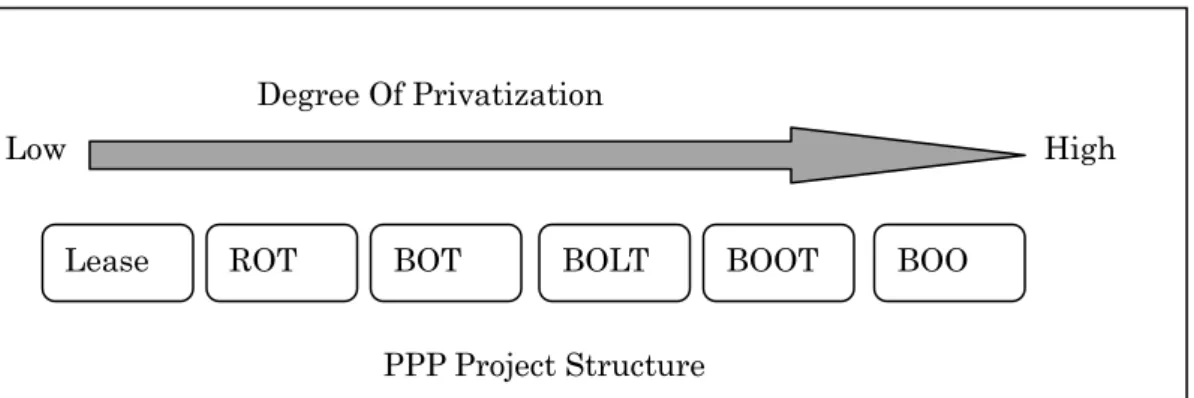
listed down the various PPP methods including BOT through several approaches. Thillai
(2004) utilized the ‘degree of privatization’ approach in listing the project structures under PPP, starting from lowest degree (lease) to highest degree of privatization
attainable (BOO).
Figure 2.1: PPP methods and the degree of privatization achievable Source : Adapted after Thillai (2004)
Degree Of Privatization
Low High
PPP Project Structure
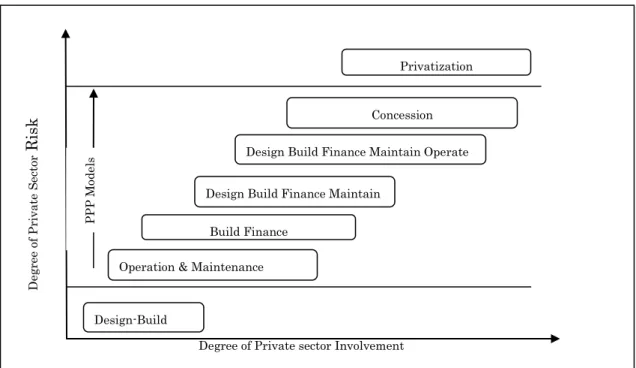
32 Another approach in listing down the wide array of arrangements under PPP is
by measuring the magnitude of private sector’s risk and involvement. By using this approach, combination of privatization degree and degree of risk allocated to the private
sector for each PPP method can be clearly defined. This approach is used by The
Canadian Council for Public-Private Partnerships as exemplified in this figure
Degree of Private sector Involvement Design-Build
Operation & Maintenance Build Finance
Design Build Finance Maintain
Design Build Finance Maintain Operate Concession Privatization P P P M od els De gr ee o f P riva te S ec to r R isk
Figure 2.2 : Category of PPP arrangement according to degree of private sector’s involvement and allocated risk
33 2.6 Definition and concept of BOT
The concept of BOT as an infrastructure procurement arrangement is said to
have originated in Turkey in the 1980s and it was the idea of the Prime Minster of
Turkey at that time to incorporate this alternative funding arrangement into Turkey’s
infrastructure privatization plan (Tiong, 1990), (McCarthy and Tiong,1991),
(Kumaraswamy and Zhang, 1999) and (Kumaraswamy and Morris, 2002). As a part of
PPP’s various arrangement, many definitions of BOT method have emerged. For example, Schaufelberger and Wipadapisut (2003) defined BOT as an approach where
the task of financing, designing, building and operating an infrastructure project
throughout a mutually agreed operating period is undertaken by the private sector. They
further added that the operation of the infrastructure project along the specified time
also includes the right for the private sector to charge users of the project as a revenue
source and generate profit for their investment. After the granted operation period has
ended, the ownership of the infrastructure must be transferred to the government.
Xenidis and Angelides (2005) defined BOT through several of its major characteristics
which are a concession period where the private sector (or concessionaire) is allowed to
operate an infrastructure project with the norm of being 30 to 40 years following the
completion of the project, the project itself being financed, designed and constructed by
34 revenue from users of the project and the transfer of the project back without incurring
any cost to the government after the concession period has ended. Several other
literatures supported the idea that BOT as one of the arrangements under PPP should
have these main concepts, namely the government appoints and awards a private sector
partner (concessionaire), the private sector or concession company being responsible for
the financing, design, construction, operation and maintenance of the infrastructure
along the concession period, a concession period for the private sector to undertake all
the responsibilities and utilize the infrastructure to generate revenue to cover their
investment and the handing back of the infrastructure to the government after the
concession period ended (Nassar, 1996) (Shalakany, 1996) (Esq, 1996) and
(Tiong,1995). Parikh and Samson (1999) give further clarification to BOT through the
way it “Provides private consortia with a concession to finance, build, operate, and maintain a facility/road. During the life of the concession, investors collect user fees to
cover the costs of construction, debt servicing, and operations. At the end of the
concession period, the facility reverts to the public authority in question” (p.5).
2.7 General literatures on BOT
Levy (1996) discussed about BOT and public procurement. As the popularity
35 countries around the world especially in the development of large scale infrastructure
project such as highways. He added that this increased popularity is also driven by the
compatibility of BOT with projects of such scale, which are characterized by huge
investment and long gestation period. From his observation, Levy suggested that in
order to incorporate BOT method into good government procurement practice, a
comprehensive, working framework which can easily attuned both processes needs to
be created. Available regulation by international bodies such as UNCITRAL, UNIDO
and World Bank have been used as guiding principles towards achieving good
governance in public procurement procedures. Therefore, the same set of regulation can
be applied to a country’s BOT scheme in order to create a sound framework for incorporating BOT into public procurement. He asserted that “a sound public
procurement law promotes good government ideals by encouraging confidence that
government will act responsibly in its purchases, by seeking optimum value for public
funds in an atmosphere of accountability, and allowing fair competition through
regulated, transparent practices” (Levy, 1996:97). The significance of public procurement is that it among others enhances infrastructure facilities and this in turn
will promote business activities and contribute towards society’s well being. Therefore,
36 product and services at the most reasonable cost and at the same time promote
confidence in government by ensuring that corruption can be restrained. As more and
more government is turning to BOT as preferred procurement method, the need for
incorporating good governance practices in its implementation becomes more eminent.
Levy suggested adapting available international guidelines which promote competitive
procurement procedures such as tendering. For BOT scheme to be successfully used as
a public procurement method, it must incorporate tendering as tendering is described as
“the method of procurement widely recognized as generally the most effective in promoting competition, economy and efficiency” (UNCITRAL). He further concurred that the correct direction for attaining good governance in BOT is through attaining the
objectives of transparency and competition. Measures that must be taken to achieve the
desired level of transparency should include the public disclosure of bid solicitation, bid
selection and award of the contract. The importance of good governance framework for
PPP arrangement such as BOT is due to the fact that it allows the public sector to obtain
economic assets (infrastructure) without depleting public fund while simultaneously
retaining control of the project. Additionally, for BOT project to be successful the public
sector’s prolonged scrutiny and control is detrimental while the private sector concurrently must be able to outline the long term viability of the project. With regard to
37 this, the current form of BOT being practiced could still be improved to increase
transparency and competition. Levy concludes that a sound regulatory model which
complies with good governance characteristics and clearly acknowledging tender as the
best procurement method should be adapted for BOT projects.
The increasing popularity of BOT as the procurement method of choice for
infrastructure projects is among others, driven by government’s tendency to seek funding source from the private sector. Based on the successful implementation BOT
projects in both developed and developing countries, McCarthy and Tiong (1991)
elucidated in detail about the financial and contractual aspect of BOT projects,
especially in infrastructure development. In BOT projects, the corporate structure is
different from conventional infrastructure procurement. The number parties involved in
BOT projects are bigger. Generally, they are the client (government or public sector),
the constructor, the operator, off takers, suppliers, lenders and investors. With these
parties as participants, the procurement procedure begins with the awarding of the
project to the concession company who in turn will undertake the ‘bundled’ tasks of
designing, constructing, financing, managing, operating and maintaining the
infrastructure asset along the agreed concession period before transferring it to the
38 task undertaken by the contractor is usually limited to construction and commissioning
(with the exception of design and build project). In this study, they also listed down
several characteristics of the financial aspect of BOT projects. The first and most
significant is that the financial instrument utilized for funding the project may differ
according to the economic condition of the BOT implementing country. For developed
country such as UK, financing of BOT project can be from investor in the domestic
market whereas in developing countries, financing usually comes from debt instrument.
To increase the success rate of BOT project undertaken, the host government should
provide several assistance and incentives in the form as follows:
Foreign-exchange guarantee – Host government should ensure that for project financed from oversea sources, remittance guarantee will be provided and
project sponsors are secured of their ability to freely remit the revenues
generated from the project
Offshore escrow – Host government should assist the project sponsor in the matter of creating an offshore escrow account for all project revenue and foreign
loans
Off take agreement – To increase lenders’ confidence that the concessionaire can generate the required amount of revenue to offset their loans, the host
39 government could assist by having a minimum guarantee of demand volume or
operating income
Supply agreement – In order to ensure the uninterrupted supply of raw materials needed for the BOT project, the host government could arrange for a guaranteed
supply of such materials at competitive prices
Allowing concession to operate existing facility – Host government can allow the concession company to operate another existing facility and charge users of
that facility
Retention of title – Host government is guaranteed ownership of the physical assets in case of project failure. Therefore, for lenders’ benefit, in view of this
provision, host government or project sponsors should provide other form of
guarantee.
Regarding the contractual aspects of BOT projects, McCarthy and Tiong
enumerated these prominent aspects:
Concessions – It is important for BOT projects to have a regulatory, controlling guideline. Although it is sufficient for BOT concession to be regulated by
contract or statute, there are some requirements in it which require intervention
40 matters pertaining to private land acquisition or processing of planning
application. Therefore, for forming concessions in BOT projects, it is better to
have enabling legislation already in place either in the form of special law or act
specific to BOT projects’ needs as its regulatory framework.
Operation and Maintenance – Operation and Maintenance in BOT projects can either be undertaken by the concessionaire company itself or contracted out.
Construction – Procurement of construction service in BOT projects is commonly executed using turnkey fixed price contract. In this arrangement
constructor’s proposition is in the form of lump sum price in which all risks associated are borne by him. Another salient aspect in procurement of BOT
project is time bonus and penalties associated to project and concessionaire’s
performance. In brief, concessionaire will be rewarded for early completion and
punished for delay.
Independent checker and project management company – Due to the large scale of BOT project and its complexity, sometimes independent checker or project
management service provider is appointed to guarantee proper execution of the
related works
41 detrimental especially in the form of economic incentives and regulatory framework. All
parties involved should understand the challenges they may face in its implementation.
McCarthy and Tiong reaffirmed that “the BOT model is a challenging and increasingly
popular method of procuring infrastructure assets…as governments, financiers and contractors become more aware of the concept, its use can only spread” (p.227).
A central topic to BOT scheme or agreement in infrastructure development is
about the risk involved. Literatures available acknowledged that BOT infrastructure
development is a complex large scale endeavour which is both resource intensive and
requires intrinsic planning and management. BOT scheme, as well as other PPP
arrangement, usually contains multiple dimensions, from economic to political. It is
because of this complex arrangement that a sound framework with sufficient
government intervention is required to ensure the success of it. Regarding government’s
duties in BOT infrastructure development, Kumaraswamy and Zhang (2001) chronicled
the ways government must act to support the private partner and guaranteeing success.
Their study was based on the example of successful BOT projects in Hong Kong (Cross
Harbour Tunnel and four other subsequent tunnel projects) and failed BOT projects in
Thailand (Bangkok Elevated Transport System) and Lao PDR (Tha Ngone Bridge