[The Sapporo University Journal, No. 34/October 2012, 87-96]
〈論文〉
Effectiveness of a Typical-Person Heuristic
for the Prediction of Conformity Behavior
Haruki Sakai
Abstract
Conformity studies using an Asch’s (1952, 1956) line judgment task have inevitably deceived participants and incurred serious ethical problems. In the present study, a videotaped unanimous group-pressure situation of Furukawa, Ban, Hoshi, and Tabata’s (1986) conformity experiment was used to find unobtrusive alternatives to deception. Provided with full explanations of the true purpose and adopted deceptions of the real conformity experiment, participants in a typical-person heuristic condition were requested to imagine and answer with the responses a typical student of their university would give in this situation. Participants in a role playing condition were requested to answer with the responses they would give as if they were actual participants in this situation. As a control group, participants in a simple video-simulation condition were requested to answer with the responses they would give without any information about the true purpose and adopted deceptions. The mean of error responses was higher in the typical-person heuristic condition than either in the role playing or in the simple video-simulation condition. The ratio of error responses given by the typical-person heuristic group was identical to the ratio reported in Furukawa et al. (1986) and almost identical to the ratio reported in Asch (1956, Experiment 1). These findings
Haruki Sakai, Department of Business Administration, Sapporo University, Sapporo, Japan.
This research was supported by the 2002-2003 research grants from Sapporo University. A part of this study was presented at the 9th European Congress of Psychology, July 8, 2005, Granada, Spain. I greatly appreciate Alan Bossaer at Sapporo University for his careful proofreading of my English manuscript and for his helpful comments on it.
Correspondence concerning this article should be addressed to Haruki Sakai, Department of Business Administration, Sapporo University, 3-7-3-1 Nishioka, Toyohira-ku, Sapporo, Hokkaido 062-8520, Japan. E-mail: [email protected]
suggest that one can predict the actual conformity behavior, not from a role-playing technique, but from a typical-person heuristic with the knowledge of the rules and normative behavior in a given situation.
Keywords: conformity, deception, typical-person heuristic, role playing, norm, video simulation
Introduction
Deception of research participants has been a serious ethical problem in experimental studies with human subjects. Though Hertwig and Ortmann (2001) have argued that experimental practices in economics proscribe deception and economists virtually never deceive participants, Smith, Kimmel, and Klein (2009) have observed that some form of deception is widespread and increasing in consumer research, in which deception is often employed without debriefing. It is also nearly inevitable to use some kind of deception in experimental social psychology. In particular, studies in conformity, obedience, and forced compliance have used heavy deception for more than a half century (for a detailed history of deception, see Korn, 1997).
Researchers of human conformity behavior using Asch’s (1952, 1956) line judgment task have hidden their true purpose, employed many confederates, and deceived naïve participants in face-to-face situations. This kind of deception has caused great psychological pain not only to the participants, but also to the confederates, the experimenters, and the researchers themselves. Are there some unobtrusive and reliable alternatives to deception while conducting research?
Role playing has been proposed as an alternative to deception (Darroch & Steiner, 1970; Greenberg, 1967; Horowitz & Rothschild, 1970; Mixon, 1971, 1972; Willis & Willis, 1970). In spite of Freedman’s (1969) doubt about its scientific value and Miller’s (1972) critical review of the empirical evidence, role playing seems worth investigating as an alternative to deception, because this procedure is ethically sound and does not lead participants to distrust, resentment, sadness, anger, or frustration. Mixon (1972) has demonstrated that active and more involved role playing can permit the testing of Milgram’s (1963) theory concerning destructive obedience to authority.
Another alternative to employing deception in conformity research involves people probably being able to predict a typical person’s behavior in a given situation if they are familiar with the rules and norms of the situation. I call this method using typicality and knowledge about the rules
gave his observer-participants a description of the compliant behavior performed by a participant selected at random and the inducement in Cohen’s (1962) forced-compliance experiment, and then asked them to estimate the actual participant’s attitude. Though this method was quite successful in reproducing the outcomes of the original dissonance experiments, he restricted its use to inferences of another person’s internal state including attitude, and later denied its full utility as an empirical research method (Bem, 1968).
Using a videotaped conformity experiment in Furukawa, Ban, Hoshi, and Tabata (1986), this study investigated the degree of accuracy of the typical-person heuristic and role playing, in the prediction of actual conformity behavior. A simple video-simulation condition was added as a control for this video-simulation experiment.
The present study tested in particular, the hypothesis that if participants are provided with complete information about the situation in which an actual person is placed, and simply requested to imagine a typical person’s behavior in this situation, they will be able to accurately predict the actual person’s conformity behavior.
Method
ParticipantsThe participants were 108 undergraduate students at Sapporo University, Japan. There were 98 men and 10 women between the ages of 18 and 23. They were recruited from the same type of pool of students Furukawa et al. (1986) used in their study. They participated in groups of two to five. They received extra credit toward their final grade in an introductory psychology class for their participation.
Participants were randomly assigned to the typical-person heuristic group, the role playing group, or the simple video-simulation group. The typical-person heuristic group consisted of 48 participants (43 men, five women, and the ratio of the women = 10.4%; Mage = 19.73 years, age
range: 18-23 years). The role playing group consisted of 48 participants (45 men and three women, and the ratio of the women = 6.3%; Mage = 19.35 years, age range: 18-21 years). The simple
video-simulation group consisted of 12 participants (10 men and two women, and the ratio of the women = 16.7%; Mage = 19.83 years, age range: 19-23 years).
Materials and Arrangement of Experimental Situation
A unanimous group-pressure condition simulating the Furukawa et al. (1986) conformity experiment using an Asch-type line judgment task was recorded using a videocamera. This original conformity experiment was performed under the supervision of the present author. The videotaped situation was used for the simulation of conformity behavior.
Figure 1 shows the arrangement of the stimuli, the screen, and the projector in the experimental room. The 18 trials of a line judgment task were successively projected on the screen exactly from the view point of an actual participant who answered sixth in a seven-person group. The original 18 sets, each of which had a standard line and three comparison lines, were also used to give participants a real image of the line judgment task in the video. The stimuli were placed beside the screen and shown successively in accordance with each judgmental task on the video screen. Three kinds of videos were made, but the only difference was the experimenter who had appeared in the original experiment. One woman and two men (including the author) served as the experimenters.
SCREEN
STIMULI
VIDEO PROJECTORXP
P
2P
3P
1Experimenter and Original Experimenters of the Videotaped Experiment
The present author (a male professor) served as an experimenter throughout. Indeed, the three kinds of videos included three original experimenters. Fifty participants watched the video of the original experiment performed by a female student, 42 participants watched the video of the original experiment performed by a male student, and 16 participants watched the original experiment performed by the male professor.
Procedure
Participants reported to the laboratory in groups from two to five at a time. Projecting the first part (i.e., the instruction part) of the videotaped experiment onto the screen, participants in both the typical-person heuristic group and the role playing group received explanations regarding the true purpose of the experiment and the necessity of the use of confederates in the conformity study. Participants in the simple video-simulation condition were not given any information about the videotaped experiment. The experimenter added that the experiment had been run recently in all the conditions.
The typical-person heuristic condition. Participants were requested to watch the screen and to
imagine and answer with responses a typical student of their own sex at their university would give on each of the 18 trials. Each participant wrote down the responses on a prepared sheet of paper. The participants were told not to look at their neighbors’ answers.
The role playing condition. Participants were requested to watch the screen and to answer as
honestly as possible with responses they would give on each of the 18 trials as if they were actual participants in this situation. Each participant wrote down the responses on a prepared sheet of paper. They were not permitted to see their neighbors’ answers.
The simple video-simulation condition. Participants were simply requested to answer with
responses they would give in this situation (without any information about the true purpose and adopted deceptions of the videotaped experiment). They were also not permitted to see their neighbors’ answers. After watching the video and giving their responses, they were fully debriefed.
Results
The mean of error responses for the 98 men (M = 2.84, SD = 3.01) did not differ significantly from that for the 10 women (M = 2.40, SD = 3.13), t (106) = 0.44, p = .662 (ns), d = 0. 15. The means (with standard deviations in parentheses) of error responses for the female-student, the male-student, and the male-professor experimenter were 2.54 (2.71), 3.05 (3.19), 2.94 (3.53), respectively.
The omnibus test of the effect of the original three experimenters in the video was not statistically significant, F (2, 105) = 0.34, p = .711 (ns), R2 = .006. Therefore, the data were collapsed across the
genders of participants as well as the original experimenters who had appeared in the video. As shown in Table 1, the mean of error responses given by the typical-person heuristic group was 4.58 which was identical to the mean of errors responses made by the actual group-pressure group. For error responses, the omnibus test of the effect of the experimental conditions was highly significant, F (2, 105) = 21.56, p < .001, R2 = .291. Multiple comparisons using the
Ryan-Einot-Table 1.
Mean of Error Responses and % Errors for 12 Critical Trials for Each Experimental Condition
Experimental condition n M (SD) % errors a Effect size d b
Typical-person heuristic 48 4.58a (2.79) 38.2% 1.48
Role playing 48 1.52b (2.51) 12.7% 0.42
Simple video-simulation 12 0.75b (1.48) 6.3% 0.20
Note. A conformity experiment in Japan using an Asch-type line judgment task (Furukawa, Ban, Hoshi, & Tabata, 1986) was recorded by a video camera from the point of view of an actual participant. For the unanimous group-pressure condition in Furukawa et al. (1986), the mean of error responses (with standard deviation in parenthesis) was 4.58 (4.15). This video was used to investigate the relative effectiveness of the typical-person heuristic, role playing, and simple video-simulation procedures for the prediction of conformity behavior.
a As calculated in Asch (1956), the % of errors was calculated as a ratio of the total number of
error responses given by all participants to the total number of trials. The ratios of error responses reported in Asch (1956, experiment 1) and Furukawa et al. (1986) were 36.8% and 38.2%, respectively. b The measure of effect size d used the standard deviation for each experimental group
as the denominator to correct the bias from the very small variance for the contro group (cf. Bond & Smith, 1996). The numerator was the difference between the mean for each experimental group and the mean for the answering-alone control group (M = 0.46) in Furukawa et al. (1986). The effect size d for the unanimous group-pressure group in Furukawa et al. (1986) was 0.99.
The means in the column that share a common subscript do not statistically differ at α = .001 according to the Ryan-Einot-Gabriel-Welsch F test.
the other hand, the mean for the role playing group did not differ signifi cantly from the mean for the simple video-simulation group, t (58) = 1.02, p = .314 (ns), d = 0. 33.
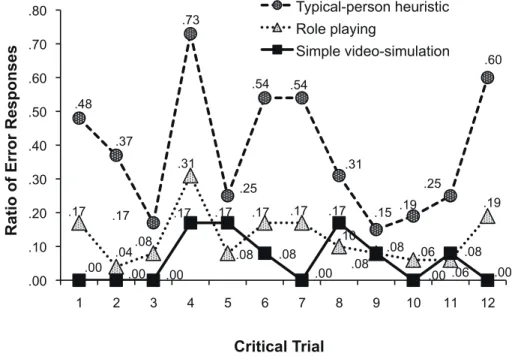
The ratios of error responses for each experimental group for the 12 critical trials are presented in Figure 2. These ratios were examined with a multivariate profi le analysis of repeated measures (12 levels of the critical trial as a within-subjects factor, and three levels of the experimental condition as a between-subjects factor).1
This GLM repeated measures procedure indicated a signifi cant effect of the critical trial: Wilks’s Λ = .731, F (11, 95) = 3.18, p = .001. The effect of the between-subjects factor, experimental condition, was also signifi cant: F (2, 105) = 21.56, p < .001. The ratio of error responses for the
Ratio of Error Responses
Critical Trial
Typical-person heuristic Role playing
Simple video-simulation
Figure 2. Ratios of error responses for the typical-person heuristic group (n = 48), the role playing group (n = 48), and the simple video-simulation group (n = 12) for the 12 critical trials in the videotaped Asch-type line judgment task.
1 For simplicity of statistical presentation, the author examined the rates of error responses for
the 12 critical trials for all experimental conditions with a profi le analysis of repeated measures. These data were also examined four times separately with Cochran’s Q test. The statistical results of this nonparametric test were in essence equivalent to those with the profi le alalysis.
typical-person heuristic group (M = .38) was much higher than the ratio either for the role playing group (M = .13) or for the simple video-simulation group (M = .06). However, there was no significant interaction between the critical trial and the experimental condition: Wilks’s Λ = .751, F (22, 190) = 1.33, p = .157 (ns). These statistical results mean that the three profiles were parallel, but they were not flat.
A post-hoc simple contrast test between the last trial and the remaining trials for all participants indicated that the ratio of error responses on Trial 12 (M = .35) was significantly lower than that of Trial 4 (M = .48, p = .006), and significantly higher than those of Trial 2 (M = .19, p = .001), Trial 3 (M = .11, p < .001) , Trial 5 (M = .17, p = .002), Trial 8(M = .20, p = .009), Trial 9 (M = .11, p < .001), Trial 10 (M = .11, p < .001), and Trial 11 (M = .15, p < .001).
Discussion
The present study investigated the relative effectiveness of a typical-person heuristic and a role-playing technique for the prediction of conformity behavior using an actual videotaped conformity situation.
The typical-person heuristic group was far more accurate than either the role playing group or the simple video-simulation group. The mean of error responses was higher in the typical-person heuristic group compared to both the role playing group and the simple video-simulation group. Although the typical-person heuristic was quite successful in predicting actual conformity behavior, the effect size d for the typical-person heuristic group was somewhat larger than that for the actual conformity group. This is because the denominator (standard deviation) was smaller for the typical-person heuristic group than for the actual unanimous pressure group.
The profile of error responses on 12 successive trials was much higher in the typical-person heuristic group than either in the role playing group or in the simple video-simulation group. In addition, the ratio of error responses for the typical-person heuristic group was identical to the ratio reported in Furukawa et al. (1986), and almost identical to the ratio reported in Asch (1956, Experiment 1). Although the profiles for the typical-person heuristic and role playing groups were parallel, they were not flat. Participants in both groups may have had equal difficulty in discriminating some sets of stimuli because of small differences between the standard line and comparison lines.
they could have imagined each target person and his or her situation. However, it's also possible that they failed to reproduce the outcomes because they did not want to be seen as innocent conformists reacting to unreasonable pressure by the experimenter or by themselves.
These findings support the hypothesis that one can accurately predict actual conformity behavior, not from a role-playing technique, but from a typical-person heuristic if one knows well the rules and norms of the situation in which a person is placed. Thus, the typical-person heuristic seems to be a strong alternative to deception.
Miller (1972) has always argued that even if role playing produces data comparable to actual data, it is not precisely the same thing as the actual behavior in its antecedent and theoretical properties. How about a typical-person heuristic? This study shows that knowledge about the rules and norms in a given situation can be helpful to predict and understand human behavior in that situation. In my view, if one of the most important features of social psychology is to predict human social behavior, the typical-person heuristic will work well.
Finally, although this study shows that the typical-person heuristic is a viable research instrument for predicting conformity behavior, whether the typical-person heuristic can also be applied as a research instrument for predicting other various human behaviors such as obedience, compliance, consumption, helping, aggression, and even influence strategy has yet to be fully determined and thus, requires further study.
References
Asch, S. E. (1952). Social psychology. Englewood Cliffs, NJ: Prentice-Hall.Asch, S. E. (1956). Studies of independence and conformity: I. A minority of one against a unanimous majority.
Psychological Monographs, 70 (9, whole No. 416)
Bem, D. J. (1965). An experimental analysis of self-persuasion. Journal of Experimental Social Psychology, 1, 199-218.
Bem, D. J. (1968). The epistemological status of interpersonal simulations: A reply to Jones, Linder, Kiesler, Zanna, and Brehm. Journal of Experimental Social Psychology, 4, 270-274.
Bond, R., & Smith, P. B. (1996). Culture and conformity: A meta-analysis of studies using Asch’s (1952b, 1956) line judgment task. Psychological Bulletin, 119, 111-137.
Cohen, A. R. (1962). An experiment on small rewards for discrepant compliance and attitude change. In J. W. Brehm, & A. R. Cohen (Eds.), Explorations in cognitive dissonance (pp. 73-78). New York, NY: Wiley.
Darroch, R. K., & Steiner, I. D. (1970). Role playing: An alternative to laboratory research? Journal of Personality, 38, 302-311.
Freedman, J. L. (1969). Role playing: Psychology by consensus. Journal of Personality and Social Psychology, 13, 107-114.
Furukawa, H., Ban, T., Hoshi, M., & Tabata , K. (1986). Ningen no douchou koudou ni tuite [On the human conformity behavior]. The Reports of Seminars of the General Education, Sapporo University, No.13, 219-226.
Greenberg, M. S. (1967). Role playing: An alternative to deception? Journal of Personality and Social Psychology, 7, 152-157.
Hertwig, R., & Ortmann, A. (2001). Experimental practices in economics: A methodological challenge for psychologists? Behavioral and Brain Science, 24, 383-451.
Horowitz, I. A., & Rothschild, B. H. (1970). Conformity as a function of deception and role playing. Journal of
Personality and Social Psychology, 14, 224-226.
Korn, J. H. (1997). Illusions of reality: A history of deception in social psychology. Albany, NY: State University of New York Press.
Milgram, S. (1963). Behavioral study of obedience. Journal of Abnormal and Social Psychology, 67, 371-378. Miller, A. (1972). Role playing: An alternative to deception? A review of evidence. American Psychologist, 27,
623-636.
Mixon, D. (1971). Behavioural analysis treating subjects as actors rather than organisms. Journal for the Theory of
Social Behaviour, 1, 19-31.
Mixon, D. (1972). Instead of deception. Journal for the Theory of Social Behaviour, 2, 145-177.
Smith, N. C., Kimmel, A. J., & Klein, J. G. (2009). Social contract theory and the ethics of deception in consumer research. Journal of Consumer Psychology, 19, 486-496. doi: 10.1016/j.jcps.2009.04.007
Willis, R. H., & Willis, Y. A. (1970). Role playing versus deception: An experimental comparison. Journal of