One
Dimensional Viscous
Conservation
Laws with
Discontinuous Initial
Data
Harumi
Hattori
Department
of Mathematics
West
Virginia
University
Morgantown,
WV
26506-6310
[email protected]
1
Introduction
I summarize the results concerning the existence and the decay rates obtained for the
viscous conservation laws with discontinuous initial data. An interesting case is the
hyperbolic-parabolic case where the system contains both hyperbolic equations and
parabolic equations.
What
we
consider is the initial value problem where there isa
discontinuity in theinitial data at $x=0$. It is well-known that the discontinuities in the initial data persist
along$x=0$for$t>0$
.
Tostudythedecayratesweusethe Laplaceand inversetransformsto obtainthe solution representations,which involve the Green functions. We first apply
theLaplacetransform toobtainasystemofordinary differentialequationsfor$x>0$and
$x<0$
.
Weusethe Rankine-Hugoniot conditions as the boundary conditionsto solve thesystem ofordinarydifferential equations. Then, theinverseLaplacetransformis applied
to obtain the solutionrepresentations, fromwhichweobtain the existence andthe decay
rates of solutions.
There are
numerous
results for the viscous conservation laws with smooth initialdata. On the other hand, there are only a few results with discontinuous initial data.
Hoff [1, 2, 3, 4, 5] studied the compressible Navier-Stokes equations. Hoff and Khodja
[6] and Pego [17] discussedthe nonmonotonecase. UsingtheGreen’s functions to study
the existence, stability,
or
decay rates of solutions is widely practiced. Kawashima$[7, 8]$ studied the large time behavior of hyperbolic-parabolic equations. Nishihara [15]
studied the
wave
equations with damping. Nishihara, Wang, andYang [16] studied the$L^{\mathrm{p}}$-convergence ratefor the p-system with damping. The decay ratesof
smoothsolutions
to travelingwavesolutionsor diffusionwaves for hyperbolic-parabolic conservationlaws
have been discussed in various literature. Liu and Zeng $[10, 11]$ and Zeng [18] discussed
the decay rates ofsolutions to the diffusion
waves.
Liu [9] also studied the decay ratesofsolutions to the traveling
wave
solutions. The solutionsare
represented through theFouriertransform. Zumbrun and Howard $[20, 21]$ and Mascia and Zumbrun [12, 13, 14]
This paper consists of four sections. In Section 2
we
describe the problem and thesolution representations are obtained in Section 3. The existence and decay results
are
stated in Section 4. Remarks about the results and some future problems are given in
Section 5.
2
Description of the
problem
Thesystem weconsider is given by
$v_{t}-u_{x}$
$u_{t}-f(v)_{x}$
$=0$,
$=u_{xx}$, (2.1)
where $f,$ $v$, and$u$
are
the stress, strain, and velocity, respectively. Weassume
that $f$ isasmooth function of$v$. $f$
can
be monotoneor
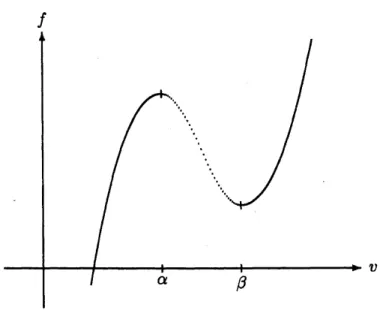
nonmonotone. Inthe nonmonotonecase
the graph of$f$ is given in Fig. 1.1.
Figure 1.1: Graphofa nonmonotone stress strain relation.
The initial data
are
given by$(v,u)(x, 0)=(v_{0},u_{0})(x)=\{$
$(v_{\mathrm{t}}, u_{1})(x)$, $x<0$,
$(v_{r}, u_{\mathrm{r}})(x),$ $x>0$, (2.2)
wherethere isa discontinuity at $x=0$
.
Weassume
that theinitial datasatisfy that$C_{0}= \sup_{1\leq \mathrm{P}\leq\infty}||v_{0}-\overline{v},$
is finite, where$p_{0}$ is
a
constant largerthanor
equal to two, $\underline{L}^{p}$ is the piecewise $L^{\mathrm{p}}$norm
in space given by
$||v||_{\underline{L}^{\mathrm{p}}}=( \int_{x<0}v(x, t)^{p}dx)^{1/\mathrm{p}}+(\int_{x>0}v(x, t)^{p}dx)^{1/p}=||v||_{L_{-}^{\mathrm{p}}}+||v||_{L_{+}^{\mathrm{p}}}$,
and$(\overline{v},\overline{u})$
are
piecewiseconstant statessuch that$\overline{v}$is thepiecewiseconstant straingivenby
$\overline{v}=\{$
$\overline{v}_{-}$, $x<0$, $\overline{v}_{+}$, $x>0$
(2.4) and $\overline{u}$ is a constant velocity. In the nonmonotone case,
we
choose$\overline{v}_{-}\in(0, \alpha]$ and $\overline{v}_{+}\in[\beta, \infty)$ so that $f(\overline{v}_{-})=f(\overline{v}_{+})$ is satisfied. In the hyperbolic case, we need to
assume
$\overline{v}_{-}=\overline{v}_{+}$.
One important difference is that in thecase
of monotone $f$, thestrength of discontinuity decays exponentially while in the
case
of nonmonotone $f$, itdoes not and it is not small by any
means.
It is well known that the discontinuity in$v$ persists for $t>0$ along $x=0$ whether
we
deal with nonmonotone $f$ or monotone $f$$(f’>0)$ while $u$becomes continuous for $t>0$
.
The Rankine-Hugoniot condition along$x=0$ is given by
$u(0_{+}, t)$ $=$ $u(\mathrm{O}_{-}, t)$,
$-f(v(0_{+}, t))+f(v(0_{-}, t))$ $=$ $u_{x}(0_{+}, t)-u_{x}(0_{-}, t)$
.
(2.5)3
Solution
representations
Substituting $(v_{\pm}, u_{\pm})=(w_{\pm}+\overline{v}_{\pm}, z_{\pm}+\overline{u})$ in (2.1) and applying the Laplacetransform,
we
obtain the systems of ordinary differential equations for $x>0$ and $x<0$.
Then,solvingtheordinary differentialequationswiththe Rankine-Hugoniot condition (2.5)
as
the boundary conditions at $x=0$ and applying the inverse transforms, we obtain the
following solution representations.
$=w_{+}(x,t)f’( \overline{v}_{-})\int_{-\infty}^{0}T_{30}^{2-}(x,\eta,t)w(\eta,0)d\eta-\int_{-\infty}^{0}T_{20}^{2-}(x,\eta, t)z(\eta,0)d\eta$
$+ \int_{0}^{t}\int_{-\infty}^{0}T_{31}^{2-}(x, \eta, t-s)\tilde{g}_{2}(\eta, s)d\eta ds$
$+f’( \overline{v}_{+})\int_{0}^{\infty}R_{30}^{+}(x,\eta, t)w(\eta, 0)d\eta+\int_{0}^{\infty}R_{20}^{+}(x,\eta, t)z(\eta,\mathrm{O})d\eta$ $+ \int_{0}^{t}\int_{0}^{\infty}R_{31}^{+}(x,\eta, t-s)\tilde{g}_{2}(\eta, s)d\eta ds$
$+ \mathrm{e}^{-f’(\overline{v}_{+)t}}w_{0}(x)-\int_{0}^{t}e^{-f’(\overline{v}_{+})(t-*)}\tilde{g}_{2}(x, s)ds$
$+f’( \overline{v}_{+})\int_{0}^{x}P_{30}^{+}(x-\eta,t)w(\eta, \mathrm{O})d\eta-\int_{0}^{x}P_{20}^{+}(x-\eta,t)z(\eta,\mathrm{O})d\eta$
$+f’( \overline{v}_{+})\int_{x}^{\infty}P_{30}^{+}(\eta-x, t)w(\eta, 0)d\eta+\int_{x}^{\infty}P_{20}^{+}(\eta-x, t)z(\eta, \mathrm{O})d\eta$ $+ \int_{0}^{t}\int_{x}^{\infty}P_{31}^{+}(\eta-x, t-s)\tilde{g}_{2}(\eta, s)d\eta ds$,
$z_{+}(x, t)$
$=$ $-f’( \overline{v}_{-})\int_{-\infty}^{0}T_{20}^{1-}(x, \eta, t)w(\eta, 0)d\eta+\int_{-\infty}^{0}T_{10}^{1-}(x, \eta,t)z(\eta, 0)d\eta$
$- \int_{0}^{t}\int_{-\infty}^{0}T_{21}^{1-}(x, \eta, t-s)\tilde{g}_{2}(\eta, s)d\eta ds$
$-f’( \overline{v}_{+})\int_{0}^{\infty}R_{20}^{+}(x+\eta, t)w(\eta, \mathrm{O})d\eta-\int_{0}^{\infty}R_{10}^{+}(x+\eta,t)z(\eta, \mathrm{O})d\eta$ $- \int_{0}^{t}\int_{0}^{\infty}R_{21}^{+}(x+\eta, t-s)\tilde{g}_{2}(\eta, s)d\eta ds$
$-f’( \overline{v}_{+})\int_{0}^{x}P_{20}^{+}(x-\eta, t)w(\eta, 0)d\eta+\int_{0}^{x}P_{10}^{+}(x-\eta, t)z(\eta, \mathrm{O})d\eta$
$- \int_{0}^{t}\int_{0}^{x}P_{21}^{+}(x-\eta, t-s)\tilde{g}_{2}(\eta, s)d\eta ds$
$+f’( \overline{v}_{+})\int_{x}^{\infty}P_{20}^{+}(\eta-x, t)w(\eta, 0)d\eta+\int_{x}^{\infty}P_{10}^{+}(\eta-x, t)z(\eta, \mathrm{O})d\eta$
$+ \int_{0}^{t}\int_{x}^{\infty}P_{21}^{+}(\eta-x, t-s)\tilde{g}_{2}(\eta, s)d\eta ds$, (3.1)
where $\overline{g}_{2}(w_{\pm})=[f(\overline{v}_{\pm}+w_{\pm})-f(\overline{v}_{\pm})-f’(\overline{v}_{\pm})w_{\pm}]$. The similar expressions can be
ob-tained for $w$-and $z_{-}$
.
Here, the subscripts $+\mathrm{a}\mathrm{n}\mathrm{d}$ –stand for $x>0$ and $x<0$,respectively. Differentiating$w_{+}$ and $z_{+}$ in $x$ and performing theintegration by parts in
$\eta$,
we
obtainas
the representation for the derivatives$w_{+x}(x, t)$
$=$ $f’(\overline{v}_{+})(w_{0}(0_{+})-w_{0}(0_{-}))T_{30}^{3-}(x, 0, t)-(z(\mathrm{O}_{-}, 0)-z(0_{+}, 0))T_{20}^{3-}(x, 0, t)$
$+ \int_{0}^{t}T_{31}^{3-}(x, 0, t-s)\{\tilde{g}_{2}(w(0_{+}, s))-\tilde{g}_{2}(w(0_{-}, s)\}ds$
$+\mathrm{s}\mathrm{i}\mathrm{m}\mathrm{i}\mathrm{l}\mathrm{a}\mathrm{r}$ terms
as
in $w_{+}(x, t)$,$z_{+x}(x, t)$
$=$ $(z(0_{+}, 0)-z(0_{-}, 0))T_{10}^{2-}(x, 0, t)+f’(\overline{v}_{+})(w(0_{-}, 0)-w(0_{+}, 0))T_{20}^{2-}(x, 0, t)$
$+ \int_{0}^{t}T_{21}^{2-}(x,0, t-s)\{\tilde{g}_{2}(w(0_{-}, s))-\tilde{g}_{2}(w(0_{+}, s))\}ds$
$+\mathrm{s}\mathrm{i}\mathrm{m}\mathrm{i}\mathrm{l}\mathrm{a}\mathrm{r}$ terms
as
in $z_{+}(x, t)$. (3.2)In the above expressions
$R_{mn}^{\pm}(x, \eta, t)=\frac{1}{2\pi i}\int_{\Gamma}\frac{(\tilde{\mu}_{\pm}-\tilde{\mu}_{\mp})}{2(\tilde{\mu}_{+}+\tilde{\mu}-)}\tilde{\mu}_{\pm}^{m}\lambda^{n}e^{\lambda\{t\mp\overline{\mu}\pm(x+\eta)\}}d\lambda$ ,
$P_{mn}^{\pm}(x- \eta, t)=\frac{1}{2\pi i}\int_{\Gamma}\frac{1}{2}\tilde{\mu}_{\pm}^{m}\lambda^{n}e^{\lambda\{t-\overline{\mu}\pm(x-\eta)\}}d\lambda$,
where $\tilde{\mu}_{\pm}=\sqrt{\epsilon\lambda+f’(\overline{v}\pm)}^{1}$ and
$\Gamma$ is a path in the complex A-plane. $T_{mn}^{l\pm}$ and $R_{mn}^{\pm}$ account
for the transmission and reflection, respectively. $P_{mn}^{\pm}$ is basically the same asthe usual
Green’s function.
4
Existence and decay
estimates
After performingthe integrations in A for$\tau_{mn}^{\iota\pm},$ $R_{mn}^{\pm}$, and $P_{mn}^{\pm}$, weobtain the following
estimates.
Lemma 4.1 For$n=0$ and$m=1$ or$n=1,$ $T_{mn}^{l\pm},$ $R_{mn}^{\pm}$, and $P_{mn}^{\pm}$ satisfy the estimates
$|T_{mn}^{l\pm}(x, \eta, t)|$
$=O(1)t^{-\frac{n+1}{2}}e^{-K\frac{(t-\ovalbox{\tt\small REJECT}_{J’(\varpi_{\mp})}^{x}-\ovalbox{\tt\small REJECT} f’(\emptyset\pm))^{2}}{t}}+O(1)t^{-\frac{n+1}{2}}e^{-\kappa^{\llcorner\llcorner^{2}}}x-\Delta\iota+\mathcal{R}$
, $|R_{mn}^{\pm}(x+\eta, t)|$ $=O(1)t^{-\oplus}e^{-K\frac{(t-\mu_{v}x+f(\pm)\rangle^{2}}{\mathrm{t}}}’+O(1)t^{-\frac{\mathfrak{n}\neq 1}{2}}e^{-K^{x}}t+Rrightarrow+\mathit{1}_{-}^{2}$ , $|P_{mn}^{\pm}(x-\eta, t)|$ $=$ $o(1)t^{-\frac{\mathfrak{n}+1}{2}}e^{-K\frac{(t-\mu_{\mathrm{t}\emptyset\pm)}x-)^{2}J’}{t}}+O(1)t^{-\frac{n\neq 1}{2}}e^{-K^{\llcorner\sim-}}+\mathcal{R}\Delta_{\iota}\mathrm{L}^{2}$ ,
where $K$ is apositive constant and$\mathcal{R}$ represents residual $te7ms$ decaying
faster
than thefirst
two terms.For$T_{mn}^{l\pm}$,
if
$n=0$ and$m=2$, using the convolution theorem, we obtain$|T_{mn}^{i\pm}(x, \eta, t)|$ $=$ $| \frac{1}{2\pi i}\int_{\Gamma}\tilde{\mu}_{\pm}\frac{\tilde{\mu}_{\mp}^{l}}{\tilde{\mu}_{\pm}^{l-1}(\tilde{\mu}_{+}+\tilde{\mu}-)}\tilde{\mu}_{\pm}e^{\lambda t\pm\mu\mp^{x\mp\mu\pm\eta}}d\lambda|$
$\leq$ $o(1) \int_{0}^{t}(t-s)^{-1}2e^{-f’(\overline{v})(t-*)}+|T_{10}^{l\pm}(x, \eta, s)|ds$. (4.1)
Similarly,
if
$n=0$ and$m=3$,$|T_{mn}^{l\pm}(x, \eta, t)|$ $=$ $| \frac{1}{2\pi i}\int_{\Gamma}\tilde{\mu}_{\pm}^{2}\frac{\tilde{\mu}_{\mp}^{l}}{\tilde{\mu}_{\pm}^{l-1}(\tilde{\mu}_{+}+\tilde{\mu}_{-})}\tilde{\mu}_{\pm}e^{\lambda t\pm\mu\mp^{x\mp\mu\pm\eta}}d\lambda|$
$\leq$ $o(1) \int_{0}^{t}e^{-J’(\overline{v}}+)(t-*)|T_{10}^{l\pm}(x, \eta, s)|ds$. (4.2)
Similar estimates
can
be obtainedfor
$R_{mn}^{\pm}$, and$P_{mn}^{\pm}$.
Using the solution representationsobtained in the previous section, weconstruct an
iteration scheme in the Banach space $X$ with the norm given by
$||(v,u)(\cdot, t)||_{X}$ $=$ $\sup$ $\{(t+1)^{\tau_{\dot{\mathrm{p}}^{-}2}^{11}}||(v-\overline{v},u-\overline{u})(\cdot,t)||_{L^{\mathrm{p}}}$
$1\leq \mathrm{P}\leq\infty,1\leq q\leq \mathrm{P}0,0\leq t<\infty$
The iteration can be constructed by putting upper-subscripts $(k+1)$ to the variables
on the left hand sides and $(k)$ to those on the right hand sides in (3.1), (3.2), and etc.
After estimating the terms in thesolution representationswith the helpof Lemma 4.1,
we
obtainLemma 4.2 Let
$N^{(k)}(t)$ $=$ $\sup$ $\{||w^{(k)},$$z^{(k)}||_{L^{\mathrm{p}}}(1+\tau)^{\iota}\mathrm{z}^{-\frac{1}{2p}}$
$1\leq P\leq\infty,1\leq q\leq P\mathit{0},0\leq r<t$
$+||w_{x}^{(k)},$ $z_{\pm x}^{(k)}-(z(0_{+}, \mathrm{O})-z(\mathrm{O}_{-}, 0))T_{10}^{2\mp}(x, 0, t)||_{\mathrm{A}^{q}}(1+\tau)^{l^{-}T_{l}}\}11$.
Then, the following inequality
$N^{(k+1)}(t)\leq C_{1}C_{0}+C_{2}C_{3}N^{(k)}(t)^{2}$
hol&, where $C_{0}$ is the constant
defined
in $($2.$S),$ $C_{1}$ and $C_{2}$are
positive constantsfrom
the Green’sfunctions, and $C_{3}= \max_{|w|\leq 1}|f’’(\overline{v}_{+}+w)|$
.
IFbom the above lemmaand the contraction mapping, we
can
easily obtainTheorem 4.3 There exists a constant$\overline{C}_{0}$ such that
if
the initial data satisfy $C_{0}\leq\overline{C}_{0}$,where $C_{0}$ is given in (2.3), the global solutions exist in $X$ and satisfy the decay rates
given by
$||v-\overline{v},$ $u-\overline{u}||_{L^{p}}$ $=$ $o(1)(t+1)^{-\frac{1}{2}++_{p}},$ $1\leq p\leq\infty$,
$||v_{x},$$u_{\pm x}-(u_{0}(0_{+})-u_{0}(0_{-}))T_{10}^{2\mp}(x, 0, t)||_{\underline{L}^{\mathrm{p}}}$ $=$ $O(1)(t+1)^{-\frac{1}{2}+_{2p}}\perp,$ $1\leq p\leq p0$,
where $T_{10}^{2\mp}(x, 0, t)$ are
diffusion
waves singular at $t=0$.
Also, the Rankine-Hugoniotcondition is
satisfied
across
$x=0$.5
Concluding remarks
In this concluding section we discuss
some
observations and the possible future work.The discontinuity in the initial data brings various interesting differences between the
hyperbolic variable $v$ and the parabolic variable $u$
.
Theyare
summarized as follows.(1) The first two terms on the right hand side of each expression in $w_{+x}(x,t)$ and
$z_{+x}(x, t)$ are from the discontinuity in the initial data. They
are
diffusion waves. $T_{10}^{2-}$behaves like a heat kernel approaching
a
delta functionas
$t\downarrow \mathrm{O}$.
On the other hand,$T_{20}^{2-},$ $T_{20}^{3-}$, and $T_{30}^{3-}$ are not singular
as
$t\downarrow \mathrm{O}$.
The parabolic variable hasa
singularityin the derivative which behaves like aheat kernel. This captures the way the parabolic
variable becomes continuous for $t>0$. On the other hand the hyperbolic variable
remains discontinuous. Therefore, there inno singular wave in the derivative.
(2)The maineffect
near
$t=0$is given by the exponentially decaying term$e^{-f’(\varpi_{+})t}w_{0}(x)$for thehyperbolic variable and the diffusive terms $\int_{0}^{x}P_{10}^{+}(x-\eta, t)z(\eta, 0)d\eta+\int_{x}^{\infty}P_{10}^{+}(\eta-$
(3) $m$and$n$ forthe hyperbolicvariableand the parabolic variablearedifferent. This
affects the behavior ofthesevariables especially near $t=0$
.
The result obtained should be extended for the following prototype systems. First,
in the Lagrangiancoordinates, the viscosity terms
are
nonlinear as shownbelow.$v_{t}-u_{x}$ $=0$,
$u_{t}-f(v)_{x}$ $=$ $( \epsilon\frac{u_{x}}{v})_{x}$,
It is important to discuss the changes necessary to treat the nonlinear nature of the
viscous term. Also, it is interestingto extend the result to the nonisothermal
case
withvarious viscosity terms. Another interesting problem is to extend to the initial data
with different values at $x=\pm\infty$. This will include the Riemann problems for viscous
conservationlaws. The difficulty isthe factthat the solutions will not approachpiecewise
constant states. We need to find the approximate solutions to which the solutions will
approach.
References
[1] D. Hoff, Construction of solutions for compressible, isentropic Navier-Stokes
equa-tions in
one
space dimension with nonsmooth initialdata, Proceedings of theRoyalSociety of Edinburgh, 103A (1986), 301-315.
[2] D. Hoff, Discontinuous solutions of the Navier-Stokes equations for compressible
flow, Arch. Rational Mech. Anal. 114 (1991), 15-46.
[3] D. Hoff, Global well-posedness ofthe Cauchy problem for the Navier-Stokes
equa-tionsofnonisentropic flow with discontinuous initial data. J. DifferentialEquations
95 (1992),
33-74.
[4] D. Hoff, Global solutions of the Navier-Stokes equations for multidimensional
com-pressible flow with discontinuous initial data. J. Differential Equations 120 (1995),
215-254.
[5] D. Hoff, Discontinuous solutions of theNavier-Stokesequationsfor multidimensional
flows ofheat-conducting fluids. Arch. Rational Mech. Anal. 139 (1997),
303-354.
[6] D. Hoff and M. Khodja, Stability of coexisting phases for compressible van der
Waals fluids. SIAM J. Appl. Math. 53 (1993), 1-14.
[7] S. Kawashima, Systems ofahyperbolic-parabolic composite type withapplications
to the equations ofmagnetohydrodynamics. Ph.D. Thesis, Kyoto University, 1983.
[8] S. Kawashima, Large-timebehaviour of solutions tohyperbolic-parabolic systemsof
conservation laws and applications. Proc. Roy. Soc. Edinburgh Sect. A 106 (1987),
[9] T.P. Liu, Pointwise convergence to shock waves for viscous conservation laws.
Comm. Pure Appl. Math. 50 (1997), 1113-1182.
[10] T.P. Liu and Y. Zeng, Large time behavior of solutions of general quasilinear
hyperbolic-parabolic systems of conservation laws. Mem. Amer. Math. Soc. 125,
(1997).
[11] T.P. Liu and Y. Zeng, Compressible Navier-Stokes equations with zero heat
con-ductivity. J. Differential Equations 153 (1999), 225-291.
[12] C. Mascia and K. Zumbrun, Pointwise Greenfunction bounds for shock profiles of
systemswith real viscosity. Arch. Ration. Mech. Anal. 169 (2003), 177-263.
[13] C. Mascia and K. Zumbrun,Stabilityofsmall-amplitudeshockprofiles of symmetric
hyperbolic-parabolic systems. Comm. Pure Appl. Math. 57 (2004), 841-876.
[14] C. Mascia and K. Zumbrun, Stability of large-amplitude viscous shock profiles of
hyperbolic-parabolic systems. Arch. Ration. Mech. Anal. 172 (2004), 93-131.
[15] K. Nishihara, $IP- L^{q}$ estimates of solutions to the damped
wave
equation in3-dimensional space and their application. Math. Z. 244 (2003), 631-649.
[16] K. Nishihara, W. Wang, and T. Yang, $I\nearrow$-convergence rate to nonlinear diffusion
waves
forp–system with damping. J. Differential Equations 161 (2000), 191-218.[17] R.L. Pego, Phase transitions in one-dimensional nonlinear viscoelasticity:
admissi-bility and stability, Arch. Rat. Mech. Anal. 97 (1987),
353-394.
[18] Y. Zeng, $L^{1}$ asymptotic behavior of compressible, isentropic, viscous 1-D flow.
Comm. Pure Appl. Math. 47 (1994), 1053-1082.
[19] K. Zumbrun, Dynamical stabilityof phasetransitions in the p–system with
viscosity-capillarity. SIAM J. Appl. Math. 60 (2000), 1913-1924
[20] K. Zumbrun and P. Howard, pointwise semigroup methods andstability of viscous
shock
waves.
Indiana Univ. Math. J. 47 (1998), 741-871.[21] K. Zumbrun and P.Howard,Erratato: “Pointwisesemigroup methods, and stability
of viscous shockwaves” [Indiana Univ. Math. J. 47 (1998), 741-871]. IndianaUniv.