The
Smith
Isomorphism
Question:A
review
and
new
results
岡山大学自然科学研究科 鞠先孟 (XianMengJU) *
Faculty of Environmental
Science
and Technology,Okayama University $\ln$ 1960, P A. Smith [Smi60] raised
an
isomorphism question:Smith tsomorphism Question. Whether the two $tangentia/G$-modules at two fixed
$\rho oints$ of
an
arbitrary smoothG-action
on a
sphere with$exactl\gamma$two
fixed points $are$/so-morphic
to
each other?Following [Pet82],
two
real $G$-modulesVand $W$are
called Smith $equ/va\prime ent$ifthereexistsasmooth action of $G$
on
asphere $S$suchthat $S^{G}=\{x,v\}$fortwo points$x$and$V$
at
which $T_{x}(S)\cong V$and $T_{y}(S)\cong w$
as
$rea\uparrow G- modules$.Let RO(G) denote the real representation ring of G. Define the $Sm/th$ set $Sm(G)$
to
be
$Sm(G)=$
{
$[]-M\in RO(G)|V$and $W$are
Smith equivalent}.TheSmith Isomorphism Question
can
be restatedas
foIlows. Smith lsomorphlsm Question. Is it true tha$t$Sm(G) $=0$?ltis
easy
to
showthattheanswer
is affirmative if $G$ isagroup
suchthateach elementhas the order 1,
2or
4.$\ln$ nineteen sixties, the first breakthrough
was
due to M. F. Atiyah and R. Bott$|AB68$, Theorem 7.15]:
Theorem 1 (Atlyah-Bott). $/fG=C_{p},$$p$
an
odd prime, thenSm(G) $=0$.Shortlythereafter, J. Milnor[Mi166, Theorem 12.
t$]
extended their result:Theorem 2 (Mllnor). If$G$ is
a
compa
$ct$group
andtheaction semi-free, thenSm(G) $=0$.$\ln$ nineteen seventies, by using the $G$-signature theorem, C. $\cup$. Sanchez [San76]
ob-tained astronger result:
Theorem 3(Sanchez). Let X $be$
a
rational-homologysphere$su\rho port/ng$an a
ctionof$C_{\mathfrak{n}}$($\mathfrak{n}$ odd)
as
a
group
of diffeomorphisms with onlytwo fixed points$x$andv a
$nd$satisfyingthecondition tha$t$
for
every
$\rho ropersubgrou\rho H$ of$C_{\mathfrak{n}}$, either$F(H, X)=\{x,y\}$or
$F(H,x, X)=$$F(H,v\cross)$ holds.
$*20\infty$MathmaticsSubiect$CIassificat|on.$ Primary; $57S17,57S25,55M35.$ Secondary; $20C05$.
August21,2007
Then$T_{x}(X)\cong T_{v}(X)$.
$\ln$ fact, bySanchez Theorem andSmith theory,
we
obtain the following Corollary. Corollary 4. $ln$eitherofthefollowingcases, Sm(G) $=0$.
$(f)G$ is
a
$grou\rho$ withodd-prime-Powerorder.(2) $G$ is
a
group
$w/th|G|=pq$ , where$P$ and$q$are
oddPrimes.
Byusing $G$-equivariant
surgery,
T. Petrie[Pet79], [PR85] obtainedthe firstcounterex-ample tothe question:
Theorem 5 (Petrle). $lfG$ is
an
odd orderfiniteabelian$grou\rho$ withatleast fournon-cyclicSylowsubgroups, then$Sm(G)\neq 0$
.
$\ln$ nineteen eighties, S. E. CaPpell and J. L.
Shaneson
[CS82]gave
firstcounterex-amples
to
the question for $G$ acyclicgroup:
Theorem 6 (CaPpeIl-Shaneson). $lfG$ is the cyclic
group
of order$4m$ such that$m\geq 2$ then$Sm(G)\neq 0$.
By character theory,
we
have $Sm(D_{6})=0$ and $Sm(C_{6})=0$.
So, $C_{8}$ is the smal[estgroup
with $Sm(G)\neq 0$.
T. Petrie and his Collaborators Obtained alot of results about $s$-Smith equivalenCe,
See [Pet83], [PR84], [Cho85], [CSu85], [Suh85], [Cho88]. K. H. Dovermann and T. Petrie
[DP85]constructed non-isomorphicSmith equivalent representations OfOdd order cyclic
groups.
Theorem7(Dovermann-Petrle). Let$G$ be
an
odd-ordercyclicgroup
suchthattheorderof$G$ has
at
least3
prime divisors. $lf$ there existreal G-modulesA and$B$ satisfying thefollowingconditions, thenSm$(G)\neq 0$
.
(0) $A\not\cong B$,
(\dagger )
$A^{9}G,$
$=B^{9}=0$ fOreach $g\in G$ which generates
a
subgrOuPof primepower
index in(2) dim$A^{K}=\dim B^{K}wh.enever|G/K|$ is divisiblebyatmost 3 distinct$\rho rimes$,
(3) ${\rm Res}_{P}^{G}A\cong{\rm Res}_{P}^{G}B$ whenever$|P|$ is
a
Prime power,
(4) $\gamma(A^{P}-B^{P})(9)=\pm 1$ whenever $|P|$ iS
a
prime Power and 9 $\in G$ generatesa
subgroupof prime
power
indexin G.The
groups
exhibited in that Paperwere
very
large. As J. $Ewi$ng
computed, theirorder
were
at
[east $10^{2812917}$. K. H. Dovermann and L. C. Washington [DW89] showedthatsuch non-isomorphicSmith equivalent representationsalso existforodd ordercyclic
groups
ofsmall order. Forexample, their orderscan
be5.11.19.29and3.13.17.23.
K. H. Dovermann and D. YSuh [DS92] constructed non-isomorphic Smlth equivalent representations in the following
cases.
Theorem 8(Dovermann-Suh). If$G$ is
a
group
withrealG-modulesA and$B$as
inThe-orem
7, then$Sm(G\cross C_{2^{k}})\neq 0$.Theorem 9 (Dovermann-Suh). $lfG$ is
a
finite abelian $groUp$ with atleast3
non-cyclicSylow$s$ubgrouPs, withreal$G$-representationsAand$B$ satisfying the followingconditions,
then$Sm(G)\neq 0$,
(0) $A\not\cong B$,
(\dagger ) $A^{K}=B^{K}=0whenever|G/K|$ is
a
primepower,
(2) dim$A^{K}=\dim B^{K}$ for all$K\subset G$,
(3) ${\rm Res}_{P}^{G}A\cong{\rm Res}_{P}^{G}B$ whenever$|P|$ is
a
primepower.
A $fini\dagger e$ grOup $G$ is
an
$O\prime iver$group
if and only if $G$never
admits anormal series$P\triangleleft H\triangleleft G$
Such$that|P|$and $|G/H|$
are
primepowers
and $H/P$ is acyclicgroup.
Forafinitegroup
$G$,the following three claims
are
equivalent ([Oli75], [LM98]). (1) $G$ isan
OIivergroup.
(2) $G$ has
a
smoothone-fixed-Point
actionon a
sphere.(3) $G$ has
a
smooth fixed-point-free actionon
a
disk.For
an
element $9\in G$, [et (9) denote the $con|ugacy$ class of9in
G. The union $(g)^{\pm}=$(g) $\cup(g^{-1})$ is called the real$conjugac\gamma$class of $g$ in G. Let $\mathfrak{a}_{G}$ denote the number of the
real $con|ugacy$classes $(g)^{\pm}$ in $G$ suchthat the order of
9is
notaprimepower.
$\ln$ 1996, in the
case
where $G$ isan
Olivergroup,
E. Laitinen [LP99, APpendix] Iighted the question again withan coniecture.
Lalttnen COnjecture. If$G$ iS
an
Olivergroup
With $a_{G}\geq 2$, then$Sm(G)\neq 0$.E. Laitinenand K. Pawatowski proved
two
theorems [LP99]:Theorem 10 (Laitlnen-Pawalowskl). If $G$ is
a
finite perfectgroup
with $a_{G}\geq 2$, then $Sm(G)\neq 0$.
Theorem 11 (Laltlnen-Pawalowski). If $G\cong A_{\mathfrak{n}},$ $SL(2,p)$
or
$PSL(2, q)$ with $a_{G}\geq 2$,where$\mathfrak{n}$ is
a
natural numberand$P$ and$q$
are
primes, then$Sm(G)\neq 0$.A real G-module Vis called
a
gap
moduleif itsatisfies(1) $\dim V^{P}>2\dim V^{H}$for
any
subgroup$P\subset G$ of primepower
orderandany
subgroup$H\subset G$ with $P\subset\wedge H$, and
Afinite
group
$G$ is calledagap group
if $G$ admitsagap
module. We referto
[MSYOO],[SumOl] and [Sum04] for
more
information aboutgap
groups.
Let $P\Sigma L(2,27)$ denote thesplitting extension of $PSL(2,27)$ bythe
group
$Aut(F_{27})$.
K. $Pawa\dagger owski$ and R. Solomon$[PaS02]$ answered the Smith isomorphism question in various
cases:
Theorem 12(Pawalowski-Solomon). $/n$either ofthefollowing cases,Sm$(G)\neq 0$holds. $(f)G/s$
a
finite Oliver$grou\rho$ ofoddorder(thus $a_{G}\geq 2$, and$G$ isa
gap
group).(2) $G$ is
a
finiteOlivergroup
witha
cyclicquotientoforderpq fortwodistinct oddPrimes
$p$ and$q$ (thus $a_{G}\geq 2$, and$G$ isa
gap
group).(3) $G$ is
a
finitenon-solvablegap
grouP with$a_{G}\geq 2$, and$G\not\cong P\Sigma L(2,27)$.Theorem 13 (Pawalowskl-Solomon). In either of the $to/low/ng$ cases, if $a_{G}<2$ then $Sm(G)=0$
.
$(f)G$ is
a
finite non-abelianslmPle group.
(2) $G\cong PSL(\mathfrak{n}, q)$
or
$SL(\mathfrak{n}, q)$ forany
$\mathfrak{n}\geq 2$ andany
primePower$q$.
(3) $G\cong PSp(2\mathfrak{n}, q)$
or
$Sp(2\mathfrak{n}, q)$ forany
$\mathfrak{n}\geq 1$ andany
Prime
Power$q$
.
(4) $G\cong A_{\mathfrak{n}}$
or
$S_{\mathfrak{n}}$ forany
$\mathfrak{n}\geq 2$.
We refer
to
the articles [PR84], [CS85], $|DPS85]_{1}|MaP85$], [PawOO] forsurvey
ofrelated results. K. $Pawa\dagger owski$ and R. Solomon [$PaS02$, Theorem A.3] pointed out that
$Aut(A_{6})$ is anon-solvableOliver
group
such that $a_{G}=2$. $\ln$ 2006, M. Morimoto $[Mor07a]$gave
acounterexample to Laitinen $Con|ecture$:
Theorem 14(Morlmoto). If$G=Aut(A_{6})$ then $a_{G}=2$, andSm(G) $=0$
.
K. $Pawa\dagger owski$ and T. Sumi $|PaS07$] claim $Sm(G)\neq 0$ for
many
Olivergroups
$G$ suchthat $a_{G}\geq 2$ and $G$ is not
agap
group,
although onlythe sketchiest ideas of proofsare
given. Let $G^{ni1}$ denote the smallest normal subgroup $N$ of $G$ such that $G/N$ is nilpotent. Announce 15 (Pawatowski-Suml). Let $G$ be
a
finite Olivergroup
such that $G/G^{ni1}$ is$isomorph/c$ toneither$p$
-group
fora
prime$p,$ $C_{2}\cross P$ foran
odd prlme$p$ anda
$p$-group
$P$,nor
$P_{2}\cross C_{3}$ fora
2-group
$P_{2}$ such thatall elements of$P_{2}$are
self-conjugate: $(g)=(g^{-1})$.
Then$Sm(G)\neq 0$
.
Announce 16 (Pawalowskl-Suml). If
a
finite Olivergroup
$G$ hasan
element of order pqr for distinct$pr/mesp,$ $q$ andr, then$Sm(G)\neq 0$.
Announce 17$(Pawalowskl\cdot Suml)$
.
Let$G$ bea
finite Olivergroup
with$non\cdot tr/v/al$center.
$lf$the order of$G^{\mathfrak{n}I\dagger}$ is
Many authors have studied the Smith equivalence for various finite
groups.
But the Smith sets Sm(G)were
rarely determined. In particular, when $G$ is anon-solvable,non-perfect
group,
Smith set Sm(G)was
not determined except thecase
Sm(G) $=0$. Wehave interested in the
group
$S_{5}\cross C_{2}$, because it is notagap
group,
but it’s subgroup $A_{5}\cross C_{2}$ isagap group.
For aprime$p$, [et $G^{\{p\}}$ denote the smallest normal subgroup $H$ such that the order of
$G/H$ is
apower
of$p$ (possibly1). Let$\mathcal{P}(G)$ denote theset
of $aII$ subgroups of $G$ of primepower
order(possibly1). Define $\mathcal{L}(G)$ by{
$H\leq G|H\geq G^{\{p\}}$ forsome
prime$p$}.
A real G-module Vis saidto be $\mathcal{L}(G)$-free if $V^{L}=0$for
any
$L\in \mathcal{L}(G)$.
Define $RO(G)_{\mathcal{P}}^{\mathcal{L}}$to be the
set
{
$[]-M\triangleleft\in RO(G)|V$and $W$are
$\mathcal{L}(G)$-free and ${\rm Res}_{P}^{G}V\cong{\rm Res}_{P}^{G}W$for all $P\in \mathcal{P}(G)$}.
Announce 18. The following$equa\prime it/es$hold for$G=S_{5}\cross C_{2}$ and$K=A_{5}\cross C_{2}$
.
(\dagger ) Sm(K) $\cong \mathbb{Z}^{2}$
and$Sm(G)\cong \mathbb{Z}$
.
(2) $1nd_{K}^{G}(Sm(K))=Sm(G)$
.
Here the maP $1nd_{K}^{G}$ : $RO(K)arrow RO(G)$ isthe inductionhomomorphism;
$[V]-[\mathbb{R}[G]\otimes_{R[K]}V]$
.
By
means
of GAP [GAP06],Thecomplex character of $G=S_{5}\cross C_{2}$ isas
in Table 1,$\ovalbox{\tt\small REJECT}\xi_{1\mathbb{C}}11I111111111111a2a2b2c3a6a2d2e4a4b6b6c5a10a$
$\xi_{2\mathbb{C}}$ 1 $-1$ $-1$ 1 $\rceil$ $-1$ $\rceil$ $-1$ $-1$
1
$-1$ 1 1 $-1$$\xi_{3\mathbb{C}}$
1
$-1$ 1 $-1$ 1 $-1$ 1 $-1$ 1 $-1$ 1 $-1$ 1 $-1$ $\zeta_{4C}$1
1 $-1$ $-1$ 11
1
1
$-1$ $-1$ $-1$ $-1$1
1
$\xi_{5\mathbb{C}}$ 4 4 $-2$ $-2$1
1 $0$ $0$ $0$ $0$1
1
$-1$ $-1$a4
$-4$ $-2$2
1 $-1$ $0$ $0$ $0$ $0$ 1 $-1$ $-1$ 1 $\zeta_{7\mathbb{C}}$4
42
2
1
1 $0$ $0$ $0$ $0$ $-1$ $-1$ $-1$ $-1$ $\xi_{8\mathbb{C}}$ 4 $-4$2
$-2$ 1 $-1$ $0$ $0$ $0$ $0$ $-1$ 1 $-1$ 1 $\xi_{10\mathbb{C}}\xi_{9\mathbb{C}}$ $55$ $-55$ $11$ $-11$ $-1-1$ $-11$ $11$ $-11$ $-1-1$ $-1t$ $11$ $-\dagger 1$ $00$ $00$ $\xi_{11\mathbb{C}}$ 5 5 $-1$ -I $-1$ $-1$ 1 1 1 1 $-1$ $-1$ $0$ $0$ $\xi_{12\mathbb{C}}$ 5 $-5$ $-1$ 1 $-1$ 1 1 $-1$ 1 $-1$ $-1$ 1 $0$ $0$ $\xi_{13\mathbb{C}}$6
6 $0$ $0$ $0$ $0$ $-2$ $-2$ $0$ $0$ $0$ $0$ 1 1 $\xi_{14\mathbb{C}}$ 6 $-6$ $0$ $0$ $0$ $0$ $-2$2
$0$ $0$ $0$ $0$1
$-1$and the complexcharacterof $K=A_{5}\cross C_{2}$ is
as
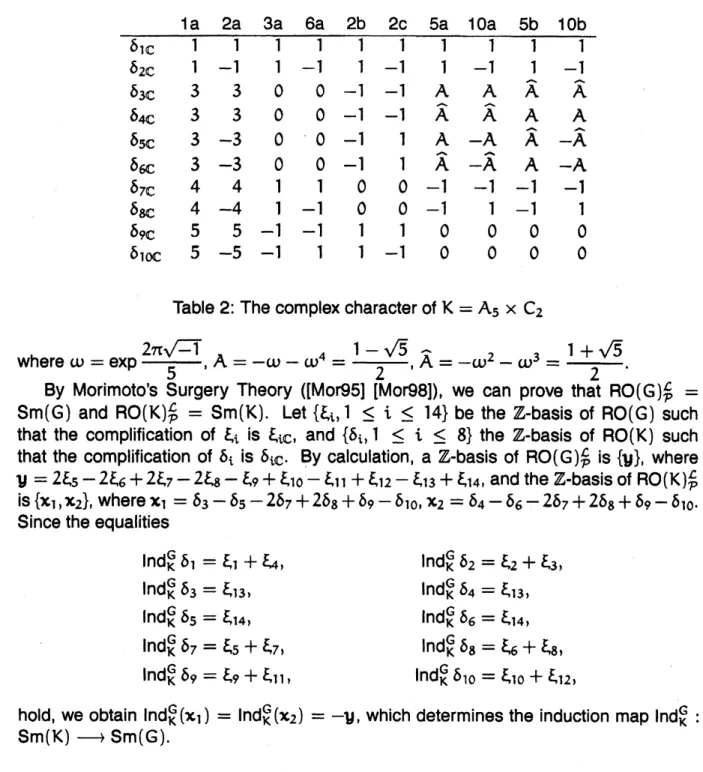
in Table 2. $\ovalbox{\tt\small REJECT}\delta_{1\mathbb{C}}11111111111a2a3a6a2b2c5a10a5b10b$ $\delta_{2\mathbb{C}}$ 1 $-1$ 1 $-1$ 1 $-1$ 1 $-1$ 1 $-1$ $\delta_{3\mathbb{C}}$ 33
$0$ $0$ $-1$ $-1$ AA $\hat{A}$ $\hat{A}$ $\delta_{4\mathbb{C}}$3
3
$0$ $0$ $-1$ $-1$ $\hat{A}$ $\hat{A}$ AA $\delta_{5\mathbb{C}}$3
$-3$ $0$ $0$ $-1$1
A-A $\hat{A}$ $-\hat{A}$ $\delta_{6\mathbb{C}}$3
$-3$ $0$ $0$ $-1$1
$\hat{A}$ $-\hat{A}$ A-A $\delta_{7\mathbb{C}}$ 4 41
1
$0$ $0$ $-1$ $-1$ $-1$ $-1$ $\delta_{8\mathbb{C}}$ 4 $-4$ 1 $-1$ $0$ $0$ $-1$ 1 $-1$ 1 $\delta_{9\mathbb{C}}$5
5
$-1$ $-1$1
1
$0$ $0$ $0$ $0$ $\delta_{10\mathbb{C}}$ 5 $-5$ $-1$1
1 $-1$ $0$ $0$ $0$ $0$Table 2: The complexcharacter of $K=A_{5}\cross C_{2}$
where $\omega=\exp\frac{2\pi\sqrt{-1}}{5},$ $A=-\omega-\omega^{4}=\frac{1-\sqrt{5}}{2},\hat{A}=-\omega^{2}-\omega^{3}=\frac{1+\sqrt{5}}{2}$
.
By Morimoto’s Surgery Theory ([Mor95] [Mor98]),
we can
prove
that $RO(G)_{\mathcal{P}}^{\mathcal{L}}=$Sm(G) and $RO(K)_{\mathcal{P}}^{\mathcal{L}}=$ Sm(K). Lel $\{\xi_{i}, 1\leq i\leq 14\}$ be the $\mathbb{Z}$-basis of RO(G) such
that the complification of $\xi_{i}$ is $\xi_{i\mathbb{C}}$, and $\{\delta_{i}, 1\leq\iota’\leq 8\}$ the $\mathbb{Z}$-basis of $RO(K)$ such
that the complification of $\delta_{i}$ is $\delta_{i\mathbb{C}}$
.
By calculation,a
$\mathbb{Z}$-basis of $RO(G)_{p}^{\mathcal{L}}$ is$\{v\}_{1}$ where
$v=2\xi_{5}-2\xi_{6}+2\xi_{7}-2\xi_{8}-\xi_{9}+\xi_{10}-\xi_{11}+\xi_{12}-\xi_{13}+\xi_{14}$, and the$\mathbb{Z}$-basis of $RO(K)_{P}^{\mathcal{L}}$
is$\{x_{I},x_{2}\}$, where$x_{1}=\delta_{3}-\delta_{5}-2\delta_{7}+2\delta_{8}+\delta_{9}-\delta_{10},$ $x_{2}=\delta_{4}-\delta_{6}-2\delta_{7}+2\delta_{8}+\delta_{9}-\delta_{10}$
.
Since the equalities$|nd_{K}^{G}\delta_{1}=\xi_{1}+\xi_{4)}$ $|nd_{K}^{G}\delta_{2}=\xi_{2}+\xi_{3}$, $|nd_{K}^{G}\delta_{3}=\xi_{13}$, $|nd_{K}^{G}\delta_{4}=\xi_{13}$, $|nd_{K}^{G}\delta_{5}=\xi_{14)}$ $|nd_{K}^{G}\delta_{6}=\xi_{14}$,
$|nd_{K}^{G}\delta_{7}=\xi_{5}+\xi_{7}$
,
$|nd_{K}^{G}\delta_{8}=\zeta_{6}+\xi_{8)}$$|nd_{K}^{G}\delta_{9}=\xi_{9}+\xi_{t1}$, $1nd_{K}^{G}\delta_{10}=\xi_{10}+\xi_{12)}$
hold,
we
obtain $1nd_{K}^{G}(x_{1})=Ind_{K}^{G}(x_{2})=-v$, which determines the induction map $1nd_{K}^{G}$:
$Sm(K)arrow Sm(G)$
.
References
[AB68] M. FAtiyah and R. Bott. ALefschetz fixed point formulafor elliptic complexes.
Il. APplications. Ann. of Math. (2), 88:451-491, 1968.
[Bre69] G. E. $Bre$don. Representations al fixed points of smooth actions of compact
[Cho85] E. C. Cho. Smith equivalent representations of generalized quaternion
groups.
$\ln$ Group $act/ons$
on
$man/folds$ (Boulder, Colo., $\dagger 983$), volume 36 ofContemP.
$Matl\iota.$, pageS317-322. Amer. Math. Soc., Providence, Rl, 1985.
[Cho88] E. C. Cho. $s$-Smith equivalent representations of dihedral
groups.
$Pacif/cd$.
Math., 135(1):t7-28, 1988.
[CS80] S. E. CaPpell and J. L. Shaneson. Fixed points of periodic
maps.
Proc. Nat.Acad. Sci. U.S.A., 77(9, part $1$)$:5052-5054$,1980.
[CS82] S. E. CaPpell and J. L. Shaneson. Fixed points of periodic differentiable
maps.
’nvent. Math., $68(:1-19$,1982.[CS85] S. E. Cappe11and J. L. Shaneson. Representations atfixed points. $\ln Grou\rho$
actions
on
manifo’ds (Bou’der, Colo., f983), volume 36 ofContemP.
Math.,pageS151-158. Amer. Math. Soc., Providence, Rl, 1985.
[CSu85] E.
C. Cho
and D. YSuh. [nduction in equivariant$K$-theory and $s$-Smith
equiva-lenceol$re$presentations. In Group actions
on
$man/fo\prime ds$ (Boulder, Colo., $\dagger 983$),volume
36
of Contemp. Math., pages311-315. Amer. Math. Soc., Providence, $RI,$ $1985$.
[DP85] K. H. Dovermann and T. Petrie. Smith equivalence of representations for odd
ordercyclic
groups.
$Topo\prime og\gamma,$ $24(3):283-305$,1985.[DPS85] K. H. Dovermann, TPetrie, and R. Schultz. Transformation
groups
and fixed point data. $\ln$ Group $act/ons$on
$man/fo\prime ds$$($Bou’der, Colo., $f983)_{l}$ volume 36of$Contem\rho$. Math., pages159-189. Amer. Math. Soc., Providence, Rl, 1985.
[DS92] K. H.
Dovermann
and D. Y. Suh. Smith equivalence for finite abeliangroups.
$Pacif/c$J. Math., $152(1):41-78$,1992.
[DW89] K. H. Dovermann and L. C. Washington. Relations between cyclotomic unlts
and Smith equivalence of representations. Topology, $28(1):81-89$,1989.
$|GAP06]$ TheGAPGroup. GAP–Groups, Algorithms, and Programming. Version4.4.9,
2006. $(h\mathfrak{n}p:lMww.gap- system.org/)$.
[LM98] E. Laitinen and M. Morimoto. Finite
groups
with smoothone
fixed pointactionson
spheres. ForumMath., $10(4):479-520$,1998.[LMP95] E. Laitinen, M. Morimoto, and K. $Pawa\dagger owski$. Deleting-inserting theorem for
smooth actionsoffinite nonsolvable
groups
on
spheres. Comment. Matb. Helv.,$70(1):t0-38$,1995.
[LP99] E. Laitinen and K. $Pawa\dagger owski$
.
Smith equivalence of representations for finite$[MaP85]$ M. Masuda and T. Petrie. Lectures
on
transformationgroups
and Smithequiv-alence. $\ln Grou\rho act/ons$
on
$man/fo\prime ds$ (Boulder, $Co\prime 0.$, t983), volume 36 ofContemp. Math., pages191-242. Amer. Math. Soc., Providence, Rl, 1985.
[Mi166] J. Milnor. Whitehead torsion. Bull. Amer. Math. Soc., 72:358-426, 1966.
[Mor89] M. Morimoto. Bak
groups
and equivariantsurgery.
K-Theory, $2(4):465-483$ ,1989.
[Mor95] M. Morimoto. Equivariant
surg
$ery$ theory: construction of equivariant normalmaps.
Pub’. $Res$.
$/nst$.
Math. $Sc/.,$ $31(1):145-167$,7995.[Mor98] M. Morimoto. Equivariant
surgery
theory: $deleting\cdot inserting$ theorems of fixed point manifoldson
spheresand disks. $K$-Theory, $15(1):13-32$,1998.[Mor02] M. Morimoto. The Burnside ring revisited. $\ln$ A. Bak, M. Morimoto, and F.
Ushi-taki, editors, Current trends in $transformat/ongrou\rho s$, volume 7of K-Monogr.
Math., pages129-145. Kluwer Acad. Publ., Dordrecht,
2002.
[Mor03] M. Morimoto. lnduction theorems of
surgery
obstructiongroups.
Trans. Amer. Math. Soc., $355(6):2341-2384$ (electronic),2003.
[Mor06] M. Morimoto. Equivariant
surgery
theoryfor homology equivalences underthegap
condition. Pub’. Res. ’nst. Math. Sct., $42(2):481-506$,2006.$[Mor07a]$ M. Morimoto. Smith equivalent$Aut(A_{6})$-representations
are
isomOrphic, 2007. ToaPpear in Proc. Amer. Math. Soc.$[Mor07b]$ M. Morimoto. Construction of smooth actions
on
spheres for Smith equivalentrepresentations. In $R/MSKok\gamma uroku$ (2007); The Theory of Transformation
Groups $and\prime tsApp//cat/ons$, eds. S. Kuroki and I. Nagasaki, Res. lnst. Math. Sci., Kyoto University,
2007.
$[MP99a]$ M. Morimoto and K. Pawafowski. The equivariant bundle subtraction theorem
and itsaPplications. Fund. Matb., 161(3)$:279-303$,1999.
$[MP99b]$ M. Morimoto and K. $Pawa\dagger owski$
.
Equivariant wedgesum
construction offi-nite contractible G-CW complexes with $G$-vector bundles. Osaka $d$. Math.,
$36(4):767-781,1999$
.
[MP03] M. Morimoto and K. Pawafowski. Smooth actions of finite Oliver
groups
on
spheres. $Topo\prime og\gamma,$ $42(2):395-421$,2003.
[MSYOO] M. Morimoto, T. Suml, and M. Yanagihara. Finite
groups
possessinggap
mod-ules. $\ln$ Geometry and $topo\prime ogy$. Aarhus $(f998)_{l}$ volume 258 of Contemp.
Math., pages329-342. Amer. Math. Soc., Providence, Rl,
2000.
[Oli75] R. OIiver. Fixed-pointsets ol
group
actionson
finite acyclic complexes. Com-ment. Math. $He/v.,$ 50:155-$77, 1975.[PawOO] K. $Pawa\dagger owski$
.
Smith equivalence ofgroup
modules and the LaitinenCon-jecture. Asurvey. $\ln Geometr\gamma$and $to\rho olog\gamma$
.
Aarhus (7998), volume 258 of Contemp. Math., pages343-35O. Amer. Math. Soc., Providence, Rl, 2000.$[PaS02]$ K. $Pawa\dagger owski$and R. Solomon. Smithequivalence andfinite Oliver
groups
withLaitinen number$0$
or
1. A’gebr. Geom. Topo’., 2:843-895 (electronic), 2002.$[PaS07]$ K. $Pawa\dagger owski$andT. Sumi. Finite
groups
with Smith equivalent, nonisomorphic$re$
Presentations.
$\ln$ Proc. of 34th Sympos.on
Transformationgroups(Yoko-hama, 2006), pages68-76. 2007.
[Pet78] Ted Petrie. $G$
surgery
I. Asurvey. $\ln$ A’gebraicandgeometric topology(Proc.$S\gamma mpos.$, Unfv. $Ca’/forn/a$, Santa $\mathcal{B}arbara$, Calif., 7977), volume 664 of Lecture $Notes/n$Mat’?., pages197-233. Springer, $Berlin_{\iota}$ 1978.
$|Pet79]$ T. Petrie. Three theorems in transformation grOuPs. $\ln$ A’gebraic $to\rho ology$, Aarhus f978(Proc. Sympos., unfv. Aarhus, Aarhus, t978), volume 763of
Lec-$t\mu re$ Notes inMath., pages549-572. Springer, Berlin, 1979.
[Pet82] T. Petrie. The equivariant Ihomomorphism and Smith equivalence of
repre-sentations. $\ln$ Gurrent$trends/na/gebra/c$topo’ogy, Part2(London,Ont., $f98f$), volume 2of $CMS$ Conf. Proc., pages223-233. Amer. Math. Soc., Providence,
$R.|.,$ $1982$
.
[Pet83] T. Petrie. Smith equivalence ofrepresentations. Math. Proc. Cambridge Philos.
Soc., $94(1):61-99$, 1983.
$|PR84]$ T. Petrieand J. D. Randall. $\mathcal{T}ransformation$
groups
on
manifolds, volume82
ofMonographsand
Textbooks
in Pure andAPplied$Mathemat/cs$.
Marcel Dekkerlnc., NewYork, 1984.
[PR85] T $Pe$trie and J. D. Randall. Spherical isotropy representations. $\prime nst$
.
HautesE’tudes
$Sc/$.
Publ. Math., (62) $:22t-256,$ $\{985$.
[San76] C. $\cup$
.
Sanchez. Actions ofgroups
of odd order
on
compact, orientable mani-folds. Proc. Amer. Math. $8oc.,$ $54:445\triangleleft 48$,1976.$|Smi60]$ $P$ A. Smith. New resultsand old problems in finite transformation
groups.
$Bu/1$.
Amer. Math. Soc., 66:4Ol-4l5, 1960.
[Suh85] D. YSuh. $s$-Smith equivalent representations of finite abelian
groups.
$\ln Grou\rho$$act/ons$
on
manifolds $(Bou\prime der, Co\prime 0., f\theta 83)$, volume 36 of $Contem\rho$.
Math.,pages323-329. Amer. Math. Soc., Providence, Rl, 1985.
[SumOl] Toshio Sumi. Gap modules for direct product
groups.
JMath. Soc. dapan,$53(4):975-990$,2001.
[Sum04] Toshio Sumi. Gap modules for semidirect product