精度保証付き数値計算による楕円型作用素の
逆作用素ノルム評価
$\ovalbox{\tt\small REJECT}^{\backslash }$部善
(Yoshitaka Watanabe)*
九州大学情報基盤研究開発センター
(ResearchInstitute for InformationTechnology, Kyushu University)
独立行政法人科学技術振興機構,CREST
(CREST, Japan Scienceand Technology Agency) Abstract
本稿では,2 階楕円型線形作用素に対する可逆性と逆作用素ノルムの上界値を数学的に厳密な意味で
保証する数値計算法をいくつか紹介する.
1
Introduction
Let $\Omega\subset \mathbb{R}^{d}$
be a bounded polygonal or polyhedral domain $(d=1,2,3)$, and for some integer $m$, let
$H^{m}(\Omega)$ denote the complex$L^{2}$
-Sobolev space of order $m$on$\Omega$.
We define the Hilbert space
$H_{0}^{1}(\Omega):=\{u(x)\in H^{1}(\Omega)|u(x)=0, x\in\partial\Omega\}$
with the inner product $(\nabla u, \nabla v)_{L^{2}(\Omega)}$ and thenorm $\Vert u\Vert_{H_{0}^{1}(\Omega)}$ $:=\Vert\nabla u\Vert_{L^{2}(\Omega)}$, where $(u, v)_{L^{2}(\Omega)}$ implies
$L^{2}$-inner producton$\Omega$
.
Let$H(\Delta;L^{2}(\Omega)):=\{u(x)\in H_{0}^{1}(\Omega)|\triangle u\in L^{2}(\Omega)\}$
be a Banach space with respect to the graph norm $\Vert u\Vert_{L^{2}(\Omega)}+\Vert\Delta u\Vert_{L^{2}(\Omega)}$. Since $\Omega$ is in a class of
the bounded domain with a Lipschitz continuous boundary, the embedding $H(\triangle;L^{2}(\Omega))\mapsto H_{0}^{1}(\Omega)$ is
compactby theRellich compactnesstheorem.
Considerthe linear elliptic operator
$\mathscr{L}u:=-\Delta u+b\cdot\nabla u+cu$ (1)
for $b\in L^{\infty}(\Omega)^{d},$ $c\in L^{\infty}(\Omega)$ with norms
$\Vert b\Vert_{L(\Omega)^{d}}\infty=ess\sup_{x\in\Omega}\sqrt{|b_{1}(x)|^{2}++|b_{d}(x)|^{2}}, \Vert c\Vert_{L(\Omega)}\infty=ess\sup_{x\in\Omega}|c(x)|,$
respectively.
The aim of this paper is to proposesomeprocedures for verifying the invertibilityofan $\mathscr{L}$ with a
computableupper bound$M>0$ satisfying
$\Vert u\Vert_{H_{o}^{1}(\Omega)}\leq M\Vert \mathscr{L}u\Vert_{H(\Omega)}-1, \forall u\in H_{0}^{1}(\Omega)$ (2)
or
$\Vert u\Vert_{H_{0}^{1}(\Omega)}\leq M\Vert \mathscr{L}u\Vert_{L^{2}(\Omega)}, \forall u\in H(\triangle;L^{2}(\Omega))$ (3)
or
$\Vert\triangle u\Vert_{L^{2}(\Omega)}\leq M\Vert \mathscr{L}u\Vert_{L^{2}(\Omega)}, \forall u\in H(\triangle;L^{2}(\Omega))$. (4)
*This is a joint work with Takehiko Kinoshita (Kyoto University) and Mitsuhiro T. Nakao (National Institute of
For example, whenonetryto find$u\in H_{0}^{1}(\Omega)$ (weak sense) satisfying nonlinearproblems
$-\triangle u(x)=f(x, u, \nabla u) , x\in\Omega$ (5)
with certain propertiesfor$f$ and apply infinite-dimensional verification approach for$u$, the norm
esti-mations (2), (3), (4) are required [13, 16, 18, 19, 20]. We note that the upper bound $M$ can also be
appliedto verified computationsofeigenvalueexclosures in Hilbert spaces [25].
2
Approximation subspace and
notations
Let $S_{h}$ be a finite dimensional approximation subspace of $H_{0}^{1}(\Omega)$ dependent on the parameter $h>$ O. For example, $S_{h}$ is taken to be afiniteelement subspace with mesh size $h$
.
Let $P_{h}$ :$H_{0}^{1}(\Omega)arrow S_{h}$ denotethe $H_{0}^{1}$-projection definedby
$(\nabla(\phi-P_{h}\phi), \nabla v)_{L^{2}(\Omega)}=0, \forall v\in S_{h}$, (6)
and suppose that $P_{h}$ has the following approximation properties.
$\Vert v-P_{h}v\Vert_{H_{0}^{1}(\Omega)}\leq C(h)\Vert\triangle v\Vert_{L^{2}(\Omega)}, \forall v\in H(\triangle;L^{2}(\Omega))$, (7)
$\Vert v-P_{h}v\Vert_{L^{2}(\Omega)}\leq C(h)\Vert v-P_{h}v\Vert_{H_{0}^{1}(\Omega)}, \forall v\in H_{0}^{1}(\Omega)$, (S)
where $C(h)>0$isapositiveconstantwhich is numericallydeterminedwith the propertythat$C(h)arrow 0$
as $harrow 0$. We emphasize that especially the estimate (7) is indispensable in our argument and the
compactness of the embedding $H(\triangle;L^{2}(\Omega))\mapsto H^{1}(\Omega)$ is essential in getting the constant $C(h)$ with
desired property. Usually the second estimation (8) for $P_{h}$ is derived by using a technique so called
Aubin-Nitsche’strick [1].
These assumptions (7) and (8) hold formanyfinite element subspaces of$H_{0}^{1}(\Omega)[1$, 9, 10, 11, 12, 15$]$or
function spaces of Fourier serieswith finitetruncation [23]. For example it canbe takenas $C(h)=h/\pi$
and $h/(2\pi)$ for bilinear and biquadratic element, respectively, for the rectangular mesh on the square
domain [9], and $C(h)=0.493h$ for the linear and uniform triangular mesh of the convex polygonal
domain [3, 6]. Furthermore, a constructive apriori $L^{\infty}$ error
estimate for the projection $P_{h}$ can also
be obtained [7, 8]. In case of
nonconvex
polygonal domain, there are some useful techniques andconsideration to obtain mathematicallyrigorousupper bounds forthe constant$C(h)$ satisfying (7) with
adequate orderforsuch nonconvexdomains [2, 5, 14, 26, 27, 28].
Define basis functionof$S_{h}$ by $\{\phi_{i}\}_{i=1}^{N}$ for$N:=\dim S_{h}$ and$N\cross N$ matrices$G,$$D,$ $L$, andHermitian
matrix $E$by
$[G]_{ij}=(\nabla\phi_{j}, \nabla\phi_{i})_{L^{2}(\Omega)}+(b\cdot\nabla\phi_{j}+c\phi_{j}, \phi_{i})_{L^{2}(\Omega)}$, (9)
$[D]_{ij}=(\nabla\phi_{j}, \nabla\phi_{i})_{L^{2}(\Omega)}$, (10)
$[L]_{ij}=(\phi_{j}, \phi_{i})_{L^{2}(\Omega)}$, (11)
$[E]_{ij}=(b\cdot\nabla\phi_{j}+c\phi_{j}, b\cdot\nabla\phi_{i}+c\phi_{i})_{L^{2}(\Omega)}$, (12)
respectively. Since $D$ and $L$ are positive definite, they can be decomposed as $D=D^{1/2}D^{H/2}$ and
$L=L^{1/2}L^{H/2}$ where $H$ indicates the conjugate transposition. Usually $D^{1/2}$ and $L^{1/2}$ are the lower
triangularmatrices. We assumethat$G$has theinverse and let$C_{p}>0$denote the Poincar\’e
or Rayleigh-Ritz constants whichsatisfies
$\Vert u\Vert_{L^{2}(\Omega)}\leq C_{p}\Vert\nabla u\Vert_{L^{2}(\Omega)}, u\in H_{0}^{1}(\Omega)$. (13)
3
Estimation
(2)
This section is devoted to an upperbound $M$safisfying
with theinvertibilityof$\mathscr{L}.$
It is well-known that for each$\xi\in H^{-1}(\Omega)$ there exists aunique$\psi\in H_{0}^{1}(\Omega)$ satisfying
$\{\begin{array}{ll}-\Delta\psi = \xi in \Omega,\psi = 0 on \partial\Omega.\end{array}$
becomes
$(\triangle;L(\Omega))\mapsto Byd$
compact because $\psi be1$ongs t$oH(\triangle;L^{2}(\Omega))andthee$mbedding Hefine t$hism$apping $\xi\mapsto\psi by(-\Delta)^{-1}:H^{-1}(\Omega)arrow H_{0}^{1}(\Omega),$
$amap(-\Delta)^{-1}|_{L^{2}(\Omega}4^{:L^{2}(\Omega)}arrow H_{0}^{1}(\Omega)H^{1}(\Omega)is$
compact. Wedefine alinear compact operator$F:H_{0}^{1}(\Omega)arrow H_{0}^{1}(\Omega)$ by
$Fu:=(-\Delta)^{-1}|_{L^{2}(\Omega)}(-b\cdot\nabla u-cu)$
.
(14) Then since the term $-b\cdot\nabla u-cu$ maps each bounded set of $H_{0}^{1}(\Omega)$ to abounded set of $L^{2}(\Omega)$, theoperator$F$ becomes compact
on
$H_{0}^{1}(\Omega)$, and the following is true. Lemma 1. [13, Theorem 2.3]If $I-F$
on
$H_{0}^{1}(\Omega)$ is invertible thenso
is$\mathscr{L}$, and $M>0$of (2) canbe taken
as
satisfying$\Vert(I-F)^{-1}u\Vert_{H_{0}^{1}(\Omega)}\leq M\Vert u\Vert_{H_{0}^{1}(\Omega)}, \forall u\in H_{0}^{1}(\Omega)$
.
(15)3.1
1st
estimation
of (2)
Our first result for (2) is asfollows.
Theorem 1. [17, Theorem 1] For
$C_{1}:=\Vert b\Vert_{L^{\infty}(\Omega)^{d}}+C_{p}\Vert c\Vert_{L\infty(\Omega)}$, (16)
if$C_{p}C_{1}<1$then $I-F$ isinvertible and $M$ of(2) canbe taken
as
$M= \frac{1}{1-C_{p}C_{1}}$
.
(17)3.2
2nd
estimation
of (2)
We define$C_{2} :=\Vert b\Vert_{L\infty(\Omega)^{d}}+C(h)\Vert c\Vert_{L\infty(\Omega)}$, (18)
$K:=\{\begin{array}{ll}C(h)(C_{p}\Vert\nabla\cdot b\Vert_{L\infty(\Omega)}+C_{1}) , if b\in W^{1,\infty}(\Omega)^{d},C_{r}C_{2}, if b\in L^{\infty}(\Omega)^{d},\end{array}$ (19)
$\rho:=\Vert D^{T/2}G^{-1}D^{1/2}\Vert_{2}$, (20)
where $\Vert\cdot\Vert_{2}$ standsfor matrix 2-norm. Notethat
$\rho$can be represented by $\rho^{-1}=\min\{|\lambda||Gx=\lambda Dx, 0\neq x\in \mathbb{C}^{n}\},$
andits verified upper bound canbe computed [22]. The below isour secondestimation of (2).
Theorem 2. [17, Theorem2] If
$\kappa:=C(h)(\rho C_{1}K+C_{2})<1$ (21)
then$I-F$ is invertible and$M>0$ of(2) is obtainedby
3.3
3rd
estimation
of
(2)
Defining$\tilde{K}:=C(h)(\Vert b\Vert_{L^{\infty}(\Omega)^{d}}C_{1}+\Vert c\Vert_{L^{\infty}(\Omega)})$ ,
$C_{3}:=C(h)\Vert b\Vert_{L\infty(\Omega)^{d}},$
wehavethe followingresult.
Theorem 3. [17, Theorem 3] If$\tilde{\kappa}$$:=\tilde{K}(\rho C_{p}K+C(h))<1,$
$I-F$ is invertible and $M>0$of (2)
is obtained by
$M= \frac{1}{1-\tilde{\kappa}}\Vert[\rho(1-\tilde{K}C(h)+KC_{3})\rho\tilde{K}C_{p}+C_{3} \rho K1(1++C_{3}C_{3})]\Vert_{2}$
If$b\in W^{1,\infty}(\Omega)$, $K=O(C(h))$ andthen$\tilde{\kappa}=O(C(h))^{2}.$
3.4
Numerical
examples
3.4.1 One-dimensional operators
We use interval arithmetic toolboxINTLABVersion 7 [21] with MATLAB 8.0.0.783 $(R2012b)$ onIntel
Core i73.$4GHz$. Divide the interval $(0,1)$ by equal partition size $h>0$ and take $S_{h}$ as the set of
piecewiselinearfunctions oneach subinterval. We cantake$C(h)=h/\pi$ and $C_{p}=1/\pi.$
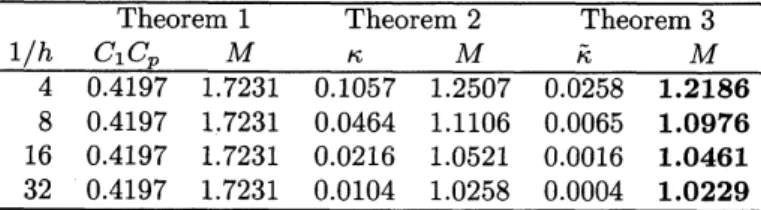
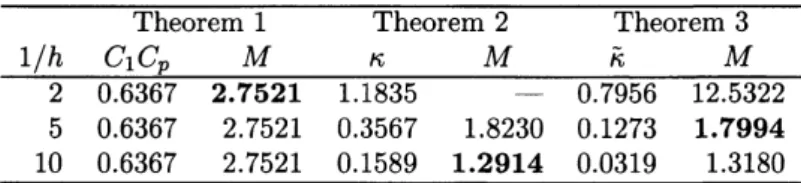
Table 1 and 2 show verification results. The bold letters indicate the smallest $M$ in the theorems.
Table 1: Verification results for $b=\sin(\pi x)$, $c=1,$ $\rho=1.0035(1/h=32)$
Theorem1 Theorem 2 Theorem 3
$\frac{1/hC_{1}C_{p}M\kappa M\tilde{\kappa}M}{40.41971.72310.10571.25070.02581.2186}$
8 0.4197 1.7231 0.0464 1.1106 0.0065 1.0976
16 0.4197 1.7231 0.0216 1.0521 0.0016 1.0461
32 0.4197 1.7231 0.0104 1.0258 0.0004 1.0229
Table 2: Verification results for $b=-\sin(\pi x)$, $c=-5,$ $\rho=2.0001(1/h=32)$
Theorem1 Theorem2 Theorem3
$\frac{1/hC_{1}C_{p}M\kappa M\tilde{\kappa}M}{40.82505.71160.22482.51550.15392.4918}$
8 0.8250 5.7116 0.0770 2.1125 0.0393 2.1122
16 0.8250 5.7116 0.0293 2.0280 0.0099 2.0285
32 0.8250 5.7116 0.0123 2.$00S2$ 0.0025
2.0084
3.4.2 Two-dimensionalnon-self adjoint operators
Consider the case for
$b=R[_{x-1/2}^{-y+1/2}], c\in \mathbb{C}, \Omega=(0,1)\cross(0,1)$ (22)
We take linear anduniformtriangularmesheson$\Omega$with the element sidelength
$h>0$foragivenfinite
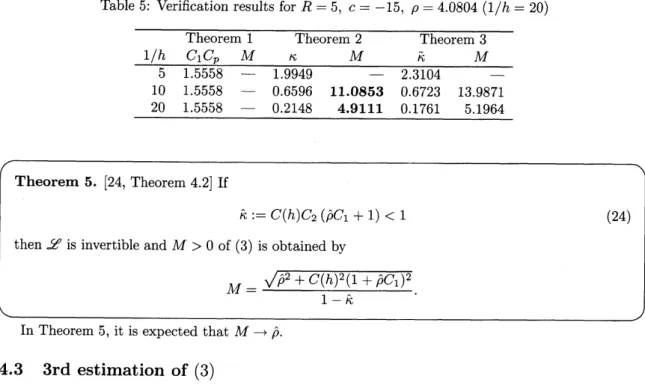
element mesh. We can take $C(h)=0.493h$ and $C_{p}=1/(\pi\sqrt{2})$. Table 3, 4, and 5 show verification
Table3: Verification results for$R=4,$ $c=0,$ $\rho=1.0001(1/h=10)$
Theorem1 Theorem 2 Theorem 3
$\frac{1/hC_{1}C_{p}M\kappa M\tilde{\kappa}M}{20.63672.75211.1835-0.795612.5322}$
5 0.6367 2.7521 0.3567 1.8230 0.1273 1.7994
10 0.6367 2.7521 0.1589 1.2914 0.0319 1.3180
Table4: Verification results for$R=6.75,$ $c=-1-1.5i,$ $\rho=1.0487(1/h=10)$
Theorem1 Theorem 2Theorem3
$\frac{1/hC_{1}C_{r}M\kappa M\tilde{\kappa}M}{41.1658-1.0408-0.892823.7783}$
5 1.1658 – 0.7608 5.6411 0.5721 5.1856
10 1.1658 – 0.3081 1.7124 0.1433 1.8585
3.5
Report for
estimation
(2)
Weconsider three computer-assisted procedures to verifythe invertibilityof second orderlinear elliptic operatorswithabound for thenormofits inverse. Although it has thelimitation,the method of Theorem 1 does not needthe computationof$\rho$ (2-norm). Themethod based on Theorem3 has the second order
for$C(h)$ when$b\in W^{1,\infty}(\Omega)$ and some verificationresults show that it could beanalternativeofTheorem
2, especially,some confirmation of the only invertibility for$\mathscr{L}$arequite essential. We stillconcludeour
second approach of Theorem 2 is robust and reliable than other two approaches.
4
Estimation
(3)
Nowwe consideran upper bound$M$ safisfying
$\Vert u\Vert_{H_{0}^{1}(\Omega)}\leq M\Vert \mathscr{L}u\Vert_{L^{2}(\Omega)} \forall u\in H(\triangle;L^{2}(\Omega))$
.
Wehave three approaches.
4.1
1st
estimation
of (3)
Our firstresult is adirect applicationof Theorem 2.
Theorem 4. [13, Theorem 2.3] If$\kappa=C(h)(\rho C_{1}K+C_{2})<1$ then $\mathscr{L}$is invertible and $M>0$of
(3) is obtained by
$M= \frac{C_{p}}{1-\kappa}\Vert[^{\rho(1-C_{2}C(h))}\rho C_{1}C(h) \rho_{1}K]\Vert_{2}$
In Theorem 4, it is expected that $M arrow C_{p}\max\{\rho$, 1$\}.$
4.2
2nd
estimation
of
(3)For
$\hat{\rho}:=\Vert D^{H/2}G^{-1}L^{1/2}\Vert_{2}$, (23)
Table5: Verification resultsfor $R=5,$ $c=-15,$ $\rho=4.0804(1/h=20)$
Theorem 1 Theorem 2 Theorem 3
$\frac{1/hC_{1}C_{p}M\kappa M\tilde{\kappa}M}{51.5558-1.9949-2.3104-}$ 10 1.5558 – 0.6596 11.0853 0.6723 13.9871 20 1.5558 – 0.2148 4.9111 0.1761 5.1964 Theorem 5. [24, Theorem4.2] If $\hat{\kappa}$ :$=C$ (ん)$C$2$(\hat{\rho}C_{1}+1)<1$ (24) then $\mathscr{L}$is
invertible and $M>0$ of(3) is obtained by
$M= \frac{\sqrt{\hat{\rho}^{2}+C(h)^{2}(1+\hat{\rho}C_{1})^{2}}}{1-\hat{\kappa}}.$
InTheorem5, it isexpectedthat $Marrow\hat{\rho}.$
4.3
3rd
estimation
of
(3)
We alsopresent the following estimate basedon afixed-point formulation.
Theorem 6. [4, Theorem 3] If$\kappa=C(h)(\rho C_{1}K+C_{2})<1$ then$\mathscr{L}$is invertible and
$M>0$of (3)
is obtained by
$M= \frac{\sqrt{\mathscr{J}(C_{p}+C(h)(K-C_{p}C_{2}))^{2}+C(h)^{2}(1+\rho C_{p}C_{1})^{2}}}{1-\kappa}.$
InTheorem 6, itisexpectedthat $Marrow C_{p}\rho.$
Comparing three theorems for (3), Theorem 5 couldconverge to the exact operatornorm for$\mathscr{L}^{-1}.$
Because of it holds that $\hat{\rho}\leq C_{p}\rho$, when$\hat{\rho}\sim C_{p}\rho$, Theorem 6 would apply suffient “good” $M$ with low computationalcost. $Rom$the actualcomputational pointofview, sincethe criterion$\hat{\kappa}<1$is sometimes harder than $\kappa<1$ forfixed $h$ experimentally, Theorem4 and6 have
aroomto be effective.
4.4
Numerical
examples
Our numerical environment and $S_{h}$ for
one-
or two-dimensional operators are same as the previoussection.
4.4.1 One-dimensional operators
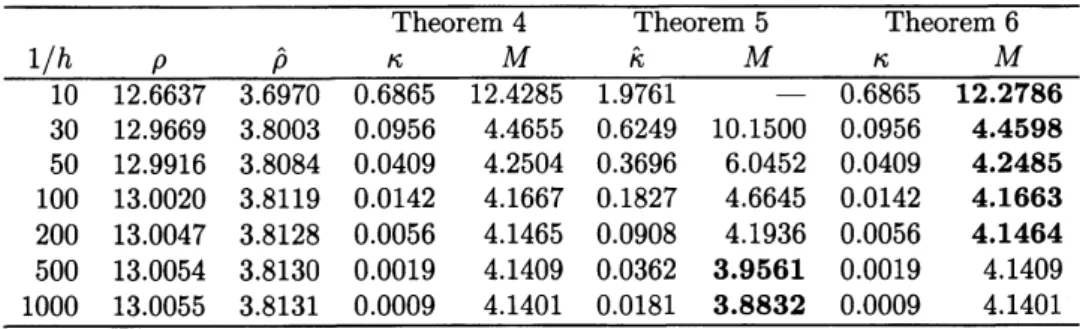
Table 6, 7, 8, and9 showverificationresults forsome $b(x)=r\sin(\pi x)$ and $c\in \mathbb{R}$ in
$\Omega=(0,1)$.
4.4.2 Two-dimensional non-self-adjoint operators
Consider thecasefor (22). Table 10 and 11 showverification results.
4.4.3 Two-dimensional operators
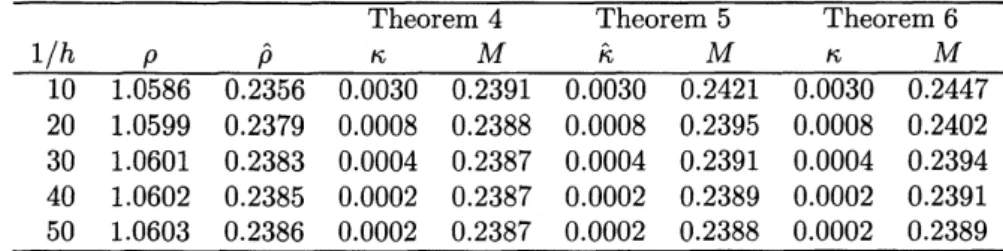
We nowreport on a case for $b=$ O. Consider an operator: $\mathscr{L}=-\triangle-1-2u_{h}+3au_{h}^{2}$ which is the
linearizedthe equation
Table 6: Verificationresults for $b=2.5\sin(\pi x)$, $c=-10$
Theorem4 Theorem 5Theorem6
$\frac{1/h\rho\hat{\rho}\kappa M\hat{\kappa}M\kappa M}{1012.66373.69700.686512.42851.9761-0.686512.2786}$ 30 12.9669 3.8003 0.0956 4.4655 0.6249 10.1500 0.0956 4.4598 50 12.9916 3.8084 0.0409 4.2504 0.3696 6.0452 0.0409 4.2485 100 13.0020 3.8119 0.0142 4.1667 0.1827 4.6645 0.0142 4.1663 200 13.0047 3.8128 0.0056 4.1465
0.0908
4.1936 0.0056 4.1464 500 13.0054 3.81300.0019
4.14090.0362
3.95610.0019
4.1409 1000 13.0055 3.8131 0.0009 4.1401 0.0181 3.8832 0.0009 4.1401Table 7: Verification results for$b=-20\sin(\pi x)$, $c=-20.$
Theorem4 Theorem 5Theorem 6
$\frac{1/h\rho\hat{\rho}\kappa M\hat{\kappa}M\kappa M}{102.64200.35523.9293-6.8074-3.9293-}$ 30 2.5044 0.3542 0.5592 1.8684 2.2167 – 0.5592 1.5439 50 2.4950 0.3542 0.2518 1.0293 1.3246 – 0.2518 0.9502 100 2.4911 0.3542 0.0948 0.8417 0.6603 1.0469 0.0948 0.8249 200 2.4911 0.3542 0.0396 0.8040 0.3296 0.5289 0.0396 0.8002 500 2.4899 0.3542 0.0140 0.7943 0.1318 0.4080 0.0140 0.7938 1000 2.4899 0.3542 0.0067 0.7930 0.0659 0.3792 0.0067 0.7929
at two finite element approximate solutions$u_{h}$ whosenamed “lower” and (upper.”
Table 12and 13 showverification results.
4.5
Report
for
estimation
(3)
Thecomputer-assisted procedure (Theorem 6) isourlatestapproachtocomputeaverified bound of the normfor secondorder linear elliptic operators$\mathscr{L}$. The criterionfor theinvertibilityof$\mathscr{L}$isthesame as
Theorem 4, however,it hasno limitation such that the lower bound of$M$ is not less than 1. Although
the proposed procedure would notconvergetoits exact operator norm,someverification examples show
that it has abetter bound than the approach in Theorem 5. We conclude that our proposed method
should be
a
bridge the gap between the two previous approaches, andone
may choicean appropriateproceduretaking into consideration given problem orcomputational cost, and
so
on.5
Estimation
(4)
Finally weconsideran upper bound $M$safisfying
$\Vert\triangle u\Vert_{L^{2}(\Omega)}\leq M\Vert \mathscr{L}u\Vert_{L^{2}(\Omega)}, \forall u\in H(\triangle;L^{2}(\Omega))$.
Wehavetwo approaches.
5.1
1st estimation
of (4)
Table8: Verificationresultsfor $b=\sin(\pi x)$, $c=100.$
Theorem4 Theorem 5Theorem6
$\frac{1/h\rho\hat{\rho}\kappa M\hat{\kappa}M\kappa M}{100.91830.05001.1665-0.35160.15081.1665-}$ 30 0.9911 0.0499 0.1458 0.4977 0.0577 0.0608 0.1458
0.3920
50 0.9969 0.0499 0.0553 0.4060 0.0275 0.0542 0.0553 0.3426 100 0.9992 0.0499 0.0155 0.3568 0.0111 0.0512 0.0155 0.3242 200 0.9998 0.0499 0.0047 0.3365 0.0049 0.0504 0.0047 0.3198 500 1.00000.0499
0.0012 0.3254 0.0018 0.0501 0.0012 0.3186 1000 1.0000 0.0499 0.0005 0.3218 0.0009 0.0500 0.0005 0.3184Table9: Verificationresults for $b=\sin(\pi x)$, $c=-10.$
Theorem4 Theorem5Theorem 6
$\frac{1/h\rho\hat{\rho}\kappa M\hat{\kappa}M\kappa M}{1094.962129.62612.1281-5.2424-2.1281-}$ 30
231.4257
72.4346 0.5767 172.3900 3.5678 – 0.5767 172.4427 50 261.5470 81.8835 0.2366 108.4156 2.3262 – 0.2366 108.4277 100 276.7469 86.6517 0.0641 93.8348 1.1938 – 0.0641 93.8375 200 280.8268 87.9316 0.0171 90.7977 0.5964 217.8445 0.0171 90.7983 500 281.9909 88.2967 0.0032 89.9844 0.2373 115.7653 0.0032 89.9846 1000 282.1580 88.3491 0.0010 89.8696 0.1184 100.2071 0.0010 89.8697Theorem 7. If$\kappa_{7}$ $:=C(h)C_{2}(\rho_{10}C_{1}+1)<1$ then
$\mathscr{L}$isinvertible and$M>0$of(4) isobtained by
$M=1+\Vert b\Vert_{L^{\infty}(\Omega)^{d}}A_{1}+\Vert c\Vert_{L^{\infty}(\Omega)}A_{0},$
where
$A_{0}= \frac{\rho_{00}+C(h)^{2}(1+\rho_{10}C_{1})}{1-\kappa_{7}}, A_{1}=\frac{\sqrt{p_{10}^{2}+C(h)^{2}(1+\rho_{10}C_{1})^{2}}}{1-\kappa_{7}}.$
5.2
2nd
estimation
of (4)
Note that if$E$is positive definite, by using$E=E^{1/2}E^{H/2}$, it is true that
Table 10: Verification results for$R=10,$ $c=-10-5i.$
$\overline{Theorem4}$
Theorem5Theorem6 $\frac{1/h\rho\hat{\rho}\kappa M\hat{\kappa}M\kappa M}{51.70390.36562.3287-3.6305-2.3287-}$ 10 1.7751 0.3946 0.7724 1.8734 1.7974 –0.7724
1.6510 201.7941
0.4025
0.28140.5384
0.87983.4926
0.2814
0.5033 50 1.7995 0.4047 0.0869 0.4222 0.3456 0.6227 0.0869 0.4174 100 1.80010.4050
0.0392 0.4092 0.17160.4897
0.0392
0.4082 130 1.8004 0.4051 0.0294 0.4076 0.13180.4670
0.0294 0.4070Table 11: Verification results for $R=10,$ $c=15.$
$\overline{Theorem4}$
Theorem5Theorem6 $\frac{1/h\rho\hat{\rho}\kappa M\hat{\kappa}M\kappa M}{50.97320.12701.8758-1.9610-1.8758-}$ 8 0.9903 0.1276 0.9032 3.3368 1.1493 – 0.9032 2.6387 10 0.9939 0.1277 0.6488 0.8671 0.8987 1.6951 0.6488 0.6589 20 0.99860.1279
0.2497 0.35430.4284
0.24530.2497
0.2760 500.9999
0.1279 0.0818 0.26320.1663
0.15590.0818
0.2316 100 1.0001 0.1279 0.0379 0.2426 0.0823 0.14000.0379
0.22675.3
Numerical
examples
Considerthe casefor two-dimensionalnon-self-adjoint operators (22). Our numericalenvironment and
$S_{h}$ issame
as
the previoussection. Table 14 and 15 showverification results.5.4
Report
for
estimation
(4)
Weproposetwocomputer-assistedprocedures to computea verifiedbound $M>0$satisfying (4). Some
verification examples show that Theorem 8 hasabetter bound than the approach in Theorem7. Ifwe
are indifferent to computationalcosts, instead ofan estimation
$\Vert b\cdot\nabla uh+cu_{h}\Vert_{L^{2}(\Omega)}\leq M_{h}(C(h)C_{2}\Vert\triangle u\Vert_{L^{2}(\Omega)}+\Vert f\Vert_{L^{2}(\Omega)})$
in the proofofthe Theorem 8, it canbe possible touse a bound such that
$\Vert b\cdot\nabla u_{h}+cu_{h}+f\Vert_{L^{2}(\Omega)}\leq\hat{M}_{h}\Vert f\Vert_{L^{2}(\Omega)}$
with numerically determined $\hat{M}_{h}>0$directly (more constructive).
Acknowledgments
This work was supported by a Grant-in-Aid from the Ministry ofEducation, Culture, Sports, Science
and Technology of Japan (No. 24340018,23740074, and 24540151).
References
[1] P.G. Ciarlet, The Finite Element Method
for
Elliptic Problems, North-Holland, Amsterdam, 1978.[2] K. Hashimoto, K. Nagatou, and M.T. Nakao, A computational approach to constructive a priori
error
estimate for finite element approximationsofbi-harmonic problems innonconvex
polygonalTable 12: Verification results for “lower” $u_{h}$ at $a=0.001.\hat{\rho}/(C_{p}\rho)\sim 0.9995(1/h=50)$.
Theorem4 Theorem 5Theorem 6
$\frac{1/h\rho\hat{\rho}\kappa M\hat{\kappa}M\kappa M}{101.05860.23560.00300.23910.00300.24210.00300.2447}$
20 1.0599 0.2379 0.0008
0.2388
0.00080.2395
0.0008 0.240230 1.0601 0.2383 0.0004 0.2387 0.0004 0.2391 0.0004 0.2394
40 1.0602 0.2385 0.0002 0.2387 0.0002 0.2389 0.0002 0.2391
50 1.0603 0.2386 0.0002 0.2387 0.0002 0.2388 0.0002 0.2389
Table 13: Verification results for “upper” $u_{h}$ at$a=0.001.\hat{\rho}/(C_{p}\rho)\sim 0.6040(1/h=50)$
.
Theorem4 Theorem 5Theorem6
$\frac{1/h\rho\hat{\rho}\kappa M\hat{\kappa}M\kappa M}{102.59480.35451.1823-0.77221.96681.1823-}$
20 2.6622 0.3624 0.2856 0.9204 0.1861 0.4756 0.2856 0.8883
30 2.6758 0.3640 0.1262 0.7216 0.0822 0.4087 0.1262 0.7074
40 2.6807 0.3645 0.0709 0.6671 0.0461 0.3887 0.0709 0.6590
50 2.6830
0.3648
0.04530.6438
0.0295
0.3800 0.04530.6386
[3] F.Kikuchi and X. Liu, Determination ofthe Babuska-Aziz constant for the linear triangularfinite
element, Japan Journal
of
Industrial and Appl\’ied Mathematics 2375-82 (2006).[4] T. Kinoshita, Y. Watanabe, and M.T. Nakao, Some remarks onthe rigorousestimation of inverse
linear elliptic operators,submitted.
[5] K. Kobayashi, A constructivea priori error estimation for finite element discretizations in a
non-convex domain using singular functions, Japan Journal
of
industrial and Applied Mathematics 26493-516 (2009).
[6] X. Liu and S. Oishi, Verified eigenvalue evaluation for the Laplacian over polygonal domains of
arbitrary shape, SIAMJournal on Numerical Analysis 511634-1654 (2013).
[7] M.T. Nakao,Computable$L^{\infty}$ errorestimates inthe finite element method withapplicationto
non-linear elliptic problems, in ContributionsinNumericalMathematics,pp. 309-319,ed.R. P. Agarwal,
World Scientific, Singapore, 1993.
[8] M.T. Nakao and N. Yamamoto, Numerical verificationof solutions for nonlinear elliptic problems using$L^{\infty}$ residual method,Journal
of
Mathematical Analysis and Applications217246-262(1998). [9] M.T. Nakao, N. Yamamoto, and S. Kimura, On best constant in the error bound for the $H_{0^{-}}^{1}$projection intopiecewise polynomialspaces, Journal
of
Approximation Theory93491-500 (1998).[10] M.T.Nakaoand N. Yamamoto,Aguaranteed boundofthe optimalconstantintheerrorestimates
forlineartriangular element,in Topics inNumericalAnalysis With Special Emphasis on Nonlinear
Problems, eds. G. Alfeld, and X. Chen, pp. 163-173, Computing Supplement, vol. 15, Springer,
Wien, NewYork,2001.
[11] M.T. Nakaoand N. Yamamoto, Aguaranteed bound of the optimalconstant intheerrorestimates
for linear triangular element Part II: Details, inPerspectives onEnclosure Methods, eds.U.Kulisch,
R. Lohner, and A. Facius, pp. 265-276, Springer, Wien, NewYork, 2001.
[12] M.T. Nakao, Numerical verification methods for solutions of ordinary and partialdifferential
Table 14: Verification resultsfor $R=20,$ $c=0.$ $\overline{\frac{1/hTheorem7Theorem8M_{h}\rho_{10}\rho_{00}A_{0}A_{1}}{20-3.53860.58430.22380.0501--}}$ 30 108.0393 2.5102 0.5854 0.2242 0.0503 1.6592 7.5689 40 12.9217 2.1922 0.5861 0.2243 0.0504 0.1867 0.8430 50 8.7114 2.0372 0.5865 0.2244 0.0504 0.1214
0.5453
1005.4943
1.7847 0.5872 0.2244 0.05040.0712
0.3178
130 5.0987 1.7350 0.5873 0.22440.0504
0.0650 0.2899Table 15: Verificationresults for$R=10,$ $c=-10-10i.$
$\overline{\frac{1/hTheorem7Theorem8M_{h}\rho_{10}\rho_{00}A_{0}A_{1}}{2016.30723.26711.04510.31720.07120.33141.5020}}$ 30 7.7991 2.7135 1.0469 0.3177 0.0714 0.1483 0.6651 40 6.3207 2.5057 1.0475 0.3179 0.0715 0.1164 0.5199 50 5.7107 2.3968 1.0478 0.3180 0.0715 0.1032 0.4600 100 4.8430 2.2077 1.0482 0.3181 0.0716 0.0843 0.3750 130 4.6888 2.1683 1.0483 0.3181 0.0716 0.0809 0.3599
[13] M.T. Nakao, K. Hashimoto, and Y. Watanabe, A numerical method to verify the invertibility of
linearelliptic operatorswith applications tononlinearproblems, Computing 751-14 (2005).
[14] M.T. Nakao, K. Hashimoto, and K. Kobayashi, Verified numerical computation of solutions for the stationary Navier-Stokes equation in nonconvex polygonal domains, Hokkaido Mathematical
Journal
36777-799.
(2007).[15] M.T. Nakao, K. Hashimoto, and K. Nagatou, A computational approachto constructive a priori
and a posteriori error estimates for finite element approximations of bi-harmonic problems, in
Proceedings
of
the4th
JSIAM-SIMAI Seminar on Industrial and Applied Mathematics, GAKUTOInternational Series, Mathematical Sciences and Applications, vol. 28, pp. 139-148, Gakkotosho,
Tokyo, Japan, 2008.
[16] M.T. Nakao and Y. Watanabe, Numerical verification methods for solutions of semilinear elliptic
boundary valueproblems, Nonlinear Theory and Its Applications, IEICE 22-31 (2011).
[17] M.T. Nakao, Y. Watanabe, T. Kinoshita, T. Kimura, and N. Yamamoto, Some considerations of the invertibility verifications for linear elliptic operators, Japan Journal
of
Industral and AppliedMathematics, toappear.
[18] M. Plum, Explicit$H_{2}$-estimatesand pointwiseboundsforsolutions of second-orderellipticboundary
valueproblems, Journal
of
MathematicalAnalysis and Applications 16536-61 (1992).[19] M.Plum,Numericalexistenceproofsandexplicitbounds for solutions of nonlinearellipticboundary value problems, Computing 4925-44 (1992).
[20] M. Plum, Existence and multiplicity proofs for semilinear elliptic boundary value problems by computer assistance, Jahresbericht derDeutschen Mathematiker Vereinigung 11019-54 (2008).
[21] S.M. Rump, INTLAB – INTerval LABoratory, in Developments in Reliable Computing, ed.
T. Csendes, pp. 77-104, Kluwer AcademicPublishers, Dordrecht, 1999.
http:$//www$.ti3. tu-harburg.$de/rump/$
[22] S.M. Rump,Verified bounds for singularvalues, inparticularfor the spectralnormofamatrix and itsinverse, BIT Numerical Mathematics 51367-384(2011).
[23] Y. Watanabe, N. Yamamoto, M.T. Nakao, and T. Nishida, A numerical verification ofnontrivial solutions fortheheatconvectionproblem, Journal
of
Mathematical Fluid Mechanics61-20 (2004).[24] Y. Watanabe,T. Kinoshita,and M.T. Nakao, Aposterioriestimates ofinverseoperatorsfor
bound-ary value problems in linear elliptic partial differential equations, Mathematics
of
Computation 821543-1557(2013).
[25] Y. Watanabe, K. Nagatou, M. Plum, and M.T. Nakao, Verified computations ofeigenvalue
exclo-suresforeigenvalue problems in Hilbert spaces, SIAMJournal on Numerical Analysis 52975-992
(2014).
[26] N. Yamamoto and M.T. Nakao, Numerical verifications of solutions for elliptic equations in
non-convexpolygonal domains, Numerische Mathematik65503-521 (1993).
[27] N. Yamamoto and K. Hayakawa, Error estimation with guaranteed accuracy of finite element
method in
nonconvex
polygonal domains, Journalof
Computationaland Applied Mathematics 159173-183 (2003).
[28] N. Yamamoto and K. Gemma, On errorestimation of finite element approximations to theelliptic
equations in nonconvex polygonal domains, Journal