RESONANCES FOR OBSTACLES IN HYPERBOLIC SPACE PETER HINTZ AND MACIEJ ZWORSKI
We consider scattering by star‐shaped obstacles in hyperbolic space and show that for the Dirichlet problem resonances satisfy a universal bound
|{\rm Im} $\lambda$| \displaystyle \geq\frac{1}{2}
which is optimal in dimension 2. In odd dimensions we also show that
|{\rm Im} $\lambda$| \displaystyle \geq\frac{ $\mu$}{ $\rho$},
for a universal constant $\mu$, where $\rho$ is the radius of a ball containing thc obstacle; this gives an improvement for small obstacles. That gives lower bounds on the rate of exponential dccay of waves outsidc of the obstacle.
In dimensions 3 and higher the proofs follow the classical vector field approach of Morawetz, while in dimension 2 we obtain our bound by working with spaces coming from gencral relativity. The lattter approach is inspired by the works of Vasy [Va13] and Hintz‐Vasy [\mathrm{H}\mathrm{i}\mathrm{V}\mathrm{a}\mathrm{l}5]. We also show that in odd dimcnsions resonances of small obstacles are close, in a suitable sense, to Euclidean resonances. The full account of
the results in presented in [\mathrm{H}\mathrm{i}\mathrm{Z}\mathrm{w}\mathrm{l}7\mathrm{a}].
For $\kappa$>0 we define hyperbolic n‐space with constant curvature -$\kappa$^{2} as
(\mathbb{H}_{ $\kappa$}^{n}, g_{ $\kappa$})=(\mathbb{R}^{n}, dr^{2}+s_{ $\kappa$}^{2}h)
, (1)where (r, $\omega$) are polar coordinates on \mathbb{R}^{n}, h= h( $\omega$, du) is the round metric on \mathbb{S}^{n-1},
and
s_{ $\kappa$}(r)=$\kappa$^{-1}\sinh( $\kappa$ r)
. We include Euclidean space as the case of $\kappa$=0, s_{0}(r)=r.Suppose that \mathcal{O} \subset \mathbb{R}^{rb} \simeq \mathbb{H}_{ $\kappa$}^{n} is a boundcd open set with smooth boundary, and
denote by
P_{ $\kappa$}:=-\displaystyle \triangle_{g_{ $\kappa$}}-(\frac{n-1}{2})^{2}$\kappa$^{2}
(2)the self‐adjoint operator on
L^{2}(
\mathbb{H}_{ $\kappa$}^{n}\backslash \mathcal{O}, dvolg
$\kappa$) with domain
\mathcal{D}(P_{ $\kappa$}):=H^{2}(\mathbb{H}_{ $\kappa$}^{n}\backslash \mathcal{O})\cap H_{0}^{1}(\mathbb{H}_{ $\kappa$}^{n}\backslash \mathcal{O})
.The resolvent ofP_{ $\kappa$}, $\kappa$>0,
R_{ $\kappa$}( $\lambda$)
:=(P_{ $\kappa$}-$\lambda$^{2})^{-1}
:L^{2}(\mathbb{H}_{ $\kappa$}^{n}\backslash \mathcal{O})\rightarrow L^{2}(\mathbb{H}_{ $\kappa$}^{n}\backslash \mathcal{O})
, {\rm Im} $\lambda$>0, (3) continues meromorphically to a family of operators defined on \mathbb{C}:R_{ $\kappa$}( $\lambda$):L_{\mathrm{c}\mathrm{o}\mathrm{m}\mathrm{p}}^{2}(\mathbb{H}_{ $\kappa$}^{n}\backslash \mathcal{O})\rightarrow L_{1\mathrm{o}\mathrm{c}}^{2}(\mathbb{H}_{ $\kappa$}^{n}\backslash \mathcal{O})
.数理解析研究所講究録
PETER HINTZ AND MACIEJ ZWORSKI
FIGURE 1. Left: a star‐shaped obstacle in the Poincaré disc with reso‐ nances satisfying a universal bound {\rm Im} $\lambda$\leq
-\displaystyle \frac{1}{2}
. Right: resonances of a disk with radius R=1 in\mathbb{H}^{2}. Highlighted are resonances correspondingto the angular momentum \ell=12.
For $\kappa$=0, the same result is true whenn is odd; in even dimensions the continuation
takes place on the logarithmic plane.
We denote the set of poles of R_{ $\kappa$}( $\lambda$) (included according to their multiplicities) by {\rm Res}(\mathcal{O}, $\kappa$). The elements of {\rm Res}(\mathcal{O}, $\kappa$) are called scattering resonances and they
determine decay and oscillations of reflected waves outside of
\mathcal{O}-sce [Zw17] for a recent
survey and references. In the odd‐dimensional Euclidean case their study goes back to classical works of Lax‐Phillips [\mathrm{L}\mathrm{a}\mathrm{P}\mathrm{h}68] and Morawetz [\mathrm{M}\mathrm{o}66\mathrm{a}], and the relation between the distribution of resonances and the geometry of obstacles has been much studied, especially for high energies (|{\rm Re} $\lambda$|\rightarrow\infty)- see [Zw17, §2.4].
When the obstacle is star‐shaped, a universal lower bound on resonance widths, |{\rm Im} $\lambda$|, can be given in terms of the radius of the support of the obstacle. Follow‐ ing earlier contributions of Morawetz [\mathrm{M}\mathrm{o}66\mathrm{a}],[\mathrm{M}\mathrm{o}66\mathrm{b}] ,[Mo72] and using Lax‐Phillips
theory [\mathrm{L}\mathrm{a}\mathrm{P}\mathrm{h}68] , Ralston [Ra78] obtained the bound
\displaystyle \mathcal{O}\subset B_{\mathbb{R}^{n}}(x_{0}, $\rho$) \Rightarrow \inf_{ $\lambda$\in \mathrm{R} $\kappa$(\mathcal{O},0)}|{\rm Im} $\lambda$| \geq$\rho$^{-1}
(4) for odd n\geq 3. Remarkably this bound is optimal in dimensions three and five—see Fig. 2 and[\mathrm{H}\mathrm{i}\mathrm{Z}\mathrm{w}\mathrm{l}7\mathrm{b}]
for a discussion of this result.In this paper we investigate analogues of (4) for \mathcal{O} \subset
B_{\mathbb{H}_{ $\kappa$}^{n}}(x_{0}, $\rho$)
. The first resultshows that the resonance widths have a universal lower bound independent of the diameter of the obstacle. Intuitively this is due to the fact that infinity is much
“larger” in the hyperbolic case.
Theorem 1. Suppose that\mathcal{O}\subset \mathbb{H}_{ $\kappa$}^{n} is a star‐shapel obstacle. Then
\displaystyle \inf_{ $\lambda$\in \mathrm{R}ae\mathrm{s}(\mathcal{O}, $\kappa$)}|{\rm Im} $\lambda$|\geq $\kappa$/2
. (5)RESONANCES FOR OBSTACLES IN HYPERBOLIC SPACE
Whcnn\geq 3the proof is based on the vector field method of Morawetz; to obtain an
argument valid also when n=2 (where the estimate is sharp when \mathcal{O}=\emptyset) we use an
approach based on ideas from general relativity and estimates on resonant states. The hyperbolic spacc version of Morawetz’s estimate for n\geq 3and a slight refinement of the argument from [\mathrm{M}\mathrm{o}66\mathrm{a}] gives an improvement for small obstacles in odd dimensions; this is due to the sharp Huyghens principle.
Theorem 2. Suppose that \mathcal{O} \subset \mathbb{H}_{ $\kappa$}^{n} is a \mathcal{S}tar‐shaped obstacle and that n \geq 3 is odd. Then
\displaystyle \mathcal{O}\subset B_{\mathrm{H}_{ $\kappa$}^{n}}(x_{0}, $\rho$) \Rightarrow \inf_{ $\lambda$\in{\rm Res}(\mathcal{O}, $\kappa$)}|{\rm Im} $\lambda$| \geq $\mu \rho$^{-1}
(6) for a universal constant $\mu$.Remark. Jcns Marklof suggested a formulation of Theorems 1 and 2 which does not depend on $\kappa$: there exist constants c_{n} such that for star‐shaped obstacles \mathcal{O}\subset \mathbb{H}_{ $\kappa$}^{n}, n odd,
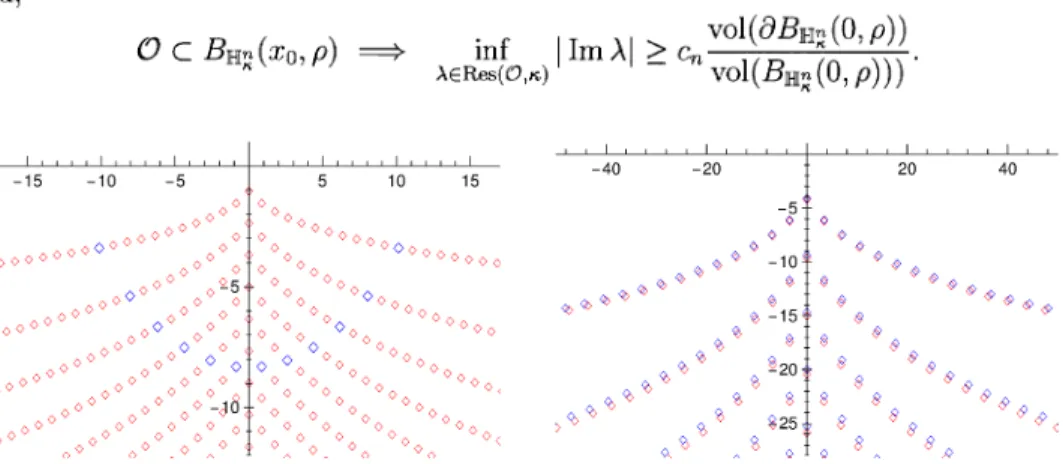
\displaystyle \mathcal{O}\subset B_{\mathbb{H}_{ $\kappa$}^{n}}(x_{0}, $\rho$) \Rightarrow \inf_{ $\lambda$\in{\rm Res}(\mathcal{O}, $\kappa$)}|{\rm Im} $\lambda$| \geq c_{n}\frac{\mathrm{v}\mathrm{o}1(\partial B_{\mathbb{H}_{ $\kappa$}^{n}}(0, $\rho$))}{\mathrm{v}\mathrm{o}1(B_{\mathbb{H}_{ $\kappa$}^{n}}(0, $\rho$)))}.
FIGURE 2. Left: resonances for the ball of radius one in\mathbb{R}^{3}. For each
spherical momentum\ellthey are given by solutions of
H_{\ell+1/2}^{(2)}( $\lambda$)=0
whereH_{ $\nu$}^{(2)}
is the Hankel function of the second kind and order v. Each zeroappears as a resonance of multiplicity 2\ell+1; highlighted are resonances corresponding to \ell = 12. Right: resonances of thc ball with radius
R=0.25 in \mathbb{H}^{3} (red) and in\mathbb{R}^{3} (blue); this illustrates Theorem 3.
We expect that $\mu$=1 in (6). (An adaptation of Ralston’s argument [Ra78] should work but would require some buildup of scattering theory; for a proof of his crucial estimate without using Lax‐Phillips theory, see [\mathrm{D}_{\mathrm{c}}\mathrm{v}\mathrm{Z}\mathrm{w}, Exercise 3.5].) That the esti‐ matc (6) is indcpcndent of $\kappa$is related to rescaling: identifying an obstacle with a subset
of \mathbb{R}^{n} and denoting by x\mapsto $\varepsilon$ x the Euclidean dilation, we see that if $\sigma$ \in {\rm Res}(6\mathcal{O}, 1)
then $\varepsilon \sigma$ \in {\rm Res}(\mathcal{O}, \in), and $\Xi \sigma$ should be close to a resonance in {\rm Res}(\mathcal{O}, 0). So even
PETER HINTZ AND MACIEJ ZWORSKI
though the bound (5) gets worse for small $\kappa$, the bound in odd dimensions is close to
(4) and improves for small diameters. This is illustrated by Fig. 2 and confirmed by the following theorem:
Theorem 3. Suppose that\mathcal{O}\subset \mathbb{H}_{ $\kappa$}^{n}\simeq \mathbb{R}^{n} is an arbitrary bounded obstacle with smooth boundary and that n\geq 3 is odd. Then
{\rm Res}(\mathcal{O}, $\kappa$)\rightarrow{\rm Res}(\mathcal{O}, 0) , $\kappa$\rightarrow 0, locally uniformly and with multiplicities.
REFERENCES
[DyZw] S. Dyatlov and M. Zworski, Mathematical theory of scattering resonances, book in prepara‐
tion; http://math. mit.\mathrm{e}\mathrm{d}\mathrm{u}/\sim \mathrm{d}\mathrm{y}\mathrm{a}\mathrm{t}\mathrm{l}\mathrm{o}\mathrm{v}/\mathrm{r}\mathrm{e}\mathrm{s}/
[HiVa15] P. Hintz and A. Vasy. Asymptotics for the wave equation on differential forms on Kerr‐de
Sitter space. arXiv:1502.03179.
[HiZw17a] P. Hintz and M. Zworski, Resonances for obstacles in hyperbolic space, arXiv:l703.01384.
[HiZw17b] P. Hintz and M. Zworski, Wave decay for star‐shaped obstacles in\mathbb{R}^{3}: papers of Morawetz
and Ralston revisited, arXiv:1703.01389, to appear in Proc. Roy. Irish Acad. Sect. A.
[LaPh68] P. D. Lax and R. S. Phillips, Scattering theory, Academic Press 1968.
[Mo66a] C. Morawetz, Exponential decay of solutions of the wave equation, Comm. Pure Appl. Math.
19(1966), 439‐444.
[Mo66b] C. Morawetz, Energy Identities for the Wave Equation, New York Univ., Courant Inst. Math.
Sci., Res. Rep. No. IMM346,1966, https: //archive. org/details/energyidentities00mora
[Mo72] C. Morawetz, On the modes of decay for the wave equation in the exterior of a reflecting body,
Proc. Roy. Irish Acad. Sect. A 72(1972), 113‐120.
[Ra78] J. Ralston, Addendum to: “The first variation of the scattering matrix” (J. Differential Equa‐ tions 21(1976), no. 2, 378−394) by J. W. Helton and J. Ralston. J. Differential Equations 28(1978),
155−162.
[Va13] A. Vasy, Microlocal analysis of asymptotically hyperbolic and Kerr‐de Sitter spaces, with an
appendix by Semyon Dyatlov, Invent. Math. 194(2013), 381‐513.
[Zw17] M. Zworski, Mathematical study of scattering resonances, Bull. Math. Sci. 7(2017), 1‐85.
E‐mail address: [email protected]
E‐mail address: [email protected]
DEPARTMENT OF MATHEMATICS, UNIVERSITY OF CALiFoRNiA, BERKELEY, CA 94720, USA