A Human Security Approach to Post-Disaster
Rehabilitation and Reconstruction : a Case
Study of the 2003 Bam Earthquake, Iran
著者
RAMEZANI Masoumeh
journal or
publication title
The science reports of the Tohoku University.
7th series, Geography
volume
60
number
2
page range
109-171
year
2014-03
URL
http://hdl.handle.net/10097/60592
A Human Security Approach to Post
-Disaster Rehabilitation and
Reconstruction : a Case Study of the 2003 Bam Earthquake, Iran
Masoumeh RAMEZANI*
Abstract This study investigates to what extent post-disaster reconstruction and
rehabilitation might impact or re-shape political systems employing a human security
approach. The increased exposure of human societies to numerous disasters with tre-mendous human and material losses has proved the insufficiency of the techno-centric
approach. Furthermore, the causes and impact of disasters are grounded in socio-
poli-tics and the violation of human security. The human security approach is considered here to be an alternative to the techno-centric approach, which purely views disaster
vulnerability as physical and relies on expert knowledge and top-down planning favored
by many government officials. To develop this human security approach an analytical framework for human security was composed with the aim of benefiting disaster stud-ies. The framework was examined through a case study of the 2003 Bam earthquake in Iran, which provided empirical detail. The salient findings are that reconstruction failed, non-state actors were mobilized, and a renegotiation of human security and
rights claims was established, although they were repressed by the government. Also, it is shown that people showed capacity to cope with such an event on the base of their own local knowledge and heritage. In conclusion, it was seen that there was potential for political change both in the social contract and in renegotiation over the issue of human security. It is also suggested that the real participation and empowerment of local people can be recognized through an evaluation of their capacities as well as their vulnerability. The reduction of disaster vulnerability depends on people’s awareness and governance of societies that can question government decision-making and
plan-ning and can help them to stress their claims to certain right as well as safeguard their human security.
Key words : human security, earthquake, reconstruction, social contract, Bam, Iran
*Doctoral graduate, Graduate School of Environmental Studies, Tohoku University, 6-6-20, Aza Aoba, Ara-maki, Aoba-ku, Sendai 980-8579, Japan
E-mail : [email protected] 1. Introduction
It is apparent that human and material losses from natural disasters have increased decade by decade since the second half of the twentieth century. Disasters, such as earthquakes, tsu-namis, typhoons and hurricanes lead to vastly different types of tragedies among human societ-ies. With the increase in the disasters of all kinds throughout the twentieth century until the
present, a theoretical understanding and conceptualization of disasters has also undergone a corresponding change due to the inefficiencies in a comprehensive response to a disastrous sit-uation using a technocratic paradigm, which over the second half of the last century was and still is the dominant paradigm within the UN and multilateral agencies such as the World Bank (Varley, 1994). In this approach, disasters are defined as the occurrence of natural or human -made forces and are represented as departures from normality (Bankoff, 2004). The main pur-pose of this approach is the transformation from traditional subsistence knowledge, defined as ‘backward’, to monitoring techniques, scientific theory and engineering structures, which are defined as ‘modern’ (see e.g. White, 1974 ; White and Haas, 1975 ; Burton et al., 1978 -updated 1993). The core assumptions of the technocratic approach lie in the possibility of rapid recovery and construction based on ‘command and control model’ planning with purely technical measures putting stress on formulating and advocating standard solutions (Bolt et al., 1977 ; Bryant, 1991). The process within which this takes place is top-down, relying on ‘expert knowledge’ and advanced technology carried out by bureaucrats and central institutions (see also Hewitt, 1983, 1995 ; Smith and Petley, 2009).
In the 1970s, some social scientists and anthropologists, in contrast to the technocratic research of the hazard-based paradigm, began to question the reading of disasters as purely nat-ural phenomena because of continuous failures in reducing disaster losses, especially in devel-oping countries (Bankoff, 2004 ; Smith and Petley, 2009). This new field of research in social science was pioneered by scholars of risk studies, such as Luhmann (1995), with lexis for ana-lyzing risk and danger as part of social process by which a differentiated social system attempts to cope with uncertain situations caused by disruption. This view stressed a social response to various disasters while acknowledging the importance of local contexts for the first time and it defined disaster as an explosion of social risks and vulnerabilities (Hewitt, 1997). In sum, they argue that on the one hand, disasters effect on people and their environment and on the other hand, human activities can increase disaster’s impact (Hewitt, 1983 ; Hewitt, 1997 ; Tobin and Montz, 1997 ; Alexander, 2000). This view has been helpful in refining some key concepts, such as poverty and vulnerability, and human vulnerability analyzing and mapping have now become important concepts for understanding the scale of a disaster (Blaikie et al., 1994 ; Bankoff, 2004 ; Wisner et al., 2004 ; Smith and Petley, 2009).
Following the slow progress in disaster reduction and more severe damages and losses of natural disasters, especially in developing countries, some social practitioners with experience in developing countries tried to define the causes of disasters in development practice and therefore discover how the impact of a disaster can be reduced in a sustainable way in the future, especially for the poorest people in a rapidly changing world. With this view, UNDP -DHA (1994) and Anderson & Woodrow (1998) argue that the effects of development can increase or reduce vulnerability to disaster risk and they call for an analytical framework, based on capacities and vulnerabilities, which defines development as the process by which vulnera-bility is reduced and local capacities increased. By contrast, Lewis (1999) rejects this view
stating that the argument that development leads to a reduction of vulnerability is not war-ranted. He posits that this is mainly because people take development as being synonymous with economic growth and identify vulnerability as a dependent variable that can be affected negatively or positively by development (UNDP-DHA, 1994). Hewitt adds that ‘[i]f there could be such a thing as sustainable development, disasters would represent a major threat to it, or a sign of its failure’ (1995 : 155). These notions of development make the crucial point that what is conceived as development by some might result in under-development for others. Meanwhile, concerning today’s explanation of climate change, ecologists call for a credible approach because future disasters are likely to be larger in scale than in the past and there will be increasingly complex human societies and concentrations of people in urban areas (Mileti and Myers, 1997 ; Rubin, 1998 ; Warner et al., 2002). For instance, widespread devastation is arising not only in the developing countries but also during this period in the richest megacities of the world (like the Kobe earthquake 1995 in Japan, Hurricane Katrina in New Orleans, USA in 2005 (Smith and Petley, 2009), and the Tohoku region’s earthquake and tsunami in 2011 in Japan). This view re-emphasizes the mutual interactions between nature and society, whereby disasters emerge when there is a lack of ‘mutuality’, a measure of both how well a society is adapted to the environment and how well that environment fares at the hands of human activity (Bankoff, 2001 ; Oliver-Smith, 1999).
The primary linkage of human security in disaster studies might be traced back to litera-ture on environmental and climate change (Ullman, 1983 ; Myers, 1986 ; Brown, 1986 ; Mathews, 1989). There, human insecurity (limited access to rights and basic needs) increases the scope and impact of vulnerability to environmental change and disaster and can influence livelihoods and the capacity to cope with future threats (Nordas and Gleditsch, 2007 ; cited in Pelling and Dill, 2010). This necessitated a broadening of the concept of security beyond state security against contain non-military threats and revisit vulnerability with a concern for human security (Birkmann and Wisner, 2005). This occurred alongside big debates within academia and among policymakers after the Cold War. These efforts resulted in conceptualizing envi-ronmental security with a special emphasis on conceptual and empirical clarity. Views were mostly divided into two ranges. The first line was best known from studies from the Peace and Conflict Studies Programme at the University of Toronto (Homer-Dixon, 1991, 1994 ; Homer-Dixon et al., 1993). Under the influence of a neo-Malthusian approach, this group asked whether and how scarcities of vital, non-renewable and renewable materials caused by environmental change, population growth, technology and the unequal social distribution of resources might produce international conflict and risk (see e.g. Homer-Dixon, 1991, 1994 ; Cocklin, 2002 ; Pelling and Dill, 2010). Another group, such as Ullman (1983), emphasizes global environmental threats and extends the security concept to include other threats to human beings, like natural disasters, namely earthquakes.
Besides initiating several programs, this group tried to find out how human security can be used to encounter environmental changes in the conditions of human livelihoods. The
Inter-national Human Dimensions Programme on Global Environmental Change (IHDP) set up a project on environment and security, the Global Environmental Change and Human Security project (GECHS). The GECHS project of the IHDP concentrates on human security and investigates whether it can raise social capacity with respect to global change (Cocklin, 2002). Longergan (1999) itemizes the GECHS’s notion of human security as centered on people’s active engagement in response to threats and reducing vulnerabilities (Lonergan, 1999). According to Lonergan, human security is retained where people have, one, the choice to reduce or cope with threats to their human, environmental, and social rights ; two, the capabil-ity and freedom to play these choices ; and, three, the opportuncapabil-ity to actively participate in achieving these choices (Lonergan, 1999). Lonergan (1999) posits three post-structuralist premises for strengthening the definition. The first considers that human perceptions and the use of the environment are based on economic, social and political constructions. The second sees that world poverty and equity must be encompassed, and the third emphasizes the contri-bution of the knowledge base at the local level rather than at the level of the nation-state in dealing with both environmental and security concerns (Lonergan, 1999 ; cited in Cocklin, 2002).
Another area of focus on disaster and human security is placed by studies on vulnerability. The contribution of vulnerability to human security was brought about by the UN University Institute for Environment and Human Security (Brauch, 2005 ; Birkmann and Wisner, 2005 ; Villagran, 2006 ; Warner, 2007). According to Birkmann (2006), applying human security approaches in vulnerability analysis includes institutions as key elements in investigating the shape of human exposure, susceptibility and coping capacity (Birkmann, 2006). As a narrative it has one leg in development and the other in disaster. The advocates of vulnerability insist that vulnerability ‘is not the same as poverty, marginalization, or other conceptualizations that identify sections of the population who are deemed to be disadvantaged, at risk, or in other ways in need’ (Cannon et al., 2003 : 4 ; see also Wisner et al., 2004) but it is supposedly a way of conceptualizing what may happen to an identifiable population under conditions of particular risks and hazards’ (Cannon et al., 2003 : 4).
Recently, the special attention to the topic of human security and disaster was raised due to the Great Eastern Japan Earthquake on 11 March, 2011. This can be identified from a num-ber of websites and symposia about human security and natural disasters which were held under the cooperation of Japanese universities, the Japan Foundation and the UN University, for instance, “Human Security-Towards New Development”1), a joint symposium of the UN Uni-versity Institute for Sustainability and Peace (UNU-ISP) and the Japan Foundation for UNU (jfUNU) (Dec. 2010). One of the main topics of the symposium was ‘natural disasters and the responsibility to protect’. The main discussion however, focused on the evolving role of the military as a security guarantee to rescue and protect people in natural disasters, such as the example of Japan’s Self-Defense Forces. Other examples are “Natural Disasters and Human Security”, which was related to an online survey on the UNU website2), “Human Security
Approaches for Disaster Recovery and Resilience” (Jimba et al., 2011) by the International Medical Community, mainly focused on how people in the 2011 earthquake and tsunami coped with the disaster. In particular, the role of young people and education was highlighted. Last but not the least is the “Joint Symposium on Human Security in Disasters ; Tohoku University and UNU Institute for Environment and Human Security (UNU-EHS)”, which was held in Feb-ruary 2012. Its major topics were around natural hazards safety, vulnerability assessment and risk management and a series of presentations by young researchers about the Great Eastern Japan Earthquake in 2011 with a perspective on human security. The common ground of all these symposia and articles was the aim to ‘best understand and respond to threats that the natural disasters pose to human safety and wellbeing. One could see few systematic and theo-retical analyses of disaster and human security from these attempts.
On 26th December 2003, at 05 : 27 am (local time), the region of Bam in southeast Iran was struck by an earthquake registering 6.6 on the Richter scale, which killed 35,000 people. Iran is located on the active Alpine-Himalayan fault. More than 180,000 people have been killed due to earthquakes in Iran over the last 90 years (National Report on Disaster Reduction, 2005). The last four decades have seen three other disastrous earthquakes : the first was in Boeen Zahra in 1961, with 10,000 deaths, the second happened in Tabas in 1978, with 19,600 human losses, that in Manjil was the third, with 35,000 deaths in 1990. Earthquakes are a serious threat to human security. These events produced a realization of the political impact of natural disasters in the early 1980s. Disaster politics analysis was seen as ‘the interaction of social political actors and framing institutions in preparing for and responding to extreme nat-ural events, and suggests that disaster events and their management are part of unfolding politi-cal histories’ (Pelling and Dill, 2010 : 21).
Therefore, the present research tries to investigate the following questions such as to what extent can natural disasters, such as earthquakes, trigger a renegotiation of human secu-rity around a new social contract. In other words, how much human insecusecu-rity is related to the existing power relations? In particular, what was the outcome of Iranian government plan-ning in the distribution of power—e.g. centralizing or decentralizing—and in the mitigation of disasters? Finally, what is the potential capacity of the people, and how do they put pressure on the government and renegotiate their demands or reduce vulnerability against earthquakes in Bam, Iran? The assumptions are that there is a corresponding relationship between disas-ter vulnerability and the nature of existing power relations in multiple levels (from individuals to international) and various time phasing (from pre-disaster to post-disaster). Also, people’s perceptions and capacities with regard to a disaster are different from those who intervene in the situation, such as governments or international and national NGOs. Then, besides their vulnerability to disasters, people have historically developed coping strategies to mitigate or at least reduce the impact of a natural disaster through long-term efforts.
anal-ysis, especially earthquake in sociological, political, and anthropological researches on disasters in Iran. The study also seeks the way to reduce human insecurity and enhance coping mecha-nisms with regard to disaster vulnerability through learning about people’s ‘heritage’ and ‘social capital’ as a means of empowerment. Ultimately, it suggests an analytical framework for disas-ter and human security. Considering the questions and assumptions of the present research, we have primarily adopted a case study method and a qualitative research approach within it. The study is based on a series of fieldwork conducted mainly in 2007.
2. Concepts and research framework
2.1. Concept of security : a historical narrative
Security is one of those conceptions which have caused a lot of dispute around its defini-tion and nature in many intellectual fields. It has been described as a ‘symbol’ (Wolfers, 1952), an ‘essentially contested concept’ (Buzan, 1983), an ‘ambiguous/privative and dual concept’ (Dillon, 1996), a ‘speech act’ (Wæver, 1995), a ‘metaphor’ (Chilton, 1996), a ‘neglected concept’ (Baldwin, 1997), a ‘thick signifier’ (Huysmans, 1998), a ‘language game’ (Fierke, 1998), a ‘leit-motif’ (Debiel and Werthes, 2005), and a ‘promiscuous concept’ (Zedner, 2009). This ambigu-ous and multi-faceted concept of security can be recognized through a terminological journey back to the Greek (asphalia) and Latin (sine cura/sicuritas) roots which then carried over into the English term, security. Asphaleia is the privative of the verb sphallo—i.e. a-sphaleia.
Sphallo means to err, to cause to fall or to fail, to bring down…. It was translated into Latin as fallo—to fall. Hence, the privative asphaleia is to avoid falling … (or a) mistake (Dillon,
1996 : 124).
The English word ‘security’, of course, derives directly from the Latin securitas/securus, which, in turn, is derived from the compound sine cura. Sine cura comprises sine, meaning without, and cura from curio meaning troubling ; solicitude ; carefulness ; … anxiety. Hence,
sine cura (and sinecure) : without solicitude ; free from cares ; … easy. Securitas is
conse-quently defined as freedom from concern ; unconcern ; composure ; freedom from danger ; safety ; security (Dillon, 1996 : 125). Cicero and Lucretius frequently referred to securitas as a kind of philosophical and psychological state of being free from mental perturbation, tranquil-ity or peace of mind (Brauch, 2005 : 6 ; Dillon, 1996 : 125).
This usage of the concept of security was carried down historically until quite recent times when security was still considered and related to the feeling of the individual sphere, but from the eighteenth century, signs of a conceptual evolution of security were starting to show (McFarlane & Khong, 2006 ; Rothschild, 1995). From then until now the concept has been defined and interpreted in different ways. The issue of security has long preoccupied the minds of scholars. One of the simplest, broadest and most reiterated definitions of security was suggested in a classic essay by Wolfers (1952). ‘Security’, he says, ‘points to some degree of protection of values previously acquired’ (Wolfers, 1952 : 484). Then, in order to specify
the concept further, Wolfers adds two dimensions to his definition : ‘security in an objective sense measures absence of the threats to acquired values, in a subjective sense, the absence of fear that such values will be attacked’3) (1952 : 485).
Baldwin (1997), aiming to construct a formulation of conceptual analysis recognized the unattainability of the absence of threats, further defines security as ‘a low probability of damage to acquired values’ (1997 : 13). This understanding places emphasis on the preservation of acquired values, which he thinks is loyal to the spirit of Wolfers’ meaning. He exemplifies this graded definition with threats like military attack, or earthquakes, in response to which some degree of security is provided—like a deterrence policy or building codes—to lower the proba-bility of damage to acquired values (Baldwin, 1997). Then, in pursuit of his concern with the criteria required for an analysis of security, he asks questions that might help to define ‘security in its most general sense’ which can be measured ‘in terms of two specifications : security for whom? And security for which values?’ (1997 : 13) In so doing, he leaves out Wolfers’ sub-jective sense and frees himself of the ‘absence of threats’ in an absolute sense by grading the levels of threats/security. He notes that the distinction between the objective and subjective dimensions becomes clearer when we ask ‘security for whom?’ To show the abstract and gen-eral character of his criteria for a definition, he states the answer we might consider can range from‘some, most or all’ individuals, states, or international systems, in relation to the research question under consideration (Baldwin, 1997). This diversity is further extended by the necessity of specifying the values for which security is sought.
But, somehow, these questions seem challengeable. For instance, giving grades to secu-rity does not sound as if it fits with the main logic of the ‘unattainability of absolute secusecu-rity’ in Baldwin’s discussion. Because, if security is relational and since, and if there is nothing intrin-sic or essential in a relational concept, then a relational concept of security also cannot deter-mine its own content which is in contrast with the aim of Baldwin to build an analysis of secu-rity in its abstract and general sense. Others, like Buzan et al. (1998), Booth (2007), and later Møller (2003), Wibben (2008), and Tajbakhsh & Chenoy (2007), also discussed the question sets of the concept of security.
Buzan (1991) thinks that questions like ‘whose security’ and ‘security of what’ should be considered as one. This notion takes its rise in Buzan’s definition of security, although he him-self notes that security is an essentially contested concept, so we cannot come to an agreed def-inition of security. Security, according to Buzan, ‘is taken to be about the pursuit of threat’, and ‘survival’ is the bottom line (1991 : 432-433). Booth, in contrast to Buzan (1991), notes that ‘if we cannot name security, how can we ever hope to achieve it? (1991 : 317). Another matter of disagreement lies in Buzan’s famous claim about the ‘essentially contested’ character of the concept of security. McSweeney (1999) points out that the phrase ‘essentially contested’ gives an exceptional advantage to the concept of security in comparison to other similar concepts like ‘the state’ and ‘justice’. He insists that if it is regarded as an essentially contested concepts in social science or international relations, then these are equally contestable, too (1999 : 83
-4). Booth also assumes that it would be more correct to use the word ‘contingently rather than essentially contested’. He proposes that ‘security as a basic concept consists of core ele-ments [a referent object, threats, and means] that are not essentially contested’, and ‘reveal security to be a simple concept at heart, as Hobbes (1651) understood four centuries ago’, but when it was imposed on world politics this simple core became a complex concept ‘as the layers of politics are wrapped around it’ (2007 : 100). ‘The problem of security’, Booth concludes, ‘is not in the meaning of the concept, but in the politics of the meaning that derive from different political theories’ (2007 : 101). That is to say, the questions ‘we’ pose—about which referent objects (states or people), and on which threats to the chosen referent, should be prioritized (military, economic, short term or long term) to overcome those threats (force or negotiations, police, camera setting, etc.)—has an influence on the conceptualizing and operationalizing of security in contingent contexts in world politics (Booth, 2007).
Although these conceptual presentations of security’s content and question sets seem to be useful tools to identify and analyze threats and their subjects and objects, these narratives are overly focused on the contents of security and on linguistic aspects. So far, the integral of all these definitions is the absence of threats or the freedom from threats or danger. Viewing security just from this framework of content and threats seems to leave little space for endeav-ors to find alternative propositions of security. This makes sense especially when we want to mainstream the concept of human security in contemporary discourse.
2.2. A definition of security through ‘Authorization’ : social contract
Until now what has been at the core of all these debates is their preoccupation with con-ceptualizing security in accordance with its content—threats, danger and risk. Here, we fur-ther view the conception of security from anofur-ther angle namely ‘authorization’ by Moore (2011) which might provide an alternative to content- and threat-based conceptions of security. In the article titled ‘Citizens into Wolves? Carl Schmitt’s Fictive Account of Security’, Moore (2011) calls for investigating security regimes through a complex process of authorization (or an epistemic view). The ‘concern with the process of authorization—how security decisions are allocated as security—transfers security away from the territory of the sovereign decision towards security as a public, negotiated discourse at the core of political communities’ (Moore, 2011 : 503). To explore this, he goes back to a comparison between the notions of Thomas Hobbes’s Leviathan ([1651] 1996) and Carl Schmitt’s4) Political Theory ([1938] 1996). Moore
intends to confront Hobbes’s and Schmitt’s account of security regime, not just as a compara-tive act in itself. Rather, he wants to show how much a security regime is based on authoriza-tion and social contract. He notes that Hobbes’s security account constructs a contingent and contractual security regime, namely the process of authorization, which might provide us with an answer for the epistemic question of how security is instituted within security discourse today. By contrast, Schmitt’s concept of security, as the foundation of a contemporary interna-tional security paradigm, is an attempt to naturalize security through the state. This results in
a security conception as a ‘condition rather than a regime’ and overlooks the contractual basis of security.
Moore proposes that there is value in examining the Hobbesian contractual account of security for the sake of an alternative to international security theory that goes beyond a single paradigm of state-centricity, in preference to Schmitt’s approach. Therefore it is important to understand how social contract theory, as a representative device, though theoretical, creating and distributing rights and responsibilities between political subjects and their state, has been viewed in Hobbes’s and Schmitt’s accounts. Here then, a security regime is defined as ‘knowl-edges in which authoritative claims about security and danger are constructed and distributed within a broader discourse’ (Moore, 2011 : 503). Schmitt’s political theory, embedded in Hobbes’s theory of the state and sovereignty, presents a valuable source to scrutinize the roots of security’s evolution in the modern state. Schmitt looks into security as the technology of the state ‘the most total of all totalities’ ([1938] 1996 : 82), and offers scholars of international relations a theory of security ‘stripped bare of social contract’ (Moore, 2011 : 504).
Schmitt’s reading of Hobbes’s Leviathan is based on ontological logic and a strategic politi-cal myth that enables security via the state. The metaphor of the Leviathan in Hobbes’s account is used as a provider of order and might be based on the ‘logic’ of contract, while in Schmitt’s reading of Leviathan, it ultimately dissolves the logic of the social contract under the ‘full force’ of a ‘higher legal order’, the ‘political premium’ namely a security regime (Moore, 2011). Leviathan is an artificial man who has a real effect in making possible an exception to the norm and an authoritative construction of a regime. This is in contrast to Hobbes’s theory by which the artificial man has been authorized when it became a representative of the public. Hobbes endorses the covenant as a way to achieve ‘peace and common defense’ in the state of nature. In other words, Hobbes changes the source of legitimation or authorization from heaven to earth through endowing the covenant with a discourse of political rights for the mul-titude (Orwin, 1975).
Schmitt intentionally neglects the contractual foundation of the security regime in Hobbes, whilst he uses Hobbes’s idea of security. Where Schmitt provides his own perception of the state of nature, it is inherently different from Hobbes’s state of nature. Hobbes regards a state of war among individuals as a pre-cultural situation that has been restrained by contract. ‘The state of nature’ as Hobbes clarifies ‘offers nothing in terms of cultural, political and moral pro-duction’ ([1651] 1996 : 89). On the other hand, Schmitt posits it as a state of war between groups (nations) with the absolute expression of subjects—dominion over all political entities by the state. This is because Schmitt looks down on work about the contractual dimension of security, which is fundamental to Hobbes’s notion to stop the state of nature, and simply shifts the political discourse from individuals to the state level. Consequently, the contingency of security discourse is neglected by Schmitt. This means Schmitt’s security conception ‘is no longer the rational extension of the values of political community’ (Moore, 2011 : 514). A security regime without authorization (social contract) is doomed to provide state with a free
hand and make citizens into docile subjects. This is against notions like Arendt’s arête/virtue or public sphere, which shows the division of public and private spheres and argues the public realm ‘gather us together and yet prevents us falling over each other so to speak’ (1958 : 52, cited in Moore, 2011 : 517).
Where notions of security are inspired by Schmitt’s account of danger and risk, the pre -agreement understanding of the form and content of security becomes unavoidable. In other words, a naturalized security regime gives a greater priority to sovereign decisions than the question of authorization. It casts off the constitutive dimensions of security. Subsequently, a security discourse without authorization takes away the capacity of people to contest the issues of security and determine their rights of security.
2.3. A brief review of local knowledge concept
There is agreement neither on the name nor on definition of the concept of local knowl-edge. A variety of terminologies are used to describe the concept, like ‘local’, ‘indigenous’, ‘indigenous technical’, ‘folk’, ‘traditional’, ‘traditional environmental’, ‘people’s science’ or ‘rural people’s knowledge’. In summarizing the main presumed characteristics of definitions of local knowledge, most authors describe it as “a body of knowledge associated with the long-term occupancy of a certain place” (Dei et al., 2000, p. 6). Local knowledge is “tacit, intuitive, expe-riential, informal, uncodified knowledge”, as opposed to the “literate” or “expert” knowledge typically attributed to Western science. Local knowledge is local, orally transmitted, and empirical rather than theoretical, largely functional, and embedded mostly in an encompassing cultural matrix (Sundar, 2000 ; in Ellen et al.). This definition of local knowledge can in part be negative and controversial. Many scholars, like Geertz (1991) and Agrawal (1995a), have challenged this view of local knowledge. Geertz pointed to the dynamic relativity of the term local with universal. In a similar vein, Agrawal argued that there is no distinction between local knowledge and western knowledge and the whole dichotomy imposes a distinguishing logic of “us” and “them” and connotes hegemonic opposition between a folk or embodied knowledge and a high or systematized knowledge (Sundar, 2000).
Historically, local knowledge was marginalized (made mute) by the late colonial, European scientific fieldwork, then it became subject to ignorance. Indigeneity was defined as a state of backwardness which needs to be translated into progress and development (Ellen et al., 2000). After fifty years or more of the dominant model of development with its centralized, technically oriented solutions and its failure to deliver on its promises, local knowledge came to occupy a privileged position in the discussion of how development can best be brought about with repre-sentations of it being in harmony with nature, and indigenous people’s needs as associated with preserving the conservation of their culture and knowledge (Brokensha et al., 1980 ; Compton, 1989 ; Gupta, 1992 ; Niamir, 1990 ; Warren, 1990).
In rhetoric and academia, it was first acclaimed and advocated by anthropologists, and then criticized. Both debates appeared in ‘Current Anthropology’ in 1998, and these still
con-tinue. The advocacy of local knowledge was founded upon the earliest pioneer writings of many anthropologists and ethnographers (see for example, Conklin, 1957 ; Lewis, 1975 ; Wyman, 1964). This was followed by Barker, Bell, Belshaw, Chambers, Howes, and Richards (all in 1979) and the seminal work by Brokensha, Warren and Werner (1980) and subsequently by Scoones and Thompson (1994). As local knowledge was welcomed by academic and devel-opment practitioners, there arose debates around the definitions and rhetoric of the term. Some of the highlighted debates and theories are about the dichotomy in the definitions of tradi-tional knowledge, where traditradi-tional knowledge is contrasted with scientific knowledge, the way of classification of local knowledge and, recently, about different systems of patents in capitalist property rights vs. local knowledge. In this regard, the main critiques were pioneered by Agrawal (1995a) who criticized the mode of distinction between local knowledge and western knowledge. He argues that the dichotomy between Western and local knowledge “idealizes and obscures knowledge and practice, disempowering peoples and systems through artificially constrictive frameworks” (Agrawal, 1995a, p. 5).
This criticism generated a lot of debates in the field. However, others like Christoph Ant-weiler took a middle path. He argued that indigenous knowledge and western science “display both commonalities and differences” (1998, 24). Another issue arose in the discussion around local or indigenous knowledge. This was due to the practice and use of indigenous knowledge in development, which uncovered several problems. When indigenous knowledge became a tool of development, it was mainly reduced to bits of knowledge disembodied from the rest of the culture and society, typically collected like a system of “packages of practices”, like the works of Alcorn (1995), which makes a lists of ‘the kinds of resources which can be ‘mined’ from ethno-botanical knowledge : principles, facts, technologies, crops, farming systems, strat-egies, and information on local constructions and opportunities’ (Ellen and Harris, 2000). These debates were followed by different systems of patents in capitalist property rights vs. local knowledge. These scholars argue that many indigenous systems are associated with a culturally determined diversity of property rights regimes (Fernando, 2003).
As the previous sections have explicated, the overall approach taken in this research is that of human security. In regard to human security’s core arguments on people-centric action and empowerment, the local knowledge concept is assumed to be well suited to an analytical frame-work of human security and disaster which deals with how people cope with and behave in a post-disaster situation with the aim of empowerment as in the case study of Bam, Iran. By considering the above discussion, local knowledge has made a contribution here as a dynamic, cultural, social and political consideration of a community in the context of power relations. 2.4. Human security framework on disaster analysis
2.4.1. Human security definition
various lines of critical studies on security, peace and development. Beside this, it also takes its place along the long road of efforts to broaden a horizontal stretch of the content of security so that it can be involved in non-militaristic threats like the economic, the political, the social and the environmental, and/or deepen the vertical stretch of the substance of security down-ward from the securing state to the individual/person—human security—or updown-ward to coopera-tive security, common security, comprehensive security, global security (Krause and Williams, 1996 ; Paris, 2001).
The concept of human security has been introduced into the international system for more than a decade now, ever since it was coined by the Pakistani economist Mahbub ul Haq in the Human Development Report 1994 commissioned by the United Nations Development Program (UNDP, 1994). The overall objective of the report was the extension of security—this oppor-tunity was provided by the optimism and anxieties associated with the end of the Cold War—to encompass non-military threats from economic and environmental domains, to critique elite -directed, modernizing, growth-obsessed development, and to advocate for equitable, ‘bottom -up’, people-oriented or ‘human development’ ; and the reconfiguration of the state as instru-mental for security but not its referent (Thomas, 2000). Thus, Human Security is chara cte rized as shifting the referent object of security ‘from an exclusive stress on territorial security to a much greater stress on people’s security’ (UNDP, 1994 : 22, 24 ; see also Krause, 2004).
In parallel with these attempts in the United Nations—though the concept was born in the ‘policy world’ and did not spring from academics or analysts (Krause, 2004)—it had influence on a wide range of think tanks, research centers, professional politicians, activists, journalists, bureaucrats, and diplomats in the 1990s, whether on a nation state, regional or global level5)
(Human Security Unit, 2009, 55-57 ; see also Krause, 2004). It also significantly shaped the foreign policy agendas of medium power states, such as Canada, Japan and Norway—though just in a way of describing or framing what they were doing, that allowed a number of disparate policy initiatives to be linked and given greater coherence (Krause, 2004 ; Jolly and Ray, 2006 ; Shani et al., 2007 ; MacLean et al., 2006).
There are three especially important institutional definitions of human security that we must briefly consider : the UNDP’s, the CHS’s, and that of the International Commission on Intervention and State Sovereignty (ICISS) (see e.g. Alkire, 2003). In 1994, with the UNDP HDR6), the original formulation of human security was defined as the security of people, their
‘freedom from fear’, and ‘freedom from want’, in ‘safety from such chronic threats as hunger, disease and repression’ and ‘protection from sudden and hurtful disruptions in the patterns of daily life in the economic, food, health, environmental, personal, community, and political secu-rity domains’ (UNDP, 1994 : 23). This definition has nevertheless been criticized for its broad focus on threats.
Another institutional definition of human security was proposed by the International Com-mission on Intervention and State Sovereignty (ICISS), which developed the Responsibility to Protect (R2P) principle in 2001. It also defined human security broadly as ‘the security of
peo-ple—their physical safety, their economic and social well-being, respect for their dignity and worth as human beings, and the protection of their human rights and fundamental freedoms’ (ICISS, 2001 : 15). According to the commission, human security requires attention to the security of ‘ordinary people’ in their everyday lives.
Subsequently, on obtaining greater conceptual clarity and providing a working definition, the Japanese Government, in cooperation with the United Nations (UN), established the Com-mission on Human Security (CHS), entitled Human Security Now, in 2003. This became an important milestone in the human security literature. The Commission’s definition was obvi-ously influenced by its co-chairs Sadako Ogata and Amartya Sen. The Commission directly endorsed the concept of human security as safeguarding the ‘vital core’ of all human lives from ‘critical’ and ‘pervasive’ threats in ways consistent with their long-term fulfillment. It also states human security as protecting and empowering people, and consequently understands this reading of global security as a universal need ; for example, the need to be free from fear and free from want (CHS, 2003 : 1-4).
Besides these institutional/formal definitions, there are plenty of definitions ranging from the national (for example, Canada’s narrower approach and Japan’s and Thailand’s wider poli-cies), through regional, NGOs and the scholarly (see e.g. Peou ed., 2009 ; Capie and Evans, 2007) to the academic literature on human security7) that have been divided over whether they
support (see e.g. Caroline Thomas, 2001 ; King and Murray, 2001 ; Tadjbakhsh and Chenoy, 2007) or reject the concept (Paris, 2001 ; Neufeld, 2004 ; Duffield and Waddell, 2004 ; Booth, 2004 ; Dillon, 2006 ; Chandler, 2008), whether they subscribe to a broad or narrow conception, whether human security displaces or complements national security and whether there is a threshold that must be satisfied—meaning that a threat must endanger human life for it be accepted as a threat (see e.g. Suhrke, 1999 ; Roberts, 2008 ; Taylor Owen, 2008 ; Wibben, 2008).
Considering the conception of security with respect to authorization and social contract, for the purpose of this research on disaster, human security is regarded as a public discourse of the (re)negotiation of rights to basic needs through the social contract. We will take the discussion further in the next section. The concern for a social contract, here, rests on the way in which contracts legitimize or authorize security and government authority, and ensure and distribute rights and responsibilities between government and citizens (see also, Boucher and Kelly, 1994 ; Hampton, 1997 ; Pelling and Dill, 2008 ; O’Brien et al., 2009).
The primary premise is that the continuation and expansion of any political regime is guar-anteed by striking a balance between competing security interests of the citizens and their gov-ernment. However, when the balance is broken, particularly in a post-disaster situation which challenges most political systems, the process of a social contract arrives at a point which might cause the opening up of a renegotiation of rights and claims, either individual or communal, between the state and its citizens—even non-state actors—in the provision of new arrange-ments for stability, order, protection and security. This is the moment Pelling and Dill, (2010)
discussed regarding how the existing social contract may be contested and can be understood as the expression of claims to rights and the revealing of the political (see e.g. Isin, 2002). 2.4.2. Analytical framework
Disaster Politics : While disaster studies have long observed the connection between disaster and politics, this ultimately rested on an implicit conception. Olson (2000) cites two reasons for this. One was related to a perspective of the leading fields in disaster studies, such as sociology and geography. The other was coyness about using the normative connotation of the politics of disaster not only among disaster researchers but also even among those who read about it. Put in the words of Drury and Olson, disaster politics ‘conjures up images of short-sightedness, self-interest, corruption, and everything that is bad about government, including official denials that a disaster has occurred or is occurring’ (1998 : 1). In 1983, Cuny, with his seminal work on Disasters and Development, explicitly stated a direct relation between natural disasters and political destabilization : ‘Disasters’ Cuny points out ‘often highlight the social struggles in a society and underscore the inherent inequities within a political system’, and a ‘disaster makes it very evident that the poor are vulnerable because they are poor, and this can lead to profound political and social changes within a society : many governments destabilize in the years immediately following a disaster’ (1983 : 54). Others, like Hewitt (1983), also criti-cized the attempts made to separate and neutralize natural disasters from development and pol-itics and represent them as isolated phenomena (Pelling and Dill, 2009).
By the end of the 1980s, disaster politics had established a place for itself with an increas-ing attention beincreas-ing paid to pre-disaster situations of vulnerability and political/critical studies, particularly about humanitarian aid and interventions. Researchers have seen increasing rates of poverty correlated to humanitarian aid (Hewitt, 1983). Though, they were mainly preoccu-pied by the pre-disaster situation and few studies dealt with the political impact of a disaster in the post-disaster (Pelling, 2001, 2006). Albala-Bertrand (1993), in The Political Economy of Large Natural Disasters, pioneered analytical research on a positive relationship between
disas-ters and long-term political outcomes in developing countries, in cases such as 1972 the Mana-gua Earthquake, and the East Pakistan (now Bangladesh) Typhoon and the Ethiopian famines in 1973 and 1974. His core argument was that international disaster management tries to por-tray a massive and negative assessment of the macroeconomic impacts of disasters, when there is ‘a high correlation, especially between the primary victims and both international assistance and overall political unrest’ (1993 : 105). This will then be secured by top-down economy -oriented disaster recovery plans, accompanied by vast development projects linked to donated or loaned capital and the global market. His other findings also indicate that society’s pre -disaster conditions characterize the effects of -disasters socially, technologically, politically and economically. Contrary to the above political economy approaches, Drury and Olson (1998) have chosen a quantitative analysis to identify the degrees of causal relationships among a range of variables, such as the level of development, a regime’s repressiveness, international
assistance, disaster severity, prior political and social unrest and income inequality, and post -disaster, politically-induced unrest. To measure these variables, they examined the impact of severe disasters in six cases with more than 1,500 human losses from 1966 and 1980. Their findings indicated that income inequality (or low income) was more positive in terms resulting in post-disaster unrest than extreme poverty. They also recognize time decay as an indicator in increasing political unrest after a disaster. Their findings accepted Albala-Berterand’s argu-ment about the pre-disaster unrest situation as being more prescient about post-disaster politi-cal unrest than positively correlated.
With increasing attention being paid to climate change and rapid urbanization, some major international organizations, such as the UN-HABIT (2007) program and IPCC (2007), have pre-ferred to address the effects of post-disasters on reconstruction and political systems. This was more seriously recognized to be a consequence of the Indian Ocean Tsunami in 2004. The instances of Aceh and its success in a peace agreement with the Indonesian government, Myan-mar’s Cyclone Nargis and China’s Sichuan earthquake all confirm the political aspects and impacts of disasters. Disasters are not unique and neutral events.
In another vein, Pelling and Dill (2006) through a qualitative survey of historical data on disasters from 1899 to 2005, propose through case studies seven hypotheses for analyzing post -disaster political change. In short, these emphasize that politically peripheral regions are more likely to experience increased tension because of effects of development politics that exacerbated existing inequalities. Political regimes differently predict and respond to post -disaster mobilization of non-state actors, some respond repressively while others try to manip-ulate disaster events in order to extend their popular legitimacy and the reverse is also possible for non-state actors to manipulate disaster events aiming at seizing power. Their findings, however, point out similarities in response to disasters by either democratic or authoritarian regimes, and this response is mainly due to pre-disaster social conditions.
Analytical framework : After exploring various concepts and theories related to this
research, we present an analytical framework for investigating human security and the dynam-ics of social forces in the post-disaster situation, especially earthquakes. For this, Pelling and Dill, (2010)’s Disaster Politics : Tipping Points for Change in the Adaptation of Social Regimes, will be adopted as a model for analyzing the case study of Bam, Iran. Concerned with the ana-lytical gap in geographical studies of disaster politics, Pelling and Dill, (2010) draw an anaana-lytical framework based on a summary of the existing literature and its legacy. Their survey of the existing literature indicates that the causal relationship between catastrophic natural disasters and potential political outcomes is either suppressed by, or results in, political change. How-ever, a gap in coherent and systematic analysis is recognized in two areas. One is associated with the fact that the diverse views, scales and aims of the knowledge contributed to disaster politics, which ranges from governmentality and humanitarian denial to political economy and human security. The other shows that few works built their theoretical base on empirical case
studies (Pelling and Dill, 2008). Pelling and Dill (2010) take this challenge further by identify-ing the ‘tippidentify-ing points’ in the political impact of a natural disaster. Accordidentify-ing to Pellidentify-ing and Dill, the tipping points are ‘critical historical moments or broader influence on systems (internal and external) that determine the direction and significance of change’ (2010 : 22). Regarding this definition, two types of outcome are acknowledged. In the first, the changes result in sta-bilizing the status quo regime (see e.g. Klein, 2007), while, in the other, disasters act as cata-lysts for a watershed moment leading to change in the established political situation—contest-ing political power/ the social contract (see, Olson and Grwronski, 2003 ; Pellsituation—contest-ing and Dill, 2006, 2008, 2010). Then, change can take place in manifolds from policy discourse to resource flows especially in the distribution of aid and material during relief or reconstruction through many scales at many levels, such as the international, the national or the sub-national.
The moments : For the purpose of this research, disaster politics is defined such that it ‘focuses on the interaction of social and political actors and framing institutions in preparing for and responding to extreme natural events and suggests that disaster events and their manage-ment are part of unfolding political histories’ (Pelling and Dill, 2010 : 21). Based on the four moments of the analytical framework by Pelling and Dill (2010), we construct the an analysis of disaster, human security and local knowledge to identify whether there is a potential for politi-cal change in contesting the existing social contract to achieve human security, and we examine the outcomes of these changes in historical learning and the local knowledge of people from a disaster, using the case study of Bam.
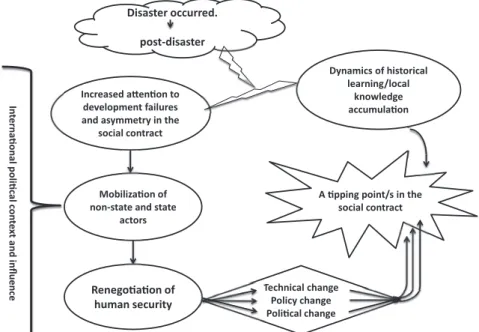
As illustrated in Figure 1, the framework is grounded on a cycle of dynamics of historical learning/local knowledge to meet or encounter disaster risk. As aforementioned, local knowl-edge is a dynamic cultural, social and political consideration in a community in the context of power relations and a holistic view which has the potential to reduce disaster vulnerability, and it is not a specialized knowledge for the mitigation of an earthquake. This includes negative and positive (missed-opportunities, inequalities and failures as well as socially and culturally invaluable capacities), progressive and regressive outcomes resulting from functioning tipping points suppressed for the sake of an accelerated status quo or political change and a contested social contract. These have impacts on the next generation of knowledge and historical learn-ing, which, in turn, can be significant during the occurrence of a disaster. These grounds shape :
• The first moment post-disaster that concentrates on to what extent the uneven social and special distribution of losses and recovery opportunities can result in contesting political and developmental discourses.
• The second moment explains how non-state actors mobilize their social/political sources to campaign to seize the critical discourse.
• The third moment of Figure 1 manifests the institutionalization of campaign discourse into policy and legislation through a renegotiation of human security. The renegotiation of human security ‘takes place through three potentially reinforcing domains—the
tech-nical, policy and political change. Each domain can contribute to a critical juncture in the social contract, progressive or regressive for human security’ (Pelling and Dill, 2010 : 30).
• The resultant potential change likely ranges from the political through policy to new political arrangements (social contracts/human security). These moments feedback into a dynamics of historical learning and local knowledge to meet or improve resilience against the risk of a disaster.
There is another important element, like international (non) governmental organizations, foreign powers and, generally the international and regional context. They can influence the first three moments of development failures, non-state actors and the renegotiation of human security. It is important to note here that, in our empirical case study survey, any of these moments can show an overlap or be revealed at different stages of the post-disaster process. 3. The case study of Bam : the geographical context
The City of Bam is located in Kerman Province in the southeast of Iran, approximately 193 km from Kerman city (capital of the province) and 1,220 km from Tehran. The city has a total
Disaster occurred. post-disaster Dynamics of historical learning/local knowledge accumulation Increased attention to development failures and asymmetry in the
social contract
Mobilization of non-state and state
actors
Renegotiation of human security
A tipping point/s in the social contract Technical change Policy change Political change In te rn ati on al p oli tic al co nte xt and in flu en ce
Figure 1 The human security and disaster analytical framework (Adopted from Pelling and Dill (2010) with slight modification)
area of 19,374 sq. km (Figure 2). The city is composed of five districts (Markazi, Roudab, Rikan, Fahraj and Narmashir), five towns (Baravat, Roudab, Mohammad Abad, Fahraj and Ros-tam Abad) and thirteen villages (Houmeh, Deh Bakri, Kork, Nartij, East Roudab, West Roudab, Chah Dekal, Rikan, Gonbaki, Gavkan, Borj e Akram, Fahraj, Posht Rood and Aziz Abad).
Because of the city’s location on the margin of the Lut-e-Zangi Ahmad desert, it is hot in the summers with temperatures of up to 50°C and cold in the winters with temperatures below the freezing point. The region also includes a range of mountains to the north of Bam extend-ing northwest and the Jebal-e-Barez mountain range to the Southwest of Bam extending in a northwest-southeast direction. Water sources within these mountain ranges are the main suppliers for the qanat (traditional irrigation) system in Bam, Baravat and their satellite vil-lages. The seasonal Posht-Rood River that flows to the north of Bam city is dry during much of the year.
The city of Bam had never a record of earthquakes prior to 2003. The city, though, is sit-uated in a highly active seismic zone along two major faults, Bam and Gowk. The Gowk Fault is located in the northwest-southeast and the Bam Fault in North-South direction towards Jebal Barez. However, four major earthquakes related to Gowk Fault have shaken the region in a period of two decades (the 1980s and the 1990s) : the Golbaf earthquake of 11 June 1981 (6.6 on the Richter scale) with 1,100 deaths and more than 4,000 injured, the Srich earthquake of 28 July 1981 (7.0) with nearly 1,300 deaths, the South Golbaf earthquake of 20 November 1989 (5.6) with 4 deaths and 45 injured, and the North Golbak earthquake of 14 March 1998 (6.6)
Figure 2 The City of Bam and surrounding rural areas, Iran.
Image source : NASA Landsat Program, 2008, Landsat ETM+ scene L71159040_04020050408, Ortho, GLS2005, USGS, Sioux Falls, 8 Apr. 2005.
with 5 deaths and about 50 injured (Hessami et al., 2004 ; Berberian and Yeats, 1999 ; Berbe-rian et al., 2001).
The total population of Bam before the earthquake was 142,375 with around 17,000 fami-lies. Its rural area, such as Baravat, near the city of Bam, had around 17,000 residents with 3,000 families. The total population of Bam and its rural area was 277,835. Of this number, 51% lived in the urban area (Bam) and the rest in rural areas which means many people live in the rural areas of the region (Iran National Census, 2006). More than half of the people in Bam are literate, but many educated people have left the city for better jobs in other main cities, like Tehran, Isfahan, Shiraz and Kerman.
Bam is one of the unique agricultural poles of Iran, and is famous internationally because of its date production. More than 25%, or around 18,241 families, of Bam residents are farmers. They farm lands of about 18,499 acres (Khazai and Hausler, 2005). Iran ranks (or ranked) number one in date production and exported more than 250,000 tons of dates annually, a consid-erable portion of which is (or was) produced in Bam. This is mainly because of the good qual-ity of the soil and the traditional irrigation systems of qanat. These made the cqual-ity of Bam the jewel of the desert. Bam also has tourist sites like Arg-e-Bam (the Bam Citadel), with more than 100,000 national and international visitors annually. The citadel was a remarkable exam-ple of a fortified medieval town that was built using the vernacular technique of mud layers. 4. The earthquake and disaster plans
4.1. The earthquake onset in Bam
The 2003 Bam earthquake, according to official estimates, killed more than 30,000 people, 21,000 injured and 75,000 left homeless, in the city of Bam (Walter, 2004). More than 90% of the building stock, according to the United Nations’ assessment team, was damaged by about 60 to 100%, and, the rest, 10% suffered about 40 to 60% damage (EERI, 2004). The economic damage was estimated at around US$ 1.5 billion dollars (US$ 1.2 billion direct damage and US$ 0.3 billion indirect damage). This meant 1% decrease in Iran’s GDP (US$ 1,355 billion) growth in 2003 (see e.g. IFRCRCS, 2004 ; EERI, 2004 ; UNDP, 2005, 2006). The lifeline infrastruc-ture of the city, including the water supply, power, telephone, healthcare/emergency services, government buildings, main roads and the only airport were paralyzed by the earthquake (Akbari et al., 2004). Specifically, the loss of medical facilities meant that emergency assis-tance was not available. There was also significant damage to the major historical/tourist attraction of Bam, namely the 2,400-year-old citadel (Arg-e-Bam), the world’s largest dried clay structure. Besides, damages to more than 65 active qanat (Manafpour, 2004) had a critical impact on the livelihood of date farmers and their date orchards. But what were the causes of such a severe disaster in Bam, given that almost every week earthquakes of a similar magni-tude occur somewhere in the world with no such devastating effect?
when exploring the intensity of the catastrophe. One takes techno-centric point of view rooted in engineering and seismology. The other concentrates more on developmental and structural explanations (Smith and Petley, 2009). The first group identified the causes of severe devastation mainly in the rupture dynamics in an unknown fault (not the Bam Fault) 5km to the west and near the city. It shocked almost directly under the city (see e.g. Peyret et al., 2007). The earthquake, therefore, right into the urban area, was felt as intensive ground tremors (Bouchon et al., 2006). All of these surveys concluded that the severe strength of the surface tremors localized and coincided with the zone of damage to the city, and this ultimately ensured that most of the buildings would have been collapsed even if they had been reinforced according to standard building codes (see e.g. Ahmadizadeh and Shakib, 2004 ; Smith and Pet-ley, 2009).
The second group, however, emphasizes the poor quality of building in Bam, which relates to the high number of deaths under the collapsed buildings. In so doing, they specifically directed their blame at the adobe structures in Bam and the Citadel (see e.g. Gharaati, 2008). However, Langenbach (2004) observed that though the adobe buildings were damaged in the earthquake, the fatalities were not limited to these structures alone. Ghafory-Ashtiany and Hosseini (2007) found that 54% of the houses were constructed of adobe brick, and the remain-ing 46% were made usremain-ing modern materials like steel and concrete. In fact, buildremain-ings less than 30 years old had the most loss of life (Smith and Petley, 2009). Photo 1 indicates that many recently constructed buildings as well as adobe structures were severely damaged or col-lapsed. Apart from these two reasons for the high level of losses, some others have been identified, for example, the ‘lack of preparedness on the part of the authorities, such as the dam-age to the lifeline infrastructure, like the medical facilities, fire stations and the emergency ser-vices, and a lack of coordination among government organizations and also between them and international agencies and the Iranian army (Smith and Petley, 2009). Official reports, how-ever, have mainly focused on the adobe structures.
Photo 1 Damage to adobe-style buildings that also used new materials (left) and modern buildings (right).
4.2. Existing disaster plans, management and institutional structures in Iran
Iran is prone to severe disasters with high levels of loss. It is a country with major faults. In fact, earthquakes have killed more than 180,000 people during the last 90 years (National Report on Disaster Reduction, 2005). The first step taken by the Iranian government was mainly to institute seismic safety codes, right after the massive losses of life (more than 12,225 people) in Buein Zahra earthquake in 1962. It launched a guideline, the ‘Seismic Safety Code for Building’, which was supervised by the Ministry of Housing and Reclamation in 1967, and it subsequently delivered seismic load calculation as ‘Standard No. 519, Minimum Loads for Buildings’ from the Planning and Budget Organization. From the Islamic Revolution (1979) until now, this has been amended three times : first, in 1988, through the ‘Iranian Code for the Seismic Resistant Design of Buildings, Standard No. 2800’ by the Building and Housing Research Centre (BHRC). This was then amended twice, in 1999 and 2004 (BHRC, 2004).
The new Iranian regime has since 1979 concentrated more on the priorities of stabilizing its position and the Iran-Iraq War than on natural disasters despite the casualties that these inflict every few years. Hence, the responsibility for disasters up to that time was discharged by the Office of the President as a special disaster task force. Following the devastating earth-quake in Manjil-Rudbar in 1990, a law was passed in 1991, under which the responsibilities and functions related to disasters were formally assigned to the Ministry of the Interior. The Min-istry also formed two main institutions under its mandate, the Bureau for Research and Coordi-nation of Safety and Reconstruction Affairs (BRCSR) and the National Disaster Task Force (NDTF). The BRSCR became a broad organization that includes many aspects ranging from research, coordination (domestic or international) and budget forecasting to reconstruction, whereas NDTF is the coordinator of inter-organizational bodies whose activities vary during different phases of a disaster. In a time of emergency, NDTF assumes the major coordinating role for relief operations carried out by technical ministries and relief organizations. During this time, it can be led by the Deputy Minister. It is headquartered at the Ministry of the Inte-rior in Tehran and relies for its activities on the BRCSR, which has the same director as NDTF (National Report on Disaster Reduction, 2005). Moreover, there are other ministries, organi-zations, sub-organizations and institutions that are involved in disaster management in Iran. All these are members of National Committee for the Natural Disaster Reduction (NCNDR) and the NDTF. Their main task is policy making, and to provide and exchange information related to their activities. However, according to Article 44 of the law of the third Economic, Social and Cultural Development Plan of the Country for disaster management, the National Compre-hensive Plan for Rescue and Relief (2000) has been mandated to the Iranian Red Crescent Soci-ety, the Ministry of the Interior and Basij8).
There are also several sub-committees and organizations under the NCNDR. The Earth-quake Risk Reduction Council is one of its sub-committees, which is mostly about strengthen-ing buildstrengthen-ings, infrastructure and facilities. As Figure 3 indicates, the disaster management plan and system is complex and bureaucratic, and there is an overlap of responsibilities with
many similarly functioning institutions and sub-institutions. It also shows a nearly total absence of pro-active measures for meeting disasters.
5. Mobilization of non-state and state actors 5.1. The non-state sector
The first mobilization of non-state actors, such as civil society and national and local NGOs was revealed in the aftermath of the Bam disaster and during the relief and rescue efforts. The high level of human and economic losses and the government’s incompetence in prepared-ness and mismanagement in response to the disaster were accompanied by the increasing dis-satisfaction of the people about the slow and deficient response in the relief and distribution of aid for reconstruction. This was the moment that civil society and NGOs became active in rescue and recovery. The first organized rescue and relief teams finally arrived in Bam twelve hours after news of the earthquake broke. Subsequently, when rescue teams were mobilized, their operations were actually delayed until the next day by the problem of reaching the disaster area due to damage to the main roads after the collapse of some qanat and heavy traffic along the roads of the area for several hours (Amini Hosseini et al., 2009). This likely affected the rescue of trapped people from hypothermia in the below freezing temperature at night in the middle of winter during the first ‘golden hours’ of rescue operation (see e.g. Moszynski, 2004).
The initial response was also hindered by destruction of local lifeline facilities : For
Presidential Office
Revolutionary
Guard (Sepah) Ministry of Interior NCNDR n BRCSR NDTF Red Crescent Bassij(Para military volunteer militia) Representatives of other ministries, organizations (Natural Disaster Headquarters, NDH)
IRHF (Islamic Republic of Housing Foundation Ministry of Housing and Urban Development Master Plan for
Disaster
Management(MPDM)
IR Army and Disciplinary forces
Figure 3 A diagram of the interactive pattern of organizations and ministries involved in disaster management in Iran.
ple, the Red Crescent Society’s headquarters, fire stations including their parking areas for emergency and public transportation vehicles, and medical centers. Of these, three main hos-pitals in Bam, 100% of the urban health centers and 95% of the rural health centers were dam-aged by the earthquake. This was exacerbated when the casualties included the deaths of one fifth of the health professionals in the region, given that the rest were not capable of providing aid because of their injuries and post-traumatic stress disorder. There was also considerable damage to their medical equipment (see e.g. Akbari et al., 2004 ; Amini Hosseini et al., 2009).
Consequently, many of the injured had to be transferred by their family members or neigh-bors by car. Indeed, those who did not receive urgently needed medical attention died. Also, the hospitals in the field or in Kerman became packed with high numbers of arrivals. This became worse with nurses’ lack of prior training and coordination—especially where overseas health teams were involved—in response to serious cases (see e.g. Movahhedi, 2005 ; Nas-rabadi et al., 2007). The depth and dimension of the earthquake also caused an inflow of mas-sive international and national aid and relief offers from various states, international NGOs and national NGOs. However, with all the limelight on the international rescue teams, their effi-ciency was limited. A total number of 34 international teams arrived in Bam from 27 coun-tries, but they could only rescue 22 people (see e.g. IFRCRCS, 2004 ; EERI, 2004). This was mainly because of the reluctance of the Iranian Army to coordinate with the international agen-cies—or even with the Iranian agencies. According to legislation passed in 2003, the Iranian Red Crescent Society was given authority to take the leading role in disaster response. In practice, though, the Iranian army was in charge, and this led to serious tension, especially over the use of aircraft, which further hindered the rescue and recovery effort (see e.g. IFRCRCS, 2004 ; Smith and Petley, 2009).
Beside this, many foreign rescue teams arrived in Bam without even evaluating the infor-mation about the local situation. For example, many of them were equipped with high-tech gear suitable for high-rise buildings while most of the structures in Bam were one-story houses. In consequence, they had little to offer to match their expertise (see e.g. Cater, 2003 ; Pan American Health Organization, 2004 ; Amini Hosseini et al., 2009). Moreover, there were also complaints of mismanagement in the distribution of aid or even the storage of donated aid. Many people in Bam confirmed that they had received tents, clothes and water from officials several days after the shock. However, the affected villages received nothing for long after (based on author’s interview with people in 2007). While, ironically, many goods, thanks to the large amount of aid received, were damaged because they were stored improperly or there was lack of space for storage (Amini Hosseini et al., 2009).
Since the occurrence of the disaster, the people of Bam proved the incorrectness of the assumption that the affected population is too shocked and helpless to take responsibility for their own survival. Nearly 80% (2000) of the victims under the debris were saved by their family members, neighbors, friends and ordinary people (EERI, 2004). This may surprise some experts who know most about the “golden hours” (Cater, 2003), which is about the 24