Japan Advanced Institute of Science and Technology
JAIST Repository
https://dspace.jaist.ac.jp/
Title
Agent-based feedback control for fluctuating
power sources and loads: watch TV with PV power
Author(s)
Javaid, Saher; Kato, Takekazu
Citation
2017 IEEE International Conference on Consumer
Electronics - Taiwan (ICCE-TW): 193-194
Issue Date
2017
Type
Conference Paper
Text version
author
URL
http://hdl.handle.net/10119/15305
Rights
This is the author's version of the work.
Copyright (C) 2017 IEEE. 2017 IEEE International
Conference on Consumer Electronics - Taiwan
(ICCE-TW), 2017, 193-194. Personal use of this
material is permitted. Permission from IEEE must
be obtained for all other uses, in any current or
future media, including reprinting/republishing
this material for advertising or promotional
purposes, creating new collective works, for
resale or redistribution to servers or lists, or
reuse of any copyrighted component of this work
in other works.
Abstract— The presence of renewable energy sources with
large power variations, dynamic power consumption behaviors of appliances, and power usage patterns of storage battery yield in development of sophisticated power control with diverse and versatile components. Our proposed agent-based feedback control method can manage power flow streams with diverse characteristics e.g., the power generated by a photovoltaic is characterized by power fluctuations and available time periods. A power with dynamic fluctuations can directly flow into load without effecting other power flows. Consequently, we are able to use variety of power sources with diverse characteristics.
I. INTRODUCTION
Taking into account the present market trends and future opportunities, a major growth in small scale power generation is observed [1]. This is mainly because residential and commercial areas represent a major part of power consumption and carbon dioxide emissions and partly because small-scale photovoltaics, wind turbines, fuel cells, and storage batteries have been introduced into houses, factories, and in office building. This results in drastic change in structure of residential and commercial areas [2].
Hence, we need to have a sophisticated control method of multiple power sources and storages so that they can cope with dynamically changing power consumption patterns and power supply conditions. This paper particularly focuses on power flow streams between fluctuating power devices, for example, a user can watch TV with PV generated power.
II. REPRESENTATION AND COMPILATION OF APOWER FLOW
PATTERN (PFP)
A power flow is defined as the power flowing from a specific power source (PS) to a specific power load (PL) with some power level in Watt. A PFP consists of multiple power flow streams between multiple PSs and PLs and specifies which PS should supply how many Watt to which PL.
A. Categorization of Power Devices
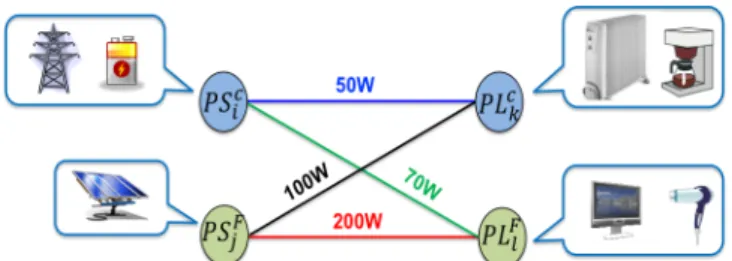
All power devices (PSs/PLs) are classified into two categories based on their types, characteristics, and functionalities (see Fig. 1). These categories of power devices are: controllable and fluctuating. A controllable 𝑃𝑆#/𝑃𝐿# can
control its power (supply/consumption) against the power fluctuation whereas, fluctuating 𝑃𝑆&/𝑃𝐿& cannot control its
power. A power agent (i.e., source agent, SA or load agent, LA) is attached to each PS and PL, which measures and controls supply/consume power of the attached power device. The power agent associated with controllable power devices and
fluctuating power devices are represented as; 𝑆𝐴#/𝐿𝐴# and
𝑆𝐴&/𝐿𝐴&, respectively. It is assumed that the system can design
a consistent and realizable PFP, which satisfies all constraints on power supply and consumption including capacity, minimum/maximum power limitation and maximum power flows from/to each power device with both types.
B. Compilation of a PFP
The compilation of a PFP is defined as a process which uses given PFP and measured power levels of fluctuating power devices (𝑃𝑆&/𝑃𝐿&) and compute power levels for controllable
power devices (𝑃𝑆#/𝑃𝐿#) under the power balance constraint
such that the total power supply from a PS is equal to the total power consumption of PL(s) attached with particular PS.
This paper focuses on power flow streams between fluctuating power devices only. Since both power devices are fluctuating and vary a lot due to the nature or operation modes of power devices, it is not possible to maintain specified nominal power levels (Watt) in PFP. Therefore, there is a need to design a compilation algorithm which can link between physical power levels by power devices and nominal power levels in PFP.
Our idea to control the power flow between fluctuating power devices (𝑃𝑆&/𝑃𝐿&) is to ask cooperation from the
controllable power devices (𝑃𝑆#/𝑃𝐿#). As these power flow
streams cannot be controlled by fluctuating power devices alone, the support from controllable power devices can make it possible to control the power fluctuations. This idea implies a constraint that each fluctuating power device involved in this type of power flow, must be directly attached with at least one controllable power device (see Fig. 2) otherwise it is not possible to control power supply or consumption of the fluctuating power device. Then, attached controllable power devices on both sides of the power flow can control the power fluctuations of the fluctuating device. In case of multiple power flow streams between fluctuating devices, system solves conflict one after the other.
C. Compilation Algorithm
As is well known, the power supply and consumption by fluctuating power devices fluctuates. This means that the
Agent-Based Feedback Control for Fluctuating Power Sources
and Loads: Watch TV with PV Power
Saher Javaid
1, Takekazu Kato
21
Graduate School of Informatics, Kyoto University, Japan
2
Graduate School of Science and Technology, Shizuoka Institute of Science and Technology, Japan
nominal power levels in PFP are just the reference and hard to maintain physically. To bridge between these nominal and physical power values, system converts given PFP into power ratios and then sends computed power ratios to each power agent for the realization of agent-based feedback control.
Fig. 2 shows a power flow between 𝑃𝑆& and 𝑃𝐿&. The PFP
specifies that the total power supply of 𝑃𝑆&, 𝑊(𝑃𝑆&), is 600W
and power ratio is computed as 1:5. According to power ratio, 𝑃𝑆& will supply 𝑊 𝑃𝑆
,& = 100𝑊 for the power flow with
𝑃𝐿& and 𝑊 𝑃𝑆
1& = 500𝑊 for the power flow with 𝑃𝐿#.
On other hand, the total power consumption of 𝑃𝐿&,
𝑊(𝑃𝐿&), is specified as 350W supplied by two PSs (𝑃𝑆# and
𝑃𝑆&) and power ratio is computed as 6:1. That is, 𝑃𝐿& will
consume 𝑊 𝑃𝐿,& = 300𝑊 supplied from 𝑃𝑆# and
𝑊 𝑃𝐿&1 = 50𝑊 supplied from 𝑃𝑆&. The given algorithm is
used to compute power levels for controllable power devices when PFP and measured power levels of attached fluctuating power devices are given.
Algorithm: For power flow between 𝑃𝑆& and 𝑃𝐿&
if 𝑊(𝑃𝑆,&) ≠ 𝑊(𝑃𝐿&1) then
𝑊567 = 𝑀𝑖𝑛 𝑊 𝑃𝑆,& , 𝑊(𝑃𝐿 1 &) 𝑊;6<<=> = 𝑊 𝑃𝑆,& − 𝑊567 𝑊;6<<=@ = 𝑊 𝑃𝐿&1 − 𝑊567 if 𝑊;6<<=> > 𝑊;6<<=@ then 𝑊 𝑃𝐿# = 𝑊 ;6<<=> + 𝑊(𝑃𝐿#) else 𝑊 𝑃𝑆# = 𝑊 ;6<<=@ + 𝑊(𝑃𝑆#) end if end if
The power flow between fluctuating power devices has two power ratios (one is computed from PS side and other is computed from PL side) which introduces a conflict of power levels for the given power flow. In order to solve the conflict of power levels, the difference of power supply (𝑊;6<<=> ) and consumption (𝑊;6<<=@ ) would be computed by taking the minimum power level (𝑊567) on both sides of the power flow.
The controllable power device attached with fluctuating power device with higher difference will compensate (supply/absorb) for the power imbalance on the power flow.
Note that, the assignment of power levels according to power ratios would be assigned to fluctuating power devices first than the controllable power devices. This is the conflict resolution for the static system, for practical situations an agent-based
feedback control protocol is introduce in next section. III. AGENT-BASED FEEDBACK CONTROL (ABFC)METHOD
For practical situations, we introduced a system protocol, which can realize static algorithm for power fluctuations and make the power system work continuously without being effected by communication and computation delays.
At first, the time axis is partitioned into a series of time-slots (TSs) with a fixed length. The system designs a PFP and compute power ratios which then broadcasts to all power agents. During 𝑇𝑆,, all power agents just measure power supply
and consumption by their corresponding power devices. In 𝑇𝑆1, power agents attached with fluctuating power devices
exchange measured power levels (of previous TS) with each other. Based on received power information, each fluctuating power agent computes difference between received power level and its own measured power level, which is then sent to attached controllable power devices along with measured data. This exchange of power levels is done by message transmission.The message transmission from 𝑆𝐴&is shown by
source measured power (SMP) while from 𝑃𝐿& is shown as
load measured power (LMP) in Fig. 3. The algorithm for each controllable power agent is addressed to compute power levels for controllable devices with ABFC method based on the received measured power information during 𝑇𝑆DE,.
The 𝑇𝑆D, 𝑡 ≥ 3 realizes the feedback control with computed
power levels for controllable power devices. We conducted couple of experiments with multiple PSs and PLs with both types which will be presented at conference presentation.
Acknowledgement: This work was supported by JSPS
Grants-in-Aid (KAKENHI) Grant Number JP16K12394. REFERENCES
[1] S. Javaid, Y. Kurose, T. Kato, and T. Matsuyama, “The power flow coloring: Giving a unique ID to a power flow from a specific power source to a specific power load,” IEICE Singapore-Japan Joint Workshop on
Ambient Intelligence and Sensor Networks (ASN), Session 2 (5), 2015.
[2] S. Javaid, Y. Kurose, T. Kato, and T. Matsuyama, “Cooperative distributed control implementation of the power flow coloring over a Nano-grid with fluctuating power loads”, IEEE Transactions on Smart
Grid, vol. 8, issue 1, pp. 342-352, 2017.
Fig. 3. Agent-Based Feedback Control Protocol. Fig. 2. Compilation of a PFP between fluctuating PS and fluctuating PL.