Japan Advanced Institute of Science and Technology Title Transfer of a low-molecular-weight compound
between two immiscible polymers
Author(s) Hachisuka, Ryosuke; Inomata, Toshiki; Yamaguchi, Masayuki
Citation Journal of Applied Polymer Science, 136(16): 47386
Issue Date 2018-12-24
Type Journal Article
Text version author
URL http://hdl.handle.net/10119/16762
Rights
Copyright (C) 2018 Wiley Periodicals. Ryosuke Hachisuka, Toshiki Inomata, Masayuki Yamaguchi, Journal of Applied Polymer Science, 136(16), 2018, 47386, which has been published in final form at [http://dx.doi.org/10.1002/app.47386]. This article may be used for non-commercial purposes in accordance with the Wiley Self-Archiving Policy
[http://www.wileyauthors.com/self-archiving]. Description
3
4
Transfer of a low-molecular-weight compound
5
between two immiscible polymers
6 7 8 9 10 11
Ryosuke Hachisuka, Toshiki Inomata,
12
Masayuki Yamaguchi
* 13 14 15 16 17 18 19School of Materials Science,
20Japan Advanced Institute of Science and Technology,
211-1 Asahidai, Nomi, Ishikawa 923-1292, JAPAN
22 23 24 25 26 27 28* To whom correspondence should be addressed
29
Phone +81-761-51-1621; Fax +81-761-51-1149
30
E-mail: [email protected]
Abstract 1
We investigated plasticizer transfer between poly(ethylene-co-vinyl acetate) (EVA)
2
and poly(lactic acid) (PLA) and its temperature dependence using laminated films
3
comprising EVA and PLA, each containing equal amounts of a plasticizer (i.e., diethyl
4
phthalate (DEP) or dibutyl phthalate (DBP)). Because the miscibility between PLA and
5
DEP is better than that between EVA and DEP, a large amount of DEP was detected in the
6
PLA film after annealing the laminated films at 80°C; i.e., some DEP moved from the
7
EVA film to the PLA film. Furthermore, more DEP migrated to the PLA film at 130°C,
8
suggesting that the difference in the interaction parameter with DEP between PLA and
9
EVA is more pronounced at higher temperatures. In laminated films containing DBP, the
10
DBP content in each film was almost equal after annealing at 80°C, although DBP
11
migrated from the PLA film to the EVA film at 130°C.
12
Introduction 1
Polymer blending has developed as the polymer industry has progressed because it is one
2
of the easiest ways of improving several polymer properties. Therefore, a great deal of
3
effort has been put into optimizing various polymer blends.1-5 Recently, advanced 4
techniques have been proposed using interesting phenomena such as: (1) miscibility
5
change or segregation behavior (concentration gradient) under a temperature gradient6,7 6
or velocity gradient, i.e., a flow field;8,9 (2) orientation correlation between matrix 7
polymer chains and low-molecular-weight compounds dissolved in a polymer;10-12 and 8
(3) selective localization of a third component in an immiscible blend.13-18 In the present 9
study, we focused on the selective localization of a third component and its temperature
10
dependence using a plasticizer as the low-molecular-weight compound in an immiscible
11
polymer pair comprising poly(lactic acid) (PLA) and poly(ethylene-co-vinyl acetate)
12
(EVA).
13
Localization and/or migration of a third component between phases has been reported
14
mostly in immiscible rubber blends,13-15, and is usually considered to be an unfavorable 15
phenomenon in the rubber industry. For example, the uneven distribution of a curative14,15 16
and/or accelerator13 directly results in a marked cure imbalance between the phases. Such 17
uneven distribution occurs in not only low-molecular-weight compounds but also
18
fillers.16-18 Recently, Kuhakongkiat et al. proposed a new technique for controlling the 19
temperature-dependent distribution of plasticizers in immiscible blends comprising
20
ethylene-co-propylene rubber (EPR) and elastomeric polyisobutylene (PIB).19 They 21
found that bis(2-ethylhexyl) adipate (DOA), which acts as a plasticizer for both rubbers,
localized in the EPR at low temperatures and in the PIB at high temperatures. In other
1
words, the DOA concentration in each rubber phase is dependent on the ambient
2
temperature. Therefore, blends in which EPR is the matrix phase have a low modulus in
3
winter and high modulus in summer. Doan et al. found a similar phenomenon in an
4
immiscible rubber blend containing a tackifier.20 Such interphase transfer is also expected 5
in damping materials that exhibit large values of loss tangent (tan δ) over a wide
6
temperature range, because the plasticizer distribution in phase-separated blends affects
7
the glass transition temperature (Tg) and the dynamic mechanical properties of each phase. 8
We used PLA and EVA in the present study, because the Tg of PLA is slightly higher than 9
room temperature and that of EVA is lower than room temperature. This situation has a
10
capability for the blend to show good damping properties over a wide temperature range
11
near room temperature. Up to now, various studies on PLA/EVA blends have been carried
12
out, especially to improve the mechanical toughness of PLA by the EVA addition.21-26 13
Although PLA sometimes shows partial miscibility with EVA,27 at which the vinyl acetate 14
content in EVA is high, it is basically known as immiscible blends. Therefore, the
15
compatibilization is the key factor for the studies, such as addition of compatibilizer,24 16
transesterification,25 and peroxide modification.26 However, the application to damping 17
materials has not been studied to the best of our knowledge.
18
In this study, we applied annealing procedure only beyond the melting point of EVA
19
to avoid the effect of crystallinity and slow diffusion in PLA at low temperature. However,
20
the current experimental results about the effect of annealing temperature on the transfer
21
phenomenon would demonstrate the importance of the concept for the material design.
Moreover, we employed two types of phthalic esters to examine the effect of the
1
plasticizer species on the transfer phenomenon. Since the plasticizers that we used are
2
conventional materials with similar structure but having different solubility parameter,
3
the comparison between the plasticizers will provide the fundamental information on the
4 material design. 5 6 Experimental 7 Materials 8
The polymers used in the present study were commercially available PLA (Lacea
9
H280, Mitsui Chemicals, Inc., Japan) and EVA (Evaflex EV360, Dupont-Mitsui
10
Polychemicals Co., Ltd., Japan). The PLA comprised 12% D-lactic acid units, and was
11
therefore not crystalline. The number- and weight-average molecular weights of the
12
PLA—evaluated by size-exclusion chromatography as a polystyrene standard—were Mn 13
= 1.5 × 10⁵ and M
w = 2.7 × 10⁵, respectively. The EVA comprised 25 wt.% vinyl acetate. 14
Its density at room temperature was 950 kg/m3, its melt flow rate at 190°C was 2 g/10 15
min, and its melting point was 77°C. The EVA had an Mn = 6.3 × 10⁴ and an Mw = 2.5 × 16
105, as determined using a polystyrene standard. The thermal and rheological properties 17
of PLA28,29 and EVA30,31 have been described in detail previously. 18
We used two plasticizers—diethyl phthalate (DEP) and dibutyl phthalate (DBP), both
19
purchased from Daihachi Chemical Industry Co., Ltd., Japan—without further
20
purification. The Hansen solubility parameters of DEP and DBP were reported to be 20.5
21
and 19.0 (MJ/m3)0.5, respectively.32 The glass transition temperatures are -90.0 for DEP 22
and -95.5°C for DBP.33 1
2
Sample preparation 3
We prepared plasticized EVA and PLA samples using a 30 cc Labo Plastomill
4
10M100 internal mixer (Toyo Seiki Seisaku-sho, Ltd., Japan) for 3 min at a blade rotation
5
speed of 30 rpm. The mixing temperatures were 180°C for the PLA blends and 130°C for
6
the EVA blends. We vacuum-dried pellets of the PLA blend at 80°C for 4 h prior to
melt-7
mixing to avoid hydrolysis. The plasticizer constituted 5, 10, 15, or 20 parts per hundred
8
of resin (phr). We compressed the obtained mixtures into flat films (0.3-mm-thick) using
9
a compression-molding machine at 130°C under 30 MPa.
10
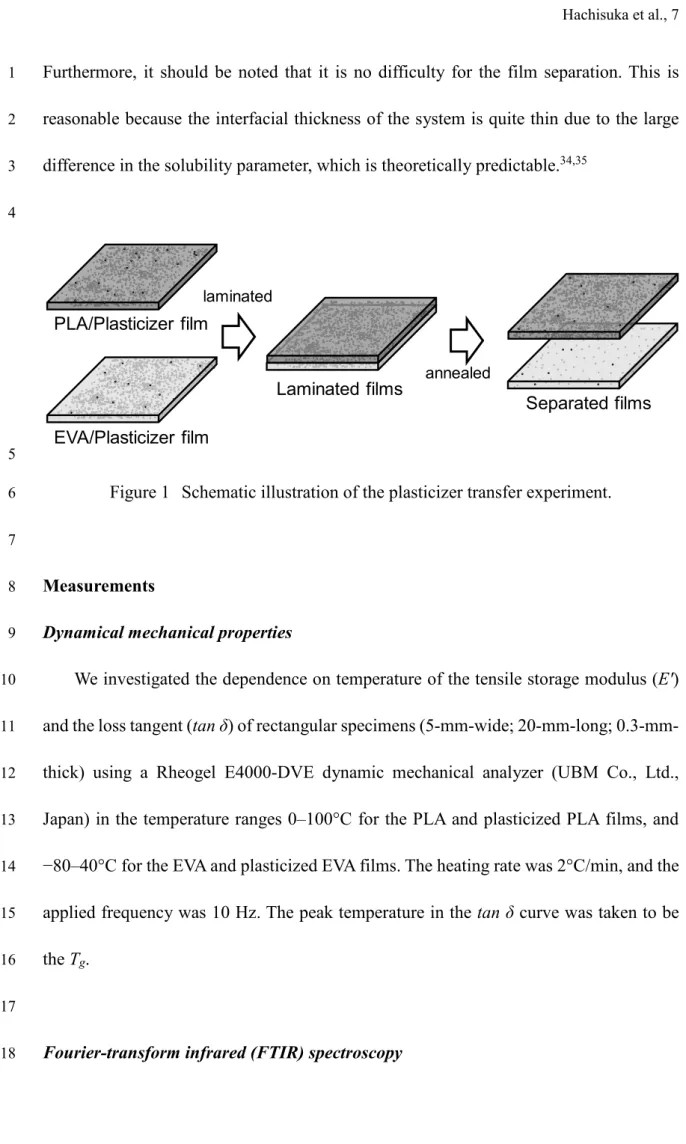
The plasticizer transfer experiments were performed using PLA and EVA, both
11
containing 10 phr of a plasticizer (DEB or DBP). As illustrated in Figure 1, the plasticized
12
PLA and EVA films were laminated together. We applied slight manual pressure only to
13
ensure perfect lamination. After the perfect contact of the films, the pressure was removed.
14
The laminated films were then annealed at 80 or 130°C for various periods such as 1, 4,
15
and 9 hours without any pressure, after which both polymers were in the non-crystalline
16
rubbery state. The film thickness hardly changed (no flow) even after 9 hours at 130°C
17
because of the high viscosity at this temperature. To confirm the reversibility of plasticizer
18
transfer, we annealed one set of laminated films at 130°C for 4 h, then further annealed
19
them at 80°C for 4 h. After annealing, we separated the films and stored them at room
20
temperature for 3 days to homogenize the plasticizer distribution in the films prior to
21
characterization. We confirmed that both surfaces provide the same IR spectra.
Furthermore, it should be noted that it is no difficulty for the film separation. This is
1
reasonable because the interfacial thickness of the system is quite thin due to the large
2
difference in the solubility parameter, which is theoretically predictable.34,35 3
4
5
Figure 1 Schematic illustration of the plasticizer transfer experiment.
6
7
Measurements 8
Dynamical mechanical properties 9
We investigated the dependence on temperature of the tensile storage modulus (E′)
10
and the loss tangent (tan δ) of rectangular specimens (5-mm-wide; 20-mm-long;
0.3-mm-11
thick) using a Rheogel E4000-DVE dynamic mechanical analyzer (UBM Co., Ltd.,
12
Japan) in the temperature ranges 0–100°C for the PLA and plasticized PLA films, and
13
−80–40°C for the EVA and plasticized EVA films. The heating rate was 2°C/min, and the
14
applied frequency was 10 Hz. The peak temperature in the tan δ curve was taken to be
15
the Tg. 16
17
Fourier-transform infrared (FTIR) spectroscopy 18 Laminated films Separated films annealed laminated PLA/Plasticizer film EVA/Plasticizer film
The attenuated total reflection (ATR) infrared spectra were collected using a
1
Spectrum 100 FT-IR instrument (PerkinElmer Inc., MA, USA) with KRS-5 as an ATR
2
plate. The intensity of a characteristic absorbance peak at 1123 cm-1 was used to determine 3
the plasticizer content of the EVA films; a calibration curve was constructed from EVA
4
films containing various amounts of the plasticizer for this purpose.
5
6
Results and Discussion 7
Characteristics of polymers containing plasticizer 8
Prior to evaluation of the transfer phenomenon, we examined the effect of the
9
plasticizer on the dynamic mechanical properties of a film made from each polymer.
10
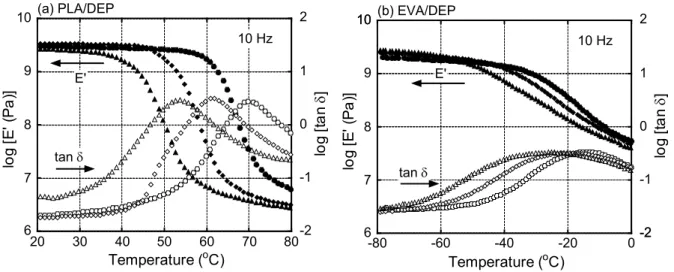
Figure 2 shows the temperature dependence of the tensile storage modulus (E′) and loss
11
tangent (tan δ) at 10 Hz of the pure polymers and the polymers with 5 or 10 phr of DEP.
12
The peak temperature of tan δ in the glass-to-rubber transition region—i.e., Tg—decreased 13
following the addition of DEP, for both PLA and EVA. The plasticization phenomenon
14
by DEP was already reported elsewhere.36,37 The peak width was hardly affected by the 15
addition of DEP for both systems, suggesting a narrow relaxation time distribution, i.e.,
16
good miscibility. In the case of the EVA blends, however, the peak was broad even for
17
pure EVA. This broad relaxation mode is ascribed to various amorphous chains having
18
different mobilities, such as floating chain, cilia chain, loop chain, and tie chain, as
19
reported previously,38-41 although the crystallinity of the EVA is not so high (ca. 15 %, 20
calculated from the heat of fusion evaluated by the DSC measurement30). Moreover, we 21
found that E′ in the glassy region was enhanced by the addition of DEP; i.e., DEP acted
as an antiplasticizer in the glassy region (the numeric data are shown in Table 1), although
1
it showed plasticizing effect around at Tg. This may be important because antiplasticized 2
systems have reduced thermal expansion.42 The E′ in the glassy region in the PLA system 3
decreased by the addition of 10 phr of DEP, which is a typical behavior for a plasticized
4
polymer.43,44 However, the small addition, 5 phr, of DEP seems to enhance the modulus 5
slightly.
6
7
8
Figure 2 Temperature dependence of tensile storage modulus (E′) and loss tangent (tan
9
δ) at 10 Hz of (a) polylactic acid (PLA) and (b) poly(ethylene-co-vinyl acetate) (EVA)
10
films containing various amounts of diethyl phthalate (DEP); (circles) 0 phr, (diamonds)
11
5 phr, and (triangles) 10 phr.
12 13
Figure 3 shows the dynamic mechanical properties for the blends with DBP. The
14
results were almost the same as those with DEP for each composition, although the PLA
15
film containing 10 phr of DBP had a slightly broader relaxation peak. The width of tan δ
16
peak, as the full-width at half-maximum (FWHM), was plotted as a function of the weight
17
fraction of a plasticizer in Figure 4. The results suggest that the concentration fluctuation
18
of DBP in PLA is more pronounced than that of DEP,38-40 indicating that DBP has poor 19 20 30 40 50 60 70 80 lo g [E ' (P a)] Temperature (oC) log [t an δ ] (a) PLA/DEP 10 -2 9 8 7 6 -1 0 1 2 10 Hz E' tan δ -80 -60 -40 -20 0 10 (b) EVA/DEP -2 10 -2 9 8 7 6 -1 0 1 2 10 Hz E' tan δ lo g [E ' (P a)] Temperature (oC) log [t an δ ]
miscibility with PLA compared with DEP. We also detected the antiplasticizer
1
phenomenon in the EVA/DBP systems in Figure 3 (see Table 1).
2 3
4
Figure 3 Temperature dependence of tensile storage modulus (E′) and loss tangent (tan 5
δ) at 10 Hz for (a) polylactic acid (PLA) and (b) poly(ethylene-co-vinyl acetate) (EVA)
6
films containing various amounts of dibutyl phthalate (DBP); (circles) 0 phr, (diamonds)
7
5 phr, and (triangles) 10 phr.
8 9
10
Figure 4 Full-width at half-maximum (FWHM) of tan δ peak as a function of the
11 plasticizer content. 12 13 14 0 10 20 30 40 50 0 2 4 6 8 10 12 PLA/DEP PLA/DBP EVA/DEP EVA/DBP FW H M ( o C ) Plasticizer Content (wt.%) -80 -60 -40 -20 0 10 (b) EVA/DBP -2 9 8 7 6 -1 0 1 2 10 Hz E' tan δ lo g [E ' (P a)] Temperature (oC) log [t an δ ] 20 30 40 50 60 70 80 (a) PLA/DBP 10 -2 9 8 7 6 -1 0 1 2 10 Hz E' tan δ lo g [E ' (P a)] Temperature (oC) log [t an δ ]
Table 1 E’ in the glassy region, Tg, and FWHM for the samples 1 E’ (GPa) Tg (°C) FWHM (°C) PLA 2.99 69.8 9.6 PLA/DEP (5 phr) 3.34 62.9 9.1 PLA/DEP (10 phr) 2.63 52.9 10.7 PLA/DBP (5 phr) 2.90 61.9 10.6 PLA/DBP (10 phr) 1.93 52.7 13.7 EVA 2.05 -15.2 28.6 EVA/DEP (5 phr) 2.48 -20.3 33.0 EVA/DEP (10 phr) 2.78 -26.3 43.1 EVA/DBP (5 phr) 2.59 -21.3 38.3 EVA/DBP (10 phr) 2.97 -26.2 44.8
E’: Values in the glassy region (at 23 °C for PLA and -80°C for EVA)
2
Tg: Peak temperature of tan δ 3
4
As shown in Table 1, the Tg values of both polymers decreased following addition of 5
the plasticizer as reported previously.31,36,37,45 Because the Tg of PLA is higher than that 6
of EVA, the Tg shift was more pronounced for the PLA systems (Tg’s of the plasticizers 7
are significantly low as mentioned in the experimental part), which is predicted by
8
blending rules such as the Fox equation and the Gordon–Taylor equation.39,46 The 9
difference in the plasticizing effect between DEP and DBP was not obvious. This is
10
reasonable because the difference in Tg between DEP and DBP is not significant as 11
compared with the Tg difference between the plastics and plasticizers. 12
13
The ATR spectra of EVA films with various amounts of a plasticizer are shown in
14
Figure 5. Because the sample films were in the rubbery state at room temperature, they
15
showed perfect contact with the ATR crystal. The absorption at 1123 cm-1, indicated by 16
the arrows in the figure, can be ascribed to the stretching vibration of O=C–O,47 which is 17
weak for pure EVA because of the low concentration of carbonyl groups. The inset figure
reveals that the absorbance was proportional to the plasticizer content with negligible
1
experimental error, indicating that the peak can be used to determine the content of the
2
plasticizer in the EVA film separated after annealing.
3
4
5
6
Figure 5 Attenuated total reflection–Fourier-transform infrared (ATR-FT-IR) spectra of
7
poly(ethylene-co-vinyl acetate) (EVA) films with various amounts of (top) diethyl
8
phthalate (DEP) and (bottom) dibutyl phthalate (DBP). The small figure represents the
9
absorbance at 1123 cm-1 as a function of a plasticizer. 10
11
Interphase transfer of plasticizer 12 900 1000 1100 1200 1300 1400 1500 Abs or ban ce Wavenumber (cm-1) 0 0.01 0.02 0.03 0.04 0.05 0.06 0 5 10 15 20 Abs or banc e at 1 123 c m -1 Plasticizer Content (wt.%) 900 1000 1100 1200 1300 1400 1500 Abs or ban ce Wavenumber (cm-1) 0 0.02 0.04 0.06 0.08 0 5 10 15 20 Abs or ba nc e at 11 23 c m -1 Plasticizer Content (wt.%)
After annealing the laminated films for various periods, the films were separated to
1
characterize the plasticizer content by the dynamic mechanical analysis (DMA). When
2
annealing for 1 hour at 80°C of laminated films, each containing 10 phr of DBP at first,
3
Tg of the separated PLA film was slightly (< 1°C) higher than that of the separated one 4
after annealing for 4 hours. Furthermore, the Tg of the separated PLA film annealed for 9 5
hours was the same with that after annealing for 4 hours. These results demonstrate that
6
the plasticizer distribution is in the equilibrium condition after at least 4 hours. This is
7
attributed to the thin (300 µm) films with low Tg even for the PLA film because of the 8
plasticizing effect. Therefore, we annealed various laminated films for 4 hours at either
9
80°C or 130°C.
10
Figure 6 shows the temperature dependence of tan δ of the separated films containing
11
DEP. It is apparent that the Tg of the PLA film decreased, whereas that of the EVA film 12
increased. These results demonstrate that the DEP migrated from the EVA to the PLA film
13
during annealing; i.e., DEP prefers PLA to EVA. This phenomenon can be attributed to
14
the difference in miscibility. The solubility parameter of EVA is calculated by the
15
summation of the contributions from ethylene and vinyl acetate units. It was found to be
16
around 18.8 (MJ/m3)0.5, whereas PLA shows a relatively high value,48 21.9 (MJ/m3)0.5. As 17
a result, DEP prefers PLA, whereas DBP tends to stay in EVA. Furthermore, it should be
18
noted that the extent of DEP transfer—i.e., the Tg shift—was enhanced during the high-19
temperature annealing, suggesting that the difference in the interaction parameter between
20
PLA-DEP and EVA-DEP was more pronounced at the high temperature.
21
The DEP content of each separated film was estimated from the Tg shift measured by 22
DMA (the calibration curve is shown in Supporting information 1) and FT-IR spectra,
1
which was summarized in Table 2. The results obtained by FT-IR spectroscopy
2
corresponded well with those estimated by DMA.
3
4
5
Figure 6 Temperature dependence of loss tangent (tan δ) at 10 Hz of (top) polylactic acid
6
(PLA) and (bottom) poly(ethylene-co-vinyl acetate) (EVA) films; (closed circles) before
7
lamination (10 phr of DEP), (open circles) separated film after annealing at 80°C, and
8
(open diamonds) separated film after annealing at 130°C. In the figure, the data for the
9
separated film after multi-annealing histories—i.e., annealing at 80°C followed by
10
annealing at 130°C—are shown as a solid line with a vertical shift.
11 12
To confirm the effect of the annealing temperature, the laminated films annealed at
13 -1 0 1 30 40 50 60 70 lo g [ tan δ] +A Temperature (oC) A=-0.3 A=0 -40 -30 -20 -10 lo g [ tan δ] +A Temperature (oC) A=0.3 A=0 -1 0
130°C for 4 hours were annealed for a further 4 hours at 80°C. As indicated by the solid
1
line in Figure 6, the Tg of the separated films—which indicates the amount of DEP in the 2
films—was determined by the final annealing temperature. The data are also listed in
3
Table 2. The results confirm that the annealing period was enough to achieve equilibrium.
4
5
Table 2 Diethyl phthalate (DEP) content in the films
6 DEP content in PLA estimated by DMA DEP content in EVA evaluated by DMA DEP content in EVA evaluated by FT-IR* Without lamination (initial content) 10 phr 10 phr 10 phr After annealing at 80oC 10.7 phr 8.0 phr 7.8 phr After annealing at 130oC 12.4 phr 6.2 phr 6.6 phr
After re-annealing at 80oC using
the sample annealed at 130oC
10.6 phr 8.1 phr ―
* FT-IR spectra are shown in Supporting Information 2
7
8
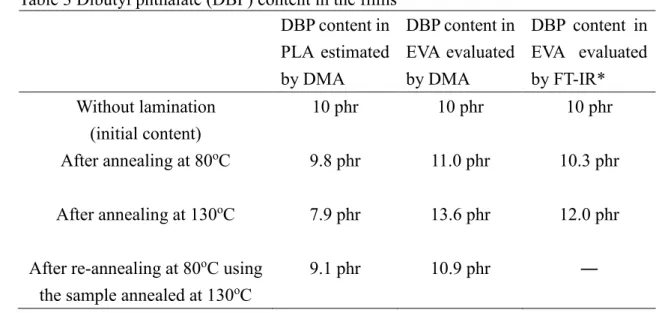
The same experiments were performed using DBP as the plasticizer, and the results
9
are summarized in Table 3. The films annealed at 80°C contained almost the same amount
10
of DBP—i.e., 10 phr—suggesting that the interaction parameter between PLA and DBP
11
was similar to that between EVA and DBP at this temperature. However, we detected DBP
12
transfer from the PLA film to the EVA film during annealing at 130°C, which was the
13
opposite direction to that observed in the DEP system. This indicates that DBP prefers
14
EVA to PLA at this temperature. These results demonstrate that the extent and direction
15
of plasticizer transfer across the boundary between the immiscible PLA and EVA films
are markedly affected by the plasticizer and the ambient temperature.
1 2
Table 3 Dibutyl phthalate (DBP) content in the films
3 DBP content in PLA estimated by DMA DBP content in EVA evaluated by DMA DBP content in EVA evaluated by FT-IR* Without lamination (initial content) 10 phr 10 phr 10 phr After annealing at 80oC 9.8 phr 11.0 phr 10.3 phr After annealing at 130oC 7.9 phr 13.6 phr 12.0 phr
After re-annealing at 80oC using
the sample annealed at 130oC
9.1 phr 10.9 phr ― * FT-IR spectra are shown in Supporting Information 2
4
5
Conclusions 6
We investigated the interphase transfer of a plasticizer between PLA and EVA using
7
laminated films at 80 and 130 oC. The extent and direction of plasticizer transfer, which 8
were estimated from the FT-IR spectra and the Tg shift measured by DMA, were 9
dependent on the annealing temperature and the plasticizer. Furthermore, the plasticizer
10
transfer phenomenon was reversible; i.e., the plasticizer content in each polymer film was
11
determined by the final annealing temperature. These phenomena can be attributed to the
12
temperature dependence of the difference in the interaction parameter with the plasticizer
13
between PLA and EVA. Because the transfer of low-molecular-weight compounds such
14
as plasticizers is also expected in blends, this information will be useful for the future
15
development of functional immiscible blends.
16
Acknowledgements 1
A part of this work was supported by JSPS Grant-in-Aid for Scientific Research (B) Grant
2 Number 16H04201. 3 4 References 5
1. Polymer Blends, Eds., Paul, D. R.; Bucknall, C. B. Wiley, New York, 2000. 6
2. Polyolefin Blends, Eds., Nwabunma, D.; Kyu, T. Wiley, New York, 2008. 7
3. Robeson, L. M. Polymer Blends; A Comprehensive Review, Hanser, Munich, 2007. 8
4. Encyclopedia of Polymer Blends, Ed., Isayev, A. I. Wiley-VCH, Weinheim, 2011. 9
5. Polymer Blends Handbook, 2nd ed., Eds., Utracki, L. A.; Wilkie, C. A. Springer, 10
Dordrecht, 2014. 11
6. Siriprumpoonthum, M.; Mieda, N.; Nobukawa, S.; Yamaguchi, M. J. Polym. Research
12
2011, 18, 2449. 13
7. Sako, T.; Nobukawa, S.; Yamaguchi, M. Polym. J. 2015, 47, 576. 14
8. Ougizawa, T.; Inoue, T. Morphology of polymer blends, in Polymer Blends Handbook,
15
2nd ed., Chap. 8, Eds., Utracki, L. A.; Wilkie, C. A. Springer, Dordrecht, 2014. 16
9. Sako, T.; Ito, A.; Yamaguchi, M. J. Polym. Research 2017, 24, 89. 17
10. Urayama, O.; Ohta, E.; Hori,H.; Adachi,K. J. Polym. Sci., Part B, Polym. Phys. 2006, 18
44, 967.
19
11. Yamaguchi, M.; Mohd Edeerozey, A. M.; Songsurang, K.; Nobukawa, S. Cellulose
20
2012, 19, 601. 21
12. Kiyama, A.; Nobukawa, S.; Yamaguchi, M. Opt. Mater. 2017, 72, 491. 22
13. Lewis,J. E.; Deviney Jr.,M. L.; Whittington,L. E. Rubber Chem. Technol. 1969, 42, 1
892.
2
14. Gardiner,J. R. Rubber Chem. Technol. 1970, 43, 370. 3
15. Bauer,R. F.; Crossland,A. H. Rubber Chem. Technol. 1988, 61, 585. 4
16. Sumita, M.; Sakata, K.; Asai, S.; Miyasaka, K.; Nakagawa,H. Polym. Bull. 1991, 25, 5
265.
6
17. Gubbels,F.; Jerome,R.; Teyssie, P. Macromolecules 1994, 27, 1972. 7
18. Fan,B.; Wiwattananukul,R.; Yamaguchi, M. Eur. Polym. J. 2017, 96, 295. 8
19. Kuhakongkiat, N.; Wachteng, V.; Nobukawa,S.; Yamaguchi,M. Polymer 2015, 78, 9
208.
10
20. Doan,V. A.; Nobukawa,S.; Otsubo, S.; Tada,T.; Yamaguchi, M. J. Mater. Sci.2013, 11
48, 2046.
12
21. Kelkar, S.; Kadam, P., Mhaske, S.; Mahanwar, P. Adv. Mater. Sci. Eng: Intern. J., 2014, 13
1, 27.
14
22. Ma, P.; Xu, P.; Zhai, Y.; Dong, W.; Zhang, Y.; Chen, M. ACS Sustainable Chem.
15
Eng., 2015, 3, 2211.
16
23. Xu, P.; Ma, P.; Hoch, M.; Arnoldi, E.; Cai, X.; Dong, W.; Chen, M., Polym. Deg. Stab.,
17
2016, 129, 328. 18
24. Moura, I.; Botelho, G.; Machado, A. V. J.Polym. Environ., 2014, 22, 148. 19
25. Pereira, E. C. L.; da Silva, J. M. F.; Jesus, R. B.; Soares, B. G.; Livi, S. Eur. Polym.
20
J., 2017, 97, 104. 21
26. Zhang, N.; Lu, X. Polym. Test., 2016, 56, 354. 22
27. Singla, R. K.; Zafar, M. T.; Maiti, S. N.; Ghosh, A. K. Polym. Test., 2017, 63, 398. 23
28. Yokohara, T.; Yamaguchi, M. Eur. Polym. J. 2008, 44, 677. 1
29. Huang, T.; Miura, M.; Nobukawa, S.; Yamaguchi, M. Biomacromolecules 2015, 16, 2
1660.
3
30. Takahashi, S.; Okada, H. Nobukawa, S.; Yamaguchi, M. Eur. Polym. J., 2012, 48, 974. 4
31. Kuhakongkiat, N.; Sugiyama, M.; Guesnier, M.; Azaman, F. A.; Yoshida, K.;
5
Yamaguchi,M. J. Appl. Polym. Sci. 2017, 135, 45927. 6
32. Hansen, C. M. Hansen Solubility Parameters, 2nd edition, CRC Press, Boca Raton, 7
2007. 8
33. Yu, V.; Tereshatov, V. V. Influence of Plasticizers on the Glass Transition Temperatrue
9
of Polymers. In Handbook of Plasticizer. 2nd edition, Ed. Wypych, G. ChemTec, 10
Toronto, 2012. 11
34. Helfand, E.; Tagami, Y. J. Chem. Phys., 1971, 56, 3592. 12
35. Yamaguchi, M. J. Appl. Polym. Sci., 1998, 70, 457. 13
36. Bronstrom, J.; Boss, A.; Chronakis, S. Biomacromolecules, 2004, 5, 1124. 14
37. Cho, C. W.; Choi, J. S.; Shin, S. C. Inter. J. Pharmaceutics, 2005, 299, 127 15
38. Ferry, J. D. Viscoelastic Properties of Polymers, 3rd ed., Wiley, New York, 1980. 16
39. Nielsen, L. E., Landel, R. F. Mechanical Properties of Polymers and Composites, 2nd 17
ed., CRC Press, Boca Raton, 1994. 18
40. Ward, I. M., Sweeney, J. Mechanical Properties of Solid Polymers, 3rd ed., Wiley, 19
Chichester, 2013. 20
41. Shimada, H.; Ayumi, K.; Phulkerd, P.; Yamaguhci, M. Nihon Reoroji Gakkaishi, 2017, 21
45, 19.
22
42. Miyagawa, A.; Nobukawa,S.; Yamaguchi,M. Nihon Reoroji Gakkaishi, 2014, 42, 23
255.
1
43. Jang, K.; Johnson, J. C.; Hegmann, T. H. E.; Korley L. T. J. Liquid Crystals, 2014, 2
41, 1473.
3
44. Jang, K.; Korley L. T. J. Polym. Eng. Sci., 2016, 56, 388. 4
45. Onwulata, C. I.; Thomas, A. E.; Cooke, P. H. J. Biobased Mater. Bioenergy, 2009, 3, 5
172.
6
46. Jamieson, A. M.; Olson, B. G.; Nazarenko, S. Positron Annihilation Lifetime Studiees
7
of Free Volume in Heterogeneous Polymer Systems, in Polymer Physics, Eds. Utracki,
8
L. A.; Jamieson, A. M. Wiley, Hoboken, 2010. 9
47. Siesler, H. W. Infrared and Raman Spectroscopy of Polymers, Marcel Dekker, New
10
York, 1980. 11
48. Siemann, U. Eur. Polym. J., 1992, 28, 293. 12