
JAIST Repository: Content Generation and Serious Game Implementation for Security Awareness Training
80
0
0
全文
(2) Master’s Thesis. Content Generation and Serious Game Implementation for Security Awareness Training. 1910129. ZENG Youmeizi. Supervisor Research Associate Professor Razvan Beuran Main Examiner Research Associate Professor Razvan Beuran Examiners Professor Yasuo Tan Associate Professor Yuto Lim Research Associate Professor Ken-ichi Chinen. Graduate School of Advanced Science and Technology Japan Advanced Institute of Science and Technology (Information Science). March 2021.
(3) Abstract With the growth of global informatization, the extensive application of information technology and the widespread use of intelligent terminals, the Internet has penetrated every aspect of our lives, and has increasingly become an indispensable part of our daily existence. However, while we use the Internet to communicate, do online shopping and so on, hence it brings infinite convenience to people, we cannot ignore the associated cybersecurity risks. In 2020, the global outbreak of COVID-19 began. To prevent the spread of the virus, people began to reduce social activities and maintain social distancing. Many governments and companies began to implement remote work measures. However, the remote work increased the cybersecurity risks to organizations. Cybercriminals use phishing emails related to COVID-19 to flood employees’ inboxes, and seemingly harmless attachments are malicious software that lures unsuspecting employees to open them. Such cyberattacks bring economic losses to companies and organizations, and can be used to gather information for political motives, or to cause people panic or fear. However, cybersecurity incidents are not only caused by system vulnerabilities. According to a survey by IBM, human factors are the weakest link in cyber defense strategies, and about 95% of cybersecurity risks are due to human errors. No one can avoid all the mistakes, but companies or organizations can try to effectively avoid security incidents caused by human error, and reduce the potential risks and losses by training employees on cybersecurity awareness. Individuals also need to increase their security awareness in order to prevent various cyberattacks, and to ensure that their rights are not violated. There are many methods to conduct training on cybersecurity awareness. In traditional ways, we will learn in the classroom or through reading materials. However, those traditional learning strategies often give learners a "dry" and "boring" learning experience, which will lead them to reduce their motivation to learn more about subject contents. Although learning by watching videos can reduce the "dry" part, it still lacks interactivity and practicality. Compared to the above training methods, this research proposes to use serious games to conduct training on cybersecurity awareness. Serious games have many potential advantages, such as flexibility, interactivity, low cost-effectiveness, and low risk. Besides, the most attractive advantage is that learners can repeatedly play the same serious game to explore the different results caused by different actions, even if such results may have. I.
(4) a disastrous impact in real life. Each pedagogic training method brings different expected effects, but these effects also depend on the actual education or training content. Creating this content is indeed one of the most time-consuming and labor-intensive tasks that developers face when designing a teaching and training program. Developers will typically ask professionals in related fields to design customized content so as to ensure the quality of the instructional content. As the risks related to Internet increase, there will be new related knowledge that needs to be understood at any time. The previous method to generate content cannot satisfy learners’ expectations for a large amount of new education content. Therefore this research proposes to use Natural Language Generation (NLG) to automatically generate the training content. In particular, we used Naive Bayes models to generate cybersecurity training content for the platform presented in this thesis. Before generating the content, we need to prepare the dataset. As training data, we extracted the paragraphs, sentences (containing the answer), questions and answers in SQuAD1.1. Then we preprocessed and standardized the data to eliminate human error or incorrectness, and avoid the impact of repeated data on the results. As actual prediction data for the platform, we extracted 2640 cybersecurity concepts from DBpedia by using "computer security" as keyword, and collected 2315 concept definitions from Wikipedia for the above concepts. Since the original data cannot be used directly, we performed feature engineering to select the key features in the text and encode them, and to convert them into data that can be used for machine learning. After feature engineering, some methods were used to deal with imbalanced data, thus prevent the dominance of larger data sets. In the end we divided the final processed data into 80% as training data and 20% as test data. The training data was used to train Naive Bayes models, and the test data to provide an unbiased evaluation of the trained model. By using 9 evaluation metrics and tuning the parameters, we finally selected the SMOTE method to train the Bernoulli Naive Bayes model after performing isotonic calibration. The prepared prediction data was inserted into this trained model, then used to generate cloze question and answer pairs. We combine and stored all the prediction data and collected data in the form of a database of training content. After solving the problem of creating training content, we developed a web application, named CyATP (Cybersecurity Awareness Training Platform), to display the generated content as a convenient way to conduct security awareness training. This application’s front end mainly uses the open source framework Bootstrap, and jQuery was used to design the web pages. The back end uses the lightweight python web framework Flask. The dataset of keywords and concept maps are stored in the relational database Neo4j, and the generated questions and puzzle data are stored in a JSON file. The CyATP platform is roughly divided into two parts: the learning activity component and the serious game component. The learning activity component includes two pages: Concept Map and Learn Concepts. Trainees use the web interface to access those two pages, and learn about the security concepts they want to understand through exploratory interest learning. The serious game component also includes two. II.
(5) pages: Take Quiz and Crossword Puzzle. Trainees play those games to test and deepen their knowledge. We recruited some volunteers to use our platform for training and asked them to fill out questionnaires after using it. The trainees gave feedback according to their level of agreement with the statements we provided about CyATP. Each question was graded from 1 (strongly disagree) to 5 (strongly agree). The questionnaire was used to evaluate the quality of the generated content, the usability of the platform, and the serious game component of the platform. The trainees’ evaluation of the concept map based learning content produced a very high score, and the general opinion was that the concept text is easy to understand and suitable for learning. We also used the SUS (System Usability Scale) to evaluate the usability of the CyATP platform. According to the average score of 80.5 given by the trainees, CyATP is a good and acceptable platform for cybersecurity awareness training. For the evaluation of serious games, we use 9 factors and 29 items. The trainees’ evaluation shows that those serious games are easy to use, give users immediate feedback, have clear goals, and it is efficient to learn security knowledge while playing the games. The implementation of the CyATP cybersecurity awareness training platform is a significant contribution of this research. CyATP is a tool for everyone who wants to gain or expand their knowledge in cybersecurity awareness. By exploratory interest learning and serious games to enhance their interest, learners can increase their security awareness knowledge and put it to use in their daily life. CyATP also provides a versatile platform for security educators, who can generate additional customized training content, then use the already-built web application structure to conduct training activities. Keywords: Security awareness training, Content generation, Serious game. III.
(6) Contents 1 Introduction 1.1 Motivation . . . . . . . . . . . . . . . . . . . . . . . . . . . . . . . . . . . 1.2 Contributions . . . . . . . . . . . . . . . . . . . . . . . . . . . . . . . . . 1.3 Structure of Thesis . . . . . . . . . . . . . . . . . . . . . . . . . . . . . .. 1 1 2 2. 2 Research Background 2.1 Cybersecurity Awareness Training . . . . . . . . . . 2.1.1 Cybersecurity Awareness Training Methods . 2.2 Content Generation . . . . . . . . . . . . . . . . . . 2.2.1 Natural Language Generation (NLG) . . . . 2.2.2 Content Generation Using NLG . . . . . . . 2.3 Serious Games . . . . . . . . . . . . . . . . . . . . . 2.3.1 Definition . . . . . . . . . . . . . . . . . . . 2.3.2 Features . . . . . . . . . . . . . . . . . . . . 2.3.3 Cybersecurity Awareness Training . . . . . .. . . . . . . . . .. . . . . . . . . .. . . . . . . . . .. . . . . . . . . .. . . . . . . . . .. . . . . . . . . .. . . . . . . . . .. . . . . . . . . .. . . . . . . . . .. . . . . . . . . .. . . . . . . . . .. . . . . . . . . .. 4 4 5 7 8 9 13 13 14 15. 3 Training Content Generation 3.1 Overview . . . . . . . . . . . . . . . . . 3.2 Data Preparation . . . . . . . . . . . . 3.2.1 Training Dataset . . . . . . . . 3.2.2 Predict Dataset . . . . . . . . . 3.2.3 Data Preprocessing . . . . . . . 3.2.4 Feature Engineering . . . . . . 3.2.5 Dealing with Imbalanced Data . 3.2.6 Training Data and Test Data . 3.3 Training Models . . . . . . . . . . . . . 3.3.1 Training and Evaluation Model 3.3.2 Parameter Tuning . . . . . . . . 3.3.3 Select Model . . . . . . . . . . . 3.4 Predict and Generate Content . . . . .. . . . . . . . . . . . . .. . . . . . . . . . . . . .. . . . . . . . . . . . . .. . . . . . . . . . . . . .. . . . . . . . . . . . . .. . . . . . . . . . . . . .. . . . . . . . . . . . . .. . . . . . . . . . . . . .. . . . . . . . . . . . . .. . . . . . . . . . . . . .. . . . . . . . . . . . . .. . . . . . . . . . . . . .. 18 18 19 20 21 22 23 27 29 30 30 35 35 37. . . . . . . . . . . . . .. . . . . . . . . . . . . .. . . . . . . . . . . . . .. . . . . . . . . . . . . .. . . . . . . . . . . . . .. . . . . . . . . . . . . .. . . . . . . . . . . . . .. 4 Cybersecurity Awareness Training Platform 40 4.1 Framework . . . . . . . . . . . . . . . . . . . . . . . . . . . . . . . . . . . 40 4.2 Learning Activity Component . . . . . . . . . . . . . . . . . . . . . . . . 41. IV.
(7) . . . . . .. . . . . . .. . . . . . .. . . . . . .. . . . . . .. . . . . . .. . . . . . .. . . . . . .. . . . . . .. . . . . . .. . . . . . .. . . . . . .. . . . . . .. . . . . . .. . . . . . .. . . . . . .. . . . . . .. . . . . . .. . . . . . .. . . . . . .. . . . . . .. . . . . . .. . . . . . .. 41 42 43 43 44 46. 5 Evaluation 5.1 Method . . . . . . . . . . . . . . 5.2 Training Content Evaluation . . . 5.3 Training Platform Evaluation . . 5.3.1 Platform Evaluation . . . 5.3.2 Serious Games Evaluation. . . . . .. . . . . .. . . . . .. . . . . .. . . . . .. . . . . .. . . . . .. . . . . .. . . . . .. . . . . .. . . . . .. . . . . .. . . . . .. . . . . .. . . . . .. . . . . .. . . . . .. . . . . .. . . . . .. . . . . .. . . . . .. . . . . .. 47 47 48 50 50 53. 4.3 4.4. 4.2.1 Concept Map . . . . . . 4.2.2 Learn Concepts Page . . Serious Games Component . . . 4.3.1 Quiz Game . . . . . . . 4.3.2 Crossword Puzzle Game Implementation . . . . . . . . .. 6 Conclusion and Future Work 57 6.1 Concluding Remarks . . . . . . . . . . . . . . . . . . . . . . . . . . . . . 57 6.2 Future Work . . . . . . . . . . . . . . . . . . . . . . . . . . . . . . . . . . 58 A Questionnaire. 59. V.
(8) List of Figures 2.1 2.2 2.3 2.4 2.5 2.6 2.7. The relationship between AI, ML, DL and NLP [5]. . . . . . . . . . . . The relationship between NLP, NLG and NLU [7]. . . . . . . . . . . . . Compare the performance of 5 models on 4 types of data. . . . . . . . . Compare the performance of 4 Naive Bayes models on 4 types of data. . Difference between gamification, serious games and playful interaction [13]. . . . . . . . . . . . . . . . . . . . . . . . . . . . . . . . . . . . . . . Using serious games fields [12]. . . . . . . . . . . . . . . . . . . . . . . . Game-based learning’s rank in the learning pyramid [14]. . . . . . . . .. 3.1 3.2 3.3 3.4 3.5 3.6 3.7 3.8 3.9 3.10 3.11 3.12 3.13 3.14 3.15 3.16 3.17 3.18. 7 8 9 12 14 14 15. The steps of machine learning [21]. . . . . . . . . . . . . . . . . . . . . . The overview of training content generation. . . . . . . . . . . . . . . . The example of SQuAD1.1 dataset. . . . . . . . . . . . . . . . . . . . . The distribution of question types in the SQuAD1.1 dataset. . . . . . . The keyword of "Computer security" and its concept map . . . . . . . . The example of the extracted data. . . . . . . . . . . . . . . . . . . . . . The example of the prepared data. . . . . . . . . . . . . . . . . . . . . . The samples of NER (Named Entity Recognition). . . . . . . . . . . . . . The samples of POS (Part-of-Speech Tag). . . . . . . . . . . . . . . . . . The detailed of TAG (Detailed Part-of-Speech Tag). . . . . . . . . . . . . The detail labels of DEP (Syntactic Dependency). . . . . . . . . . . . . . Example data after extracting features. . . . . . . . . . . . . . . . . . . . Example data after encoding. . . . . . . . . . . . . . . . . . . . . . . . . The sample generation in the synthetic algorithm [25]. . . . . . . . . . . Compare 4 methods to processing imbalanced data. . . . . . . . . . . . . The confusion matrix of BernoulliNB model. . . . . . . . . . . . . . . . . The trained results of 4 Naive Bayes models. . . . . . . . . . . . . . . . . Reliability curve and probability distribution of the BernoulliNB and MultinomialNB model. . . . . . . . . . . . . . . . . . . . . . . . . . . . . 3.19 Reliability curve and probability distribution of the BernoulliNB model after isotonic calibration . . . . . . . . . . . . . . . . . . . . . . . . . . . 3.20 The structure of the cybersecurity learning content dataset. . . . . . . . .. 18 19 20 21 21 23 24 24 25 25 26 26 27 28 29 32 33. 4.1 4.2. 40 41. The architecture of CyATP. . . . . . . . . . . . . . . . . . . . . . . . . . The screenshot of the concept map page. . . . . . . . . . . . . . . . . . .. VI. 34 37 39.
(9) 4.3 4.4 4.5 4.6 4.7 4.8. The The The The The The. screenshot screenshot screenshot screenshot screenshot screenshot. of of of of of of. the the the the the the. learn concepts page. . quiz page. . . . . . . . feedback of quiz page. crossword puzzle page. survey page. . . . . . CyATP home page. .. . . . . . .. . . . . . .. . . . . . .. . . . . . .. . . . . . .. . . . . . .. . . . . . .. . . . . . .. . . . . . .. . . . . . .. . . . . . .. . . . . . .. . . . . . .. 42 43 43 44 45 46. 5.1 5.2 5.3 5.4. Barplot of the evaluation results of training content. The evaluation results of web page test. . . . . . . . The score of SUS [35]. . . . . . . . . . . . . . . . . The evaluation results of serious games. . . . . . . .. . . . .. . . . .. . . . .. . . . .. . . . .. . . . .. . . . .. . . . .. . . . .. . . . .. . . . .. . . . .. 50 51 52 56. VII. . . . . . .. . . . . . .. . . . . . ..
(10) List of Tables 2.1 2.2. Comparison of 6 learning and training ways in cybersecurity awareness training. . . . . . . . . . . . . . . . . . . . . . . . . . . . . . . . . . . . . Comparison of 5 serious games in cybersecurity awareness training and education. . . . . . . . . . . . . . . . . . . . . . . . . . . . . . . . . . . .. 6 17. 3.1 3.2 3.3 3.4 3.5 3.6. The information of concept map. . . . . . The information of predict dataset. . . . . The information of training data. . . . . . The information of test data. . . . . . . . The trained results . . . . . . . . . . . . . The trained results of MultinomialNB and tuning . . . . . . . . . . . . . . . . . . . .. . . . . . . . . . . . . . . . . . . . . . . . . . . . . . . . . . . . . . . . . . . . . . . . . . . . . . . . . . . . . . . . . . . . . . . . . . . . . . . . . . . . . . BernoulliNB after parameter . . . . . . . . . . . . . . . . .. 36. 5.1 5.2 5.3 5.4. The The The The. . . . .. 48 49 53 55. demographics of participant. . . . . . evaluation results of training content. evaluation results of platform. . . . . evaluation results of serious games. . .. VIII. . . . .. . . . .. . . . .. . . . .. . . . .. . . . .. . . . .. . . . .. . . . .. . . . .. . . . .. . . . .. . . . .. . . . .. . . . .. . . . .. 22 22 30 30 31.
(11) Abbreviation ADASY N. Adaptive Synthetic. AI. Artificial Intelligence. AP I. Application Programming Interface. AR. Augmented Reality. AU C. Area Under the Curve. CDN. Content Delivery Network. CT F. Capture the Flag. CyAT P. Cybersecurity Awareness Training Platform. DEP. Syntactic Dependency. DL. Deep Learning. DN S. Domain Name System. F MA. Free Music Archive. GIF. Graphics Interchange Format. HT M L. Hypertext Markup Language. HT T P S. Hypertext Transfer Protocol Secure. JP EG. Joint Photographic Experts Group. JSON. Javascript Object Notation. LOD. Linked Open Data. M AP. Maximum A Posteriori Estimation. ML. Machine Learning. M N IST. Modified National Institute of Standards and Technology database. IX.
(12) NB. Naive Bayes. N ER. Named Entity Recognition. N IH. National Institutes of Health. N LG. Natural Language Generation. N LP. Natural Language Processing. N LU. Natural Language Understanding. P OS. Part-of-Speech Tag. ROC. Receiver Operating Characteristic. SM OT E. Synthetic Minority Oversampling Technique. SQuAD. Stanford Question Answering Dataset. SSL. Secure Sockets Layer. SU S. System Usability Scale. SV M. Support Vector Machine. T AG. Detailed Part-of-Speech Tag. T CP. Transmission Control Protocol. TTFB. Time To First Byte. W HO. World Trade Organization. W SGI. Web Server Gateway Interface. X.
(13) Acknowledgment Time flies, two years of graduate school life is coming to an end, and I can still remember when I stepped into the JAIST campus. No matter where I am, I will not forget this wonderful time here in the following days. Foremost, I would like to express my sincere gratitude to my supervisor Razvan Beuran, who helped me with many things in the research. From idea to plan, then implementation to realization, he patiently guided me and gave me suggestions at every stage, witnessing my growth in research. Without his help, my research and writing of this thesis would not be completed so smoothly. I could not have imagined having the best mentor in the study. Second, I want to thank my friends for their continued support and encouragement. Especially those who have been by my side and fighting with me. It was you who made my college life rich and colorful in the past two years and left very precious memories. Last but not least, I want to thank my family who have always supported me. Thank you for believing and supporting my choice and let me do what I want to do. Even if you don’t understand the research I’ve done, you are still doing your best to help and solve my difficulties. There are always difficult things in life that make me feel sad and depressed, but you always tell me that there is nothing impossible. Thanks to everyone I met, I became who I want to be because of you. Treasure all the memories, and see you again.. XI.
(14) Chapter 1 Introduction In this chapter, we first talk about the importance of cybersecurity awareness training and the problems encountered in current training, propose three issues that cannot be ignored. Next, we introduce the contributions of this thesis. Finally, we describe the structure of the thesis.. 1.1. Motivation. With the growth of global informatization, extensive application of information technology and widespread use of intelligent terminals, the Internet has penetrated every aspect of our lives and has increasingly become an indispensable part of our daily lives. However, while we use the Internet to communicate, shopping, and enjoy it brings people infinite convenience, we cannot ignore the cyberattacks and risks. When the global outbreak of the COVID-19 in 2020, it threatens everyone, organizations and government agencies worldwide and even came to a standstill. In order to avoid the spread of the virus, many governments and companies have recommended measures to the remote workforce, which is followed by many cyber challenges that companies cannot afford to ignore. Although the virus has a great impact on our lives, cybercrime has not slackened and has targeted unsuspecting individuals and organizations to steal personal information or company data. Based on the study by Ponemon Institute [1], 2,215 IT and security workers in the US, the UK and other countries participate in the survey on how organizations’ cybersecurity has been affected by the move to telework. Since the virus outbreak, 63% of U.S. respondents have seen an increase in phishing/social engineering attacks, but unfortunately, 50% of U.S. respondents said their organization does not provide cybersecurity training for remote workers. Before the coronavirus broke out, cybersecurity personnel tried to keep up with the pace of cyberattacks and provide defenses, but COVID-19 increased their burden. Most of the cyberattacks during this period were phishing, conference bombing, and ransomware. To defend against these attacks, in addition to maintaining vulnerabilities, it is more important to train individuals on cybersecurity awareness.. 1.
(15) In the current social situation, traditional training methods in the classroom or reading training materials have not met the demand. We want to find a combined education and entertaining way to conduct cybersecurity awareness training and improve learning motivation. Simultaneously, like training, the impact of learning content on trainers is not ignored, and many quality materials are needed. For security awareness training, the following three issues cannot be ignored: (i) Firstly, how to quickly and efficiently obtain a large amount of customizable training content; (ii) Secondly, how to base on the training materials, provide a cybersecurity awareness training platform for learners to combine education and entertaining; (iii) Finally, how to enable security trainers to easily build their own platform according to their needs and implement security awareness training. This research aims to solve these three questions.. 1.2. Contributions. The following points can be considered as main contributions of this research: • We propose a way to automatically generate cybersecurity training content using Natural Language Generation technology. This method can quickly, easily and efficiently generate a large amount of training content, can meet users’ needs. • The proposed method was highly evaluated. Thus, for user evaluation with the generated content, the average score of the result was 4.07. And the evaluation results of the trained model used to generate the content had a high accuracy score of 84.3%. • We develop and implement a cybersecurity awareness training platform CyATP. It provides a tool for everyone who wants to gain or expand their knowledge in cybersecurity awareness. • The implemented platform was also highly evaluated. Thus, the performance evaluation showed that it is fast, and the browsing experience is smooth. The user evaluation via the System Usability Score (SUS) resulted in an average score of 80.5, which means a good and acceptable platform. • We provide the source code of CyATP as an open-source project on GitHub that can be easily deployed by security educators and used for training content generation and as a training platform.. 1.3. Structure of Thesis. The remainder sections of this thesis are organized as follows: • Chapter 2 – Research Background: We introduce the current cybersecurity training method and proposed to use serious games with potential advantages for training.. 2.
(16) Then we discuss the content generation problem that cannot be ignored in cybersecurity training, and proposed to use NLG technology to automatically generate security training content. • Chapter 3 – Training Content Generation: We describe the details of training content generation in this research. First, we introduce an overview of content generation, then we discuss data preparation and training models, and finally we use the trained models to make predictions to generate the final training content. • Chapter 4 – Cybersecurity Awareness Training Platform: In order to display and utilize the generated content, we have built a web application platform CyATP for trainees. In this section we talk about the framework and implementation of this platform and introduce the specific functions of each page. • Chapter 5 – Evaluation: We invited some volunteers to use our platform, and then evaluated our research from three aspects: the quality of generated training content, the usability of the platform, and the serious games, which are presented in this section. • Chapter 6 – Conclusion and Future Work: We summarize this thesis’s whole work and give suggestions about aspects that could be improved in the future. • Appendix: The appendix provides information related to the questionnaire survey, including an introduction to the questionnaire, the implementation process, and the specific questions used in the survey.. 3.
(17) Chapter 2 Research Background In this chapter, we focus on introducing the background knowledge needed in this thesis. First, a brief introduction to cybersecurity awareness training situation and method. Then, we talk about content generation and using the Natural Language Generation (NLG) method for content generation. Finally, introduce the definition and application of serious games, and compare serious games used in cybersecurity awareness training.. 2.1. Cybersecurity Awareness Training. As information technology develops, and the widespread application of information technology, the Internet has increasingly become an indispensable part of our lives. However, while information technology brings unlimited convenience and benefits to people, it also brings risks. For example: On June 8, 2020, Japanese automobile production company Honda was attacked by the ransomware "EKANS." The attack caused its factories’ production and shipment system in Japan and overseas to suspend operation, bringing substantial economic losses to the company. Of course, security incidents do not only occur in one region but on a global scale. In the global medical organizations fight the COVID-19, about 25000 email addresses and passwords were leaked online, which belonged to the World Trade Organization (WHO), the National Institutes of Health (NIH), and the Gates Foundation. Cyberattacks will bring economic losses to the company and organization, and can be used gather information for political motives, or to cause people panic or fear. However, cybersecurity incidents are not only caused by system vulnerabilities. According to a survey by IBM [2], human factors are the weakest link in cyber defense strategies, and about 95% of cybersecurity risks are due to human errors. There are broadly two types of human errors: skills-based errors and decision-based errors. The main difference between the two human errors is whether the operator has the required knowledge, and does the correct action. Skill-based errors such as mistakes, the operator know the correct operation method, but the mistakes lead to errors. The reason for errors happens maybe the operator is tired or distracted. Decision-based errors is the wrong decision made by the operator. It usually includes operators who. 4.
(18) lack the necessary knowledge or unawareness. No one can avoid all the mistakes, but companied or organizations can try to effectively avoid security incidents caused by human error, and reduce the potential risks and losses by training employees on cybersecurity awareness. Individuals also need to increase their security awareness in order to prevent various cyberattacks, and to ensure that their rights are not violated.. 2.1.1. Cybersecurity Awareness Training Methods. While we use information technology, there are also many potential dangers. Many companies organize their employees to learn cybersecurity knowledge to prevent data leakage caused by human error; many school organizations train students’ cybersecurity awareness to prevent them from becoming the victim of some cyberattack. There are many methods to conduct training on cybersecurity awareness. In traditional ways, we will learn in the classroom or through reading materials. However, those traditional learning strategies often give learners a "dry" and "boring" learning experience, which will lead them to reduce their motivation to learn more about subject contents. Although learning by watching videos can reduce the "dry" part, it still lacks interactivity and practicality. Using hands-on training (such as the apprentice model), not only allows learners to apply their knowledge to real-world situations, but also provides the learners with reinforcement and feedback. Nevertheless, this training method is used in the real world, which may bring irreparable risk. CTF (Capture the Flag) is widely used for cybersecurity competitions and awareness training. Player teams can solve various security problems of different complexity in a limited time ranging from hours to days. The participates usually asked to solve the tasks and find a specific piece of text that may be hidden in files or images [3]. In these challenges, the only clear goal is to find the flag (like a string), which may give clues in some competitions. However, the CTF might discourage some learners, especially beginners. The tasks are usually too difficult for less experienced participants. Sometimes, without guidance, novice learners miss essential learning goals and take longer to learn concepts. Moreover, the level of tasks must be designed by professionals, which will cost a lot of money. Some competitions only pay attention to whether the final result finds the flag, not the finding process. Compared to the above training methods, this research proposes to use serious games to conduct training on cybersecurity awareness. Serious games have many potential advantages, such as flexibility, low cost-effectiveness, low risk, and standardized assessments that can be compared between learners. Besides, the more attractive advantage is that learners can repeatedly play the same serious game to explore the different results of different actions, even if such results may have a disastrous impact on real life. The table 2.1 on the following page shows a comparison between classroom learning, reading material learning, watching video learning, hands-on training, CTF, and serious game training.. 5.
(19) 6. Classroom learning # ! # # # # ! # !. Reading material learning ! # # # # # ! ! #. Watching video learning ! # # # # # ! ! #. Hands-on training ! ! ! ! ! ! # # #. CTF (Capture the Flag) ! ! ! ! ! ! ! # #. Table 2.1: Comparison of 6 learning and training ways in cybersecurity awareness training.. Comparison Item [4] Flexibility Interactive Immediate feedback Personalized learning Increases motivation Application to real world environment Low physical risk Cost effective Standardized assessment. Serious game training ! ! ! ! ! ! ! ! !.
(20) 2.2. Content Generation. Each cybersecurity pedagogic training method brings different expected effects, but these effects also depend on the actual education or training content. Careful production of content is necessary because the content has a considerable influence on learners. Creating this content is indeed one of the most time-consuming and labor-intensive tasks that developers face when designing a teaching and training program. Usually, developers will ask professionals in related fields to design customized content to ensure the quality of the instructional content. As the risks related to Internet increase, there will be new related knowledge that needs to be understood at any time. The previous method to generate content cannot satisfy learners’ expectations for a large amount of new education content. How to efficiently and quickly generate a large amount of educational content has become a key point of cybersecurity awareness training and education. Not only the content itself, but the way it is produced also affects the quality and cost of education. If the generated content is not timely enough or takes a long period, when it is found that the content is not suitable for the existing teaching methods, it may be too late to regenerate. Especially if this problem is discovered in the later development stages, it may cause expensive additional work. Therefore, the method of content generation is an important topic. In recent years, with the development of Artificial Intelligence (AI) technology and the increase in types, Natural Language Processing (NLP) technology has become widely available. It has evolved from a system based on simple templates and rules to can understand complex human grammar. In the past, we may be dissatisfied with the ridiculous content and inconsistent results generated by machine translation and Natural Language Processing. However, through researchers’ continuous efforts in this field, AI has become more reliable and mature. In the figure 2.1, we can know NLP is a subset of AI, and uses ML (Machine Learning) and DL (Deep Learning) technologies.. Figure 2.1: The relationship between AI, ML, DL and NLP [5].. 7.
(21) There have been many examples of using NLP to generate content. For example, Heliograf, an artificial intelligence robot independently developed by The Washington Post, issued about 300 reports during the Rio Olympics. Chatbots are now also used by many companies, that can provide customers with consultation, complaints and help with related procedures. The development of these chatbots not only requires advanced NLP capabilities to understand customers’ needs, but also requires NLG capabilities to answer customers’ questions.. 2.2.1. Natural Language Generation (NLG). Natural Language Generation (NLG) is focused on producing human understandable natural language output from some nonlinguistic information as inputs. Generally, the goal of the NLU systems uses knowledge about language and the application domains to automatically generate documents, reports, instructions, help messages, and other types of texts [6]. From the figure 2.2 we can know the NLG and NLU is are the subset of NLP.. Figure 2.2: The relationship between NLP, NLG and NLU [7]. NLG and NLU are very closely. They both study computer systems that understand human language, share many of the same theoretical foundations, and are often used together in application programs [6]. For example, conversational AI robots like Siri use NLU and NLG technologies to communicate with people. However, considering the process, NLG is the inverse of NLU. NLG is the process of mapping from computer structured data to human language, whereas NLU is the process of mapping human language to computer structured data. Compared with NLG, NLU is more difficult to implement. Because the language itself is ambiguous and complex, sometimes it is more necessary to understand it better through the context. This feature brings challenges to construct the NLU system. Question Generation from text is an NLG task concerned with generating questions from unstructured text [8]. In this research, we use NLG to generate the cloze question to provide the cybersecurity learning content.. 8.
(22) 2.2.2. Content Generation Using NLG. NLG can generate content, but to automate this process and extract accurate data, Machine Learning is required. Machine Learning uses computer algorithms to analyze data and make intelligent decisions based on what has been learned without being explicitly programmed. The algorithm teaches the machine how to automatically learn and improve from experience, accelerate basic text analysis functions, and ultimately convert unstructured text into usable data. Machine Learning can be divided into three types: supervised learning, unsupervised learning, and reinforcement learning. Supervised Machine Learning uses labeled or tagged datasets to train algorithms, and the trained model uses learned experience to classify data or accurately predict the output. Also, there are many algorithms for supervised NLP Machine Learning, such as the Naive Bayes Model, Decision Tree, KNearest Neighbor, Random Forest, Logistic Regression, and Support Vector Machine (SVM). Unsupervised learning is to classify the original material in order to understand its internal structure. At the beginning of learning, it did not know the classification results were correct, and it took the initiative to find out the rules of its potential categories from these materials. The algorithms like Clustering, Dimensionality Reduction, and so on. Reinforcement learning is that the agent learns in a "trial and error" manner, to get the maximize reward by interacting with the environment. Compared with supervised learning, reinforcement learning is no need for the labeled pairs and explicitly correct sub-optimal actions.. Figure 2.3: Compare the performance of 5 models on 4 types of data.. 9.
(23) We used four synthetic data sets (moon, circles, blob, and linearly) in scikit-learn [9] to test the performance of Linear Support Vector Machine (SVM), Decision Tree, Random Forest, AdaBoost, and Naive Bayes. Form the results of the figure 2.3 on the previous page, on the moons data set, the accuracy of Decision Tree and Random Forest is relatively high; on the circle data set, Adaboost performs best; on the blobs data set, the Random Forest can reach up to 70% accuracy; on the linear data set, Random Forest, AdaBoost and Naive Bayes have the highest accuracy. In this research, cybersecurity awareness training materials include keywords, concept maps, quizzes, and crossword puzzles. In the quiz part, the questions and answers require Natural Language Generation. Generate the cloze question is a linear classification problem. According to the results in figure 2.3 on the preceding page, Random Forest, AdaBoost and Naive Bayes have the highest accuracy on the linear data sets. Among those three machine learning method, Naive Bayes model is good at dealing with classification problems, such as the classification of spam, also the training time is short, and the performance can be stable even using few data for training. Therefore we proposes to use Naive Bayes models to generate cybersecurity training content. Bayes’ Theorem Bayes’ theorem gives a method to calculate the posterior probability P(A|B), through P(A), P(B) and P(B|A). The equation shows below: P (A|B) =. P (B|A) ∗ P (A) P (B). The Naive Bayes model is based on Bayes’ theorem. Given the value of a class variable, the "naive" assumption of conditional independence between each pair of features is applied. According to the derivation, the formula is finally expressed as: yˆ = arg max P (y) y. n Y. P (xi | y). i=1. we can use Maximum A Posteriori (MAP) estimation to estimate P (y) and P (xi | y); the former is then the relative frequency of class (y) in the training set. The main difference between different naive Bayes methods lies in their assumptions about the distribution of P (xi | y). Although the independence assumption of Naive Bayes method is usually incorrect in real life, it works well in many practical situations (suck as document classification and spam filtering). Types of Naive Bayes Algorithms According to the predicted data distribution, the Naive Bayes method is divided into Gaussian Naive Bayes, Multinomial Naive Bayes, Bernoulli Naive Bayes and Complement Naive Bayes.. 10.
(24) The Gaussian Naive Bayes model assumes that the features may be normally distributed, the conditional probability P (xi | y) will change in the following manner (The parameters σy and µy are estimated using maximum likelihood.): (xi − µy )2 P (xi | y) = q exp − 2σy2 2πσy2 1. !. The Multinomial Naive Bayes assumes that the data is a multivariate distribution, and this classic model is often used in text classification. The conditional probability shows below: P ( i xi )! Y xi P (xi | y) = Q pk i i xi ! i The Bernoulli Naive Bayes assumes that the data is a multivariate Bernoulli distribution, each feature is a binary variable, and allowing multiple features. The formulate shows below: P (xi | y) = P (i | y)xi + (1 − P (i | y))(1 − xi ) The Complement Naive Bayes was designed to correct the “severe assumptions” made by the Multinomial Naive Bayes, and is an adaptation of the Multinomial Naive Bayes. It uses statistics from the complement of each class to compute the model’s weights. The procedure for calculating the weights show below: θˆci =. P. αi + j:yj 6=c dij P P α + j:yj 6=c k dkj. wci = log θˆci wci wci = P j |wcj | We also use the four synthetic data sets (moon, circles, blob, and linearly) in scikitlearn to test the performance of Gaussian Naive Bayes, Multinomial Naive Bayes, Bernoulli Naive Bayes and Complement Naive Bayes. The four Naive Bayes models’ performance results are shown in figure 2.4 on the next page.. 11.
(25) Figure 2.4: Compare the performance of 4 Naive Bayes models on 4 types of data. Form the results of the figure 2.4, on the moons data set, the accuracy of Gaussian Naive Bayes and Multinomial Naive Bayes is relatively high; on the circle data set, Gaussian Naive Bayes performs best; on the blobs data set, the Complement Naive Bayes can reach up to 72.5% accuracy; on the linear data set, Gaussian Naive Bayes and Beinoulli Naive Bayes have the highest accuracy 95%. However, the synthesized data set cannot represent the real data set, we will select which model is suitable for cybersecurity awareness training content generation in Section 3.3.. 12.
(26) 2.3. Serious Games. The games have been attracting people since they came out, and most people spent a lot of leisure time on them. But the games also a tool for the education field, such as the serious games. In this section, will introduce the definition of the serious games, the features of the serious games, and the serious games in cybersecurity awareness training.. 2.3.1. Definition. Abt [10] first introduced the "Serious Game" in its modern meaning in 1970. One of the goals of his research is to use serious games for education and training. The serious games T.E.M.P.E.R. designed by Abt used to study the Cold War conflict for military officers on a world-wide scale. He gives a clear definition of "Serious Game": "Games may be played seriously or casually. We are concerned with serious games in the sense that these games have an explicit and carefully thoughtout educational purpose and are not intended to be played primarily for amusement. This does not mean that serious games are not, or should not be, entertaining." Also, many researchers and professionals have redefined the "Serious Game." Sawyer created the Serious Game Initiative in 2002, and his white paper [11] suggests using the technology and knowledge from the entertainment video game industry to improve game-based simulations in public policy. However, the definition of the development is still has debated. A popular definition by Zyda [12] in 2005: "A mental contest, played with a computer in accordance with specific rules, that uses entertainment, to further government or corporate training, education, health, public policy, and strategic communication objectives." It is also worth mentioning the fact that while serious games did not originally refer to video games alone, those extend to any other type of games. In addition, it is also necessary to clarify the difference between serious games and gamification. From the Deterding’s paper [13], we can see the figure 2.5 on the next page, the serious game is more inclined to the two elements of the "whole" and "game", gamification is more inclined to the two elements of the "elements" and "game." Deterding also defined the "serious games" as Using the designed game as the whole game with goals related to nonentertainment purposes, and the design for playful interactions. In this research, we more simply defined "serious game" as "Games which incorporate pedagogic elements." Furthermore, its purpose is to emphasize the importance of the whole game, which is a feature that cannot be ignored in serious games.. 13.
(27) Figure 2.5: Difference between gamification, serious games and playful interaction [13].. 2.3.2. Features. Serious games are now developing rapidly and have become a hot topic of research. They are used in many different fields since they can be applied to a broad range of problems and challenges. As figure 2.6 shows, serious games be used in healthcare, public policy, training and education, game evaluation, and so on.. Figure 2.6: Using serious games fields [12].. 14.
(28) Among those areas, it is used in the field of training and education because it engages learners and brings better learning outcomes. Games can continuously motivate learners and challenge them to continue. This way, they keep being engaged with the subject material. According to the Kipp-report [14], as shown in figure 2.7, compared with "teach others", the "Game based interactive learning" at the top position can produce the retention rate of 95% in terms of what learners remember after a period of time.. Figure 2.7: Game-based learning’s rank in the learning pyramid [14]. This means that game-based learning(including serious games) can positively impact on the process of enhancing learning and memory, and establish a learning situation that attracts students’ attention with challenge and entertainment [15]. Thus, the serious game also a good ideal for cybersecurity awareness training.. 2.3.3. Cybersecurity Awareness Training. Serious games have received widespread attention in cybersecurity awareness training. One example is an online game Anti-Phishing Phil [16], created by Carnegie Mellon University. The game aims to teach users to keep good habits, avoid phishing fraud or attacks. In the game, the user plays a small fish role to determine whether the URL carried by the nearby worm is a phishing link. Through interactive operations, give users some hints to help them to distinguish whether the link is genuine or phishing. Although this game effectively helps people identify phishing websites, due to phishing websites’ ever-changing nature, the examples given in the game cannot represent all the possible types of phishing websites, which has limitations for learning potential attacks. Another example is the video game CyberCIEGE [17] developed by Naval Postgraduate School, a simulated network environment, allowing students to play different roles to understand network attacks. The game, including seven fundamental network attacks and customizable scenarios. Nevertheless, installing and configuring the game is troublesome and not very friendly to the user experience.. 15.
(29) Internet Hero [18] is the learning game. Children need to solve four mini-games related to aspects of Internet use. In the game, players learn about the technical and social basis of using the Internet through their fictional world roles. A tutor role will be provided in the game to explain aspects of the Internet and games. Although the game was enjoyable for children, there are not many contents related to cybersecurity awareness training. Moving forward, CSRAG [19] is a card game, aims to teach players the knowledge of software security and cybersecurity concepts while playing the game. This game has multiple features, such as role-playing, team-based learning, and extensive security content. However, this game requires participants to be in the physical world, it will take some time for novices to understand the rules of the game, and there are requirements for the number of participants in the game (games with less than two people will lose interest). Finally, CybAR [20] was developed by Macquarie University, is applied to increase players’ cybersecurity awareness and knowledge by the mobile augmented reality (AR) game. In particular, this game uses interactive features to show players the terrible consequences of not being aware of the potential cyber dangers. Train users through a series of game tasks applied quizzes learning principles to optimize the learning effect. This innovative pedagogical method can increase cybersecurity awareness after training, but this game only focuses on identifying potential attacks, thus ignoring the skills of educating users on how to deal with threats or management. The table 2.2 on the following page shows the comparison between 5 serious games in cybersecurity awareness training and education. Unlike the above five studies on the application of serious games in cybersecurity awareness training, our CyATP platform provides the serious game and exploratory interest learning pedagogic method to enhance their interest, learners can increase their security awareness knowledge and put it to use in their daily life.. 16.
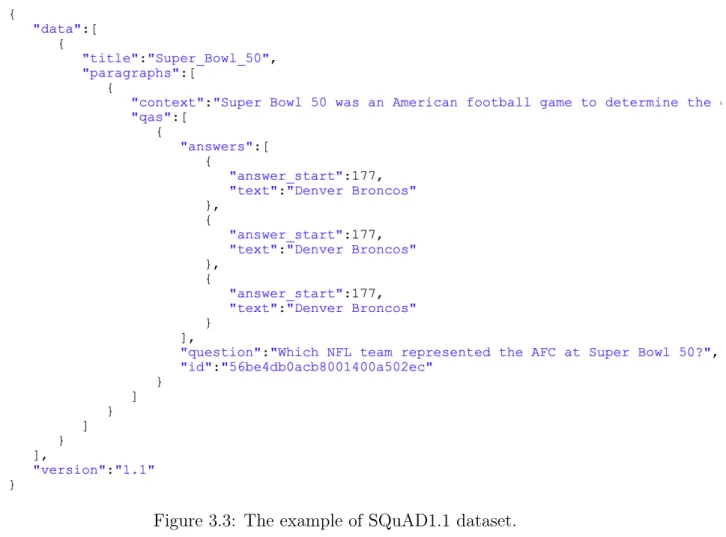
(30) 17 Incorporates all potential cyberattack techniques. Emails, Malicious programs, Social networks, Connection types Software system security. Network security. Phishing attacks. Cybersecurity content. Purpose. To educate players about important cybersecurity related concepts.. Be responsible for achieving a balancing act minimizing the risk to the enterprise while allowing users to accomplish their goals. To solve different mini-games correlating to four aspects of Internet use, players to understand the basic technical or social aspects of these topics. To make aware the technology players regarding security concepts, and the possible ways to identify potential threats in real environment.. To teach players how to identify phishing URLs, and use search engines to find legitimate sites.. Assessment method. Questionnaire. Pre-Test and Post-Test, Usability Questionnaire. Data logging and Questionnaire. Pre-Test and Post-Test, Usability Questionnaire. Pre-Test and Post-Test, Usability Questionnaire. Results. Improve cybersecurity awareness. Positive effect on security learning outcomes. Children liked this game. Generally positive. Improved learning and susceptibility of phishing. Table 2.2: Comparison of 5 serious games in cybersecurity awareness training and education.. Mobile Augmented Reality Application, 3D. CybAR, 2020[20]. Web online mini-games, 2D. Internet Hero, 2014[18]. Card based game. Video Games, 3D. CyberCIEGE, 2014[17]. CSRAG, 2019[19]. Type. Web online game, 2D. Name. Anti-Phishing Phil, 2007[16]. Features Easy to play Story line Time pressure Play different roles Personalized learning Customize scenarios Easy to play Story line Different types Play the role Content extensive Team-based learning Demonstrates the actual consequences of cybersecurity attacks Good interactivity Timely feedback.
(31) Chapter 3 Training Content Generation In this chapter, we will introduce the process of generating the training content. First, we introduce the overview of Machine Learning used to generate content. Then we introduce data preparation, feature engineering and training models respectively. Finally, we use the trained model to predict and generate training content.. 3.1. Overview. There are different methods of Machine Learning, but the workflow for processing data is roughly the same. As shown in figure 3.1 , these processes including: Data collection, Data preparation, Choosing a model, Training, Evaluation, Parameter tuning and Prediction.. Figure 3.1: The steps of machine learning [21]. In this study, the overview of content generation is shown in figure 3.2 on the following page, which is roughly divided into three parts: Data preparation, Training, Development and Evaluation model, and Prediction. In section 3.2 data preparation, will discuss the sources of training data and predict data. In section 3.3, present how to process feature processing on the training data. In section 3.4, select the best model based on the results of evaluation and tuning parameters, and finally in section 3.5, use the trained model to predict and generate content.. 18.
(32) Figure 3.2: The overview of training content generation.. 3.2. Data Preparation. There is a very famous quote in the Machine Learning field: data determines the upper bound of machine learning, the model and algorithm just approach this upper bound. This shows that data is a significant part of Machine Learning. Usually, different datasets are used according to different research purposes. For example, use some representative public datasets. For image processing datasets: the handwritten digits dataset MNIST, the visual dataset ImageNet; For voice processing datasets: Free Spoken Digit, Free Music Archive (FMA); For text processing datasets: the news dataset Twenty Newsgroups, the sentiment analysis dataset Sentiment140. However, for some specialized fields, it is not easy to find ready-made datasets. That needs researchers to collect and process the data by themselves. Data collection methods can use web crawlers, database pull, or API calls. Compared with the dataset compiled by oneself, the public dataset is more representative, and data processing results are easier to be recognized. In addition, the public dataset can handle the problems of data overfitting, data deviation, and missing data better. In this study, we use the public dataset for training. Because there is no suitable cybersecurtiy awareness training dataset, we collect it by ourselves as the predict dataset.. 19.
(33) 3.2.1. Training Dataset. We use the public dataset Stanford Question Answering Dataset (SQuAD1.1) [22] as training data. It includes 100,000+ question-answer pairs on more than 500 articles. The questions are asked by workers based on the paragraph of articles on Wikipedia. The answer to each question is a piece of text from the corresponding paragraph. The original official data is divided into three parts: train sets, development sets, and test sets. Among them, train sets and development sets are available for download, and test sets are used for the official evaluation of machine learning models.. Figure 3.3: The example of SQuAD1.1 dataset. As shown in figure 3.3, the structure of the dataset is divided into data and version. The data contains titles, paragraphs, context, qas, answer start location, answer text, question and id. In this research, we merge the official train sets and development sets as the training dataset, which has 490 articles, 20963 paragraphs, and 98169 questions. In all questions show in figure 3.4 on the following page, what type questions accounted for 58%, who type questions accounted for 10%, and which type questions accounted for 6.7%.. 20.
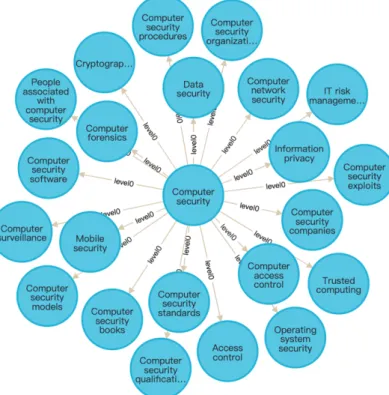
(34) Figure 3.4: The distribution of question types in the SQuAD1.1 dataset.. 3.2.2. Predict Dataset. Source of Keyword and Concept Map Based on the research [23] of constructing the computer security concept map from the LOD database DBpedia, our research uses the keywords and concept maps part, to show the cybersecurity concept map to learners in a visual form, so that they can understand security knowledge more conveniently.. Figure 3.5: The keyword of "Computer security" and its concept map As shown in figure 3.5, it is a concept map of the one level associated with "Computer. 21.
(35) security" as the root node. There are a total of 2640 keywords, and each word has its concept map. Through the collected data keywords and concept maps, to provide users with more information security-related knowledge. In particular, the concept map method makes the knowledge nodes related, easy to establish a knowledge framework, and facilitates the use and memory of subsequent knowledge. Source of Concept Text In order to maintain the consistency of all data, the concept text is also from Wikipedia. Through the python library Wikipedia to get each keywords’ concept text summary. While collecting the concept text data, use regular expressions to filter special characters in the text to ensure clean data. From table 3.1, we can see a total of 2640 keywords, of which 2315 keywords can query the concept text. Some keywords cannot find the concept text because of ambiguity errors. The same keyword has different conceptual interpretations under different fields, so ambiguity may arise when searching for keywords without specifying the division. No Concept text With Concept text Total. Keyword 325 2315 2640. Table 3.1: The information of concept map. Organize all the predict data, the construction of the predict dataset can be see in table 3.2. There are a total of 8 levels of keywords and concept texts from level 0 to level 7. The corresponding number of each level can be viewed in the table below. Keyword Concept text. Level 0 1 1. Level 1 22 17. Level 2 103 90. Level 3 205 182. Level 4 287 266. Level 5 266 234. Level 6 463 402. Level 7 1293 1123. Total 2640 2315. Table 3.2: The information of predict dataset.. 3.2.3. Data Preprocessing. To generate cloze questions and answers, we need to extract the paragraphs, sentences (containing the answer), questions and answers in SQuAD1.1. For example, figure 3.6 on the following page shows one piece of data, the first item is a paragraph, the second item is the sentence where the answer is, the third item is the question, and the fourth item is the answer. Because the raw data cannot directly use, after extracting those data information, need to preprocess and standardize data to eliminate human error or incorrectness, and the impact of repeated data on the results.. 22.
(36) Figure 3.6: The example of the extracted data. 1. Check out the missing data. Before using the dataset, we first check the completeness of the data and whether it lacks attribute values. Focus on whether the questions in the data set have corresponding answers. If the answers are missing, the corresponding questions will not be used. Of course, if any of the paragraph, question and answer is missing in a piece of data, this data will be deleted. 2. Delete inappropriate data. We expect that all questions and answers are based on paragraphs. Check the similarity of the question and sentence, the answer and sentence in each piece of data. Delete the data with the similarity of 0. 3. Clean data. There are some duplicate values and inconsistencies in the data. Delete these data so as not to affect the accuracy of the results.. 3.2.4. Feature Engineering. Feature engineering uses the prepared data in Section 3.2.3, to create the features expected by the Machine Learning Model. This process is to convert text into data that can be used for Machine Learning. Features Selection The goal is to generate text-based cloze questions and answers. First, we need to understand the relationship between the questions-answers and the text. An example from the prepared data in figure 3.7 on the next page, that shows people always like to ask W-questions (what, when, where, who, why), most of these objects are entities or noun chunks (marked by color). Through this habit of people, we selected 11 items to construct features data. There are "Is_Answer" (Does the word or noun chunk appear in the answer), "TitleId" (The text id of the word or noun chunk), "ParagraphId" (The paragraph id of the word or noun chunk), "SentenceId" (The sentence id of the word or noun chunk), "InSentencePosition" (The position of the word in the sentence), "Word_Count" (the count of word or noun chunk), "NER" (The named entity recognition), "POS" (The simple part-of-speech tag), "TAG" (The detailed part-of speech tag), "DEP"(Syntactic dependency),"Is_Alpha" (Is. 23.
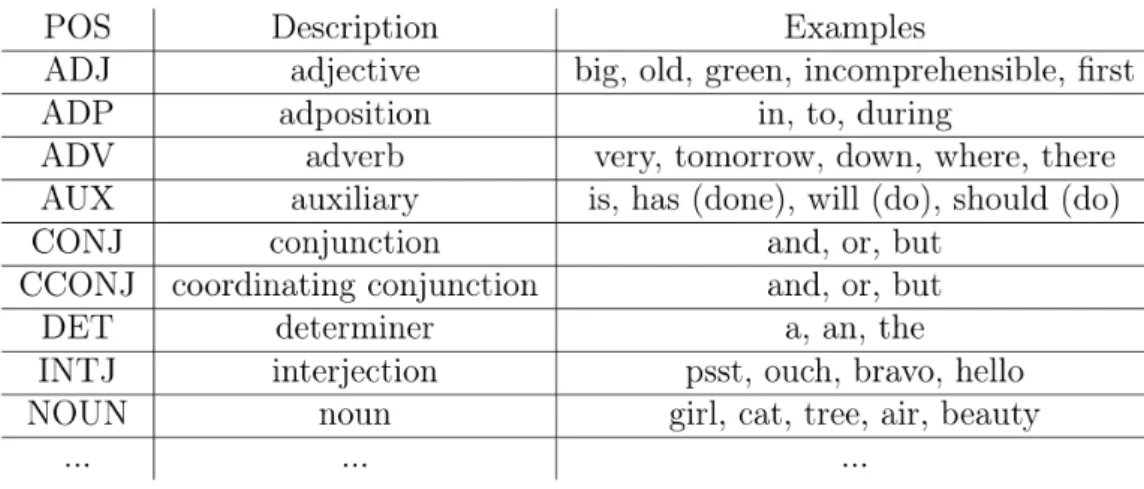
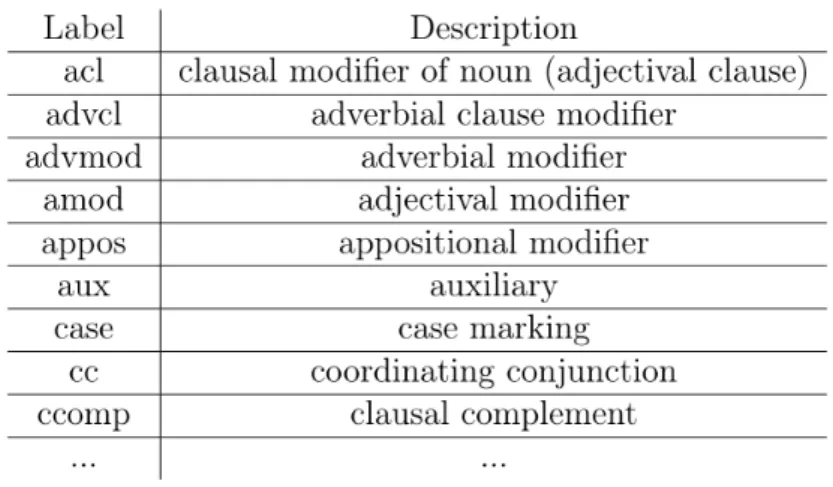
(37) Figure 3.7: The example of the prepared data. the word or noun chunk an alpha character), "Is_Stop" (Is the word or noun chunk a stop word). Among them, "NER", "POS", "Tag", "Dep", "Is_alpha", and "Is_stop" items are realized through Spacy [24] python library. The types of NER can be seen in figure 3.8. Examples of POS can be seen in figure 3.9 on the next page. The details of TAG can be seen in figure 3.10 on the following page. The example labels of DEP can be seen in figure 3.11 on page 26.. Figure 3.8: The samples of NER (Named Entity Recognition).. 24.
(38) Figure 3.9: The samples of POS (Part-of-Speech Tag).. Figure 3.10: The detailed of TAG (Detailed Part-of-Speech Tag).. 25.
(39) Figure 3.11: The detail labels of DEP (Syntactic Dependency). Extract features Extract each noun and noun chunk from the prepared set, to determine whether they have the selected features. Due to the extraction of features from words and noun chunks, there will be duplicate data. It is necessary to deduplicate and delete strange data after extracting features. As shown in figure 3.12, it is ten random examples after extracting features.. Figure 3.12: Example data after extracting features.. Encoding Although the data after the feature extraction has a good structure, it cannot be directly put into the model, because the model cannot recognize the string, and it needs to be converted into a number before it can be put into the model. Use OneHot Encoding to digitize discontinuous and discrete features. The specific process of One-Hot encoding mainly uses N-bit status registers to encode N states. Each state has its independent register bit, and only one bit is valid at any time. It can avoid the problem that Integer Encoding allows the model to assume the natural ordering. 26.
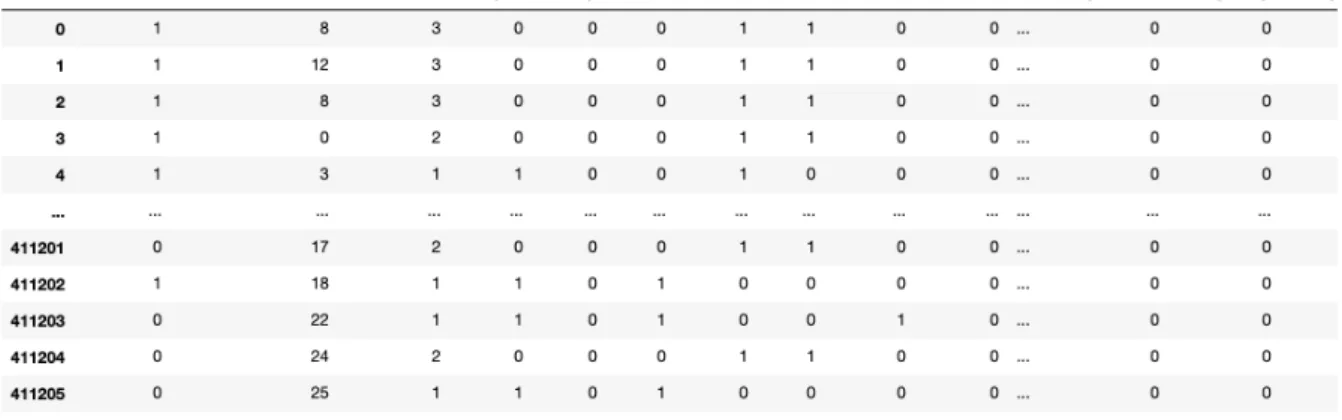
(40) between categories and cause poor performance. As shown in figure 3.13, the example of data after encoding, the "Words" item is deleted, and the original 11 features items are expanded to 118.. Figure 3.13: Example data after encoding.. 3.2.5. Dealing with Imbalanced Data. After the encoding is completed, the sample data that is not an answer is much larger than the sample data that is an answer, and this situation is imbalanced data. If this problem is not dealt with, the model will always predict the side with more data and lose the meaning of learning. We use the following four methods to balance the minority samples and select the most suitable method according to the training results in section 3.3.3. Resampling adjustment method For solving imbalanced data, oversampling and undersampling are the two most basic methods. - Oversampling is a method of randomly sampling from minority samples to increase the size of minority samples. However, some samples will repeatedly appear in the dataset after oversampling, which may lead to the overfit of the trained model. - Undersampling is to randomly select a small number of samples from the majority of samples to balance the proportion of minority samples. However, in order to ensure the balance of the dataset, the undersampling method discards some data, which may be particularly important for the training of the model, so that the model only learns a part of the data.. 27.
(41) Generate synthetic samples The basic idea of SMOTE (Synthetic Minority Oversampling Technique) algorithm and ADASYN (Adaptive Synthetic) algorithm is to analyze minority samples, artificially synthesize new samples based on minority samples and add them to the dataset [25]. The algorithm flow is as follows: 1. Randomly select a minority sample Xi 2. Find the k neareast-neighbors closest to Xi (as shown in figure 3.14 the blue circle with 3 nearest-neighbors) 3. Randomly select a nearest neighbor Xzi 4. Generate Xnew according to the Xnew = Xi + λ × (Xzi − Xi ), λ is a random number in the range [0,1].. Figure 3.14: The sample generation in the synthetic algorithm [25]. The difference between SMOTE and ADASYN algorithm is to select Xi before generating new samples. Although the use of synthetic algorithms can eliminate imbalance and improve the efficiency of learning [26], the selected minority class samples are surrounded by the majority class samples, then this type of sample may be noise, and the newly samples will overlap most of the surrounding majority samples, making it difficult to classify.. 28.
(42) Comparison 10000 sample datas are generated in figure 3.15, and each class accounts for 94% (class 2: 9345), 5% (class 1: 523) and 1% (class 0: 132) respectively. Using these samples we compare the 4 different methods to deal with imbalanced data.. Figure 3.15: Compare 4 methods to processing imbalanced data.. 3.2.6. Training Data and Test Data. The data after feature engineering is divided into 80% training data and 20% test data. The training data is used to train the Naive Bayes Models, and the test data is used to provide an unbiased evaluation of the trained model.. 29.
(43) The training data is then processed according to the 4 methods introduced in Section 3.2.5, and finally the data of the training data is shown in table 3.3, and the data of the test data is shown in table 3.4. Number of Data Total False Label True Label. Original Data 328964 271929 57035. Resampling Techniques Oversample Undersample 543858 114070 271929 57035 271929 57035. Generate Synthetic Samples SMOTE ADASYN 543858 530960 271929 271929 271929 259031. Table 3.3: The information of training data. Total Data False Label True Label. 82242 67888 14354. Table 3.4: The information of test data.. 3.3. Training Models. Put 5 types of training data (Original Data, Oversampling Data, Undersampling Data, SMOTE Data, ADASYN Data) into 4 types of Naive Bayes model (Gaussian Naive Bayes, Bernoulli Naive Bayes, Multinomial Naive Bayes, Complement Naive Bayes) for training. According to the evaluation criteria, tune the parameters and select the best model.. 3.3.1. Training and Evaluation Model. In this research, we use the computing server Cray XC40 to train the models. Each training job used 4 nodes to improve the training speed. The size of the node is Intel Xeon E5-2695v4 (2.1GHz, 18Core x 2), 128GB Memory (16GB DDR4-2133 x8). The trained results are shown in table 3.5 on the following page. We used 9 evaluation metrics to quantify the performance of the models. The Accuracy, Precision, Recall, F1 score are calculated by the confusion matrix. Each column of the confusion matrix represents the predicted class, and the total number of each column represents the number of data predicted to be that class; each row represents the true attribution class of the data, and the total number of data in each row represents the number of data instances of that class. An example of Bernoulli Naive Bayes trained results is shown in figure 3.16 on page 32, TN means true negative, predicted to be false label, actual label is also false; TP means true positive, predicted to be true label, actual label is also true; FP means false positive, predicted to be true label, actual label is false; FN means false negative, predicted to be false label, actual label is true.. 30.
(44) 31. Models GaussianNB_original GaussianNB_oversampled GaussianNB_downsampled GaussianNB_smote GaussianNB_adasyn MultinomialNB_original MultinomialNB_oversampled MultinomialNB_downsampled MultinomialNB_smote MultinomialNB_adasyn ComplementNB_original ComplementNB_oversampled ComplementNB_downsampled ComplementNB_smote ComplementNB_adasyn BernoulliNB_original BernoulliNB_oversampled BernoulliNB_downsampled BernoulliNB_smote BernoulliNB_adasyn. Time Cost 00:01:496647 00:02:245883 00:00:385076 00:02:456814 00:01:969841 00:00:401142 00:00:665214 00:00:140885 00:00:648798 00:00:719254 00:00:411723 00:00:591467 00:00:114780 00:00:785985 00:00:711147 00:00:763727 00:01:402953 00:00:264403 00:01:352380 00:01:248105. Accuracy Score 0.21206926 0.21197199 0.22906787 0.21230028 0.21222733 0.8437538 0.74626103 0.75863914 0.71930401 0.32437198 0.74843754 0.74626103 0.75863914 0.71930401 0.32248729 0.84410642 0.8035432 0.80326354 0.80422412 0.32175774. Precision Score 0.17929026 0.17927203 0.1821728 0.17926832 0.17913221 0.91870824 0.27114952 0.28065134 0.26296357 0.18890315 0.27389535 0.27114952 0.28065134 0.26296357 0.1885747 0.92324682 0.36392453 0.36287173 0.3662942 0.18776568. Recall Score 0.98237425 0.98237425 0.9793089 0.98181692 0.98077191 0.11495054 0.26884492 0.24494914 0.33739724 0.8716734 0.26731225 0.26884492 0.24494914 0.33739724 0.87250941 0.11648321 0.16796712 0.16831545 0.16671311 0.86777205. Table 3.5: The trained results. Train Score 0.21188945 0.5163425 0.52438853 0.51891119 0.50766159 0.84517759 0.56244645 0.5587271 0.57181102 0.52680428 0.7516628 0.56244645 0.5587271 0.57181102 0.52609424 0.84551805 0.55536188 0.55451915 0.55599991 0.52538044. F1 Score 0.30323753 0.30321145 0.30719976 0.30317959 0.3029351 0.20433437 0.2699923 0.26158768 0.2955662 0.31051384 0.27056376 0.2699923 0.26158768 0.2955662 0.31012282 0.20686669 0.2298489 0.22996383 0.22913774 0.30872949. Logloss Score 27.0077149 27.0674237 25.8808404 27.1991909 27.1925823 0.43041942 0.63081726 0.62945755 0.63157566 0.68917234 0.63042638 0.63081726 0.62945755 0.63157566 0.70493198 0.43136699 0.62748113 0.62580716 0.62906228 0.76578037. Brier Score 0.78793511 0.78802325 0.7732826 0.78769976 0.78777248 0.13152304 0.22125465 0.22066417 0.22176806 0.25140331 0.22117735 0.22125465 0.22066417 0.22176806 0.25913893 0.13120632 0.22051391 0.21972351 0.22132073 0.28796226. AUC 0.52564678 0.52500933 0.53463587 0.51592697 0.51612131 0.6396292 0.63827303 0.64000931 0.63741558 0.64300326 0.63962916 0.63827299 0.64000927 0.63741558 0.64300326 0.59650404 0.59643657 0.59515103 0.59639772 0.57645776.
(45) The matrix shows that 14354 data are labeled as answer, 67888 data are labeled as not answer. The model predicted that 6532 data as answer and 75710 data are not answer. Use the following metrics to evaluate the performance of the model:. Figure 3.16: The confusion matrix of BernoulliNB model. - Time cost. Time spent training the model. - Train Score. The accuracy of the model on the training data. - Accuracy Score. The accuracy of the model on the test data. Accuracy =. TP + TN TP + TN + FP + FN. - Precision Score. The correct rate in the predicted answer. P recision =. TP TP + FP. - Recall Score. The proportion of predicted answer in actual answers. Recall =. TP TP + FN. - F1 Score. The weighted average between precision and recall. It is useful when dealing with unbalanced samples. F1 = 2 ∗. P recision ∗ Recall P recision + Recall. 32.
(46) (a) GaussianNB Model Trained Result. (b) MultinomialNB Model Trained Result. (c) ComplementNB Model Trained Result. (d) BernoulliNB Model Trained Result. Figure 3.17: The trained results of 4 Naive Bayes models. - Logloss Score. That is used to measure the degree of inconsistency between the predicted value of the model and the true value. It is a non-negative real-valued function. The smaller the loss function, the higher the accuracy of the prediction. - Brier Score. It is only used to evaluate two classification problems, measuring the error between the probability of the class predicted by the model and the true value. The lower the value of this score, the better the prediction. The score for a perfect prediction is 0. The worst score is 1. If the Brier score hovers around 0.5 points, it is difficult to determine the quality of the model. - AUC. The ROC (Receiver Operating Characteristic) curve is the relationship curve between FP and TP, and AUC (Area Under the Curve) is the area under the ROC curve. The larger the area, the better the performance of the model. As figure 3.17a shows the trained results of GaussionNB model, roughly the same results for different data sets, with low accuracy, large errors, and high Logloss score. The model tends to divide the data into true class. From the AUC score, the model basically does not have the ability to classification. So this model is not suitable for this research.. 33.
(47) (a) BernoulliNB model using original dataset. (b) MultinomialNB model using original dataset. Figure 3.18: Reliability curve and probability distribution of the BernoulliNB and MultinomialNB model.. The figure 3.17b on the previous page shows MultinomialNB trained results, the model has a relatively high accuracy on the test data. Since the training data is processed with balanced data, the scores of training accuracy and test accuracy will be different. The Logloss score is small, model trends classify the data as false label, and the AUC score performs better. The ComplementNB results as figure 3.17c on the preceding page shows, although the model is nice, it did not perform so well in accuracy compared to the MultinomialNB and BernoulliNB. And the model tends to predict the data as false label. The figure 3.17d on the previous page shows BernoulliNB trained results, the accuracy of predicting the test data can reach up to 0.8441, with small errors. The model tends to predict the data as false label. The AUC score is relatively high. In section 3.2.5, we discussed the use of ADASYN to deal with imbalanced data. As show in table 3.5 on page 31, the performance of the four models on this data is not. 34.
図


![Figure 2.6: Using serious games fields [12].](https://thumb-ap.123doks.com/thumbv2/123deta/6080665.1074184/27.892.167.728.604.997/figure-using-serious-games-fields.webp)

+7

Outline
関連したドキュメント
Two grid diagrams of the same link can be obtained from each other by a finite sequence of the following elementary moves.. • stabilization
For example one could estimate consistent initial conditions using Sobolev descent locally at the left boundary, then run a multi-step method to calculate a rough approximate
Nov, this definition includ.ing the fact that new stages on fundamental configuration begin at the rows 23 imply, no matter what the starting configuration is, the new stages
Standard domino tableaux have already been considered by many authors [33], [6], [34], [8], [1], but, to the best of our knowledge, the expression of the
In 2003, Agiza and Elsadany 7 studied the duopoly game model based on heterogeneous expectations, that is, one player applied naive expectation rule and the other used
Smith, the short and long conjunctive sums of games are defined and methods are described for determining the theoretical winner of a game constructed using one type of these sums..
In this paper we give the Nim value analysis of this game and show its relationship with Beatty’s Theorem.. The game is a one-pile counter pickup game for which the maximum number
In this paper, based on the concept of rough variable proposed by Liu 14, we discuss a simplest game, namely, the game in which the number of players is two and rough payoffs which
