MECHANISM OF THE FORMATION OF VOLCANIC ASHES
FROM SAKURAJIMA VOLCANO, JAPAN, AND ITS
INFLUENCES TO THE ENVIRONMENTS
著者
OBA Noboru, TOMITA Katsutoshi, YAMAMOTO
Masahiko, INOUE Kozo, NAKAMURA Toshifumi,
ISHII Toshihiko, KIYOSAKI Seiichi
journal or
publication title
鹿児島大学理学部紀要. 地学・生物学
volume
17
page range
1-22
別言語のタイトル
桜島火山灰の生成メカニズムと環境に与える影響
URL
http://hdl.handle.net/10232/5945
FROM SAKURAJIMA VOLCANO, JAPAN, AND ITS
INFLUENCES TO THE ENVIRONMENTS
著者
OBA Noboru, TOMITA Katsutoshi, YAMAMOTO
Masahiko, INOUE Kozo, NAKAMURA Toshifumi,
ISHII Toshihiko, KIYOSAKI Seiichi
journal or
publication title
鹿児島大学理学部紀要. 地学・生物学
volume
17
page range
1-22
別言語のタイトル
桜島火山灰の生成メカニズムと環境に与える影響
URL
http://hdl.handle.net/10232/00009974
No. 17, p.1-22, 1984.
MECHANISM OF THE FORMATION OF VOLCANIC ASHES
FROM SAKURAJIMA VOLCANO, JAPAN,
ITS INFLUENCES TO THE ENVIRONMENTS
By
Noboru ObAl, Katsutoshi TOMITAl, Masahiko YAMAMOTO , Kozo INOUE Toshifumi NAKAMURA3, Toshihiko ISHIIl and Seiichi KIYOSAKI
(Received July 2, 1984)
Abstract
Modal and chemical analyses, X-ray diffraction, differential thermal analysis,
micro-scopic observation, scanning electron microscopy, and measurements of grain-size distribu-tion and refractive indices have been carried out for volcaic ashes erupted out from Sakura-jima Volcano, Japan.
Volcanic ashes can be classified into four: black ash, i. e., most common volcanic ash characterized by blackish grey in mass color appearance, the presence of irregular
shaped-●
matrix grains which sometimes show the porphyritic texture; red ash characterized by reddish dark grey in mass color appearance, abundant rounded matrix grains showing reddish brown-color, the low-content of FeO and the high-content of Fe203 in chemical composition, a wide
range of refractive index in matrix volcanic glass, and by the presence of α -cristobalite, gyp-sum and anhydrite; black ash analogous to the red ash characterized by both natures of the black ash and the red ash; and white ash characterized by greyish white in mass color appear-ance, abundant colorless- and irregular shaped-grains in which abundant vesiculated matrix volcanic glass is contained and by the higher refractive index in some major constituents as compared to other volcanic ashes.
Many evidences show that the black ash came from solidifying lavas, by which the sum-mit crater of the vole叩o had been burried, those which were explosively crushed and ejected out by volcanic gas pressure which was accumulating within the volcanic vent. The red ash is possibly considered to be a mixture of the preexisted volcanic ash which was affected by alteration due to action by volcanic gases, perhaps, nearby the summit crater bottom, and re-cent volcanic ash. The presence of the black ash analogous to the red ash shows a grada-tional process between the black ash and the red ash. It seems that the white ash was blown up in a vesiculated state in accompanying with the adiabatic expansion through a narrow vol-canic vent successively and immediately from magma which came up to the summit crater from magma chamber at depths.
The presence of gypsum was identified by X-ray diffraction, differential thermal analysis and scanning electron microscopy not only in the red ash, but also in the black ash. With
re-spect to the origin of gypsum crysals less than 5 tim in size adhered to the surfaces of the
●
black ash-grains, it is reasonable to consider that sulfate ions, calcium ion and water those which were accompanied as volcanic gases together with the black ash just after the eruption were combined with each other at temperatures less than 1500C while the black ash was float-ing and fallfloat-ing down in the air.
1 2 3
Institute of Earth Sciences, Faculty of Science, Kagoshima University, Kagoshima, 890 Japan. Institute of Geology, Faculty of Science, Hiroshima Universiyty, Hiroshima, 730 Japan. Shoko Junior High School, Kanagawa Prefecture, 258 Japan.
Plots of most of the volcanic ashes fall within a field of the calc-alkalic rock series on MIYAS苧IRO′s (1974) SiO2-total FeO/MgO diagram. The field occupied by the plots of the
volcanic ashes is, however, located away from the field occupied by the plots of volcanic
rocks and bombs of Sakurajima Volcano on both the SiCb-total FeO/MgO diagram and the● ●
AFM diagram. This is originated in the presence of gypsum in the volcanic ashes. The
presence of grains of the vesiculated matrix volcanic glass in most common volcanic ashes represented by the black ash, shows that the volcanic ashes were subjected to the adiabatic expansion and vesiculation.
The natural and social environments are affected by major two factors due to volcanic
●
ash; physical factor and chemical factor. The physical factor by which the environments are affected is attributed to the substantial nature and grain size of volcanic ash, and the chemi-cal factor to the presence of volcanic gases and its chemichemi-cal action.
The result of the measurement of grain-size distributor! shows that micrograins ranging in grain size from 5.0 to 0.5 /Jm occupy approximately 2.0-1.5 wt. % in the accumlative ratio in volcanic ashes consisting of grains less than 250 /Jm at maximum. Micrograins, essentially,
of silicate substances, ranging in grain size from 5 to 2 /*m in volcanic ash, invade into every environments and give them undesirable influences, for example, when they fill epidermal stomata of plants or pulmonary alveoli of animals, respiration is stopped or hypo function occurs. Volcanic gases, such as sulfer oxides and hydorgen chloride, those which are adhered to the surfaces of volcanic ash・grais, accompanied with native volcanic ash just after the eruption, are combined with water and converted into acids such as sulfuric acid and hy-drochloric acid while they are floating and falling down in the air. Acid volcanic gases
in-●
vade into every environments and give them undesirable influences, for example, when func-tions as to be the organisms are subjected to volcanic gases or acids, they are lowered or dis-ordered. Besides, discussions will be also given to mechanisms that farm products and hu-man body are affected by the physical and chemical factors due to volcanic ash.
Introduction
Volcanic activity of Sakurajima Volcano has interruptedly maintained for thirty years since the time when volcanic activity represented by the summit explosion with smoke started again in 1955. Amount of volcanic ash fell down so greatly has increased since 1972 that the natural and social environments, such as farm products, industries, civic life, etc., have been affected by serious damages. However, mechanism that the en-vironments are subjected to undesirable influences, as represented by d☆ing down of fluits and atrophy die of silkworms due to volcanic ash, has been obscure on the reason that nature of volcanic ash itself has not been clear.
Social demand for the nature of volcanic ash has become too much strong. Thus, analyses of mineral and chemical compositions, X-ray diffraction, differential thermal analysis, measurement of grain-size distribution, optics of constituent minerals,
micro-●
scopy and scanning electron miroscopy have systematically and synthetically been carried ●
out for volcanic ashes to make clear their physicochemical nature and factors by which ●
the environments are affected since 1977, though collection and microscopic observation of volcanic ashes have been maintained by one of the present authors since 1955.
Some of the cooperative research products have been reported in 1980 and 1981 (Oba and others, 1980, 1980a, b, 1981). This paper is an outgrowth of the cooperative
re-searches having been carried on upto date. Major attention will be given to mechanism
of the formation of volcanic ashes and the influences due to volcanic ash to the environ-merits. It is most important that multifaceted approach by means of observation,
descrip-●
ton, measurement and other various analyses, as is treated in paper, is maintained for vol-canic ash for a long period in order to make clear various subjects which already occur-red or those are going to occur tdward the future throughout over the natural and social environments.
Volcanic ashes available for academic research and nomenclature
Volcanic ashes used for academic research must be fresh and pure so that their own essential nature is reflected well. When volcanic ashes were encountered to rain and
washed out with water, and volcanic gases adhered to surfaces of volcanic ash-grains were flowed away, they are not native volcanic ashes, but just only sorted sand.
I
Volcanic ashes with impurities or those which fell down in rain time should also be avoided. Only volcanic a、shes which were carefully collected by one of the authors at the environment as clean as possible at the time when they were falling down, were used for
■
study.
Collected samples of volcanic ash are given in Table 1. Volcanic ash of sample no. 681013 looks reddish dark grey, that of sample no. 140111 looks greyish white, those of sample no. 79083001 and no. 79110801 look dark grey tinged with red, and others look
●
blackish grey, in mass color appearance. They are called, in convenience, red ash, white ash, black ash analogous to the red ash and black ash, respectively (Oba and others, 1980a). Black ash is most common in volcanic ashes.
Table 1. Samples of volcanic ashes from Sakurajima Volcano used for study 1e no. Date of eruption Coll. Name of ash Mass co一or in Localities
& collection 820917★ Sep. 17, 1982 820730★ July 30, 1982 May 24, 1982 81081901 Aug. 19, 1981 80051101 May l1, 1980 79110801 Nov. 8, 1979 Aug. 3, 1979 78052301 May 23, 1978 77052301 May 23, 1977 741025 Oct. 25, 1974 July 23, 1974 681013 Oct. 13, 1968 140111 Jan. ll, 1914 NO Black ash Weather & time appearance
Blackish grey Faculty of Science, Cloudy, windy, ll:30 Kagoshima Umv.
Fine, gent一e windy
tl ll ll ‖ 日 日 , 09:00 11 日 Fine, windless
Dark grey ana一 tinged with red ash red
lI H
Black ash Blackish grey
Grey tinged Ushine, Tarumizu, Kagoshima Greylsh white Kagoshima City
Fine, gent一e windy, 09:00 Fine, weak windy, 10:00 Fine, gentle windy, ll:00 Fine
ll
Unknown
*Used for only differential thermal analysis. NO, N. OBA; SK, S. KIJIMA; TS, T. SAKURAI.
Mineral composition
Modal analyses of major constituents were made of eight samples of vocanic ashes,
as shown in Table 2. Volcanic ashes represented by the black ash are composed mainly
Table 2. Modal analyses (vol. %) of volcanic ashes from Sakurajima Volcano
ample no. Name of ash Measured grain Plagioclase Hypersthene Augite Olivine Magnetite Matrix Transparent SlZe Black ash 300-100 ¥m 80051101 日 16.5 4.7 2.1 79110801 Black ash 250- 50 20.4 2.9 5.8 analogus to red ash 79083001 日 78052301 Black ash -100 77052301 日 200-1 00 681013 Red ash - 50 140111 White ash -Volcanic bomb* ejected out in 1977 †rom South Peak 1946 lava 58031 90ト日 日 8 5 2 4 9 9 O CM i- t- <T> O CO CM IT) If) 00 (T> ォ J - < T > i -c c a c c c Anal. Ref. volcanic glass 1.2 0.6 76.2 ? TN 1.5 * * c m r * . r > . i -サ 0 0 0 1 -サ > * ォ d - O c o i v . i o i o o o r > - r ^ . o o ォ * r > ォ m < & r -O r- C", _-19.9 3.4 1.3 1.1 (り ) ) I I ) ) i- e¥j cm ( t ( t t t VI I- i^ ^ i^ i^ 3E (5) NO (5)
Collected by T. Kakuta. ** Cavities are included. Abbreviations.-p, present; n, not present; KI, K. 1NOUE; MY, M. YAMAMOTO; NO, N. OBA; TN, T. NAKAMURA. References.-(l) OBA and others (1981); (2) OBA and others (1980); (3) OBA and others (1980a); (4) OBA and others (1980b); (5) NAGASAWA and OBA (1959).
of lithic grains, plagioclase, hypersthene and augite. Magnetite and other iron oxide
minerals, apatite and zircon are accompanied. Olivine is present only in the black ash analogous to the red ash, sample no. 79110801. The reason is obscure. For compari-son, modal analyses of 1946 lava, so-called "Showa lava", and volcanic bomb ejected out from South Peak (Minami-dake) crater of Sakurajima Volcano in 1977 are tabulated in the same table. From this table, it can be seen that most volcanic ashes except only the red ash are nearly similar in modal composition to the 1946 lava.Observation for the constituent materials under the microscope, as will be mentioned later, shows that lithic grains came from matrix of lava on the summit crater. So, the lithic grains are called, in convenienece, matrix grains in this paper. The matrix grains are composed mainly of volcanic glass, microlite and crystallite, and, sometimes, pheno-crystic minerals are accompanied. The matrix grains in the black ash attain 65-76 % in volumetric prportion, while the red ash is characterizedTdv the fact that the matrix grains are distinctly abundant, but rock-forming minerals are few.
●
Refractive ndices of major constituents
∵
Refractive indices were measured of hypersthene, plagioclase and volcanic glass from volcanic ashes. Measured refractive indices were adjusted as to be those at 20 C. The results are tabulated in Table 3.
Hypersthenes:
Refractive indices of hypersthenes from the black ash were measured to be γ ≡ 1.693- 1.711. Hypersthenes from the red ash are lower, and, in contrast, those from the white ash are higher, as compared to those from the black ash in refractive index.
Plagioclases:
Table3.RefractiveindicesofconstituentmineralsofvolcanicashesfromSakurajimaVolcano Samp-NameofashHypersthenePlagioclase冨atrixvolcanic lassJ;号en;E号:entM:完sure-Ref. t yn.AnX 80060601 Black ash 80051101 日 78052301 日 77052301 681013 Red ash 140111 White ash 1.710 1.693 1 I.711 1 I.711 1 1.707 1 1.716 1 1.506-1.536 n.m. 84 1.517-1.528 1.506 55 1.524 く1.512 59 1.524 く1.524 59 1.517-1.538 く1.517 60 1.530 1.530 ) ヽ ■ . ■ ′ l ・ l ■ ■ ′ l 1 2 2 日 = u J H U n H J H H H ー r ‖ J →1 K T N N N N
n.m., not mesured. Other abbreviations are the same as those in Table 2. References. -(1) OBA and others (1980); (2) OBA and others (1980a).
Most of plagioclases ranges in refractive index m from 1.557 to 1.560.
●Matrix volcanic glass and transparent volcanic glass:
Volcanic glass, which occupies a major portion of the matrix grain and contains
● ●
microlite and crystallite, is called matrix volcanic glass; and reddish brown-colored trans-parent volcanic glass, which is judged to have been derived from inclusions which had been contained within phenocystic minerals, is called brown-colored transparent volcanic glass or simply transparent volcanic glass, in convenience (Oba and others, 1980, 1980b).
The matrix volcanic glass from the black ash ranges in ref active index from 1.506 to 1.528. That from the red ash has higher refractive index ranging from 1.517 to 1.538 as compared to that from the black ash, while high refractive index, 1.530, was measured to
that from the white ash. Meanwhile, refractive index of the transparent volcanic glass
from volcanic ashes except the white ash is lower than that of the matrix volcanic glass. Such a fact suggests that the transparent volcanic glass was formed under the physi-cochemical condition different from the matrix volcanic glass.
Chemical analyses
Volcanic ashes were chemically analyzed by a combination of the fluorescence X-ray spectroscopy method or gravimetric method for SiC>2 and Ti02, the gravimetric method for 士, the volumetric method for FeO, and the atomic absorption method for AI203, total Fe20s, MnO, MgO, CaO, Na20 and K20. They were puverized by a vibrating mill in advance for analysis. Chemical analyses are given in Table 4.
●
Judging from chemical composition, the black ash erupted out in 1978, sample no. 78052301, and that in 1977, sample no. 77052301, are quite the same. The black ashes erupted out in 1974, 1980, 1981 and 1982 are, in chemical composition, almost the same as the former two. These volcanic ashes are, roughly speaking, composed of SiCL 59 %, ALOs 17 96, FeO 5-6 %, FeaOa 2 %, MgO 2.5-3.0 %, CaO 6 %, NaaO 3.0-3.5%, and K20 1.5%.
The red ash erupted out in 1968 is apparently different from the black ash in the re-spect that it is very rich in Fe203, and, in opposite, poor in FeO, SiCb, AI203 and Na20, particularly in FeO. The white ash clearly differs in the contents of Si02, FeO, Fe20s, MgO and CaO against the black ash. Two black ashes analogous to the red ash erupted
e 1 3 3 1 e x 蝣 - c m c m O O o + i m i t j E -C < O 一 H O O c M C M O O O O O J O l U o o t C V -r--r- - <V CD C O) ft) 10 N N N N O Z < / > < 」 C J l / ) h < l i . U . 」 S U Z i ( I I O . I
-Table 4. Chemical analyses of volcanic ashes from Sakurajima Volcano
0 0 8 1 0 9 1 A VI CM CO CO ^ 0 -1 8 24 5 A Y 1 0 8 M 2 8 11 0 A U l 4 5 6 79110801 79083001 78052301 770 BAR BAR BA MY MY MY (1) (2) (2) 59.58(G) 59.40(G) 59.07(G) 59.18(G) 59.85(XS) 59.68(XS) 0.83(C) 0.80(C) 0.90(C) 0.71(C) 1.41(XS) 0.85(XS) 16.68 16.86 16.13 16.95 16.91 17.51 2・41 2.32 2.01 2.99 2.70 1.92 5.23 4.93 6.49 3.98 0.17 0.16 0.19 0.15 2.89 2.69 3.74 2.76 6.12 6;45 6.31 3.47 3.50 3.32 1.53 1.51 0.78 0.87 0.50 tr 0.10 0.06 0.13 0.17 0.07 99.82 99.78 100.30 3.85 5.17 0.15 0.15 2.72 2.88 6.59 5.63 6.14 3.46 3.17 3.19 1.56 1.41 1.38 1.32 1.55 0.78 0.28 0.38 0.06 0.1I 0.08 0.10 100.04 99.81 99.81 ^ ^ o サ o w 5 r - i n o c s i i o n - 蝣 - o o < n 5 1 9 8 9 10 11 Methods ) S L 1 . 1 3 X ハ d I - . q J 山 E < H M 山 H L * l K = < " v o p o r - r -O 良 U 1 3 一 b 3 1 蝣 - o o o I -. > - i r > . - 川 I ) S rrq 甘^E3 5 T t ( 2 , 4 2 3 2 8 2 7 2 0 7 1 8 3 9 0 A U I -サ < 」 > C 0 1 ー B V -3 z : H r -* 3 -O C M v 。 C 。 1 3 。 0 ⋮ ︼ H H L H リ S S 1 V ∧ ∨ ∧ 0 ( ( 3 8 2 2 3 0 6 9 7 7 7 1 0 9 1 2 A v I a ¥ i n o o -681013 140111 RA WA MY MY (3) (3) 54.45(G) 61.68(G) XS.G 1-.19(C) 1.24(C) XS.C 15.44 16.59 AA 4.90 2.19 日 2.65 3.77 0.09 0.13 1.49 1.79 5.75 4.86 3.68 1.12 1.70 8.32 1,58 2.26 0.40 nd 0.06 100.07 99.67 V A H A G H C
Abbreviations.-BA, black ash; BAR, black ash analogous to the red ash; WA, white ash; MY, M. YAMAMOTO; TF, T. FUKUDA; YY, Y. YAMASHITA; AA, atomic absorption spectroscopy; C, colorimetry; G, gravimetry; V, volumetry; XS, fluorescence X・ray spectroscopy. References.-(l) 0-BA and others (1981); (2) OBA and others (1980); (3) OBA and others (1980a).
out in 1979, those which are judged to have been affected by heating and oxidation (Oba and others, 1980a), are apparently high in Fe20a-content and low in FeO-content.
X-ray diffraction
X-ray powder diffraction was made of black ashes erupted out in 1977, 1978, 1980, 1981 and 1982, black ashes analogous to the red ash in 1979, white ash in 1914, and red ash in 1968. X-ray powder diffraction patterns are given in Figs. 1, 2, 3 and 4. The fol-lowings were made clear.
●
(i) Strong peaks indicating the presence of feldspar (see F in Fig. 1) or plagioclase (see PI in Figs. 2 and 3) at 2 ♂ 28-, 21.80 23.5-, 24.4o and 26.4-, particularly, a double peak characteristic to feldspars at 2 ♂ 28- are recognized. Although two volcanic ashes erupted out in 1979 belong in chemical feature to the black ash analogous to the red ash,
●
they are quite the same as the black ash in the d-value and intensity of peaks.appeared on the X-ray powder diffraction patterns.
(ii) The bias upward of the base between 2β loo and 30- seen in the white ash of 1914 (sample no. 140111 in Fig. 1), suggests that the white ash is dominant in amor-phous silica.
(iii) As a result of the X-ray powder diffraction of the red ash of 1968 (no. 681013 in Fig. 4), a -cristobalite, anhydrite and gypsum were detected. They were, furthermore, examined by the heat treatment. The peak indicating the presence of gypsum dis-appeared at 130-C, and, in place, the peak indicating the presence of hemihydrate appeared. The peak indicating the presence of hemihydrate disappeared at 600-C, and, in place, the peak indicating the formation of anhydrite appeared. Meanwhile, the peak
indi-●
of α-ド
l 10 20 30 40 可 20(CuKa)
Fig. 1. X-ray powder diffraction patterns for black ashes and white ash from Sakurajima Volcano. 30 KV, 15 mA. Sample no. 140111, no. 77052301 and no. 78052301 are white ash erupted out in 1914, black ash in 1977 and black ash in 1978, respectively. F, feldspar. Analyst. K. TOMITA.
10 20 30 ●0 1$0 20(叫■)
Fig. 3. X-ray powder diffraction patterns for black ashes from Sakurajima Volcano. 30 KV, 15 mA. Sample no. 81081901 and no. 820524 are black ash erupted out in 1981 and that in 1982. PI, plagioclase; A, augite; H, hypersthene. Analyst. K. TOMITA. Pl h
二へ-l問Ill
3 10 20 30 40 50 60 26(CuKα)Fig. 2. X-ray powder diffraction patterns for black ashes analogous to the red ash and black ash from Sakurajima Volcano. 30 KV, 15 mA. Sam-pie no. 79083001 and no. 79110801 are black ashes analogous to the red ash erupted out in 1979, and no. 80051101 is black ash erupted out in 1980. PI, plagioclase. Analyst. K. TOMITA.
a-c f
3 10 20 30 40-20(CuKot)
Fig.4. X-ray powder diffraction patterns for red ash erupted out in 1968 from Sakurajima Volca-no. 30 KV, 15 mA. α-C, α-cristobalite; β・C, β-cristobalite; F, feldspar; G, gypsum; H, hemihydrate; A, anhydrite. Analyst. K. TOMITA.
cristobalite. Thus, the presence of α -cristobalite, anhydrite and gypsum in the red ash
was identified. Besides, the bias upward of the base between 10- and 30o in 2β as seen in the white ash, is recognized in the red ash too. This suggests the presence of the dominant amorphous silica.
(iv) Augite and hypersthene were detected in the black ashes of 1981 and 1982 (no. 81081901 and no. 820524 in Fig. 3).
Differential therma一 analy引S
●
Differential thermal analysis (DTA) was made of four black ashes erupted out in 1981 and 1982. DTA curves are given in Fig. 5. Low temperature endothermaic peaks due to dehydration in gypsum are recognized at 170-C and 1900C in all black ashes. The presence of gypsum, as will be mentioned later, could be detected by the scanning
●
electron microscope. On the DTA curve of the black ash, sample no. 820917 (see 4 in Fig. 5), a strong endothermic peak at 110-C, which appears to have been originated from the presence of sulfide minerals, and a strong exsothermic peak at 300-C, which also appears to have been related to sulfide minerals, are observed. Meanwhile, an endother-mic peak at 240-C seen in two black ashes, samples no. 81081901 and no. 820730(see 1 and 3 in Fig. 5), appears to be originated in the presence of Na2S04.
Fig. 5. Differential thermal analysis curves for black ashes
●
from Sakurajima Volcano. 1, sample no. 8108190; 2, sample no. 820524; 3, sample no. 820730; 4, sample no. 820917. Analyst. K. TOMITA.
し ⊥ I I I 1 I I I ]---I o 200 too BOO 800 I抑Oc
Microscopic observation of volcanic ash-constituents and microstructures
●
Volcanic ashes were sieved into three groups of grains following to grain size; group
●
of grains ranging in grain size from 200 to 50 jutm, group of grains ranging from 50 to 10 ● ● ●
〃m and group of grains less than 10 〟m. Grains were immersed in different immersion oil for purpose and examined under the microscope.
1. Grains ranging in grain size from 200to 50/im (1) Blackashes
Observed black ashes are quite the same in color, form and microstructure of their
●
frequently be observed in the matrix grains. Grains containing bubbles, that is, grains of vesiculated matrix volcanic glass are recognized. Plagioclases with inclusions of the brown-colored transparent volcanic glass and those without them are present. The inclu-sions of the brown-colored transparent volcanic glass are arranged parallel to cleavage of its host mineral (Oba and others, 1980b), and concentrically line along zonal structure of plagioclase. The brown-colored transparent volcanic glass is rarely contained in pyroxene too.
(2) Red ashes
Red ashes are dominant in smaller grain in grain size as compared to the black ash. Grains of rounded matrix vocanic glass showing reddish brown-color owing to the pres-ence of iron oxids, are distinctly abundant (Oba and others, 1980b). Grains of the brown-colored transparent volcanic glass, which is judged to have been derived from in-elusions contained within phenocrystic minerals, are rarely observed. None of bubble is recognized in grains of the matrix volcanic glass.
(3) White ash
Among all kinds of volcanic ashes, the white ash is most dominant in the smallest grain in grain size. Irregular shaped-grains with acute angle, such as splitted flake,
ascicular form and long prismatic form, are abundant (ObA and others, 1980b). Most of
the matrix grains are composed of colorless-transparent volcanic glass and crystallite.Too many grains of vesiculated volcanic glass containing bubbles are recognized (Oba and others, 1980b). Plagioclases which contain inclusions of the brown-colored trans-parent volcanic glass are rarely observed.
2. Grains ranging from 50tolO/zm and grains lesthan lo〟m in grain size
Results of microscopic observation which was made mainly of black ashes are
●
summarized in brief as follows. (1) Forms of grains
Observed forms of grains are grouped into the following three.
●
(a) Grains showing ascicular form or long prismatic form
This type of form is observed mainly in grains of plagioclase, microlite and crystal-lite.
(b) Grains showing millet-like form, lath-shaped form or short prismatic form This type of form is observed mainly in grains of microlite and crystallite. (c) Grains showing rounded form or irregular-shaped form
Many of the matrix grains and the matrix volcanic glass show this type of form. (2) Differency in mineral association depending on different grain size
(a) Grains of more or less 50 〟m in grain size
The matrix volcanic glass containing crystallite and microlite or both, and plagio-clase are most frequently observed in grains of more or less 50 /Jm in grain size. Following to them, grains of the brown-colored transparent volcanic glass are also observed.
(b) Grains ranging in grain size from 10 to 5 jum and grains less than 5 jum
Most frequently observed grains are microlite, crystallite and volcanic glass.
Submicron and micron grains are impossible to be discriminated. Scanning electron microscopy
●
Microstructure, shape and form of micrograins, which are called in convenience for
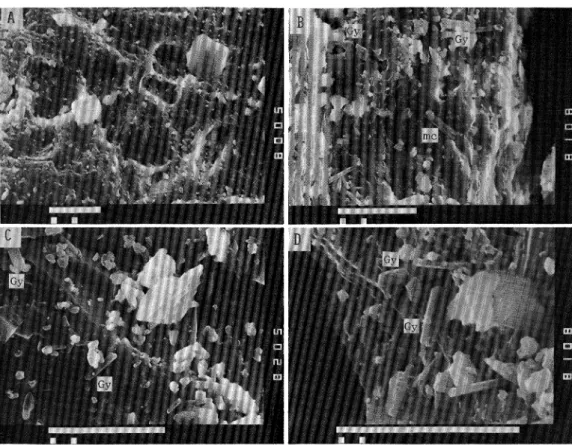
micron or submicron grains in size, of black ashes erupted out in 1980, 1981 and 1982 were examined by the scanning electron microscope. Scanning electron microphot0-graphs are shown in Fig. 12. The following two characteristic features were noted.
(a) Gypsum crystals, which show a long prismatic form with oblique cut at both edges of less than 5 /um in elongation, adhred to the surfaces of the matrix volcanic glass were recogizad (see Gy in B, C and D in Fig. 12).
(b) Many cavities showing that volcanic gases passed through out were apparently
recognized on the surfaces of the matrix volcanic glass. ●
Grain-size distribution
Measurments of the grain-size distibution were made of black ashes erupted out in 1974, 1977 and 1978 and black ash analogous to the red ash erupted out in 1979. For the reason of technical accuracy on the range of grain size, the measurement for the grain-size distribution in a broad range was made at the first step, and, in separate with this, that for the grain-size distribution in a narrow range was made at the second step, and, furthermore, that for the grain-size distribution in a specified narrow range was made at the third step. That is, the measurements were made of the range in grain size from 300 to 0 ^m and the range from 50 to 0 /urn for the black ashes, and, next, the range from 180 to 0 〟m and the range from 10 to 0 〟m for the black ash analogous to the red ash.
Measurement for both the red ash and the white ash was impossible to do on the reason
of too small amount of sample. The measurements were made by Micron-photosizer
SKN-1000 at Seishin Co., Ltd.
1. Grain-size distribution ranging in grain size from 300 toO//m
Grain-size distribution ranging in grain size from 300 to 0 jbtm was measured for
● ●
Table 5. Grain-size distributions ( ≠ <300 urn) of volcanic ashes from Sakurajima Volcano Sample no. 78052301 77052301 741025
Name of ash Black ash Black ash Black ash S.G. 2.48 2.46 2.39 Micron interval AV AR AV AR AV 0 - 10叩1 10 -20 20 - 60 60 -100 一oo-150 1 50-200 200-300 o> (O n * in * o ● ● ● ● ● ● C O 蝣 - O I O O 蝣 - ォ 3 " V O 0 0 O > O li i - C M C M C M f * . P ^ r > -* * o io oo n oo 6 3 1 O r - v o f O ● ● ● ● O C M l > . O IL lLrL IL li r - c o i n c n j l o a ¥ a ●● O co in o i - * * 蝣 V O O O < T > 0 1 1 7 7 7 7 2 2 N * (M O 5 2 1 0 <¥J LT> ● o o - i r > r > . o o r l J h J H 「 H L r = 6 9 1 C O C O t O ● ● ● ● ● ● ● c o o c m v o r > . r * a r - ^ - L f > I * . . O ¥ O 1 (o in s is eg m O C M ォ d " C M t f i O O r - ( M I - N I - I f l ● ● ● ● ● o c m o o 蝣 - m o サ e n
7 70 52 301
7410 2 5
1020 60 一oo 150 200 um
Fig.6. Grain-size accumulation curves ( ≠ < 300 /^m) for black ashes from Sakurajima Volcano. Sample no. 78052301, no. 77052301 and no. 741025 are black ashes eruped out in 1978, 1977 and 1974.
black ashes of 20 gr of sample no. 741025, 40 gr of sample no. 77052301 and 52 gr of sample no. 78052301. The results are tabulated in Table 5, and the grain-size accumula-tion curves constructed from these data are given in Fig. 6. Measured three samples of the black ash, as seen from Fig.6, show to be almost the same in the grain-size distribu-tion. Grains less than 50 /um in grain size occupy 35-39 wt. % in the accumulative ratio in the whole grains less than 300 /Jm.
2. Grain-size distribution ranging in grain from 50 to OMm
Measurements for the range from 50 to 0 jum in grain size of black sahes, 30 gr of
sample no. 77052301 and 50 gr of sample no. 78052301, were made in order to know the grain-size distribution of grains corresponding to cell unit in size. The results are tabu-lated in Table 6, and the grain-size accumulation curves constructed from these data are
Table 6. Grain-size distributions ( ≠ <50 /um) of volcanic ashes from Sakurajima Volcano
Sample no. 78052301 77052301 Name of ash Black ash Black ash S.G. 2.65 2.65 Micron Interval 0.0- 0.5 v爪 0.5- 1.0 1.0- 2.0 2.0- 4.0 4.0- 5.0 5.0- 6.0 6.0-10.0 10.0-20.0 20.0-30.0 30. 0-50.0 2クー一b3一ocmniooO tクーl‖001124′00 rJi O23クー8sssaa.s軸8 0は 124 ′0 0147132670′00 日LU ′Or>サ蝣-o>ォォ蝣02細柑S5SmSS2 ●●1234
7 8 0 5 2 3 0 1
7 70 52 3 0ー
1 5 10 20 30 40 50um
Fig.7. Grain-size accumulation curves ( ≠ <50 //m) for black ashes from Sakurajima Volcano.
given in Fig. 7. Grains ranging from 5.0 to 0.5 〟m corresponding in size to epidermal stoma of plants or pulmonary alveolus of animals occupy 10.5-ll.4 wt. % in the accumlative ratio in the whole grains less than 50.0 /Jm.
3. Grain-size distribution ranging in grain size from 180 toO^m
Measurement for the range from 180 to 0 /Jm in grain size was made of black ash analogous to the red ash of 25 gr of sample no. 79110801. The result is tabulated in Table 7, and the grain-size accumulation curve constructed from the data is shown in Fig. 8, A. Grains less than 10 /Jm in grain size occupy 7.4 wt. % in the accumulative ratio in the whole grains less than 180 jum. Grain size at 50 wt. % in the accumulative ratio denotes about 61 〟m.
Table 7. Grain-size distribution ( ≠ <180 fj.m) of volcanic ash from Sakurajima Volcano
Sample no. 79110801 Name of ash Black ash analogus
to red ash S.G. 2.65 Micron interval 0- 5岬1 5- 10 10- 20 20- 40 40- 50 50- 60 60- 80 80-1 00 100-120 120-150 150-180 m * (Ti OO 1 0 0 ^ O O O O < * C T > O L O < 」 > 0 1 n < J t u > N ォ ) 0 ) 0 ∵■山 rL 6 5 9 9 4 9 9 9 9 9 4 oo i- co o> m o o n o o oj ^a- m vo r^ 00 0 1 2 m L . " r 6 1 u rn ■ ▲ - ▲ A ▲ ■ 10 30 50 4 .2 u m B 一■■■▲一 0 1 5 10 urn
Fig. 8. Grain-size accumulation curves for vol-canic ash from Sakurajima Volcano. Sample no. 79110801, black ash analogous to the red ash. Measured ranges in grain size: A, ≠ 100-0jiimiB, ≠ 10.0-0.Ofxm.
4. Grain-size distribution ranging in grain size from 10 to 0 /im
Measurement for the range from 10 to 0 〟m in grain size for the black ash analogous to the red ash of 25 gr of sample no. 79110801 was made in order to know the grain-size distribution of grains corresponding to cell unit in size. The result is given in Table 8,
and the grain-size accumulation curve constructed from the data is shown in Fig. 8, B. From these, it can be seen that grains ranging from 5.0 to 0.5 /Jm corresponding in size
● ●
to epidermal stoma of plants or pulmonary alveolus of animals occupy 43.3 wt. % in the accumlative ratio in the whole grains less than 10.0 〟m, and 57.6 wt. % in grains less
than 5′.0 〟m.
Besides, the grain-size accumulation curve of Fig. 8, B shows a sharp decreasing in the accumulative ratio between 1.5 and 0.0 /Jm in grain size, no distinctive change in the accumulative ratio in the range from 3.0 to 1.5 //m in grain size, and a positive re-latioship between the grain size and the accumulative ratio in grains ranging in grain size
●
from 10.0 to 3.0 p,
Table8. Grain-size distribution ( ≠ <10 /am) of volcanic ash from Sakurajima Volcano
Sample no. 79110801 Name of ash Black ash anaiogus
to red ash S. G. 2.65 Micron interval AV 0.0- 0.1 ¥∬ 0.1- 0.5 0.5- 1.0 1.0- 2.0 2.0- 3.0 3.0- 4.0 4.0- 5.0 5.0- 7.0 7.0-10.0 0.0004 0.03 0.1779 14.30 0.3297 26.40 0.4228 0.4585 36.70 47.90 0.7182 57.60 0.9433 75,60 1.2477 100.00
Summary and discussions 1. Mechanism of the formation of black, red and white ashes
On the basis of mass color appearance, X-ray diffraction patterns, chemical composi-tion, presence of sepcific constituents and refractive index of minerals, volcanic ashes from Sakurajima Volcano can be classified into four; black ash, red ash, black ash
anal0-■ ●
gous to the red ash, and white ash. Mechanism of the formation of the respective
volca-nic ash will be as follows. (1) Blackash
The whole black ashes erupted out in 1974, 1977, 1978, 1980, 1981 and 1982 have quite the same nature in both mineral and chemical compositions, refractive index and microstructure of constituent materials, X-ray powder diffraction pattern and grain-si^e distribution. With respect to mineral composition, chemical composition and refractive
index of constituent materials, these black ashes are almost the same with or very similar
and lava erupted out in 1946 (Oba and others, 1980a); that is, they correspond to just crushed and pulverized materials of the volcanic bombs or lava. Some of the matrix grains retain the porphyritic texture. The texture as represented by the hyalopilitic
tex-● tex-●
ture is also recognized. Such a fact shows that the matrix grains had formed the ground-mass of volcanic ro丘k before the time when lavas were blasted out into volcanic ash. Irregular shaped-grains with acute angle are abundant.
These facts mentioned above show that the black ashes came from essentially the same substance, and they were ejected out intermittently from the same source under the same environmental condition. That is, it is judged that they came from solidifying
lavas, by which the summit crater of the volcano had been burried, those which were ex-plosively crushed and blown up into volcanic ash by volcanic gas pressure which was
accumulating beneath a volcanic vent.
(2) Redash
Some volcanic ashes such as those which were erupted out in October 1968 and
October 1972 belong to the so-called "red ash" reported by Oba and others (\1980a). The
red ash clearly differs from either of the black ash or the white ash in mineral and chemical compositions, refractive index of constituent minerals and form of grains. That is, in mineral composition, the red ash is few in rock-forming minerals, and, in opposite, abundant in rounded matrix grains showing reddish brown-color owing to the presence of
● ●
iron oxides; in chemical composition, it is poor in FeO, Si02, AI203 and Na20, particular-ly, in FeO, but, in contrast, distinctly rich in Fe20a as compared to the black ash, as shown apparently in the SiOa-Fe2Os/FeO diagram, Fig. 9 ; and a wide range of refrac-tive index, which is not detected in other volcanic ashes, is measured on its matrix volca-nicglass. ●4 ●5 2*サ1 サ 3-7 ●9 oll 55 60 SiO2
Fig. 9. Diagram showing a relationship between the Fe203/TeO ratio and the SiCte-content for the analyzed vol-canic ashes from Sakurajima Volcano. Symbols.-Solid circles, black ashes; solid triangle, red ash; open circle, white ash. Numbers attatched to symbols are accod with those in Table 4.
The fact that a wide range of refractive index is measured of grains of the matrix volcanic glass suggests that the red ash is composed of a mixture of newly erupted vol-canic ash and pre-erupted volvol-canic ash. The fact that the red ash is, in chemical com-position, poor in Si02, AI203 and Na20 as compared to the black ash, appears to indicate that these oxides were leached out from the initial volcanic ash nearby or at the summit crater. The facts that the red ash is distinctly rich in FeaOs, while very poor in FeO, and
that the presence of anhydrite, gypsum and α -cristobalite and the suggested dominant
amorphous silica were detected by X-ray diffraction, show that the red ash before the eruption had been at the environment whdre volcanic gases such as sulfer oxides and
●
hydrogen chloride as well as water are abundant, and that the red ash was subjected to alteration due to heating, oxidation and chemical reaction.
●
Thus, mechanism of the formation of the red ash will possibly be illustrated as fol-lows. A mixture consisting of newly erupted ejecta and pre-existed ejecta at the environ-ment where volcanic gases are abundant, perhaps, nearby or at the summit crater, was affected by heating, oxidation, and chemical action due to volcanic gases, and, as a re-suit, it was subjected to alteration accompanied by the leaching out of various compo-nents and the formation of new minerals.
(3) Black ash analogous to the red ash
Volcanic ashes erupted out in 1979, samples no. 79083001 and no. 79110801, look dark grey tinged with red in mass color appearance. They are, in chemical composition, clearly very rich in Fe2C>3 and poor in FeO, and, in mineral composition, they contain much more the matrix grains showing reddish brown color owing to the presence of iron oxides which denote to tave been subjected to oxidation, as compared to the black ash.
Meanwhile, other natures of the red ash are quite the same as those of black ash. From
the features as pointed out above, they were called "black ash analogous to the red ash" ●
by Oba and others (1980a).
Mechanism of the formation of the black ash analogous to the red ash will possibly
be illustrated as follows: lavas which had been at the summit crater were subjected in part to alteration accompanying with oxidatioP heating and action by volcanic gases for【
a certain period, and, successively, they were explosively占ject占d out. The fact that vol-canic activity represented by the summit eruption accompanying with volvol-canic ash had been in the ceased state throughout the period during from April 30 to August 18, 1979, before the time when the black ash analogous to the red ash, sample no. 79083001, was erupted out, suggests the condition of the formation of the black ash analogous to the red ash or the red ash itself. That is, an possibility attributable to such a condition is that this kind of volcanic ash is ejected out after a ceaed period of the volcanic activity of the
● ●
summit eruption with smoke. ●
(4) White ash
So-called "white ash" (Oba and others, 1980a) erupted out in 1914, sample no. 140111, is different from either of the black ash or the red ash in many respects: the white ash contains abundant colorlss- and irregular shaped-grains with acute angle;
vol-canic glass and hypersthene are higher in refractive index as compared to those of other volcanic ashes; in chemical composition the white ash is somewhat different from the
black ash in the contents of SiC>2, FeO, Fe20s, MgO and CaO; grains of the vesiculated matrix volcanic glass are too much abundant; and X-ray powder diffraction patern sug-gests the presence of the dominant amorphous silica.
Regarding the mechanism of formation of the white ash, the facts mentioned above suggest the followings. Source magma from which the white ash was originated would have had been different in chemical nature from magmas from which volcanic ashes have been erupted out since 1955. At the time when the magma containing abundant volcanic gases would have come up to the crater from magma chamber at depths, and abruptly been pushed out into the atmosphere of relatively lower temperatures and pressures im-mediately through narrow volcanic vents, the adiabatic expansion would have taken place, and, as a result, the white ash composed dominantly of grains in a vesiculated state would have successively been erupted out.
2. Significance of the presence of gypsum in the black ash
As a result of differential thermal analysis and scanning electron microscopy, the
●
presence of gypsum in the black ash was made clear.
(1) Origin of gypsum crystals adhered to the surfaces of volcanic ash-grains
The formation of gypsum was made clear not only in the red ash in which the pre-sence of gypsum was identified before by means of X-ray powder diffraction (Oba and others, 1980a), but also in most common volcanic ashes represented by the black ash. It is readily to understand that volcanic gases such as sulfer dioxide, hydrogen sulfide, hy-drogen chloride and hyhy-drogen fluoride are accompanied with volcanic ash at the same time when the eruption takes place, and, at that time, calcium hydrosulfate, CaSCU-21120,
●
i. e., gypsum, is formed if sulfate anions are combined with calcium cation and water. The fact that gypsum crystals are formed and become to grow up when sulfate anions are
accompanied with native volcanic ash一grains just after the eruption and water and cal-l
cium cation are present, has been observed by one of the authors under the microscope in 1955 (Oba, 1970).
(2) Place where gypsum crystals were formed
If gypsum crystals were formed at or nearby the crater, some of them must have grown up, and, accordingly, an aggregate of gypsum crystals must have become into a mixture of small crystal and big crystal in size. Observation under the scanning electron microscope, however, shows that most gypsum crystals adhered to the surfaces of vol-canic ash-grains are regular crystals less than 5 fxm in size. It is impossible to consider that gypsum was formed at places at temperatures more than 200-C, while it is possible to consider that gypsum was formed at places at temperatures lower than approximately 150 C which is a stability temperature for gypsum at atmospheric pressure. Therefore, it is reasonable to consider that gypsum crystals adhered to the surfaces of black ash-grains were formed while the black ash in a state of smoke was floating and falling down in the
air.
3. Volcanic rock series
Plotting of the analyzed volcanic ashes on Miyashiro's (1974) Si02-total FeO/ MgO diagram, Fig. 10, regarding the general boundary between the calc-alkalic rock series and the tholeiitic series for westerm Pacific island arcs, most of the plots fall with-in a field of the calc-alkalic rock series. For comparison, volcanic rocks and bombs from Sakurajima Volcano are also plotted in the same diagram. The field occupied by the plots of the analyzed volcanic ashes is located away from the field occupied by the plots of volcanic rocks and bombs, except a few cases. It must be that this is originated
in the presence of gypsum adhered to grains of the analyzed volcanic ashes. When the
analyzed volcanic ashes are plotted on the A (Na20+K2O)-F (total FeO)-M (MgO)
dia-gram, Fig. ll, the field occupied by the plots is highly biased in location toward the
apex M against the field occupied by the plots of volcanic rocks and bombs. This comes
from the same reason mentioned above.
ロ ロ ′ ′ KE p/V
<?/#
日 ′ 日 ′′ロ ′ / □ ′ □′′ ′ ● ′ ′ ▲10 0 I 2 Total FeO/MgO 3 4Fig. 10. Plots of the analyzed volcanic ashes from Sakurajima Volcano on MIYASHIRO's (1974) SiCh-total FeO/MgO diagram. Symbols.-Open
squares, volcanic rocks and bombs from
Sakura-jima Volcano; other symbols are the same as thosel
in Fig 9. Analytical data for volcanic rocks and bombs from FUKUYAMA and ONO (1981), TANEDA and MORITA (1958) and YAMAMOTO (1979).
Fig. ll. Plots of the analyzed volcanic ashes from Sakurajima Volcano on the A (NagO +K20) - F(total FeO) - M(MgO) dia-gram. Volcanic rocks and bombs are also plotted for comparison. Symbols are the same as those in Fig 10.
4. Relationship between the mechanism of formation of volcanic ashes and its source magmas
(1) Significance of the presence of the vesiculated matrix volcanic glass
Grains of the vesiculated matrix volcanic glass can frequently be observed in most common volcanic ashes represented by the black ash. Such a fact shows that at the time
when magma which was under the relatively higher temperatures and pressures at depths moved up to the summit crater of the relatively lower temperatures and pressures through a volcanic vent, and was abruptly pushed out and explosively ejected out as volcanic ash into the atmosphere, the adiabatic expansion took place and vesiculation phenomenon occurred at least in part.
(2) Significance of the presence of the brown-colored transparent volcanic glass con-tained in major rock-forming minerals
● ●
Regarding to microstructure in major constituent minerals of volcanic ashes under the microscope, the fact that the brown-colored transparent volcanic glass is contained in a regular arrange町ent within phenocrystic minerals such as plagioclase and pyroxene,
●
suggests that pre-crystallized major rock-forming minerals had been subjected to remelt-ing in part at magma chambers at depths, and, as a result, the brown-colored transparent ●
volcanic glass had been formed under the condition controlled by crystal structure of the rock-forming minerals (Oba and others, 1981) before the time when magmas, from which volcanic ashes were originated, attained at the summit crater.
(3) Discontinuity in time and space in crystal growth of plagioclases
Plagioclases, composing of a core plagioclase with many inclusions of the
brown-● brown-● brown-● brown-●
colored transparent volcanic glass and a fresh and clear margin of plagioclase without the same kind of inclusion, are recognized in volcanic ashes (Oba and others,1981). Such a fact shows that clearly there was discontinuity in time and space, as well as in
● ●
composition, during the processes of crystallization of plagioclase; and, at the same time, ●
it suggests that there was discontinuity in time and space at the magma environment ● ●
where plagioclase was crystallizing out. ● ●
Influences of volcanic ash to the environments
1. Influences due to volcanic ash to the natural and socical environments
Major two factors, i. e., physical factor and chemical factor, are deeply concerned to
the influences due to volcanic ash, as represented by dying down of fluits and atrophy die of silkworm, giving to the natural and social environments, e. g., plants, industries and civic life.(1) Physical factor due to volcanic ash by which the environments are affected (a) Physical factor due to volcanic ash
Physical foctor due to volcanic ash by which the environments are affected is attrib-uted to the substantial nature and grain size of volcanic ash. If components of volcanic gases adhered to or accompanied with volcanic ash are ignored, volcanic ash erupted out
●
from Sakurajima Volcano is that which is composed of grains, essentially, of silicates.
● ●
Micrograins ranging in grain size from 5 to 2 /utm those which correspond in size to
epidermal stoma of plants or pulmonary alveolus of animals are contained in volcanic
ash. When such the micrograins are adhered to and fill epidermal stomata of plants,
pul-monary alveoli of animals, etc., as a result, respiration is stopped or hypo function occurs. ●
en-vironments, where every kinds of materials and goods, such as various precision instru-merits and machines, are subjected to undesirable influence.
(b) Amount of micrograins ranging in grain size from 5.0 to 0.5 〟m in volcanic ash The result of the measurements of grain-size distribution those of which were made of three black ashes erupted out in 1974-1978, shows that grains less than 10 /Jm in grain size occupy about 3-4 wt. % in the accumulative ratio in the whole grains less than 300 jum at maximum (Oba and others, 1980). The result of the measurement of grain-size distribution that of which was made of the range in grain grain-size from 180 to 0 〃m for the black ash analogous to the red ash erupted out in 1979, consisting of grains less than
●
250 jum at maximum, shows that grains less than 10 jum in grain size occupy 7.4 wt. % in the accumulative ratio. The result of the measurement for the range in grain size from 10 to 0 /Jm of the same sample, shows that micrograins ranging in grain size from 5 to 0 /Jm
● ●
occupy about 58 wt. % in the accumulative ratio. From these, it may possibly be said that micrograins, ranging in size from 5.0 to 0.5 jura, those which correspond to
●
epidermal stoma of plants or pulmonary alveolus of animals in cell unit, occupy approx-imately 2.0-1.5 wt. % in the accumulative ratio in volcanic ash consisting of grains less
●
than 250 urn at maximum.
(2) Chemical factor due to volcanic ash by which the environments are affected (a) Chemical factor due to volcanic ash
Chemical factor due to volcanic ash by which the environments are affected is attri-buted to the presence of and action by volcanic gases accompanied with volcanic ash. Volcanic gases, such as S02, H2S, Cl, F, etc., are always accompanied by native volcanic ash just after the eruption. They are adhered to surfaces of grains of volcanic ash and readily combined with the coexisting water while they are floating and falling down in the air, and immediately converted into acids such as sulfric acid, hydrochloric acid, etc. They also form acids on moisturized epidermis of plants and respiratory organs of
ani-■
mals. Thus, the functions as to be the organisms are lowered or disordered by action of
acids. In addition to this, volcanic gases and its accompanying volcanic ash一grains in ●
micron unit invade into every environments, and, as a result, every kinds of materials and goods, such as metals and plastics, are subjected to the depletion and decaying. Thatis, it must be said that volcanic gases play just the same role as the so-called " rain which accelerates the depletion and decaying in materials.
(b) Volcanic gases adhered to volcanic ash-grains
An accompanying of volcanic gases to native volcanic ash-grains just after the
erup-● erup-●
tion is.apparent from the fact that the presence of microcrystals of calcium hydrosulfate, i- e-> gypsum, those of which are formed on surfaces of volcanic ash-grains, was identified by differential thermal analysis and scanning electron microscopy in most common VOL
●
canic ashes represented by the black ash.
Ossaka and Ozawa (1975) showed that fresh volcanic ash-grains are accompanied by unexpectedly abundant volcanic gases, that is, the content of SO4 soluble in water attains to 208 mg/kg at the lowest and 13,000 mg/Kg at the highest, and the content of
Cl to 18.4 mg/Kg at the lowest and 2,800 mg/Kg at the highest in regard to volcanic ashes erupted out in 1975 from Sakurajima Volcano.
● ●
The amount of components of volcanic gases adhered to the surfaces of volcanic ash-grains is acceleratedly increased at the square of the radius of grain. The fact that
●
the farm products were subjected to much more serious damge by the red ash than by the black ash, will possibly be illustrated to depend on the grain size of volcanic ash-grains, that is, on the reason that constituent一grains of the red ash are smaller in grain size as compared to those of the black ash, and, accordingly, components of volcanic gases accompanied with the red ash had been much more abundant in amount.
∫
2. Influences due to volcanic ash to farm products and human body (1) Influences due to volcanic ash to farm products
When micrograins ranging in grain size from 5 to 2 /um in volcanic ash are adhered to and fill epidermal stomata of plants, the respiratory organs are lost. At the same time, when acid volcanic gases, such as sulfer oxides and hydrogen chloride, accompanied
with native volcanic ash一grains just after the eruption, are combined with the coexisting ● ●
water during floating and falling down in the air or with water on the moisturized ● ●
epidermis of plants and converted into acids, the respiratory organs of epidermal stomata are lowered or disordered. Thus, farm products are resulted into killing down by a com-posite factor of the physical factor in the former and the chemical factor in the latter. (2) Influences due to volcanic ash to human body
Native volcanic ash just after the eruption is essentially a mixture of silicate grains
●
and acid volcanic gases such as sulfer oxides and hydrogen chloride. Accordingly, most simply speaking, it will possibly be said that it is a mixture of micro fragments of silicate glass and acids such as sulfric acid and hydrochloric acid.
When the fact that a certain amount of grains in micron unit as almost the same as
〟m of the pulmonary alveolus is contained in volcanic ash is taken account, and if it is supposed that man inspires uninterruptedly a considerable amount of volcanic ash every day for many years, man showing respiratory deceases such as silicosis and/or pneumoconiosis or their analogous deceases will certainly come out, while man showing
●
a condition symptoma of a decease caused by acid volcanic gases may also possibly come out, though an influence caused by volcanic ash on the human body has basically been uncertain. The former depends on the physical factor, while the latter on the chem-ical factor, due to volcanic ash. In general, however, man will be affected by a com-posite factor of the physical factor and the chemical factor due to volcanic ash.
Acknowledgements
Many thanks are given to Mr. T. Sakurai and Mr. S. Kijima for their presentation of unusual volcanic ashes; and to Dr. S. Nawata, Emeritus Prof, of Kagoshima University,
●
for his useful suggestions from the point of view of medical science. Thanks are also given to Prof. K. Yunoki, Prof. H. Tagawa, Dr. J. Yukawa and Dr. T. Higashi,
Kagoshi-ma University, for their suggestions in improvemens of terms in medical, botanical and zoological sciences. This work was finacially supported in part by the Conference for Scientific Research of Sakurajima Volcano, organized by Kagoshima Prefectural
Govern-● Govern-●
ment.
References
Fukuyama, H., and Ono, K. (1981): Geological map of Sakurajima Volcano, 1:25,000. Geological
Sur-veyoHapan.
MIYASHIRO, A. (1974): Volcanic rock series in island arcs and active continental margins. Am. Jour. Sci.,
vol. 274, p. 321-355.
Nagasawa, R., and ()ba, N. (1959): Fumaroles and geological structure in Showa-lava zone, Kurokami, Volcano Sakurajima. Sci. Repts., Kagoshima Univ., no. 8, p. 127-146
Oba, N. (1970): Birth of rock: IV, mechanism of formation and transition in minerals and rocks. Jour. Assoc. Earth Sciences of Kagoshima, no. 34, p. 7-16
Oba, N., Tomita, K., Yamamoto, M., Inoue, K., and Ohsako, N. (1980): Physicochemical nature of vol-canic ashes erupted out during 1977-1979 from 'Sakurajima Volcano, Japan. Repts. Conference for Scientific Research of Sakurajima Volcano, Japan, p. 75-88* *
Oba, N., ToMITA, K., Yamamoto, M., Ohsako, N., and Inoue, K. (1980a): Mineral and chemical composi-tions, and mechanism of formation of volcanic ashes from Sakurajima Volcano, Kyushu, Japan. Jour. Japan. Assoc. Mineralogists, Petrologists, Econ. Geologists, vol. 75, p. 329-336
Oba, N., Tomita, K., Yamamoto, M., Ohsako, N., and Inoue, K. (1980b): Nature and origin of black ash, red ash and white ash from Sakurajima Volcano, Kyushu, Japan. Rep. Fac. Sci., Kagoshima Univ., no. 13,p. ll-27"
Oba, N., Yamamoto, M., Tomita, K., Ohsako, N., Inoue, K., and Nakamura, T. (1981): Constituent materials, nature and mechanism of formation of volcanic ashes erupted in 1979-1980 from
Sakura-jima Volcano, Japan. Rep. Fac. Sci., Kagoshima Univ., no. 14, p.ト19*.
Ossaka, J., and Ozawa,T. (1975): Chemical compositions of volcanic gases from Sakurajima Volcano. Repts. Cooperative Research for Sakuraiima Volcano, Decmber 1974-March 1975, p. 62-66"
Taneda, S., and Morita, J. (1958): New bomb of the Sakurajima Volcano. Jour. Japan. Assoc. Miner-alogists, Petrologists, Econ. Geologists, vol. 42, p. 202-203*
Yamamoto, M. (1979)‥ Estimation of temperature of magma reservoir of Sakurajima Volcano by volcanic bomb. Rep. Fac. Sci., Kagoshima Univ., no. 12, p. 33-38'
Fig. 12. Scanning electron microphotographs of microstructure and gypsum crystals on the surfaces of grains of black ashes from Sakurajima Volcano. Bars represent 10 /im. Taken by K. TOMITA.
A. Cavities, showing that volcanic gases passed through out, in the matrix volcanic glass. Sample no. 80051101.
B. The presence of gypsum crystals (Gy) less than 5 /Jm in size of elongation adhered to the surface of the ma-trix volcanic glass with cavities, which show that volcanic gases passed through out, is noted. Microlites (me) are also observed. Sample no. 81081901.
C. Gypsum crystals (Gy), showing a long prismatic form with oblique cut at both edges, less than 3 〟m in size of elongation are recognized on the surface of the matrix volcanic glass with cavities which show that vol-canic gases passed through out. Sample no. 820524.
D. Close up of gypsum crystals (Gy) on the surface of the matrix volcanic glass with cavities. Sample no. 81081901.