Imperfect Competition and Costly Screening in
the Credit Market under Conditions of
Asymmetric Information
著者
Kubo Koji
権利
Copyrights 日本貿易振興機構(ジェトロ)アジア
経済研究所 / Institute of Developing
Economies, Japan External Trade Organization
(IDE-JETRO) http://www.ide.go.jp
journal or
publication title
IDE Discussion Paper
volume
15
year
2004-11-01
INSTITUTE OF DEVELOPING ECONOMIES
Discussion Papers are preliminary materials circulated to stimulate discussions and critical comments
DISCUSSION PAPER No. 15
Imperfect Competition and Costly
Screening in the Credit Market under
Conditions of Asymmetric Information
§Koji Kubo
†November 2004
AbstractThis article provides an analysis of how banks determine levels of information production when they are in imperfect competition and there is a condition of information asymmetry between borrowers and banks. Specifically, the study concentrates on information production activities of banks in duopoly where they simultaneously determine intensity of pre-loan screening as well as interest rates. The preliminary model of this paper illustrates that due to strategic complementarities between banks, banking competition can result in inferior equilibrium out of multiple equilibria and insufficient information production. Policymakers must take into account the possible adverse effects of competition-enhancing policies on information production activities.
Keywords: Banking, Imperfect competition, Information production JEL classification: D82, G21
§ An earlier version of this paper was presented at the 2004 Spring Meeting of the Japanese Economic Association. The author would like to express gratitude to Keiichi Hori (Ritsumeikan Univ.) for helpful comments. The author alone is responsible for any remaining errors.
† Research Fellow, International Economics Studies Group, Development Studies Center, IDE ([email protected])
The Institute of Developing Economies (IDE) is a semigovernmental, nonpartisan, nonprofit research institute, founded in 1958. The Institute merged with the Japan External Trade Organization (JETRO) on July 1, 1998. The Institute conducts basic and comprehensive studies on economic and related affairs in all developing countries and regions, including Asia, Middle East, Africa, Latin America, Oceania, and East Europe.
The views expressed in this publication are those of the author(s). Publication does not imply endorsement by the Institute of Developing Economies of any of the views expressed.
INSTITUTE OF DEVELOPING ECONOMIES (IDE), JETRO 3-2-2, WAKABA,MIHAMA-KU,CHIBA-SHI
CHIBA 261-8545, JAPAN
Imperfect Competition and Costly Screening in the Credit Market under Conditions of Asymmetric Information
INTRODUCTION
It has been observed in both developed and developing countries that faster loan growth coincides with higher loan losses in the banking industry. Examples include Thailand in the middle of the 1990’s, Scandinavian countries in the early 1990’s, and Japan in the late 1980’s. In the literature of financial crises, such phenomena are often attributed to financial liberalization and the moral hazard of banking1. This paper suggests imperfect competition as the background of higher loan losses in the aftermath of lending booms. From this viewpoint, it can be argued that when the economy is in a boom period and banks compete in expanding loans, competition may lead banks to reduce costly information production on borrowers in order to undercut rivals. This then results in higher loan losses.
This study concentrates on information production activities of the banks in imperfect competition as viewed within the framework of the Hotelling-Bertrand duopoly model. Not only do banks simultaneously set interest rates, but they also interact strategically to determine the intensity of pre-loan screening in the presence of information asymmetry on the borrower’s business risk. Intensifying pre-loan screening improves the quality of the loan portfolio by allowing the bank to distinguish good from bad projects. At the same time, such screening creates deterioration in the quality of the pool of applicants of the rival bank ceteris paribus because then low
1 McKinnon and Pill [1998] provides a theoretical analysis; Demirguc-Kunt and Detragiache [2001] as well as Hutchison and McDill [1999] provide an empirical analysis.
quality rejected firms are likely to flow to the rival bank.
There is a trade-off when intensified pre-loan screening is costly, and banks redirect a part of the costs on the lending interest rate. While intensified screening improves the quality of the loan portfolio, the associated rise in the interest rate to cover the costs of this screening decreases the bank’s share of the credit market. Often, one bank may choose strategies in consideration of similar strategies on the part of its rival. Such strategic complementarities between banks can bring about multiple equilibria, and may also result in inferior equilibrium in terms of social welfare in situations where sufficient information production activities are not undertaken. In such cases, policy intervention is required to improve social welfare.
The bulk of literature on the analyses of credit markets under uncertainty and imperfect competition focuses either on information problems or on imperfect competition2. Among the relatively few studies that address both information problems and interaction of bank strategies3, some attention has been given to pre-loan screening by banks and to the externalities of one bank’s strategies on those of others. Broecker [1990] studied the relation between the number of banks in the market and their profitability. He viewed cases where banks perform imperfect pre-loan screening on loan applicants, and rejected applicants can hang around to apply repeatedly to other banks. In such cases, he found that an increase in the number of banks would make the quality of the pool of applicants for individual banks worse, and this in turn would lead
2 For a comprehensive survey of the literature, see Freixas and Rochet [1997]; Chapter 3 concerns imperfect competition and Chapter 5 includes information problems in credit markets. The adverse selection problem is usually discussed with either a monopolistic bank or a perfectly competitive market, so the interaction of banks is out of consideration. Examples include Besanko and Thakor [1987], and Stiglitz and Weiss [1981]. In the analyses that concentrate on interaction of banks, the information problem is often subtracted as in Chiappori et al. [1995] and Yanelle [1997].
3 Among others, Dell’Ariccia [2001] and Villas-Boas and Schmidt-Mohr [1999] fall into this category.
to deterioration in the quality of loan portfolios and profitability of banks. Shaffer [1998] and Hyytinen [2003], among others, took into account standardized credit scoring and the common database among banks on borrowers. They extended the above analysis by looking at the correlation between screening processes of individual banks and the impacts of such correlation on borrower behavior. While they succeeded in clearly representing the strategic interaction of banks in the presence of adverse selection, their analyses handled screening intensity as exogenous.
This study treats the intensity of the pre-loan screening as endogenous, and seeks to shed light on information production of banks under imperfect competition4. With similar interest, Gehrig [1998] compared equilibrium intensity of pre-loan screening in monopolies and in duopolies. He argued that introducing competition might lead to sub-optimal screening intensity. In his analysis, however, competition in duopoly simply results in the Bertrand competition of zero-profit equilibrium with no costly screening. In contrast, the present study illustrates the relation between screening intensity and the costs and accuracy of screening. It seeks to confirm the conditions for equilibrium with sufficient information production.
This article is organized as follows; Section 1 describes the background of the model. Section 2 involves the derivation of equilibrium with banking competition and evaluates the stability of such equilibrium. A comparison of the level of equilibrium from the viewpoint of social welfare is also given. Section 3 concerns the relation of information production with economic conditions and the intensity of competition, indicating that, competition enhancing policies can be associated with
4 Hauswald and Marquez [2003] deal the similar problem, while they apply the framework of auction game. Investing in pre-lending screening leads the bank to information advantage, and allows her to avoid ‘winner’s curse’ in lending rate bids. The bank with the information advantage would acquire positive profits. However, their analysis does not comprise the adverse selection problem.
loan growth and insufficient information production. This section also explores a possible policy scheme to prevent the banking competition from sticking to inefficient equilibrium with insufficient information production. Section 4 includes a summary and conclusion.
1. MODEL
1.1 Environment
The credit market is viewed within the framework of the Hotelling-Bertrand competition model. In this model, there are two banks and a continuum of firms. The number of firms is normalized to unity, and firms are thus distributed uniformly on a line of length one. A bank is located at each end of the line. All agents have risk-neutral preference.
1.2 Firms
Each firm has a project that requires one unit of good as input. Firms do not possess any funds, so they apply for loans from banks in order to finance their projects. Projects are completed in one period. When a project is successful, it yields λ (λ >1) units of goods. When it fails, the output is zero. There are two types of firms, good and bad. The probability of success for the projects of a good type firm is one. The probability of success for a bad type firm is p, and its probability of failure is 1-p. The bad type’s project is not viable5. For simplicity of analysis, we assume p≅0.
5 That is, p⋅λ <1<λ. Nonetheless, under limited liabilities, bad type firms have a demand for loans since their expected profits in the success state are positive.
Knowledge of whether a firm is good or bad is private. A firm is aware of whether it is a good or bad type, but others do not know this information. The proportion of good types and bad types in the population is represented by θ:(1−θ), and this is common knowledge. Both good and bad type firms are distributed uniformly on the line. The parameters λ and θ can be regarded as indicators of the economic condition; a boom period is associated with higher λ and θ.
1.3 Banks
Two banks compete with each other in the credit market by setting lending interest rates simultaneously. However, they can acquire deposits perfectly elastically at the exogenous deposit interest rate r .d 6 Banks also simultaneously choose the intensity of pre-loan screening. For clarity of analysis, the choice is restricted to be binary (screening or no-screening). Pre-loan screening enables banks to distinguish good projects from bad ones. However, the screening technology is imperfect. While good type firms are always identified correctly, a proportion ε (0≤ε <1) of bad type firms are misidentified as good type firms. The cost of screening for each firm is α (α >0), regardless of its true type.
Following Chiappori et al. [1995] and Villas-Boas and Schmidt-Mohr [1999], it is assumed that from the borrower’s perspective, borrowing incurs a transaction cost per unit of loan (i.e., traveling cost), and this cost is in proportion to its distance with a creditor. Denoting the distance between a firm and that firm’s creditor bank with d, the transaction cost is depicted as , where t is the coefficient of transaction costs. The following relation is assumed between this coefficient and screening costs;
d t⋅
6 In the context of a small open economy, the exogenous deposit interest rate would be considered the foreign interest rate.
t
⋅ <θ α
3 . (A1)
This condition implies that the screening cost is relatively small compared with the transaction cost. Further, it is assumed that transaction costs emerge at the time of repayment, but a loan application does not cost a firm anything. Finally, when the loan application of a bad type firm is rejected by a particular bank, it can apply to the other bank, because information acquired through screening is not shared between the two banks in any credible way. Still, it cannot apply again to the bank that has rejected it once.
2 EQUILIBRIUM ANALYSIS
This study focuses on equilibrium of banking competition with pure strategies.
2.1 Three States of Banking Competition
As screening is costly, banks will make a strategic decision as to whether or not they want to carry it out. Accordingly, three states are possible; (1) both banks do not carry out screening, (2) both banks carry out screening, and (3) one bank carries out screening while the other does not. Firms conjecture credit examination policies of two banks by looking at the interest rates they offer.
(1) Non-screening Equilibrium
of any firm type. The lending interest rate of the bank on the left (right) side of the line can be denoted as ( ). A firm may compare the lending interest rates of two banks as well as the distance with banks. That firm may then choose the bank on the left (Bank L) when the effective cost is the lower than if it borrowed from Bank R;
L r rR )] 1 ( [ ) (rL +t⋅dL ≥ − rR +t⋅ −dL − λ λ , (1)
where dL (0<dL <1) is the distance between the firm and Bank L, and is the transaction cost when the firm borrows from Bank L. Solving (1) with respect to yields L d t⋅ L d 1 2 0< = + − < t r r t d R L L . (1’) L
d can be interpreted as Bank L’s share in the credit market. This share increases as a
function of the rival bank’s lending rate, and it decreases relative to its own lending rate.
Bank L’s profit function can be described as follows;
L d L d L L ≡ ⋅ r −r + − ⋅ p⋅r −r ⋅d Π [θ ( ) (1 θ) ( )] , (2 a)
where r is the exogenous deposit interest rate, d θ is the proportion of good type firms in the population, and p is the probability of success for a bad type firm. Analogously, Bank R’s profit function can be described as
) 1 ( )] ( ) 1 ( ) ( [ L d R d R R ≡ ⋅ r −r + − ⋅ p⋅r −r ⋅ −d Π θ θ . (2 b)
Banks maximize their profit with respect to lending interest rates. Deriving the reaction function of each bank, the equilibrium lending interest rate and profits are calculated as
follows: θ θ θ d d R L r t p r t r r ≅ + ⋅ − + + = = ) 1 ( , 2 2 ] ) 1 ( [ p t t R L ⋅ ≅ ⋅ ⋅ − + = Π = Π θ θ θ .
The approximation is based on the assumption that p≅0. It can be seen that the lending interest rate rises proportionally with the coefficient of transaction costs, t. This coefficient can be interpreted as an indicator of the oligopolistic market power of each bank. The higher t is, the higher the oligopolistic profits of the bank. The lower θ, the higher the lending interest rate.
(2) Screening Equilibrium
When both banks carry out pre-loan screening, they can distinguish the bulk of bad type from good type firms and reject unprofitable loan applications. However, those firms that are rejected by one bank will apply to the other bank. Taking into account such re-applications of bad type firms, the profit function of Bank L is described as
) 1 ( ] ) ( [ ) 1 ( ) 1 ( ] ) ( ) ( ) 1 [( L d L L d L d L L= − ⋅ ⋅ p⋅r −r + ⋅ r −r − ⋅d + − ⋅ − ⋅ ⋅ p⋅r −r − ⋅ −d Π θ ε θ α θ ε ε α (3) The first term refers to the profits from those firms who first apply to Bank L. It includes deficits relative to bad type firms, profits made from good type firms and screening costs. The second term refers to deficits due to bad type firms who are rejected first by Bank R. The equilibrium interest rate and profits are derived next;
α θ ε θ θ θ ε θ θ ⋅ ⋅ − + + ⋅ ⋅ − + + ≅ = (1 ) 2 d (1 ) R L r t r r , ) ( ) 1 ( ) 1 ( 2 θ ε ε α θ⋅ − − ⋅ − ⋅ ⋅ + ≅ Π = Π d R L r t .
It can be seen that banks redirect the costs of funds and screening into the lending rate. In comparison with non-screening equilibrium, the lending rate can be higher or lower depending on the cost of screening relative to the deposit rate, the accuracy of screening, and the proportion of good types in the population of firms. The profits of banks are unambiguously smaller in screening equilibrium than in that of non-screening equilibrium.
(3) Asymmetric Equilibrium
In this state, bad type firms tend to concentrate on the non-screening bank, while the screening bank raises the lending rate and looses a portion of good type borrowers. For bad type firms, the order of applying to the two banks depends on the following inequality; )] 1 ( [ )] 1 ( [ ) 1 ( ) ( rS t dS p rN t dS p rN t dS p⋅ − − ⋅ + − ⋅ ⋅ − − ⋅ − ≥ ⋅ − − ⋅ − ⋅ λ ε λ λ ε (4) Subscripts S and N refer to the screening bank and the non-screening bank, respectively. LHS indicates that a bad type first applies to the screening bank, and with the probability of 1−ε it is rejected and then re-applies to the non-screening bank. RHS shows the expected profits of directly applying to the non-screening bank. When the inequality holds, a bad type first applies to the screening bank. Rearranging terms yields the same expression as (1’). For good type firms, the share of the screening bank
is also given as t r r t d N S S 2 − + = .
From these, the profit function of banks can be formulated;
S d S d S S = ⋅ r −r − + − ⋅ ⋅ p⋅r −r − ⋅d Π {θ ( α) (1 θ) [ε ( ) α]} , (5a) S d N S d N d N N = ⋅ r −r + − ⋅ p⋅r −r ⋅ −d + − ⋅ − ⋅ p⋅r −r ⋅d Π [θ ( ) (1 θ) ( )] (1 ) (1 θ) (1 ε) ( ) , (5b) where and represent the profits of the screening bank and non-screening bank, respectively. First order conditions are
S Π ΠN 0 2 ] ) 1 ( [ 2 ) ( = ⋅ ⋅ − + − − ⋅ − ⋅ − + = ∂ Π ∂ t r r t r r t r d S S N S S θ θ α θ θ ε , (6a) 0 2 ] ) 1 ( [ 2 ) ( + − ⋅ − ⋅ − + − ⋅ ⋅ = = ∂ Π ∂ t r r t r r t r d N N S N N θ θ θ θ ε . (6b)
Each bank sets the lending rate at a level that will make the sum of the marginal increase in the revenue from individual loan contracts equal with the marginal cost that is associated with a decline in market share. Due to screening cost α, the marginal return per market share is smaller for the screening bank. In other words, the marginal cost associated with a decline in market share is smaller for the screening bank. In contrast, the non-screening bank eventually accepts the bulk of the bad type firms regardless of the interest rate it offers. Therefore, when it comes to the marginal cost of a decline in market share, it is higher than that of the screening bank. As a result, the non-screening bank sets the lending rate lower than that of the screening bank.
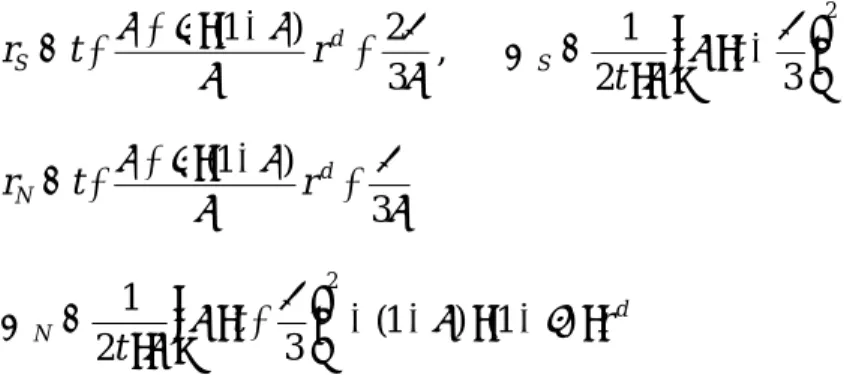
Solving the problem yields the equilibrium lending rates and profits of the two banks:
θ α θ θ ε θ 3 2 ) 1 ( − + ⋅ + + ≅ d S t r r , 2 3 2 1 ⎟ ⎠ ⎞ ⎜ ⎝ ⎛ ⋅ − ⋅ ≅ Π θ α θ t t S θ α θ θ ε θ 3 ) 1 ( − + ⋅ + + ≅ d N t r r , d N t r t ⎟⎠ − − ⋅ − ⋅ ⎞ ⎜ ⎝ ⎛ ⋅ + ⋅ ≅ Π (1 ) (1 ) 3 2 1 θ α 2 θ ε θ
Because of the lower lending rate, the non-screening bank acquires the larger market share. However, bad type firms tend to concentrate on this non-screening bank, and the net effects on profits depend on the cost and accuracy of screening, α and ε.
2.2 Nash Equilibrium
Nash equilibrium can be selected among the above-listed equilibria. Banks’ payoff in each state is summarized in the following matrix.
Table 1. Banks’ Payoff Matrix
Bank R
N (No screening) S (Screening)
N
(
ΠNN ΠNN)
(
ΠNS ΠSN)
S(
ΠSN ΠNS)
(
ΠSS ΠSS)
B an k LNote: The payoff in each state is depicted in the order of (Bank L, Bank R).
2 t NN ⋅ ≅ Π θ , 2 3 2 ⎟⎠ ⎞ ⎜ ⎝ ⎛ − ⋅ ≅ Π θ α θ t t SN ,
d NS t r t ⎟⎠ − − ⋅ − ⋅ ⎞ ⎜ ⎝ ⎛ + ⋅ ≅ Π (1 ) (1 ) 3 2 2 ε θ θ α θ , ) ( ) 1 ( ) 1 ( 2 θ ε ε α θ⋅ − − ⋅ − ⋅ ⋅ + ≅ Π d SS r t .
It can be seen that the relation ΠNN >ΠSN always holds. That is, when a bank does not carry out screening, the other bank will not carry out screening, either. Given this, two cases can be considered: First, when α is large and ΠNS >ΠSS, non-screening is the dominant strategy and non-screening equilibrium is Nash equilibrium. Second, when α is small and , both non-screening equilibrium and screening equilibrium are Nash equilibrium.
NS SS >Π
Π
The condition of multiple equilibria, ΠSS >ΠNS, is equivalent to
(
)
d r t t⋅ ⋅ ⋅ ⋅ + + − ⋅ − ⋅ < − ⋅ − ⋅ 2 2 ) 1 ( ) 1 ( ) 1 ( ) 1 ( 6 18 1 α θ α θ ε α θ ε θ . (7)Substituting Assumption (A1) yields
(
)
d r t t ⎥⎦⋅ < − ⋅ − ⋅ ⎤ ⎢⎣ ⎡ + − ⋅ − < ⋅ − ⋅ − + + ⋅ ⋅ ⋅ ⋅ 2 2 ) 1 ( ) 1 ( ) 1 ( ) 1 ( 3 10 ) 1 ( ) 1 ( 6 18 1 α θ α θ ε α θ ε α θ ε θ . (7’) In the second inequality, rearranging terms results in the following:) 1 ( ) 1 ( 3 10 ) 1 ( ) 1 ( 2 ε θ ε θ α − ⋅ − + − ⋅ − < d r . (7”)
It can be confirmed that ⎟<0 ⎠ ⎞ ⎜ ⎝ ⎛ ∂ ∂ d r α ε and ⎟⎠<0 ⎞ ⎜ ⎝ ⎛ ∂ ∂ d r α
θ . As a whole, these suggest that the case of multiple equilibria (both screening and non-screening equilibrium are Nash equilibrium) is likely to take place when the cost of screening relative to the
deposit rate is low, the accuracy of screening is high (i.e., smaller ε), or when the proportion of good type firms is high.
2.3 Welfare Analysis
An important issue in this analysis is efficiency of equilibrium in terms of social welfare. Defining social welfare as the sum of profits of both banks and firms, social welfare in non-screening and screening equilibrium can be calculated.
The social welfare of the two equilibria can be compared implicitly by weighing the costs of screening against loan losses from wasteful lending to bad type firms. When both banks do not carry out screening, the aggregated loan loss of the two banks is . On the other hand, when both banks carry out screening, the aggregate loan loss is reduced to while screening incurs costs of
d r ⋅ − ) 1 ( θ d r ⋅ ⋅ − ⋅ − + −θ) (1 θ) (1 ε)] ε 1 [( α ε θ θ θ+(1− )+(1− )⋅(1− )]⋅
[ for the two banks as a whole. Weighing losses and
costs, screening equilibrium is associated with higher social welfare on the condition that ) 1 ( ) 1 ( 1 ) 1 ( ) 1 ( 2 ε θ ε θ α − ⋅ − + − ⋅ − < d r . (8)
In other words, this inequality indicates the range where screening technology saves more than it costs. Similar to the condition of multiple equilibria (7”), it can be confirmed that with regard to (8) ⎟<0
⎠ ⎞ ⎜ ⎝ ⎛ ∂ ∂ d r α ε and ⎟⎠<0 ⎞ ⎜ ⎝ ⎛ ∂ ∂ d r α θ . From (7”) and (8), efficiency of equilibrium can be summarized in Figure 1.7 In this figure, the horizontal axis is α rd . A higher α rd is associated with non-screening equilibrium. The shaded range represents Inequality (8). As far as this shaded area is concerned,
7 From (A1), in terms of d
r
non-screening equilibrium is possible and it is inferior equilibrium.
Figure 1. Efficiency of Equilibrium
Multiple equilibria ((7”) holds.)
Non-screening equilibrium ((7”) does not hold.)
d r α ) 1 ( ) 1 ( 1 ) 1 ( ) 1 ( 2 ε θ ε θ − ⋅ − + − ⋅ −
In summary, screening technology is said to be efficient when the cost of screening α is low in relation to the deposit rate, accuracy of screening, and the proportion of good types in the population of firms. In this case, non-screening equilibrium is inferior equilibrium in terms of social welfare.
3 POLICY ANALYSIS
The previous analysis shows that banking competition may result in insufficient utilization of screening technology. However, not only economic conditions but also policies to enhance market competition between banks may produce such less information production. After providing support for this proposition, a policy termed the “interest supplementation scheme” is proposed. This scheme is designed to prevent bank competition from being bound to inferior equilibrium.
3.1 Competition-enhancing Policies and Information Production
From the view of the social welfare, banks may undertake pre-loan screening in less than the optimal levels due to competition. Such circumstances are associated with not only economic booms but also policies implemented to enhance competition between banks. With regard to Inequality (1), both of the two banks are monopolistic if the following holds; 2 1 ˆ 0 0 ) ˆ * ( < < = ⋅ + − d t d r λ (9)
The term r* is the equilibrium lending rate, and represents the share of banks. In this case, the credit market is divided, and two banks do not compete directly. Further, there is no divergence between the optimizing behavior of a monopolistic bank and the choice of screening intensity from the social welfare viewpoint. A monopolistic bank will always undertake screening as long as the screening technology is efficient enough to satisfy the following:
dˆ ) 1 ( ) 1 ( θ ε α < − ⋅ − d r . (10)
In other words, banks can completely utilize screening technology in the monopolistic state. This is because banks can fully redirect the costs of screening to borrowers without fear that competitors will erode market share.
Solving the monopolistic bank’s problem, (9) can be rewritten as;
. (9’) θ θ λ⋅ − < ⋅ < rd t 0
monopoly and fully make use of screening technology. Thus, it is quite possible that economic slowdowns (i.e., lower productivity and smaller proportion of good types in the population of firms) give rise to bank monopolies as well as sufficient information production. Nonetheless, monopolistic equilibrium is accompanied by social costs. Although information production is sufficient, the supply of loans is smaller in a monopolistic equilibrium than in a competitive one. Fewer firms can receive loans in a monopolistic equilibrium.
In contrast, when the economy is in a boom (i.e., higher λ and θ and (9’) is )
not satisfied, banking competition emerges, and this may result in less information production. Analogously, policies to enhance competition and curtail the oligopolistic power t of each bank would invite competition. On the one hand, such competition-enhancing policies would increase the supply of loans relative to a monopolistic state. On the other hand, such policies might destabilize the banking sector because information production activities might be reduced under competition, and this could result in higher loan losses.
3.2 Interest Supplementation
A public intervention scheme can be considered that is designed to prevent banking competition from falling into the inferior non-screening equilibrium in the presence of efficient screening technology. Specifically, the “interest supplementation scheme” can be proposed. Firms that pass the bank’s pre-lending screening can get a government subsidy for part of their interest cost at the time of repayment. The government can balance expenditures by levying taxes on firm profits.
Regardless of the scheme, the payoff of banks would be the same except in the case where banks are each taking a different strategy (i.e., (screening, non-screening)).
Therefore, payoffs of banks have to be examined only relative to asymmetric equilibrium. Denote with ϖ the interest supplementation that the government gives to each of those firms that repay their debt to the screening bank. When one bank carries out screening, the share of the non-screening bank in the population of the good type firms is;
1 2 ) ( 0< = + − − < t r r t d N S S ϖ . (11)
Solving the maximization problem of banks, the equilibrium interest rates and profits are derived as follows:
3 3 2 ) 1 ( * ϖ θ α θ ε θ θ + + ⋅ − + + ≅ d SN t r r , 2 * 3 3 2 ⎟⎠ ⎞ ⎜ ⎝ ⎛ − + ⋅ ≅ Π θ ϖ α θ t t SN , 3 3 ) 1 ( * ϖ θ α θ ε θ θ − + ⋅ − + + ≅ d NS t r r , NS t rd t ⎟⎠ − − ⋅ − ⋅ ⎞ ⎜ ⎝ ⎛ + − ⋅ ≅ Π (1 ) (1 ) 3 3 2 2 * θ θ ε ϖ α θ .
where ΠSN* and ΠNS* represent the profits of the screening bank and non-screening bank under the scheme, respectively.
To eliminate inferior equilibrium, an intervention scheme must be such that a screening strategy becomes the dominant strategy. The conditions can be written as;
NN SN >Π Π * : 2 3 3 2 2 t t t ⋅ > ⎟ ⎠ ⎞ ⎜ ⎝ ⎛ − + ⋅ θ θ ϖ α θ , (12) SS NS <Π Π * : (1 ) (1 ) ( ) 2 ) 1 ( ) 1 ( 3 3 2 2 α ε ε θ θ ε θ θ ϖ α θ − − ⋅ − ⋅ < ⋅ − − ⋅ − ⋅ ⋅ + ⎟ ⎠ ⎞ ⎜ ⎝ ⎛ + − ⋅ d d r t r t t (13)
NN
Π and ΠSS are from Table 1. From (12), ω must be greater than α⋅ . Setting θ δ
θ θ α
ω= ⋅ +3 ⋅ , where δ ≅0, and substituting into (13), the conditions can be approximated as; ) 1 ( ) 1 ( ) 1 ( ) 1 ( 2 ε θ ε θ α − ⋅ − − ⋅ − < d r . (13’)
Since (13’) always holds in the range of Inequality (8), the interest supplementation scheme is feasible. It helps the credit market to avoid being bound by inferior non-screening equilibrium in the presence of efficient screening technology.
Further, all the government has to do is to announce the scheme, and it is not required to mobilize any resources among firms. As subsidies are provided only at the time of repayment, those firms who default on their loans cannot claim them. Thus, those who receive subsidies coincide with firms with tax levies. There is no transfer among firms.
4. CONCLUDING REMARKS
Analysis has been presented on the information production activities of banks in duopoly where they simultaneously determine the intensity of pre-loan screening as well as interest rates. When a bank intensifies screening, it faces a trade-off. Intensifying screening may improve the quality of loan portfolios, but it may also be accompanied by a rise in the lending interest rate due to the cost of screening, and this may lead to a loss in the bank’s share of the credit market. Due to strategic complementarities between banks, banking competition can result in inferior
equilibrium out of multiple equilibria and insufficient information production.
The preliminary model of this paper provides an account of the phenomena where loan losses increase in the aftermath of lending booms and intense competition of banks in expanding loans. An economic boom as well as competition enhancing policies may give rise to a greater loan supply but less pre-loan screening. When the economy is slow or banks have strong market power, banks tend to behave as monopolies. In such a state, there is no divergence between the monopolistic bank’s optimizing behavior and the choice of information production from the viewpoint of social welfare. Rather, divergence can emerge through competition. Policymakers must take into account the possible destabilizing effects of competition enhancing policies.
REFERENCES
Besanko, D., and A. Thakor [1987] Collateral and rationing: Sorting equilibria in monopolistic and competitive markets, International Economic Review, Vol. 28, pp.671-689
Broecker, T. [1990] Credit-worthiness tests and interbank competition, Econometrica, Vol. 58(2), pp.429-452
Chiappori, P., D. Perez-Castrillo, and T. Verdier [1995] Spatial competition in the banking system: Localization, cross subsidies and the regulation of deposit rates, European Economic Review, Vol.39, pp.889-918
Dell’Ariccia, G. [2001] Asymmetric information and the structure of the banking industry, European Economic Review, Vol. 45(10), pp.1957-80
Demirguc-Kunt, A., and E. Detragiache [2001] Financial liberalization and financial fragility, in Caprio, G., P., Honohan, and J. Stiglitz (eds.) Financial liberalization: How far, how fast? Cambridge, New York and Melbourne:
Cambridge University Press
Gehrig, T. [1998] Screening, cross-border banking, and the allocation of credit, Research in Economics, Vol. 52(4), pp.387-407
Freixas, X., and J. Rochet [1997] Microeconomics of Banking, Cambridge: MIT Press
Hauswald, R., and R. Marquez [2003] Information technology and financial services competition, Review of Financial Studies, Vol. 16(3), pp.921-948
Hutchison, M. and K. McDill [1999] Are all banking crises alike? The Japanese experience in international comparison, Journal of the Japanese and International Economies, Vol. 13(3), pp. 155-80
Hyytinen, A. [2003] Information production and lending market competition, Journal of Economics and Business, Vol. 55, pp.233-253
McKinnon, R., and H. Pill [1998] The overborrowing syndrome: Are East Asian economies different? in Glick, R. (ed.) Managing capital flows and exchange
rates: Perspectives from the Pacific Basin. Cambridge, New York and
Melbourne: Cambridge University Press
Shaffer, S. [1998] The winner’s curse in banking, Journal of Financial Intermediation, Vol. 7, pp.359-392
Stiglitz, J., and A. Weiss [1981] Credit rationing in markets with imperfect information, American Economic Review, Vol. 71(3), pp.393-410
Villas-Boas, J.M., and U. Schmidt-Mohr [1999] Oligopoly with asymmetric information: differentiation in credit markets, RAND Journal of Economics, Vol.30 (2), pp.375-396
Yanelle, M.O. [1997] Banking competition and market efficiency, Review of Economic Studies, Vol. 64, pp.215-239