Introduction
The international labour migration of Thai women commenced over two decades ago. The initial overseas destination in the 1970s was Europe, especially Switzerland, Germany and Scandinavia. Between the late 1980s and the early 1990s, during the economic boom in Japan, the number of immigrant workers entering the Japanese labour market dramatically increased. In this period Japan became one of the countries which received a large number of female women from Thailand annually. The statistics of the Japanese Immigration Bureau show that no less than 70,000 Thais entered Japan in 2000, and about one half of these new entrants were women, many of whom later became overstayers.
There is a number of reports and studies about Thai female immigrants in Japan, mostly on specific issues, for example about Thai sex workers (Vanaspong 1996, Watenabe 1997), about the life and community of Thai migrant workers (Smutkupt and Kitiarsa 1996), as well as about the quality of working life (Rawiwong and Patanasri 1997, Sriwattananukunkit 1998), but little has been recorded about the migratory process of the women. Though the work of Singhanetra-Renard (1995) touches this aspect, it has focused mainly on the formation of linkages between Thailand and Japan, and as a result there is still little insight into the migratory process and the global view of Thai female migration to Japan as a whole.
Based on narrative biographical interviews with 22 Thai female migrants at conducted in Japan1 during July and August 2001 and information provided by Non Governmental Organisations (NGOs) helping Thai women, this study discusses the process of migration which includes migration motivation, networks in migration, socio-economic factors associated with migration and women’s experiences as migrants in Japan.
Due to the absence of baseline data extending to the aspects covered here, the term “Thai women in Japan” as used here is not intended necessarily to refer to the group as a whole. Rather it refers to those Thais whom I interviewed. All names cited in this article are pseudonyms.
1.The Migration of Thai Women to Japan
Since 1979, Japanese multinational corporations have obtained permission from the Thai government to send their Thai employees to undergo training in the “mother” corporations in Japan (Rawiwong and Patanasri 1997, p. 26). This was the beginning of legal labour migration from
Entry Exit Balance 120000 100000 80000 60000 40000 20000 0 1978 1980 1982 1984 1986 1988 1990 1992 1994 1996 1998 2000
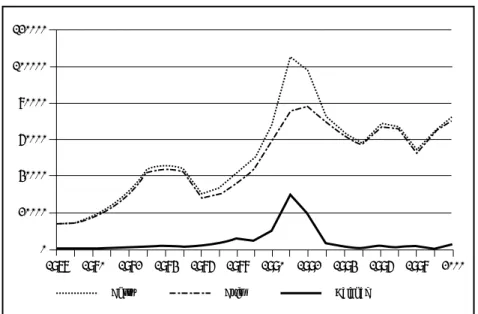
Thailand to Japan. Along with this kind of labour migration, the illegal recruitment of Thai labour, especially that of women for prostitution, began in 1981. Annual statistics on Thai entry into, and exit from, Japan from 1980 to 2000, are given in figure 1. The data indicate that the rate of entry of Thai immigrants has been very volatile. It increased in a relatively steady manner from 1980 to 1989. In 1991, when the economic boom in Japan reached its peak, the number of Thais entering Japan had exceeded 100,000, but thereafter, within only five years, it sharply declined by nearly half. According to the findings of Ito Chiaki this decrease has to do with changes in Japanese immigration policy in the early 1990s, which cam up in the form of a strict approval procedure by visa application and tightened control on the entry points (Ito 2000, p. 15). After 1996 the number of Thai immigrants increased slightly but constantly. The same dynamic character is also found in the number of female Thai immigrants. From 1980 there is a steady increase in the number of entries of Thai women (see figure 2). This number reached its peak in 1991 (nearly 50,000) and shrank in the two following years, then increased steadily in the following years. The information from NGOs reveals an increase in unlawful entries and disguised entries by those holding passports of other nationalities. These entries do not appear in the statistics cited here. The number of Thais entering Japan thus is likely to be higher than official statistics show.
Statistics of Thai nationals exiting Japan reveal a difference between the number of Thai new entrants and those leaving the country, viz. the number of the former group exceeds that of the latter. This indicates a number of overstayers, about half of whom are women e.g. in 1994 there were 46,973 Thai overstayers in Japan, 25,905 were women (Ito 2000, p. 16). The balance of entries to and exits from the country of male and female Thai migrants in Japan is given in figure 3. It shows the balance of female migrants slightly exceeds that of the males. Each year the number of unauthorized visa overstayers by country of origin is reported by the Japanese Bureau of
Figure 1. Thai Migrants in Japan
Entry Exit Balance 1978 1980 1982 1984 1986 1988 1990 1992 1994 1996 1998 2000 0 10000 20000 30000 40000 50000
Female (Balance) Male (Balance)
1978 1980 1982 1984 1986 1988 1990 1992 1994 1996 1998 2000 0 -5000 5000 10000 15000 20000
Immigration Control under the Ministry of Justice. According to Yamanaka (2000, p. 65) this calculation is done by matching data of individual entries and exits on entry visas. If an entrant is found not to have departed by the end of the valid period of stay, he or she is defined as a visa overstayer. Thus, due to Yamanaka, a simple calculation of the annual excess of entries over exits provides an approximate number of overstayers each years. But this simple calculation does not take into account the number of people who have changed their visa status and who have been deported, both of which can influence the amount of the number of exits. Therefore this calculation
Figure 2. Female Thai Migrants in Japan
Source: Ministry of Justice, Annual Report of Statistics on Legal Migrants, 1981―2000 Note: Figures for 1995 not available.
Figure 3. Male and Female Thai Migrants in Japan
Source: Ministry of Justice, Annual Report of Statistics on Legal Migrants, 1981―2000 Note: Figures for 1995 not available.
can result only in a very rough estimate of overstayers. Following this calculation it can be estimated that there are no less than 40,000 Thai women overstayers in Japan up to the year 2000. According to the Annual Report of Statistics of the Ministry of Justice (1980−2000), no less than 1,000 Thai people since the early 1980s, more than 7,000 in 1992 and over 10,000 in 1993 and 1994 are deported each year and women account for about half of them. Another figure that has to be taken into account in the estimation of the number of Thai female overstayers is the increasing number of intermarriages between Thai female migrants and Japanese men. In 1994 9.6% of all international marriages in Japan were marriages of Thai and Japanese nationals, most of which are between Thai women and Japanese men (Komai 1997 cited in Ito 2000, p. 17). As a result, through marriage Thai women can obtain a spouse visa and achieve a legal status. Therefore, to obtain a more adequate estimation of the number of Thai female overstayers the number of Thai female deportations and of women receiving a spouse visa has to be subtracted from the total excess of arrivals over departures. According to Japanese government statistics, the number of Thai female overstayers has gradually declined from a high of almost 30,000 in 1993. However, the same official source estimates the number of female overstayers from Thailand to still exceed 20,0002
(Ministry of Justice 1997, 2000, cited in Human Rights Watch 2000, p. 31). Thus the number of Thai women without legal status might be over 20,000 but less than 40,000.
The Japanese immigration law requires migrants staying in Japan for over 90 days to register with the local government. This includes immigrants without legal status though few do register. The majority of registered migrants are those holding legal status. In 1999 there was a registered Thai population of 25,253 in Japan, 6,760 of whom were men and 18,493 women (Ministry of Justice 1999). Based on figures mentioned above the conclusion can be drawn that it is hard to quote the exact number of the Thai population in Japan and especially that of Thai females because of insufficient data. On the other hand, the available figures mentioned above support the estimation that there might be about 40,000 Thai female migrants living in Japan, both with and without legal status.
2.Typology of Thai Female Migrants in Japan
I have built up a typology of Thai female migrants in Japan through interviews with 22 women. The typology, reflecting each woman's life and situation, is dynamic, and changes within the phase of migration. For a better understanding of the dynamic of the lives of these women, I divide the migration process into three phases: (1) the period before migration, (2) the period of arrival in Japan and (3) the phase after initial migration, i.e. the women’s experiences as migrants in Japan. This section treats only the first two phases while the third phase will be discussed in the later sections.
In the period before migration the women can be grouped into three distinct categories: (1) prostitutes, (2) single women and (3) supporting mothers. Two criteria are used for classifying, namely marital status and occupation prior to migration.
Prostitutes
Workers
Sex Workers
Single Women
Brides
Single Mothers
Prostitutes Four women belong to this group and were commercial sex workers in Bangkok or the tourist city of Phuket, Thailand, prior to their immigration. Whilst Prao and Praeo worked as prostitutes in Bangkok’s Pat Pong or in beer bars, Pring earned her income as a hostess in a cocktail lounge, a kind of covert prostitution establishment. Only Porn, a masseuse at a Japanese massage palour in Bangkok, has gained experiences in the sex industry in other Asian countries, viz. Hong Kong, Macau and Singapore. Better earnings is a reason for these women’s entry this occupation.
Single women Generally these women, of whom there were ten, belong to the Thai lower middle class and feel affected by economic deprivation. This does not mean that they have to face severe economic difficulties. Rather, in their own perception, they see no possibility to achieve economic advancement according to their own criteria if they stay in Thailand. Migration to Japan is considered as the means of access to the things they desire. As opposed to other unmarried women Wanpen has lived with a Thai husband as a de-facto couple without a marriage certificate. They separated immediately before her emigration. I put her into this group because she does not have a child to take responsibility for, which is the crucial criterion for classification as a supporting mother.
Supporting mothers This group of women, of whom there were eight, had married or lived with a Thai husband as a de-facto couple without marriage certificate, but had divorced, separated or become a widow. They all have children, for whom they are the sole breadwinner. This is an important stimulus for the women to migrate abroad in the expectation of economic improvement. One exception is the case of Mora. She was not yet divorced at the time of emigration but had completed the divorce a few months after arrival when her Thai husband took a new wife and she found her Japanese husband. The reason for putting her into this group is that, even though she was still legally married, she was the sole breadwinner for her children.
Upon arrival in Japan-the second phase of migration-the typology of Thai women interviewed changes according to the new roles and career patterns they chose or were compelled to follow. Three groups of women can be classified as (1) sex workers, (2) labourers and (3) brides.
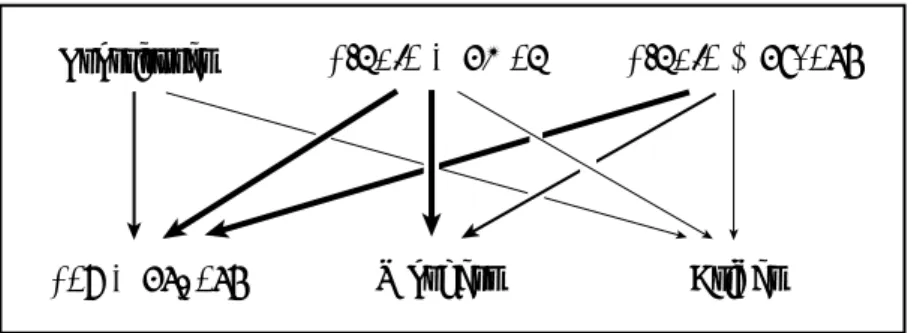
Figure 4 shows the transition of types upon arrival as against the phase prior to migration. The thickness of the arrows indicates the number of transitions observed in my sample. 11 women from the three groups mentioned above, i.e. three prostitutes and four each of the single women and supporting mothers, became commercial sex workers, whilst another four (two single women and one each from the prostitutes and supporting mothers) are going to be a bride. Four single women and three supporting mothers became labourers. But none of the prostitutes earn their livelihood as non -sex industry workers, they rather voluntarily join the transnational prostitution industry in Japan.
Sex workers The women in this group have to provide sexual service, including sexual intercourse, for monetary exchange. All of them were placed into employment as hostesses in “dating” snack bars. Snack bars, often referred to simply as “snacks,” are a common venue where many Japanese go for relaxation and conversation, but “dating” snack bars indicate bars from which clients may take women out for sexual services (HRW 2000, p. 84). Other women besides the group of prostitutes are enticed into transnational prostitution in Japan. The brokers promised them employment with high incomes in manufacturing, or in conserved food factories, or as waitresses or dishwashers. Upon arrival, instead of working in these workplaces the women were sold to owners of snack bars, mainly in Tokyo, Chiba and Ibaraki prefectures, where they were compelled to sell drink and accompany customers to hotels to perform sexual services. Only the prostitutes and two of the single women knew what kind of work awaited them in Japan.
Labourers The women of this group have been given employment in Japan, but not the kind of jobs they expected. Mak and Mee, two supporting mothers in over fifty years of age, got employed a cooks in Thai restaurants, while Mora was sent to work in furniture manufacturing. Waree, a single woman, joined her mother and earned her livelihood as a waitress in an Izakaya, a kind of small restaurant. The other three single women entered Japan as so-called covert workers in the guise of language students, as Wanni pointed out: “we didn’t come here only to study, frankly we want to work.” They have registered and paid fees for a language school for the purpose of obtaining student visas, which enables them to work a certain amount of hours daily. Usually the initial working places of these so-called covert workers are Izakaya-restaurants, beginning as kitchen hands, later with improved Japanese as waitresses.
Brides The women belonging to this typology entered Japan as the fiancee of a Japanese man with the purpose of getting married to him. Most of the women met their husband-to-be in Thailand, through the introduction of a friend or in the workplace (such as tourist cafes or bars). Rendezvous in a tourist site of Thailand is found to be a common place of initial relationship among Thai
marriage migrant women and German men too (see Ruenkaew 2001). Only Wipa became
3.Socio-economic Profiles and Patterns of Migration
Socio-economic Profiles
Most of the prostitutes are poorly educated, having only completed the compulsory education. Only two could continue their study in secondary school but without completion. Six supporting mothers have completed elementary education, while the other two passed secondary school. Among all Thai women interviewed the group of single women are the best educated. Six of them have completed vocational education, senior high school and university, while three others have passed elementary education. Nine women were married or lived with a Thai husband as a de-facto couple without a marriage certificate, most of the women, except Mora were divorced, separated or widowed. All of them have children, except Wanpen.
From the point of view of the last occupation before emigration, two main groups can be distinguished. One consists of women engaged in prostitution, including women working in massage parlours. The second group of Thai female migrants earned their income from various professions such as traders, cooks, labourers in manufacturing, singers, or company employees. Only two had just completed their education, one elementary school graduate and one university graduate, but had not yet entered the labour market.
Most of the women interviewed have a rural background. The majority were born in the North East of the country, mainly Udon Thani (five out of eight). The remaining migrants came from the central regions (7), the North (2), the South (2), and from Bangkok (2). A close examination of biographical data reveals that most of the Thai female migrants have taken part in the rural-urban migration process in Thailand. In their younger days these women left their home town in rural area, mostly after completing compulsory education. For most of the sample moving to an urban area had served the purpose of searching for a job in order to support their families and themselves and for a few it was the only means of access into higher education. After completing higher education another step of migration was undertaken on searching for employment. The need to find an alternative source of income drives the women to set off on another step of migration, particularly to places offering economic improvement. Prior to their migration to Japan three women have even gained experiences in transnational migration. Mawika was a labourer in Saudi-Arabia, Pring worked in the sex industry in Hong Kong and Singapore, whilst Marisa immigrated to Switzerland in search of a marriage partner.
At the time of interview the women were aged between 24 and 67 years and on average 38.90 years old. Upon immigration to Japan most of them were older than 23 years (the average is 26.59 years). There is a vast difference in age upon immigration of Thai women. Mak, the oldest supporting mother, entered the country at the age of 53, while Watana was the youngest single woman at the age of 14. This indicates that women in nearly all age group join transnational labour migration to Japan. Looking at their first step in the rural-urban migratory process in Thailand they were much younger, between 14 and 20 years (15. 9 years in average). These figures reveal a long
village
provincial capital foreign countries
foreign countries Japan centres of prostitution
Bangkok
legend:
labour and educational migration prostitution
direct entry into prostitution single step migration
strech of time between their first movement from the places of origin and the immigration to Japan.
Pattern of Migration
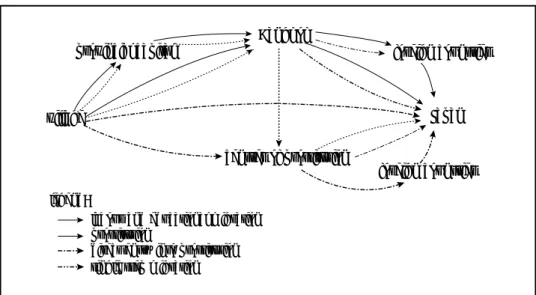
The biographies of the women, particularly prior to their immigration to Japan, as pointed out above, reveal that the majority of them, most of those of origin in the rural area, have an internal migration history. Moreover, some of these former internal female migrants had already gained experience as transnational labour migrants. Therefore, one conclusion based on empirical analysis can be drawn, namely that the transnational labour migration to Japan is the last phase of a staged international migratory process of Thai women, with its beginning mainly in villages in remote areas. This pattern is also found in the marriage migration of Thai women to Germany, which in fact means a variety of transnational labour migration patterns (Ruenkaew 2001). It affirms the findings of my recent study (Ruenkaew 1998; 2001), that transnational labour migration is a continuation of internal migration. The pattern of international migration of Thai women to Japan is depicted in figure 5.
As shown in figure 5, the migratory process of Thai women to Japan includes a variety of internal migration processes. The exceptions are in the cases of women born in Bangkok (2) and of the few women with a rural background (3), who have no previous migration history. For these groups the migratory process is found to be a one step process, that is from a rural area directly to Japan.
The migratory process to Japan can be described as follows:
1. It begins mainly in villages in rural areas. The women move, usually after compulsory education, from their places of birth to urban areas in a district or provincial capital. Some migrate directly to the national capital. The purpose of the movement is employment or higher education. Few women move directly from villages to become a prostitute in Bangkok. 2. From the district or province, they move on to a bigger city or to Bangkok, looking for better
earnings or advanced education.
3. From female labour migrants to prostitution: They further migrate to the centres of the sex industry such as Bangkok or to some provinces in the South and become commercial sex workers.
4.The last phase is transnational migration to Japan. The women find many different ways to migrate to Japan. For the women with origins in Bangkok and for some from rural areas without internal migration experience it is a one step migratory process.
4.Motivation for Migration
For economic perspectives (such as Ravenstein 1889, Borjas 1989) people emigrate in search of better economic opportunities than those available to them in their origin country. This seems to be affirmed in the cases of Thai female migration to Japan. The findings of this study and those of Chunjitkaruna (2000) and Ruangsuwan (2000) reveal that expectations of economic improvement and high paid are among the important motivations of women of all three categories to leave for Japan. With regard to some women it can be stated that they are seduced by the chance to earn a long amount of money in a very short time, like Wandee, a single woman, who reported:
My friend said working in manufacturing I would get 40−50,000 Baht monthly. . . . here I have to stand the whole day long and earn only 7,000 Baht (Wandee, p. 1).
But this must not be taken to mean that migration to Japan is caused by poverty. In general, most of the women, I interviewed earn enough for their livelihood. What they want is an opportunity for building an economic existence. They hope to receive a large sum of money in a very short time and return to establish themselves-to buy a house or land or start their own business on the basis of their earnings in Japan.
The motive for migration to Japan for the bride is clear: to marry a Japanese fiance. Besides, the data from interviews suggest that the expectation of the economic betterment is a motive for marriage and leaving Thailand too. Mayura, a supporting mother who entered Japan as a bride told me:
It was not that long, I met him only that day we went for dinner. I decided to forge ahead, to take a chance ahead. If I stay here my life remains unchanged, no progression. But if he is a good guy, it might be good for me too. I might have money to send for my children and my mother (Mayura, p. 3).
In case of Praoe, a prostitute in Phuket, marriage to a Japanese can also mean a chance to retire from prostitution without losing economic security. This is found to be an important motivation of former Thai prostitutes to marry German tourists and undertake marriage migration to Germany (Ruenkaew 2001, pp. 185−188).
the sole decisive motivation to leave Thailand. A close examination of interview data suggests that non economic factors also have an influence on the decision to emigrate. Mayura’s statement above reveals that her migration should benefit her family, especially her children, too. Statement asked why they came to Japan, all the supporting mothers referred to their children for whom they are responsible. For them, economic security through their transnational migration can result in economic and social advancement of their children. Besides providing support to the parents their sojourn in Japan offers an avenue to prosperity for their close siblings. This is the belief of the groups of single women and prostitutes. The remittances from Japan can be used for higher education of these relatives, which in return could help them find better occupation, status and higher income. Or, these people could follow in their footsteps and obtain better economic opportunities in Japan. In fact, many women do recruit their brothers, sisters or even daughters to work with them. Porn has one sister and one brother working in her Thai restaurant. Waree was recruited by her mother who came to work in an Izakaya restaurant four years prior to Waree’s immigration. A brother of Wanna is found being a covert worker under the status of student of language school, the migration venue of his sister some years ago. Familial responsibilities must therefore be regarded as an important motivation.
Can these familial responsibilities be considered as family or household strategies? Under the household strategy perspective (e.g. Wood 1982, Chant and Radcliffe 1992) migration is seen as a household strategy to self-insure against risk to income, production and property, or to gain access to scarce investment capital. Thus, the decision as to who will migrate is made by the family or household not the individual. As discussed above, most of the women I interviewed were internal migrant workers living in the destination area of their internal migration rather than with their families in their village of origin. Many of them decided to emigrate without consulting with, or informing the family left behind. One exception might be the case of Watana, a single woman who was only 14 years old at the time of entry to Japan, since her mother acknowledged her sojourn and was the one discussing the migration venue with the broker. But, unlike the other women, Watana did not remit money to her mother, after she knew that her first and second remittances were wasted by her mother. In regard to familial responsibilities, although the women provide financial support to their parents and close siblings, this does not happen with the intention to establish a
“family” business or any enterprise in the sense of familial belonging. Rather, it is a intrinsic bond that family members should support each other. On the other hand the women consider property, such as land bought by their remittances, as their possession.
My family is highly indebted. They put land in pledge. I always send them money to pay back. . . . This year I will stay a bit longer in Thailand. I want to go to the government office to let them transfer the ownership of the land that was redeemed from my remittances to be mine. (Wandee, p. 2).
Therefore, familial responsibility in the case of Thais in Japan should not be understood as a household strategy.
As pointed out by Zlotnik (1995, p. 265), among women, migration and marital dissolution are closely linked, since those who are separated or divorced are more likely to engage in migration than women in stable unions. This is true of Thai female migrants to Germany. One determinant of female migration lies in the quality of ties within the family and between spouses (Ruenkaew 2001, p. 213). Similarity in this aspect is also found among Thai women migrants to Japan, particularly the supporting mothers. “I had just separated from the father of my daughter. I was broken hearted and wanted to be out of Thailand, no matter where I would go” (Marisa, p. 1). Considering this aspect of ties in the family and the above discussion of familial responsibilities, familial aspects seem to be one factor in the motivation for migration. This supports Zlotnik’s (1995) suggestion that the family perspective is especially important for the analysis of female migration.
Factors associated with Migration
However, in addition to the motivations previously discussed, there are other important factors behind the flow of Thai female migration to Japan. As a response to my question on the motive of coming to Japan; Pring said “I want to work to get big money and to pai muang nok (go abroad)” (Pring, p. 2). In Thai society muang nok (foreign country) and all matters concerning muang nok, especially Europe or America, or Japan, have been given high social value. Pai muang nok (going abroad) or khong muang nok (products from abroad) are symbols of social prestige. Going abroad and owning products made abroad are expensive and only the wealthy can afford them. It is sad, but true, as Chunjitkaruna (2000, p. 259) has pointed out, that money has gradually replaced traditional power. Leadership, social status and prestige can be attained for those who have money and wealth. Thus, money has become a crucial condition to improve social status. And among Thai female migrants, migration to Japan is understood as an avenue to wealth.
On the other hand “going abroad” refers to curiosity, the urge for new experiences, for “bright lights” and for adventure, which are normal characteristics of young people. Under the “bright lights hypothesis”, the desire for a change in life, particularly from rural to urban areas, can be understood as a motive for migration (May and Skeldon 1977). Migrants are attracted by the social and economic opportunities on offer in cities (Yap 1977; Arnold and Cochrane 1980). Comparing Thailand and Japan it is obvious that Japan presents more options for economic and social advancement and is thus very seductive for Thais. Besides Japan belongs to a temperate zone certainly comprising many things not available exist in a tropical land like Thailand (e.g. snow), which make Japan attractive enough for some Thais to visit. Walaya, a single woman reports: “I did not think about anything, as his parents came to see me in Bangkok. I wanted only to see Japan . . . . I wanted to see Sakura, to see snow. . . .” (Walaya, p. 2). In regard to the age at the time of the decision to emigrate, Pring and Walaya were still young, in the early twenties. Accordingly, they were influenced by these human drives for curiosity and for “bright lights.”
The most decisive factor making migration possible is embeddedness in social and kinship networks providing information and support necessary for emigration. Empirically, the transnational migration of Thai women to Japan contains an element of chain migration. The pioneer female migrants later function as parts of social networks, maintaining links to their home community, providing information about living and working conditions and on modalities of entrance into the target country; they organize the trip and help at the place of destination, and sometimes even recruit more women. Hence, within these networks the transnational migration of Thai women becomes “self-sustaining”.
Japan has no policy of accepting “unskilled” immigrant workers despite the fact that medium and small business are faced with a labour shortage. There are no official overseas labour contracts between Thailand and Japan. Thus, many Thais enter the country of destination through venues facilitated by transnational criminal networks that will be discussed below.
5.Venues of Migration
For most of the women, in the group of sex workers and labourers, except Waree who came to Japan with the help of her mother, their entry to Japan is facilitated by brokers who belong to transnational criminal networks. In general, the women gain information on economic opportunities in Japan from relatives, friends, or other acquaintances who later introduce them to the brokers. These brokers then make arrangements for the women’s travel and job placement, obtaining the necessary documents, contacting job brokers in Japan, and hiring escorts to accompany the women on the trip. When the women arrive in Japan, job brokers receive them and deliver them to employers.
After the agreement on working in Japan had been made the women in the sex workers group were told to wait in an apartment, somewhere in Bangkok, where they had to stay with other women sharing the same destination. As the sex workers I interviewed reported, this waiting period can be considered as a process of preparing the women to be attractive sex workers who can bring a lot of profit to the brokers. The women have to beautify themselves, get their skin whitened or even undertake plastic surgery. Women who were regarded as not beautiful enough were given a ticket home. During the stay in this apartment the women were provided with free board and lodging and all of the expenses for beautifying were taken care of by the brokers, too. When they needed money to remit home (for example, in the case of supporting mothers) they were introduced to Thai male clients to perform sexual services in exchange for money.
In this regard I asked one respondent whether she was sceptical about this act and whether it revealed the reality of the work she would undertake. The answer was: “They said we only to go with a man here in Bangkok. In Japan we would work in a factory. Every thing is free of charge, but if we want money we have to do this. Because they could not give us money to send home. Every woman had to do the same as me” (Marisa, p. 2). This may sound naive but the women
showed no suspicion. The only explanation that can be applied here is that their desire for high waged employment in Japan was so strong that it made them blind. The length of stay in such apartments varied depending on how long the beautifying process took and how fast the brokers could arrange travel. From the interview data, it took between two weeks and two months.
According to other studies (Chunjitkaruna 2000, HRW 2000), Thai brokers and agents have ties to and work together with transnational organized criminal sydicates located in many countries including China, Hong Kong, Korea, Taiwan and Malaysia. This claim is supported by in the cases of the Thai women I interviewed, when the routes of travel are analyzed. Only Prao, Mukdee, Wandee and Marisa flew directly from Bangkok to Tokyo holding their own passports. Watana was only fourteen years old so she had to travel through Singapore with a passport of a woman of the age of twenty five who obtained a visa for Japan. Some women, like Mawika, left Bangkok with their own passport, then dropped in to third countries like Hong Kong or Malaysia to receive a new passport with a visa for Japan. Usually it is a real passport issued by the Ministry of Foreign Affairs in Thailand, but the agents change the photograph of the holder. The other route is through Hat Yai, Thailand, to Malaysia. There, the women, like Wilai, were given a Malaysian passport and travelled to Tokyo accompanied by either a Malaysian or a European man as a couple spending holidays in Japan. The brokers will hire one or two escorts to accompany the women to Tokyo but in some cases the brokers themselves will come along on the trip. No fee is charged until after entry to Japan. Some of the interviews were told that they would be in debt upon arrival in Japan, but the amount of debt was mainly misrepresented.
For the group of labourers the procedure of travel organized by the brokers is quite similar. One difference is that the women need not undertake the beautifying process and they have only to wait for a passport and visa. The waiting period takes from two weeks to one month. After obtaining a passport and visa the brokers or escorts hired by them take the women to Japan. In the cases I interviewed the route was from Bangkok directly to Tokyo. For all these services the women were charged about 250,000 Baht (about 700,000 Yen) and this had to be paid before departure. The data from the interviews reveal that brokers sending the women for sex work and those facilitating people for other jobs have links or one broker engages in both businesses. As reported by Mora the broker organized her labour migration also sent women for sex work. Four relatives of hers who entered Japan through the service of the same broker were put into employment as sex workers in snack bars in Nagano. Some women were recruited by their relatives working already in Japan who have experience in organizing documents and facilitating entry. Waree’s travel was organised by her mother who had already been working for three years in an Izakaya restaurant. Mak and Mee went to Japan with a visa as a cook in a Thai restaurant belonging to Mee’s daughter who facilitated the trip. In such cases the women were not deceived and given a job promised, nor they were charged a fee. Another venue to become a worker in Japan is through enrolling in a Japanese language school. This was the route of Wanna, Wanni and Weena who came to Japan as
 ̄  ̄
come to study in a variety of schools other than the institutions of higher education specified in the School Education Law, or vocational and special schools. Most people who entered the country with this status become students in a Japanese school, like these three women in my study. The news of
 ̄
shugakusei as a convenient vehicle for becoming workers in Japan is spread by the brokers behind the scenes as well as the recruiting slogans of schools such as “you can get a part−time job in Japan while you study” (Komai 1995, p. 55). There have also been cases where companies have set up language schools specifically to secure low―wage labour (Komai 1995, p. 56). These companies established a Japanese school and had the students work on its premises. Based on interview data two women, Wanna and Wanni, who were friends and colleagues in the same firms, were attracted by the advertisements of such schools in a Thai daily newspaper. There were Thai brokers also behind this type of recruitment. Wanni was the one who made contact with the brokers at the address given in the newspaper. These brokers organised the application to the school. All these services costed Wanni about 80,000 Baht (230,000 Yen). Three months after Wanni’s safe arrival and settlement in Tokyo, Wanna followed her footsteps and with her assistance became a covert migrant
 ̄
worker in Japan. Weena also used the status of shugakusei as a vehicle to come and work in Japan. But her trip was organized by her sister, Wipa who came to Japan as a bride in 1983.
In the case of the “brides” I interviewed, their migration took the form of accompanying their Japanese husband or fiance. As mentioned, above most of the brides met their husband-to-be in Thailand; Mayura through the introduction of her friend; Walaya whilst working in a cafe in Bangkok; and Praeo in a bar in Phuket. The procedure from building up a relationship to marriage migration to Japan has some similarities with Thai women in Germany (see Ruenkaew 2001). The couple got to know each other in Thailand then the man went back to his country. Contact is maintained through correspondence, then the fiance comes and takes his partner to be married in Japan. In case of Praoe, after meeting her husband the two lived together as a de-facto couple in Phuket, where they opened a “beer-bar”. After some time her husband got bored with living in a touristic milieu and came back to Japan. Praoe accompanied him and got married there. Wipas procedure follows the same steps, the difference being that she met her husband in Japan during a business trip.
6.The Phase after Migration: Work and Living Conditions and Legal Status
Work and Living Conditions
The sex workers I interviewed entered Japan between 1984 and 1992, mainly between 1990 and 1992, which were the gold era for Thai sex workers to earn a big amount of money in a very short time. During this time over 100,000 Thai people entered Japan. Upon arrival most of the them still had no idea of the work they were going to do until they were brought to snack bars one after another to place into employment as snack hostesses. Some women could find a bar owner who took them within two or three weeks, but some women, like Mawika who was considered as too old
and Marisa who was not beautiful enough in the eyes of bar owners, were taken around from one prefecture to another searching for a snack bar which would accept. In general the women I interviewed were first taken to find a work place in Shinjuku, Tokyo. If they had no success they were taken to Chiba and Ibaraki prefecture or Nagoya. Most of them were put into snack bars in Aragawa, Ibaraki prefecture, the place with a number of bars with Thai sex workers which was given the name “little Bangkok” between 1990 and 1992. HRW (2000) reveals that until the end of the 1990s there were still women from Thailand who were deceived in the same way. This indicates the continuation of recruitment of Thai women for sexual services in Japan whose end can not be foreseen in the near future.
In the snack bar, as Watana reported, the women were told to undress to show their bodies to the owner of the bar, then the bargaining about the price of the women selected by the bar owner started. When the broker and the bar owner agreed on the price, the bar owner paid the broker. The women on their part were charged with the same amount as the one paid by the bar owner, thus becoming a commodity and debtor at the same time. The amount of the women’s debts varied depending on their entry period, from the middle to the end of the 1980s between 2 to 2. 5 million yen and during the early 1990s 3 million to 4 million yen. The debts were increased at the employers’ discretion as fees for such items as housing, food, or clothing. All of them had to reimburse the debts through sex work often under coercive conditions, such as physical violence or threats to be resold to another snack bar which would mean an increase in debt. “I changed the bars quite often because I did not want to work. I tried always to escape so they beat me. . . . When I arrived in Tokyo they told me I had 4 million yen in debt. When I escaped and they found me they increased my debt to 5 million yen (Wandee, p. 1).” The other way the brokers and bar owners prevented women from escape was to confiscate their passport and other documents while they were in debt. Most of them did not get their passports back. The women would not receive money for their work until their debts were repaid. “I have never seen the money. The clients paid it to “mama san”, for a short time 250,000 yen, for the whole night 300,000 yen. . . . Mama wrote all these in the book, and when the debt was repaid, she told us.” (Marisa, p. 3). In the case of the women I interview the amount of time it took women to repay their debts varied from one month to nearly one year. After this period most of the women continued their work in the same snack bar for some time then moved somewhere else later. Within this time the women were relatively free, they could choose which clients to take or which day to work. They could earn money from what they worked and make remittances to their families in Thailand. Some time later they met a Japanese husband, gave up their job and got married.
An examination of the process of this recruitment comprising the preparation before emigration, the way the women were put into such employment as well as their working conditions, reveals the characteristics of trafficking in women.
making for the brokers. Because the more beautiful the women were, the higher price the bar owner would pay. It can be compared with the preparation of` “goods” to be sold. (2)The method whereby the women were brought to the bar owners, and the way they have
to show their body can not be anything other than presenting “goods” for the buyer.
(3)Most of the women, expected to work in either manufacturing or small factories, but in fact they were put into prostitution. Thus female migration to Japan, particularly for sex work, can be understood as a kind of trafficking in women.
Some women, like Prao, Mukdee, Mawika, Watana and Wandee managed to stop work before their debts were repaid. With the assistance of a client Wandee managed to escape and returned to Thailand. The others were released from debt bondage by a client who paid off the outstanding debts in exchange for becoming his mistress. Except Watana, all the women mentioned here married the Japanese man who helped them out of sex work business. Watana stayed for two years with the man then separated and met her husband some time later. The client assisting Wandee followed her to Thailand and proposed marriage to her.
According to Sriwattananukunkit (1998) most Thai migrant workers find employment in restaurants, in construction work (mainly for men) or in manufacturing with intensive work. Except construction work, these are found to be the areas of employment for the Thai female migrants I interviewed. When the women in the group of the labourers arrive, job brokers receive them and deliver them to employers. Mora was put into employment in a small food factory. The employer arranged a place in a house for her to stay together with twenty other Thais working in different manufacturing plants belonging to the same employer. Mora reported that she earned 200,000 yen a month. Mak and Mee have contracts as cooks in Mee’s daughter restaurant, so did not use the services of brokers. Working in that restaurant they received 200,000 yen at the beginning, later increasing to 300,000 yen.
 ̄
For the women in the category of covert labourers, as shugakusei, they were allowed to work part- ̄
time for about five hours daily. But in fact most shugakusei spent more time on earning money than they were allowed. The income from working only five hours can not cover all living expenses in Japan and, in cases of the women I interviewed, not enough to remit home. The interviews reveal that they worked from 8 to 12 a.m., then attended classes from 1 to 5 p.m. and started working again from 6 p.m. till midnight. The typical jobs they took at the beginning were dishwashing or kitchen hand in Izakaya or Thai restaurant, jobs which do not need good Japanese knowledge. After some time when their Japanese was improved they shifted to waitressing thus
 ̄
opening up a job in the kitchen for newcoming shugakusei. Working in such restaurants the women  ̄
earned 850 to 900 yen per hour. The Thai shugakusei I interviewed either entered in the early 1990 s or in 1999. The method of entry and the kind of employment they obtained reveal no difference.
 ̄
Thus, it can be concluded that shugakusei is still a vehicle for foreigners to immigrate to work legally in Japan. Similar to the group of sex workers most of the women in the category of labourers
married or lived as a de-facto couple with a Japanese man at some stage.
Most of the women complained about the bad conditions of their employment. The wages they received was not enough to cover their living expenses so they needed to work in different places or to do overtime. Some faced discrimination in their work places, with the employer treating foreign and Japanese workers differently. For example in the restaurant the Japanese were allowed to take a drink free of charge, but the foreign workers had to pay for it. The women consider such discrimination not to be gender specific. In other words, they understand this as racial discrimination rather than sexual discrimination.
At the time of interview all the Thai female migrants in this study were married or living as a de-facto couple waiting for marriage, with the exception of Wilai who is divorced and Mak and Mee who were olds: The situation reported in the following thus comprises not only that of the brides but the sex workers and labourers as spouses also.
All of the brides became housewives after marriage. One barrier that impeded their ability to work outside the home were the children which came shortly after marriage. Asked about her occupation, Mayura answered “I do not work now. My work is here. I look after my children, three of them.” (Mayura, p. 3). In contrast to the bride the sex workers and labourers continued working. Some sex workers still kept their employment in snack bars selling drinks but did not perform sexual services with clients. The other sex workers found a job as kitchen hands or waitresses, while most of the labourers remained in their former work. Some time later the sex workers faced the same barrier to employment as those of the brides when their children were born. They had to give up their job since finding a baby sitter was difficult and too expensive. On the other hand, most of the husbands did not appreciate and support the employment of their wives. The women always complained about the double burden as working woman. In the morning before setting off for work they have to prepare breakfast and a packed lunch for themselves and their husbands. After work they had to cook dinner and finish all household works. Most of the Japanese husbands leave these tasks to their Thai wives.
In the early stage of marriage most of the women suffered from isolation and loneliness. This can be attributed to the lack of Japanese language skills which impedes their communication with social environments and separates them from Japanese society. Accordingly it leads them strengthen their ties with the Thai community they are already in contact with which in turn strengthens their isolation from the Japanese environment. Some women had to stay in a remote area with no Thai people around. This led also to isolation, when they were not yet able to communicate with Japanese neighbors. Many Japanese husbands were much more concerned with their work, and therefore unintentionally neglected their wives. This was another factor leading to loneliness. On the other hand this “isolation” is regarded by some Thai women as convenient. In their opinion less contact means fewer opportunities for conflict and they prefer to keep their distance. Keeping one’s distance to avoid conflicts is found to be a survival strategy for Thai migrants in Germany too (Ruenkaew 2001).
Many Thai-Japanese couples stayed with the parents of the Japanese husband, which was very unpleasant to some women because they were not accepted by their parents in law. In the women’s opinion there are two reasons, first the stigmatisation of Thai women as prostitutes in Japan and second because they are foreigners and the Japanese society is not open to people from other cultures. Some women reported that it was not easy to understand the Japanese mentality and to deal with the Japanese. ‘The Japanese do not show their feelings, whether they like you or hate you, whether they agree or disagree. They do not say, and how could I know, what they want.’ (Walaya, p. 3). Some women felt that they were not welcome and were discriminated against, not only by the parents and relatives of their husband but by the society, too, because they were foreigners. In some cases the refusal by the parents was an impediment to their marriage. Thus some couples had to live as a de-facto couple without a marriage certificate. On the other hand, some women felt accepted by the Japanese society, particularly by parents in law, who provided assistance in various aspects.
This situation discussed above occurred mainly during the early stage of the marriage. As time went on the situation changed, particularly when the children grew up. When the children reached school age there were many activities which required the participation of parents, especially mothers,
because they were the ones staying at home. The women were more or less pushed to
communicate with the outside society.
Through these contacts they gradually learned the language which inspired them to attend language class. From school activities some women joined community and voluntary works and had less time to be lonely. For some women, especially those who felt rejected and discriminated against, it was the period of their skill-building. They participated in the labour market, earned their own livelihood and joined charity activities. They gained recognition from the people they worked with. This compensated for the discrimination from their in-laws and helped them survive the unpleasant circumstances in their surroundings.
In regard to problems with the parents-in-law, it was again the children that were a decisive factor which changed the situation. Most of the Japanese parents accepted the immigrant daughter-in-law when they saw their grandchild. Some couples had managed to moved away to their own apartment to avoid conflicts.
Some sex workers quit their jobs in snack bars and established their own businesses such as selling clothes, vegetables and food. They started vending from a bicycle, then using a van and sometime later they were able to open a Thai shop or restaurant. By contrast some women like Mak and Mee, who entered the country as legal migrant workers, obtaining a job as promised, were kicked out of employment in their early sixties. They became members of the Thai population with no legal status.
Thus, the living situation of Thai female migrants in Japan changes over time and over circumstances.
Legal Status
 ̄
The group of brides and labourers with status of shugakusei entered the country with a valid visa and could obtain legal status while living in Japan. Regularly attending class is the only condition
 ̄
for shugakusei to fulfill if they want to have their visa extended. So, as the women reported, they had to go to the class even though they were very exhausted from their work. Whether they could learn or gain the knowledge or not was not so important, the main thing was that they had to appear
 ̄
in the class regularly. Except for the brides and labourers with the status of shugakusei, the Thai women I interviewed entered Japan with a tourist visa, which allowed them to stay for a maximum period of 90 days. After this period all of them overstayed their visa. Only Mak and Mee who entered the country as cooks were allowed to stay for one year. But the process of visa extension was complicated, so after the visa expired for the second time the employer let these two women overstay.
Thus, many Thai women I interviewed did not obtain legal status at the initial period of their stay in Japan. They had to avoid the immigration police, otherwise they might be arrested and deported to Thailand, like Mora. After a five-year stay as an illegal migrant worker Mora was arrested together with forty other Thais working in the same factory. They were then deported to Thailand. After 14 months with the arrangement of her Japanese husband Mora came back to Japan again as a bride.
She married him and obtained a spouse visa, which enabled her to stay and work legally. Like Mora most of the sex workers obtained a residence permit after they married a Japanese man.
Therefore a decisive factor that can change the status of the women from illegal migrants to legal migrants is marriage to a Japanese national. For the women I interviewed, to obtain legal status can be considered an important motive for marriage to Japanese men. Mora preferred to live as a de-facto couple because she knew that her partner might help her to gain legal status one day. Marisa had a similar motive in selecting her husband as a partner. “He asked me whether I would stay with him. I had no backer. I asked him whether he could help me, whether he could marry me”(Marisa, p. 4). Marriage seems to be the last way for some labourers to immigrate to and remain in Japan. “After completing my study I returned to Thailand. After a year I came to Japan again with a tourist visa. This time I had to marry him because there was no way out for me. If I wanted to live and work here I had to ask for his help. I had to rely on him. I was in an impasse.” (Wanni, p. 1).
This reveals that the women utilized marriage as a means to obtain a residence permit which would enable them to work legally. This is also the legal pathway of the immigration of Thai women to Germany, which I define as “marriage migration”: migration concerning or emerging by means of marriage (Ruenkaew 2001, p. 52). The decisive mechanism shaping the immigration of Thai women into this specific form of marriage migration is the Japanese immigration law which stipulates exactly the types of immigrants entitled to stay and work in Japan. Given the barriers of
immigration policy of countries of destination, marriage has turned out as a means of legal immigration coupled with the expectation of social and economic achievement.
Chunjitkaruna (2000, p. 269) pointed out correctly that Thai female migrant workers wish to marry Japanese men because this might guarantee them legal status. This is confirmed by my findings. But whether the women really wish to have children of Japanese nationality in order that they could obtain legal status, as Chunjitkaruna stated in her conclusion, is questionable. Data from interviews with women in shelters reveals that it is very difficult for children born out of wedlock to acquire Japanese citizenship, even if the father is Japanese. The procedure of acquisition of Japanese citizenship is complicated. On the other hand most of the women lack such knowledge. This is the reason why there are so many children born from foreign mothers and Japanese fathers that have no nationality.
At the time of interview most of the women had obtained their legal status through marriage to a Japanese man. Some women, like Mak and Mee, who are in older age groups remained illegal migrant workers. A few of the sex workers had not yet acquired a legal status because they were waiting for some documents from Thailand which are necessary to register a marriage. Very soon their status can be changed into a legal status after marriage to Japanese men. In regard to legal status, there are two paths taken by Thai female migrants in Japan. Some women make a transition from illegal to legal status through marriage, while others remain illegal and become members of the Thai community without a residence permit.
Type Bride Labourer Sex Worker
Junior Senior
Age under 25 from 18 to 35 over 50 from 14 to 39
Socio-economic
Background *poorly educated *mainly unattached *internal migration experience *well educated *mainly unattached *internal migration experience *poorly educated *divorced or separated *internal migration experience *poorly educated *former prostitutes,
single women and supporting mothers *experience with internal migration, some with international migration Mediators of Migration
Japanese men *brokers  ̄ *shugakusei *relatives *brokers *brokers *international criminal networks Legal Status spouse *initially illegal
workers, later as spouse
*initially illegal workers, later still illegal migrants
*initially illegal migrant, later mainly as spouse
Conclusion
Based on narrative biographical interviews with 22 Thai female migrants this article has discussed the process of female migration from Thailand to Japan. The findings show that Thai women immigrating to Japan comprise former prostitutes, single unattached women and supporting mothers. They enter the country to work in the sex industry, in the service sector, small manufacturing, or to be a bride. Because of Japanese immigration policy there is no possibility for unskilled foreign labourers to work legally in Japan. Thus, many women enter the country through venues facilitated by transnational criminal networks, which often attain the characteristic of trafficking in women, particularly when recruiting women for sex work.
Due to economic deprivation that impedes them from establishing a livelihood the women migrate to Japan with the expectation of economic and social improvement. Though economic motives are crucial, familial responsibilities, particularly for the children and parents, also have a great influence on the decision to emigrate. For them, transnational migration can result in the economic and social advancement of their children and in financial support for the parents and close siblings in need.
There are two patterns of transnational female migration from Thailand to Japan. In the case of women born in Bangkok or of a rural background with no previous migration history, the migratory process is found to be a one step process, i.e. from rural origin directly to Japan. The majority of women with origins in the rural area have an internal migration history, some of them even had already gained experiences as transnational labour migrants. For this group the transnational labour migration to Japan is the last phase of a long stayed international migratory process with its beginning mainly in villages in remote areas. For some women the immigration to Japan bears the characteristic of “marriage migration” i.e. the women utilize marriage as a means to immigrate in order to obtain a residence permit which enables them to work legally. Because of the barriers of Japanese immigration policy marriage seems to be the only legal pathway open for Thai female unskilled workers to enter the country.
Women’s lives and situations are dynamic, and so the legal status the women gain is also transformed. While many women, mainly the sex workers, could change their status from initial illegal migrants to legal immigrants through marriage, many women became or remain illegal migrant workers. As time went by this latter group turned themselves into illegal immigrants and formed a Thai community without legal status. The members of such group are not only Thai migrants of working age but also children born to Thai couples with no legal status, as well as aged people. Except for the study of Smutkupt and Kitiarsa (1996) which analysed the formation of the community of Thai migrant workers in Japan, there is little knowledge of the population of illegal Thai immigrants, or of the situation of these stateless children and aged illegal Thai immigrants. These aspects should be the focus of research by academics to analyse the situation of this Thai ethnic community and its young as well as old members. Such research is also necessary so that Thai and Japanese policy makers can devise some measures against these problems.
This article has considered the migratory process of Thai female migration to Japan and analysed the motives as well as the factors accompanying migration. But the transnational migration of Thai women to Japan involves two countries. This study has analysed the causes and factors in the sending country, namely in Thailand.
However, the causes and factors in the receiving country, namely Japan, remain unexamined. Many questions have to be raised with respect to the demand side of migration. Why, for example, are Japanese men so eager to have Thai women as their sexual partners or as brides? Unless studies on this aspect are conducted the process of transnational female migration to Japan can not be completely understood.
Acknowledgements
The author would like to thank the Nippon Foundation for awarding the Asian Public Intellectual Fellowship for the sojourn in Japan, without which this paper would not have been possible. Special thanks are offered to Prof. Ito Ruri of the Institute of Gender Study (IGS), Ochanomizu University, and all of its staff, and to Dr. Hayami Yoko of the Center for Southeast Asian Studies, Kyoto University, for their cooperation and assistance throughout the period of my fellowship in Japan.
Notes
1.The interviews took place in the Tokyo, Mie, Aichi, Ibaraki, Kanagawa and Tochigi Prefectures.
2.In 1997 there were an estimated 22,574 Thai women overstaying their visa in Japan (Ministry of Justice, Immigration Bureau, 1997)
Bibliography
Anchalee Singhanetra-Renard. Networks for Female Migration Between Thailand and Japan. In International Female Migration and Japan: Networking, Settlement and Human Rights, ed. International Peace Research Institute, Meiji Gakuin University. Tokyo: International Peace Research Institute, Meiji Gakuin University, 1995. pp. 51−68.
Arnold, Fred, and Susan Cochrane. Economic Motivation Versus City Lights: Testing Hypotheses about Inter-Changwat
Migration in Thailand. Washington, D.C.: The World Bank, 1980.
Borjas, George J. “Economic Theory and International Migration.” International Migration Review, Special Silver Anniversry Issuevol. 23, no. 3 (1989): 457−485.
Chant, Silvia, and Sarah A. Radcliffe. “Migration and Development: the Importance of Gender.” In Chant, Sylvia (Hg.):
Gender and Migration in Developing Countries,ed. London; New York: Behaven, 1992. pp. 1−29.
Chunjitkaruna, Phannee. “Pitfalls and Problems in the Search for a Better Life: Thai Migrant Workers in Japan.” In
Thai Migrant Workers in East and Southeast Asia 1996―1997, ed. Supang Chantavanich, Andreas Germershausen and Allan Beesey. Bangkok: ARCM Publication Nr./019, Bangkok, 2000. pp. 246−271.
Human Rights Watch. Owed Justice: Thai Women Trafficked into Debt Bondage in Japan. New York; Washington; London; Brussels: Human Rights Watch, 2000.
Ito, Chiaki. “Overview of Thai Migrant Wokers in Japan.” Paper presented at the National Seminar of the Research Project on Thai Migrant Workers in Southeast and East Asia, Bangkok, September 18, 2000.
*Dr. Pataya Ruenkaew はドイツ・ビーレフェルト大学にて社会学博士号を取得。日本財団アジア・
フェローシップの・プログラムの第1回フェローとして、平成13年7月1日から8月15日の間研究員
としてお茶の水女子大学ジェンダー研究センターに所属し、“Thai Migrant Women in Japan” の テーマで研究を行った。
1995.
Komai, Hiroshi. An Encyclopaedia of Understanding New Comer and Old Comer. [駒井洋ほか編『新来・定住外国人がわかる 事典』東京 : 明石書店、1997年] Tokyo: Akashi Shoten, 1997.
May, R. J., and Ronald Skeldon. “Internal Migration in Papua New Guinea: An Introduction to its Description and Analysis.” In Change and Movement: Readings on Internal Migration in Papua New Guinea, ed. R. J. May Canberra: Papua New Guinea Institute of Applied Social and Economic Research in association with Australian National University Press, 1977. pp. 2−26.
Ministry of Justice 1981−95, 97−2000. Annual Report of Statistics on Legal Migrants. Statistics on the Foreigners Registered
in Japan.
Ravenstein, Ernest G. The Laws of Migration. New York: Arno Press, 1885.
Rawiwong, Wichit and Pawana Patanasri. Kan suksa khunnaphap chiwit kan tam ngan khong satri thai nai yi pun (Study of the Quality of Working life of Thai female labourers in Japan). Bangkok: Thammasart University, 1997.
Ruangsuwan, Kiattipong. “Labour Migration: A Case Study of Thai Migrant Workers in Tokyo and Returnees in Dok Kham Tai District, Thailand.” Documentation of the Asian Research Center for Migration, Institute of Asian Studies, Bangkok, 2000.
Ruenkaew, Pataya. “Heiratsmigration: Zur Soziologie der Einwanderung thailandischer Frauen in die Bundesrepublik.” Research report, Faculty of Sociology, University of Bielefeld, Bielefeld, 1998.
. Heiratsmigration and transnational Partnersuche: eine empirische Untersuchung deutsch-thailandischer Ehen. Dissertation, University of Bielefeld, 2001.
Smutkupt, Suriya, and Pattana Kitiarsa. Khon chai khob: manutsayawitthaya nai sangkhom Lokapiwat (The Anthropology of Global and Marginal Cultures) Nakhon Ratchasima, Thailand: Thai Nithat Anthropological Collection, Institute of Social Technology, Suranaree University of Technology, 1996.
Sriwattananukunkit, Seksin. “Quality of Working Life of Thai Labors in Japan: Case Study of Illegal Workers.” Research report Faculty of Social Science, University of Chiang Mai.
Vanaspong, Chitraporn. “A Muliti-Million Baht Business.” Bangkok Post, 18 August 1996.
Watanabe, Satoko. “Migrant Sex Workers as Autonomous Subjects.” In Global Sex Workers, Right, Resistance, and
Redefinition, eds. Kamala Kempadoo and Jo Doezema. New York and London: Routledge, 1997. pp. 114−123.
Wood, Charles H. “Equilibrium and Historical-Structural Perspectives on Migration.” International Migration Review, vol. 16. no. 2 (1982): 299−319.
Yamanaka, Keiko. “Nepalese Labour Migration to Japan: from Global Warriors to Global Workers.” Ethnic and Racial
Studies,vol. 23. no. 1 (January 2000): 62−93.
Yap, Lorence Y. L. “The Attraction of the Cities: A Review of the Migration Literature.” Journal of Development Economies,vol. 4 no. (September 1977): 239−264.
Zlotnik, Hania. “Migration and the Family: The Female Perspective.” Asian and Pacific Journal, vol. 4. no. 2−3 (1995): 253−271.