A08
The Distribution of Mainshock-Foreshock Magnitude Differences: Uniform, Exponential or
Something Else?
〇Christine SMYTH, Jim MORI, Masumi YAMADA
Large main shocks are often preceded by foreshocks. It is currently impossible to tell if an arbitrary earthquake is a foreshock in a real time setting. However, it is possible to search historical earthquake catalogs of foreshock-mainshock pairs to determine if particular patterns occur. Specifically, it is of much interest to determine if mainshock magnitudes are independent of foreshock magnitudes, or if larger mainshocks have larger foreshocks. Therefore, researchers have previously investigated the distribution of the difference in magnitude between foreshocks and mainshocks.
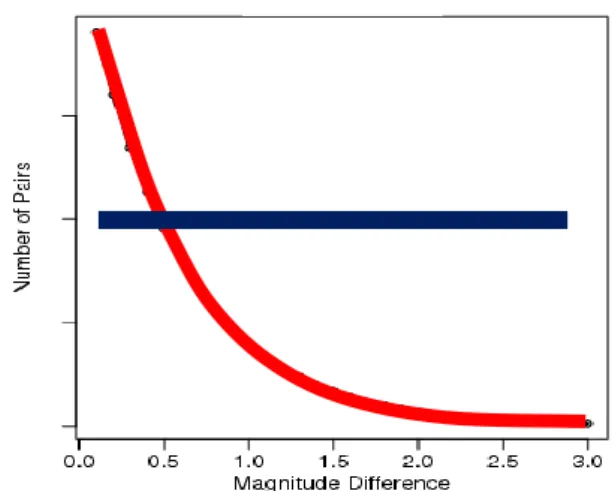
Jones (1985) found that the magnitude difference between a foreshock and a mainshock is more likely to be small than large. This result is shown schematically as the red line in Figure 1, and implies that large mainshocks are preceded by large foreshocks. Other authors have found that the magnitude difference between the foreshock and the mainshock is equally likely to be large as to be small (Agnew and Jones, 1991; Reasenberg 1999). Such an observation seems to imply that all main shocks are preceded by foreshocks and that mainshock magnitudes are independent of foreshock magnitudes. This distribution is shown schematically as the blue line in Figure 1.
The differences between these historical studies have been noticed by other authors. For example, Agnew and Jones (1991), comment that the Jones (1985) finding is a negative exponential distribution, and suggest that it is a consequence of using a uniform magnitude threshold for foreshocks and mainshocks.
We hypothesize that the two different results simply reflect the study designs, and in this research seek the dissimilarity in design that is driving the difference in distributions.
Figure 1. The red line shows the theoretical distribution of foreshock-mainshock differences, assuming smaller differences are more likely. The blue line shows the theoretical distribution of foreshock-mainshock differences, assuming all differences are equally likely.
We consider foreshock-mainshock pairs within the recent Japanese earthquake catalog and worldwide data. We found that the results of the previous historical studies differed because of the different earthquake foreshock-mainshock pairs that were considered by the two sets of authors. We show that either of the distributions shown in Figure 1 can be derived analytically using the definitions employed by the authors, and further show that the red curve also implies that mainshock magnitude is independent of foreshock magnitude.