臨界点近傍及び超臨界ベンゼン中における、有機金
属化合物を用いた自己組織化による炭素ナノ構造物
の創生
著者
Yasuhiro Hayasaki
学位授与大学
東洋大学
取得学位
博士
学位の分野
工学
報告番号
32663甲第417号
学位授与年月日
2017-03-25
URL
http://id.nii.ac.jp/1060/00008969/
Creative Commons : 表示 - 非営利 - 改変禁止 http://creativecommons.org/licenses/by-nc-nd/3.0/deed.jaDoctoral Thesis
Creation of carbon nanostructures via self-assembly
using organometallic compounds in benzene
under near- and super-critical conditions
Yasuhiro Hayasaki
4R10100001
Doctoral Course
Course of Bio-Nano Science Fusion
Graduate School of Interdisciplinary New Science
Toyo University, Japan
Preface
There are carbon allotropes such as graphite, graphene, diamond, lonsdaleite, fullerene, carbon nanotubes, carbon coils and carbon onions. These allotropes have their own unique mechanical, electrical, optical and chemical properties. The densities of two phases; gas and liquid, become identical and the size of molecular clusters increases at the critical points. Fluid over the critical point is called super-critical fluid. Near-critical and super-critical fluids are often used in nanotechnology as well as chemical, electrical, environmental science and engineering.
The objective of the present doctoral study is to synthesise novel carbon nanostructures in near- and super-critical benzene. The thesis is composed of six chapters. Three types of nanostructures; i.e., (a) magnetic metal-containing carbon nanoparticles, (b) magnetic alloy-containing carbon nanoparticles and (c) carbon coils, are produced by mixing different organometallic compounds with near- and super-critical benzene, which is irradiated with ultraviolet laser beams of different wavelengths. Those nanostructures are self-assembled via the interactions among the organometallic molecules, benzene molecules and photons.
The presently synthesised magnetic nanoparticles can be utilised particularly in the field of biomedicine as well as in the fields of mechanical, electronic, optical and chemical engineering. I believe that the present methodology may well be utilised for the synthesis of a variety of carbon nanoparticles containing different core particles by mixing different organometallic compounds with the solvent.
Contents
Nomenclature and units 1
Abbreviation 3
Tables and figures 5
Chapter 1 Introduction 9
1.1 Carbon and carbon nanostructures 11
1.2 Near- and supercritical fluids 16
1.3 Benzene 20
1.4 Metallocene 22
1.5 Metal nanoparticles 24
1.6 Objective an outline of the thesis 25
References 26
Chapter 2 Equipment and method for materials characterisation 31
2.1 Scanning electron microscopes 33
2.2 Transmission electron microscopes 34
2.3 Energy dispersive X-ray spectroscopy 34
2.4 Vibrating Sample Magnetometer 38
2.5 Superconducting quantum interface device 41
2.6 X-ray diffraction 45
2.7 Raman spectroscopy 48
2.8 Thermogravimetric analyser 51
Chapter 3 Creation of metal-containing carbon onions via self-assembly in metallocene/benzene solution irradiated with an ultraviolet laser
53
Abstract 55
3.1 Introduction 57
3.2 Experimental details 59
3.3 Results and discussion 62
3.4 Conclusions 71
Chapter 4 Synthesis of magnetic alloy-containing carbon nanoparticles in super-critical benzene irradiated with an ultraviolet laser 75
Abstract 77
4.1 Introduction 79
4.2 Experimental details 81
4.3 Characterisation of nanoparticles 84
4.4 Cell viability evaluation by an Alamar blue assay 84
4.5 Evaluation of hyperthermic performance 87
4.6 Results and discussion 89
4.7 Conclusions 115
References 116
Chapter 5 Creation of carbon coils in near-/super-critical benzene
119
Abstract 121
5.1 Introduction 123
5.2 Experimental details 124
5.3 Results and discussion 126
5.4 Conclusions 140
References 141
Chapter 6 Conclusions 143
Acknowledgements 147
- 1 -
Nomenclature and units
CPW: Cells per well [-]
d: Lattice spacing [nm] f: Frequency [Hz] Lp: Laser power [W mm-2] H: Magnetic field [A m-1] Mc: Coercivity [A m-1] Mr: Remnant magnetisation [Wb m kg-1] Ms: Saturation magnetisation [Wb m kg-1] P: Pressure [Pa]
Pc: Critical pressure [Pa]
T: Temperature [K], [°C]
Tc: Critical temperature [K], [°C]
ρ: Density [kg m-3]
ρc: Critical density [kg m-3]
- 3 -
Abbreviation
AC: Amorphous carbon nanoparticles
CO: Carbon onions
Co@C: Cobalt-containing carbon nanoparticle CNT: Carbon nanotube
CVD: Chemical vapour deposition DWNT: Double-walled carbon nanotube EDS: Energy dispersive X-ray spectrometry
Fe@C: Iron-containing carbon nanoparticle
FC: Field Cooling
ICDD: International Centre for Diffraction Data
MAC: Metal-containing amorphous carbon nanoparticle MA@C: Magnetic alloy-containing carbon nanoparticle MCO: Metal-containing carbon onions
MWNT: Multi-walled carbon nanotube PVD: Physical vapour deposition
SEM: Scanning electron microscope, Scanning electron microscopy SQUID: Superconducting quantum interference device
SWNT: Single-walled carbon nanotube
TEM: Transmission electron microscope, Transmission electron microscopy TGA: Thermogravimetric analyser
UV: Ultraviolet
VSM: Vibrating sample megnetometer
XRD: X-ray diffraction, X-ray diffratometry, X-ray diffractometer ZFC: Zero field cooling
- 5 -
Tables and figures
Chapter 1 Introduction
Table 1 Critical temperature (Tc), pressure (Pc) and density (ρc) of various
substances
Figure 1 Fullerene and carbon onion
Figure 2 Single-walled carbon nanotubes with different chiralities
Figure 3 Classification of carbon nanotubes based on the number of walls Figure 4 Pressure-temperature phase of substances
Figure 5 Photographs of benzene confined in a container Figure 6 Benzene
Figure 7 General chemical structure of a metallocene compound
Chapter 2 Equipment and method for materials characterisation
Figure 1 Scanning and transmission electron microscope Figure 2 Scanning electron microscope
Figure 3 Transmission electron microscope Figure 4 Energy dispersive X-ray spectroscope Figure 5 Vibrating sample magnetometer Figure 6 Vibrating sample magnetometer Figure 7 Josephson-device
Figure 8 Rf-SQUID Figure 9 Dc-SQUID
Figure 10 Superconducting quantum interference device Figure 11 X-ray diffraction
Figure 12 X-ray diffractometer Figure 13 Raman scattering Figure 14 Raman spectrometer
- 6 -
Chapter 3 Creation of metal-containing carbon onions via self-assembly in metallocene/benzene solution irradiated with an ultraviolet laser
Table 1 Carbon structures created in benzene after laser irradiation
Figure 1 Outline of the experimental system into metallocene/benzene solutions Figure 2 TEM images of metal containing carbon onions
Figure 3 TEM images, SAED pattern and EDS mappings of iron-containing
carbon onions
Figure 4 TEM images, SAED pattern and EDS mappings of cobalt-containing
carbon onions
Figure 5 Absorption spectra of benzene, ferrocene/benzene and cobaltocene/benzene solutions
Figure 6 Magnetisation-magnetic field curves
Chapter 4 Synthesis of magnetic alloy-containing carbon nanoparticles in super-critical benzene irradiated with an ultraviolet laser
Table 1 The average of core diameter and film thickness
Table 2 Magnetisation-magnetic field data of FeCo@C
Figure 1 Outline of the experimental system
Figure 2 Outline of the experimental system of alamar blue assay Figure 3 Outline of the experimental system of induction heating Figure 4 TEM images of FeCo@C
Figure 5 EDS mappings and energy peak of as prepared FeCo@C Figure 6 EDS mappings and energy peak of annealed FeCo@C 600 °C Figure 7 EDS mappings and energy peak of annealed FeCo@C 800 °C Figure 8 X-ray diffractogram of FeCo@C NPs
Figure 9 Raman spectra
Figure 10 Distribution of the diameter of a core particle and the thickness of a layer
covering the core particle
Figure 11 ZFC-FC curves of FeCo@C NPs measured between 2 and 400 K
Figure 12 Mass magnetisation-magnetic field curves of FeCo@C NPs measured at
- 7 -
Figure 13 Mass magnetisation-magnetic field curves of FeCo@C NPs measured at
300 K
Figure 14 Viability of cell line L929
Figure 15 Time variation of the surface temperature of the solution of NPs
dispersed in ethanol
Figure 16 Time variation of the temperature of the solution of as prepared FeCo@C
NPs dispersed in ethanol
Figure 17 Time variation of the temperature of the solution of annealed at 600 °C
dispersed in ethanol
Figure 18 Time variation of the temperature of the solution of annealed at 800 °C
dispersed in ethanol
Figure 19 Magnetisation-magnetic field curves of NPs measured at 300 K
Chapter 5 Creation of carbon coils in near-/super-critical benzene
Figure 1 Outline of the experimental system
Figure 2 SEM image of carbon coils formed after irradiation of a laser beam of
532 nm wavelength
Figure 3 SEM image of carbon coils formed after irradiation of a laser beam of
355 nm wavelength
Figure 4 SEM image of carbon coils formed after irradiation of a laser beam of
266 nm wavelength
Figure 5 TEM image and EDS mappings of carbon coils
Figure 6 Dependence of the size of a catalytic particle, and the helical diameter
and diameter of a coil on the wavelength of a laser beam
Figure 7 TEM image of a carbon coil
Figure 8 TEM image of a carbon coil and a catalytic copper particle Figure 9 TGA curve of Cu(tbaoac)2
Figure 10 SEM image of copper nanoparticles formed after pyrolytic
decomposition of Cu(tbaoac)2 on the window of the container
Figure 11 SEM image of copper nanoparticles formed after pyrolytic
decomposition of Cu(tbaoac)2 in liquid benzene
Figure 12 TEM image of copper nanoparticles formed after pyrolytic
- 9 -
Chapter 1
Introduction
- 11 -
1.1 Carbon and carbon nanostructures
Carbon is an element which forms the backbone of all organic compounds. The atomic number and atomic weight of carbon are 6 and 12.0107. There are three carbon isotopes; that is, 12C, 13C and 14C. 12C is used for the determination of the atomic weight
of atoms. 13C exists in nature although the amount of 13C is very small, whereas 14C is
radioactive, nothing that 14C, which is present in organic matter, is used for radiocarbon
dating. Carbon has allotropes such as graphite, graphene, diamond, lonsdaleite, fullerene, carbon nanotubes, carbon coils and carbon onions. These allotropes have their own unique mechanical, electrical, optical and chemical properties. The most commonly used carbon allotrope is graphite. Graphite is composed of only six-membered rings of carbon which are formed via sp2 hybrid orbitals [1], whereas graphite layers are weekly bonded
via van der Waals forces [2], because of which graphite can be easily peeled off. A single layer of graphene has recently been separated from graphite by Geim and Novoselov [3] and its mechanical, electrical, electronic, optical and magnetic properties have been intensively investigated and analysed [4-8]. Diamond and lonsdaleite are mechanically extremely hard. In diamond, carbon atoms are bonded in a three-dimensional space via sp3 hybrid orbitals. Diamond is the hardest material on the earth. Taking advantage of this
property, diamond is widely used in the blade of industrial cutters. The thermal conductivity is very high [9], but the electrical conductivity is very low [10]. Lonsdaleite, which was named in honour of Kathleen Lonsdale, is also called hexagonal diamond [11]. Pure lonsdaleite is harder than diamond [12]. C60 fullerene, which was discovered by
Kroto and his group in 1985 [13], is a soccer ball shaped molecule formed by 60 carbon atoms (Figure 1(a)). The application of C60 molecules to various fields has been
intensively investigated in mechanical, electrical, chemical, biochemical and medical engineering [14-18]. C60 is semiconducting [19, 20], physically stable [21, 22] and a good
gas absorbent [23]. It is also well known that several atoms can be captured inside C60
- 12 -
also be captured in carbon onions [26]; e.g., iron intercalated into carbon onions can be protected from oxidation [27]. Carbon nanotubes (CNTs), which were discovered by Iijima et al in 1991 [28], are acknowledged as one of the most important nano materials as well as fullerene and graphene. CNTs were discovered in a cathode of an arc discharge system in the process of synthesising C60 [29]. A single-walled CNT (SWNT) (Figure 2)
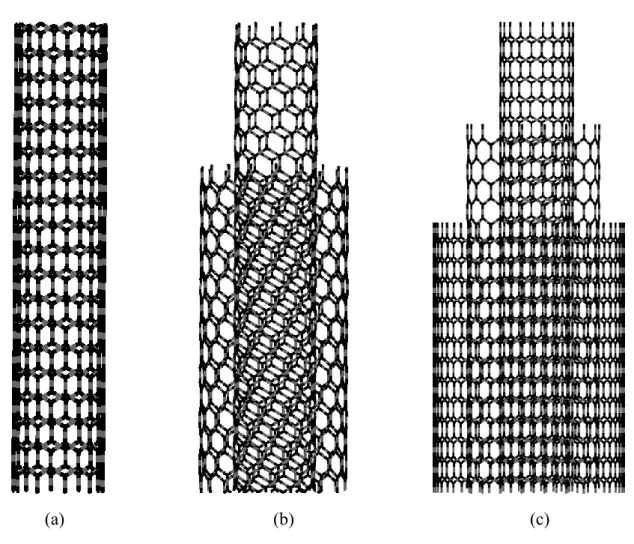
is in a sense a rolled-up graphene and there are three types of SWNTs depending on the differences in chirality; i.e., chiral, armchair and zig-zag SWNTs (Figure 2(a)(b)(c)) [30,31]. SWNTs are conductive in the case of an arm chair arrangement, whereas they are semiconducting in the case of zigzag and chiral structures [32]. CNTs are categorised into three types depending on the number of walls; that is, single-, double- and multi-walled CNTs (SWNTs, DWNTs and MWNTs) (Figure 3(a),(b),(c)) [33-35]. Magnetic materials-containing carbon nanotubes have also been synthesised [36]. Bamboo-shaped CNTs are interesting for their unique shapes, structures and growth modes [37,38]. Carbon coils are spring-like carbon structure [39]. Typically, carbon coils can be grown using metallic catalysts [40,41]. The shape of carbon coils is changed depending on the shape of metallic nanoparticles [42]. Carbon coils possess excellent mechanical strength, thermal stability and thermal conductivity, which are comparable to those of CNTs [43-46]. Carbon coils are expected to be used as nano springs, electric conductors and electromagnetic wave absorbers [47-50].
- 13 -
Figure 1 Fullerene and carbon onion. (a) C60 fullerene. (b) Carbon onion.
- 14 -
Figure 2 Single-walled carbon nanotubes with different chiralities. (a) Chiral. (b)
Armchair. (c) Zig-zag.
- 15 -
Figure 3 Classification of carbon nanotubes based on the number of walls. (a)
Single-walled CNT (SWNT). (b) Double-Single-walled CNT (DWNT). (c) Multi-Single-walled CNT (MWNT).
- 16 -
1.2 Near- and super-critical fluids
Charles Cagniard de la Tour discovered the critical point of alcohol in 1822, observing that the gas-liquid interface disappeared at a certain temperature [51]. Each substance in fact has its own critical pressure, critical temperature and critical density. A generalised phase diagram of substances is shown in Figure 4, where the critical point is characterised by the critical temperature; Tc, pressure; Pc, and density; ρc. Table 1.2 shows
the critical parameters of some typical substances. At the critical point, the densities of two phases; gas and liquid, become identical and the size of molecular clusters increases and becomes comparable to the wavelength of light. Figure 5 shows photographs of benzene in a sub-critical region, at the critical point and in a super-critical region. Fluid is not transparent at the critical point; known as critical opalescence. Fluid over the critical point is called super-critical fluid. In terms of non-equilibrium transport phenomena, perturbations of the temperature, pressure and density propagate as acoustic waves due to low thermal diffusivity and high compressibility, which is known as the piston effect [52-55], and strong buoyancy convection is induced due to the low thermal diffusivity and high temperature coefficient of volume expansion [56-62]. Near-critical and super-critical fluids are often used in nanotechnology as well as chemical, electrical, environmental science and engineering. Chemicals are extracted, semiconductors are washed and cleaned and nanomaterials and nanostructures are efficiently created in near-critical and super-near-critical fluids [63,64]. The application of supernear-critical carbon dioxide to decaffeinate from coffee beans is well known. Super-critical and near-critical carbon dioxide is commonly used as a solvent to extract and dry a specific substance [65,66]. Near- and super-critical benzene can also be used for the creation of carbon nanostructures. The critical-temperature, pressure and density of benzene are, respectively, 562.16 K, 4.89 MPa and 302 kg m-3 [67].
- 17 -
- 18 -
Table 1 Critical temperature (Tc), pressure (Pc) and density (ρc) of various substances.
Substance temperature Critical
Tc [K] Critical pressure Pc [MPa] Critical density ρc [kg m-3] Benzene (C6H6) 562.16 4.898 302 [67] Carbon dioxide (CO2) 304.2 7.38 466 [68] Water (H2O) 647.30 22.12 315.46 [69] Ethane (C2H6) 305.30 4.871 204.5 [70] Xenon (Xe) 289.73 5.840 1110 [71] Carbon monoxide (CO) 132.91 3.491 299 [52] Helium (He) 5.1 0.229 69.30 [72] Argon (Ar) 151 4.862 531 [73] Dimethyl ether (C2H6O) 467 3.606 264 [74] Acetone (C3H6O) 508.50 4.721 273 [75] Ethyl alcohol (C2H6O) 516 6.382 276 [76] Cyclohexane (C6H12) 553 4.052 273 [77]
- 19 -
Figure 5 Photographs of benzene confined in a container. (a) Sub-critical region. Gas and
liquid are separated under terrestrial gravitational conditions. (b) Near-critical region. Incident light cannot penetrate the fluid due to the formation of large molecular clusters. (c) Super-critical region. There is no interface and the fluid is transparent again.
- 20 -
1.3 Benzene
Faraday discovered benzene in 1825 and Mitsctherlich, who named this organic substance as benzene, clarified the molecular formula of benzene in 1834. Benzene, the chemical formula of which is C6H6, is the simplest aromatic hydrocarbon (Figure 6).
Carbon atoms are bonded via sp2 hybrid orbitals to form a hexagonal six-membered ring.
Benzene is highly volatile, flammable and toxic. The melting and boiling points of benzene are, respectively, 5.5 and 80.1 °C. Benzene in general reacts with the electrophile (aromatic electrophilic substitution reaction). Benzene is often used as a carbon source to create carbon nanostructures such as amorphous carbon, fullerene, carbon onions, carbon nanotubes and carbon coils [78-85].
- 21 -
- 22 -
1.4 Metallocenes
Metallocene is an organometallic compound, in which a metal atom is in general sandwiched between two cyclopentadienyl ligands (Figure 7). One of the most well-known metallocenes is ferrocene. Pauson and Kealy synthesised a metallocene in 1951. Metallocene is soluble in organic solvents and carbon dioxide [86,87]. Metal nanoparticles and metal-containing carbon structures; e.g., nickel-, iron- and cobalt-containing carbon nanoparticles and carbon onion, were created by mixing metallocene with organic solvents and carbon dioxide via arc discharge, chemical vapour deposition and laser ablation processes [88-90]. Alloy-containing carbon structures such as alloy-containing carbon nanotubes and carbon nanoparticles were also synthesised by CVD and plasma CVD [91,92]. Metallic nanowires were synthesised by mixing benzene with ferrocene and sulphur [93]. The application of magnetic particles-containing carbon structures or nanoparticles to biomedical fields is particularly important considering their mechanical, electrical, electronic and optical properties; e.g., magnetic particles can be utilised for nano drug delivery, hyperthermia and a contrast agent [94-97].
- 23 -
- 24 -
1.5 Metal nanoparticles
Metal nanoparticles have been intensively studied in various fields. There are several methodologies for synthesising metal nanoparticles; e.g., the grinding, aggregation, thermal decomposition, physical vapour deposition (PVD), chemical vapour deposition (CVD) and laser ablation methods. Magnetic nanoparticles can be manipulated using magnetic fields [98] and heated via the hyperthermic effect applying alternating magnetic fields [99], whereas nonmagnetic nanoparticles can also be used as catalysts, contrast agents and photo thermal media heated by near-infrared light [100].
- 25 -
1.6 Objective and outline of the thesis
The objective of the present doctoral research is to synthesise novel carbon structures in near- and super-critical benzene.
In Chapter 2, the equipment and methods, which were used for materials characterisation, are summarised, focusing on scanning electron microscopy (SEM), transmission electron microscopy (TEM), energy dispersive X-ray spectroscopy (EDS), vibrating sample magnetometry (VSM), superconducting quantum interference device (SQUID), X-ray diffractogramme (XRD) and Raman spectroscopy. In Chapter 3, the creation of metal-containing carbon onions via self-assembly in metallocene/benzene solution, which is irradiated with an ultraviolet laser, is investigated. Those carbon nanostructures contain iron or cobalt nanoparticles. In Chapter 4, Fe/Co alloy-containing carbon onions are synthesised by irradiating a UV laser into benzene, in which ferrocene and cobaltocene are dissolved. The effect of the annealing temperature on the structures, compositions and magnetic characteristics is clarified. In Chapter 5, the effect of catalysts of organometallic compounds on the formation of carbon coils in near- and super-critical benzene is investigated. Organometallic compounds of copper are mixed with super-critical benzene and a UV laser beam is irradiated into the solution. Nanoparticles and nano fibres composed of copper and carbon coils are synthesised. In Chapter 6, the results obtained by the present doctoral research are summarised.
- 26 -
References
[1] Chen N and Yang R T 1998 Carbon 36 1061
[2] Rydberg H, Dion M, Jacobson N, Schröder E, Hyldgaard P, Simak S, Langreth D C and Lundqvist B I 2003 Physical Review Letters 91 126402
[3] Geim A K and Novoselov K S 2007 Nature Materials 6 183
[4] Li Y, Hu Y, Zhao Y, Shi G, Deng L, Hou Y and Qu L 2011 Advanced Materials 23 776
[5] Goerbig M 2011 Reviews of Modern Physics 83 1193
[6] Lu C, Chang C P, Huang Y C, Chen R B and Lin M 2006 Physical Review B 73 144427
[7] Liu F, Chung S, Oh G and Seo T S 2012 ACS Applied Materials & Interfaces 4 922
[8] Sepioni M, Nair R, Rablen S, Narayanan J, Tuna F, Winpenny R, Geim A and Grigorieva I 2010 Physical Review Letters 105 207205
[9] Wei L, Kuo P, Thomas R, Anthony T and Banholzer W 1993 Physical Review
Letters 70 3764
[10] Jin S and Moustakas T 1993 Applied Physics Letters 63 2354
[11] Shumilova T, Mayer E and Isaenko S 2011 Doklady Earth Sciences 441 1 1552 [12] Frondel C and Marvin U B 1967 Nature 214 587
[13] Kroto H W, Heath J R, O'Brien S C, Curl R F and Smalley R E 1985 Nature 318 162
[14] Ginzburg B, Tabarov S K, Tuichiev S and Shepelevskii A 2007 Technical Physics
Letters 33 1007
[15] Rikukawa M, Furumi S, Sanui K and Ogata N 1997 Synthetic Metals 86 2281 [16] Maggini M, Scorrano G and Prato M 1993 The Journal of the American Chemical
Society 115 9798
[17] Tokuyama H, Yamago S, Nakamura E, Shiraki T and Sugiura Y 1993 The Journal
of the American Chemical Society 115 7918
[18] Singh R and Lillard Jr J W 2009 Experimental and Molecular Pathology 86 215 [19] Voz C, Puigdollers J, Cheylan S, Fonrodona M, Stella M, Andreu J and Alcubilla
R 2007 Thin Solid Films 515 7675
[20] Bronner M, Opitz A and Brütting W 2008 Physica Status Solidi (a) 205 549 [21] Giovane L M, Barco J W, Yadav T, Lafleur A L, Marr J A, Howard J B and Rotello
V M 1993 The Journal of Physical Chemistry 97 8560
[22] Zhang B, Xu C, Wang C, Chan C and Ho K 1992 Physical Review B 46 7333 [23] Kartsova L and Makarov A 2004 The Journal of Analytical Chemistry 59 724
- 27 -
[24] Andreoni W and Curioni A 1996 Physical Review Letters 77 834
[25] Maiti A, Brabec C and Bernholc J 1993 Physical Review Letters 70 3023
[26] Banhart F, Hernandez E and Terrones M 2003 Physical Review Letters 90 185502 [27] He C N, Tian F, Liu S J, Du Z J, Liu C J, Li F and Chen S Q 2008 Materials
Letters 62 3697
[28] Iijima S 1991 Nature 354 56
[29] Gamaly E G and Ebbesen T W 1995 Physical Review B 52 2083
[30] Venkateswaran U, Rao A, Richter E, Menon M, Rinzler A, Smalley R and Eklund P 1999 Physical Review B 59 10928
[31] Wildoer J W G, Venema L C, Rinzler A G, Smalley R E and Dekker C 1998 Nature
391 59
[32] Odom T W, Huang J L, Kim P and Lieber C M 1998 Nature 391 62 [33] Kong J, Cassell A M and Dai H 1998 Chemical Physics Letters 292 567
[34] Hiraoka T, Yamada T, Hata K, Futaba D N, Kurachi H, Uemura S, Yumura M and Iijima S 2006 The Journal of the American Chemical Society 128 13338
[35] Kresin V 1995 Nature 377 135
[36] Lv R, Kang F, Gu J, Gui X, Wei J, Wang K and Wu D 2008 Applied Physics
Letters 93 223105
[37] Shanmugam S and Gedanken A 2006 The Journal of Physical Chemistry B 110 2037
[38] Saito Y 1995 Carbon 33 979
[39] Yang S, Chen X, Motojima S and Ichihara M 2005 Carbon 43 827
[40] Motojima S, Itoh Y, Asakura S and Iwanaga H 1995 P The Journal of Materials
Science 30 5049
[41] Shaikjee A, Franklyn P J and Coville N J 2011 T Carbon 49 2950 [42] Chen X, Yang S and Motojima S 2002 Materials Letters 57 48
[43] Chen X, Motojima S and Iwanga H 2002 The Journal of Crystal Growth 237 1931 [44] Chen X, Zhang S, Dikin D A, Ding W, Ruoff R S, Pan L and Nakayama Y 2003
Nano Letters 3 1299
[45] Tang N, Zhong W, Au C, Yang Y, Han M, Lin K and Du Y 2008 The Journal of
Physical Chemistry C 112 19316
[46] Qin Y, Yu L, Wang Y, Li G and Cui Z 2006 Solid State Communications 138 5 [47] Poggi M A, Boyles J S, Bottomley L A, McFarland A W, Colton J S, Nguyen C V,
Stevens R M and Lillehei P T 2004 Nano Letters 4 1009
[48] Yang S, Chen X and Motojima S 2004 Diamond and Related Materials 13 2152 [49] Ok J G, Kim B H, Sung W Y, Lee S M, Lee S W, Kim W J, Park J W, Chu C N
- 28 -
and Kim Y H 2007 The Journal of Micromechanics and Microengineering 18 025007
[50] Hayashida T, Pan L and Nakayama Y 2002 Physica B: Condensed Matter 323 352 [51] Motojima S, Hoshiya S and Hishikawa Y 2003 Carbon 41 2653
[52] Tour C de la 1822 Annual Review of Physical Chemistry 22 127 [53] Onuki A, Hao H and Ferrell A 1990 Physical Review A 41 2256
[54] Boukari H, Shaumeyer J N, Briggs M E and Gammon R W 1990 Physical Review
A 41 2260
[55] Ishii K, Maekawa T, Azuma H, Yoshihara S and Onishi M 1998 Applied Physics
Letters 72 16
[56] Maekawa T, Ishii K, Shiroishi Y and Azuma H 2004 The Journal of Physics A:
Mathematical and General 37 7955
[57] Zappoli B, Amiroudine S, Carles P and Ouazzani J 1996 The Journal of Fluid
Mechanics 316 53
[58] Garrabos Y, Bonetti M, Beysens D, Perrot F, Föhlich T, Carlés P and Zappoli B 1998 Physical Review E 57 5665
[59] Carlés P and Ugurtas B 1999 Physica D: Nonlinear Phenomena 126 69
[60] Azuma H, Yoshihara S, Onishi M, Ishii K, Masuda S and Maekawa T 1999
International Journal of Heat and Mass Transfer 42 771
[61] Meyer H and Kogan A B 2002 Physical Review E 66 056310
[62] Wang C W, Chang R T, Lin W K, Lin R D, Liang M T, Yang J F and Wang J B 1999 The Journal of the Electrochemical Society 146 3485
[63] Fukuda T, Ishii K, Kurosu S, Whitby R and Maekawa T 2007 Nanotechnology 18 145611
[64] Kritzer P 2004 The Journal of Supercritical Fluids 29 1 [65] Hawthorne S B 1990 Analytical Chemistry 62 633
[66] Inoue T and Osatake H 1988 Archives of Histology and Cytology 51 53
[67] Shimansky Y I and Shimanskaya E 1996 International Journal of Thermophysics
17 651
[68] Harris J G and Yung K H 1995 The Journal of Physical Chemistry 99 12021 [69] Liu X Y, He M G and Zhang Y 2011 The Journal of Supercritical Fluids 56 194 [70] Noble J D and Bloom M 1965 Physical Review Letters 14 250-1
[71] Giglio M and Benedek G B 1969 Physical Review Letters 23 1145-9
[72] Harms J, Toennies J P and Knuth E L 1997 The Journal of Chemical Physics 106 3348
- 29 -
[74] Ihmels E C and Lemmon E W 2007 Fluid Phase Equilibria 260 36
[75] Ambrose D, Sprake C and Townsend R 1974 The Journal of Chemical
Thermodynamics 6 693
[76] Xu C and Etcheverry T 2008 Fuel 87 335
[77] Hugill J and McGlashan M 1978 The Journal of Chemical Thermodynamics 10 95
[78] Shao M, Li Q, Wu J, Xie B, Zhang S and Qian Y 2002 Carbon 40 2961
[79] Cheng H, Li F, Su G, Pan H, He L, Sun X and Dresselhaus M 1998 Applied
Physics Letters 72 3282
[80] Endo H, Kuwana K, Saito K, Qian D, Andrews R and Grulke E A 2004 Chemical
Physics Letters 387 307
[81] Li Q, Yan H, Zhang J and Liu Z 2004 Carbon 42 829
[82] Devaux X, Tsareva S Y, Kovalenko A, Zharikov E and McRae E 2009 Carbon 47 1244
[83] Golberg D, Bando Y, Kurashima K and Sasaki T 1999 Carbon 37 293
[84] Li Z, Wu P, Wang C, Fan X, Zhang W, Zhai X, Zeng C, Yang J and Hou J 2011
ACS Nano 5 3385
[85] Fukuda T, Watabe N, Whitby R and Maekawa T 2007 Nanotechnology 18 415604 [86] Shafer H O, Derback T L and Koval C A 2000 The Journal of Physical Chemistry
B 104 1025
[87] Aschenbrenner O, Kemper S, Dahmen N, Schaber K and Dinjus E 2007 The
Journal of Supercritical Fluids 41 179
[88] Hasumura T, Fukuda T, Whitby R L D, Aschenbrenner O and Maekawa T 2010
Chemical Physics Letters 493 304
[89] Hasumura T, Fukuda T, Whitby R L D, Aschenbrenner O and Maekawa T 2011
The Journal of Nanoparticle Research 13 53
[90] Hayasaki Y, Fukuda T, Hasumura T and Maekawa T 2012 Advances in Natural
Sciences: Nanoscience and Nanotechnology 3 035010
[91] Kozhuharova R, Ritschel M, Elefant D, Graff A, Mönch I, Mühl T, Schneider C and Leonhardt A 2005 The Journal of Magnetism and Magnetic Materials 290 250
[92] Ibrahim E M M, Hampel S, Wolter A U B, Kath M, El-Gendy A A, Klingeler R, Täschner C, Khavrus V O, Gemming T and Leonhardt A 2012 The Journal of
Physical Chemistry C 116 42 22509
[93] Luo T, Chen L, Bao K, Yu W and Qian Y 2006 Carbon 44 2844
- 30 -
93 139701
[95] Hayashi K, Ono K, Suzuki H, Sawada M, Moriya M, Sakamoto W and Yogo T 2010 ACS Applied Materials & Interfaces 2 1903
[96] Hergt R, Dutz S, Müller R and Zeisberger M 2006 The Journal of Physics:
Condensed Matter 18 S2919
[97] Yu X, Song S K, Chen J, Scott M J, Fuhrhop R J, Hall C S, Gaffney P J, Wickline S A and Lanza G M 2000 Magnetic Resonance in Medicine 44 867
[98] Morimoto H, Ukai T, Nagaoka Y, Grobert N, & Maekawa T 2008 Physical
Review E 78 2 021403
[99] Sadhukha T, Wiedmann T S & Panyam J 2013 Biomaterials 34 21 5163
- 31 -
Chapter 2
Equipment and methods for materials
characterisation
- 33 -
The materials synthesised and/or dealt with in the present doctoral research were thoroughly characterised and analysed using the following microscopes and spectroscopic analysers.
2.1 Scanning electron microscopes
Scanning electron microscopes (SEMs) are the most commonly used devices for the observation and analysis of the structures of nanomaterials. When an electron beam is irradiated on the sample surface (Figure 1), backscattered electrons (BSEs), secondary electrons (SEs), Auger electrons, X-ray and Cathode luminescence come out from the surface of the sample. When the sample is very thin, the electron beam transmits through the sample, noting that the electrons are called transmitted electrons. In SEM, BSEs and SEs come out from the surface of the sample are detected and the surface structure is visualised. BSEs are suitable for observation of the composition and unevenness of the surface of the sample, whereas SEs for observation of the shape of the surface of the sample. Therefore, users need to choose the best viewing mode depending on the characteristics of samples. In the present research, an SEM (SU8030, Hitachi Ltd.) (Figure 2) is used for observation of carbon coils and copper nanoparticles.
- 34 -
2.2 Transmission electron microscopes
Transmission electron microscopes (TEMs) are also used for observation of nanomaterials. An electron beam transmitted through the sample is detected and therefore, it is possible to observe the internal structure of nanoparticles (Figure 1). What is more, 3D images of samples can be constructed thanks to recent advancement in tomographical technology. In the present research, the internal structure of graphitic layers of carbon nanoparticles and carbon coils is visualised by a TEM (JEM-2200FS, JEOL) (Figure 3).
2.3 Energy dispersive X-ray spectroscopy
Energy dispersive X-ray spectroscopy (EDS) is one of the most commonly used elemental analysis systems. When an electron beam is irradiated onto a sample, X-rays are emitted from the surface of the sample (Figure 1). The elements composing the sample can be identified detecting a specific X-ray emitted from the sample. EDS is often equipped with SEMs and TEMs. In the present research, elements such as carbon, iron, cobalt and copper are identified using an EDS (JED-2300T, JEOL) (Figure 4).
- 35 -
Figure 1 Scanning and transmission electron microscopy. When an electron beam is
irradiated onto a sample, various types of electrons and X-ray are emitted from the surface of the sample, whereas when the sample is very thin, transmission electrons are also detected.
- 36 -
Figure 2 Scanning electron microscope. SU8030 (Hitachi Ltd.).
- 37 -
- 38 -
2.4 Vibrating Sample Magnetometer
A vibrating sample magnetometer (VSM) is a device for measuring the magnetic properties of samples. A sample is placed in a uniform magnetic field and then is vibrated at a constant frequency and amplitude (Figure 5). The induced electromotive current is measured by a detection coil installed around the sample so that the magnetic properties of the sample such as the saturation magnetisation, remanent magnetisation and coercivity can be evaluated. In the present study, the magnetic properties of iron-containing and cobalt-containing carbon onions are measured by a vibrating sample magnetometer (VSM) (7407, Lake Shore Crytronics Ins.) (Figure 6).
- 39 -
Figure 5 Vibrating sample magnetometer. A sample is vibrated and the change of the
- 40 -
- 41 -
2.5 Superconducting quantum interference device
Superconducting quantum interference devices (SQUIDs) are also designed for measuring the magnetic properties of samples. SQUIDs are composed of Josephson-devices. Each Josephson-device has one or two Josephson-junctions, which are constructed by a very thin normal conductor or insulator sandwiched by superconductors (Figure 7). There are two types of SQUID devices; i.e., SQUID and dc-SQUID. An rf-SQUID has a one point Josephson-junction (Figure 8), whereas dc-rf-SQUID two points Josephson-junctions (Figure 9). Dc-SQUIDs are generally used for accurate measurement of the magnetic properties. The sensitivity of dc-SQUIDs is higher than that of rf-SQUIDs.
In the present study, a dc-SQUID (MPMS3, Quantum Design, Inc.) (Figure 10) was used for the measurement of the magnetic properties of materials synthesised and processed.
- 42 -
Figure 7 Josephson-device. Insulator or normal conductor are sandwiched vertically
between superconductors.
- 43 -
- 44 -
Figure 10 Superconducting quantum interference device. MPMS3 (Quantum Design,
- 45 -
2.6 X-ray diffraction
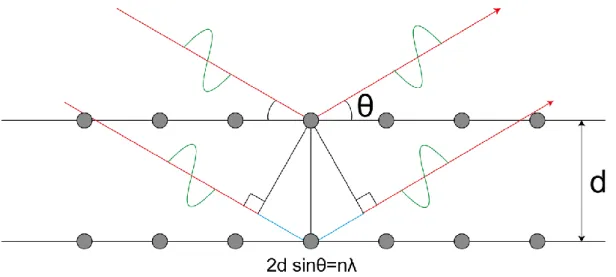
X-ray diffraction (XRD) is widely used in the fields of nanoscience/technology and materials science/technology as a means of examining the structural state and physical properties of materials. When X-rays, the wavelength of which ranges of the atomic distance (0.05 - 0.3 nm), are irradiated onto a substance, in which atoms are regularly arranged, they are scattered by electrons belonging to each atom. The scattered X-rays interfere with each other and construct specific patterns in a particular direction (Figure 11). The path difference of X-rays scattered by the first and second grating surfaces is 2d sinθ, where d, θ and 2θ are the lattice spacing, Bragg angle and diffraction angle. When the path difference is an integral multiple of the wavelength of the incident X-rays, the intensity is increased. Therefore, the diffracted X-rays are observed only in the direction that satisfies the following Bragg equation (eq. (1)).
2d sinθ=n λ (1)
Knowing θ and λ in advance, the d-spacing of a sample material; that is, the structure of the crystal, is clarified. In the present study, the crystallinity and components of nanoparticles synthesised are analysed by an X-ray diffractometer (XRD) (SmartLab (9 kW)-RPA, Rigaku Corp.) (Figure 12).
- 46 -
Figure 11 X-ray diffraction. When X-rays hit crystal lattices, some specific patterns are
- 47 -
- 48 -
2.7 Raman spectroscopy
Molecular dynamics can be analysed by Raman spectroscopy, which detects the spectrum of light scattered by materials of molecular vibration. When photons are irradiated onto materials, reflection, refraction, absorption and scattering occur. The scattered light includes some wavelengths different from those of the incident light (Figure 13). The Raman spectroscopy can measure the molecular structure and crystallinity of materials and evaluate the identification of chemical bonds of substances, and the degrees of distortion of the crystal lattices by detecting Stokes and Anti-Stokes light. In the present research, a Raman spectrometer (LabRAM, HR-800, HORIBA JOBIN YVON S.A.S) (Figure 14) is used for measuring the state of carbon before and after annealing.
- 49 -
Figure 13 Raman scattering. When incident light is irradiated onto molecules, the
incident light is scattered by molecular vibration. Stokes light is detected in the case of carbon materials.
- 50 -
- 51 -
2.8 Thermogravimetric analyser
A thermogravimetric analyser (TGA) is used for the analysis of the oxidation, pyrolysis, dehydration, heat resistance and reaction rate of the sample materials. In the present research, a TGA (DTG-60H, Shimadzu) (Figure 15) is used for the annealing of as-synthesised nanoparticles (Chapter 4) and for the analysis of pyrolysis of bis(t-butylacetoacetato)copper(II):Cu(tbaoac)2 (Chapter 5).
- 52 -
- 53 -
Chapter 3
Creation of metal-containing carbon onions
via self-assembly in metallocene/benzene
solution irradiated with an ultraviolet laser
- 55 -
Abstract
Sub- and super-critical benzene, in which metallocene such as ferrocene or cobaltocene is dissolved, is irradiated with a UV laser of 266 nm wavelength and it is found that benzene and metallocenes are dissociated and iron- and cobalt-containing carbon onions (Fe@C and Co@C) are created. The operational temperature of the present method is much lower than that of conventional ones for the growth of nanomaterials and therefore coagulation among metal-containing carbon onions is avoided. The average diameters of the core iron and cobalt nanoparticles are, respectively, 7.5 and 7.2 nm, whereas the thickness of the layers of carbon onions surrounding the core metal particles is 3.2 nm in both Fe@C and Co@C cases. The metal-containing carbon onions show superparamagnetic characteristics.
- 57 -
3.1 Introduction
Nanostructures are commonly created by so-called top-down ultra-fine fabrication techniques such as photolithography, X-ray lithography and etching [1,2], whereas they can also be formed via bottom-up self-assembly processes learning from biological systems [2,3]. Carbon nanostructures such as fullerenes, carbon nanotubes and graphene are self-assembled during the arc-discharge, laser ablation and chemical vapour deposition processes [4]. It has been shown that fluids such as carbon dioxide and benzene under near- and super-critical conditions can be used as solvents for the creation of nanostructures [5-13]. Gas-liquid coexistence curves terminate at the critical points, where large clusters are formed by fluids’ molecules and as a result, incident light, scattered by the clusters, cannot penetrate the fluids, which is known as critical opalescence [14]. The physical properties such as the specific heat and compressibility diverge as the fluid systems approach the critical points due to the long ranged coherent molecular clusters and the abnormal behaviour of fluids under near-critical conditions has been investigated from a universal point of view both theoretically and experimentally [14]. In terms of non-equilibrium transport phenomena occurring near the critical points, it is known that temperature and pressure perturbations propagate as acoustic waves due to the extremely low thermal diffusivity and high compressibility, which is known as the piston effect [15-18], and strong buoyancy convection is induced due to the low thermal diffusivity and high temperature coefficient of volume expansion [17-23]. In addition to their unusual characteristics, near- and super-critical fluids have been recognised as useful fluids from a technological point of view and therefore they are often used in chemical, electronic and environmental sciences and engineering. Reactions are encouraged [24], chemicals are extracted [25], semiconductors are cleaned and purified [26] and nanostructures are created [5-13] in super-critical fluids. In terms of the formation of nanostructures, carbon particles, onions, coils, needles and fibres were created in near- or super-critical carbon dioxide, benzene and their mixture
- 58 -
[5-13]. In this chapter, a bottom-up method of producing metal-containing carbon onions is demonstrated using benzene under sub- and super-critical conditions. Metallocene such as ferrocene or cobaltocene is mixed with benzene and an ultraviolet laser is irradiated into the metallocene/benzene solution. Ii is found that iron- and cobalt-containing carbon onions are formed via self-assembly in benzene under sub- and near-critical conditions. The dependence of the structural and magnetic characteristics of the nanoparticles produced in benzene on the temperature of the benzene/metallocene solution is clarified.
- 59 -
3.2 Experimental details
An outline of the experimental system is shown in Figure 1. Metallocene such as ferrocene or cobaltocene was dissolved in benzene and the metallocene/benzene solution was confined in a cylindrical container made of stainless steel. The mass concentration of ferrocene or cobaltocene in benzene was set at 3.52, 11.76, 17.64 or 23.52 mg ml-1 and the amount of benzene was set at the critical density. The inner and
outer diameters and inner and outer heights of the container were, respectively, 13 and 60 mm, and 23 and 66 mm. A synthetic quartz was mounted at the top of the container for the introduction of the laser beam (see Figure 1). The diameter and thickness of the quartz window was 20 and 10 mm. A platinum resistance thermometer (Pt100, Chino Co. Ltd.) was set in the container wall and the temperature of the fluid was controlled by a heater installed around the container and a temperature controller (LT470, Chino Co. Ltd.). The fluid conditions were changed from a sub-critical liquid-gas two-phase region to super-critical one by controlling the fluid temperature. Note that the critical temperature Tc, pressure Pc and density ρc of benzene are Tc = 289 °C, Pc = 4.92 MPa,
ρc = 300 kg m-1 [27]. In each experiment, 50000 pulses of a UV laser beam of 266 nm wavelength were irradiated from a neodymium doped yttrium/aluminium/garnet (Nd:YAG) laser (Brilliant Quantel Ltd. Co.) into the metallocene/benzene solution, the temperature of which was set at 25, 150, 200, 250 or 290 °C. The diameter of the laser beam was 10 mm and the energy flux was Lp = 5.2 mW mm-2. The duration of each
laser pulse and the frequency of the pulse generation were 4.3 ns and f = 10 Hz. The beam was not focused on any particular point. After each experiment, the temperature of the fluid was decreased gradually down to room temperature.
I observed the residue products in benzene by a scanning electron microscope (SEM) (JSM-7400F, JEOL) and transmission electron microscope (TEM) (JEM-2200FS, JEOL). I also analysed the structures of the products by the selected area electron diffraction (SAED) method (JEM-2200FS, JEOL), the elementary components of the
- 60 -
structures by energy-disperse X-ray spectroscopy (EDS) (JED-2300T, JEOL) and the magnetisation by a vibrating sample magnetometer (VSM) (7407, Lake Shore Crytronics Inc).
- 61 -
Figure 1 Outline of the experimental system. Benzene, in which metallocene such as
ferrocene or cobaltocene is dissolved, is confined in a cylindrical container made of stainless steel. The temperature is controlled by a heater installed around the container and a laser beam of 266 nm wavelength is irradiated into the solution.
- 62 -
3.3 Results and discussion
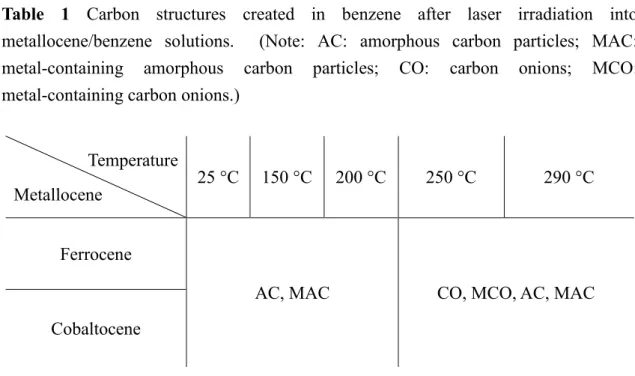
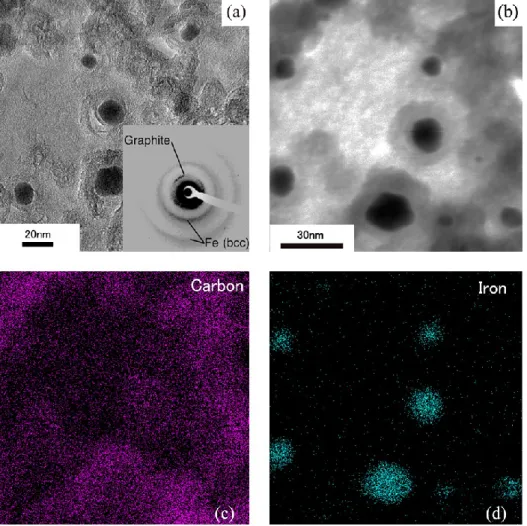
I irradiated UV laser into sub- and super-critical benzene, in which ferrocene or cobaltocene was dissolved, at different temperatures; 25, 150, 200, 250 and 290 °C. The relation between the structures created in the solution after the laser irradiation and the temperature of the solution is summarised in Table 1. Amorphous carbon particles and metal-containing amorphous carbon particles were produced when the temperature was lower than or equal to 200 °C, whereas carbon onions and metal-containing carbon onions as well as amorphous carbon particles and metal-containing amorphous carbon particles were produced when the temperature was 250 and 290 °C. TEM images, SAED patterns and EDS mappings of carbon nanostructures formed in ferrocene/benzene and cobaltocene/benzene solutions are, respectively, shown in Figures 2, 3 and 4, where the temperature of the solution during laser irradiation was 290 °C and the mass concentration of ferrocene or cobaltocene mixed with benzene was 3.52, 11.76, 17.64 or 23.52 mg ml-1. Iron-containing and cobalt-containing carbon
onions were produced at both 250 and 290 °C irrespective of the differences in the mass concentration of ferrocene and cobaltocene mixed with benzene. It is clearly shown that the core particles were formed by iron or cobalt. The number of metal-containing carbon onions formed at 290 °C was more or less the same as that formed at 250 °C, whereas no metal-containing carbon onion was formed when the temperature was lower than or equal to 200 °C as mentioned. The number of metal-containing carbon onions increased with an increase in the mass concentration of metallocenes mixed with benzene. I measured the diameters of the core metal particles from TEM images, targeting 1083 iron particles and 921 cobalt particles. The diameter of the core iron particles produced at 290 °C was 7.5 ± 5.2 nm, whereas that of the cobalt particles 7.2 ± 3.6 nm. The average thickness of the carbon onions was 3.2 nm in both cases of iron- and cobalt-containing carbon onions. The gap between the adjacent graphitic layers in carbon onions was 0.34 nm [28] (see Figure 2).
- 63 -
Table 1 Carbon structures created in benzene after laser irradiation into
metallocene/benzene solutions. (Note: AC: amorphous carbon particles; MAC: metal-containing amorphous carbon particles; CO: carbon onions; MCO: metal-containing carbon onions.)
Temperature
Metallocene 25 °C 150 °C 200 °C 250 °C 290 °C
Ferrocene
AC, MAC CO, MCO, AC, MAC
- 64 -
Figure 2 TEM images of metal containing carbon onions. (a) Iron-containing carbon
onion. (b) Cobalt-containing carbon onion. The distance between adjacent graphitic layers is 0.34 nm in both cases.
- 65 -
Figure 3 TEM images, SAED pattern and EDS mappings of iron-containing carbon
onions. (a) TEM image and SAED pattern of iron-containing carbon onions. The contrast of the SAED pattern was modified using photographic software (Adobe Photoshop CS5 ver.12.1, Adobe Systems Inc.). (b) TEM image of iron-containing carbon onions. (c) EDS mapping of carbon corresponding to (b). (d) EDS mapping of iron corresponding to (b).
- 66 -
Figure 4 TEM images, SAED pattern and EDS mappings of cobalt-containing carbon
onions. (a) TEM image and SAED pattern of cobalt-containing carbon onions. The contrast of the SAED pattern was modified using photographic software. (b) TEM image of cobalt-containing carbon onions. (c) EDS mapping of carbon corresponding to (b). (d) EDS mapping of cobalt corresponding to (b).
- 67 -
The diameters of the metal-containing carbon onions and core metal particles were the same irrespective of the differences in the temperature; i.e., 250 and 290 °C, and the mass concentration of metallocenes mixed with benzene. The sources of metals forming the core particles are metallocenes; i.e., ferrocene and cobaltocene, whereas those of carbon are benzene and metallocenes. The dissociation energy of one hydrogen atom from benzene is 4.90 eV [29]. Photons of 266 nm wavelength, which were irradiated into benzene in the present experiment, are absorbed by benzene [29]. The photon energy of 266 nm wavelength being 4.66 eV, it is supposed that at least two-photon absorption was occurring for hydrogen dissociation from benzene. However, the dissociation energy of the second hydrogen atom is lower than 4.90 eV once the first hydrogen atom has been dissociated [29] and therefore six-membered rings of carbon atoms may be quite easily produced. It is also possible for carbon atoms to be dissociated from metallocenes [30, 31]. It is known that the decomposition energy corresponding to Fe(cp)2 → Fe + cp + cp is 6.8 eV [32], whereas that corresponding to
Co(cp)2 → Co + cp + cp is 5.64 eV [33]. It is therefore supposed that two-photon
absorption was constantly occurring and ferrocene and cobaltocene were decomposed into iron and cobalt and two cp-rings during the irradiation of photons of 266 nm wavelength. It is also supposed that during the interval between two pulses, dissociated high-energy iron and cobalt atoms were cooled and coagulated each other to form the core particles, during which the excess energy was transferred to cp-rings and six-membered rings and as a result, those rings formed carbon onions [35]. I suppose that the diameter of iron particles was more or less the same as that of cobalt particles since the melting temperature and surface tension of iron and cobalt are similar [36] and the absorption characteristics of UV photons of 266 nm wavelength passing through ferrocene/benzene, cobaltocene/benzene solutions are also the same (see Figure 5).
- 68 -
Figure 5 Absorption spectra of benzene, ferrocene/benzene and cobaltocene/benzene
solutions. The absorption spectrum of ferrocene/benzene solution is very similar to that of cobaltocene/benzene solution. Each sample also has a UV absorption near 266 nm.
- 69 -
The magnetisation curves of iron- and cobalt-containing carbon onions are shown in Figure 6. The iron- and cobalt-containing carbon onions showed super paramagnetic characteristics. The saturation magnetisation increased with an increase in the mass concentration of ferrocene, but in the case of cobaltocene, it did not change when the mass concentration of cobaltocene was over 17 mg ml-1 since cobaltocene did not
dissolve in benzene at room temperature once the mass concentration exceeded 17 mg ml-1. Note that super paramagnetism of iron and cobalt is, respectively, caused by bcc
[37] and hcp lattice structures [38] (see also Figures 3(a) and 4(a)). The saturation magnetisation of cobalt-containing carbon onions was higher than that of iron-containing carbon onions since the crystallinity of the cobalt particles was higher than that of the iron particles. I suppose that the difference in the crystallinity of the core particles might have been caused by the difference in the initial temperature of iron and cobalt atoms dissociated from metallocenes. The initial temperature of the cobalt atoms was higher than that of the iron atoms since the decomposition energy of cobaltocene is lower than that of ferrocene as mentioned.
- 70 -
Figure 6 Magnetisation-magnetic field curves. (a) Iron-containing carbon onions. The
magnetisation increased with an increase in the mass concentration of ferrocene mixed with benzene. (b) Cobalt-containing carbon onions. The magnetisation did not change once the mass concentration of cobaltocene mixed with benzene exceeded 17 mg ml-1.
There was no hysteresis loop in the magnetisation curves in both iron- and cobalt-containing carbon onions cases.
- 71 -
These particles are covered with carbon and therefore the surface of the particles can be quite easily chemically modified, which makes the present magnetic nanoparticles more attractive and practical considering their application to the fields of nanoelectronics, nanomagnetics, biochemistry and biomedical science and engineering [39-42]. The operational temperature of the present methodology is as low as 290 °C, which is also favourable for a practical use since coagulation of particles can be avoided during the synthesis process of the particles [43]. The present metal-containing carbon onions may well be utilised particularly in biomedical fields; e.g., the imaging of biomolecules and cells [44], nanosurgery [45] and drug delivery [46], as well as in the fields of nano/micro electronics, magnetics and electromechanics [47]. It may be possible to synthesise alloys such as Fe-Co and Fe-Ni by mixing two types of metallocenes such as ferrocene and cobaltocene, or ferrocene and nickelocene with benzene, in which case the magnetisation may be changed by altering the elementary ratio. The synthesis of alloy-containing carbon nanoparticles will be focused on in Chapter 4.
3.4 Conclusions
I irradiated sub- and super-critical benzene/metallocene solutions with a laser beam of 266 nm wavelength and found that iron- and cobalt-containing carbon onions, which have superparamagnetic characteristics, are created. The number and diameter of metal-containing carbon onions were the same irrespective of the difference in the temperature; i.e., 250 and 290 °C, and the saturation magnetisation of iron- and cobalt -containing carbon onions increased with the mass concentration of metallocenes mixed with benzene. The present metal-containing carbon onions may well be utilised particularly in biomedical fields as well as in the fields of nano/micro electronics, magnetics and electro mechanics.
- 72 -
References
[1] Sun N, Chen J, Jiang C, Zhang Y and Shi F 2012 Industrial & Engineering
Chemistry Resarch 51 788
[2] Mijatovic D, Eijikel J C T and Van Den Berg A 2005 Lab on a Chip 5 492 [3] Chan H K and Kwok P C L, 2011 Advanced Drug Delivery Reviews 63 406 [4] WuY H, Yu T and Shen Z X, The Journal of Applied Physics 2010 108 071301 [5] Fukuda T, Ishii K, Kurosu S, Whitby R L D and Maekawa T, 2007
Nanotechnology 18 145611
[6] Fukuda T, Maekawa T, Hasumura T, Rantonen N J K, Ishii K, Nakajima Y, Hanajiri T, Yoshida Y, Whitby R L D and Mikhalovsky S 2007 New Journal of
Physics 9 321
[7] Fukuda T, Watabe N, Whitby R L D and Maekawa T 2007 Nanotechnology 18 415604
[8] N. J. K. Rantonen, T. Toyabe and T. Maekawa, 2008 Carbon 46 1225
[9] Hasumura T, Fukuda T, Whitby R L D, Aschenbrenner O and Maekawa T 2010
Chemical Physics Lettetrs 492 304
[10] Hasumura T, Fukuda T, Whitby R L D, Aschenbrenner O and Maekawa T 2011
The Journal of Nanoparticle Research 13 53
[11] Kurosu S, Fukuda T, Shibuya Y and Maekawa T 2011 Nanoscale Research Letters
6 80
[12] Fukuda T, Katsube Y, Watabe N, Kurosu S, Whitby R L D and Maekawa T 2011
The Journal of Supercritical Fluids 58 407
[13] Aschenbrenner O, Fukuda T, Hasumura T, Maekawa T, Cundy A B and Whitby R L D 2012 Green Chemistry 14 1196
[14] Stanley H E 1971 Introduction to Phase Transition and Critical Phenomena (Oxford: Oxford University Press)
[15] Onuki A, Hao H and Ferrell A 1990 Physical Review A 41 2256
[16] Boukari H, Shaumeyer J N, Briggs M E and Gammon R W 1990 Physical Review
A 41 2260
[17] Ishii K, Maekawa T, Azuma H, Yoshihara S and Onishi M 1998 Applied Physics
Letters 72 16
[18] Maekawa T, Ishii K, Shiroishi Y and Azuma H 2004 The Journal of Physics A:
Mathematical and General 37 7955
[19] Zappoli B, Amiroudine S, Carles P and Ouazzani J 1996 The Journal of Fluid
Mechanics 316 53
- 73 - 1998 Physical Review E 57 5665
[21] Carlés P and Ugurtas B 1999 Physica D: Nonlinear Phenomena Journal 126 69 [22] Azuma H, Yoshihara S, Onishi M, Ishii K, Masuda S and Maekawa T 1999
International Journal of Heat and Mass Transfer 42 771
[23] Meyer H and Kogan A B 2002 Physical Review E 66 056310 [24] Shi J, Song Y, Guo Q, ahai G and Liu L 2006 Carbon 44 1298
[25] Vaquero E M, Beltrán S and Sanz M T 2006 The Journal of Supercritical Fluids
37 142
[26] Wang C W, Chang R T, Lin W K, Lin R D, Liang M T, Yang J F and Wang J B 1999 The Journal of the Electrochemical Society 146 3485
[27] Kobe K A and Lynn R E 1953 Chemical Reviews 52 117 [28] Ugarte D 1995 Carbon. 33 989
[29] Blanksby S J and Ellison G B 2003 Account of Chemical Research 36 255 [30] Luo X and Chung D D L 2001 Carbon. 39 615
[31] Huh S H and A Nakajima 2006 The Journal of Applied Physics 99 064302
[32] Ray U, Hou H Q, Zhang Z, Schwarz W and Vernon M 1989 The Journal of
Chemical Physics 90 4248
[33] Famiglietti C and Baerends E 1981 Chemical Physics 62 407
[34] Ketkov S Y, Selzle H L, Schlag E W and Titova S N 2003 Chemical physics 293 91
[35] Park J B, Jeonga S H, Jeongb M S, Kimc J Y and Cho B K 2008 Carbon. 46 1369 [36] Iida T and Guthrie R 2010 Metallurgical and Materials Transaction B, – Process
Metallurgy and Materials Processing Science 41 437
[37] Yelsukov E P, Voronina E V and Barinov V A 1992 The Journal of Magnetism and
Magnetic Materials 115 271
[38] Pan T, Spratt G W D, Tang D L and Laughlin D E 1996 The Journal of Magnetism
and Magntic Materials 155 309
[39] Lynch I, Cedervall T, Lundqvist M, Lundqvist M, Cabaleiro C, Linse S and Dawson K A 2007 Advances in Colloid and Interface Scence 134 167
[40] Roca A G, Costo R, Rebolledo A F, Veintemillas-Verdaguer S, Tartaj P, González-Carreño T, Morales M P and Serna C J 2009 The Journal of Physics D:
Applied Physics 42 224002
[41] Wozniak M J, Wozniak P, Bystrzejewski M, Cudzilo S, Huczko A, Jelen P, Kaszuwara W, Kozubowski J A, Lange H and Leonowicz M 2006 The Journal of
Alloys and Compounds 423 87
- 74 -
Günther D and Stark W J 2010 Industrial Engineering Chemistry Research 49 19 9355
[43] hibuta Y and Suzuki T 2010 Chemal Physics Letters 498 323
[44] Cognet L, Tardin C, Boyer D, Choquet D, Tamarat P and Lounis B 2003
Proceedings of the National Academy Science U.S.A. 100 11350
[45] Nair B G, Nagaoka Y, Morimoto H, Yoshida Y, Maekawa T and Kumar D S 2010
Nanotechnology 21 455102
[46] Dobson J 2006 Drug Development Research 67 55
[47] Shipway A N, Katz E and Willner I 2000 CHEMPHYSCHEM of chemical physics
- 75 -
Chapter 4
Synthesis of magnetic alloy-containing
carbon nanoparticles in super-critical
benzene irradiated with an ultraviolet laser
- 77 -
Abstract
Magnetic nanoparticles are of great importance particularly in the field of biomedicine as well as nanotechnology and nano materials science and technology. Here, magnetic alloy-containing carbon nanoparticles (MA@C NPs) are synthesised via the following two-step procedure; (1) irradiation of a laser beam of 266 nm wavelength into super-critical benzene, in which both ferrocene and cobaltocene are dissolved, at 290 °C; and (2) annealing of the particles at 600 and 800 °C. It is found that the core particles are composed of cobalt (Co), iron (Fe) and oxygen (O) and covered with carbon layers. The structure of the core particles as-synthesised and annealed at 600 and 800 °C is, respectively, amorphous, CoFe2O4 and FeCo. The viability of L929 cells in
the presence of MA@C NPs is investigated and it is found that there is no serious advert effect of the MA@C NPs on the cell viability thanks to the carbon layers covering the core particles. The magnetic properties are well characterised. The saturation and remnant magnetisation and coercivity increase and as a result, the hyperthermic efficiency becomes higher with an increase in the annealing temperature. The further modification of the surface of the present particles with several functional molecules becomes easier due to the carbon layers, which makes the present particles more valuable. It is therefore supposed that the presently synthesised MA@C NPs may well be utilised for nanotechnology-based biomedical engineering; e.g., nano bioimaging, nano hyperthermia and nano surgery.